The third earthquake in two weeks in NSW’s Hunter Valley today highlights the serious questions about the Liberal National Coalition’s plans for nuclear reactors they are still refusing to answer, says Solutions for Climate Australia.
The earthquake’s epicentre was again very close to the existing Liddell power station, where the Coalition aims to build at least one nuclear reactor. Solutions for Climate Australia Senior Campaigner Elly Baxter said the Coalition has not answered the many questions already raised about safety, emergency response, radioactive waste and water availability at the site.
“Five of the seven sites proposed by the Coalition as suitable for nuclear reactors experience earthquake activity,” Baxter said. “Their energy spokesman Ted O’Brien told ABC Radio Newcastle that a nuclear reactor at Liddell would not proceed if it was deemed unsafe, but what about the four other sites? If these sites are ruled out, where will the Coalition build their nuclear reactors? And will those communities be informed ahead of the federal election?
“Meanwhile, the safety issues we raised two weeks ago remain unanswered. Would local firefighting volunteers handle the nuclear material? What training would local firefighting volunteers receive in handling nuclear radiation? Who would train them? Would the army come in to help?
“How would iodine tablets be distributed to locals to try to reduce cancer risk? What would be the fallout zone and where would the local emergency staging area be? Where would nuclear refugees be accommodated?
“Would the Federal Government be responsible for the emergency management given under the Liberal National policy, the Federal Government would own the nuclear reactor?
“What would happen to the radioactive waste and who would be responsible for that? Where would the enormous volume of water come from to deal with the toxic, radioactive emergency?
“The safety issues highlighted by these earthquakes only compound our concerns that nuclear reactors will take far too long to build to protect Australians from the worst impacts of climate change.”
Aboriginal elder Hilda Kickett, 68, who has been accepted as Mr Hancock’s love child by his widow, Rose Porteous, said some of the relatives of seven other suspected part-Aboriginal children of the late mining magnate were even paid royalties from mines opened on their traditional land.
Many of Mr Hancock’s suspected grandchildren have taken jobs in family mines and others in the vast northwest of Western Australia, which was opened up by the businessman……
Mr Hancock, who discovered iron ore in the Pilbara, once called for part-Aboriginals to be sterilised.
He also dismissed indigenous land claims, saying: “The question of Aboriginal land rights and things of this nature shouldn’t exist.”
The elephant in the room is the fantasy that we will somehow graduate to having a self-sustaining nuclear industry. Firstly, this would be in breach of the Nuclear Non-Proliferation Treaty, which, AUKUS notwithstanding, would bring down on our heads the disapproval of the civilised world. The difficulties I have described above, with the fuel rods presumably purchased from a weapons state, most likely the US, would be compounded by the need for the International Atomic Energy Agency to ensure that any processing of the fuel in Australia meets non-proliferation standards.
On the face of it, it is all whizzbang white heat of technology (albeit of 60 years ago) and no carbon emissions (never mind the other ones). The problem lies with the nature of the beast.
The energy produced is heat, resulting from nuclear fission (the splitting of atoms, from a critical mass of highly radioactive material, e.g., uranium 235). The process needs to be controlled or it goes off like Hiroshima, so it is a technical fear of some delicacy, given the cost of failure, as can be seen from Chernobyl and Fukushima.
The fuel is usually in the form of rods containing the fissile material, and, over time, it is transmuted into “waste” which contains residual fuel and what are quaintly called the “daughter products of fission”. The spent fuel is reprocessed to extract further and remaining fissionable material and the “daughters’, which are extremely radioactive and dangerous with radioactive half-lives of some thousands of years and which, up to now, have not been found a final resting place that can guarantee their safety for future generations for those thousands of years.
The most celebrated aggregation of these products is at Sellafield in the UK where they have sat awaiting adequate disposal for decades. Dutton blithely says the spent fuel rods will be stored on the power station site, which is mostly not the case elsewhere. For how long, how many and where they might be sent, once processed, for future generations to be safe, is ignored.
The nations he says happily depend on nuclear power, such as France or Japan, either fuel their stations with fissile material from their nuclear weapons programs, as in the case of France, (the cost is, thus, a defence secret), or they are trying to reduce their dependence, to reduce the cost of ensuring safe operation (Japan and Germany).
The cost overruns of nuclear power stations under construction in the UK and elsewhere are notorious. The light-bulb idea of small modular stations has yet to be demonstrated in practice, though the concept has been around for decades. They too have the problems of what to do with the waste as described above which remain unsolved .
The elephant in the room is the fantasy that we will somehow graduate to having a self-sustaining nuclear industry. Firstly, this would be in breach of the Nuclear Non-Proliferation Treaty, which, AUKUS notwithstanding, would bring down on our heads the disapproval of the civilised world. The difficulties I have described above, with the fuel rods presumably purchased from a weapons state, most likely the US, would be compounded by the need for the International Atomic Energy Agency to ensure that any processing of the fuel in Australia meets non-proliferation standards.
The idea that we could produce the fuel rods from our own supply of uranium would entail our establishing a uranium enrichment facility. All that we now know about the cost of doing this, in the face of international obloquy, is that it is a defence secret, which has never been undertaken commercially. Indeed President Richard Nixon famously offered GE and Westinghouse free access to the technology and they both declined to take it on as a business.
Consider then, what is involved in uranium enrichment. Uranium comes in two isotopes. U235 (the fissile one) and U238. To achieve fission, the concentration of U235 needs to be higher than is found in nature, so increasing the proportion of U235 is what needs to be done. That is, increasing the amount of the lighter isotope, and this can only be done by physical means, separating on the basis of three parts by weight out of 238. The only medium for achieving this separation is, in the case of uranium, uranium hexafluoride, an extremely corrosive gas, making the process entirely contained and corrosion resistant the only way to go ahead.
What is the mechanism working in this severely constrained process? A long series of gas centrifuges of the highest quality stainless steel requiring a constant supply of energy to keep the spinning process going. A task at the very edges of technical feasibility. Desperate stuff, or as Dr Johnson said of women preaching, surprising that it is done at all. Cost estimate? A deep dark secret.
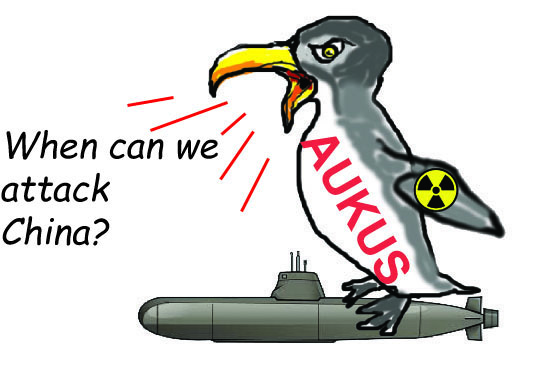
Lastly, Dutton’s pro-AUKUS stance goes along with his wilful blindness to the nuclear safety issue. Way back, Billy McMahon denied entry of nuclear-powered submarines to all Australian harbours, because of the mere possibility of an escape of waste or other nuclear materials into populated environments. In the UK and US, berthing of nuclear powered vessels takes place largely at purpose-designed port facilities away from population centres. AUKUS plans to berth near Adelaide, and port cities in NSW. Imagine the effect of a minor “excursion” on real estate prices near Adelaide or even Port Kembla. “It’s clean, it’s green,” Peter cries, with no evidence whatsoever of the cost of keeping it all safe.
A magnitude 4.7 earthquake struck near Muswellbrook just after midday on Friday, a few kilometres from the site where the Coalition has pledged to build a nuclear power plant, damaging some buildings in the town and sending tremors as far away as Sydney.
The State Emergency Services were called to help some people who suffered damage to their homes and businesses in Muswellbrook, but there were no reports of serious injuries.
Some buildings in Muswellbrook’s CBD had broken windows, fallen chimneys and stock spilling off shelves, locals said. At least two public schools were evacuated, and the local power grid was knocked until 2.30pm.
“It was quite alarming, we certainly felt it within the building,” said Muswellbrook Shire Council’s general manager Derek Finnigan. “It went for about 15 seconds I suppose, but it seemed longer of course.”
“We are assessing reports of minor damage to buildings in the community, some private structures in the CBD.”
Tremors were felt in a large radius around the quake’s epicentre at Denman, just south of Muswellbrook, from southern Sydney to Coffs Harbour on the Mid North Coast.
About 2400 people contacted Geoscience Australia to report that they had felt the quake which struck at 12.01pm, senior seismologist Hadi Ghasemi said.
“That is a very large number,” he said. “The earthquake itself was of a decent size and at a depth of 10 kilometres it was quite shallow, so it’s not surprising that it was widely felt.”
Ghasemi said fault lines run near the quake’s epicentre, and these had probably been triggered by stress building up as Australia’s continental plate nudges slowly north-east at a pace of about seven centimetres per year.
“There are existing cracks and weaknesses in the rock in this area, so it is a place where you might expect stress to build up,” he said.
The quake’s epicentre was a few kilometres west of Lake Liddell, where the federal Coalition plans to build a nuclear power plant if elected.
Nuclear facilities can be designed to withstand quakes of magnitude 4.8 and above, according to the World Nuclear Association and studies prepared by the Australian Nuclear Science and Technology Organisation for the Lucas Heights reactor in southern Sydney. However, hardening nuclear facilities against large quakes would add to the overall cost of building them…………………………………..https://www.theage.com.au/national/nsw/earthquake-damages-buildings-near-site-of-proposed-nuclear-plant-20240823-p5k4te.html
Illawarra Mercury, By Marion Rae, August 14 2024 –
AGL Energy has staked millions more on the clean energy transition as higher power prices and fewer outages generate stellar profit growth and spare cash.
Australia’s biggest emitter announced on Wednesday the $250 million acquisition of Firm Power and Terrain Solar, adding solar power and battery storage across all states.
Their combined projects, at 8.1 gigawatts, will add to renewable sources of electricity as coal-fired power plants close from coast to coast.
However, recent polls show that many Australians don’t believe the transition is feasible or on track for the national target of 82 per cent renewable energy by 2030.
“We’re investing back into the transition … it’s well underway,” AGL managing director Damien Nicks told AAP.
He said big batteries would ultimately assist renewable generation by responding to market demand in milliseconds, along with pumped hydro and other firming assets including fast-start gas.
“It is the most complex transition this country has seen but you’re right, community engagement through this time is going to be critical … whether that’s on our sites or outside of our sites,” Mr Nicks said.
“We’re also trying to utilise the infrastructure and grid that’s available to us today, whilst the transmission gets built out around the rest of the country – that’s incredibly important.”
But he dismissed the option of nuclear reactors, which the coalition has promised to build if it wins power in 2025.
“Nuclear is not part of our plans, nor our strategy … we cannot sit around and wait for nuclear,” Mr Nicks said.
“The rationale for that is both cost and time to get there.
“We need to find 12 gigawatts of renewable and firming assets by 2035.”
AGL earlier posted an underlying net profit of $812 million for the year to June 30, up 189 per cent, while underlying earnings rose 63 per cent to $2.22 billion.
WA Mines Minister David Michael has ruled out any change to the Cook government’s long-standing policy on uranium mining.
There is an effective ban on mining the mineral in WA, where only one uranium mine is permitted to operate.
Peter Dutton says the ban is “ideologically based” and should be overturned.
Western Australia’s mines minister has rejected calls from federal Liberal leader Peter Dutton to overturn the state’s long-standing ban on uranium mining and insisted that future energy needs will be met by renewable sources.
The state has had an effective ban on mining the nuclear fuel since Labor was swept to power in 2017, while Mr Dutton has made nuclear power development the centrepiece of the Coalition’s energy policy.
Speaking on the sidelines of this week’s Diggers and Dealers Mining Forum in Kalgoorlie-Boulder, Mr Dutton said the WA policy should be scrapped.
But WA Mines Minister David Michael, who attended the final day of the forum, poured cold water on the idea and said the state government’s stance on uranium would not be changing anytime soon.
“WA Labor, for two elections, has committed to not approving any uranium mines and there is no intention to change that policy,” Mr Michael said……………………………………………………………………………………..
Mr Michael said he spoke with officials from Deep Yellow at Diggers and Dealers and believed renewables such as wind, solar and battery storage were a safer bet than uranium.
“I think it’s more important to focus on critical minerals in terms of the renewable future,” he said.
“We know that renewable energy is what the world moves to sooner or later.
Preposterous’: AUKUS creates more problems than solutions THE AUSTRALIAN, The timelines for Australia’s transition from ageing Collins-class to its first nuclear-powered sub just don’t add up. There is hardly a single strategist in the country who believes it will happen.By CAMERON STEWART10 Dec 21
Now that Australia has finally weathered the diplomatic fallout caused by the creation of the three-nation AUKUS pact, it is time to work out exactly what it means for the nation’s security.
The Morrison government faces a series of critical multi-billion dollar decisions in the coming year that will set the course of Australia’s maritime defence for the next half a century.
These will require Canberra to test the limits of its alliance with both the US and the UK to ensure they make good on their AUKUS promise to share their sensitive nuclear know-how to help Australia acquire a nuclear-powered submarine fleet.
………….But the not-so-good news is that AUKUS has delivered as many conundrums for Australia as it has solutions.
………. the AUKUS announcement and the related scrapping of the French submarine project offers far more problems than solutions.
The timelines for Australia’s transition from its ageing Collins-class submarines to its first nuclear-powered submarine just don’t add up. Put simply, unless something changes, Australia risks having either no submarine fleet or a grossly antiquated one in the late 2030s and early 2040s……..
The government has given itself up to 18 months from the AUKUS announcement in September to study its options, although it says it hopes to decide on a plan of action earlier.
………………… The trouble is that the government’s initial projection for the completion of the first of eight nuclear-powered submarines, which it claims will be built in Adelaide, is not until 2038, meaning it would not be brought into naval service for another two years after that, in 2040, with one new nuclear boat every three years after that. This timetable is hugely ambitious and there is hardly a single strategist in the country who believes this will happen. The lessons of naval shipbuilding in Australia is that a first-of-class boat is never completed on time, much less the building of a nuclear submarine – easily the most complex construction of its kind in the country’s history.
……….
The solutions that have been floated, in no particular order, are to shorten the process by building at least some of the nuclear submarines overseas rather than in Australia; lease nuclear submarines from the US or UK; build a new conventional submarine in Australia as an interim measure; or extend the life of the Collins for a second refit cycle, meaning they would be sailing into the 2050s.
Every one of these proposals is problematic.
………………….. if the government chooses not to build a new conventional submarine and it deems that the Collins can be extended only for a decade, rather than two decades, then the only option is to acquire nuclear submarines more quickly than the current 2040 guideline.
This is the option that Dutton is pursuing but it requires delicate diplomacy with Australia’s AUKUS partners. First, Dutton must decide whether to ditch the government’s intention to build the eight nuclear submarines in Adelaide. While building all boats here will maximise Australian defence industry content, it will almost certainly slow the project down compared to a decision which would allow at least the first few boats to be constructed in US or UK shipyards.
Second, Dutton must choose between acquiring the US Virginia-class or the UK’s Astute-class submarines. Neither the UK nor the US production lines have room to include Australian boats in the foreseeable future. Dutton would need to lean heavily on London or Washington to make room for Australian boats to be constructed in their own shipyards. In the US, it would probably require Australia to partly fund a third shipyard to build the Virginia-class boats because the current two shipyards are struggling to keep up with the orders of the US Navy.
Hellyer believes the choice between the two countries is simple. “With nuclear submarines, we are not just picking a boat we are picking a strategic partner and that can only be the US,” he says…….
However, ditching the British submarine option would require delicate diplomacy from Canberra given that Britain’s prime minister Boris Johnson promised that the AUKUS deal would create “hundreds” of highly skilled jobs across the UK and would reinforce Britain’s place “at the leading edge of science and technology”.
The Morrison government appears to have gone cold on the option of leasing nuclear submarines to get them into the navy earlier. On closer inspection, neither the UK or the US have submarines available to lease. And in any case, Australia does not have the crews or the skills to sail them.
It will take at least a decade and probably longer for Australia to be able to train enough crew to the high levels required to man a nuclear-powered boat. A vast amount of that training will need to be done in the US or UK while Australia builds up the nuclear infrastructure and knowledge that will be needed to crew, maintain and manage a nuclear fleet.
All of these options amount to multi-billion dollar decisions by the government. If the wrong option is chosen, it will not only hit taxpayers, but it could severely compromise the country’s defence for decades.
The lease on the Northern Territory’s Jabiluka uranium mine will not be renewed, months after its remote surrounding area was granted new protections.
Energy Resources Australia (ERA) had applied for a 10-year lease renewal on the Jabiluka uranium mine, but was knocked back on Friday.
The NT mining minister, Mark Monaghan, said the decision to not renew was based partially on advice from the federal government.
“We have gone through a thorough process to ensure that all stakeholder views have been considered in this decision,” he said.
“The federal government advice, along with the wishes of the Mirarr people, were critical to this process and outcome.”
The Northern Territory government declared special reserve status over the Jabiluka area, which is in the surrounds of Kakadu national park, in May.
This prevents any future applications for the grant of a mineral title over the Jabiluka area once the current lease ceases on 11 August.
The Australian Conservation Foundation welcomed the decision, calling it a “huge win” for traditional owners.
“This decision allows a line to be drawn under the divisive era of uranium mining in Kakadu,” a statement read.
“This is a responsible decision that ends the threat that has hovered over this very special place for four decades.”
Mirarr people have long opposed any mining in the area, holding protests in the late 1990s and early 2000s when more than 5,000 people travelled to Kakadu to prevent uranium mining at Jabiluka.
Energy Resources of Australia, a subsidiary of the Rio Tinto Group, has been contacted for comment
Shoalhaven City Councillors voted unanimously to remain a nuclear-free zone at Monday night’s ordinary meeting. A motion was tabled seeking council reaffirm its 2006 position that it would oppose any plan or attempt to establish a nuclear reactor or power plant in the region or in the Jervis Bay Territory. It comes after federal Opposition Leader Peter Dutton flagged seven nuclear sites across Australia in June.
So why is Gina Rinehart buying? She has no interest as a shareholder in making money. She wants to buy influence.
In 1979, Gina’s father, Lang Hancock argued: “We can change the situation so as to limit the power of government,” before concluding: “it could be broken by obtaining control of the media and then educating the public”.
The Conversation, By Andrew Jaspan, Editor, 11 Feb 12, News of Gina Rinehart’s tilt at Fairfax Media is a circuit breaker in the never-ending story of the media company’s decline. As a former editor of The Age, one of Fairfax’s prized mastheads, I have spent the day wondering where this might end. Whichever way, it looks bad for quality, independent journalism. This is a defining moment for the kind of Australia we want….
Fairfax’s papers have an awful lot of clout. The combined audience for The Age in print and online is about 1 million readers per day, and the SMH just above. For those who follow these things, that’s higher than for any Channel 7, 9, 10 or ABC news bulletins. And more importantly, the audience for the Fairfax papers, including The Australian Financial Review, is the influential and affluent “AB” market. For these people, what the Fairfax papers report, matters.
Unlike the tabloids read by the bulk of Australians. The Age, SMH and The Fin, along with The Australian, set Australia’s news agenda and are slavishly followed by the radio talk-back and TV news shows.
So why is Gina Rinehart buying? She has no interest as a shareholder in making money. She wants to buy influence. In 2007 she placed full page ads in The Age and SMH against then-Prime Minister Kevin Rudd’s proposed mining tax. That campaign ended with the removal of Rudd and the collapse of the tax. Now instead of buying pages, she wants to buy the papers.
Such motivation is deep in the Rinehart family genes. In a 1979 polemic called Wake up Australia, Gina’s father, Lang Hancock argued: “We can change the situation so as to limit the power of government,” before concluding: “it could be broken by obtaining control of the media and then educating the public”.
And on the miners’ right to mine anywhere, he wrote: “Nothing should be sacred from mining whether it’s your ground, my ground, the blackfellow’s ground or anybody else’s. So the question of Aboriginal land rights and things of this nature shouldn’t exist.” The Murdoch press in Australia is already favourably disposed to the miners and the Minerals Council view of the world. Fairfax provides an alternative view. And one that Gina no doubt wants neutered, silenced or turned around. Perhaps by Gina’s favourite columnist, Andrew Bolt?
Political friction appears to be building in the seven regions set to host government-built nuclear reactors as part of the Coalition’s vision for the future of Australia’s energy mix.
Opposition leader Peter Dutton has visited the Callide coal-fired power station in Queensland, where he has talked up job creation and cheaper energy.
Meanwhile, community organisations in the areas selected in the Coalition’s nuclear policy have joined forces in an anti-nuclear campaign.
Featured: Peter Dutton, Opposition leader Wendy Farmer, Voices of the Valley president James Khan, Collie traditional owner
……………………………….Jon Daly: The Coalition’s earmarked seven sites across five states where it wants to co-locate nuclear reactors with retiring coal-fired power stations. Two will be in Queensland, two in New South Wales and one each for Victoria, South Australia and West Australia. The Opposition claims the sites would make good use of existing transmission lines and local workforces, though Mr Dutton is yet to reveal how much the nuclear builds would cost taxpayers.
Peter Dutton: We’ll have more to say about costings in due course and again as we know in somewhere like Ontario they’re paying a fraction for electricity compared to what we’re paying here. It’s a really important point that nuclear provides cheaper electricity. There’s a big up-front capital cost.
Jon Daly: The Coalition claims the first nuclear plant could be up and running by 2035. The Coalition has flagged two and a half years of local community consultation, but communities would not ultimately be given a chance to veto nuclear plans in their area. In Victoria’s coal heartland of the La Trobe Valley, Voices of the Valley President Wendy Farmer says that’s not consultation, that’s dictation.
Wendy Farmer: In other words, we are going into communities to tell them exactly what the Coalition wants to do and don’t argue with us because that’s what we’re going to do to your regions. That is not the way any community would expect to be treated.
Jon Daly: Voices of the Valley and other community organisations in the seven selected regions have launched an alliance opposing the current plan.
Wendy Farmer: So we thought that by the seven regions getting together, it just gives strength to all the regions and we can support each other. And we can actually do a much louder call for Australians to support the regions to say no to nuclear.
Jon Daly: What’s been the reaction from, say, your local community as the details of this proposal have unfolded?
Wendy Farmer: There’s a mixed reaction, Jon. You know, some do support having nuclear. They want the jobs. Then you’ve got the other people that are just saying we do not want nuclear reactors at all, ever, in our region.
Jon Daly: In West Australia, Collie’s coal-fired power station is closing by 2029 and the town is trying to find industries to replace those lost jobs. The Coalition has picked the town as a site for nuclear power. James Khan is a traditional owner of the area. He’s a Wilman man of the Bibbulmun Nation and he says he’s dead against nuclear energy being built there.
James Khan: Well, my thoughts on that there is negative. It’s a negative. It’s why are we going into something that we don’t know nothing about and it could affect everything, the vicinity of it. Nuclear reactors is too dangerous, too slow and it’s too expensive.
Peter Dutton has hit the sticks to promote his controversial nuclear energy plan but remains mum on how much the “essential” project will cost.
news.com.au Nathan Schmidt, July 22, 2024
Opposition Leader Peter Dutton has for the first time spruiked the Coalition’s controversial nuclear energy plan in an electorate earmarked for a new “modular reactor”, promising the ambitious project will be more efficient than replacing wind turbines “every 25 years”.
The Liberal leader on Monday championed the contested energy project in Mount Murchison, a town of little more than 100 people in the Shire of Banana on Queensland’s central coast, following the unveiling earlier this year of the Coalition’s nuclear energy plan.
Mr Dutton flagged seven sites – two in Queensland and NSW and one each in South Australia, Victoria, and Western Australia – for potential new small-scale nuclear reactors under the plan that he promised to take to the next federal election in 2025.
Despite pushback from energy experts about the proposal’s feasibility, Mr Dutton said nuclear power would be “good for jobs” and “the underpinning of 24/7 reliable power into the future”, blaming Labor for warnings about future power shortages.
“The Coalition’s policy of renewables and gas and of nuclear (power) is absolutely essential to keeping the lights on, to having cheaper power and to making sure that we can reduce our emissions,” Mr Dutton said on Monday alongside Liberal Flynn MP Colin Boyce.
He claimed warnings by the energy regulator about brownouts were based on Labor policies. “The PM and Chris Bowen have us on this 100 per cent renewables-only path which is what’s driving up the price of your power bill. It’s what is making our system unreliable,” Mr Dutton said.
“If we want to have cheaper power, if we want greener power, and if we want reliable power, then nuclear is the way in which we’ll provide that 24/7 power into the future … let’s have an honest discussion because Australians are really struggling under this government.”…………………………………………………..
Clare Silcock, 21 July 2024, https://www.queenslandconservation.org.au/nuclear_option_shutting_off_cheap_solar Queensland Conservation Council (QCC) has today released a new analysis showing that the equivalent of 45,000 Queensland household solar systems would need to be shut off every day to allow just one nuclear power station to operate in 2040. With the renewable energy rollout well underway, by the time we have built a nuclear power station in Queensland, we won’t have the need for it.
Clare Silcock, Energy Strategist at QCC, said:
Nuclear power stations can’t easily turn off, which means by 2040, we’d have to turn off a staggering 3,700 GWh of cheap renewable energy every year just to run one nuclear power station. We would be shutting off cheap energy to allow expensive nuclear power to run.
This report shows that nuclear power simply doesn’t fit into a modern grid and isn’t what we need to meet our future energy demands at the least cost.
Our energy system is changing rapidly. We’ve nearly doubled renewable energy in Queensland in five years. A large part of this has been from rooftop solar systems which have fundamentally changed when we need energy to support the grid.
Baseload generation is what our power system was built on, but it’s not what we need in the future. Saying that we need baseload generation is like saying that we need floppy disks to transfer files between computers.
What we need is flexible generation and storage which can move energy from when we have lots of it, in the middle of the day, to when we need it overnight. That is not how nuclear power stations work.
The earliest we could possibly build a nuclear power plant in Australia is 2040 – by then we will have abundant renewable energy and technology like batteries and pumped hydro will be providing the flexible storage we need to support that renewable energy.
Nuclear is also much more expensive than renewable energy backed by storage. CSIRO estimates nuclear could be up to four times more expensive to build. It’s as clear as day that the Federal Coalition’s nuclear plan is a fantasy to delay the closure of Australia’s polluting coal-fired power stations.
We would like to see the Federal Opposition focus on a real plan for bringing down emissions and power prices and that would mean backing renewable energy and storage.
Earmarking Port Augusta for the opposition’s nuclear plan has proved wildly unpopular with Indigenous leaders, who say mining and dumping nuclear material is akin to “killing your mother”.
Others say they believe Australia is lagging behind and needs to embrace nuclear energy.
What’s next?
Questions remain, with voters saying they are still in the dark about how much the plan will cost and how the privately owned land would be acquired.
Earmarking Port Augusta for Peter Dutton’s nuclear plan has proved wildly unpopular with an Indigenous leader, who says he feels so strongly about the issue that he is willing to go to court to fight the proposal.
Nukunu elder Lindsay Thomas said his community was against mining fissionable elements, such as uranium as a whole.
“Our people don’t believe in this, we don’t believe it should have even been dug out of the ground anywhere in Australia,” he said.
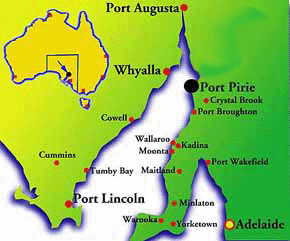
When the federal and state governments were deciding on a location to announce a funding deal that will underwrite South Australia’s final leap to its remarkable goal of 100 per cent net renewables within the next three years, Port Augusta was the obvious choice.
The city at the top of the Spencer Gulf, like the neighbouring Whyalla, is everything that the climate deniers, the renewable naysayers, the conservative media and the federal Coalition say is not possible.
Port Augusta once played host to the state’s ageing and incredibly dirty coal generators. Whyalla was the subject of taunts from former prime minister Tony Abbott that it would be rendered a ghost town by a carbon price.
Now the two cities are host to thriving renewable energy hubs, new green industries and technologies that will help propel the state into a clean energy future.
And it is remarkable how little is actually known about the achievements of South Australia beyond its borders. Already it is at an annual average of 70 per cent renewables, and by 2027 it intends to be the first in the world to reach 100 per cent net renewables primarily through wind, solar and storage.
Just to be clear, that does not mean that it will consume only renewables. “Net” means that the amount of power it produces from wind and solar during the year will be equivalent to the amount it consumes. But it will still export and import as needs must.
It’s a stunning achievement, and still one that the naysayers insist is not possible. The state has become a globally significant testing ground in technologies – it hosted the first Tesla big battery that helped change the thinking on future grids around the world – and it is addressing and solving complex engineering issues that many experts thought were too difficult and some still say are insurmountable.
More importantly, it is doing this as a result of bipartisan policy. Labor kicked it off more than a decade ago by making itself the most welcoming state for wind and solar.
The Liberal state government set the target of reaching 100 per cent renewables by 2030. Labor is now back in power and has accelerated that target to 2027. It is marvellous what can be achieved when the coal lobby is removed and not pulling the strings of the politicians and public mood.
Despite all this, the achievements in South Australia remain largely ignored by the rest of the country.
The announcement by federal energy minister Chris Bowen and state energy minister Tom Koutsanstonis about the funding deal for a gigawatt of new wind and solar and 600 MW (2,400 MWh) of battery storage – to ensure the 100 per cent net renewable target is met – barely rated a mention in mainstream media outside the state.
Yet it is here, in Port Augusta, that federal Opposition leader Peter Dutton has decided should be one of seven sites – along with Collie, Liddell, Mt Piper, Loy Yang, Callide and Tarong – that should play host to their nuclear power plant proposals.
They were chosen, the Coalition tells us, because they are locations that still have or once supported coal fired power generators, and – they claim – would have available transmission capacity. But as Koutsantonis pointed out during his visit this week, that is simply not the case. That capacity has already been taken up by other projects.
“This site here where the Port Augusta power station once sat is now at capacity in terms of our renewable transmission lines to Adelaide,” he told journalists. “So the idea you can just plug in a nuclear power station here is just folly.
“I haven’t seen Peter Dutton here. I haven’t seen the Commonwealth Opposition here at all talking to the state government about their pretend plans for nuclear power in South Australia.”
Indeed, it is not surprising that Dutton has not shown up: South Australia is not just shining a path to the future, it is a real life repudiation of the folly of the federal Coalition’s nuclear plans, and the sheer nonsense of its claims.
Let’s remember that the Coalition and the conservative media’s nuclear arguments are based almost entirely around the assumption that wind and solar cannot power a modern economy.
South Australia proves them wrong, emphatically so. The grid is reliable, wholesale power prices are falling, and will continue to do so as it free itself from the yolk of fossil gas. Legacy industries are being revived by the growth of wind and solar, new industries are being established, and big business with big loads are being attracted to the state.
The once broke Whyalla steelworks, for example, has based its revival around plans for “green steel” underpinned by wind and solar, and BHP will power its giant Olympic Dam mine with a unique “firmed renewables” contract sourced from the state’s biggest wind project and a big battery.
The state’s transmission operator ElectraNet reports inquiries amounting to several gigawatts of new load from industries attracted to cheaper and greener power, and apparently not the least bit concerned about the scare campaigns that the lights will surely go out.
South Australia is already at the stage where enough rooftop solar is generated in the middle of the day to meet all local demand. That will soon occur in other states too, including Western Australia, effectively eliminating grid demand and requiring storage or new load or exports to soak up the excess.
As every major utility in Australia makes clear, the era of always-on base-load power is well and truly passed in such grids. South Australia has not just shut down its last coal generators, and is closing down its remaining combined cycle gas plants, which perform a similar role. The gaps will be filled by facilities that are fast and flexible. There is simply no room in the grid for an always-on nuclear plant.
“This site is taken. So I’m not quite sure where he’s planning to build this or how he’s planning to build this,” Koutsantonis said.
“If Peter Dutton was serious about what he was talking about, he would have come to us earlier and spoken to us about it, consulted with us. For whatever reason, he hasn’t even stepped a foot on this site to actually have a look at it.”
Bowen has been taking that message across the country. “This whole precinct’s being transformed … into a renewable energy hub, a green cement hub and a critical minerals hub,” he said at Port Augusta.
The next day, Bowen popped up in Lithgow, at the site of another mooted nuclear site, the Mount Piper coal generator, where the asset owner Energy Australia also outlined plans to build pumped hydro, a giant battery and to convert its coal plant into a “flexible” asset rather than an “always on” baseload asset in the interim.
“Traditionally Mount Piper has been a full-load, continuous load power station, and today it’s becoming much more flexible,” EnergyAustralia’s head of operations and projects Sue Elliott said. “It now operates during the day and seasonally depending on renewable availability in the market.
“We are progressing planning for a Lake Lyell Pumped Hydro Project … and we’re also planning a 500 megawatt, four hour Mount Piper Battery Energy Storage System right here on site to take advantage of transmission assets.”
As Bowen pointed out, this is real investment happening now, not some time in the distant future.
“I’m not sure if Mr Dutton and (Opposition energy spokesman Ted) O’Brien have been here yet, but they have a plan for nuclear power, which is at least 30 years away,” he said.
“They admit 2035 at its earliest; even that is wildly ambitious and optimistic and unrealistic. But that doesn’t fix the problems today.
“It doesn’t create jobs today. It doesn’t create investment today and, indeed, it will chill investment. It will stop people investing in the alternative plans because of the investor uncertainty created by having a nuclear plan, which is never going to happen – it’s a fantasy.”
South Australia, and its charge towards 100 per cent renewables, is very real. And worth talking about.








 Antinuclear