“Normalising” radioactive trash – Maralinga as tourist attraction
The indigenous people who used to wander these lands called the radioactive plume the “puyu,” or black mist, and still are reluctant to visit despite having fought hard for the land to be returned.
“They deem it as a bad place, what they call ‘mamu,’ like a devil country,” says Mr. Matthews, whose wife is indigenous to the area…….
 Australia’s Newest Tourist Attraction: Nuclear Test Zone At Maralinga, Australia, visitors are given an unusual welcome: Don’t stay too long and never, ever dig. WSJ, By
Maralinga, a deserted former military base in the Outback, has become ground zero for an unusual type of vacation Down Under. In a country best known for its white beaches and coral reefs, Mr. Matthews wants vacationers to wish they were here: on land once used for nuclear-weapons explosions.
Nearly 2,000 warning signs ring the red soil around Maralinga, displaying a Ghostbuster-style graphic prohibiting camping ……
The stark beauty of the hills here, on the edge of the vast Nullarbor Plain where the sun sinks in the same ocher color of the desert, belies its notorious past. Continue reading
Yackandandah – small Victorian town with a big renewable energy future
Yackandandah’s small steps to a big renewable future, http://www.theage.com.au/national/yackandandahs-small-steps-to-a-big-renewable-future-20150605-ghfj1l Michael Green The old brick-veneer community centre in Yackandandah has been transformed.
“We’ve had some really cold days this week,” says Ali Pockley, the centre’s manager. “But you come in here and it’s just toasty. It was hopelessly inefficient up until the retrofit, no doubt about that.”
With the help of a state government grant, local tradies installed a large solar photovoltaic system, insulation, double-glazing, shading and efficient air conditioners for heating and cooling. Electricity bills have plunged by three-quarters.
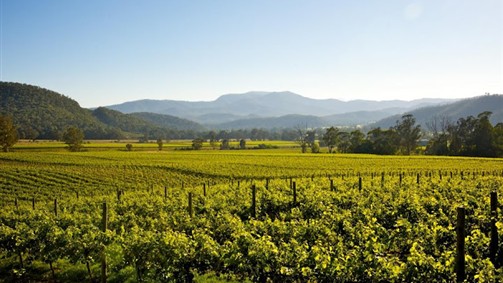
Pockley launched the retrofit of the community centre together with an even bigger initiative: Totally Renewable Yackandandah. A group of residents are aiming for the north-eastern Victorian town to produce more electricity than it uses, by 2022. They began working on their scheme twelve months ago, and already the number of solar households in the town has jumped. Now, one in every three houses has solar power, more than double the national average.
Matthew Charles-Jones, from Totally Renewable Yackandandah, says they’re surveying residents and working on their grand plan, with the help of a local council grant. In the meantime, new solar panels, like those on the Men’s Shed, will make it easier to reach the target.
Yackandandah is one of four Australian towns plotting to become 100 per cent renewable, along with Newstead, in central Victoria, and Byron Bay and Uralla in northern NSW. Newstead was recently awarded a $200,000 grant from the state government to develop its plan. Continue reading
International embarassment: Led by Tony Abbott, Australia has lost the plot on climate change
Australia was grilled by other delegatesat a United Nations conference in Bonn, Germany on Thursday.
 Australia has forfeited world leadership on climate policy, says Kofi Annan panel, Guardian, Shalailah Medhora, 5 June 15 Canberra has withdrawn from constructive engagement on the issue, says report, as Australia is grilled at crucial meeting in Germany. Australia has forfeited its position as a global leader on tackling climate change and is now a “free-rider”, a panel led by former secretary general of the United Nations Kofi Annan has said.
The Africa Progress Report 2015 disputes claims by the fossil fuel lobby that moving away from carbon would impede economic growth in developing countries. It says high-emitting nations, such as Australia, have stepped back from global discussions in favour of unilateral action.
It is particular scathing about the direction in which Australia’s climate change policies are headed.
“With one of the world’s highest levels of per capita emissions, Australia has gone from leadership to free-rider status in climate diplomacy. Repeal of the Clean Energy Future Plan effectively abolished carbon pricing. Continue reading
House of Representatives passes draft laws on Renewable Energy Target
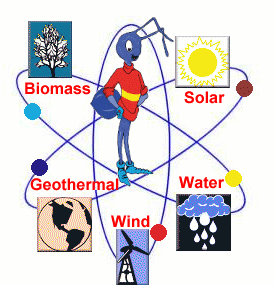 Draft laws on renewable energy targets pass through lower house 9 News 3 June 15 Draft laws on a bipartisan renewable energy target have passed the lower house despite the concerns of two government MPs.
Nationals MP Keith Pitt broke ranks during debate on the legislation, which pares back the target from 41,000 gigawatt hours to 33,000,
………However, his vote was not formally counted among those in opposition, with only independents Bob Katter and Andrew Wilkie voting against the bill.
Liberal Craig Kelly questioned the efficacy of solar panels, saying such an investment would simply be “pissed up against the window”.
He ridiculed how building 2000 new wind turbines would reduce the impact of climate change……..
The government included the burning of wood waste as a renewable source of fuel in the legislation, to much consternation from Labor, which wants it removed and omitted from any future laws on the target.
The opposition argues that what is considered wood waste is not just timber offcuts, bark and branches but also the whole of any tree not harvested………
Read more at http://www.9news.com.au/national/2015/06/03/02/36/draft-renewable-energy-laws-pass-through-lower-house#HlQSdZTUvSdZvczq.99
South Australia the renewable energy leader- and now with battery storage!

 Plans for Australia’s first non-hydro renewable storage project move forward http://reneweconomy.com.au/2015/plans-for-australias-first-non-hydro-renewable-storage-project-move-forward-52911 By Giles Parkinson on 4 June 2015 The potential site for what will be the first large-scale, non-hydro storage project for renewable energy in Australia has identified three possible sites in South Australia, and received more than 40 different storage proposals and ideas. The project – known as Energy Storage for Commercial Renewable Integration South Australia (ESCRI-SA) – is a ground breaking project for Australia because it will be first and biggest of its type.
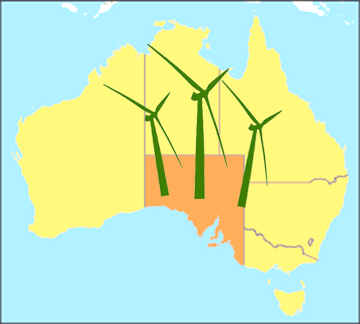 South Australia has already reached 40 per cent generation from variable renewable energy sources such as wind (33 per cent) and solar (7 per cent). It is one of the highest penetrations of variable renewables in modern industrial economies.
Up to now, that share of wind and solar has been relatively easily accommodated, but as this share grow, battery storage will be required as yet more coal-fired generators are retired, and even the need for gas plant diminishes.
The storage will be needed to soak up excess generation (such as wind at night-time or solar during the day) to be stored for use at peak time. It will also be used to provide ancillary services such as frequency – a critical component of the grid. In Germany, battery storage is being used for the same purpose.
Paul Ebert, from Worley Parsons who is leading the project lead funded by the Australian Renewable Energy Agency and with support from AGL Energy, and transmission group ElectraNet says the storage is likely to be located in one of three locations – near Port Lincoln on the Eyre Peninsula, near the Monash sub station on the Yorke Peninsula, or the Dalrymple sub-station in the river land area of the state. Continue reading
Queensland’s Millmerran solar farm to go ahead – biggest in Australia?
 Millmerran solar farm plans move ahead despite disappointment over lower Renewable Energy Target http://www.abc.net.au/news/2015-06-04/solar-firm-pushes-ahead-with-plans-for-big-darling/6520796 By Fidelis Rego, 4 June 15 A solar company says it is disappointing the Federal Government wants to reduce the Renewable Energy Target (RET) but it is still forging ahead with plans for a solar farm on the Darling Downs in southern Queensland.
The Government and Opposition have agreed to reduce the amount of power produced from renewable energy sources to 33,000 gigawatt hours by 2020.
Angus Gemmel from Solar Choice said it had not jeopardised its plans to build what could be the country’s biggest solar farm at Millmerran.
He said construction was expected to begin later next year.
“It’ll certainly have an impact, it is sad to see Australia is the first country to go backwards on a renewable energy target rather than forwards, so I guess it’s with a mixture of disappointment but also relief that we can finally get some first major stages underway,” he said.
“We’re still very confident that even in the medium to longer term this project will be built.
“We’re at an excellent site with optimal conditions for large-scale solar farming long-term and once our first stage is in the ground that’s going to make it so much easier and cost-effective to make stages two and three and subsequent away as well.”
Australian electricity utilities to supply battery energy storage
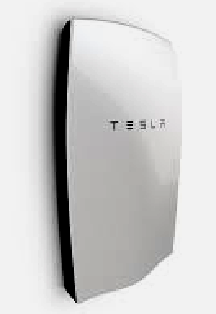 Australian Utilities Cozy Up to Home Storage: ‘If We Don’t Respond, Someone Else Will’ Three Australian power companies are set to offer Panasonic’s residential battery systems. Greentech Grid Jason Deign June 5, 2015
Australian utilities are moving to combat the threat of revenue loss from residential energy storage by opting to supply batteries themselves. Three companies — Red Energy, Ergon Energy and ActewAGL — announced trials offering Panasonic battery systems.
“Our customers are already showing interest in this technology, and if we don’t respond to what our customers want, someone else will,” said ActewAGL CEO Michael Costello.
The Australian Capital Territory utility, which already has more than 15,000 residential installations in its catchment area, expects to start offering the systems this October.
“The trial will validate batteries as a product offering in the Canberra environment and evaluate the product functionality,” Costello said.
He confirmed ActewAGL had been working with Panasonic for two years “on how to make a trial of battery energy storage in Canberra a reality.”
Panasonic, which last year won the contract to supply Tesla’s Gigafactory in the U.S., is said to be keen on using utilities and retailers as a channel to the residential market, rather than selling direct to homeowners…….http://www.greentechmedia.com/articles/read/australian-utilities-cozy-up-to-energy-storage
Solidarity between Indigenous Australians and Canadians in fighting fossil fuel pollution
“We are here because we also believe making strong relations with First Nations around the world is essential to the fight with the fossil fuel industry,” said Johnson. “The fossil fuel industry is not the wave of the future.”
The Wangan and Jagalingou people have twice refused to give consent for the mine, despite the company’s offer of compensation for loss of property, said Burragubba.
But Adani is taking the company’s case to Australia’s tribal land court to try to override the objections. That would allow the state to grant the lease. “We do not intend to give consent and no amount of compensation will get us to give consent,” said Johnson.
Aboriginal group fighting massive Australian coal mine consults with Alberta First Nations http://www.edmontonjournal.com/Aboriginal+group+fighting+massive+Australian+coal+mine+consults+with+Alberta+First+Nations/11106554/story.html BY SHEILA PRATT, EDMONTON JOURNAL JUNE 3, 2015 On Adrian Burragubba’s ancestral lands in Australia — arid pasture land, beautiful mountains, rivers and clear springs — the world’s second-largest coal mine would devastate the wildlife and the land, he says.
“We’re the messengers here to tell the world together we can stop this mine,” Burragubba said Wednesday.
Burragubba and Murrawah Johnson have come to Alberta to learn from Alberta First Nations who have struggled to protect land, wildlife and water in the middle of vast open-pit oilsands mines in the boreal forest.
The $16.5-billion Carmichael coal mine, proposed by Indian conglomerate Adani, Continue reading
Renewable energy chemicals can be exported to Australia’s energy customers
Any form of renewable electricity can be used in electrolysis, including wind and solar. Research around the world and in Australia continues to aim at reducing the costs of electrolysis………
The possible future scale of producing renewable energy chemicals in Australia is enormous. To imagine it one can mentally sum up all the investments that have made in Australia in coal, in liquefied natural gas (LNG), and that will be made in renewable energy to meet our own domestic energy needs, and more.
Hundreds of billions of dollars indeed. At MEI, we think it is time to start planning how Australia can competitively meet the future renewable energy needs of our traditional energy customers.
Meeting the future needs of Australia’s energy customers with renewable energy chemicals, Climate Spectator TIM FORCEY 4 JUN, “…… One day those fossil fuel exports and imports will cease as Japan and South Korea continue to improve their energy productivity and expand their use of renewable energy. Some of that will be home-grown – renewable energy that Japan and South Korea can make for themselves. Already Japan is building impressive large-scale solar photovoltaic facilities out over the sea.
However, these man-made solar islands illustrate the physical and economic limits Japan and South Korea face while recognising they will need to rely partly on renewable energy imports. But imports from where? Preferred will be imports from countries that have extensive renewable energy resources that can be harvested and transported at reasonable cost, that are politically stable, and that have long histories as reliable energy suppliers. In other words, countries like Australia.
But how can renewable energy be exported 8000km from Australia to northeast Asia? Continue reading
Paladin – the ugly Australian in Malawi faces opposition, as its uranium pollution takes its toll
“It’s shocking that Paladin has disposed of millions of tons of radioactive and chemically hazardous waste on a plateau with very negative geological and hydrogeological characteristics,”
On the shores of Malawi’s lake of stars, activists raise uranium fears, Guardian, Santorri Chamley, 3 June 15
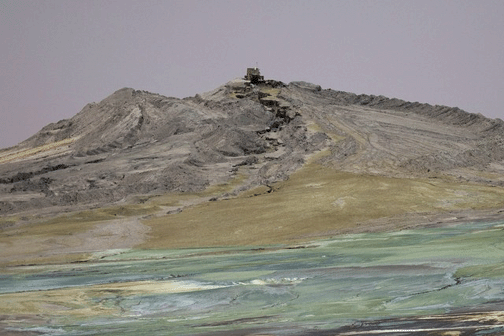
When dead fish were washed ashore in northern Malawi, activists and residents looked to a nearby uranium mine for answers – the latest battle in a protracted conflict with Paladin, the mine’s Australian owners “……For many of the tens of thousands of people living in Karonga, a lakeside district in northern Malawi, life revolves around fishing. So when dead fish began to wash ashore, they were worried. Some blamed pollution from the nearby Kayelekera uranium mine, the country’s biggest foreign investment.
“People are fearful because there are a lot of fish dying in the lake, so people are suggesting that they are dying because of the discharge from the Kayelekera mine,” said Harry Hudson Mwanyembe, the chairman for health and environment on Karonga’s district council.
The Australian company that owns the mine, Paladin Energy Ltd, says it has complied with all its environmental obligations and routinely monitors aquatic life in the Sere River and elsewhere. It denies any responsibility for the dead fish but its operation in Kayelekera has been beset by controversy since it was openedby the late president Bingu wa Mutharika in 2009.
The disputes, legal battles and public concern over the mine go to the heart of what many call Africa’s resource curse. As one of the continent’s poorest countries – ranking 174 of 187 countries in the UN human development index – Malawi desperately needs foreign exchange, as well as employment and infrastructure. But its pursuit of extractive wealth has been stymied by a lack of adequate regulation and transparency as well as by corruption, activists say.
In Kayelekera, the pitfalls associated with launching a multi-million dollar enterprise, with government backing, in an area where people lack access to both information and power, are evident in the many rumours, claims and counter-claims surrounding the mine’s operations……
resident of Kayelekera, Philip Simbowe, said the government had sold the lives of Malawians for cash. Continue reading
Paladin (apparently not Australian owned) signs Western Australian uranium deal
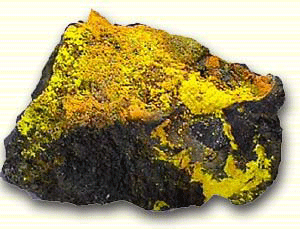 Paladin signs uranium land deal MICHAEL RODDAN BUSINESS SPECTATOR JUNE 01, 2015 Uranium miner Paladin Energy will pay $16 million for land containing a uranium deposit as the group looks to enhance the value of its neighbouring project.
Paladin (PDN) will take over Energia Minerals’ Carley Bore uranium project in north west Western Australia for $15.8 million in cash and shares.
The Carley Bore project in the Carnarvon Basin consists of three connected exploration licenses, located 100km south of Paladin’s Manyingee uranium project, and will increase the miner’s mineral resources in the area by more than 30 per cent……….But the miner has said it will not develop any new projects before it is confident of a sustainable uranium price of at least $US70 a pound. The material has traded between $US34 and $US40 a pound this year.
“The current low uranium price and sustained sector weakness have created an opportunity to consolidate our portfolio in strategically important regions,” Paladin chief executive John Borshoff said.
The takeover is subject to regulatory approval by the Foreign Investment review Board, as Paladin is deemed to be a foreign corporation under Australian law. http://www.theaustralian.com.au/business/mining-energy/paladin-signs-uranium-land-deal/story-e6frg9df-1227377778419
The Nuclear Fuel Chain Cost Calculator
 John Mecklin: Introducing the Nuclear Fuel Cycle Cost Calculator http://thebulletin.org/introducing-nuclear-fuel-cycle-cost-calculator8361
… Over the last two years, the Bulletin of the Atomic Scientists and the University of Chicago have created an online tool that will help countries understand the true cost of choosing the reprocessing route—and perhaps also help limit the spread of nuclear reprocessing.

The Nuclear Fuel Cycle Cost Calculator estimates the full cost of electricity produced by three configurations of the nuclear fuel cycle. This calculator is the first generally accessible model to provide a nuanced look at the economic costs of nuclear power, particularly in regard to the reprocessing of spent nuclear fuel. Among many other things, the calculator clearly demonstrates that in most cases, reprocessing results in electricity that is considerably more expensive than other nuclear power, when all costs are added in.
Senators David Leyonhjelm and Bob Day salivate over thought of free nuclear-powered electricity
The Conservation Council of SA this week said it did not support an expansion of SA’s role.
“Uranium mining in SA has a history of very significant environmental impacts that show no signs of abating,” spokesman Jim Green said.
“All forms of energy generation have some environmental impact … nuclear power brings with it a range of unavoidable risks to public health and safety that other energy options simply do not.”
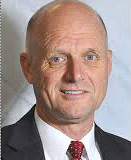 Senators David Leyonhjelm and Bob Day want atomic industry advanced
  to make nuclear submarines viable TORY SHEPHERD POLITICAL EDITOR THE ADVERTISER JUNE 03, 2015 CHEAP or free power for South Australia is an “excellent” idea, crucial crossbench Senator David Leyonhjelm says, arguing it could come through a nuclear or a coal deal.
The Liberal Democrat also joined South Australian Senator Bob Day in calling for Australia to get nuclear-powered submarines.
The Advertiser revealed earlier this year that Liberal Senator Sean Edwards was working on a plan to earn billions of dollars by storing nuclear waste and generating nuclear power, and using that money to deliver free electricity and abolish state taxes.
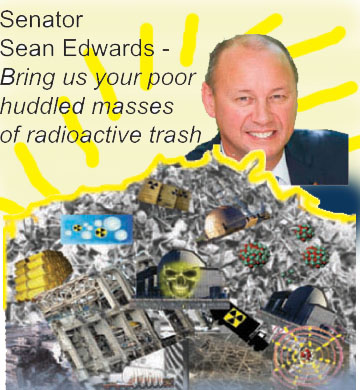
That would make SA a magnet for investment, he said. Continue reading
Offgrid solar power an economic winner for Western Australian farming family
 WA farming family opts for solar power battery system over costly grid connection, ABC News By Kathryn Diss 3 June 15 When Katherine Naughton’s family moved to a farm in Northam, north-east of Perth, it was going to cost them up to $60,000 to connect their house to the power grid.
But for just two thirds of that cost they have been able to install a solar power storage system, harnessing all of their electrical needs from the sun.”Not having that $400 bill every three months is just fantastic,” Ms Naughton said.
Perth-based company Solar Balance designed the system with Chinese battery manufacturer BYD.The batteries charge from rooftop solar panels during the day and store the energy for use when the sun goes down.
And unlike connecting to the grid, it is an investment that pays for itself. “With the cost of power going up, it’s quite scary how much it keeps going up by every single year, and you don’t know how much it’s going to be in the next five years,” Ms Naughton said. “So if we can go solar then we don’t have to worry about that bill.”
Battery storage an affordable option
With the entry of new players it will put downward pressure on battery costs which is going to be good for everyone over time because it will become more and more affordable. – Rod Hayes
The power revolution may be taking place slowly, just one household at a time, but the industry believes that is set to change………..
Curtin University’s Sustainability Policy Institute’s Jemma Green said the power grid will become less relevant.
“The grid will have a place but it will become more of a back up system as electricity prices go up even further and the price of solar and batteries decline further, the economics of grid defection are going to stack up sooner.
“This is going to have an impact on the utilisation of the grid and therefore the revenue that the government currently derives from using it.
“I think the grid and the business models of the utilities, that is the generators and the poles and wires will need to evolve to deal with this changing energy system which is effectively a centralised and decentralised energy model,” Ms Green said.
Bosche, LG and Samsung have also indicated they plan to enter the market. http://www.abc.net.au/news/2015-06-03/farming-family-opts-for-solar-power-battery-system/6519960
Australian govt pushing for international financial deregulation in Trade Agreement – Wikileaks reveals
 WikiLeaks reveals new trade secrets, SMH June 4, 2015 Philip Dorling
Highly sensitive details of the negotiations over the little-known Trades in Services Agreement (TiSA) published by WikiLeaks reveals Australia is pushing for extensive international financial deregulation while other proposals could see Australians’ personal and financial data freely transferred overseas.
The secret trade documents also show Australia could allow an influx of foreign professional workers and see a sharp wind back in the ability of government to regulate qualifications, licensing and technical standards including in relation to health, environment and transport services.

In its largest disclosure yet relating to the TiSA negotiations, WikiLeaks has published seventeen documents including draft treaty chapters, memoranda and other texts setting out the overall state of negotiations and individual country positions in a secret bargaining on banking and finance, telecommunications and e-commerce, health, as well as maritime and air transport.
The leaked documents were to be kept secret until at least five years after the completion of the TiSA negotiations and entry into force of the trade agreement. Continue reading
1 This month
17 October, Free Public Talk on Nuclear Issues in South Australia
David Noonan will speak on public interest concerns over the new Roxby Downs Indenture Act 2026 on BHP copper-uranium mining and ore processing in SA, and on how AUKUS may face SA with a High-Level nuclear waste agenda.
Dr Jim Green will discuss international developments in the field of nuclear power including ‘small modular reactors’ and Generation 4 ‘advanced’ nuclear reactor concepts.


Help Aunty Sue Protect Her Land and Sacred Sites From Destructive Rocket Testing.
.

Australians deserve the truth
about
AUKUS – https://aukuspublicinquiry.com/

PETITION – To: Prime Minister Anthony Albanese and the Australian Labor Government

of the week – Australians for War Powers Reform (AWPR)
To see nuclear-related stories in greater depth and intensity

