Nuclear Power’s Economic Crisis and its Implications for Australia

Nuclear Power’s Economic Crisis and its Implications for Australia, Nuclear Free Campaign, Friends of the Earth Australia
December 2021 report by Friends of the Earth Australia, ‘Nuclear Power’s Economic Crisis and its Implications for Australia’.
The full report is available as a PDF.
The introduction (minus references and footnotes) is copied below.
INTRODUCTION & SUMMARY
Despite the abundance of evidence that nuclear power is economically uncompetitive compared to renewables, the nuclear industry and some of its supporters continue to claim otherwise. Such claims are typically based on implausible cost projections for non-existent reactor concepts. For example the Minerals Council of Australia conflates self-serving, implausible company estimates for small modular reactors (SMRs) with “robust estimates” based on “conservative assumptions”. And the Australian Nuclear Association bases its claim that nuclear power is Australia’s “least cost low carbon energy option” on the non-existent BWRX-300 SMR.
Claims about ‘cheap’ nuclear power certainly don’t consider real-world nuclear construction projects. Those following real-world developments have come to the opposite conclusion. Indeed supporters of nuclear power have issued any number of warnings in recent years about nuclear power’s “rapidly accelerating crisis” and a “crisis that threatens the death of nuclear energy in the West” while pondering what if anything might be salvaged from the “ashes of today’s dying industry”.
Consider the following statements, many of them from industry insiders:
- “I don’t think we’re building any more nuclear plants in the United States. I don’t think it’s ever going to happen. They are too expensive to construct.” ‒ William Von Hoene, Senior Vice-President of Exelon, 2018.
Nuclear power “just isn’t economic, and it’s not economic within a foreseeable time frame.” ‒ John Rowe, recently-retired CEO of Exelon, 2012.- “It’s just hard to justify nuclear, really hard.” ‒ Jeffrey Immelt, General Electric’s CEO, 2012.
- “We see renewables plus battery storage without incentives being cheaper than natural gas, and cheaper than existing coal and existing nuclear.”‒ Jim Robo, NextEra CEO, 2019.
- France’s nuclear industry is in its “worst situation ever”, a former EDF director said in November 2016 ‒ and the situation has worsened since then.
- Nuclear power is “ridiculously expensive” and “uncompetitive” with solar. ‒ Nobuo Tanaka, former executive director of the International Energy Agency, and former executive board member of the Japan Atomic Industrial Forum, 2018…………………
Several reasons can be posited for the crisis which led Bob Carr ‒ a former nuclear supporter, NSW Premier and Australian Foreign Minister ‒ to describe nuclear power as lumbering, cripplingly expensive and moribund:
- The Fukushima disaster in Japan in 2011.
- A suite of economic challenges: catastrophic cost overruns with reactor projects; nuclear power’s negative learning curve (it has become more expensive over time); and nuclear power’s inability to compete economically with renewables.
- Nuclear corruption scandals in many ‒ perhaps most ‒ of the countries operating nuclear power plants.
Other reasons could be added to that list, such as the failure to find solutions to manage long-lived nuclear waste, and the explosion in the world’s only deep underground nuclear waste repository in 2014.
This paper focuses on nuclear power’s economic problems ‒ catastrophic cost overruns with reactor projects, and nuclear power’s large and worsening economic disadvantage relative to renewables.
Summary
Every power reactor construction project in Western Europe and the US over the past decade has been a disaster:
- The only reactor construction project in France is 10 years behind schedule and the current cost estimate of A$30.6 billion is 5.8 times greater than the original estimate.
- The reactor under construction in Finland is 13 years behind schedule and the current cost estimate is 3.7 times greater than the original estimate.
- The Hinkley Point nuclear plant in the UK was meant to cost £2 billion per reactor and be complete by 2017; but construction hadn’t even begun in 2017 and costs have increased more than five-fold.
- The V.C. Summer project in South Carolina was abandoned after the expenditure of around US$9 billion.
- The Vogtle project in Georgia is six years behind schedule and costs have doubled.
Western Europe and the US provide the most striking examples of nuclear power’s crisis and the most striking examples of a more generalised problem: alone among energy sources, nuclear power has become more expensive over time, or in other words it has a negative learning curve.
Section 5 discusses nuclear power globally and in important countries other than those in Western Europe and North America. Suffice it to note here that nuclear power is struggling almost everywhere. China is said to be the industry’s shining light but nuclear growth is modest (an average of 2.1 reactor construction starts per year over the past decade) and paltry compared to renewables (2 gigawatts (GW) of nuclear power capacity added in 2020 compared to 135 GW of renewables).
Outside of China, the writing is on the wall: 48 power reactor start-ups and 98 permanent shut-downs from 2001‒2020 as well as a looming wave of shut-downs because of the ageing of the world’s reactor fleet and, in some countries, nuclear phase-out policies. Globally, renewable power capacity grew by a record 256 GW in 2020 (four times greater than Australia’s total capacity) compared to 0.4 GW for nuclear power.
Small reactors have a history of failure. Recent and current SMR construction projects are few and far between and exhibit familiar patterns of lengthy delays and large cost overruns:
The SMR under construction in Argentina is seven years behind schedule; the cost exceeds A$1 billion for a plant with the capacity of two large wind turbines; and the current cost estimate is 23 times higher than preliminary estimates.- Russia’s floating nuclear plant ‒ said to be the only operating SMR in the world ‒ was nine years behind schedule, more than six times over budget, and the electricity it produces is estimated to cost an exorbitant A$284 / megawatt-hour (MWh).
- The high-temperature gas-cooled SMR in China is eight years behind schedule, plans for additional reactors at the same site have been dropped, the cost is 2‒3 times higher than initial estimates, and hopes that the reactor could produce cheaper electricity than large nuclear reactors have been dashed.
- China recently began construction of an SMR based on conventional light-water reactor technology. According to China National Nuclear Corporation, construction costs per kilowatt (kW) will be twice the cost of large reactors, and the levelised cost of electricity will be 50% higher than large reactors.
- Russia recently began construction of an SMR based on fast reactor technology. Construction was expected to be complete in 2020, but didn’t even begin until 2021. The construction cost estimate has increased by a factor of 2.4.Sections of the nuclear industry ‒ and some outside the industry ‒ claim that SMRs have a bright future. Those claims have no factual or logical basis. Everything that is promising about SMRs belongs in the never-never; everything in the real-world is expensive and over-budget, slow and behind schedule. Moreover, there are disturbing, multifaceted connections between SMR projects and nuclear weapons proliferation, and between SMRs and fossil fuel mining.
- Nuclear power ‒ large or small ‒ has become far more expensive than renewables and the gap widens every year. Research by the CSIRO and the Australian Energy Market Operator demonstrates that nuclear power is far more expensive than renewables plus backup power in the Australian context. Research by the same organisations demonstrates that nuclear power is far more expensive than renewables plus integration costs (transmission, storage and synchronous condensers).
- Support for nuclear power in Australia has no logical or rational basis. The persistence of that support can be attributed to several factors:
- Ignorance.
- Commercial interests (direct nuclear interests as well as indirect interests ‒ Australian economist Prof. John Quiggin notes that “in practice, support for nuclear power in Australia is support for coal).
- Ideological ‘culture wars’. Former prime minister Malcolm Turnbull describes nuclear power as the “loopy current fad … which is the current weapon of mass distraction for the backbench.”
- The same reasons could explain support for nuclear power within the Morrison federal government. Nonetheless, the federal Department of Industry, Science, Energy and Resources expects 69% renewable supply to the National Electricity Market by 2030. There is zero or near-zero support for nuclear power among state and territory governments, including conservative governments ‒ they are focused on the renewables transition (albeit unevenly). Tasmania leads the pack thanks to its hydro resources. South Australia is another pace-setter: wind and solar supplied 62% of local power generation over the past 12 months, wholesale electricity prices were the lowest on the mainland at an average of A$48 / MWh, and grid emissions have fallen to a record low. South Australia is on track to comfortably meet its target of 100% net renewables by 2030. https://nuclear.foe.org.au/economics/?fbclid=IwAR3Q4ib7eX6r2KPY6kXNztlDKR4_SVzZPL4JeWGc50XLOnyCDeyhPWu0Imw
Traditional owners apply for judicial review to stop South Australia nuclear waste dump
Traditional owners apply for judicial review to stop South Australia nuclear waste dump
Barngarla people say they were never consulted over the project which ‘should never be built’ Guardian, Tory Shepherd, Tue 7 Dec 2021 .
Traditional owners say they will keep fighting to stop a nuclear waste dump planned for South Australia.
Late last month, the federal government confirmed a facility will be built at Napandee, 24km from Kimba, and it is beginning the regulatory and design processes.
However, the Barngarla people say they’ve been excluded from consultation and will now lodge an application for a judicial review of the entire project.
The first hearing is expected to be in March – the month the SA election is due and the federal election could be held. That could then be appealed and the case could end up in the high court, and in a different political context.
Plans to build a nuclear waste facility in South Australia have been thwarted for more than two decades. After a series of governments, inquiries, and a state royal commission, one was meant to be operational in 2020. Now it is planned for 2030.
Barngarla Determination Aboriginal Corporation chair Jason Bilney said if they win the legal challenge, it opens the way for the government to nominate other sites.
They didn’t include us from the start,” he said. “What we’ve always hoped for and fought for is to stop the nuclear waste dump because it should never be built on Napandee. It didn’t have our support,” he said.
A ballot of ratepayers found more than 60% supported the facility. The traditional owners say they were excluded because they do not live in the council area. They held a separate ballot, in which they unanimously rejected the proposal.
Bilney said if you added those two ballots together, the support would have been less than half.
“This [judicial review] will delay it,” he said.
“Everyone has the right to question this government and the processes they go through.”
Bilney also said the site was just a “Band-Aid solution” and echoed conservationists who are pushing for the low and intermediate level waste to be stored at the Australian Nuclear Science and Technology Organisation’s facility at Lucas Heights………..
The Australian Conservation Foundation said it was a “long way from a done deal”.
“This plan will face scrutiny in the federal court, but it also needs to face the court of public opinion. The government needs to give Australians, particularly South Australians and the Barngarla people, a genuine say about this plan and its inter-generational risks and impacts,” campaigner Dave Sweeney, said. https://www.theguardian.com/australia-news/2021/dec/07/traditional-owners-apply-for-judicial-review-to-stop-south-australia-nuclear-waste-dump
Union leaders demand super funds dump nuclear-linked companies

Six super funds have already divested from the 26 companies on the list, including Active Super, Australian Ethical, Christian Super, Crescent Wealth, Future Super and Verve Super.
CareSuper previously had holdings in Safran and Thales but has divested from these companies, according to the report.
Union leaders demand super funds dump nuclear-linked companies, https://www.afr.com/policy/tax-and-super/union-leaders-demand-super-funds-dump-nuclear-linked-companies-20211208-p59frc , Michael Read Reporter, Dec 8, 2021 Hostplus has agreed to divest from companies linked to the nuclear weapons industry after coming under pressure from progressive think-tank the Australia Institute and Quit Nukes.
Other industry funds are being lobbied to follow suit, including AustralianSuper, which has $1.5 billion invested in 18 companies that critics say are linked to the nuclear weapons industry.
A new report by the Australia Institute and Quit Nukes says 17 of Australia’s largest super funds, including Aware Super and BT Funds Management, are investing in companies linked to the nuclear weapons industry.
The report argues that funds can divest from these companies without negatively affecting financial returns.
The report says Hostplus has agreed to divest by the end of the year, but The Australian Financial Review was unable to reach the fund to confirm.
“Just prior to the launch of this report, Hostplus confirmed with Quit Nukes that it has decided to include nuclear weapons in their definition of controversial weapons,” the report says.
It quotes Hostplus as saying: “Our Responsible Investment Policy and our Controversial Weapons Divestment Policy have both been updated and approved by the Board. Hostplus expects to be fully divested of their holdings in nuclear weapons companies by the end of January 2022.”
Wide range of investments
The Australia Institute classifies 26 companies as involved in the nuclear weapons industry. The companies are involved directly in the development, testing, production or maintenance of nuclear weapon-related technology, parts products or services.
The list includes defence industry giants such as Lockheed Martin and Raytheon and missile system producers Bharat Dynamics and Aerojet Rocketdyne.
Some of the companies on the list are conglomerates such as Airbus and Boeing whose corporate activities extend well beyond their involvement in the defence industry.
The report finds that the nation’s largest super fund, AustralianSuper, has $1.5 billion invested across 18 companies linked to the nuclear weapons industry. The investments include a $1.6 million stake in BWX Technologies, which is involved in uranium processing and other site-specific services for the United States’ nuclear arsenal.
AustralianSuper did not respond to a request for comment.
Aware Super holds a stake in 12 companies on the list, including US firm Textron, which produces re-entry vehicles for intercontinental ballistic missiles, and Safran, which is involved in missile production for the French nuclear arsenal.
A spokesman for Aware Super committed to reviewing its investment framework and said nuclear weapons companies were already excluded from its socially responsible investment option.
AustralianSuper did not respond to a request for comment.
Aware Super holds a stake in 12 companies on the list, including US firm Textron, which produces re-entry vehicles for intercontinental ballistic missiles, and Safran, which is involved in missile production for the French nuclear arsenal.
A spokesman for Aware Super committed to reviewing its investment framework and said nuclear weapons companies were already excluded from its socially responsible investment option.
“BT excludes securities where industries or activities undertaken breach our ESG (environmental, social and governance) exclusions framework, this includes nuclear weapons activities in contravention of the UN Treaty on the Non-Proliferation of Nuclear Weapons,” a spokeswoman said.
We have investment options available that exclude all nuclear weapons and we regularly review and refine our investment approach across a broad range of ESG issues … We haven’t seen the full report, so can’t comment on its findings,” she said.
Unions call for divestment
Union leaders are demanding that super funds divest from companies that critics say are linked to nuclear weapons production.
Electrical Trades Union national assistant secretary Michael Wright said it was “tough to claim industry funds are an ethical choice if they continue to invest in nuclear weapons”.
“I know a lot of our members are with funds called out in this report as investing in nuclear weapons. If these funds don’t divest soon our members may well look to place their retirement savings with funds that are more ethical,” Mr Wright said.
For union- and employer-backed industry funds, the equal representation board model means directors are sourced equally from the two groups.
Six super funds have already divested from the 26 companies on the list, including Active Super, Australian Ethical, Christian Super, Crescent Wealth, Future Super and Verve Super.
CareSuper previously had holdings in Safran and Thales but has divested from these companies, according to the report.
Australian Nursing and Midwifery Federation federal secretary Annie Butler said there was “an urgent need for superannuation funds to ensure their investments are safe and ethically sound – and not in industries which can ultimately cause so much devastation and misery to our populations”.
Australian Services Union national secretary Robert Potter said investments in nuclear weapons undermined the work done by the union’s members.
“We welcome the nuclear weapon ban treaty and we’re committed to steering workers capital to align with the objectives of our ASU national policy,” Mr Potter said.
The Australia Institute’s senior researcher, Bill Browne, said he hoped the report would act as a “wake-up call to all superannuation funds still investing in nuclear weapons companies”.
“Superannuation is one of the great Australian projects, guaranteeing retirement income for millions of workers,” Mr Browne said. “Most Australians would have no idea that their retirement money is being used to finance nuclear weapons.
“It is incumbent upon all funds to invest in the future of Australians – and that future does not include nuclear weapons.”
Complicity of the corporate media in the defamation of Julian Assange’s character
Assange / December 2021 issue / Human Rights
New FOI responses confirm the British government’s media campaign against Julian Assangeby The Indicteron December 5, 2021 By Nina Cross, Acting chief-editor of The Indicter.
This article revisits the ‘The role of the BBC in the state-sponsored persecution of Julian Assange. Part 1’ in light of relevant FOI responses we have received from the British government (linked to below). They confirm that Jeremy Hunt’s BBC interview on 11th April 2019 was specifically arranged in the Foreign Office for the purpose of commenting on Assange’s arrest. Assange was arrested for the minor offence of breaching a police bail in 2012 as the result of seeking political asylum in the Ecuadorian embassy. He feared persecution by the US government for Wikileaks’ publication of evidence showing US war crimes.
In order to recognise the significance of Hunt’s statement and its impact on Assange, we can measure it against the ECHR’s understanding of how the right to freedom of expression (Article 10 of the European Convention of Human Rights) can impact on the right to a fair trial (Article 6 of the same Convention):
“Article 10 of the Convention, includes the freedom to receive and impart information. Article 6 § 2 cannot therefore prevent the authorities from informing the public about criminal investigations in progress, but it requires that they do so with all the discretion and circumspection necessary if the presumption of innocence is to be respected…The Court has emphasised the importance of the choice of words by public officials in their statements before a person has been tried and found guilty of a particular criminal offence …As to press campaigns against an accused or publications which contain accusatory aspects, the Court has noted that these may prejudice the fairness of a trial by influencing public opinion and, consequently, the jurors called upon to decide on the guilt of an accused…”
With this clarification by the ECHR in mind, Hunt’s comments on Assange can be examined:
No one is above the law. Julian Assange is no hero. He has hidden from the truth for years and years and it is right that his future should be decided in the British judicial system. What has happened today is the result of years of careful diplomacy by the foreign office and I commend particularly our ambassador in Ecuador, and Alan Duncan and his team here in London for their work but also the very courageous decision by President Moreno in Ecuador to resolve the situation that has been going on for nearly seven years I mean it’s not so much Julian Assange being held hostage in the Ecuadorian Embassy, it’s actually Julian Assange holding the Ecuadorian embassy hostage in a situation that was absolutely intolerable for them so this will now be decided properly, independently by the British legal system respected throughout the world for its independent and integrity and that is the right outcome.”
There are no specific facts in Hunt’s statement regarding any charges, crimes or convictions. His comments “no hero” “hidden from the truth” “holding the Ecuadorian embassy hostage” “absolutely intolerable” are speculative opinion. His statement is designed to provoke disgust.
As we asked in Part 1 regarding the government’s statements the day Assange was arrested, what possible proportionate and legitimate reason could exist allowing senior ministers to make multiple public statements across government and which infer guilt: “It is only right he is facing justice.” “No one is above the law”. The issue of public interest could have been addressed with a single objective statement of fact on Assange’s arrest. But this was not about public interest; it was a strategy to protect the actions of the Ecuadorian government which had unlawfully stripped Assange of asylum. It was a coordinated campaign by the senior Cabinet ministers to paint Assange as a serious criminal who should “face justice” thereby setting the scene for the US Department of Justice to launch its attack on Assange and set in motion the process to criminalise investigative journalism…………..
Should Assange’s case ever go to the European Court of Human Rights, the malevolent manipulation by politicians should be laid bare. The extent to which senior politicians have abused their office to interfere with and frame public opinion of Assange should be set out in the Court, as should the role of the British corporate media. The connivance of politicians through the use of the media is further evidence that the persecution of Assange is state-sponsored and has relied on networks and relationships between powerful individuals in public office and powerful media figures and institutions.
The defamation of Assange’s character by the British government is institutional; to this day, over two and a half years after he was rendered by hostile states and placed in high security Belmarsh prison, treated as a terrorist, the government continues its disinformation and smearing campaign against him, as seen on the government website:……….
But only through the complicity of the corporate media has this abuse been possible. Without its sustained collusion and servility, the powerful would not have impunity; they would not dare attempt what appears to be the slow assassination of a journalist in full public view for exposing their crimes. https://theindicter.com/new-foi-responses-confirm-the-british-governments-media-campaign-against-julian-assange/?fbclid=IwAR3_g27G5_2LIGeWfWtD-CU4-nuYKQTC9RfseI2GEV-qnzvB2JGpBELEE04
Many wheels to turn before that Kimba nuclear dump can go ahead, especially if Labor wins in elections.
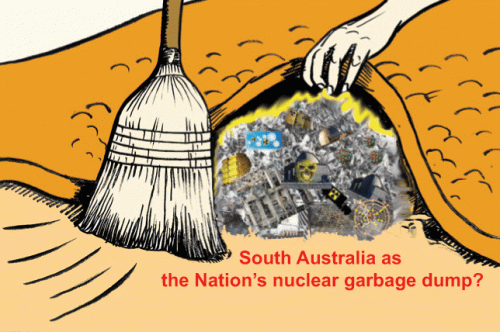
David Noonan Facebook: Fight to stop a nuclear waste dump in South Australia. 5 Dec 21. Regarding the planned nuclear waste dump at Kimba, South Australia, there will be better potential options if Federal ALP win office (and some if SA Labor do too);
there will have to be an SA Parliamentary Inquiry (likely starting sometime May on, after the elections & likely after any Judicial Reviews into Min Pitt’s siting decision & process has run its course);
there will be an EPBC Act environmental assessment including on transport issues and involving ‘public consultation’;
ARPANSA will (we expect) do separate Licensing processes – for proposed Low Level Disposal, with (better) ‘public consultaion’, and await the outcome of the EPBC Act assessment before making their Licensing decision (this will be very hard to head off if Lib gov’s are re-elected);
And in parallel or subsequently ARPANSA hold a separate process over indefinate above ground Storage of nuclear fuel wastes & ILW; ARPANSA (and a new ALP fed gov & even an SA Labor gov) will have and hear a range of concerns over co-located indefinate Storage of ILW et al and could eventually decide its preferable to retain such wastes at ANSTO Lucas Heights – until an ILW disposal option arises. There are a lot of wheels to turn yet…
In the next extradition court case for Julian Assange, we can expect the judge there to be very biased against Assange

Now the most powerful judge in England and Wales, Burnett will soon rule on Assange’s extradition case. The founder of WikiLeaks faces life imprisonment in the US. ……………………
As minister, Duncan did not hide his opposition to Julian Assange, calling him a “miserable little worm” in parliament in March 2018.
Duncan watched UK police pulling the WikiLeaks publisher from the Ecuadorian embassy via a live-feed in the Operations Room at the top of the Foreign Office.
He later admitted he was “trying to keep the smirk off [his] face”, and hosted drinks at his parliamentary office for the team involved in the eviction.
ASSANGE JUDGE IS 40-YEAR ‘GOOD FRIEND’ OF MINISTER WHO ORCHESTRATED HIS ARREST
Julian Assange’s fate lies in the hands of an appeal judge who is a close friend of Sir Alan Duncan – the former foreign minister who called Assange a “miserable little worm” in parliament. DECLASSIFIED UK
MATT KENNARD AND MARK CURTIS 2 DECEMBER 2021 LORD CHIEF JUSTICE IAN BURNETT, THE JUDGE THAT WILL SOON DECIDE JULIAN ASSANGE’S FATE, IS A CLOSE PERSONAL FRIEND OF SIR ALAN DUNCAN, WHO AS FOREIGN MINISTER ARRANGED ASSANGE’S EVICTION FROM THE ECUADORIAN EMBASSY.
The two have known each other since their student days at Oxford in the 1970s, when Duncan called Burnett “the Judge”. Burnett and his wife attended Duncan’s birthday dinner at a members-only London club in 2017, when Burnett was a judge at the court of appeal.
Now the most powerful judge in England and Wales, Burnett will soon rule on Assange’s extradition case. The founder of WikiLeaks faces life imprisonment in the US. ……………………
As minister, Duncan did not hide his opposition to Julian Assange, calling him a “miserable little worm” in parliament in March 2018.
In his diaries, Duncan refers to the “supposed human rights of Julian Assange”. He admits to arranging a Daily Mail hit piece on Assange that was published the day after the journalist’s arrest in April 2019.
Duncan watched UK police pulling the WikiLeaks publisher from the Ecuadorian embassy via a live-feed in the Operations Room at the top of the Foreign Office.
He later admitted he was “trying to keep the smirk off [his] face”, and hosted drinks at his parliamentary office for the team involved in the eviction.
Duncan then flew to Ecuador to meet President Lenín Moreno in order to “say thank you” for handing over Assange. Duncan reported he gave Moreno “a beautiful porcelain plate from the Buckingham Palace gift shop.”
“Job done,” he added………………………………. https://declassifieduk.org/assange-judge-is-40-year-good-friend-of-minister-who-orchestrated-his-arrest/
The people of South Australia are being excluded from the discussion and decisions about the Federal govt’s planned nuclear waste dump
Flinders Local Action Group
Bob Tulloch, 5 Dec 21, IS SOUTH AUSTRALIA DESTINED TO BE A NUCLEAR STATE? Six years ago, the Department of Industry, Innovation and Science (DIIS) suddenly burst into our lives with their push to establish a National Nuclear Waste Management Facility within our communities.Our lives, friendships and communities where fractured and torn apart, the effects still lingering today. The communities I refer to are Hawker/ Quorn in the Flinders Ranges and Kimba on Eyre Peninsular in South Australia.The ‘pro facility’ doctrine was loud, clear, and biased. Presented in a process where ‘community consultation’ was co-opted to ‘manufacture consent’. A process tightly controlled by DIIS with little room for alternative points of view, local dissent controlled with intimidation and bullying tactics.
It came as a shock to those involved, that our Government would use such tactics to push through their agenda, culminating after 40 years of failed efforts.This is when I started investigating behind the scenes in an attempt to understand why the Federal Government wanted to establish a nuclear waste facility at Kimba, so far from the main source of supply, Lucas Heights.
The Federal Government, under the NRWM Act, has the power to over ride state laws and has used these powers during the site characterisation study of the site Napandee near Kimba, which has now been officially declared as the site for a National Nuclear Waste Facility.
The Marshall Government is keen to set up a nuclear defense industry in South Australia to compliment the proposed nuclear submarine industry.Our state opposition, although opposed to the recent site selection process, is keeping very quiet, not forgetting under Jay Weatherall’s leadership in 2016, introduced the idea of importing the world’s nuclear waste to South Australia.My concern is, the people of South Australia are now being left out of the conversation and the decision making process.
Kimba residents who oppose the nuclear waste dump plan are not backing down.
Opposing residents refusing to back down on nuclear stance, Port Lincoln Times
- Claire Harris 2 Dec 21,. Kimba residents opposed to the nuclear waste facility being built in the district are not backing down on their stance, following the selection of the Napandee site by the federal government earlier this week.
No Radioactive Waste on Agricultural Land in Kimba or SA president Peter Woolford said he was disappointed in the announcement, but not surprised.
“It’s a bitter pill to swallow, because last week we were announced SA Ag Town of the Year, and now we’re the nuclear dump town,” he said.
“Ag is our big passion, it’s made Kimba, and will be a big factor influencing Kimba in future, so we’re standing up and opposing this because we want to protect what we have.”
Mr Woolford said he didn’t “subscribe to the theory” that the nuclear waste facility would be issue-free.
“We all take out insurance not because we know something is going to happen, but to protect against a potential risk if something does happen – this is no different,” he said.
He said the group would seek legal advice going forward to explore all avenues, potentially including a judicial review.
Retired Kimba farmer Peter McGilvray also opposes the choice and expected the community would remain divided on the issue.
“The damage is done. I came here in 1976 and was never going to leave, but this has pushed the button for me, and now I don’t plan on staying much longer,” he said.
Despite the criticism, Napandee site owner Jeff Baldock said the definitive decision was a step in the right direction for the town….. https://www.portlincolntimes.com.au/story/7534854/opposing-residents-refusing-to-back-down-on-nuclear-stance/s
Federal government spinning the virtues of nuclear waste to Whyalla, Port Lincoln, Ceduna, who had no say in the decision.
Roni Skipworth Facebook: No nuclear waste dump anywhere in South Australia ·
Those here who are of Aboriginal Culture please be aware this is happening in Whyalla Pt Lincoln Ceduna. The Federal Government didn’t want to include the Barngarla Custodians of Eyre Peninsula’s input when a new site for Australian Nuclear Waste Dump in Kimba Farming District. Though now that the Barngarla Culture is taking the Federal Government to COURT they want input from those towns mentioned. To give them SPIN in how the Culture can receive $$$, employment n investment into ANSTO the company who creates Nuclear Medicine in Lucas Heights NSW.
The Farmers The Landowners and City dwellers of SA hav been fighting this for 6-7yrs with State n Federal Govs. The best place to hold this Dump is at Lucas Heights as they received $60 million grant to extend ANSTO. Now Rowan Ramsay and the property owner of Napandee with the Mayor of Kimba are rubbing their hands together in bonuses of your well earned and Gst Taxes to start building in 4 years.
I live within the 50km limit though we and other neighbours on the borders of Kimba and in Wudinna didn’t have a say as well as the Barngarla Custodians have a vote. We meaning Mother Earth and those who have said NO seemed not to be heard.Please spread this to your friends and families of the Barngarla Culture of Eyre Peninsula.
How the federal government gets around the problem of trucking nuclear waste over Aboriginal land.
– Kazzi Jai 5 Dec 21, (Facebook No nuclear waste dump anywhere in South Australia) . The [Napandee . Kimba] property is not now Aboriginal land, as there is no Native Title over this piece of land. However there are parcels of land with Native Title neighbouring the site, which are used for camping and hunting by the Barngarla people of the region 2 The present Bill new section 19B empowers the Minister to acquire additional land for road access., thus overcoming Native Title on those areas. Minister Pitt says he will introduce an amendment to ensure that Title rights cannot be compulsorily acquired. (from Hansard)
Australia’s Minister for Defense Peter Dutton Mocks ‘Silly’ China Criticism of Nuclear Subs

Australian Defense Minister Peter Dutton derided the “inflammatory” remarks, describing them in a television interview as “provocative, sort of comical statements, really that are so silly it’s funny.”
Dutton had said at the weekend that he could not conceive of a situation in which Australia would not support the United States in the event of armed conflict with China over control of Taiwan.
Australia Mocks ‘Silly’ China Criticism of Nuclear Subs, Australia increased its defense spending in 2020 and is focusing on projecting military power in the Indo-Pacific. Defense News., STAFF WRITER WITH AFP NOVEMBER 19, 2021 Australia on Friday openly mocked a senior Chinese diplomat’s warnings about its plan to acquire nuclear-powered submarines, saying they were “so silly it’s funny.”
The Chinese embassy’s charge d’affaires, Wang Xining, said Australia would become the “naughty guy” if it procures the submarines, which are capable of stealthy, long-duration missions.
Nuclear-powered submarines are designed to launch long-range attacks, Wang argued in an interview with The Guardian.
“So who are you going to attack? You are no longer a peace lover, a peace defender, you become a sabre wielder in certain form,” said Wang, who is China’s top representative in Australia since the previous ambassador’s departure last month after a five-year term.
Wang said Australia had “zero nuclear capacity” to deal with any trouble affecting the submarines and asked if politicians were ready to apologize to people if any incident occurred.
Australian Defense Minister Peter Dutton derided the “inflammatory” remarks, describing them in a television interview as “provocative, sort of comical statements, really that are so silly it’s funny.”
Dutton said the acting Chinese ambassador “is probably reading off a script from the Communist Party but I think most Australians see through the non-productive nature of the comments.”………
In his interview with The Guardian, Wang also cautioned Australian politicians not to do anything “destructive to the relationship”.
Dutton had said at the weekend that he could not conceive of a situation in which Australia would not support the United States in the event of armed conflict with China over control of Taiwan.
Icy relations between Australia and China have led to a freeze in high-level diplomatic contacts for almost two years…….. https://www.thedefensepost.com/2021/11/19/australia-china-nuclear-subs/
Legislative and regulatory obstacles, highly dangerous wastes – Kimba nuclear dump is still an uncertain project.

no point moving intermediate waste from its temporary storage in Lucas Heights, to temporary storage in Napandee.
3 reasons the announcement to dump radioactive waste in South Australia is extremely premature , The Conversation, Ian Lowe, Emeritus Professor, School of Science, Griffith University Prof. Ian Lowe was for twelve years a member of the Radiation Health and Safety Advisory Council, which advises the regulator ARPANSA. 1 Dec 21,
The site, Napandee, comprises 211 hectares of government-acquired land, with radioactive waste set to be stored for over 100 years in deep trenches.
Radioactive waste is extremely hazardous to people and the environment. It emits radiation, which can pollute water, kill wildlife and cause a number of deadly human health issues such as cancer. Even waste with low potency levels needs to be stored away for centuries, so the community should be assured the repository is well designed and properly managed.
While Pitt is celebrating what he regards as a resolution, there are three reasons this announcement is premature……………
1. Legislative and regulatory hurdles
Twenty years ago, The Olsen government of SA passed legislation to prevent radioactive waste being brought into the state. When the Howard government proposed storing radioactive waste in the state soon after, the subsequent Rann government strengthened that legislation.
This means the new proposal will require the current SA government to repeal or amend the current law. This will be difficult, as Premier Steven Marshall runs a minority government and, with an MP defecting in October, he’s likely to struggle to get the support he needs.
There is also a regulatory hurdle. A proposal such as this needs the approval of the regulator, the Australian Radiation Protection And Nuclear Safety Authority (ARPANSA), which will assess the proposal to determine whether it ensures the safety of people and the natural environment.
ARPANSA took the previous proposal by the Howard government very seriously. The process included public hearings at which the Director of ARPANSA was assisted by two scientists – I was one and the other was a Canadian expert in radioactive waste management.
It became clear in the assessment process that the federal government had made no attempt to calculate the risk of transporting radioactive waste from the various sites where it’s now stored to the more secure centralised facility. It simply asserted that the risk was minimal.
ARPANSA was not impressed by this data-free approach. Faced with opposition by the state government and questions raised by the regulator, the federal government withdrew the proposal.
2. The waste is more dangerous
The second serious hurdle is that “intermediate level” waste from a nuclear reactor temporarily stored at Lucas Heights will be sent there.
The new Napandee facility will mostly store the comparatively benign “low-level waste”. This includes residues from nuclear medicine, scientific research and industrial applications. Once buried in deep trenches, this poses relatively little risk to humans or wildlife.
Intermediate level waste is much nastier and demands much greater levels of security. It contains long-lived radioactive isotopes that need to be isolated and contained for periods of thousands of years – effectively permanent disposal. This is generally seen as requiring engineered underground containment facilities, rather than the near-surface repositories used for low-level waste.
No such facility to safely, and permanently, house this waste has been built in Australia, and the regulator will undoubtedly require assurances it could be safely constructed and managed.
It will also be much more difficult to justify transporting this waste along the roads of three states, given it’s now securely held at Lucas Heights. Transporting nuclear waste comes with risks of accidents or possible theft by terrorists of the dangerous material.
There seems to be no point moving intermediate waste from its temporary storage in Lucas Heights, to temporary storage in Napandee.
3. No consent from Traditional Owners
The third hurdle for the proposal is the opposition of the Barngarla Traditional Owners, who have made clear they do not support the proposal for radioactive waste to be stored on their land.
After the consultation process in SA, a ballot showed 60% of the local residents supported the proposal. But the the Barngarla people say they have not been included in consultations.
In previous decades, our governments have ridden roughshod over the wishes of Traditional Owners and imposed developments they did not want. Today, the Australian public is generally more respectful of the wishes of Traditional Owners.
There will certainly be legal challenges to the government’s scheme. But even if the Barngarla people don’t have the law on their side, they have the moral authority. It will be politically difficult for any government to justify going ahead with a scheme that is totally opposed by the relevant Indigenous group. https://theconversation.com/3-reasons-the-announcement-to-dump-radioactive-waste-in-south-australia-is-extremely-premature-172766?fbclid=IwAR1AHoelrqg9AWWS4sicLvV6t3KIHFbFidE_rot3ncTVJ-Avlitu09Tl6bQ
Traditional owners say Vimy Resources is not listening to Aboriginal people
Tom Robinson Kalgoorlie Miner, Tue, 30 November 2021
Debbie Carmody spoke at Vimy’s AGM as a proxy for a shareholder.
A Goldfields Aboriginal woman has taken her people’s opposition to Vimy Resources’ proposed Mulga Rock uranium mine to the company’s inner sanctum, and says Vimy is not listening to traditional owners.
Anangu Spinifex woman Debbie Carmody is descended from displaced Aboriginal people, who were forced off their country at Maralinga in South Australia by nuclear testing in the mid-20th century.
Now, she is a prominent voice against the proposed uranium mine 290km east of Kalgoorlie-Boulder, within her traditional lands on the Upurli Upurli Nguratja native title claim — which was registered on January 22 this year.
She believes her people’s cultural and social relationship with their country is threatened by the prospect of uranium mining.
Ms Carmody travelled to Perth last Friday to join protesters at Vimy’s AGM, and spoke at the meeting as a proxy for a shareholder who was in opposition to the Mulga Rock proposal, and bought the shares to gain access to the company’s meetings.
Conservation Council of WA protesting against the proposed uranium mine in front of Vimy’s AGM last week. Credit: Daniel Wilkins/The West Australian
Ms Carmody said she told the AGM that Vimy had not consulted with UUN traditional owners and outlined the fears she holds for her country, but she said her protests fell on deaf ears.
“Our people have a long history with radioactive fallout and our families have died and have suffered rare and painful deaths as a result of radiation poisoning,” she said.
“We want to protect our special sites, the flora and fauna, and the underground water. We want to protect the destruction of our homelands.”
Last Thursday, Vimy Resources rejected claims it had not consulted with the UUN group, with interim chief executive Steven Michael saying the company met with Central Desert Native Title Services, which was acting on behalf of UUN.
But Ms Carmody said this did not represent proper consultation and felt the miner should have spoken to the UUN group directly.
“Vimy claimed to have consulted with Central Desert Native Title Services, I pointed out that they are not UNN with whom you should be speaking to,” she said.
“I also stated that all registered Native Title claimants have a right to negotiate, and therefore Vimy is not following due process.”
The company was given five years to begin work on Mulga Rock as part of ministerial approval for the controversial project issued on December 16, 2016 — at last week’s AGM the company listed a series of milestones it had met in the interim including the recent clearing of about 143ha at the site, but it is yet to make a final investment decision.
Ms Carmody said the clearing was disrespectful and showed “a lack of social value, moral and ethical leadership”.
Liberal MP Rowan Ramsey has misled South Australia, in greatly minimising the amount of Intermediate Level nuclear waste intended for Napandee farm site.

So on the basis of the above figures the amount of ILW contained in the big canister that Rowan mentioned is actually only 0.1 per cent by volume of the ILW intended for Napandee. (In other words the documented volume of ILW intended for Napandee is about 1000 times more than what he stated).
Andrew Williams, Fight to stop sa nuclear waste dump in South Australia, 1 Dec 21, Rowan Ramsey stated that the TN-81 canister in the Interim Waste Store at Lucas Heights is the only Intermediate Level Waste intended for Napandee. This is not correct.
The large canister that he mentioned contains reprocessed used nuclear fuel from the old decommissioned HIFAR reactor, which ARPANSA notes as having radioactivity at the higher end of the ILW range.
That means it must remain safe from people and the environment for 10,000 years according to International guidelines followed by the Australian regulator. Another load of reprocessed used nuclear fuel from the old HIFAR reactor is due back next year and is intended to end up at Napandee, in the same type of TN-81 container.
Of the waste intended for Napandee, this highly hazardous reprocessed nuclear fuel is the most radioactive. However there is a lot more intermediate level waste (ILW) than what is in these two big containers intended for Napandee. All of the reprocessed highly hazardous used nuclear fuel produced by the existing OPAL reactor over its operating life is intended for Napandee in years to come.
However during the production of radioactive isotopes (some of which are used in nuclear medicine) ILW is produced. The Australian Radioactive Waste Management Framework (2018) reports total ILW at 1770 cubic metres, with 95% by volume as federal gov. wastes. It is intended to produce a further 1,960 cubic metres over the next 40 years (all intended for Napandee), most of which will be produced at Lucas Heights. (This is documented and can be checked).
All of this ILW is intended to go to Napandee for up to 100 years of above ground storage. A TN-81 container can hold up to 28 canisters, each containing 150 litres of vitrified reprocessed fuel waste. 28×150 litres = 4,200 litres = 4.2 cubic metres. So on the basis of the above figures the amount of ILW contained in the big canister that Rowan mentioned is actually only 0.1 per cent by volume of the ILW intended for Napandee. (In other words the documented volume of ILW intended for Napandee is about 1000 times more than what he stated).
Kimba temporary nuclear waste dump plan is unnecessary, now that federal government has approved upgraded storage plan at Lucas Heights.
South Australian farm near Kimba to be nation’s first nuclear waste facility, Queensland Country Life 30 Nov 21,
A SOUTH Australian farm will be turned into a national nuclear waste facility, after the federal government officially selected the site in the last parliamentary sitting week of 2021.
The site near the town of Kimba, in the Eyre Peninsula, was always considered the front runner for the facility,…………
Australian Conservation Foundation national nuclear-free campaigner Dave Sweeney said the plan lacked a rationale and a social licence, as the region’s Traditional Owners were excluded from key consultation processes.
Mr Sweeney said the planned facility was unnecessary given federal parliament’s recent support for a $60 million waste storage upgrade to secure the most problematic intermediate level waste at the Australian Nuclear Science and Technology Organisation’s (ANSTO) Lucas Heights nuclear site for the next three to five decades.
“The Kimba plan is effectively redundant on the day Minister Pitt has made his decision,” Mr Sweeney said.
Extended storage of Australia’s most problematic waste at Lucas Heights where most of it is already stored, makes far more economic, environmental and radiological sense than the ill-considered Kimba plan.”
1 This month
7 April – WEBINAR – Australia and the Doomsday Clock – Preventing nuclear war through NoFirstUse and other policies
Online | Tuesday April 7, 4:00-5:30pm, Australian Eastern Time / 8:00-9:30am Central Europe Time
– Access the registration link
15 April – Zoom –Nuclear Power is Not the Solution
Apr 15, 2026 01:00 AM in Canberra, Melbourne, Sydney

Join the International Physicians for the Prevention of Nuclear War (IPPNW) on Tuesday, April 14th for a timely webinar exploring the risks associated with nuclear power and challenging the myth that it offers a simple, safe, carbon-free solution to the climate crisis

21 April Webinar: No Nuclear Weapons in Australia
Start: 2026-04-21 18:00:00 UTC Canberra, Melbourne, Sydney (GMT+10:00)
End: 2026-04-21 19:30:00 UTC Canberra, Melbourne, Sydney (GMT+10:00)
Event Type: Virtual
A virtual link will be communicated before the event.
Host Contact Info: australia@icanw.org

of the week – Australians for War Powers Reform (AWPR)
To see nuclear-related stories in greater depth and intensity
 Antinuclear