The Law and the Profits: Response to the Tentative Findings of the SA Nuclear Fuel Cycle Royal Commission
 Response to the Tentative Findings of the SA Nuclear Fuel Cycle Royal Commission A Submission by Paul Langley Nuclear Exhaust 16 Mar 16 “…..The Law and the Profits.
Nuclear nations all have their own laws regarding nuclear matters. For instance the United States has many laws, including the Atomic Energy Act, as currently amended, associated laws and regulations. It has long been an issue that the US Act prevents full disclosure regarding “special nuclear material” – that is plutonium and uranium as used and produced in a reactor. This matter has long been a concern in the US democratic setting. For instance, see CARDOZO LAW REVIEW, VOL 26, NO 4, MARCH 2005, PP. 1401-8.
The HLNW repository is promoted by the Royal Commission as being South Australian, owned by the government and benefitting the people of SA. To what extent then, in the course of contract negotiations, will the government and people of SA become beholden to the provisions of foreign laws regarding disclosure and other matters in regard a client nation’s HLNW? Will the contracts be commercial in confidence ? Will provisions alien to SA law be invoked in order to comply with contracted obligations? Will such provisions restrict our right to know and our freedom to speak? Will the full nature of the stockpile resident in the HLNW repository be secret in any way? Will the people be able to study each contract? What is an unclassified restricted document, and what happens if an ordinary person figures out it’s contents? ……..” https://nuclearexhaust.wordpress.com/2016/03/15/response-to-the-tentative-findings-of-the-sa-nuclear-fuel-cycle-royal-commission/
Gaining Public Trust: Response to the Tentative Findings of the SA Nuclear Fuel Cycle Royal Commission
Response to the Tentative Findings of the SA Nuclear Fuel Cycle Royal Commission A Submission by Paul Langley Nuclear Exhaust 16 Mar 16
“……..Gaining Public Trust. Relevant Safety Assurances made by nuclear “experts” in my life time.
In the 1980s, the government of South Australia returned ownership of the Maralinga Lands:
“In 1984, the South Australian Government returned the freehold title for the Maralinga Tjarutja Lands to its Traditional Owners. Concerns over radiological hazards prevented the handback of Section 400.” Source: “Maralinga Tjarutja Lands: handback of Section 400” , The Anangu Lands Paper Tracker, at http://www.papertracker.com.au/archived/maralinga-tjarutja-lands-handback-of-section-400/
As I recall at that time the then Premier, the Late John Bannon, visited the Maralinga Lands, along with Peter Burns and other ARPANSA scientists. Peter wrote a detailed description of the problem at Maralinga in a Saturday Advertiser centre page spread at that time. Mr. Bannon was appalled and surprised at the state of some areas of the lands and though the land was handed back, it was too dangerous to permit the owners to return on a permanent basis.
Full handback was not possible until the 21st century………..
For decades the relevant nuclear experts – especially those under Professor Titterton – had assured Australia and Australians that Maralinga was “perfectly safe”. From the 1950s until 1984. Many individuals who contested the opinion of these experts were threatened with jail for breaching the official secrets act. (Source: Mr Kevin Wakefield, Ex RAN, Monte Bello Island, Mr Terry Toon, Ex Maralinga, Mr Alan Batchelor, Ex Maralinga. Mr John Hutton, Ex Maralinga.) While some ordinary people knew the truth, they were not allowed to tell it. And when they did speak out, they received threats and disbelief. It is reasonable to think, given that the RAN surveyed the Monte Bello Islands until 1975, the same would be true of the Army and Maralinga. Everyone is a Sergeant Schulz on that one.
Well it was not perfectly safe. Was it? This is one of South Australia’s formative experiences with nuclear authorities. Professor Titterton remained entrenched at the Federal level as a nuclear safety “leader” until the era of the Whitlam government.
This is not ancient history. It is for some people like yesterday. The 1984 McClelland Royal Commission records an exchange between Titterton and the Royal Commissioner. In this exchange Titterton admits he could not disclose all he knew about safety to the Safety Committee due to the fact that he was constrained by the secrecy provisions of both the United States and Great Britain. Will history repeat in this regard? What will Jay not be able to say the people of South Australia? Will silence due to “American and British secrecy provisions” reign again? The Royal Commissioner McClelland found that some Australians in authority were akin to Fifth columnists acting more in the interests of foreign lands than they were towards Australia and its people.
This earlier Royal Commission also found that nuclear experts had stated to the effect that the critical interests of “a handful of natives” were not going to “stand in the way of the BritishCommonwealth of Nations.” (Royal Commission, Conclusions, 8.4.38 – 39). Saving the world required some local sacrifice. As far away from the North as possible. The ones closest in are the ones most affected. Shall we do it again Jay W.?
Nuclear history is the art of waiting for historic promises to be exposed for what they are at some future point……..
The proposed repository is a sociological experiment. It will take decades for it to provide the history lesson. A very costly higher education.
“Perfectly Safe”, in the History of South Australia, has been a nuclear science fiction, and anyone can prove it. It has never actually true, and contaminated land remains from the time when the owners were forcibly trucked off it in the 1950s. To be concentrated in camps near the Ceduna sub basin of the Bight Basin, which overlays, in part, the Gawler Craton. Such history lies beneath the apparently solid rock statement made by today’s youngster biologists who claim expertise as nuclear people……” .https://nuclearexhaust.wordpress.com/2016/03/15/response-to-the-tentative-findings-of-the-sa-nuclear-fuel-cycle-royal-commission/
AN ALTERNATIVE: Response to the Tentative Findings of the SA Nuclear Fuel Cycle Royal Commission
Response to the Tentative Findings of the SA Nuclear Fuel Cycle Royal Commission A Submission by Paul Langley Nuclear Exhaust 16 Mar 16
“……..An Alternative We are told Secure Base load Electrical Power is a certainty upon which our civilization rests. Not withstanding the constantly falling price of off grid generation and storage of domestic and industrial power.
As each day passes, alternatives grow in attractiveness. As usual old industries, such as nuclear industry, bemoan the competing technology as inadequate. The odds are by the time today’s five year child is twenty five they will generate, store and use their own off grid power simply, easily and at a cost that would make TEPCO and Westinghouse executives go green. At the moment though the nuclear industry remains a dedicated future-phobe. Those who call for a nuclear revival merely confirm, in the shrillness of their demands, the proven failures of the industry over time, all over the globe.
A large solar power plant, used for both day time power generation and day time sea water electrolysis, could provide 24 hour base load power. An onsite hydrogen fuelled generator station, generating at night or as required, fuelled by solar produced Hydrogen, could transform the SA economy. The benefits would not have to be weighted against risks spread population wide. This is 2016. Hydrogen is in daily use around the world. In SA there are potential energy sources as yet resolutely untapped.
A hybrid solar hydrogen power plant could be constructed with current knowledge and hardware. But of course, it would be an inappropriate icon in a state dominated by the nuclear promise.
A far thinking Parliament would not be bound to digging holes in the ground for a living. It might actually originate and facilitate something that actually could save the planet. Sadly it won’t. It does not have the creative will to do so. Such things would already be done if it had.
Such ideas are deemed crazy ones in the halls of nuclear power, in that place where thinking differently seems to be a sin against the prayer book of a compulsory religion.
No thanks, I do not wish to buy this product. It sucks very badly. Have you got anything else? Preferably something sensible and compatible with the future. Not some rust belt thing that the children of all tomorrows curse us for giving them. https://nuclearexhaust.wordpress.com/2016/03/15/response-to-the-tentative-findings-of-the-sa-nuclear-fuel-cycle-royal-commission/
Excellent previous submissions to #NuclearCommissionSAust
The website of South Australia Nuclear Fuel Chain Royal Commission, is not all that user friendly – hard to find the previous submissions. However they are at
http://nuclearrc.sa.gov.au/submissions/?query=&cat=View+all&search=Submissions&max_page_items=50&sort_by=
some of the best submissions are on THIS website, even if not complete.
Here they are, not in any particular order:
SUBMISSIONS FOCUSING ON NUCLEAR WASTE IMPORTATION
Sisters of St Joseph make a powerful case against radioactive trash dumping
NGOPPON TOGETHER INC – Management, Storage and Disposal of Wastes. also on impact of unclear waste import on Tourism etc
Christine Anderson – nuclear waste no bonanza for South Australia
Environmental Defenders Office (SA)
Noel Wauchope – Answer Points on Importing Nuclear Waste
BHP not interested in nuclear waste import
Bill Fisher spells it out on nuclear waste
Plans for radioactive trash dumping on Aboriginal land ?
West Mallee Protection – an Aboriginal Perspective
Clean Bight Alliance Australia
MORE GENERAL SUBMISSIONS
Josephite SA Reconciliation Circle
South AustraliaEnvironment Groups
South Australia Nuclear Royal Commission Issues Paper 4 – misleading and serious omissions
Dr Helen Caldicott’s Submission on all 4 Nuclear Royal Commission Issues Papers
Dr Caldicott’s submission concerning radiation
Medical Association for Prevention of War & Public Health Association of Australia
Annie McGovern Addressing questions of WATER
Construction Forestry & Mining. Also Uranium Free NSW.
Rebecca Keane Renewable Energy way ahead of nuclear
Electrical trades Union of Australia dispels the hype about Generation IV Nuclear Reactors
John Quiggan demolishes the case for Small Modular Nuclear Reactors in South Australia
Ally Fricker & Bob Lamb for ENuFF
Yurij Poetzl scrutinises Questionable Integrity of the Royal Commission
City of Port Adelaide Enfield notes poor prospects for New Nuclear Technology
Until 18 March, South Australia Nuclear Fuel Chain Royal Commission will accept responses to its Tentative Findings

It’s a well kept secret from the whole of Australia, but the nuclear lobby plans to invite in the world’s most toxic nuclear trash – to poor old South Australia – the State with the greatest potential to be a world – leading renewable energy hub.
This plan can be stopped – as it has been before.
One step in exposing and stopping this noxious plan by a few greedy people is to RESPOND TO the ROYAL COMMISSION’S TENTATIVE Findings. their Guidelines are here
It’s not that difficult. The Commission put up fewer obstacles this time. Say what you really think.
You can find good advice on sending a response at Action Australia
By the way, the COVER SHEET has to be signed, which implies that the comments should be posted. I am posting mine, but because of concerns about the postal service these days, I am sending it by email, too. It’s not as hard as last time – much as the Royal Commission would probably like to intimidate us all into not bothering. Please bother! Comments can be lodged via email to: enquiries@nuclearrc.sa.gov.au
Nuclear Royal Commission findings agree with French report: Nuclear power is prohibitively expensive
 The Nuclear Industry Prices Itself Out Of Market For New Power Plants, Climate Progress, BY JOE ROMM MAR 8, 2016 “……… in newly-released findings, South Australia’s nuclear royal commission found that the price of electricity from new nukes greatly exceeded not only business-as-usual projections for electricity prices but also prices in a “strong climate action” case. The Commission concluded “it would not be commercially viable to generate electricity from a nuclear power plant in South Australia in the foreseeable future.”
The Commission explicitly looked at plausible electricity prices for a new reactor in 2030 based on both current designs and possible fourth-generation ones, such as small modular reactors (SMRs). The Commission estimated the cost for the most viable nukes at US$7 billion for a typical large 1125-megawatt reactor and $2.8 billion for two 180-megawatt SMRs. The smaller SMRs would be providing electricity for a whopping US$0.17 a kilowatt-hour!
A study done for the Commission found that both large nukes and SMRs “consistently deliver strongly negative NPVs” (net present values) for both 2030 and 2050 — even for the strong climate action scenario. The Commission Chair noted that given how Australia’s National Electricity Market works, renewables are “the first energy that goes into the market” because they have the lowest costs.
The Commission’s findings are consistent with a 2014 Energy Policy study, “The cost of nuclear electricity: France after Fukushima.” Using cost data released by the French government after the Fukushima disaster, the study found the cost of French nuclear plants steadily escalated over the past four decades. Further, it projects “the future cost of nuclear power in France to be at least 76€/MWh (US$0.084/KWh) and possibly 117€/MWh (US$0.129/KWh),” which “compares unfavorably against alternative fuels,” such as wind……..”http://thinkprogress.org/climate/2016/03/08/3757281/nuclear-industry-prices/
#NuclearCommissionSAust ‘s plan – not necessarily an Eldorado for South Australia
 SA’s Nuclear Waste Boom: A Hot Story Requires Cool Heads http://adelaidereview.com.au/opinion/business-finance-opinion/nuclear-waste-boom-a-hot-story-requires-cool-heads/ John Spoehr Director of the Australian Industrial Transformation Institute at Flinders University February 26, 2016
As the alluring prospect of a nuclear waste storage boom fades a little in our minds, attention needs to turn to the risks associated with large–scale radioactive waste storage…….
I think the Commission’s estimates might prove to be over-optimistic. If the proposition is as attractive as the modeling provided by the Commission suggests, then you would expect a range of players to enter the market at the same time as Australia does……
We cannot rely on a radioactive storage facility to deliver short-term benefit. ‑The lead times on a project like this are long and will be complicated by the need for very thorough and accurate geological, environmental, social and economic impact assessment. Community attitudes will be shaped by this as it unfolds.
In the meantime, we must guard against seeing the Commission’s findings as the foundation for some kind of nuclear Eldorado. The prospect of great riches and jobs flowing from being a storehouse for radioactive material is seductive at a time when job losses in the automotive, mining and steel industries loom large. We must be convinced rather than seduced by the case for a storage facility in South Australia. Future generations will not forgive us if we get this one wrong.
#NuclearCommissionSAust willing to pass huge costs on to future generations
we are bequeathing a stream of costs to our successor generations. They will be poorer as a result, and will have reason to curse their forebears for selfishly making themselves better off at their expense.
Nuclear waste dump confounds cost-benefit analysis, In Daily, 23 Feb 16 The proposal for a South Australian high level nuclear waste dump places too much risk on future generations, argues economist Richard Blandy.
The Nuclear Fuel Cycle Royal Commission delivered its tentative findings on 15 February. It is seeking responses to these findings up until 18 March. I intend to submit this article to the commission for its consideration.
The only aspect of the nuclear fuel cycle that received the Royal Commission’s support in its tentative findings was the storage and disposal of used nuclear fuel, entirely from overseas, obviously. The Royal Commission described such an integrated storage and disposal facility as “likely to deliver substantial economic benefits to the South Australian community”.
I believe that the Royal Commission has got this wrong and that South Australia should not use part of its land mass as a dump for highly radioactive used fuel from overseas nuclear reactors (called “high level waste”) which, in the Royal Commission’s own words, “requires isolation from the environment for many hundreds of thousands of years”.
The reason why South Australia should not allow a nuclear dump within its borders goes to the heart of cost-benefit analysis involving many generations of people, literally tens of thousands of generations, in this case. Cost-benefit analysis works well when the costs are up front and the benefits accrue into the future. But it falls apart when the benefits are up front and the costs accrue into the future.
This is the case with the proposed high level nuclear waste dump. We are promised an up-front bonanza, after 30 years of construction of the facility, with a net present value of “more than $51 billion (at the intergenerational discount rate of 4 per cent)”. Continue reading
Next steps in the push for South Australia as world’s nuclear toilet
 Friends of the Earth 20 Feb 16 The ‘Tentative Findings’ report is posted at: http://nuclearrc.sa.gov.au/tentative-findings/
The deadline for written submissions responding to the interim report is March 18 (see the Royal Commission website for details).
The final report will be published in May 2016. http://www.foe.org.au/royal-commission
9 News 19 Feb 16 The report is due on May 6 and the state government will not make any decisions before the end of the year.
That could include putting the issue to a referendum at the next state election, due in 2018
Nuclear Semioticians (sign experts): how to warn future generations of the wastes danger
they established the field of nuclear semiotics……. an “atomic priesthood”
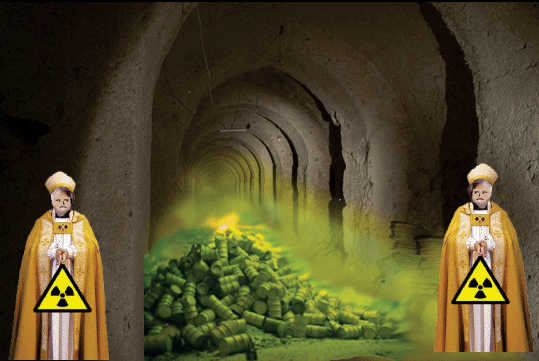
The message walls would have the faces as well as simple messages
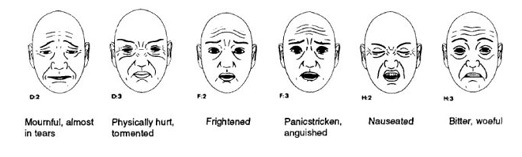
Temple of Doom: How do we warn the future about nuclear waste?, Triple J Hack, by James Purtill, 19 Feb 16 This week the South Australian Royal Commission released “tentative findings” recommending the state take more than 100 tonnes of high-level radioactive waste and store it in the desert for hundreds of thousands of years.
……..If the facility goes ahead, the designers may consider a problem that has baffled linguists and semioticians (sign experts): how to tell the distant future don’t dig up the dump?
Atomic priesthoods and ‘ray cats’
In 1991, the Department of Environment hired linguists, scientists and anthropologists at a cost of about $1 million to answer what is basically a conundrum of labelling. How do you warn far-off civilisations or scattered bands of post-apocalyptic survivors that invisible beams of energy emanating from the earth could kill them, and this was not a trick, there’s no buried treasure?
The report runs to 351 pages and has the (rather dry) title: Expert Judgement on Markers to Deter Inadvertent Human Intrusion into the Wasteland Isolation Pilot Plant.
Here’s some of the problems they identified:
- Languages evolve too fast to communicate with the future: Few English speakers understand Old English, which was spoken about 1000 years ago.
- The meanings of symbols is too ambiguous: For example, the physicist Carl Sagan was invited to join the researchers, couldn’t make it, and wrote to suggest they simply use the skull-and-crossbones symbol to signify danger. But this symbol has only been current for a few hundred years, has meant ‘poison’ for the last 100, and is no longer very threatening. It’s on ‘pirate theme’ drink bottles.
- Even if they understand the warnings, future trespassers might not believe them. Curses associated with the burial sites of the Egyptian Pharaohs did not deter grave robbers.
Maralinga tipped for the site of Premier Jay Weatherill’s nuclear waste site fantasy
 Planning 500 years ahead makes nuclear storage a difficult road, AFR, Simon Evans 20 Feb 16, It’s the first 500 years that bring the biggest worries about radioactivity when it comes to spent nuclear fuel rods.
After that, most of the radioactive elements have decayed, but they still need to be isolated from the environment in a deep underground nuclear storage facility for many hundreds of thousands of years. Everything in the nuclear waste industry has an enormously long outlook, including the promise of a $257 billion pay-day for South Australia . Correct, billion. That is if it’s able to traverse a difficult political road and build a sophisticated nuclear waste facility 500 metres below ground to operate over a projected 120-year commercial life……….
DEEP-BELOW-GROUND STORAGE
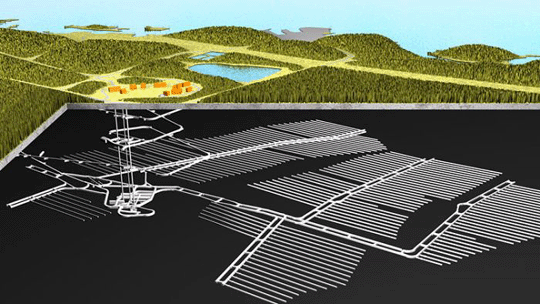
political considerations collide with the economics of the proposed plant. He says the $33 billion cost of the underground facility is so vast it would need to be shared between the state and federal government, which also needs to change legislation to allow it to proceed. Federal Resources and Energy Minister Josh Frydenberg gave cautious support to the plan if a political and community consensus can be developed……..
One submission to the royal commission by a private company called SA Nuclear Energy Systems has proposed the Maralinga atomic bomb test sites about 850km north-west of Adelaide as a good spot for an underground facility. Maralinga was used by Britain to test atomic bombs in the late 1950s, with the site later becoming embroiled in controversy because of the long-term health effects on the Aboriginal owners of the land and on military personnel who had been present. http://www.afr.com/business/energy/nuclear-energy/planning-500-years-ahead-makes-nuclear-storage-a-difficult-road-20160216-gmvchl#ixzz40e9J9qEw
What does the #NuclearCommissionSAust report say?
the waste-to-fuel fantasies of Senator Edwards and Ben Heard are dead and buried.
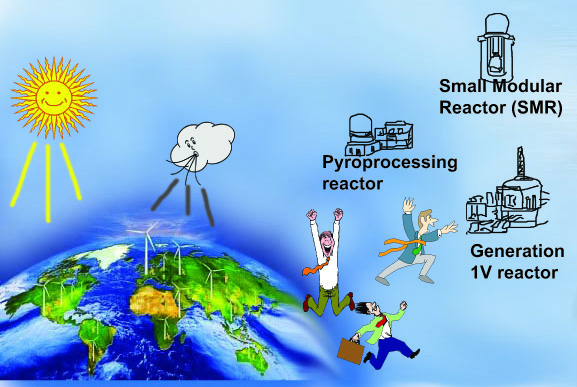
 [Wastes storage] timeframes – 150 years in the U.S. report and 120 years in the Royal Commission study – are nothing compared to the lifespan of nuclear waste. It takes 300,000 years for high level waste to decay to the level of the original uranium ore. The Royal Commission report notes that spent nuclear fuel (high level nuclear waste) “requires isolation from the environment for many hundreds of thousands of years.”
 the Waste Isolation Pilot Plant (WIPP) in the U.S. state of New Mexico. WIPP was closed in 2014 because of a chemical explosion which ruptured a nuclear waste barrel and resulted in 23 workers being exposed to radiation. Before WIPP opened, the government estimated one radiation release accident every 200,000 years. But there has been one radiation release accident in the first 15 years of operation of WIPP.
 The Royal Commission’s report is silent about WIPP. It is silent about the Asse repository in Germany, where massive water infiltration has led to the decision to exhume 126,000 barrels of radioactive waste. The report is silent about the fire at a radioactive waste repository in the U.S. state of Nevada last year. And the report is silent about many other problems with the nuclear industry that it should have squarely addressed
Summary of ‘Tentative Findings’ of SA Nuclear Fuel Cycle Royal Commission Friends of the Earth Australia, by Jim Green, national nuclear campaigner, Friends of the Earth 20 Feb 16 What does the report say?
In a nutshell, the Royal Commission is negative about almost all of the proposals it is asked to consider – but positive about the proposal to import high-level nuclear waste from nuclear power plants for disposal in South Australia. Continue reading
No country has a nuclear waste repository that will last long enough
Temple of Doom: How do we warn the future about nuclear waste?, Triple J Hack, by James Purtill, 19 Feb 16 “…….This week the South Australian Royal Commission released “tentative findings” recommending the state take more than 100 tonnes of high-level radioactive waste and store it in the desert for hundreds of thousands of years…….
This is true, but it’s worth pointing out none of these already built repositories are for the final disposal of nuclear fuel. They are either for low to intermediate level waste, which needs to be isolated for several hundred years, or they are temporary, interim solutions to the problem of finding a final resting place that will isolate waste for tens of thousands of years.
Finland is building the world’s first deep underground repository for high level nuclear waste and Sweden is close behind. The Finnish site is scheduled for completion in 2023.
A better example of the kind of repository proposed for South Australian is the United States’ Waste Isolation Pilot Plant (WIPP), deep in the New Mexico desert. It’s the only working long-lived nuclear waste repository in the world. It holds barrels of gloves and masks and machines and bomb parts contaminated by nuclear testing. The site is designed to last for 10,000 years.
WIPP is scheduled to close in the 2040s. It will be sealed up and left alone. Centuries will pass and become millennia. On the surface, civilisations will rise and fall.
China, the world’s oldest continuous civilisation, stretches back about 5,000 years. The world’s oldest inscribed clay tablets date from about the same time.
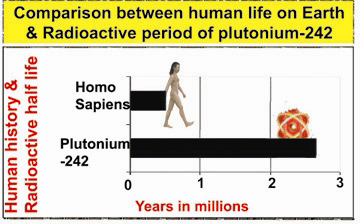 The half-life of plutonium-239, which can produce fatal radiation doses during short periods of direct exposure, is 24,000 years – the time it takes to decay to half its level of radioactivity. In 10 times that period, or 240,000 years, it decays to uranium-234, which is fairly harmless.
Homo sapiens began to evolve about 200,000 years ago………..http://www.abc.net.au/triplej/programs/hack/temple-of-doom-how-do-we-warn-the-future-about-nuclear-waste/7181278
#NuclearCommissionSAust ignores the long term problem of storing radioactive trash
South Australia ponders nuclear waste options MAX OPRAY, The Saturday Paper, 20 Feb 16 The initial findings of a royal commission into the merits of South Australia becoming a hub for uranium mining and waste storage raised as many questions as they answered.”…… Scarce put forward a premise even more audacious than his necktie – that South Australia’s seemingly hopeless descent into economic oblivion could be reversed by importing 138,000 tonnes of high-level nuclear waste from all over the world, reaping $445 billion in profits over 120 years. ……
The royal commission’s brief was to examine the feasibility of South Australia mining more uranium, processing it, using it for nuclear energy and then storing the waste – turning the state into a value-adding, vertically integrated hub of radioactivity.
The initial findings, based on interviews with 128 witnesses and more than 250 submissions, will be out for public comment for a five-week period before informing a final report due on May 6……….
Scarce urged attendees in Adelaide to contemplate the state’s future, but when question time arrived, the locals appeared to be thinking further ahead than he had in mind.
There was Lorraine Brady, who described herself as being from a group of mothers concerned about jobs for their children and future generations, but “not at any price”.
Brady asked: “How can you guarantee the safe containment of toxic, high-level nuclear waste for thousands of years to come?”
To speak of millennia is not hyperbole – by the royal commission’s own admission, some of the waste in question will remain hazardous for hundreds of thousands of years.
Craig Wilkins, chief executive of Conservation Council SA, an organisation that has actively questioned the impartiality of the royal commission, said the overall time frame needed to be taken into account not just in an environmental sense but an economic one.
“The commission acknowledges that nuclear waste needs to be isolated from the environment for ‘many hundreds of thousands of years’ yet there is no attempt to cost the management of waste over those time frames,” he said.
“If there’s one thing we know, the nuclear industry is expert at overstating the benefits and radically understating the costs and risks.”……..
there is the actual journey – the transportation of waste internationally across oceans, and then through ports and populated areas, before arriving at a temporary above-ground dump site, where it will have to remain until enough funds have been accrued from such imports to invest in a large-scale underground facility.
As the attendees noted, communities all along the route would need to offer consent, along with anyone living near the final destination………..https://www.thesaturdaypaper.com.au/news/politics/2016/02/20/south-australia-ponders-nuclear-waste-options/14558868002910
World’s most expensive and toxic “stranded asset” – Nuclear Waste Dump For South Australia
 Nuclear Royal Commission: What’s Scarce in Kevin’s Report, Independent Australia
17 February 2016,The Scarce Report recommends South Australia being storing the world’s nuclear waste, opening the door for nuclear power generation in Australia in the future, writes Noel Wauchope.
Kevin Scarce’s Report on the “tentative findings” of the South Australian Nuclear Fuel Chain (I mean Cycle) Royal Commission runs to 42 pages. Still, he manages to leave a few questions unanswered and, indeed, a few questions not even asked, as well as leaving a few grey areas to be brushed over in a suitably vague manner.
MONEY
The major recommendation of the Report is for South Australia to make billions by importing, managing, storing and disposing of nuclear waste.
Who pays up first?
An interesting question – and grey area – is exactly who would be responsible for paying for the building of the nuclear waste facilities; for the construction of the dedicated port facility, airport and rail freight line; and the maintenance of all the infrastructure?
Well, that question is not answered clearly at all by the Report. However, as it states that ‘the facilities would need to be controlled and owned by government’, we can assume that the tax-payer will be responsible for the costs, now unto eternity, as eternity is about how long that high level radioactive wastes have to be contained and kept secure .
The Commission’s financial advice from Jacobs MCM makes this clear:
‘Capital and operating costs are assumed to be met from revenue. In the first few years of the model costs are assumed to be incurred before revenue is received.’
The payments for taking in spent fuel (high level wastes) from other countries would start only ‘at the moment of transfer from ship to shore in South Australia’, which would happen 15 years after the waste storage facility was built
Now how could they sell that idea to the public? Well, there’s the possibility of other countries paying for some of it, sort of:
‘…the potential to negotiate advance reservation fees with some prospective client countries to offset at least a portion of this cost.’
How much will it all cost?
Scarce reports the underground disposal facility as costing $33 billion. The Jacob report does not make all of the costs clear. It does not reveal the costs of the surface storage facilities and of maintaining high level wastes for many decades in dry storage casks.
The Jacobs MCM financial advisory report to the Commission has a tone of optimism and yet its 214 pages contain many “ifs” and “buts”.
Some of these include:
- Disposal of spent fuel (SF) will account for 93% of the costs. No country except UK has actually priced this cost, and estimates for these costs vary wildly from country to country.
- Countries with established nuclear experience – USA, UK, France, Sweden, Finland, Russia, China and India – will not be exporting nuclear waste to Australia, which leaves potential markets to a number of nuclear-inexperienced countries in Asia and Middle East — some with unstable regimes. Japan is committed to reprocessing its nuclear wastes, with no plan to export them……….
How come Australia is the only country to jump at this opportunity? Continue reading
1 This month

of the week – Australians for War Powers Reform (AWPR)
To see nuclear-related stories in greater depth and intensity
 Antinuclear