Tim BickmoreNuclear Citizens Jury Watch South Australia, 5 Nov 16 quotes from a Jury member ,“….. I want to be assured by the government that any report drafted during this process will not be considered to substitute or abrogate the rights of other citizens who were not able to participate in this process. We have not been told how social consent will be obtained and the Premier has expressed opposition to a referendum, which has historically been used when significant legislative amendments which affected the rights of citizens have been proposed. How can I say go ahead and change the laws on behalf of other citizens? It is my strongly held view that I cannot, and indeed should not.
Our ability to give or withhold consent goes to human dignity, which is a fundamental human right. Much more needs to be done to obtain it, before any more South Australian public money is laid down by the government on this issue. ” https://www.facebook.com/groups/1172938779440750/
Tim Bickmore 0750/ Nuclear Citizens Jury Watch South Australia, 4 Nov 16
CJ Message Board Nov4 by Yuri Poetzl “Any One Game to Touch This One? When this Nuclear Royal Commission saga gets reviewed down the track, I anticipate snippets of this footage will be featured in documentaries.
I know you are all busy, but you might want spare a couple of minutes and watch this you-tube clip of Kevin Scarces 2014 Investigator Lecture – Rear Admiral the Honourable Kevin Scarce AC CSC RAN Rtd
At the 39 minute mark ol’ mate Kev starts talking about expanding SA’s nuclear involvement. At the 47.30 mark he seems to admit being an advocate for the nuclear industry!
This was filmed before he was selected as Royal Commissioner and seems to contradict his later claims of impartiality. Does this diminish his credibility?
Under the Royal Commissions Act: Royal Commissions are obliged to act with procedural fairness. This includes observing the rules of natural justice, which require an unbiased Commission…
Have the SA public received natural justice?
Have we been issued a fair and unbiased assessment of the Nuclear Industry, or have we been issued an extensive and expensive sales brochure?
The Royal Commission was over seen by Attorney General John Rau. Mr Rau has previously labelled community groups as “morons”.
Bias of SA Nuclear Royal Commission finally exposed, REneweconomy, By Jim Green on 4 November 2016 “……..SA Premier Jay Weatherill should initiate a Royal Commission to investigate the discredited, $9 million Nuclear Fuel Cycle Royal Commission. He should also have the decency to fall on his sword for his role in the fiasco.
Weatherill’s exit is looming as a real possibility. He hoped that the state Labor conference on October 29 would give him licence to push ahead with his nuclear waste plans. But he had to defuse a plethora of no-dump resolutions by promising to hold a ‘Special ALP Convention’ to discuss the issue. The resolution read: “This Special ALP Convention should be held at the conclusion of community consultation and before a decision is made on the development of a high level nuclear waste repository in SA.”
Yet days later, on November 1, Weatherill denied that he had made a commitment to hold a special convention. He told Parliament: “There is no upcoming special convention. There will be a special convention at a time when it is necessary. It is not going to happen anytime soon. It may be a question of years away”.
There is plenty of angst within the state Labor Party (an election is just over a year away) and there will be plenty more as a result of Weatherill’s welshing on his promise to hold a special convention.
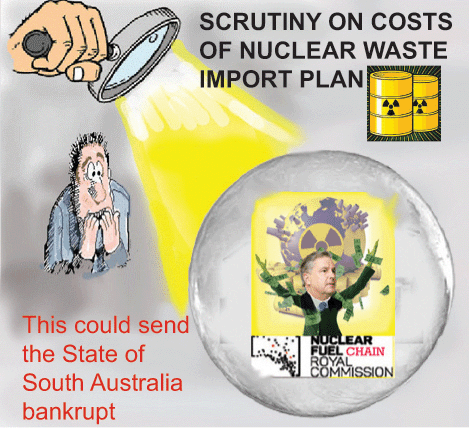
And there is plenty of public opposition: a protest rally in Adelaide on October 15 attracted 3,000 people; Aboriginal Traditional Owners are overwhelmingly opposed to the nuclear waste plan and are fighting hard to stop it; trade unions and churches are speaking out in opposition; and the SA Liberal Party is hedging its bets by pointing to the huge upfront costs (estimated at between $600 million and $2.4 billion) that the state would need to gamble before any income was generated.
Local nuclear jurors prepare report, Port Lincoln Times Jarrad Delaney 2 Nov 2016,Port Lincoln residents involved in the nuclear Citizen’s Jury are on the home straight as they work together on a final report on the issue of storing nuclear waste in South Australia. The jurors met for their third and fourth days in Adelaide this past weekend where they heard from witnesses who provided information on the issue.
Local man Gregory Miller, who is one of the jurors, got to speak with several Port Lincoln residents before heading to Adelaide for this session.
He said although he didn’t hear from as many people as he thought he would, the overall feeling was against the notion of nuclear waste in South Australia.
“The impression I get is they’re dead set against the idea,” he said.
Mr Miller said he felt people were more willing to open up to him and other local jurors because they knew they were from the community and weren’t from the government.
Bias of SA Nuclear Royal Commission finally exposed, REneweconomy, By Jim Green on 4 November 2016 “………The Royal Commissioner, retired Rear Admiral Kevin Scarce, denied claims of a conflict of interest. He told the ABC: “The conflict of interest would arise if they [Jacobs MCM] were the only source of information that we were using to assess the evaluation. They were not.”
Scarce’s claim is false. As Prof. Barbara Pocock, an economist at the University of South Australia, told the ABC: “All the economists who have replied to the analysis in that report have been critical of the fact that it is a ‘one quote’ situation. We haven’t got a critical analysis, we haven’t got a peer review of the analysis”.
Another South Australian economist, Prof. Richard Blandy from Adelaide University, said last week: “The forecast profitability of the proposed nuclear dump rests on highly optimistic assumptions. Such a dump could easily lose money instead of being a bonanza.” Blandy contributed a submission to the Royal Commission but was not invited to speak at the Commission’s public hearings.
SA Conservation Council CEO Craig Wilkins said that asking pro-nuclear advocates to provide “independent” advice was “like asking the crew of the Sea Shepherd to provide an independent review of whaling in the Antarctic.”
The Jacobs MCM report estimated that the total costs associated with the project would amount to a whopping $145 billion. And while some allowance is made for cost overruns, both Jacobs MCM and the Royal Commission glossed over massive cost overruns evident overseas. Estimates of the clean-up costs for a range of (civil and military) UK nuclear sites have nearly doubled over the past decade. Estimates of the cost of a building a deep underground nuclear waste dump in France have nearly doubled over the past decade.
And between 2001 and 2008, the estimated cost of constructing the Yucca Mountain nuclear waste dump in the US and operating it for 150 years increased by 67 percent. The Yucca Mountain project was abandoned by the Obama administration, so the US wasted A$17.8 billion on a failed repository project.
The Jacobs MCM report is honest enough to state that many of its assumptions are highly speculative; for example, no-one knows which countries might want to off-load their nuclear waste to South Australia or how much they might be willing to pay. But the speculative nature of its findings was downplayed in the Royal Commission’s report and has been largely ignored by the SA government and its Nuclear Consultation and Response Agency.
The Australia Institute crunched the numbers presented in the Royal Commission’s interim report and wrote a detailed rebuttal. Kevin Scarce responded on ABC radio on 31 March 2016, saying that the Royal Commission would “take apart” the Australia Institute’s report “piece by piece”. When asked if such an aggressive attitude was appropriate, Scarce said: “I’m a military officer, what would you expect?” …….
Before his appointment as the Royal Commissioner, Kevin Scarce said little about nuclear issues but what he did say should have excluded him from consideration. Speaking in November 2014 at a Flinders University guest lecture, Scarce acknowledged being an “an advocate for a nuclear industry”. Just four months later, after his appointment as the Royal Commissioner, he said the exact opposite: “I have not been an advocate and never have been an advocate of the nuclear industry.”
Other than generalisations, and his acknowledgement that he is a nuclear advocate, Scarce’s only comment of substance on nuclear issues in his 2014 lecture was to claim that work is “well underway” on a compact fusion reactor “small enough to fit in a truck”, that it “may be less than a decade away” and could produce power “without the risk of Fukushima-style meltdowns.” Had he done just a little research, Scarce would have learnt that Lockheed Martin’s claims about its proposed compact fusion reactor were met with universal scepticism and ridicule by scientists and even by nuclear industry bodies.
So the SA government appointed Scarce as Royal Commissioner despite knowing that he is a nuclear advocate who has uncritically promoted discredited claims by the nuclear industry. Scarce appointed an Expert Advisory Committee. Despite claimingthat he was conducting a “balanced” Royal Commission, he appointed three nuclear advocates to the Committee and just one critic. There wasn’t even a single, token critic on the staff of the Royal Commission.
More recently, the SA government’s Nuclear Consultation and Response Agency is conducting a thinly-veiled state-wide promotional exercise under the guise of ‘consultation’ and the Agency doesn’t have even a single, token nuclear critic to provide any balance to its nuclear advocates………http://reneweconomy.com.au/bias-sa-nuclear-royal-commission-finally-exposed-57819/
The danger here is that the Nuclear Citizens’ Jury is being presented as a neutral process, when in reality it is designed to manufacture the outcome the Premier wants.
The question the jurors have been asked to answer is a leading one. As one juror put it to me: “This is a ‘yes’ question.”
the purpose of the amber can only be one: to nudge jurors towards the middle-of-the-road option: the “yes but”. That is, the “proceed with caution” desired by the Premier.
why call it a jury? Why not call it a “focus group” or a “citizens’ inquiry”? Because “jury” appeals to our notions of citizenship and predisposes participants towards trust and good faith. “Jury” implies a trusted verdict.
this process is arguably the most sophisticated illustration of manufacturing consent in the history of South Australia.
Manufacturing consent for SA’s nuclear programwww.crikey.com.au/2016/11/03/manufacturing-consent-for-sa-nuclear-program/The SA government has turned to a “citizen’s jury” to manufacture trust in its nuclear policy. But the process is far from independent, writes University of Adelaide politics lecturerBenito Cao.
This weekend the Nuclear Citizens’ Jury is expected to deliver a report to South Australian Premier Jay Weatherill that will shape the future of the nuclear industry in this country. But although the jury is presented as a non-partisan body able to make a decision in the state’s best interest, the Premier has designed it so it will return the result he wants.
The jury has been asked to answer this question: “Under what circumstances, if any, should South Australia pursue the storage and disposal of high level nuclear waste from other countries?”
If, as expected by the Premier, the report recommends to “proceed with caution“, the South Australian government will feel legitimised to embark on the gradual expansion of the nuclear industry in the state. The answer, however, will have implications for the whole of Australia.
The Nuclear Citizens’ Jury was established as the centrepiece of the community consultation instituted by Weatherill. In his opening address to the Citizens’ Jury on day one, the Premier presented the jury’s work as “a contribution to democracy” and “a better way of citizens coming together and answering complicated questions”.
However, his words also reveal what is at the heart of this matter: trust. The Premier has said that the Citizens’ Jury was set up because people don’t trust government, and that an independent process was needed to address the complex and contentious issue that is the potential expansion of the nuclear industry in South Australia. Continue reading →
Conservation SA sounds alarm on nuclear dump lobbyists exposé, Impress Media, 03 November 2016 Conservation SA is alarmed by revelations that “independent” advice for the Royal Commission that has recommended a nuclear waste dump for SA was provided by long-time advocates for the dump. ……
Conservation SA CEO Craig Wilkins said pro-nuclear advocates providing “independent” advice was a clear conflict of interest. “It’s like asking the crew of the Sea Shepherd to provide an independent review of whaling in the Antarctic,” he said.
“The Nuclear Fuel Cycle Royal Commission has described the Jacobs MCM report as an independent, technical analysis of the business case for a high level waste dump.
“However these revelations cast a dark shadow on the alleged independence of the advice provided to the Royal Commission upon which the entire business case for the nuclear waste dump rests.
“The Royal Commission report’s bullish predictions of decades of super-profits from a global nuclear waste dump in SA must now by viewed in the light that it was informed by pro-nuclear boosters.
“We, the people of SA, have been duped. These revelations raise serious doubts about the quality and integrity of the Royal Commission findings and reveal a gaping flaw in its business case.”
Conservation SA (Conservation Council of South Australia) is SA’s peak environment organisation which represents more than 90,000 people from 60 environment related community groups in SA.
Mr. Wilkins said two of the Jacobs MCM report co-authors, Charles McCombie and Neil Chapman, have advocated for a nuclear waste dump since the 1990s, when they were involved in a company called Pangea Resources Australia Pty Ltd. “After that went pear-shaped, the Pangea team re-formed as ARIUS, an advocacy group for underground storage of nuclear waste,” he said.
“Mr McCombie and Mr Chapman now run the Swiss-based consultancy MCM, which specialises in radioactive waste management. The revelation that the President and Vice President of ARIUS were two of the lead authors of the Jacobs MCM modelling for the Royal Commission brings into question the value of that modelling.
“Why did the Royal Commission claim their input was independent when it clearly wasn’t, and why was it considered appropriate to base the Royal Commission findings on this single business case developed by these industry advocates?”
“Such a dump could easily lose money instead of being a bonanza.”
Critics argue Nuclear Fuel Cycle Royal Commission skewed by advocacy group’s evidence, ABC 3 Nov 16 by Stephen Long “…….Claims that building a radioactive waste dump would give a massive boost to the South Australian economy rely on a report co-authored by members of an advocacy group for international nuclear storage “solutions”.
A royal commission into the nuclear fuel cycle has urged South Australia to develop a facility for the disposal of international used nuclear fuel and waste, arguing it could provide “significant and enduring economic benefits to the South Australian community”.
It based its finding on a “viability analysis” conducted for the commission that found that a nuclear waste dump could “generate more than $100 billion income in excess of expenditure” over the life of the project, or a $51 billion benefit in today’s dollars.
That analysis was co-authored by Charles McCombie and Mr Neil Chapman, the president and vice president of ARIUS, the Association for Regional and International Underground Storage. The association’s role is to “promote concepts … for storage and disposal of long-lived radioactive wastes” and to “act as an advocate for international and regional storage and disposal options”.
Its motto is: “The world needs nuclear power — nuclear power needs multinational facilities”.
As well as co-authoring the viability analysis, Dr McCombie and Mr Chapman wrote the safety analysis that the royal commission relied upon.
Advocates’ advice tainted analysis: critics
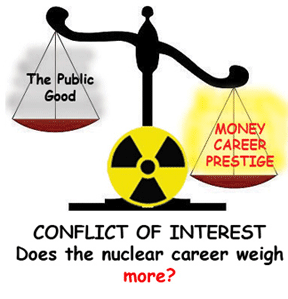
Critics argue that using leading members of an advocacy group to assess the viability and economic benefits of building a nuclear waste dump gives rise to a clear conflict of interest and taints the analysis.
“I think it is really disappointing and I think Australians should be asking fundamental questions about the independence of the economic analysis on which this entire case, on which this entire royal commission, rests,” Barbara Pocock, an economist and research professor at the University of South Australia, told the ABC.
Professor Pocock, who is a member of Mothers for a Sustainable South Australia, said the royal commission appeared to rely entirely on the “viability analysis” for its recommendation of a nuclear waste facility.
“All the economists who have replied to the analysis in that report have been critical of the fact that it is a ‘one quote’ situation.
“We haven’t got a critical analysis, we haven’t got a peer review of the analysis, which appears to have come from an interested source,” she said……..
Its modelling assumes that South Australia will receive $1.75 million per tonne for taking spent nuclear fuel and intermediate radioactive waste and command half the available market, though it says it would still be viable with a lower price and market share.
Critics describe the price forecasts as heroic, and the assumption that the forecast price would not bring rival facilities into market as puzzling.
“The forecast profitability of the proposed nuclear dump rests on highly optimistic assumptions,” Richard Blandy, professor of economics at the University of Adelaide, told the citizens’ jury last week.
Bias of SA Nuclear Royal Commission finally exposed, REneweconomy, By Jim Green on 4 November 2016 “……….Given the make-up of the Royal Commission, it came as no surprise that numerous questionable claims by the nuclear industry were repeated in the Royal Commission’s report released in May 2016. Critical analyses of the Royal Commission’s findings are posted online. Suffice it here to mention one example here. The Commission’s main recommendation was to import 138,000 tonnes of high level nuclear waste for disposal in a deep geological repository. Yet the Commission’s report only offered a few sentences on the world’s one and only deep geological repository ‒ the Waste Isolation Pilot Plan (WIPP) in the US, shut down since 2014 because of a chemical explosion in an underground nuclear waste barrel.
Kevin Scarce said that WIPP received little attention because it involved different waste forms (long-lived intermediate level waste). But the high level nuclear waste that he wants South Australia to import is vastly more hazardous than the waste managed at WIPP, so Scarce’s argument is disingenuous.
While completely ignoring the world’s one and only existing deep underground nuclear waste dump, the Royal Commission’s report went into detail about deep underground repositories under construction in Finland and Sweden. According to the Royal Commission’s report, those two countries “have successfully developed long-term domestic solutions” for nuclear waste. But in fact, neither country has completed construction of a repository let alone demonstrated safe operation over any length of time.
The Royal Commission also had little to say about failed repository projects. Incredibly, the Royal Commission ‒ and now the SA government ‒ want to import many thousands of tonnes of nuclear waste before construction of a repository even begins, and 50,000 tonnes of high level waste before a repository begins accepting waste. What if it proves impossible to build a repository for one reason or another ‒ as has the been the case in many countries around the world? There is no Plan B………http://reneweconomy.com.au/bias-sa-nuclear-royal-commission-finally-exposed-57819/
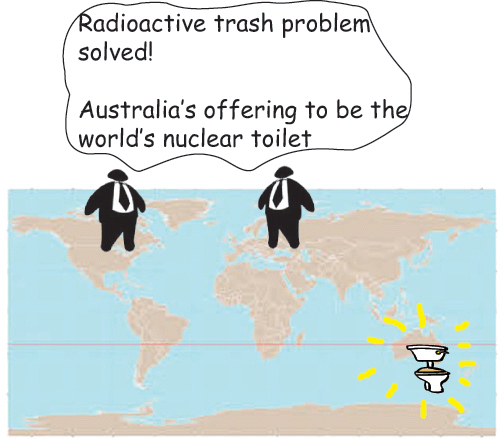
So – the Australian public dreams on – preoccupied with the Melbourne Cup and other sporting events. And the global nuclear lobby continues its machinations. It would be such a strong selling point, to be able to tell South Asian countries that they can go ahead with nuclear power, as Australia will take out the radioactive trash
Australia has been pretty much of a forgotten player in the global nuclear “renaissance”. Not any more. The big nuclear players – USA, Russia, Canada, France, China , Japan South Korea are busily marketing nuclear technology to every other country that they can. Strangely enough little ole non-nuclear Australia, (population 23 million) has a starring role to play in all this.
You see, the global nuclear lobby’s problem is – what to do with the radioactive wastes? I know that the new geewhiz guys and gals are pushing hard for Generation IV reactors that will “eat the wastes”. The trouble is – there is an awful lot of the stuff. World total of high level radioactive wastes was estimated at 250,000 tonnes in 2010 . There must be quite a bit more by now. The other trouble is that even the most geewhiz of the as yet non- existent Gen IV nuclear reactors still would leave a smaller but highly toxic volume of radioactive trash, which would still require disposal.
This leads to a serious marketing issue. If countries such as USA, Japan, Canada, South Korea, are still having trouble dealing with their own domestic accumulation of nuclear waste, how can they persuasively sell nuclear reactors to Asian, Middle Eastern and African countries? The waste problem must be solved!
The wizards of the global nuclear lobby have come up with what they see as the perfect answer. A far away land, with lots of space that’s owned by “unimportant” indigenous people, could import the wastes, and thus remove the problem. It’s a sort of variant on the old “toilet way down the back”. Continue reading →
Jim Green, 3 Nov 16 No High Level International Nuclear Waste Dump in South Australia
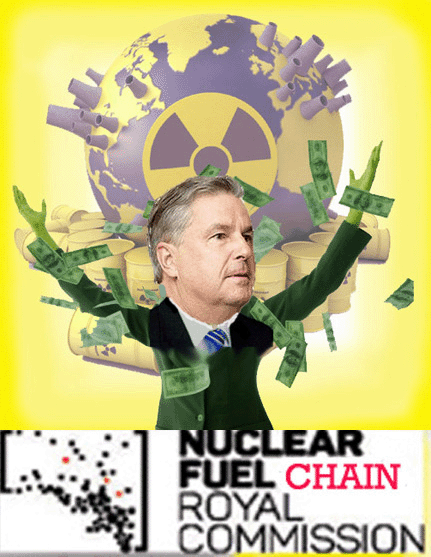
The Nuclear Royal Commission was a disgraceful con-job from start to finish.
The SA government chose a nuclear advocate as Royal Commissioner.
The Royal Commissioner stacked his Advisory Committee with three strident nuclear advocates, ‘balanced’ by one token critic.
There wasn’t even one token nuclear critic on the Royal Commission’s staff.
And there isn’t even one token nuclear critic on the SA government’s Consultation & Response Agency which has been exerting influence on the Citizens’ Jury, and which also has strong influence over the statewide ‘consultation’ process (thinly-disguised promotion).
This morning the ABC reveals that the economic modelling commissioned by the Royal Commission was co-authored by the president and vice president of a group which aims to promote nuclear waste “solutions” and which also promotes nuclear power. A clear conflict of interest and an absolute disgrace. (www.abc.net.au/am/content/2016/s4568141.htm)
Royal Commissioner Kevin Scarce told the ABC this morning:
“The conflict of interest would arise if they were the only source of information that we were using to assess the evaluation. They were not.”
Really? In fact, only one, conflicted consultant was used by the Royal Commission for economic modelling. The fanciful speculation of the conflicted consultant was heavily promoted in the Royal Commission’s report and is now being promoted as solid, factual information by the government’s Consultation & Response Agency.
THERE NEEDS TO BE A ROYAL COMMISSION TO INVESTIGATE THE ROYAL COMMISSION.
For a serious discussion on the economics of the plan to turn SA into the world’s high-level nuclear waste dump, see this submission from Prof. Richard Blandy: http://nuclearrc.sa.gov.au/…/upl…/2016/04/Blandy-Richard.pdf
And see also the report by the Australia Institute: http://www.tai.org.au/…/P222A%20Digging%20for%20answers%20-…
Tim Bickmore Nuclear Citizens Jury Watch South Australia 2 Nov 16
There will be a ‘Minority Report’ & this is being actively collated by a designated juror who volunteered for the task. It’s focus will probably be upon alternate projects which would enhance the SA Great brand & demonstrate better options for the future direction of the SA economy.
Nov 2 snippet “I felt that the idea of a nuclear waste dump was a stepping stone in acquiring a nuclear reactor and the bogey man appeared straight away after the mood of the jury had been felt. I wondered why certain people were so keen to establish the waste site it would have been better to be upfront with everyone and declare their intentions we are aware of the tactics used.”
… “Re changing the legislation
The advice we were given at the table was that the legislation does not prohibit the next stages of investigation that are needed to fill the gaps identified in the extremely dubious case for this project. But even if they did this legislation applies only to spending public funds. If this project is such a financial bonanza as some proponents keep insisting it is then maybe the industry should fund the next stage of the feasibility study – and there is absolutely no barrier to spending industry rather than public funds to do this .
One juror gave me the question I’ve been searching for in all of this: Would you want to invest your superannuation funds in this project? If so please feel free to do so – I wouldn’t and I suspect most people with any financial nous (or sense of financial responsibility) wouldn’t either.” Australia https://www.facebook.com/groups/1172938779440750/
Jim Green, Facebook, 31 Oct 16Numerous train derailments involving nuclear materials transport have been documented (but not in the Royal Commission’s report, of course).
Transport incidents and accidents are routine in countries with significant nuclear industries. For example a UK government database contains information on 1018 events from 1958 to 2011 (an average of 19 incidents each year). There were 187 events during the shipment of spent nuclear fuel flasks from 1958−2004 in the UK (an average of four per year) – 46% involved excess contamination and 24% involved collisions and/or low speed derailments.
The South Australian government set up this site for comments on the plan. Comments close at 5 pm today (30 October). I wonder if the Citizens Jury members will have managed to see them – the vast majority of comments were very negative about the plan Here are some of the most recent:
Claudio Pompili 28 Oct 2016
I was shocked to read in 26 October’s InDaily: Jay spruiks nuclear expansion as an agent of economic change
Jay Weatherill has told a nuclear industry forum in Adelaide he is personally convinced of the potential for an expansion of South Australia’s role in the fuel cycle, framing the push as part of his ambition to forge a “new economy”.
It appears that Premiere Weatherill has at last come out and played his pro-nuke card. So much for his publicly-avowed position that he would make up his mind when the whole process of the RC has been undertaken. It’s patently clear that he’s been captured by the nuclear industry and foisted an expensive sham of a royal commission onto the SA public, which overwhelmingly has repeatedly been opposed to expansion of nuclear in this state.
The Royal Commission process and the biased ‘findings’ of its subsequent Report are deeply flawed on a range of issues from the dubious economics right through to the non-existent risk assessment. No project of this magnitude, scope, cost and risks into the far-distant future, should be entertained without a comprehensive Risk Assessment Plan. The Report does not meet the criterion in the Terms of Reference to present “the risks and opportunities associated with establishing and operating those facilities” It does present the supposed opportunities but dismisses the risks and assures us that risk assessments will be done in due course. Continue reading →
Noel Wauchope 30 Oct 2016 I trust that the Nuclear Citizens’ jury has noted the fact that there are only two situations under which any commercial nuclear reactor could ever be built.
The first is the situation for democracies , such as the United States. They set the pattern by passing the Price Anderson Act, ensuring that the tax-payer would cover the monumental costs of any serious accident.
The second is for totalitarian states such as China and Russia. Here the taxpayer pays for the whole lot, from nuclear construction to waste disposal.
If South Australia is foolish enough to set up a waste import and disposal industry, South Australia will be following the Russian and Chinese examples. Not being a private enterprise job, I guess they won’t need a Price Anderson Act. I do hope that the Citizens’ Jury members are aware of this.
Apr 15, 2026 01:00 AM in Canberra, Melbourne, Sydney
Join the International Physicians for the Prevention of Nuclear War (IPPNW) on Tuesday, April 14th for a timely webinar exploring the risks associated with nuclear power and challenging the myth that it offers a simple, safe, carbon-free solution to the climate crisis
21 April Webinar: No Nuclear Weapons in Australia
Start: 2026-04-21 18:00:00 UTC Canberra, Melbourne, Sydney (GMT+10:00)
End: 2026-04-21 19:30:00 UTC Canberra, Melbourne, Sydney (GMT+10:00)
Event Type: Virtual A virtual link will be communicated before the event.









 Antinuclear
I was shocked to read in 26 October’s InDaily:
Jay spruiks nuclear expansion as an agent of economic change
Jay Weatherill has told a nuclear industry forum in Adelaide he is personally convinced of the potential for an expansion of South Australia’s role in the fuel cycle, framing the push as part of his ambition to forge a “new economy”.
It appears that Premiere Weatherill has at last come out and played his pro-nuke card. So much for his publicly-avowed position that he would make up his mind when the whole process of the RC has been undertaken. It’s patently clear that he’s been captured by the nuclear industry and foisted an expensive sham of a royal commission onto the SA public, which overwhelmingly has repeatedly been opposed to expansion of nuclear in this state.
The Royal Commission process and the biased ‘findings’ of its subsequent Report are deeply flawed on a range of issues from the dubious economics right through to the non-existent risk assessment. No project of this magnitude, scope, cost and risks into the far-distant future, should be entertained without a comprehensive Risk Assessment Plan. The Report does not meet the criterion in the Terms of Reference to present “the risks and opportunities associated with establishing and operating those facilities” It does present the supposed opportunities but dismisses the risks and assures us that risk assessments will be done in due course. Continue reading →