Royal Commission silent on dangers of nuclear transport and security required
 Peter Mahoney, Your Say site 17 Oct 2016 The Royal Commission report appears to be silent on the details of how these radioactive materials would be transported to South Australia, and what sort of defence force support would be required to ensure that they are not the subject of terrorist attack. Who would be responsible for ensuring that they are correctly and securely sealed in their containers in the country of origin, say India or Pakistan? How would an SA facility ensure that proper standards are being followed at every step. The consequences of undetected, small or slow leaks would be enormous if they occur all the way from the country of origin, across the oceans and then across the land to SA.
Plan for nuclear above-ground waste facility, before contracts, and with no lndependent Nuclear Regulator
 Malgo Schmidt, from Your Say site 16 Oct 2016 “……..There is no independent Nuclear Regulator in Australia and SA has a conflict of interest
The current Federal nuclear regulator would requiré legislative amendments before it could claim to ‘regulate’ lnternational nuclear wastes. SA is disqualified from doing so by clear conflict of interest’
This senate can block any nuclear dump legislation up to the next Federal Election ALP, Greens and the Xenophon team can together block any pro-dump legislation in the senate
Four key themes in community concern over international nuclear waste dumping:
It is quite clear that there are 4 key concerns that have to be dealt with collectively. Failure to pass any of these tests should stop further consideration of a Nuclear Dump. They are:
1. safety of workers and community throughout the nuclear waste supply chain.
2. Flawed Economic assumptions
3. Aboriginal veto
4. Environmental and inter-generational concerns, risks and impacts
Safety is compromised by import of nuclear waste long before any disposal capacity
The Nuclear Commission proposed import of nuclear waste in Project Year 11′ four years ahead of an agreed licensed disposal site and some 16 years ahead of any potential waste disposal capacity
SA faces the threat of a Nuclear port receiving nuclear waste ships every month for decades
Reality check analysis shows there is No Profit in Nuclear waste
South Australians are being misled by inflated revenue claims, untenable assumptions including globally unprecedented scale of dump plans and under reported nuclear waste costs & liabilities’
Nuclear dump plans are prone to fail- like Yucca Mountain in the USA, and end in debt not profit.
Future generations – importing international nuclear waste is an irrevocable decision
The nuclear waste would be here forever and remain dangerous for hundreds of thousands of years’ our children will have no say in this decision hgt be left with this liability into the future ‘
The Campaign needs to mobilise mainstream community to oppose nuclear waste dumps
Countering the Premier’s nuclear waste agenda requires mobilising SA community’ working through the steps in who? when? where? and How? to engage groups across society on these issues’
We can all contribute to protect SA from nuclear dumping and build strength in our community’ For further info see: www.foe.org.au/import-waste & http://www.nodumpalliance.org.au/
Witnesses recommended for the next Citizens’ Jury on Nuclear Waste Importing, South Australia
 This is a full list of witnesses chosen by the Nuclear Citizens’ Jury on October 9th and invited to be witnesses for the next Nuclear Citizens’ Jury on 29 October.
Here I have endeavoured to shed light on the likely evidence of each, according to the following code :
GREEN = Anti-nuclear waste dumping , Yellow – doubtful on waste importing. ORANGE=Neutral – Uncertain, about waste dumping, BLACK = I don’t know, PINK = probably pro waste dumping , RED = Pro nuclear waste dumping
- I ran into a spot of bother with the many Aboriginals recommended. As far as I can tell, they are all opposed to importing nuclear waste, except Parry Agius . Some of the most prominent Aboriginal persons are: Kevin Buzzacott, Karina Lester, Rose Lester, Vivienne McKenzie, Enice Marsh.
- Some pro nuclear people might be opposed to the dump plan, so I put those in pink.
 Nuclear Citizens Jury Two: Witness work
WITNESSES CHOSEN BY JURY AND INVITED FOR THE 29th
No List Ref Name Votes Theme
1 123 Richard Dennis 96 Economics
2 121 Professor Richard Blandy 54 Economics
3 128 Professor Barbara Pocock 45 Economics
4 179 Professor Brian Cox 45 Safety
5 166 Hon Nick Xenophon 44 Trust
6 56 Paddy Crumlin 34 Safety
7 1 Timo Aikas 34 Safety
8 4 Professor Rodney Ewing 31 Safety
9 168 Dr Karl Kruszelnicki 30 Safety
10 116 Dr Simon Longstaff 29 Trust
11 5 Robert J Halstead 27 Safety
12 19 Dr Jim Green 25 Safety
13 9 Dr Carl Magnus‐Larsson 25 Safety
14 162 Ian Hore‐Lacy 22 Economics
15 49 Professor Tilman Ruff, AM 22 Safety
16 53 Frank Boulton 21 Safety
17 188 Someone from the Attorney Generals Department to provide advice on the legislation that will be required to be developed/changed. DemocracyCo seeking advice on who. Trust
18 124 Assoc. Professor Mark Diesendorf 20 Economics
19 7 Dr Andrew Herczeg 20 Safety
20 42 Dr Ian Fairlie 19 Safety
21 137 Hon Mark Parnell, MLC 18 Economics
22 39 Dr Margaret Beavis 18 Safety
23 119 Assoc. Professor Haydon Manning 17 Trust
24 122 John Carlson AM 16 Economics
25 200 Dr Benito Cao 16 Economics
26 18 Professor David Giles 16 Safety
27 115 Steven McIntosh 16 Trust
28 2 Dr Ian Chessell 14 Safety
29 34 Professor Sandy Steacy 14 Safety
30 69 Gill McFadyen 11 Consent
31 74 Dave Sweeney 10 Consent
32 104 Bob Watts 9 Consent
33 76 Ross Womersley 8 Consent
34 72 Dr Gerald Ouzounian 7 Consent
35 73 Dan Spencer 6 Consent
36 126 Tim Johnson 7 Economics Invited to provide info on the Royal Commission economic modelling after 20+ requests on Information Gap Cards Dotmocracy Results ‐ 25 plus a few extras to allow for availability Top 6 from Consent ‐ as Gill is unavailable.
Nuclear Citizens Jury Two: Witness work
ABORIGINAL WITNESSES ALREADY INVITED ON THE 29TH Continue reading
More safety problems in canisters for storing nuclear wastes
Premature failure of U.S. spent nuclear fuel storage canisters, San Onofre Safety.org, “……Stainless Steel Dry Canister Problems Darrell Dunn, an NRC materials engineer, stated stainless steel dry storage canisters are vulnerable to failure within about 25 – 42 years. If any of the fuel cladding in the canister fails, there is no protective barrier and we could have a serious radiation release.
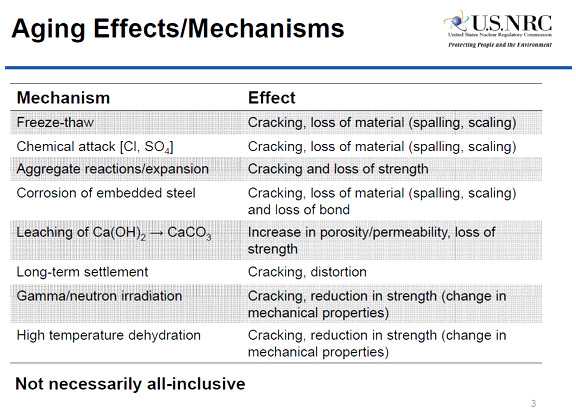
The NRC said they have no current mitigation plan for that consequence. They suggested we MIGHT be able to put the fuel back in the spent fuel pool. However, Edison plans to destroy the spent fuel and transfer pools. And there is no technology to repair the canisters. The NRC said they HOPE there will be a solution for mitigation in the future. Even an NRC May 2nd High Burnup Fuel letter admits there are mitigation problems.
No Inspections of Stainless Steel Canisters EPRI 2012 presentation To make matters worse, these stainless steel canisters are not inspected after they are loaded into the unsealed concrete overpacks (Areva NUHOMS) or concrete casks (Holtec and NAC Magnastor). The NRC proposed having each nuclear plant inspect the outside of only ONE stainless steel canister before they receive a license renewal and then do that once every 5 years. The industry balked at having to even check one canister at every plant. The problem with the stainless steel canisters is they do not protect against gamma rays; so it’s not a simple task to remove a canister from the concrete overpack/cask to examine the exterior for corrosion or other degradation. And since welded canisters do not have monitoring for helium leaks, we may not have any warning of an impending radiation release.
Concrete Overpack Corrosion Problems Darrell Dunn discussed serious corrosion problems with the concrete overpacks/casks, especially in coastal environments…….. https://sanonofresafety.org/2014/08/21/premature-failure-of-u-s-spent-nuclear-fuel-storage-canisters/

Citizens’ Jury members not allowed to change the wording of their set question.
9 Oct 16 Tim Bickmore Some of the Jury Members requested that the form of the question be changed to adjust the term ‘circumstances’ into better context ie the question should be along the lines of …. whether or not to pursue the HLW dump, & if so, under what circumstances…..
They were informed that there would be no change to the question. This calls into question any claims that the Jury is in Charge of the process.
The set question is “Under what circumstances, if any, could South Australia pursue the opportunity to store and dispose of nuclear waste from other countries?”
Monitoring South Australia’s Nuclear Citizens’ Jury
 I have not been watching today’s Citizens’ Jury Two Livestreaming and Video. However, these sessions are available for viewing. I saw at the agenda – See the agenda here – that the gathering was to be opened by Premier Jay Weatherill, and Kevin Scarce, former chief of the Nuclear Fuel Chain Royal Commission.
Unlike may other critics of the nuclear industry, I have some faith in the process. I did think that DemocracyCo ran the first Citizens’ Jury meetings well, and the jury members asked intelligent questions. The problems were:
- The whole premise was not really a jury situation in any sense. The jury were told that they were not to make a decision (the essential brief of any real jury). They were told to produce a ‘Summary of the Nuclear Fuel cycle Royal Commission’s Report.
- The witnesses were not always well informed, and some were both ignorant and biased. They were chosen at an early stage by the jury members, who clearly did not then have access to impartial and well informed experts.
- Members of the Nuclear Fuel Chain Royal Commission were far too prominently present and vocal. Greg War and Chad Jacobi made sure to dazzle all with their pro nuclear knowledge, whenever it looked as if criticism of the nuclear industry was coming up.
This new Citizens’ Jury has been given a loaded question to consider:
“Under what circumstances, if any, could South Australia pursue the opportunity to store and dispose of nuclear waste from other countries?”
So – much as I admire DemocracyCo’s the group management efforts, and real attempts at fairness, I am not optimistic about the outcome of this Citizens’ Jury 2. I think it will boil down to another delaying tactic by the Weatherill government, to keep the State guessing – while behind the scenes, the nuclear lobby gets on with its preparations for nuclear waste importing to south Australia.
8 – 9 October – Nuclear Citizens Jury 2, Adelaide: LOOK OUT FOR THE WITNESS LIST
I say “Look out for the witness list, because for citizens’ jury 1, the big weakness was in 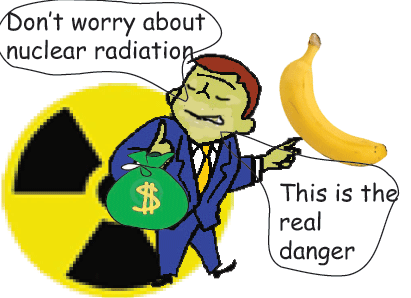 the witnesses – some of whom were clearly ignorant and biaseed. This was particularly apparent in the appalling way they covered (up) the question of ionising radiation and health.
October 8th and 9th Citizens’ Jury Two Livestreaming and Video
See the agenda here. Note these two important sections on Sunday 9th:
3.45pm Working afternoon tea – witness selection
4.15pm Defining the witness list
Citizens’ Jury Two will be held over two weekends in October and one weekend in November. The original 50 members of Citizens’ Jury One will be supplemented by an additional 300 South Australians to answer the question: Under what circumstances, if any, could South Australia pursue the opportunity to store and dispose of nuclear waste from other countries?
The Jury will deliberate on the question using both the Nuclear Fuel Cycle Royal Commission Report and first Citizens’ Jury report, with feedback from the community consultation and expert witnesses also used as important inputs.
The unedited and unchanged jury report will be presented to the Premier and tabled in the South Australian Parliament. The report will play a vital role in informing the State Government’s response to the Royal Commission’s Report later this year.
Dates for Citizens’ Jury Two are 8/9 October, 29/30 October, 5/6 November 2016.
Should Australia invest in importing nuclear waste, with nuclear industry in decline?
 In summary, the branding of nuclear as ‘green’ is fallacious
To invest in an industry that is in global decline, does not appear to be as rational as investing in a growth area such as renewable energy. Renewable energy is a business space where Australia has a multitude of trained engineers, existing infrastructure, and an abundance of sunshine. Building intentional renewable overcapacity in Australia will potentially be a wise investment, as that surplus can then be used to generate hydrogen or other fuels that can be liquefied and traded on overseas markets.
Nuclear power – Game over – Derek Abbott, October 2016, “……..Renewables vs. nuclear While nuclear power plants experience economic decline, renewables are rapidly growing and penetrating the market on an exponential curve. The global annual increase in renewable generation for 2015 alone was 50 GW for solar panels, 63 GW for wind power, and 28 GW for hydropower.26
Nuclear power is large and centralised, with enormous entry and exit costs. By contrast, renewables are made up of small modular units that yield a faster return on investment. The revolution we are witnessing is akin to the extinction of big powerful dinosaurs versus resilient swarms of small ants working in cooperation.
Nuclear power is sinking under the weight of its complexity, costs, and the headache of its waste issue. On the other hand solar power is brought to us via free sunshine exposing the promises of nuclear as mere moonshine………
What really matters is rate of carbon footprint reduction Continue reading
Long delay for money in for South Australia’s Temporary Nuclear Waste Storage facility
David Salomon, Nuclear Fuel Cycle Watch South Australia, 30 Sept 16
At any election during this time approval for the project could be overturned by either state or federal governments as happened with the Yucca Mountain Repository in the USA after being approved in 2002 and funding withdrawn in 2011. Were there to be another Chernobyl or Fukushima that leads to shut down of existing nuclear power stations the demand for the waste facility would be restricted to existing not projected waste. The business plan fall apart.
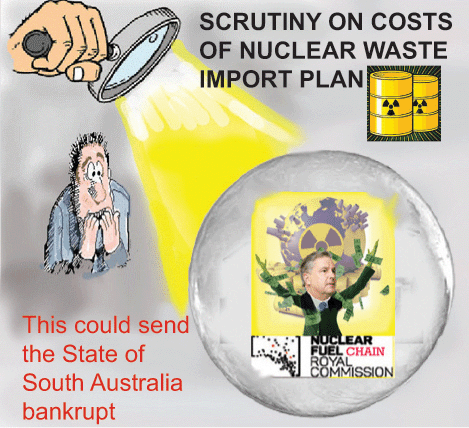
The fact that the only new reactors are planned by non market economy countries. Business seems not to be interested in building new power plants without massive public subsidy. In the UK this means guaranteeing double the market price for the power supplied. You need very deep pockets to be engaged in the nuclear industry. Could it be that South Australia is in danger of exhausting itself financially and politically on going for the one big prise on the horizon that is actually a mirage when you get closer. We do have a history of doing that in the past. Would it not make better business sense to invest in renewables and ride that wave for the next 25 years or so, or is it that we can see what is right in front of us. We are already at 40% renewables, a manufacturing workforce itching for something to do and in need of greater independence in power supply.
I know that there are people who think about renewables like Bill Gates did in the early days of the internet when he said, “the internet was a novelty that would give way to something better”, though I do believe this sentiment does apply to the waste dump proposal. (BTW I don’t know if Bill likes renewables or what his attitude to Nuclear fuel is, just that people of high status can say some dumb things.)
Check out the outgoings references in this report: https://antinuclear.net/2016/05/06/major-financial-risks-for-south-australia-are-ignored-by-nuclear-fuel-cycle-royal-commission/
I think you’ll find the financial analysis in the Royal Commission somewhat lacking. https://www.facebook.com/groups/1021186047913052/
Risky plan for thousands of shiploads of radioactive trash to South Australia
Derek Abbott, No High Level Nuclear Waste Dump in South Australia, 27 Sept 16, To fulfil the economic analysis of the Royal Commission report, SA’s dump will have to receive a shipload of
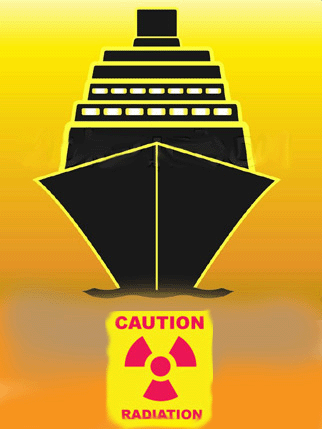 waste once every THREE weeks for the life time of the dump.
Hmmmm…..
I think the Commission hasn’t thought through how unrealistic that workflow will be to manage and how many double hulled ships will have to be purpose built for this. They haven’t thought through how many contract guarantees they are going to need to get that kind of volume. They haven’t thought through the tendency of the nuclear industry to defer costs, and possibly renege on those contracts.
When they don’t even have the sniff of even one contract yet, this is all highly risky. https://www.facebook.com/groups/1314655315214929/
Unpleasant consequences for Australia in setting up international nuclear waste dump?
Paul Richards No High Level International Nuclear Waste Dump in South Australia 17 Sept 16
 What are the probabilities this futurist scenario will unfold via TPP international treaties, setting up a nuclear industry here in Australia controlled by the United States?
1) Strip out State & Federal legislation prohibiting a nuclear industry
2) Legislate to allow US & foreign nuclear submarines to port
3) French Sf/Barracuda sub diesels drive swapped out for reactors
4) Stakeholders in sub reactors to train nuclear engineers
5) Sovereign Capital to fund waste repository and enrichment plant
6) Enrichment plant built next to waste storage [for the world’s unspent fuel including plutonium & weapons grade nuclear material]
7) Commission environmental reports for deployment of reactors
8) Fund reprocessing of unused fuel to fire experimental reactors
Be mindful, defunding of cheap alternative energy systems has already started, as the Federal Government has reduced the ARENA budget; while maintaining carbon energy subsidies and encouraging the nuclear industry sales executives to promote their product
A scenario where the acquisition of nuclear weapons is an obvious long-term objective of our government. Where Australia becomes a platform for not our own Foreign Policy or our sovereign interests, but US sovereign interests, deferring to US Foreign Policy
In doing so, becoming the 52 State of the United States of America by proxy for the Southern Hemisphere
Be aware, the UN Security Council P5; China, France, Russia, United Kingdom, United States and the International Atomic Energy Agency – IAEA police all international nuclear treaties on weapons & reactors
The IAEA answers nuclear weapons, energy and health issues only to the UN Security Council P5.
The World Health Organisation-WHO, sit’s below this chain of command. Since it’s inception in 1946 the WHO, has always sat outside the then WWII Allied “Big Four”; China, Soviet Union, the UK, the and the US hierarchical structure.
This information is on public record easily found scanning the United Nations Portal https://www.facebook.com/groups/1314655315214929/
Your Say – comments on the diseconomics of the nuclear waste dump plan
Paul Laris 31 Aug 2016 I am very concerned that SA may be placed at environmental and/or financial risk if the nuclear waste storage project goes ahead. The business case rests on the assumption of continuing demand for storage over several decades. This cannot be assured. If, over that period there is another nuclear power station catastrophe, or the cost of other renewable sources of baseline power falls significantly, then demand for storage, and income, will shrivel. These are both highly plausible scenarios. I note that Germany is committed to closing all nuclear power stations by 2022.
The business case involves temporary surface storage until there is a sufficient accumulation of income to build the very costly underground infrastructure required for safe millenial storage. If demand and income faulters during the next 30 years or so, there is a major risk that we will be left with a large amount of inadequately surface-stored waste – a stranded liability. To leave it that way will be environmentally iresponsible. To store it safely will be financially crippling.
Due dilligence demands we do not proceed to burden our children and suceeding generations with such high levels of risk.
Claire Catt 08 Aug 2016 There is a simple principal question, one needs to ask how a venture relaying on a once off payment of an uncertain amount could be viable when costs are unknown but certainly lasting for thousands of years. How could that ever add up.
I would speculate the money won’t last to actually pay for any underground storage many years hence.
There is certainly no precedent of any Government ever being able to manage a large amount of money responsibly so far into the future. And most certainly not this Government.
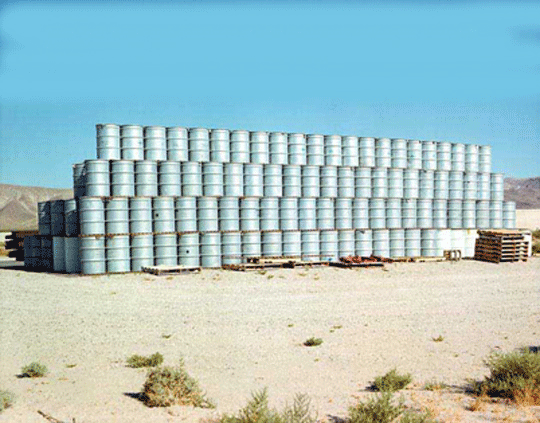 So even to the average person, the economics look shonky. The risks however are crystal clear! Several above ground ‘temporary’ storage sites all over our state for a very very long time to be guarded and somehow kept from all forms of life for thousands of years.
Really, it’s unbelievable our own Government is even thinking about it. Money, even if it was there, doesn’t come into it. The nuclear industry needs to get out of this country and stop spreading their horrendous problems all over this world.
Claire Catt 14 Aug 2016 It is utterly unpredictable what the longterm maintenance and security costs of such a large and dangerous dump would be. All figures in the Royal Commission’ Report are speculative and untested. The optimistic promises of riches reek of bias and manipulation.
There is far more opportunity in South Australia in a clean and green future with a healthy, involved and participating population. We don’t want a dirty secretive industry here which will endanger the longterm well being of us all.
Mary-Ann Lovejoy 29 Aug 2016 The economics of this proposal IMO seem highly speculative. I understand they have not even been costed by someone reputable and independent of ANY bias (pro or con.)
 I understand not even Treasury have been permitted to examine the figures – perhaps Belinda could answer that question definitively? Or tell us if that will happen, before we go any further in the debate of economics?
Nick Xenophon responded to my query on his nuclear position – he replied he did not support this proposal as the “alleged” benefits were outweighed by the potential risk. Given it’s such an important topic for his/our state, I’m sure he will have examined the figures well, prior to his statement of position.
What runs often through my mind, in discussion of nuclear, is the Deepwater Horizon oil disaster off the USA coast, where the technology that was stated to be beyond reproach caused a huge disaster. The costs, (environmental, economic and social) were devastating, and the company responsible did its best to avoid liability for the cleanup. That frightens me, as not only would our state be devastated by such an event (nuclear waste accident, terrorist attack, human error, equipment failure, whatever the cause) , but how could it be cleaned up? Is it even possible to do so? And what of the resultant cost? Surely it would bankrupt our state?
Like Xenophon, I think the benefits are speculative, and the potential risks too great.
I demand a vote of all citizens before this proceeds any further, to test community consent. If there’s not initial consent, how on earth can there be “on-going consent”? important.http://nuclear.yoursay.sa.gov.au/get-invol…/statewide-survey
Your Say. Nuclear Commissioner Kevin Scarce biased: supporter of nuclear waste dumping
Your Say: Nuclear waste deal – stealthy plan to get nuclear submarines?
 Steve Charles 13 Sep 2016 I suggest the real reason behind turning SA into a high level nuclear waste dump is that the SA Government knows that the submarines to be built in Adelaide are already a nuclear design and will need to be converted to diesel, but this is difficult and costly. Perhaps they are wanting to get nuclear submarines by stealth, but will need somewhere to dump the spent fuel. We cannot trust this government. See: http://www.abc.net.au/news/2016-09-13/dick-smith-questions-submarines-project-over-nuclear-power/7837946 important.
http://nuclear.yoursay.sa.gov.au/get-invol…/statewide-survey
Your Say: brand South Australia to be irrevocably smirched by nuclear waste dump
 adrian hill 04 Sep 2016 Safety isnt what we should be worrying about
Our brand is more at risk. We want to be known for our great food and wine. While there is not risk at all the waste will reach anywhere near our food chain, we know the how the media can paint a city. I’m concerned that SA will be rebranded as the waste dump state which could affect our tourism. It wouldnt bother me if we could redraw the boarders so the area is not our state. Could it be an independant state like canberra? Or do we name a town where the dumping will occur and push the name of that town rather than associate with SA….google ‘snowtown important.
http://nuclear.yoursay.sa.gov.au/get-invol…/statewide-survey
1 This month

of the week – Australians for War Powers Reform (AWPR)
To see nuclear-related stories in greater depth and intensity
 Antinuclear