Nuclear Waste Business Plan from Hell – South Australia
Blandy conveyed his objections to the royal commission — which substantially ignored them. Instead, the commission continued putting its trust in Jacobs MCM, which it had engaged to perform its financial modelling.
Jacobs, The Australia Institute notes, “consult extensively to the nuclear industry and have an interest in its expansion and continuation”
Nuclear waste dump case unravels, World News Report, 13 July 16 , Green Left By Renfrey Clarke “…….That the environmental and health risks posed by the international waste scheme are alarming and the economics could well be prohibitive are being ignored by the scheme’s supporters.
In its February “tentative findings” and in its May 9 final report, the state government’s royal commission set the hucksters drooling with its view that a high-level waste dump “could generate more than $100 billion income in excess of expenditure over the 120-year life of the project”.
Even this sum was too modest for the Murdoch-owned Adelaide Advertiser as it sought to herd public opinion behind the government’s plans. Working only from revenues and ignoring costs, the newspaper declared on February 17 that “a gigantic $445 billion would be pumped into the state’s finances over at least 70 years”.
The truth is that the economic case for the project rests on such wild assumptions that any competent entrepreneur would view it as a business plan from hell.
Hopes of a monster pay-out were savaged during March when The Australia Institute published a detailed analysis of the waste dump scheme.
Retired professor of economics Richard Blandy, the economic commentator for the Independent Daily, exploded the royal commission’s guesswork still more definitively on June 7.
The figure for net income of $100 billion, Blandy explained, was based on a completely fanciful estimate of the price that South Australia could expect to obtain for storing spent reactor fuel.
To obtain this estimate, of $1.75 million per tonne of heavy metal, the commission had assumed that the South Australian authorities of the future would have perfect knowledge of the maximum price that potential customers were willing to pay and that the state would face no competitors in the waste storage market-place.
The reality, as Blandy pointed out, is that India and China — to name just two countries — have extensive nuclear power industries and are highly likely to create their own waste repositories.
For these countries to add extra capacity to accommodate international customers would be relatively cheap — and much cheaper than could be managed by an Australian dump relying exclusively on imported waste.
The “$100 billion” figure also reflected an estimate that 37 countries that now have nuclear power industries — or that might someday set them up — would contract with South Australia to store 50% of their reactor waste.
But what if this estimate was grossly inflated?
If South Australia’s dump attracted only a quarter of the wastes targeted, Blandy calculated, and if the price received equalled the costs of building storage capacity in Sweden or Finland (costs, we must assume, that would be high compared to those in India or China) then the South Australian dump would lose money.
Blandy conveyed his objections to the royal commission — which substantially ignored them. Instead, the commission continued putting its trust in Jacobs MCM, which it had engaged to perform its financial modelling.
Jacobs, The Australia Institute notes, “consult extensively to the nuclear industry and have an interest in its expansion and continuation”…… plans.https://world.einnews.com/article/334731841/OM4SBscz5Dp42697
Big Business and right-wing Labor are backing nuclear waste project, despite its dodgy economics
 Nuclear waste dump case unravels, World News Report, 13 July 16 , Green Left By Renfrey Clarke “……….Business backing The waste dump project may not have good arguments, but it certainly has powerful friends. “We’re absolute advocates,” Nigel McBride, CEO of the industry and commerce peak body Business SA told the Independent Dailyon June 17. “We’re now absolutely saying this is not only feasible but absolutely viable.
“I can tell you Business SA is overtly advocating for a high-level nuclear waste facility in SA, subject to an educational process that will get social consent.”
If this typifies the business skills of South Australia’s moneyed elite, then the state’s economic woes are no mystery.
The Weatherill government has made no formal commitment to the waste dump project, and will not do so before a process of “consultation” with South Australians ends in November.
But few people take the premier’s claim of open-mindedness seriously. Influential figures within the state Labor Party’s dominant right faction are on record as enthusiasts for the waste scheme and big business is cracking the whip.
Weatherill made his views clear when he defied the anti-nuclear thrust of federal Labor policy to set up the royal commission and named the conservative-technocratic retired rear-admiral and former state governor Kevin Scarce as commissioner.
More recently, the government has funded two “citizens’ juries” to hear the testimony of (mainly) pro-nuclear figures and to deliver reports that can be claimed as indicating popular agreement to the nuclear-waste plans……..https://world.einnews.com/article/334731841/OM4SBscz5Dp42697
South Australian Premier Jay Weatherill’s deception about the Nuclear Citizens’ Jury
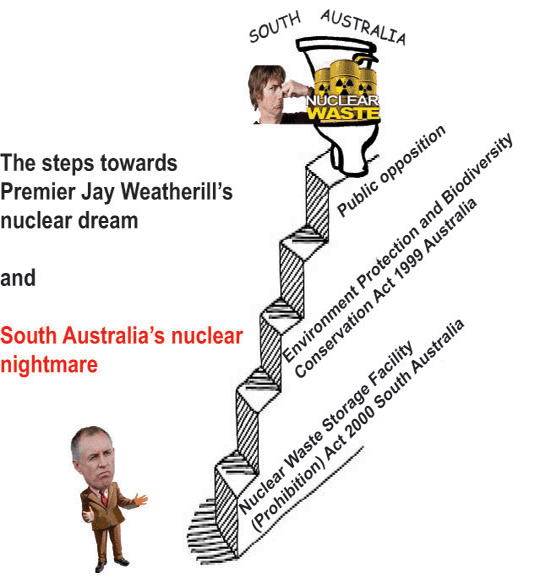
The Citizens’ Jury has delivered exactly what Jay Weatherill wanted- a summary of the Royal  Commission recommendations, with enough uncertainty to justify the nuclear lobby’s next step.
(I’m correcting a previous version of this post, here) The South Australian government already rushed through legislation that overturned South Australia’s legislation against spending money on nuclear industry development, (making this retrospective of course – to cover the $millions already spent)
The next step is to overturn the whole Act, or at least those parts of it which prohibit importing a nd storing foreign wastes.
Weatherill is quoted in THE AUSTRALIAN today as saying ”
“they (the Citizens’ Jury) are asking us to also change the legislation to undertake that work”.
That is a lie. The jury was merely repeating what the Nuclear Royal Commission said. The jury kept to their brief – no decisions or recommendations – just regurgitate what the Commission said.
Nuclear waste – Interim storage containers not necessarily safe
 LobbyistsRule, – comment on The Advertiser, 11 July 16
The temperatures inside these casks normally sit at 200 to 300 degrees Celcius – but if the vents of the concrete overjacket get blocked the temperature can rise to 500 degrees Celcius.
These casks have only been around for twenty years – they should start popping all over the USA in a decade or two.
All this information is available from the USA’s Nuclear Regulatory Commission web site for anyone to read. http://www.adelaidenow.com.au/news/south-australia/citizens-jury-on-sa-nuclear-waste-dump-releases-initial-report/news-story/e76096fa7ec07edcbe18ae0b989683dd
Important questions for the South Australian Nuclear Citizens’ Jury
 Dan Monceaux, 11 July 16

1) Jury should ask for access to all submissions made to the Parliamentary Committee currently considering responses to the NFCRC’s Final Report.
2) Jury should realise that future consideration is for a multi-lateral nuclear fuel centre, which could involve enrichment, reprocessing, fuel fabrication etc. Waste storage is an entry point: see “Nuclear Fuel Leasing” in the NFCRC’s Report for details.
3) Jury should ask: What is the defence sector’s interest in the nuclear fuel cycle? If defence wants it, how important is the economic case for further processing? Could these proceed without a commercial proposition?
4) Jury should consider the USA’s Energy Employees Occupational Illness Compensation Program and discuss why this was not considered in the NFCRC’s Final Report. it was submitted to the Commission as evidence.
5) Jury should consider the USA’s Radiation Exposure Compensation Act and discuss why this was not considered in the NFCRC’s Final Report. it was submitted to the Commission as evidence.
6) The jury should ask the question: what evidence did the Commission receive and choose NOT to include in its Final Report? Particularly on the topic of safety.
Citizens jury concerned about economics of nuclear waste dump plan
 Citizens’ jury questions economics of SA nuclear dump THE AUSTRALIAN JULY 11, 2016 Rebecca Puddy The bid to establish a nuclear waste storage facility in South Australia has suffered a further setback, after an independent “citizens’ jury” raised concerns about the economic viability of the project.
A citizens’ jury of 50 people met over two weekends to discuss the nuclear royal commission report, handing a nine-page summary to Premier Jay Weatherill last night.
But after hearing from experts, the jury questioned the economic underpinnings of the commission’s findings.
“There were varying views between expert witnesses on the economic viability of this project and therefore questions remain relating to the economic modelling by the royal commission report to feel comfortable progressing to further involvement,” the jury report said.>Mr Weatherill accepted the report from the jury, describing it as “commonsense”.
But he confirmed there was extra work to be done on the estimated size of the economic benefit. “They want some more work on the assumptions so they can be clear on what the benefits are and those assumptions are really what is the actual price an overseas country is prepared to pay for storing their waste in our country and that will only be known if we undertake that work,” Mr Weatherill said.
“That will require expenditure and they are asking us to also change the legislation to undertake that work, so it’s a commonsense recommendation and one we will work on.” Another 350 people will meet in October in another citizens’ jury to look at feedback from the statewide consultations………The South Australian Labor government’s examination into the merits of engaging in the nuclear fuel cycle has so far cost the state’s taxpayers $11.8 million.
This is despite Labor’s national platform, updated last year, strongly opposing establishment of nuclear power plants and any stages of the nuclear fuel cycle, other than uranium mining, in Australia. The platform states strong opposition to the importation and storage of nuclear waste from overseas.
In his opening speech to the citizens’ jury, Mr Weatherill said the group was not meant to arrive at a decision but “to actually arrive at a decision about whether the government can make a decision”……..Varying expert views on the economic benefits of storing nuclear waste have already prompted the government to review work already undertaken by its $7.2 million royal commission.
Opposition spokesman Rob Lucas questioned the value of the citizens’ jury to government. “If that is all there is it has been a massive waste of money which hasn’t clarified anything or progressed the debate at all.”
Mr Weatherill has committed to providing a response to the royal commission by the end of the year. The report royal commission’s recommended pursuing a waste dump. http://www.theaustralian.com.au/national-affairs/state-politics/citizens-jury-questions-economics-of-sa-nuclear-dump/news-story/07e997242e2cb7e71daa0dd45d866a51
Citizens’ jury questions safety concerns surrounding dump proposal
Nuclear royal commission: Citizens’ jury questions safety concerns surrounding dump proposal, ABC News, By Daniel Keane, 10 July 16 A grassroots report into a proposal to build a high-level nuclear waste dump in South Australia has identified safety as a major concern.
The report by a citizens’ jury of 50 randomly selected South Australians also found “significant additional research” is required before residents can make an “informed decision”.
The report, presented to Premier Jay Weatherill on Sunday afternoon, followed four days of intense discussions and meetings with experts both for and against the proposal.
Timeline: SA’s nuclear dump debate Plans for a national nuclear waste dump have been on the agenda for decades, and for much of that time SA’s outback has been touted as a possible site.
“The jurors recognise there are potential economic benefits, but there are also substantial risks to consider,” the report stated. “There is a degree of uncertainty around both the benefits and risks associated with establishing such a facility…….
Nuclear radiation a concern to people, environment Continue reading
Losing faith in Nuclear Citizens’ Jury process – today’s hearings
Unfortunately, despite the genuine hard work of the jury members, it could all be a bit of a waste, or worse. The Nuclear Fuel Chain Royal Commission NFCRC was over months ago. But whaddya know – the NFCRC seems to be well in control of the jury proceedings.
DemocracyCo people are trying hard, but are they the patsy in all this?
Dan Monceau reports on Facebook https://www.facebook.com/groups/1021186047913052/:
At the session I observed yesterday, Lucinda Byers (of the NFCRC) was a major participant in the conversation about ‘Trust’.
Geordan Graetz, a Royal Commission staff member who was first disclosed in the Royal Commission’s final report was hanging around.
I notice today that Ashok Kaniyal, another Royal Commission staff member appears to be present.
The media manager for CARA (the Department of Premier & Cabinet’s new reponse agency) is Jenny Turner, who was previously Senior Communications officer, employed by the Royal Commission.
DPC is “in charge” of the process, but the Commission’s staff are clearly and quite intimately involved in this current Citizens Jury process.
South Australia Nuclear Citizens Jury afternoon session 9 July
 In this session, facilitator (probably Emily Jenke from DemocracyCo) was asking the jury to discuss and develop a consensus on the wording of their reports on several topics.
I hope that there will be a transcript of this – (a) because I missed quite a lot and (b) because the to and fro of questions between jurors is hard to follow in an attempted transcript such as I’m doing.
In fact, I learned only some of the discussion on subjects of Education, Community Consent and Trust, and Safety.
Parts that I found particularly significant –
- On Economics – how much investment does the State of South Australia have to put into development of nuclear waste importing facilities? Some jurors felt that there was not enough economic modelling. on education: when will a yes or no answer be acceptable?
- on Trust : it was stressed that this is important because the current South Australian legislation prohibits import and storage of foreign nuclear waste. We need to decide if South Australia, as producer of uranium, has a moral and ethical obligation to take back wastes. Apparently Haydn Manning in a previous hearing has suggested that there is this obligation. However, one juror stated that this was not the finding of the old Ranger Inquiry. International standards state that the society that generates the waste (i.e in nuclear reactors) has that obligation, (not the society that provides the uranium). The Royal Commission Report also states this.
- on Safety – a comprehensive report was given on this, outlining many questions. Here one juror complained that the risks had been emphasised, rather than safety. He referred the jurors back to then evidence given the previous week on radiation risks. At this point my live-stream reception cut out – just as it was getting interesting, seeing that last week’s Citizens’ jury speakers produced a whole lot of trivial nonsense on this topic.
Nuclear Citizens Jury discusses Community Consent
Enice Marsh from the Adnyamathanha Camp Law Mob led off with a clear and passionate statement on the fact that, despite the friendliness and courtesy of the Nuclear Commission’s Jon Bok, their group utterly rejects nuclear waste importing.
This discussion focused mainly on Aboriginal issues. Of course, mainly white people talking. But it is encouraging to note that these jurors showed real concern for the interests of Aboriginal people.
Some interesting discussion on whether the question of importing nuclear waste is an “ethical question or an economic question”
One juror answered firmly –
“If you read the Royal Commission’s report, it’s all about the money”
Nobody disputed that , and the facilitator moved the discussion on quickly.
A juror questioned the lack of information amongst the ordinary public, including the jurors, about radiation. This matter was not followed up.
Proposals were made that there should be no further discussion, until all potential native landowners be fully consulted, before there is any further progress in the State discussion on nuclear. waste importing. It doesn’t look as if that proposition will be taken up. It was knocked on the head by another Aboriginal speaker – Harry?
The group ended up working out a paragraph for their Final Report. – along these lines:
“We have confidence that the best consultation must be what works for the people being consulted. It should not be rushed, and this must be clear from the start.”
South Australian Greens leader shows up folly of Jay Weatherill’s nuclear waste boondoggle
| Throwing good money after bad – How the nuclear waste dump folly could wreck the State Budget | ||||
The additional $3.6m allocated in the SA State Budget to advance the case for an international nuclear waste dump means that $13m will have been spent on this deeply flawed proposal by the end of the year, according to Greens SA Parliamentary Leader, Mark Parnell MLC.
“If the Government decides at the end of this year to proceed further with the nuclear waste dump, then this amount must be budgeted for. There will be no revenue, only costs. “On the other hand, if the Government abandons this nuclear waste dump folly now, then we can cut our losses and re-allocate that money to genuinely benefit South Australians rather than impose a toxic legacy for countless future generations”, said Mr Parnell. Here are some better uses to which $600m could be spent: · Finish electrification of the Gawler line and new tram lines to make AdeLink a reality · Better cycling infrastructure · Solar panels on all public housing · Better rural health services and mental health services · Reducing payroll tax for wages paid to apprentices and trainees |
||||
South Australian govt could spend over $600 million on nuclear waste folly, before any contracts signed
Parnell blasts allocated nuclear waste money, Transcontinental Matt Carcich @MattCarcich July 8, 2016, SA Greens state Member of Legislative Council (MLC) Mark Parnell, says the South Australian government’s allocated $3.6 million in the state budget to ‘advance the case for an international waste dump in South Australia’, is deeply flawed.
This advance includes pursuing a waste dump, simplifying mining approvals processes and seeking a relaxation of federal restrictions on nuclear power generation in Australia. It means $13 million will have been spent on the project by the end of the year, a worrying sign, according to Greens SA Parliamentary Leader, Mark Parnell MLC.
“Spending $13 million of scarce taxpayer funds on a project that doesn’t add up economically, is throwing good money after bad,” Mr Parnell said. Mr Parnell says the alleged costs before any substantial announcements is detrimental to the state budget.
“According to consultants engaged by the Royal Commission (and paid for by the Government), the amount of government expenditure prior to any decision to go ahead with the dump and BEFORE any contracts have been signed would be around $300 million to in excess of $600 million, over the next 6 years!” Mr Parnell said.
“Spending in excess of $600 million preparing for a nuclear waste dump that will never eventuate is a shocking waste that will eat a massive hole in the projected surpluses over the forward estimates.”Mr Parnell says if the state government proceeds with the nuclear waste dump, they will inflict further costs to the budget.
However, Mr Parnell says if the state government abandons it, more money could be re-allocated to other projects in Port Augusta. “My number one in Port Augusta would be the solar thermal power plant, replacing the Alinta with solar thermal is a key measure,” “On top of that, rural mental health is far substandard to what’s available in metro areas.”…… http://www.transcontinental.com.au/story/4018264/parnell-blasts-allocated-nuclear-waste-money/
Greg Ward, Chad Jacobi, Nigel McBride, Jason Kuchel, Michael Penniment mislead the Nuclear Citizens Jury about Radiation
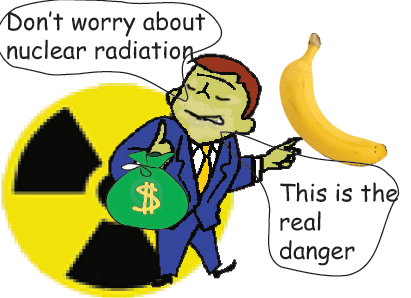
Bananas, brazil nuts and some other foods contain radioactive potassium-40 — but in extremely low doses. Potassium-40 in bananas has a specific activity of 71 ten millionths of a curie per gram. Compare that to the 88 curies per gram for Cesium-137. This is like comparing a stick of dynamite to an atomic bomb. Our bodies manage the ingested Potassium 40, so that after eating bananas, the excess is quickly excreted and the body’s Potassium-40 level remains unchanged.
The radioactive isotopes that come from nuclear fission (such as strontium -90, cesium -137 and iodine 131) were unknown in nature before atomic fission: our bodies are not adapted to them. And as well as being far more radioactive that Potassium -40, they can accumulate in the body.
I had hoped for something sensible to come out of these Citizens’ Juries. That doesn’t look like happening if the juries continue to be fed this kind of nonsense.
Chocolates, bananas, ionising radiation and a nuclear waste dump https://independentaustralia.net/life/life-display/chocolates-bananas-ionising-radiation-and-a-nuclear-waste-dump,9200 5 July 2016
On the matter of ionising radiation and health, Noel Wauchope rebuts five misleading speakers at the Nuclear Citizens’ Jury hearings on Australia’s nuclear waste importation plan.
IN TWO DAYS of 25 Citizens’ Jury sessions in Adelaide (on 25-26 June), about nuclear waste importing, there was minimal coverage of the question of ionising radiation and health.
What little there was, was skimpy, superficial and downright deceptive, in 209 pages of transcripts.
There was not one mention of the world’s authoritative bodies on the subject — The World Health Organisation, U.S. National Academy of Sciences, Canadian Nuclear Safety Commission or any of the reports on biological effects of ionising radiation.
There was no explanation of the “linear no threshold” (LNT) theory on ionising radiation and health, despite the fact that this theory is the one accepted by all the national and international health bodies, including the Ionising Radiation Safety Institute of Australia who, on this topic, quote the Australian Radiation Protection and Nuclear Safety Agency (ARPANSA).
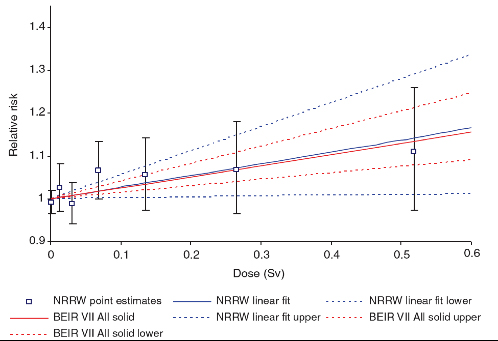
Instead of explaining this basic concept in radiation protection, the slight coverage on radiation and health given to the Jury, was done in a trivial manner as the following examples (listed in the transcript report) illustrate. Continue reading
Nuclear Citizens’ Jury – dubious process, and very dubious purpose
It’s not a proper “Jury”, with a purpose to arrive at a yes or no verdict. It is a campaign ruse by the Weatherill government to get these “ordinary people” to develop a readable, understandable, summary of the RC’s 320 pages of recommendations. Apparently the RC personnel are not able to do this themselves.
Two rays of light in all this. First, the jury members are already asking intelligent questions. Secondly, DemocracyCo’s personnel are making every effort to run these hearings fairly, and transparently.
The South Australian nuclear lobby may be in for some surprises.
Nuclear Citizens Jury in action: the purpose and the process, Online Opinion,
By Noel Wauchope – , 5 July 2016 On June 25 and 26, the South Australian government held the first of three citizens juries, dedicated to discussing the recommendations of the recent Nuclear Fuel Cycle Royal Commission. The sessions are being run by the South Australian company DemocracyCo.From the start, there are problems with the purpose of this Citizens’ Jury. Premier Weatherill did not really help to clarify this, in his opening speech, as he explained its purpose:
|
Nuclear Citizens’ Jury kept in the dark about radiation health risks
Conveniently ignored was a significant body of evidence from studies on workers and the public exposed to low levels of radiation that there is no safe level – no threshold below which significant health effects do not occur.
for now there is no systematic structured way that the detail of these concerns can be brought to the attention of the jurors leaving us with the distinct impression that they are, to borrow a phrase, being treated like mushrooms – kept in the dark and fed on bullshit!
Testing the accepted Linear No Threshold (LNT) model for radiation and health
Citizen’s Jury – weighing evidence or manufacturing consent? Observations from the first sitting day http://chriswhiteonline.org/2016/06/sa-nuclear-waste-dump-questions/
Following on from the already much criticised recommendation from the Nuclear Industry Royal Commission that South Australia become the site for storage and hopefully disposal of around a third of the world’s nuclear waste, the government has funded a ‘citizens’ jury’ process. In the first stage of this a group of 50 people have been randomly selected as representing a cross section of the public – balanced by age, gender and whether they own or rent their homes – to spend 4 days identifying questions of concern and producing a consensus report on the evidence to be later presented to a large group of around 450 citizens for further consideration.
Let us for a moment leave aside the concern about the way the naming of this process as a ‘jury’ is so obviously a myth – divorced from anything that resembles a balanced legal process where evidence is weighed by a group of citizens in the context where a case for and against is presented to them in the presence of an impartial judge who ensures that the process is fair and balanced. Let us focus on one of the all-prevailing concepts of trial by jury: where people giving evidence commit to telling the truth – the whole of it and nothing but. On this simple basic requirement, the process of the citizens’ jury leaves much to be desired.
As part of a small group I was permitted to observe the first two sessions of the first day of this ‘jury’ process dominated by three representatives of the Royal Commission presenting the main recommendations contained in the 320 page report released in May 2016. I left deeply concerned that the jury were, if not being directly lied to, being given something far short of the whole truth. Let me give just three examples. Continue reading
1 This month

of the week – Australians for War Powers Reform (AWPR)
To see nuclear-related stories in greater depth and intensity
 Antinuclear