Australia Institute Analyses Senator Sean Edwards’ Nuclear Plan For South Australia
The impossible dream Free electricity sounds too good to be true. It is. A plan to produce free electricity for South Australia by embracing nuclear waste sounds like a wonderful idea. But it won’t work. The Australia Institute Briefing paper Dan Gilchrist February 2016
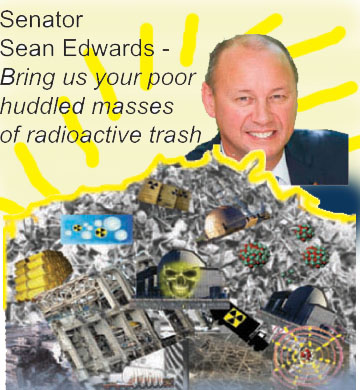
Even if the countries of origin chose not to implement the miraculous technology proposed for South Australia, other countries could compete with Australia to provide this service. A plan predicated on monopoly profits of over 400 percent is, therefore, unrealistic.
Environmental Defenders Office (SA) outlines critical issues in proposal for nuclear waste facility
 Possibility of a high level nuclear waste facility in SA Environmental Defenders Office (SA) Inc. The environment’s legal team since 1992 – protecting the public interest – evening the odds 10 Feb 16
As our nuclear industry, insofar as it exists is principally focused on mining and not on the generation of electricity there would have to be a large amount of new legislation that would have to be enacted in order to establish a high level nuclear waste facility in SA. There are issues regarding environmental impacts, workplace safety, the imposition on aboriginal land, the impact on future generations, the potential for technological changes and security concerns.
Some of the major issues.
Continue reading
AUSTRALIAN NUCLEAR ASSOCIATION wants nuclear reactors on Spencer Gulf
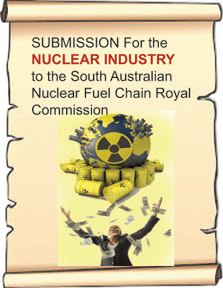
THE AUSTRALIAN NUCLEAR ASSOCIATION (ANA) put in a submission to #NuclearCommissionSAust devoted only to promoting NUCLEAR ELECTRICITY GENERATION. Of course, they made no attempt to consider renewable energy generation, let alone compare the costs. Heaven forfend, as that would have blown their argument right out of the water!
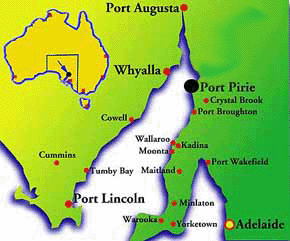
Anyway, they selected recommending Upper Spencer Gulf Area as the site for South Australia to get nuclear reactors:
“The sites are · Site 1 – Fleurieu Peninsula · Site 2 – Upper Spencer Gulf Crag Point · Site 3 – Kadina site, Spencer’s Gulf east coast”
ANA went to great lengths comparing the different types of nuclear reactors – large, small and medium reactor types.
They were hesitant about Generation IV (new nukes) stating that emerging technologies would be available too late to be effective against global warming.
As for Small Modular Nuclear Reactors, ANA sees hurdles, and is not enthusiastic:
“their deployment is highly dependent on: 1. An order book which matches factory scale manufacture to ensure their economic competitiveness 2. A new regulatory regime which enables operations and security personnel to be deployed in reduced numbers to match the scale of power output”
So, ANA wants to put existing types of nuclear reactors on Spencer Gulf coast:
“the Westinghouse AP1000, the Russian VVER1000 and the Enhanced Candu 6”
Their conclusion?
“nuclear power is a realistic option to connect the grid in SA provided the interconnector to Victoria is upgraded.” (Nary a word about how there’s have to be a nuclear waste dump site set up first. )
Peter Burn, Australian Industry Group’s Submission to #NuclearCommissionSAust – is weakly pro nuclear
This is one of those pro nuclear Submissions that carefully hedges its bets, while coming out as weakly pro nuclear.
It comments on – “future world demand for nuclear fuels. We recognise that this is highly uncertain”
It even warns on the effect on Australia’s uranium industry, if nuclear reprocessing were to be adopted: “would alter the dynamics of the world market for nuclear fuels and potentially reduce the prospects for expanded uranium mining”
Peter Burn’s Submission comes up with that interesting bit of ?logic that I keep meeting. Acknowledging that currently there is a poor market for nuclear electricity, then his argument goes that we’d better get cracking on setting up a nuclear industry in case there’s a big demand later!
“these facts and uncertainties mean that any investment commitments are likely to be many years away – and that now is a good time to start preparing our energy options, including a potential nuclear generation sector.”
Like all the pro nuclear proponents, this AIG Submission calls for “review of the legal context of these developments” – i.e change Australia’s Environmental Laws.
This is not a very enthusiastically pro nuclear Submission. It lists 7 recommendations, all of which come straight from Australia’s pro nuclear front group “Think Climate Consulting”, headed by Barry Brook.
The two major ones are a “cost benefit” study of South Australia importing nuclear waste, and of setting up nuclear recycling. Left to Barry Brook’s nuclear lobby group, we can guess what the outcome of that study would be.
Charles Waite’s Submission to #NuclearCommissionSAust wants tax-payer to buy Small Modular Nuclear Reactors
Energy.Proj.AU presents: C. M. Waite’s CONSOLIDATED PAPER A Submission to SA’s Nuclear Fuel Cycle Royal Commission C. M. Waite, M Sc, B Sc Ed .
Charles Waite’s Submission to the South Australian Nuclear Fuel Chain Royal Commission is a hymn of praise to new nuclear technology.
“South Australia has before it a great opportunity to PIVOT into Nuclear Energy”
“SA Government announced its $20 Billion plan to PIVOT the State to a Nuclear Energy economy”
“Molten Salt Reactors have been proven safe, viable & reliable”
And also a hymn to to those new nuclear companies, – Bill Gates’ Terra Power, Terrestrial Energy, Transatomic Power etc
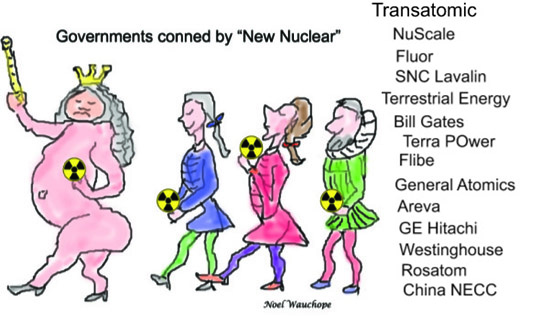
Interestingly, he does not recommend GE-Hitachi’s IFR PRISM reactor as too expensive.
Waite wants the South Australian government, i.e: the taxpayer to buy “new nukes”
“It seems to me “best” for SA to own+run some WAMSR’s, so that it has at least some customers for its processed Fuel Rods.”
“SA should consider owning some MSRs, ie, rather than being dependent on the whims of a private generator; since SA Govt’s announcement of a plan to PIVOT the State to a Nuclear Energy economy”
Waite’s chosen location for these new, untested Molten salt Nuclear Reactors? – near South Australia’s desalination plant ?(Port Stanvac)
Legal Aspects of Australian Government Submission to #NuclearCommissionSAust
The Australian Government put in a lengthy Submission. For now, I will select just one part – what the Australian government wants, in legislation.
ENVIRONMENTAL LAW In a submission that is in its overall theme, favourable to the nuclear industry, Government wants some legislative changes, quietly giving the nod to to changing Australia’s environmental laws that prohibit Australia’s further involvement in the nuclear fuel chain:
“Whether or not immediate opportunities exist, the Commonwealth considers that any possibilities that do emerge should not be closed off by governments where they have a demonstrated net benefit, and the risks can be managed effectively. We are working with the States and Territories on improving the regulation of nuclear industries, including by responding to technical developments and streamlining or removing unnecessary regulation.”
“Commonwealth legislation prohibits some of the activities under consideration by the Royal Commission, including construction or operation of nuclear reactors for generating electricity or facilities for enriching uranium, fabricating nuclear fuel or reprocessing spent nuclear fuel. The Commonwealth Government looks forward to considering the Royal Commission’s report, the response of the South Australian Government and the implications for Commonwealth policy and regulatory framework.”
LIABILITY LAW Secondly, the Government points to the need for laws covering liability in the case of nuclear accidents:
“Nuclear liability The IAEA and the OECD Nuclear Energy Agency have developed an international regime covering compensation for damage from nuclear activities – civil nuclear liability. Most countries undertaking nuclear activities have developed national legislation consistent with that regime, irrespective of whether they are parties to the relevant international conventions.
Exceptionally, Australia has no special legislation covering civil nuclear liability. There are significant differences between liability under general law and liability under the international nuclear liability regime, particularly in relation to the responsibility of the facility operators and the standard of proof required.
Further involvement in the fuel cycle would require the adoption of nuclear liability legislation to ensure operators are held liable for incidents and are able to provide adequate compensation, and that claims for compensation for an accident in Australia are dealt with in Australia.”
Christopher Camarsh Submission to #NuclearCommissionSAust touts underwater nuclear reactors
Christopher Camarsh Submission to South Australia Nuclear Fuel Chain Royal Commission http://nuclearrc.sa.gov.au/app/uploads/2015/11/Christopher-Camarsh-03-08-2015.pdf
Mr Christopher Camarsh is an investment manager and Managing Director of AIXI Investments. His lengthy submission is a detailed promotion for a company selling underwater nuclear reactors.
“The Blue Energy System (BES) is a new production system for global power generation and distribution. It utilises transportable submerged power stations produced at a central facility that can be located off shore from energy consuming centers.”

Like all the company promotions to the RC, this submission sticks to its role, so of course, no attention to comparisons to non nuclear energy systems.
However, Camarsh does give an opinion approving of South Australia as nuclear dump site
” MANAGEMENT, STORAGE AND DISPOSAL OF NUCLEAR AND RADIOACTIVE WASTE We believe that a waste, storage, disposal strategy is ultimately a sovereign matter but have strong convictions that the commission should recommend South Australia engage in this activity as it contains in our view the most suitable locations globally”
Business South Australia wants nuclear waste import, worried about public opinion.
BUSINESS SA’s Submission to South Australia’s Nuclear Fuel Chain Royal Commission http://nuclearrc.sa.gov.au/app/uploads/2015/11/Business-SA-03-08-2015.pdf
“South Australia’s clearest economically viable expansion opportunity in the nuclear fuel cycle will be in the form of used fuel storage and disposal”
“South Australia must focus on what the world needs, particularly in the case of used nuclear fuel storage or disposal.”
“In order to build community confidence, it is likely that a pilot storage site would need to be constructed first and this should form part of the Royal Commission’s deliberations.”
Business South Australia’s Submission clearly promotes the nuclear industry, with a commercial argument that completely ignores the negative effects that this would have on other industries in that State.
While its main focus is on the benefits of nuclear waste importing, (as a way of creating jobs, and fixing the budget deficit), Business South Australia is in fact favouring the whole nuclear fuel chain:
“the opportunity to recycle used fuel as technology advances will be lost if South Australia only considers its complete disposal. Storing used nuclear fuel in a deep geological repository will at least enable us to take advantage of advances in areas such as Generation IV nuclear reactor design”
It supports nuclear fuel reprocessing, with touching faith that a safe method will be found, some time in the future:
“Purex technology was developed in the 1950’s and the future of re-processing through the next generation of reactors should not be overlooked on the basis of the pros and cons of this technology alone. Furthermore, there is a view that in future a different process could be used to recover all anions together, including plutonium, to reduce the risks associated with Purex.”
Their submission is ambivalent about uranium enrichment, conversion and fuel fabrication, and nuclear power, but keen on the idea of South Australia developing a shipping industry geared to transporting nuclear fuels and wastes.
They are reassuring about any anxieties over safe transport of radioactive materials, especially shipping, but also about air transport:
“we request the Royal Commission to investigate the practicality of using air freight to deliver used nuclear fuel to a dedicated air strip adjoining a storage or disposal site.”
The State Government’s Industry Participation Advocate is seen to be an important aid to their case for South Australia expanding its nuclear industry role.
Business South Australia is worried about public opinion – it seems that they would like to have nuclear matters decided on by nuclear experts, rather than by the people of South Australia:
“ the Royal Commission should not be fixated on just what the general public prefers, but rather what is in the best interests of the State.”
Australia should not be guinea pig for new nuclear reactors – Australia’s Chief Scientist
 Dr Alan Finkel, Australia’s Chief Scientist, recommends that IF Australia gets ‘new generation’ nuclear reactors, they should be proven successful first, in some other country:
Australian Academy of Technological Sciences and Engineering. President Dr Alan Finkel Submission to South Australia Nuclear Fuel Chain Royal Commission
EXTRACTS
“ If the Royal Commission should favour establishment of a nuclear power plant, ATSE recommends that ‘first of a kind’ (FOAK) technology – specifically, Generation IV reactors should not be considered by South Australia at this time”
Finkel supports a nuclear waste import industry:
“South Australia and thus Australia as a whole is well positioned to undertake waste storage as part of the nuclear fuel cycle.”
But qualifies this:
“The opportunity for South Australia to provide commercial permanent waste storage facilities for overseas nuclear power plant spent fuel owners could exist and would certainly offer commercial opportunities for the State. However, based on the negative public reaction to the poorly explained and marketed Pangea proposal some years ago, the public may still find this concept unacceptable”
It is a careful submission, thorough, and with qualified support for the nuclear fuel chain.
On URANIUM MINING – he recognises that the market is at best uncertain.
On URANIUM ENRICHMENT PROCESSING & FUEL FABRICATION –he is in favour but with some serious qualifications.
On NUCLEAR POWER – only vaguely in favour.:
“ – may require government guarantees and/or government capital injections to encourage investment. This could possibly require the South Australian or Commonwealth governments becoming a stakeholder in the establishment of a nuclear power plant.”
“Any feasibility would also establish the likely cost of power from such reactor technologies and the guaranteed selling price to the grid. If this is not an equitable situation then the project would not be able to proceed. If nuclear power is to proceed in its development it will need to be competitive against carbon fuelled generation including carbon capture and storage (CCS) in its supply of baseload generation, and likely renewable energy generation if storage methods continue to improve”
“EPBC Act would need to be amended. South Australian legislation also regulates environmental and transportation matters, including the Radiation Protection and Control Act 1982 and the Radiation Protection and Control (Transport of Radioactive Substances) Regulations 2003.”
As mentioned above, Finkel is opposed to Australia being the test place for the first Generation IV reactors
ASSOCIATION OF MINING AND EXPLORATION COMPANIES (AMEC) wants Pro Nuclear Public Education
Submission to South Australia Nuclear Fuel Chain Royal Commission –ASSOCIATION OF MINING AND EXPLORATION COMPANIES (AMEC)
A common theme is emerging in the pro nuclear Submissions to the RC. Apart from the common factor these Submissions mostly come either directly or indirectly from vested interests, their common agenda is very often that the RC should recommend public education about the nuclear industry. (and I don’t think that they mean informing the public about the environmental, health, safety, economic hazards – quite the reverse.)
- An equally important theme is to push for removal of laws that accept the nuclear industry as especially hazardous, due to its special danger of ionising radiation:
EXTRACT
AMEC wants “The removal of “mining or milling of uranium ore” from the definition of ‘nuclear action’ in section 22(1)(d) of the Environment Protection and Biodiversity Conservation Act 1999”
- AMEC confines itself to promoting the uranium industry – getting tax-payer incentives for exploration, easier licensing, Commonwealth funding, and lessening regulations, weakening environmental approval processes e.g:
“Early implementation of the ‘one stop shop’ environmental assessment and approval process.”
“it is important that the policy barriers applying to container ports identified for uranium export are removed”
- Importantly AMEC wants to make making it easier to get around Native Title:
“Priority focus on resolving outstanding Native Title claims.
Mechanisms that will provide greater clarity and certainty to third parties who need to engage with the Applicant and native title claim group outside the claims process (for example in the context of making future act and heritage agreements) are required.
That consideration should be given as to whether an Applicant can authorise an agent to act on its behalf, and what powers can be abrogated to the agent.”
- And on course – the public education bit:
“The development of a national public education and awareness strategy” The challenge is to increase public education, awareness, confidence and acceptance of the uranium industry.” …’ http://nuclearrc.sa.gov.au/app/uploads/2015/11/Association-of-Mining-and-Exploration-Companies-24-07-2015.pdf
George Bereznai’s Submission to #NuclearCommissionSAust – religious faith in “new nukes”
This is a comforting submission that the world can keep on making radioactive trash, in the religious belief that, with faith, sometime in the future, geewhiz nuclear reactors will solve that problem. ( – “it is expected” by whom? Those with clear or vested interests in the nuclear industry.)
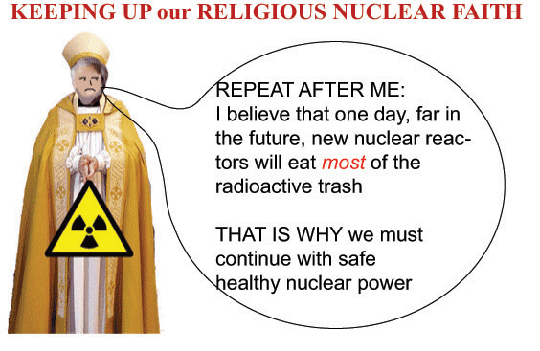
Bereznai ( engineering qualifications) wants nuclear power for South Australia.
He’ s not keen on uranium enrichment, but thinks that nuclear fuel conversion and fabrication might be viable.
He pushes for nuclear power – “ the supply of electricity needs to be centrally managed, and must meet the demand at all times. ….base load” . For nuclear as pretty much greenhouse emissions free. Wants the RC to supply information to get “social licence”
“waste. …… is in reality a unique feature, and can be seen as a key advantage of nuclear-electric generation.”……
“The safe management and storage of fuel that has been irradiated in the normal operation of a nuclear reactor has been well established and demonstrated by several thousand of reactor-years of operations”
“It is expected that by the time radioactive fuel needs to be moved from above ground dry-storage to deep geological repositories, fast reactor technology will have reached a level of economic viability wherein the reprocessing of previously used nuclear fuel will be implemented.
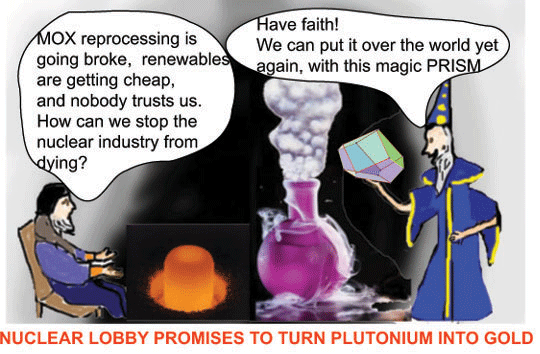
While some long lived radioactive by-products may remain after reprocessing and subsequent passes through fast reactors, these volumes will be very small, and can be permanently stored in deep geological repositories.”
“significant benefits to South Australia’s citizens would accrue in the areas of economy, environment, health and safety by …. the construction and operation of nuclear electrical generating units in South Australia.”
Geoff Russell Submission to #NuclearCommissionSAust: convince public that radiation is OK
Geoff Russell’s Submission is all about how to overcome public dislike of the nuclear industry.
I love it! Russell doesn’t bother with the nuances of argument, or indeed, even with the facts. Here he goes on radiation:
“The demonstrated health risks associated with the Fukushima meltdowns are various and it’s simple to show that radiation was and remains the smallest. Fear of radiation demonstrably killed more people than radiation could ever have. “
Note the use of the word “demonstrated”. As with smoking, the cancer cases from ionising radiation appear decades later – but not much in the early years after exposure, can’t be “demonstrated then) .
Russell explains that public concern about Fukushima radiation is due to “ignorance” and ““incompetent news reporting”. He tries to demolish any information that Chernobyl nuclear radiation caused illness or death. He’s good at dazzling you with jargony non-science : – “Put another way, normal DNA damage is about 10,000-15,000 times greater than the public was getting from radiation at Fukushima”
Russell’s forte is rubbishing well known people, authors Guy Rundle and Mark Willacy, Professor Ian Lowe, and also governments: “But it isn’t just the news media that seem to go out of their way to ignore evidence, the Government of Japan provides an excellent, but tragic, example with its response to the meltdowns at Fukushima in 2011” He rubbishes the Japanese government’s response to the Fukuhsima nuclear disaster as an over-reaction, with the evacuation as unnecessary.
He rubbishes the idea of ionising radiation as a cause of cancer, except for these odd remarks
“only a small section of the community will generally be at any significant risk at all; young children and pregnant woman…….The Hiroshima and Nagasaki doses and outcome makes it clear that any general outcome from Fukushima can only be, at worst, a slight ripple in cancer rates….”
(Now we know who matters to Geoff Russell, and who doesn’t!)
He attacks the accepted Linear No Threshold Theory (LNT) of radiation – the one endorsed by World Health Organisation (WHO) all reputable health organisations world-wide:
“Radiation experts know that LNT is simply a model which is useful in some circumstances but quite clearly wrong; both for high doses and low doses”
“……If this Royal Commission is to present an expansion of the nuclear industry as a viable option in South Australia it must deal explicitly with the causes of the Fukushima evacuation. ….. The truth is that the Fukushima meltdowns never posed any significant public health risk and that the Government of Japan mishandled the event from the outset and at every subsequent point.”
Russell goes on to a big jargony waffle about why ionising radiation in water is of no concern. Then he wanders all over the place about other causes and mechanisms of cancer development.
Russell’s conclusion:
The Royal Commission is uniquely placed to learn from the past, but it will need to deal with the drivers of nuclear fear in the community. To build confidence in the community, the Commission’s report will need to convince both sides of politics to speak with one voice about the misinformation that drove (and drives) the Fukushima evacuation. Appeasement, in the form of more and more levels of safeguards and protocols to attempt to say that “it can’t happen here” isn’t the answer.
There will always be accidents despite every effort to avoid them. Planes still crash, but people understand the relative risks and board them regardless of personal fear. They understand that fear is their personal problem and not a function of the objective facts…….
In Australia in 2010-11 there were 7730 Worker’s45 Compensation claims for serious injury resulting from falls from a height. How many were associated with rooftop solar panels? As far as I can see, nobody is even counting, but a million solar rooftops means more people on ladders; many of them amateurs. This is real danger, the kind that can put you in a wheel chair for the rest of your life. http://nuclearrc.sa.gov.au/app/uploads/2015/11/Geoff-Russell-22-07-2015.pdf
Floating nuclear reactors – a Submission to #NuclearCommissionSaust
Geoff Hudson’s Submission to the South Australia Nuclear Fuel Chain Royal Commission recommends SeaBurn – floating Portable Generation IV Reactor Development to process existing used fuel rods.
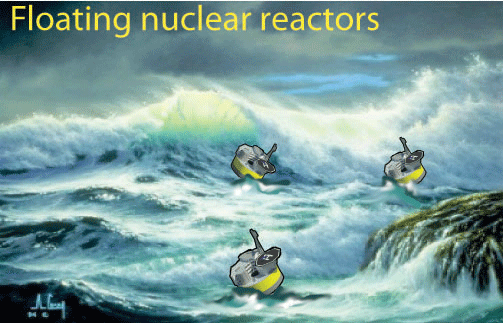
“…..It is expected that one or more foreign companies like Transatomic Power, GEHitachi, or Westinghouse would be involved. A consortium involving a South Australian Government authority (to be created), one or more overseas companies (to be chosen) and possibly the United States Department of Energy would develop the technology, first on land near a waste repository, and then in ships or submarines.
A major contribution from South Australia will be a significant fraction of the funding. It is expected that the source of that funding will be part of the income from a waste repository. The repository needs SeaBurn to offer reduction in the life time of the wastes, but will support SeaBurn from its income. This synergy means that SeaBurn should not be adopted if there is no waste repository……http://nuclearrc.sa.gov.au/app/uploads/2015/11/Geoff-Hudson-15-06-2015.pdf
Geoff Russell: a pro nuclear Submission to #NuclearCommissionSAust
Geoff Russell seems to have sent two Submissions. He is preoccupied with the need for the Royal Commission to build public confidence in the nuclear industry.
“There is extensive evidence that people in Australia are strongly opposed to any artificial nuclear process, and in the view of the author, the entire work of the Commission could easily be wasted because of this opposition.
A procedure to address this opposition is presented, beginning with surveys, passing through production of media materials, to a referendum.”
MANAGEMENT, STORAGE, AND DISPOSAL OF NUCLEAR AND RADIOACTIVE WASTE On building public confidence in the nuclear waste dump plan:
“1. The relationship between knowledge of nuclear processes and the desire to limit any nuclear activities or industry. I keep in touch with colleagues who also studied Nuclear Physics, To a man, they regard the great bulk of the general phobia about all things nuclear as an aberrant result of lack of knowledge combined with passionate but incorrect argument.
- The cost of an insurance premium to cover any damage caused by any nuclear accident or leakage. If you can take out a policy which, for example, will pay you $1,000,000 if your farm becomes unsafe for food production for $100 per year, then you are much more inclined to take a rational view of the risks”
Russell advises the Commission to survey public knowledge and level of aversion:
“Measure Correlation between Knowledge and Aversion Check the correlation between the knowledge and the level of aversion shown in the survey. Most people trained in nuclear physics expect that strong aversion will be correlated strongly with low knowledge.
Publicize the Correlation In the event that the correlation anticipated above is observed, then publicise that fact. The ABC or SBS may be willing to assist here. …..”
“Prepare Communication Materials on Nuclear processes Prepare general materials (e.g. a short film) suitable for high schools to explain the actual risks of radioactivity and the actual risks of other industrial processes, especially power production. Provide copies of these materials to schools and the media. Having produced two Ockham’s Razor talks on nuclear issues, as well as a keynote presentation to the Uranium conference held in Adelaide and to a U3A group, I feel able to contribute to this activity, and would welcome the opportunity to do so…”
He suggests an insurance plan for damage to life or property from an nuclear waste establishment.
“…….Analysis The strong public resistance to nuclear power and the storage of nuclear waste means that the chance that nothing will come of this Royal Commission, other than affirmation of the existing public opinion, is very high. This is the elephant in the room, and failure to address it is an admission that the cost and effort of the Commission will be wasted.”……. http://nuclearrc.sa.gov.au/app/uploads/2015/11/Geoff-Hudson-15-06-2015.pdf
John Emerson’s Submission to #NuclearCommissionSAust – wants a BHP waste dump
John Emerson wants BHP to set up a nuclear waste dump http://nuclearrc.sa.gov.au/app/uploads/2015/11/John-Emerson-22-07-2015.pdf – a pity that BHP has ruled this out in its own Submission :
BHP Billiton does not handle or manage intermediate and high-level radioactive wastes. Nevertheless we understand that current thinking is toward long term storage rather than disposal, as it is foreseeable that the contained energy may be able to be harnessed in the future. Irrespective of whether storage or disposal is preferred, BHP Billiton considers that either option would be inconsistent with our core business of mining and the production of high quality copper and associated by-products at Olympic Dam. http://nuclearrc.sa.gov.au/app/uploads/2015/11/BHP-Billiton-03-08-2015.pdf

1 This month
Chernobyl: The Lost Tapes – A good documentary on Chernobyl on SBS available On Demand for the next 3 weeks– https://www.sbs.com.au/ondemand/tv-program/chernobyl-the-lost-tapes/2352741955560
15 April – Zoom –Nuclear Power is Not the Solution
Apr 15, 2026 01:00 AM in Canberra, Melbourne, Sydney

Join the International Physicians for the Prevention of Nuclear War (IPPNW) on Tuesday, April 14th for a timely webinar exploring the risks associated with nuclear power and challenging the myth that it offers a simple, safe, carbon-free solution to the climate crisis

21 April Webinar: No Nuclear Weapons in Australia
Start: 2026-04-21 18:00:00 UTC Canberra, Melbourne, Sydney (GMT+10:00)
End: 2026-04-21 19:30:00 UTC Canberra, Melbourne, Sydney (GMT+10:00)
Event Type: Virtual
A virtual link will be communicated before the event.
Host Contact Info: australia@icanw.org

of the week – Australians for War Powers Reform (AWPR)
To see nuclear-related stories in greater depth and intensity
 Antinuclear