Business South Australia – a strident pro nuclear lobbyist -ruled to not be a ‘charity’
 Business SA loses legal fight to prove it is a charity for tax purposes http://www.adelaidenow.com.au/business/business-sa-loses-legal-fight-to-prove-it-is-a-charity-for-tax-purposes/news-story/0ca7426794b7a85ad13ae7fd4bb006ac, Andrew Hough, The Advertiser, August 31, 2017 THE role of the state’s peak business lobby group has been called into question after a judge ruled its “dominant purpose” was not to advance trade and commerce in South Australia.
Business South Australia – still a strident voice for the nuclear lobby
 Nuclear fight isn’t over, vows Business SA, Business SA has vowed to continue the nuclear waste dump fight after the next election, with boss Nigel McBride slamming the state’s politicians for killing off the debate because of populist politics,In Daily, Tom Richardson, 19 October 17 .
The recommendation received majority support, with Labor, Liberal and Greens MPs backing it and the Australian Conservatives MLC dissenting.
Greens MLC Mark Parnell went further, pushing to reinstate laws that would prevent any Government consulting publicly on the merits of a nuclear waste storage.
But McBride today hit out at the political consensus, warning it set a dangerous precedent of shutting down mature debate on complex issues…….
He said the state had already spent at least $14 million of taxpayers’ money on the Royal Commission – let alone subsequent community consultations………
he reserved particular scorn for Weatherill’s bid to hasten the decision process through a series of citizens’ juries…….
McBride was among those who spoke at the jury sessions, and described the jurors as “intelligent, thoughtful, questioning, decent members of the public”……..
Despite being a long-time advocate for exploring nuclear waste storage in SA, McBride was among the first proponents to declare the plan “dead” after the state Liberals last year withdrew bipartisan support……..https://indaily.com.au/news/local/2017/10/19/nuclear-fight-isnt-vows-business-sa/
No more money for investigating nuclear waste importing – South Australian Parliamentary Committee report
 No more cash for nuclear vision as parties conspire
  against waste dump. In Daily, Tom Richardson , 18 Oct 17 A parliamentary inquiry into Jay Weatherill’s doomed nuclear waste repository has told the State Government not to spend another cent of public money on the plan, with MPs from both major parties conspiring to drive the last nail into the project’s political coffin.The final report of a committee established to review the findings of former Governor Kevin Scarce’s Nuclear Royal Commission, tabled in parliament yesterday, makes only one recommendation: “That the South Australian Government should not commit any further public funds to pursuing the proposal to establish a repository for the storage of nuclear waste in SA.”
The recommendation was endorsed by Liberal, Greens and Labor members of the committee – surprisingly, including even outspoken nuclear advocate and Labor whip Tom Kenyon………
Earlier this year, InDaily revealed Weatherill’s declaration that the project would not be revisited by his Government.
But the work of the committee has continued, with the inquiry hearing “concerns from witnesses that if market conditions changed, for example through competition or changes in technology, the state may be left with a facility which, from an economic and financial perspective, is a break-even proposition at best”.
“Further, while no direct losses would be incurred, there could be significant costs attached to losing other, potentially higher value, investment opportunities,” the report stated.
“Further still, the minimum pre-commitment, or baseline viability, does not mitigate risk of writing-off pre-commitment expenditure estimated at roundly $600 million if the facility did not proceed.”
The committee noted “the possibility of a customer country unilaterally deciding not to send waste to SA despite contractual agreements to do so which, depending on the timing of the risk impact, could leave the facility significantly under-funded”.
Greens committee member Mark Parnell, a consistent opponent of the repository plan, said today “the project was ill-conceived from the outset”.
“The whole exercise has been a colossal waste of millions of dollars of taxpayers’ money, but it’s now good the process has finished and we can move on to talking about more realistic projects that will create employment and opportunity for South Australians,” he said.
Calling the inquiry’s recommendation the “second-last nail in the coffin”, Parnell insisted the Government must now reinstate Section 13 of the Nuclear Waste Storage Facility (Prohibition) Act of 2000, which was repealed last year.
The law prevented the Government from consulting on the merits of a nuclear waste storage facility, holding that “no public money may be appropriated, expended or advanced to any person for the purpose of encouraging or financing any activity associated with the construction or operation of a nuclear waste storage facility” in SA.
Parnell has his own legislation before parliament to re-establish the original act, saying “we need to fix the legislation to make sure no future government comes back with a project like this, without coming to parliament first”……..https://indaily.com.au/news/politics/2017/10/18/no-cash-nuclear-vision-parties-conspire-waste-dump/
South Australian Labor commends Weatherill govt on acknowledging Citizens Jury outcome – no nuclear waste importing

In addition to the parliamentary committee report released today …
Motion / resolution passed unanimously by the Australian Labor Party SA Branch, State Convention 2017
13 October 2017
Motion 22. MUA
Federal Nuclear Waste Dump
Andrew Allison, Nuclear Fuel Cycle Watch South Australia-18 Oct 17 -South Australian Labor congratulates the Weatherill government for acknowledging the Citizens Jury outcome to reject the establishment of the nuclear dump, which reflected a majority of the state’s residents, some two thirds of Jury participants. The Weatherill Government is to be commended for acknowledging the community, social and environmental concerns.
Recommendation
SA Labor continues to acknowledge, respects and endorse the ALP National Platform on Nuclear Waste.
“The Advertiser’s” nuclear advertising article drew strong responses
Jim Green, 18 Oct 17 Dean Jaensch makes two comments about nuclear power ‒ both of them false (‘Nuclear power could be the solution for Australia’s energry crisis‘, The Advertiser, yesterday). He claims that 19 of the G20 utilise nuclear energy in their power production. But in fact, Indonesia Turkey, and Saudi Arabia have no reactors.
And in most of the G20 countries that operate reactors, nuclear power is either negligible or in a world of trouble. In Japan, for example, less than one-tenth of the pre-Fukushima reactor fleet is operating. Estimated clean-up and compensation costs for the 2011 Fukushima disaster have doubled and doubled again and now stand at $245 billion.
Could the state economy cope with a $245 billion hit if Fukushima happened in SA? Of course not.
Jaensch’s claim that nuclear power “emits absolutely no carbon” is also false as a cursory review of the relevant literature demonstrates.
 Robyn Wood, 19 Oct 17 Regarding nuclear power, Dean Jaensch is very mistaken when he claims that nuclear power emits no carbon (Advertiser 17/10/17). He forgets to include the fossil fuel burned during uranium mining, transport of uranium by truck, train or sea, plus the construction of a waste facility along with associated transport of waste.
He also forgets that last year’s nuclear Royal Commission  found that nuclear power is currently uneconomic compared to other sources of power. Costs for the construction of new nuclear power plants around the world are skyrocketing while the costs of renewables are rapidly falling. If our government is wise enough to also invest in constructing pumped hydro dams which act as energy storage, then renewable energy can be stabilised to provide continuous electricity for the benefit of all Australians.
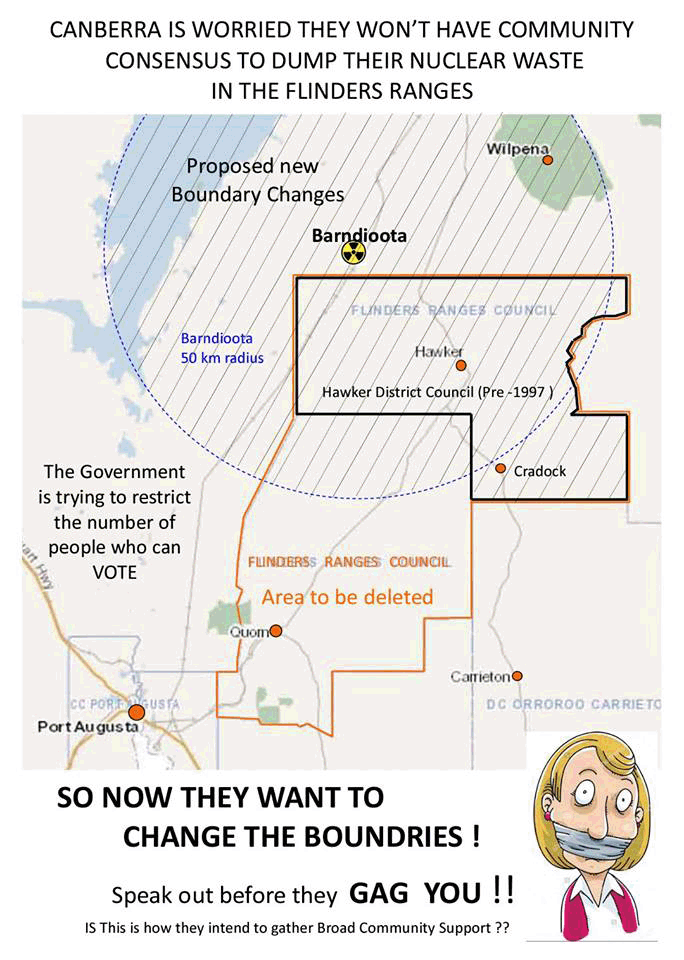
Australian govt changing electoral boundaries, in effort to get support for radioactive waste dump in South Australia?
New $400 million solar farm for Port Augusta.
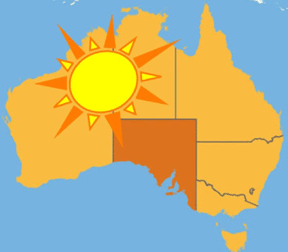 European energy giant Enel to build $400m solar plant in Port Augusta http://www.adelaidenow.com.au/news/south-australia/european-energy-giant-enel-to-build-400m-solar-plant-in-port-augusta/news-story/94dfb0cd8 Adam Langenberg, Political reporter, The Advertiser, October 9, 2017 EUROPEAN energy giant Enel has received final approval for a $400 million solar farm on the outskirts of Port Augusta.
South Australia’s Chief Scientist Leanna Read publicly advocating for illegal nuclear waste imports
“Why would South Australians want to become further involved in this industry when there are much safer alternatives available for people, the environment, country, culture and the economy?”
Kaurna ask the Scarn (South Auustralia Nuclear Fuel Chain Royal Commission) to justify the illegal immoral plotting which is being paid for by our tax dollars at the rate of a million dollars per month … a simple question which exposes the wasteful stupidity of the Scarn and the evil of radioactive poisons.
http://nuclearrc.sa.gov.au/…/2016/03/Kaurna-Yerta-04-09-201…
South Australia’s network of charging stations for electric cars
Tesla charging stations to link Adelaide with world’s largest battery http://reneweconomy.com.au/tesla-charging-stations-link-adelaide-worlds-largest-battery-20202/ By Andrew Spence on 28 September 2017, The Lead
A network of car charging stations is being developed in South Australia to allow Tesla drivers to visit the world’s biggest lithium-ion battery being built by Elon Musk in the state’s north.
Eight fast charging stations: four generic chargers for a range of electric vehicles, and four Tesla Superchargers, opened today in the capital city of Adelaide, completing an Australian Tesla charging network that stretches to Brisbane.
The fastest electric car charging units available in Australia, the Tesla Superchargers can charge Tesla Model S and X vehicles in 30 minutes, allowing a range of 270km.A Tesla charging station also opened today at the Clare Country Club to complement two existing chargers in the wine region about 140km north of Adelaide. From there, it is only about 90km further to the site of the world’s largest battery being installed by Tesla at Neoen’s Hornsdale Wind Farm north of Jamestown.
Tesla CEO Elon Musk flew into Adelaide, the South Australian capital, in July to announce his company would build the 100MW/129MWh lithium-ion battery in the state’s Mid-North.
The tech billionaire told reporters the Tesla Powerpack would be three times as powerful as the next largest lithium ion battery.
“I was made aware there was this opportunity to make this significant statement about renewable energy to the world,” Musk said in July.
“Coal does not have a long-term future.”
Musk will be back in Adelaide on Friday to update the International Astronautical Congress on plans by his company SpaceX to send humans to Mars in its Big Falcon Rocket.
It is not known if he will use the opportunity to make the trip north to Jamestown to check on the progress of the battery.
South Australian Energy Minister Tom Koutsantonis said construction at the site was well underway and the batteries were on track to be operational by December 1, the start of the Australian summer.
Last month, Fluid Solar took its four-storey, renewable energy powered headquarters about 30km north of Adelaide off the main electricity grid.
Surplus electricity generated at the site will be used as part of Tesla’s car-charging network, with 11 electric vehicle bays that will be supplied completely by solar power harvested from a 98 kWp array of 378 PV solar panels on the building’s roof.
Eleven more electric vehicle charging points will be installed in the Adelaide Central Market car park in the centre of the city by the end of November and another 25 will be built around the city by mid next year.
South Australia leads the nation in the uptake of wind energy and roof-top solar with renewable sources accounting for almost 50 per cent of the electricity generated in the state.
However, the closure of two coal-fired power stations in recent years has increased South Australia’s reliance on energy supplies from the eastern Australian states, particularly in times of peak demand.
Rural South Australia could end up with the curse of stranded nuclear wastes
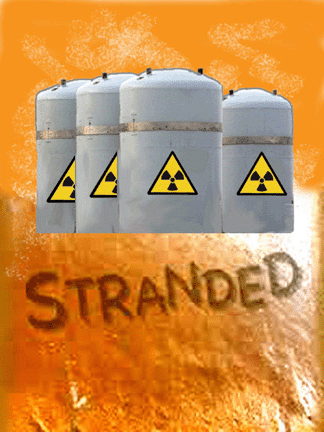 Robyn Wood, Fight To Stop Nuclear Waste Dump In Flinders Ranges SA, 19 Sept 17
On the charge
HEAD of Resources Division, Department of Industry, Innovation and Science (DIIS), Bruce Wilson’s statement that “the federal Government is not pushing for a … National Radioactive Waste Management Facility to be hosted in SA” is not supported by the facts (“Nuke healing”, The Advertiser, 6/9/17).
Since the call for potential sites across Australia in March 2015, the process narrowed to focus on three, all in SA, two near Kimba and one near Hawker.
For over a year, DIIS staff have visited Hawker and Quorn almost weekly promoting the facility and answering questions.
A consultative committee meets monthly, a community liaison officer has been appointed and an economic working group has been formed. Newsletters appear regularly.
A delegation from Champagne in France, where there is a similar facility, has been presented praising the benefits of the facility to their region. Individuals and groups, including school students, have been funded to tour Lucas Heights.
In 2016, the federal Government allocated a $2 million community benefit package to Hawker. Another $2 million is promised this financial year with a similar allocation for Kimba, which will also have its own consultative committee and community liaison officer.
Mr Wilson’s letter emphasises the disposal of waste from the production and use of radioactive medical isotopes. He does not mention that the problematic intermediate level component of this waste can only be stored there on a temporary basis with no plan for its disposal.
Current state legislation, the Nuclear Waste Storage Facility (Prohibition) Act 2000, prohibits the storage in SA of the type of material proposed for this site.
GREG BANNON, Chair, Flinders Local Action Group, Quorn. more https://www.facebook.com/groups/344452605899556/
When Adelaide got hit by Maralinga nuclear radiation fallout
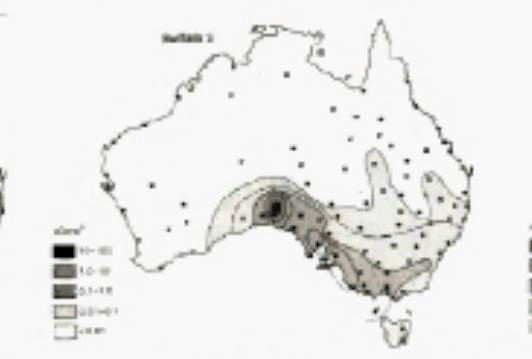
Fallout map from the day Adelaide got hit hard, 11 Oct 1956 …
I was luckily living elsewhere at the time, in NSW … I do remember having bad nose bleeds … we moved to Adelaide a few years later so many of my school and uni and work and sport mates and their mothers were in the thick of the fallout from the British bomb test called Buffalo 3 .. and there are many sad stories of retarded siblings and congenital cardiac issues and early cancers.
QUOTE:
In 1956 a series of atomic tests were carried out in the far north of the state at Maralinga, including the dropping of a bomb from a plane on October 11th, with devastating impacts on nearby Aboriginal communities.
Australian Atomic Confessions [Full Documentary]
Retired academic Roger Cross’s book “Fallout” focuses on the drift of radiation many hundred kilometres south of the site to Adelaide.
“Fortunately for South Australia it was rather a small bomb, but it was dropped from a Valiant Bomber and was designed to explode in the air which it did do,” Mr Cross told Ian Henschke on 891 ABC Adelaide mornings.
“Part of the cloud blew south towards Adelaide and the minor cloud then blew east as it was supposed to across largely uninhabitated areas towards the towns of Sydney and Brisbane and exit Australia between those two cities.
“But the main part of the cloud actually blew down south towards Adelaide and there was great controversy about that,” he said.
Mr Cross says this wasn’t admitted to at the time, causing great controversy.
He says authorities didn’t realise a man called Hedley Marston who was involved with the tests, checking thyroids of sheep and cattle around the area, also set up a secret experiment at the CSIRO building in Adelaide.
Mr Marston recorded a level of 98 thousand counts per hundred seconds the day after the bomb had been dropped.
“The average count in Adelaide at that time was between 40 and 60 counts per hundred seconds,” said Mr Cross.
Mr Marston also carried out some tests on sheep just south and north of Adelaide, finding elevated levels of radiation material in the sheep that were on pasture but not in others that had eaten hay cut the year before.
“This was a very elegant experiment because by luck he had a control, he had this group of sheep that were penned under cover that were just eating hay from previous harvests.”
Mr Cross says Hedley Marston was concerned about strontium 90 in particular and it getting into milk and then being consumed by young children and pregnant women.
Silent Storm atomic testing in Australia
Anti-nuclear campaigner Dr Helen Caldicott entered medical school in Adelaide in 1956 and told Ian Henschke there was no mention of a possible health impact of the tests, and she is not aware of a study of the human population following that test.
“We the population of Adelaide were kept in ignorance and for that I feel very bad about that as a doctor.”
She says you would have to test all the population exposed to radiation throughout their entire life and compare it to people who were not exposed to know if the incidence of cancer was high.
“My prediction is definitely I’m sure it was but we don’t have any evidence.
“Adelaide got a hell of a fallout, and I must say as a young medical student not being taught about that I have deep resentment that the public was not informed about it,” said Dr Caldicott.
(Quote from http://www.abc.net.au/local/stories/2011/03/21/3169570.htm )
(Map is a detail from https://nuclearhistory.wordpress.com/…/allowable-lifetime-…/ )
After Australian Energy Market Operator’s initiatives, South Australia defers energy security target
S.A. puts energy security target on back-burner after AEMO steps in http://reneweconomy.com.au/s-a-puts-energy-security-target-on-back-burner-after-aemo-steps-in-86049/ By Giles Parkinson on 11 September 2017 South Australia has abandoned plans to have its state-based energy security target in place this summer after conceding is could have little impact given the new initiatives by the Australian Energy Market Operator and the lack of competition in the local grid.
Officially, South Australia has decided to “defer” the start date of the EST until 2020, having already deferred it from a July 1 start to a January 1, 2018 start. But given the state poll in 2018, and the new initiatives taking place in the broader market, it seems unlikely to ever see the light of day.
The EST was a key component of the $550 million Energy Security Plan the S.A, government unveiled earlier this year following its dismay at the forced load shedding in February and other incidents.
But it seems likely that the only two components to have a lasting impact will be the Tesla big battery, which is due to come into service on December 1, and the 150MW solar tower and molten salt storage facility in Port Augusta, which will contract to supply the government’s own electricity needs.
The EST was to be one of the centerpieces of the plan, aiming to ensure that 50 per cent of demand was met by S.A.-based “dispatchable” generation by 2025.
The original structure of the EST was harshly criticised because it was thought it would favour gas plants over battery storage, would not reduce prices and could end up as a $3.5 billion subsidy to the gas industry.
But it appears to have been made redundant by AEMO’s decision – explained here – to require that at least three gas generators operate at all times, and more if the wind output from the state’s wind farms is more than 1200MW.
That guarantees the presence of gas-fired generation, but it also means that because three gas units are generating at the same time, and therefore sets the price, the chances of a reduction in wholesale prices are effectively removed.
The impact of the curtailment was made evident last week, when the wind output ran at a steady 1200MW for three days, with no significant fall in prices – apart from when the link to Victoria was constrained – because gas generators had to continue generating.
The S.A. government says that modelling from Frontier Economics, one of the architects of the EST, indicates that if the scheme was to lower power prices it requires the operation of a more competitive energy market.
It suggests that may not occur till 2020, when the solar tower and storage facility, and new facilities supported by the $150 million Renewable Technology Fund are built.
“Since we announced the EST a number of changes in the National Electricity Market have delivered system security outcomes similar to those the EST would seek to achieve,” energy minister Tom Koutsantonis said, noting also AGL’s decision to invest in a new gas generator and the implementation of 49 out of 50 Finkel recommendations.
South Australia’s naval defence interests aiming for nuclear submarines, eventually?
Dan Monceaux Nuclear Fuel Cycle Watch South Australia, 8 September 2017.
Naval defence interests (including ADF, ASC, DCNS, Thales) in the Port Adelaide area are expanding their presences as Australia’s Future Submarine Program advances. DCNS was awarded the contract in April 2016. The Shortfin Barracuda Block 1A was the chosen design.
The French fleet of Barracuda class submarines is being fitted with nuclear propulsion, provided by Areva. The Australian build is expected to use diesel propulsion, but the prospect of a hybrid (some diesel propelled, some nuclear) has been speculated upon.https://www.facebook.com/groups/1021186047913052/
South Australia’s energy security target deferred
 S.A. put energy security target on back-burner after AEMO steps in, REneweconomy By Giles Parkinson on 11 September 2017 South Australia has abandoned plans to have its state-based energy security target in place this summer after conceding is could have little impact given the new initiatives by the Australian Energy Market Operator and the lack of competition in the local grid.
Officially, South Australia has decided to “defer” the start date of the EST until 2020, having already deferred it from a July 1 start to a January 1, 2018 start. But given the state poll in 2018, and the new initiatives taking place in the broader market, it seems unlikely to ever see the light of day.
The EST was a key component of the $550 million Energy Security Plan the S.A, government unveiled earlier this year following its dismay at the forced load shedding in February and other incidents.
But it seems likely that the only two components to have a lasting impact will be the Tesla big battery, which is due to come into service on December 1, and the 150MW solar tower and molten salt storage facility in Port Augusta, which will contract to supply the government’s own electricity needs……..http://reneweconomy.com.au/s-a-put-energy-security-target-on-back-burner-after-aemo-steps-in-86049/
South Australian responses to Federal Nuclear Waste Dump plan – Facebook
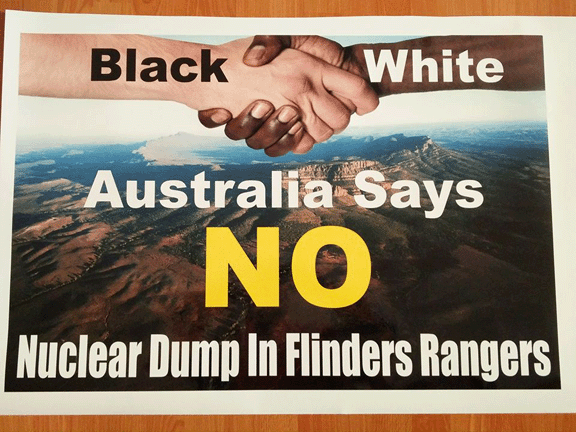 Paul Waldon Fight To Stop Nuclear Waste Dump In Flinders Ranges SA https://www.facebook.com/groups/344452605899556/
Regina McKenzie I say No to nuclear waste dump in the Flinders Ranges or anywhere , the government says if there is a strong community movement against it , they will walk away . So why are they still hanging around Barndioota, Like blow flies on a shitty arse sheep? Honest they say one thing and do another , just a form of bullying from the Federal government, SA dont want No Nuclear Waste dump! Get over it and move on ….. We Say No!
Paul Waldon, How does your community make a small fortune gambling on nuclear waste? You start with a big fortune! The monkeys in the community happy to accept peanuts to risk contamination and death of their environment, maybe satisfied till things go wrong. But remember the culturally significant, seismically unstable, flood prone, non reducing, aquifer vulnerable, tourism missed, and peoples welfare are all issues that ANSTO, ARPANZA, and the Department of Industry, Innovation and Science have all overlooked or have NO regard for, in their wrongful pursuit to ensure their own job security.
Steve Dale They do it because they are drowning in a sea of nuclear muck of their own creation, and they want to keep creating nuclear muck for profit. They are drowning and they are desperate – and if we are not careful they will drag down everything good about South Australia with them.
NOW..
IF A CONTAINMENT FIELD THAT IS MADE `SAFE` CANNOT BE SITUATED NEAR LUCAS HEIGHTS.??..
.
WHY DOES IT NEED TO BE `OUTBACK` IF ITS SOOO SAFE..??..
WE DONT TRUST U MOB TO LEAVE IT LOW..
CMON.. U THINK WE ARE STUPID..!!..
ONCE YOU HAVE LOW-THEN U GO MEDIUM… THEN U GO HIGH AND STUFF FROM ALL OVER THE WORLD(SPENT RODS ect)
Gets sent here for REHAB.. 200,000YRS .
NOOO.. THAT MEANS NNNOOO…
1 This month


Help Aunty Sue Protect Her Land and Sacred Sites From Destructive Rocket Testing.
.

Australians deserve the truth
about
AUKUS – https://aukuspublicinquiry.com/

PETITION – To: Prime Minister Anthony Albanese and the Australian Labor Government

of the week – Australians for War Powers Reform (AWPR)
To see nuclear-related stories in greater depth and intensity

