Fragile ecosystem of the Flinders Ranges – threatened by nuclear waste dumping
 Paul Waldon Fight To Stop Nuclear Waste Dump In Flinders Ranges SA Yesterday,Thursday the 7th of September was Threatened Species Day. The promotion of nuclear waste abandonment in the Flinders Ranges by The Department of Industry, Innovation and Science (DIIS), and ANSTO can only be seen as a irresponsible act pushing life to extinction with a radioactive assault on a incompatible and fragile environment, while threatening the taxon and the biotas of the Flinders Ranges.
South Australia’s Tesla big battery can stop the price gouging by Australia’s major energy players
 How Tesla’s big battery can smash Australia’s energy cartel, REneweconomy, By Giles Parkinson on 4 September 2017 A series of reports from Australia’s Energy Regulator has illustrated how Australia’s big energy players have taken advantage of their market dominance to push up prices for critical grid services, and underline why South Australia was so keen to support the new Tesla big battery.
The Tesla battery, due to be installed by December 1, has been derided by the federal government as too small to do much and about as useful as a Big Banana or Big Pineapple.
But going by the AER reports, it could completely puncture the price gouging (which, we should point out, is perfectly legal according to the market rules) by major energy players that is costing consumers $60 million a year. Continue reading
Deep divisions caused in rural community of Kimba, over Federal govt’s radioactive trash dump plan.
Community torn over Kimba nuclear plan, Eureka Street Michele Madigan | 28 August 2017 The Unlucky Australians, the documentary of the Gurindjis’ campaign for their land, aired on the ABC late on Sunday night 20 August 2017. The Gurindjis’ successful struggle against the combined might of the Vestey empire and the Australian federal government is one of the greatest Australian stories……
Half a century after the Gurindji Walkoff and half a continent away, on Saturday 19 August at a gathering in Port Adelaide, two modern beleaguered groups, one Aboriginal, one non-Aboriginal, shared their current experiences in striving to protect their own lands and ways of life. Like the Gurindji, their struggle is with the federal government and this time, indirectly, with another big business — the nuclear industry. In contrast to the Gurindji struggle however, modern day communities and even families are being torn apart by enticements and pressures.
Two months ago, South Australia’s Premier Jay Weatherill conceded that there is ‘no bipartisan government support’ and ‘not sufficient community support’ to continue with the extraordinary scheme that a SA government sponsored nuclear royal commission had recommended. The Premier gave a commitment that a State Labor government, if re-elected, would now not pursue a high-level international nuclear waste dump.
The federal government however continues its pursuit in SA — the disposable state — of a federal dump for the intermediate long-term nuclear waste from the Lucas Heights nuclear reactor and for medical waste. Now, once again, three sites are being offered up: two in Kimba, at the top of Eyre Peninsula in South Australia, as well as the ongoing Flinders Ranges site.
At the 19 August meeting, Kimba farmers spoke of the offers of a paltry $10 million and a tiny 15 (or fewer) permanent jobs as the payoff for the deep divisions and the certain risk to their markets a federal dumpsite would bring. Farmer Toni Scott, overcome by describing a formerly close-knit community now torn apart, broke down in tears. The close voting statistics for and against the site belie the former Minister for Resources and Northern Australia, Matt Canavan’s assertion that Kimba is clearly in favour.
Farmer Tom Harris’s neighbour is one of two Kimba farmers who have offered possible dumpsites. However the site is closer to Tom’s family homestead than it is to the neighbour’s. It was sobering to hear his facts. Kimba region farmers ‘are recognised as some of the best dry farmers in the world’ but the competition between grain farmers for international markets is so intense that the warning from the professionals is clear: proximity to a nuclear waste dump will have predictably disastrous negative effects. And the irony — ‘It’s the farmers who’ve kept the town going.’
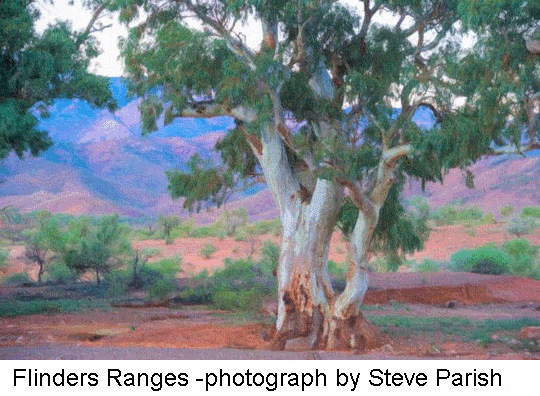
Meanwhile, the Adnymathanha and other Flinders Ranges station and townspeople continue their efforts to protect SA’s iconic Flinders Ranges from the same fate. During the 31 months it has been a preferred site, their trauma has deepened as they have seen other locals acquiesce. Sadly, with the government’s ‘no-strings-attached’ $2 million for community projects, the tearing apart of families has intensified.
The Gurindji had Frank Hardy and Australian unions supporting them during their terrible privations. Many Kimba farmers and townspeople, and the Adnyamathanha, together with some of the townspeople and most of the Flinders Ranges landholders, are grateful for their own southern (or eastern) supporters. They plead for more: ‘Please help us to be heard!’ https://www.eurekastreet.com.au/article.aspx?aeid=52964#.WaXSuvMjHGh
Radioactive wastes: South Australia
 Royal Adelaide Hospital waste to be shipped back overseas when it closes http://www.adelaidenow.com.au/news/south-australia/royal-adelaide-hospital-waste-to-be-shipped-back-overseas-when-it-closes/news-story/a3cdebd7c500f00e67b7913b48e7d900?nk=ba26857f63080120cbd5fc74c94d3959-1503908527, Daniel Wills, State Political Editor, August 27, 2017
RADIOACTIVE waste currently stored at the old Royal Adelaide Hospital is set to be sent back overseas as the site is cleared when health services shift to the other end of North Tce.
With demolition and redevelopment of the site imminent once medical services are transferred to the new hospital next week, The Advertiser can reveal the State Government is developing plans to return the waste back to it European or British origin.
More than a year ago, Renewal SA chief executive John Hanlon told a State Parliament committee how the Government was working on plans to house the waste in SA when the old RAH closed. While no proposal was settled, officials investigated a new SA site that could also be a repository for other low-level radioactive waste scattered in other sites around the state.
A SA Health spokeswoman said the old RAH waste, mostly used for patient treatment and research, was no longer needed once the shift to the new hospital was complete.
“The radioactive sources are currently stored in lead-lined boxes in a secure store in preparation for the removal process,” she said. “Once the old RAH site is decommissioned, the majority of waste radioactive sources will be safely returned to the country of origin.”
Most of the radioactive sources at the old RAH used for medical purposes came from the UK or Europe. SA Health is also working to identify any other origin countries. Final disposal is expected to be dealt with by the source material’s manufacturers.
The department is working with the Australian Nuclear Science and Technology Organisation and the state Environment Protection Authority to ensure safe, and legal removal. The old RAH is one of 78 different facilities in SA currently storing low or intermediate level waste, according to the government’s Nuclear Fuel Cycle Royal Commission.
Low level waste is generated in hospitals and by industry. It comprises paper, rags, tools, and gloves with short-lived radioactivity that do not require shielding during normal handling.
Intermediate waste is typically metal and other materials from decommissioned reactors. It emits higher levels of radiation and requires shielding during handling, transport and storage.
Parliament was told in 2011 that radioactive waste currently at the old RAH is in a basement.SA Health is responsible for the removal of all known radioactive sources before the site is handed over to Renewal SA, which will oversee a $1 billion redevelopment.

A truly good news story – the cuttlefish are back in Spencer Gulf
 South Australians – pat yourselves on the back. When the nuclear lobby wanted to put the nuclear industry up at the top of Spencer Gulf – South Australia said “NO” – as South Australians have been doing for decades – fighting back. Nuclear power would have caused releases of hot water into the Gulf, ruining the special temperature conditions essential for the breeding of these unique and beautiful animals.
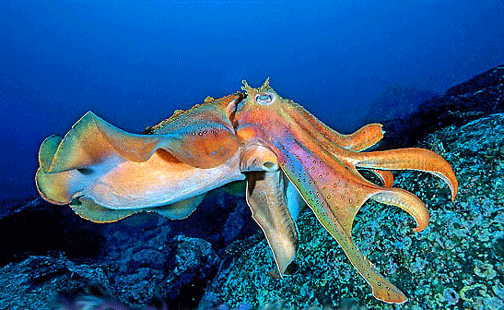
We don’t really know why they dwindled, and why they’re now back. But hooray for their return!
Thousands of giant cuttlefish back in SA http://www.heraldsun.com.au/news/breaking-news/thousands-of-giant-cuttlefish-back-in-sa/news-story/f859a1f7bd568fb213ae2fe4fe66b680, Australian Associated Press, August 25, 2017 Thousands of giant cuttlefish are flocking to the rocky coastline of the upper Spencer Gulf in South Australia to spawn in record numbers, reserving a worrying decline.
More than 100,000 cuttlefish have journeyed to Point Lowly near Whyalla to breed, according to data from the state government’s principal research institute.
The number is up from a record low of just over 13,000 in 2013.
The giant Australian cuttlefish – which can reach up to 60cm in length and weigh five kilograms – live for two to three years and migrate annually to Spencer Gulf to spawn.
The worrying decline in their numbers in 2013 promoted more research into their breeding patterns. This year’s population estimate is the third-highest recorded over the last decade,” said senior research scientist Dr Mike Steer.
It is still not completely understood why cuttlefish migrate to the Spencer Gulf nor why their numbers declined, but fishing restrictions have been put in place until 2018 as a precaution.
“The last five years of research has clearly demonstrated the population’s capacity to rebound from low numbers very quickly,” Dr Steer said.
Safety concerns about Port Pirie’s former uranium plant site raised by Liberal candidate
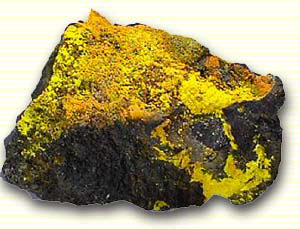 Liberal candidate raises safety concerns about Pirie’s former uranium plant site, Port Pirie Recorder, 25 Aug 17, Frome Liberal candidate Kendall Jackson is calling on the state government to restore the fence at the former Port Pirie Uranium and Rare Earth Treatment Plant and Tailings site.
She said the State Development Department was responsible for managing the area and was yet to release the Radiation and Environment Management Plan for the site.
This was expected to be released in the first half of this year.
“The government must publicly release its plans for the former uranium plant site,” Mrs Jackson said.
“Residents deserve to know what the government has planned for the site and why the report is taking so long to be publicly released…..http://www.portpirierecorder.com.au/story/4877490/fears-over-former-uranium-plant-site/
Energy Minister Frydenberg stalling on decision about $110m Port Augusta solar thermal funds?
 Frydenberg calls for advice on $110m Port Augusta solar thermal funds, REneweconomy
In a statement late Thursday, Frydenberg said he had written to SolarReserve asking for details about the proposal to spend $650 million building a 150MW solar tower plant with molten salt storage near the shuttered coal plants outside of Port Augusta.
“Solar thermal plants operate in a similar way to traditional fossil fuel power plants with steam spinning a conventional turbine, which means they can contribute to network stability and reliability when coupled with built-in storage,” Frydenberg noted.
A contract signed between SolarReserve and the South Australian government promises a price cap of $78/MWh for all the state government’s electricity needs, but the price is dependent on SolarReserve accessing the cheap equity on offer from the federal government.
That offer – made by both mainstream parties in the lead up to the last election – was reinforced in the federal budget by the Turnbull government as part of a tax policy deal with Senator Nick Xenophon.
However, the funds had yet to be allocated to any project. ARENA was tasked with seeking expressions of interest on the solar thermal funding for Port Augusta, but did not call for detailed proposals…..
“ARENA and the CEFC have a strong track record in supporting the commercialisation of emerging technologies and will use that expertise to take solar thermal to the next level in Australia,” he said in a statement.
The IPFA advises the Federal government on funding and financing solutions for nationally significant infrastructure across all sectors, including energy. http://reneweconomy.com.au/frydenberg-calls-for-advice-on-110m-port-augusta-solar-thermal-funds-54190/
South Australia calls for Federal Govt loan for Port Augusta solar plant
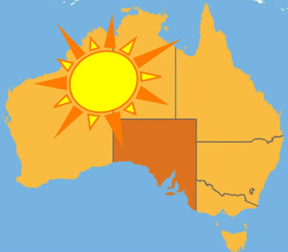 Premier Jay Weatherill calls on Federal Government to provide $110m loan for $650m Port Augusta solar plant, Adam Langenberg, Luke Griffiths, The AdvertiserAugust 23, 2017 PREMIER Jay Weatherill has dared the Federal Government to block a $110 million loan banked on to finance Port Augusta’s $650 million solar thermal plant……
Mr Frydenberg was in Whyalla on Wednesday as he launched a $30 million battery storage facility on the Yorke Peninsula, as revealed by The Advertiser yesterday.
He said it would play an important role in securing South Australia’s electricity network.
Less than two months after the State Government announced its deal with US billionaire Elon Musk’s Tesla, Mr Frydenberg unveiled plans that would see the Federal Government’s Australian Renewable Energy Agency fund up to 40 per cent of a 30MW, 8MW/h battery.
Electranet will design and build the battery before leasing out its commercial operation to a yet-to-be-decided energy retailer.
To be located at Dalrymple — one of the electricity network’s “weak points”, according to Mr Frydenberg — it is expected to be connected to the grid by February 2018.
The Tesla battery, to be located in Jamestown, will be 100MW, 129MW/h.
“We don’t claim to have the biggest battery or the biggest system, what we do claim is to be putting in place practical, cost-effective, needed policy solutions and practical solutions to the challenges SA faces,” Mr Frydenberg said prior to presenting at the Global Maintenance Upper Spencer Gulf conference in Whyalla…….
In his speech, Mr Koutsantonis declared the Upper Spencer Gulf an economic participation region under the State Government’s industry participation policy.
Local businesses will now be given a 20 per cent weighting when vying for public project work.
“We have seen how successful this policy has been since it was implemented in northern Adelaide and now we want to replicate those achievements in the Upper Spencer Gulf,” he said. http://www.adelaidenow.com.au/news/south-australia/premier-jay-weatherill-calls-on-federal-government-to-provide-110m-loan-for-650m-port-augusta-solar-plant/news-story/40c4bb6cffce77e1c2cf0f5816fd1334
Non nuclear production of medical radioisotopes st South Australian Health and Medical Research Institute
85% of ANSTO Lucas Heights isotope production is for Technetium 99. This can also be made in a cyclotron by using electricity – which makes NO Intermediate Level Waste & NO long lived LLW – thereby negating a national radioactive dump facility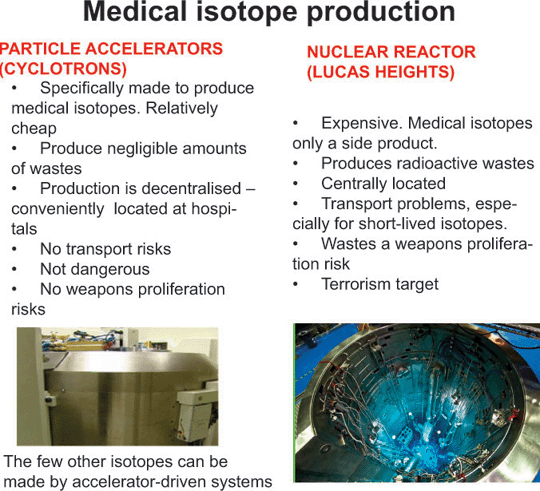
State’s most advanced clinical imaging centre, worth $13m, opens at SAHMRI http://www.adelaidenow.com.au/news/south-australia/states-most-advanced-clinical-imaging-centre-worth-13m-opens-at-sahmri/news-story/a20eb257edad98bb0597dd787aa6837b?nk=ba26857f63080120cbd5fc74c94d3959-1503458683, Brad Crouch, Medical Reporter, The Advertiser February 15, 2017 THE growing South Australian Health and Biomedical Precinct takes another step forward today with the opening of the most advanced clinical imaging centre in the state.
The $13 million Clinical and Research Imaging Centre at the South Australian Health and Medical Research Institute has been established in partnership with Dr Jones and Partners Medical Imaging.
Space on the ground level of the SAHMRI building on North Terrace has become a Dr Jones & Partners clinic, with dedicated time allocated to SAHMRI researchers for clinical research without compromising the scheduling of patient treatments.
State-of-the-art imaging equipment in the centre includes CT, MRI and PET/CT platforms.
Officials say the arrangement is moving SAHMRI in a new direction of commercialisation with industry partners to create a facility to benefit researchers with the aim of improving the treatment and diagnosis of patients. Continue reading
30MW battery to create renewables-based mini grid in South Australia
 http://reneweconomy.com.au/30mw-battery-to-create-renewables-based-mini-grid-in-south-australia-63304/, By Giles Parkinson on 23 August 2017 The Australian Renewable Energy Agency says it is providing $12 million towards the $30 million cost of a major battery storage installation to be located on the Yorke Peninsula in South Australia and close to the Wattle Point wind farm.
The 30MW/8MWh large scale battery will deliver both network services and market services, and is the result of a lengthy study begun in 2014 called ESCRI (Energy Storage for Commercial Renewable Integration) by local grid operator ElectraNet, Worley Parsons and AGL.
It is designed principally to provide fast frequency response and help balance the local network, but it will also help reduce congestion on the Heywood interconnector with Victoria, because its placement means more power can be transported over the line. This should relieve constraints imposed by the market operator.
It will also have the ability to “island” the local network – pairing with the local 90MW Wattle Point wind farm and local rooftop solar PV as a local micro-grid to ensure grid security and so keep the lights on in case the network failures elsewhere in the state.
ARENA CEO Ivor Frischknecht says having a series of mini-grids across the state would help ensure grid security. If more were added, “it means over the longer term that state wide blackouts will be a think of the past,” he told Reneweconomy.
Indeed, AGL – which will operate the battery – said last year after the state-wide blackout that renewable-based micro-grids were the best way to ensure grid security. Continue reading
South Australian govt’s pro nuclear propaganda campaign was expensive
 Agency formed to push nuclear waste dump to SA spent $7.6 million http://www.adelaidenow.com.au/news/south-australia/agency-formed-to-push-nuclear-waste-dump-to-sa-spent-76-million/news-story/34c2ed1ade9a24c8d195ecf32f45709d 20 Aug 17, Miles Kemp,
THE taxpayer has been handed a “catering” bill that is the equivalent of 45,000 cups of coffee, for a talkfest on nuclear energy. The catering bill for the so-called “Nuclear Fuel Cycle Royal Commission Consultation and Response Agency” was $182,580.
Two Kimba farmers happy at the prospect of stranded radioactive trash on their land
 Nuclear medicine production in Australia at risk if dump site can’t be found, industry head says ABC, Landline By Marty McCarthy 19 Aug 17, Australia may have to stop producing nuclear medicine if it cannot find a central site to dump all of the radioactive rubbish made in the process in the next decade.
The Federal Government has been trying to find a site somewhere in Australia to dump nuclear waste for 30 years, including all the waste produced by the government-owned OPAL reactor at Lucas Heights.
There is about 4,250 square metres of radioactive waste in Australia — enough to fill two Olympic-sized swimming pools — and most of it is held at the Australian Nuclear Science Technology Organisation (ANSTO) at Lucas Heights…… the facility also stores a small amount of intermediate-level waste.
This waste comes from the spent fuel rods used in Australia’s first nuclear reactor, HIFAR, which operated for 50 years and was decommissioned in 2007.
The TN81 cask is a 120-tonne rubbish bin that currently contains more than half of the waste from 2,000 spent fuel rods used in HIFAR over its half-a-century-lifespan.
“This does actually represent one of the more radioactive things in Australia,” said James Hardiman, waste operations manager at ANSTO…..
‘It’s for Kimbra we are doing this’
The rural town of Kimba, on South Australia’s Eyre Peninsula, could be the eventual home of all of Australia’s nuclear waste. Two farmers in the region have put forward their properties, along with a third at Barndioota in the Flinders Rangers, for the Federal Government to build its facility on.
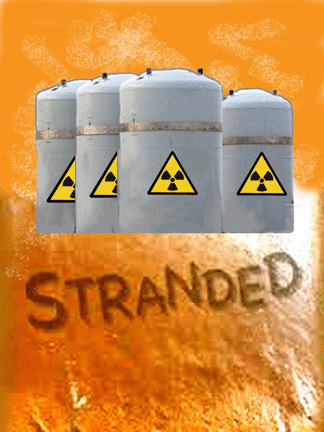 The site would be a permanent dump for all of the low-level waste, which would be buried in cement chambers and left for 300 years, and a temporary storage site for the more dangerous, intermediate-level waste…..To guarantee your town’s future for the next 300 years is pretty good reason for me, because they are talking 100 years of storing the waste and 300 years of monitoring,” Jeff Baldock said.
Bob Maitland, who owns farmland next to Mr Baldock’s property, said he had a moral obligation to support his neighbour’s nuclear dump plan. “It’s for Kimba we are doing this, not for ourselves.” http://www.abc.net.au/news/2017-08-19/nuclear-medicine-production-in-australia-at-risk:-industry-head/8815902
Stand Tall: No Dump Alliance urges South Australian leaders to halt nuclear waste plan.
The No Dump Alliance has today launched a petition targeting Premier Jay Weatherill and Opposition leader Steven Marshall to take a stand and use SA’s existing no dump laws to publicly oppose the federal government plan to build a nuclear waste dump in South Australia.

One site in the Flinders Ranges and two sites near Kimba on the Eyre Peninsular are now being assessed by the federal government to become the nation’s nuclear waste facility.
The majority of this waste is currently in storage at secure federal facilities and no compelling case has been made for its transfer. There is clear community opposition to Canberra’s plan in both affected regions and the Alliance supports the growing national call for an open review of all waste management options, rather than targeting regional communities for a dump site.
In a statement the Alliance outlined that this “is the time to stand up. South Australians have fought and won the nuclear waste battle before.” The Alliance petition is calling on the leaders of both major political parties in SA to commit to using the existing Nuclear Waste Storage Facility (Prohibitions) Act, 2000 to send a clear message of active opposition to the federal dump plan.
“We need our state leaders to stand with us against this federal plan, this process had already cause immeasurable damage to our community and it needs to stop. We do not want our agricultural region exposed to the risks this nuclear waste presents and we need our leaders to ensure our that state legislation is upheld.” said Kimba resident and No Radioactive Waste Dump on Agricultural Land in Kimba or SA President, Peter Woolford.
Following the end of plans for SA to host international radioactive waste the No Dump Alliance has refocused its work to support communities targeted by the federal government’s plan to build a nuclear waste dump in SA. This will be a key focus of the Alliance’s work in the lead up to the 2018 state election.
“The Australian Education Union applauded the Premier’s announcement that an international waste dump in SA is no longer in question and will not be progressed by the current or future Labor governments. However, if by his own admission the show of solidarity by the wider community with the Aboriginal community in protest of any nuclear storage on SA land is to have any credence this must be followed with a clear rejection of the Federal government’s proposal to use this state as the nuclear waste bin for the nation” Said Dash Taylor Johnson, Australian Education Union and No Dump Alliance member.
South Australian Premier announces Solar thermal power plant for Port Augusta
Solar thermal power plant announced for Port Augusta ‘biggest of its kind in the world’, ABC, 15 August 17, A 150-megawatt solar thermal power plant has been secured for Port Augusta in South Australia, State Premier Jay Weatherill has announced.
Construction of the $650 million plant will start in 2018.
Concentrated Solar Power Simple Explanation
Aurora facts:
- 150-megawatt solar thermal power with eight hours of storage
- Plant will deliver 495 gigawatt hours of power annually, or 5 per cent of SA’s energy needs
- Equivalent to powering more than 90,000 homes
- Located 30 kilometres north of Port Augusta
- Company says it is “completely emission free”
Mr Weatherill said the Aurora Solar Energy Project would be ready to go in 2020 and would supply 100 per cent of the State Government’s needs.
The Government will pay a maximum of $78 per megawatt hour.
Mr Weatherill said the solar thermal plant was “the biggest of its kind in the world”.
“Importantly, this project will deliver more than 700 jobs, with requirements for local workers,” he said…….
A 150-megawatt solar thermal power plant has been secured for Port Augusta in South Australia, State Premier Jay Weatherill has announced.
Construction of the $650 million plant will start in 2018.
Mr Weatherill said the Aurora Solar Energy Project would be ready to go in 2020 and would supply 100 per cent of the State Government’s needs.
The Government will pay a maximum of $78 per megawatt hour.
Mr Weatherill said the solar thermal plant was “the biggest of its kind in the world”.
“Importantly, this project will deliver more than 700 jobs, with requirements for local workers,” he said.
Mirrors to direct sunlight onto tower
Solar thermal uses heliostats, or mirrors, to concentrate sunlight onto a tower that heats molten salt. The heat created is then used to generate steam.
Solar Reserve said the plant will be able to provide between eight and 10 hours of storage and had no requirement for gas or oil generated electricity as a backup.
It is expected to employ 50 full-time workers on an ongoing basis once it is operational.
The company said the power station will operate in a similar fashion to a coal or gas station, meaning many of the jobs would “require the same skill sets”.
Mr Smith said he looked forward to supporting “federal and state renewable energy targets”. http://www.abc.net.au/news/2017-08-14/solar-thermal-power-plant-announcement-for-port-augusta/8804628
Port Augusta local community welcome greenlighting of solar thermal power plant
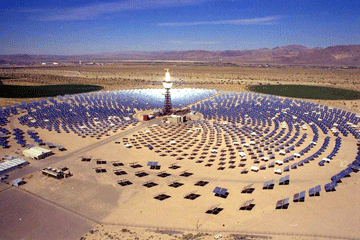 Solar thermal power plant supporters and locals welcome greenlighting of Port Augusta project, ABC North and West , By Khama Reid 14 Aug 17 The Port Augusta community and its clean energy supporters have welcomed the news that the world’s largest solar thermal power station will be built in the region.
It was announced yesterday that US operator Solar Reserve would build the 150 megawatt power station known as the Aurora Solar Energy Project at Carriewerloo Station, about 330 kilometres north of Adelaide……
The Government and company attended a public meeting at Port Augusta where they were met with applause and cheering…..
Local Aboriginal leader Malcolm ‘Tiger’ McKenzie said he could see many opportunities in the project to boost employment for Aboriginal people.
“We’re 30 per cent of the population but we don’t participate in the workforce as much,” he said.
Mr McKenzie said he wanted to work with the Government and Solar Reserve to get the best employment outcomes.
“It’s a modern Australia now. We as Aboriginal people have got to maximise opportunities to live in this country and that’s having a job, having an education and contribute.”……
http://www.abc.net.au/news/2017-08-15/port-augusta-welcomes-solar-thermal-power-plant-announcement/8810394
1 This month


Help Aunty Sue Protect Her Land and Sacred Sites From Destructive Rocket Testing.
.

Australians deserve the truth
about
AUKUS – https://aukuspublicinquiry.com/

PETITION – To: Prime Minister Anthony Albanese and the Australian Labor Government

of the week – Australians for War Powers Reform (AWPR)
To see nuclear-related stories in greater depth and intensity

