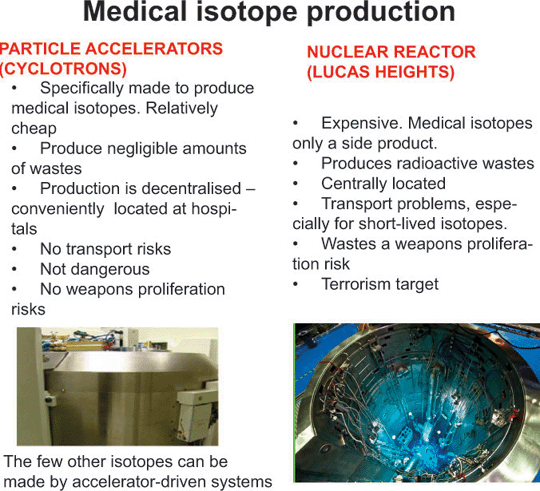
85% of ANSTO Lucas Heights isotope production is for Technetium 99. This can also be made in a cyclotron by using electricity – which makes NO Intermediate Level Waste & NO long lived LLW – thereby negating a national radioactive dump facility
Having the CRIC located on the same site as SAHMRI’s cyclotron will enable new shorter half-life compounds to be used in research. There are now several compounds being developed using the cyclotron for conditions such as dementia, cancer and cardiovascular disease which need to be tracked by advanced imaging machines.
The $13 million Clinical and Research Imaging Centre at the South Australian Health and Medical Research Institute has been established in partnership with Dr Jones and Partners Medical Imaging.
Space on the ground level of the SAHMRI building on North Terrace has become a Dr Jones & Partners clinic, with dedicated time allocated to SAHMRI researchers for clinical research without compromising the scheduling of patient treatments.
State-of-the-art imaging equipment in the centre includes CT, MRI and PET/CT platforms.
Officials say the arrangement is moving SAHMRI in a new direction of commercialisation with industry partners to create a facility to benefit researchers with the aim of improving the treatment and diagnosis of patients. Continue reading →
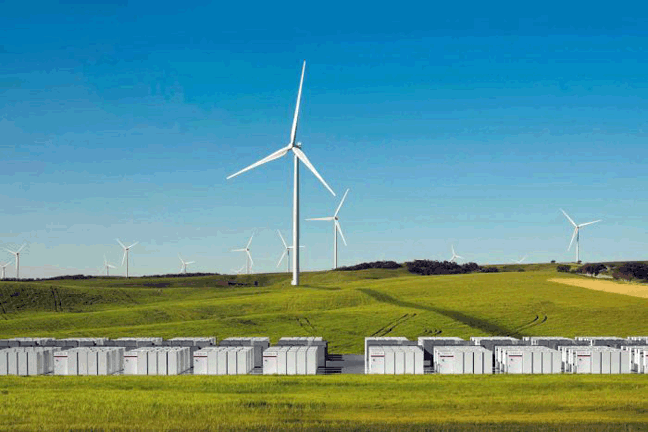
The 30MW/8MWh large scale battery will deliver both network services and market services, and is the result of a lengthy study begun in 2014 called ESCRI (Energy Storage for Commercial Renewable Integration) by local grid operator ElectraNet, Worley Parsons and AGL.
It is designed principally to provide fast frequency response and help balance the local network, but it will also help reduce congestion on the Heywood interconnector with Victoria, because its placement means more power can be transported over the line. This should relieve constraints imposed by the market operator.
It will also have the ability to “island” the local network – pairing with the local 90MW Wattle Point wind farm and local rooftop solar PV as a local micro-grid to ensure grid security and so keep the lights on in case the network failures elsewhere in the state.
The battery is due to be in operation by February, 2018, adding to the Tesla big battery which is due to be in place by December 1, up to 100MW of demand response, and emergency back-up generators.
ARENA CEO Ivor Frischknecht says having a series of mini-grids across the state would help ensure grid security. If more were added, “it means over the longer term that state wide blackouts will be a think of the past,” he told Reneweconomy.
Indeed, AGL – which will operate the battery – said last year after the state-wide blackout that renewable-based micro-grids were the best way to ensure grid security. Continue reading →
THE taxpayer has been handed a “catering” bill that is the equivalent of 45,000 cups of coffee, for a talkfest on nuclear energy. The catering bill for the so-called “Nuclear Fuel Cycle Royal Commission Consultation and Response Agency” was $182,580.
The extraordinary cost is revealed in Freedom of Information documents released to the Opposition, which show the agency’s budget blew out by $400,000 to $7.6 million. It included $185,477 for media monitoring, $1.04 million for photography/AV and production, $152,373 for accommodation in South Australia, $256,771 for international and domestic travel, and $1.08 million spent on contractors.
The agency’s brief was to sell thefindings of the Royal Commission to the South Australian public — that nuclear energy generation was not feasible but a dump should be explored.
Opposition treasury spokesman Rob Lucas said: “Taxpayers should be concerned about how their money was spent chasing the Weatherill Government’s nuclear thought bubble’’.
“It is incredible that the agency managed to rack up an $180,000 catering bill in one year. That could have bought more than 45,000 cups of takeaway coffee or 123 coffees per day. Given the Weatherill Government’s track record of treating taxpayers’ money with contempt, we’ll be pursuing a further breakdown of these costs.”
Former Royal Commissioner Kevin Scarce distanced himself from the budget blowout and said it all happened after his watch. “The commission I led had no connection with CARA. CARA formed as the commission completed its work,’’ he said.
The stated purpose of the agency was to: “Seek to understand the South Australian community’s perspectives on further involvement in the nuclear fuel cycle’’.
The second jury comprised 300 people randomly selected from the population, which could explain the large expenditure.
A Government spokesman said the nuclear fuel cycle consultation was “the biggest in the state’s history” and the budget was publicly disclosed and “received bipartisan support”. “The Government makes no apologies for undertaking such an extensive consultation process to ensure all South Australians had the opportunity to have their say on this important matter,” he said.
Nuclear medicine production in Australia at risk if dump site can’t be found, industry head says ABC, Landline By Marty McCarthy 19 Aug 17, Australia may have to stop producing nuclear medicine if it cannot find a central site to dump all of the radioactive rubbish made in the process in the next decade.
The Federal Government has been trying to find a site somewhere in Australia to dump nuclear waste for 30 years, including all the waste produced by the government-owned OPAL reactor at Lucas Heights.
There is about 4,250 square metres of radioactive waste in Australia — enough to fill two Olympic-sized swimming pools — and most of it is held at the Australian Nuclear Science Technology Organisation (ANSTO) at Lucas Heights…… the facility also stores a small amount of intermediate-level waste.
This waste comes from the spent fuel rods used in Australia’s first nuclear reactor, HIFAR, which operated for 50 years and was decommissioned in 2007.
The TN81 cask is a 120-tonne rubbish bin that currently contains more than half of the waste from 2,000 spent fuel rods used in HIFAR over its half-a-century-lifespan.
“This does actually represent one of the more radioactive things in Australia,” said James Hardiman, waste operations manager at ANSTO…..
‘It’s for Kimbra we are doing this’
The rural town of Kimba, on South Australia’s Eyre Peninsula, could be the eventual home of all of Australia’s nuclear waste. Two farmers in the region have put forward their properties, along with a third at Barndioota in the Flinders Rangers, for the Federal Government to build its facility on.
The site would be a permanent dump for all of the low-level waste, which would be buried in cement chambers and left for 300 years, and a temporary storage site for the more dangerous, intermediate-level waste…..To guarantee your town’s future for the next 300 years is pretty good reason for me, because they are talking 100 years of storing the waste and 300 years of monitoring,” Jeff Baldock said.
The No Dump Alliance has today launched a petition targeting Premier Jay Weatherill and Opposition leader Steven Marshall to take a stand and use SA’s existing no dump laws to publicly oppose the federal government plan to build a nuclear waste dump in South Australia.
One site in the Flinders Ranges and two sites near Kimba on the Eyre Peninsular are now being assessed by the federal government to become the nation’s nuclear waste facility.
The majority of this waste is currently in storage at secure federal facilities and no compelling case has been made for its transfer. There is clear community opposition to Canberra’s plan in both affected regions and the Alliance supports the growing national call for an open review of all waste management options, rather than targeting regional communities for a dump site.
In a statement the Alliance outlined that this “is the time to stand up. South Australians have fought and won the nuclear waste battle before.” The Alliance petition is calling on the leaders of both major political parties in SA to commit to using the existing Nuclear Waste Storage Facility (Prohibitions) Act, 2000 to send a clear message of active opposition to the federal dump plan.
“We need our state leaders to stand with us against this federal plan, this process had already cause immeasurable damage to our community and it needs to stop. We do not want our agricultural region exposed to the risks this nuclear waste presents and we need our leaders to ensure our that state legislation is upheld.” said Kimba resident and No Radioactive Waste Dump on Agricultural Land in Kimba or SA President, Peter Woolford.
Following the end of plans for SA to host international radioactive waste the No Dump Alliance has refocused its work to support communities targeted by the federal government’s plan to build a nuclear waste dump in SA. This will be a key focus of the Alliance’s work in the lead up to the 2018 state election.
“The Australian Education Union applauded the Premier’s announcement that an international waste dump in SA is no longer in question and will not be progressed by the current or future Labor governments. However, if by his own admission the show of solidarity by the wider community with the Aboriginal community in protest of any nuclear storage on SA land is to have any credence this must be followed with a clear rejection of the Federal government’s proposal to use this state as the nuclear waste bin for the nation” Said Dash Taylor Johnson, Australian Education Union and No Dump Alliance member.
Solar thermal power plant announced for Port Augusta ‘biggest of its kind in the world’, ABC, 15 August 17,A 150-megawatt solar thermal power plant has been secured for Port Augusta in South Australia, State Premier Jay Weatherill has announced.
Construction of the $650 million plant will start in 2018.
Concentrated Solar Power Simple Explanation
Aurora facts:
150-megawatt solar thermal power with eight hours of storage
Plant will deliver 495 gigawatt hours of power annually, or 5 per cent of SA’s energy needs
Equivalent to powering more than 90,000 homes
Located 30 kilometres north of Port Augusta
Company says it is “completely emission free”
Mr Weatherill said the Aurora Solar Energy Project would be ready to go in 2020and would supply 100 per cent of the State Government’s needs.
The Government will pay a maximum of $78 per megawatt hour.
Mr Weatherill said the solar thermal plant was “the biggest of its kind in the world”.
“Importantly, this project will deliver more than 700 jobs, with requirements for local workers,” he said…….
A 150-megawatt solar thermal power plant has been secured for Port Augusta in South Australia, State Premier Jay Weatherill has announced.
Construction of the $650 million plant will start in 2018.
Mr Weatherill said the Aurora Solar Energy Project would be ready to go in 2020and would supply 100 per cent of the State Government’s needs.
The Government will pay a maximum of $78 per megawatt hour.
Mr Weatherill said the solar thermal plant was “the biggest of its kind in the world”.
“Importantly, this project will deliver more than 700 jobs, with requirements for local workers,” he said.
Mirrors to direct sunlight onto tower
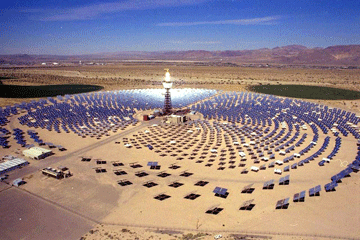
Solar thermal uses heliostats, or mirrors, to concentrate sunlight onto a tower that heats molten salt. The heat created is then used to generate steam.
Solar Reserve said the plant willbe able to provide between eight and 10 hours of storage and had no requirement for gas or oil generated electricity as a backup.
It is expected to employ 50 full-time workers on an ongoing basis once it is operational.
The company said the power station will operate in a similar fashion to a coal or gas station, meaning many of the jobs would “require the same skill sets”.
Solar thermal power plant supporters and locals welcome greenlighting of Port Augusta project, ABC North and West , By Khama Reid 14 Aug 17 The Port Augusta community and its clean energy supporters have welcomed the news that the world’s largest solar thermal power station will be built in the region.
It was announced yesterday that US operator Solar Reserve would build the 150 megawatt power station known as the Aurora Solar Energy Project at Carriewerloo Station, about 330 kilometres north of Adelaide……
The Government and company attended a public meeting at Port Augusta where they were met with applause and cheering…..
Local Aboriginal leader Malcolm ‘Tiger’ McKenzie said he could see many opportunities in the project to boost employment for Aboriginal people.
“We’re 30 per cent of the population but we don’t participate in the workforce as much,” he said.
Mr McKenzie said he wanted to work with the Government and Solar Reserve to get the best employment outcomes.
BY the end of this decade the skyline of Port Augusta will be marked by a massive tower generating enough power to supply all the schools, hospitals, police stations, government offices, and electrified trams and trains across the state.
Plans were confirmed yesterday to build a sprawling hi-tech solar thermal power plant just outside the regional city.
Residents, environmentalists and politicians have lobbied for years to secure the renewable energy source as the city faced the closure of its long-standing Northern coal-fired power station.
Yesterday they recorded a much-anticipated victory which will benefit the Upper Spencer Gulf region, and the wider state.
US-based company SolarReserve will stump up $650 million to erect the plant, featuring 12,000 “billboard-sized” mirrors focusing the sun’s rays to a point atop a 227m tower to a temperature of 565C.
The technology will enable the mirrors to follow and reflect the sun’s rays with pinpoint precision.
SolarReserve executives said they chose the Port Augusta site, in part, because it boasts workers skilled in power plant operations, who will be buoyed by the new employment prospect.
About 700 direct jobs, and up to 4000 indirect roles, will be created as a result.
The site could even prove to be a tourist attraction, like a similar – but smaller – plant in the American state of Nevada.
And the increased energy market competition should contribute to lower prices for all users.
Unlike previous construction job creators, such as the new RAH or South Rd upgrades, no taxpayer funding was needed for the project.
Instead, the State Government has signed a contract to buy all the power it requires for the next two decades – and at a cheap price, according to the Premier.
South Australia has faced searing criticism in recent months for its unstable energy supply and desperately needs a baseload generator like this to improve reliability and costs.
L-R ANSTO’s Chief Nuclear Officer Hef Griffiths; Michelle Rayner; Brett Rayner with the most radioactive waste on site at ANSTO:
Steve Dale Fight To Stop Nuclear Waste Dump In Flinders Ranges SAThe container pictured contains 15 Petabecquerels of radioactivity. If the walls weren’t 20cm thick solid steel it would kill any who stood too close for too long. Estimates are around 20 Petabecquerels of Cesium-137 contaminated the land and sea around Fukushima. There’s enough radioactivity in that high level waste container to Fukushima all the farmland, fisheries and tourism around Kimba. https://www.facebook.com/groups/344452605899556/
SA’s energy revolution – what it means for Australia http://www.examiner.com.au/story/4803957/sas-energy-revolution-what-it-means-for-australia/?cs=97 John Grimes 23 Jul 2017 The energy storage revolution has arrived with a bang. The recent announcement by the South Australian government that it will partner with Elon Musk’s Tesla to build the world’s biggest lithium-ion battery was a lightning bolt moment with profound implications for regional communities. The 100MW battery will provide stability for a wind farm, and emergency backup power. It will also provide badly needed jobs for regional towns in construction, operation and maintenance, as well as tourism from those flocking to see this technological wonder.
This project marks just the beginning. Both Victoria and Queensland are planning similar large-scale battery projects, and storage is also being rolled out in homes, businesses and regional communities across the country.
Australia has the highest rate of household solar use in the world, so it makes sense that families would look to batteries to store excess electricity (created during the day) to be used when they need it most (when returning home from work or school).
Around 20,000 families have solar batteries now, but as prices keep plummeting it’s not unreasonable to expect 500,000 Australians will have them by 2020.
Many companies offer mouth-watering financial packages that combine solar and storage. German battery storage company Sonnen is offering Aussies free electricity – paying customers’ power bills in return for accessing the battery storage capacity to provide grid balancing services for network operators.
Storage has arrived and it will give you control of your energy use, and slash your power bills. With power prices set to rise by up to 20 per cent, now is the time to shop around and see how solar and storage can work for you.
John Grimes is the Chief Executive of the Australian Solar Council and Australian Energy Storage Council.
“…….Mr Parnell said the laws — changed last year to allow public consultation on the issue — must be reinstated now Premier Jay Weatherill said the nuclear debate was dead.
“The Government has already wasted over $13 million of taxpayers’ money on this dump proposal and I want to make sure that any future public relations exercises for harebrained schemes like this won’t be funded without Parliament’s approval,” Mr Parnell said.
“There are still too many diehard nuclear dump supporters inside both the old parties for us to trust them with public money.”
States harden threat to got it alone on clean energy target, THE AUSTRALIAN, 15 July 17 ROSIE LEWIS, Reporter, Canberra @rosieslewis and SID MAHER, NSW Editor, Sydney@sidmaher
Labor states have ramped up pressure on the Turnbull government to adopt a clean energy target but refused to lift bans on gas exploration, triggering warnings from industry leaders that time was running out for a national approach to lowering electricity costs and securing supply.
A crucial meeting of the nation’s state and federal energy ministers yesterday signed 49 of the 50 recommendations handed down by Chief Scientist Alan Finkel, but Queensland, Victoria, South Australia and the ACT stuck to their threat to “go it alone” on a target and moved to “immediately develop and design” options for implementing the mechanism………
The Australian Energy Council, representing major gas and electricity businesses, said brokering a national and bipartisan CET was fundamental to overcoming the energy crisis.
“Successful reform and lower energy bills will only come from bipartisan support and national implementation. Investment behind this reform will run for decades, so we need to find broad and enduring agreement to give it the confidence to proceed.’’
Key Finkel recommendations agreed to at the Council of Australian Governments Energy Council meeting in Brisbane include an obligation on intermittent sources of generation such as wind and solar to provide appropriate levels of backup power to guard against blackouts; a requirement for large generators to give at least three years’ notice before closing; and the establishment of an energy security board to scrutinise the National Electricity Market’s health, security and reliability.
The states also backed the federal government’s decision to abolish the Limited Merits Review — a tool the government says has been used by power companies to increase electricity prices — and accelerate the timetable for gas pipelines reform.
The price and availability of long-term electricity retail contracts will be published so big consumers can understand the market they are competing in.
Grattan Institute energy director Tony Wood said the only factors likely to drive any easing of prices were a decision by the Queensland government to order its generators to lower their returns, and the final commissioning of the Gladstone LNG export facilities, which could see more gas made available for domestic use and ease gas prices……
What Elon Musk’s investment tells us about our energy crisis, The Age, Perry Williams and Jason Scott JULY 14 2017 – Elon Musk’s intervention in Australia’s energy crisis is widening a divide over the future of coal.
The billionaire Tesla founder, who’spromised to help solve South Australia’s clean energy obstacles, sees no place for the fossil fuel.That conflicts with the federal government’s push for it remaining a mainstay source of electricity generation, as well as the “clean, beautiful coal” technologies that US President Donald Trump sees helping to save American mining jobs.
“Coal doesn’t have a long-term future,” Musk told reporters in Adelaide last week during a short trip to Australia. “The writing’s on the wall.” His declaration in energy-strapped South Australia, where the 46-year-old entrepreneur announced plans to build the world’s biggest battery to support the state’s blackout-plagued power grid, has rankled politicians.
Energy minister Josh Frydenberg, 45, accused the state of tapping a celebrity to paper over its patchy clean energy record. Tesla’s battery plan “is a lot of sizzle for very little sausage”, Frydenberg, a member of the conservative Liberal-led federal government, said on Monday. Deputy Prime Minister Barnaby Joyce, 50, said Musk’s plan “doesn’t make a hell of a lot of difference” to the nation’s struggles over energy security.
Most of Australia’s states and territories – free to determine their own energy and climate policies independent of the national government – beg to differ. Just hours after Musk’s announcement, the neighbouring state of Victoria closed the door on new coal-fired power stations, saying energy companies would rather invest in renewables.
Energy policy is a fraught subject with a push by the majority of Australians for more renewable power sources from the Australian majority is clashing with the government’s political imperative to keep a lid on soaring power prices. Currently, some 76 per cent of Australia’s electricity is drawn from coal-fired power stations which, while a cheap supply source, are at odds with a commitment to lower climate emissions……
The economics of building new coal plants don’t stack up and increasingly renewables will dominate base-load power, AGL chairman Jeremy Maycock said last week. Australians overwhelmingly want the government to focus on clean energy, according to a June poll by the Sydney-based Lowy Institute.
‘Highly improbable’
“It’s highly improbable that AGL will be constructing new coal-fired power stations because we don’t think the economics are likely to favour that,” Maycock said in a phone interview. “As the largest generator, we want to play our fair share in the country’s emissions reduction targets.”
For Prime Minister Malcolm Turnbull, banging the drum on coal is proving a treacherous task…….
the existing and perceived political and environmental costs attached to coal are deterring lenders.
“The high risk and cost associated with new coal plants make investors and financiers run a million miles from it in Australia,” said Ali Asghar, an analyst with Bloomberg New Energy Finance in Sydney. “The only way new coal could get built is if the government funds it and indemnifies any private entity against all future carbon risks.”
And doing so makes little sense, given that the cost of building cleaner, so-called high-efficiency, low-emission coal plants in Australia exceeds that of new projects relying on solar, wind, or gas, Asghar said.
The power of renewables and the South Australian example, Independent Australia 12 July 2017While the Turnbull Government persists in spruiking “clean coal”, renewables continue to be the quiet achievers in energy generation. Jade Manson reports.
THE FUTURE of Australia’s energy generation has been a topic of impassioned debate in recent years.
This has been spurred on by sharp reductions in the installation price of renewable energy.
Solar and wind energy have now in many cases reached parity with installation prices for coal, and gas and is cheaper in the long-term. In December 2016, the World Economic Forumreported that solar and wind had the same installation price as fossil fuel companies in more than 30 countries. In 2016, clean energy investment grew by almost 50% in Australia. We have reached a tipping point, where investment in renewable energy will continue to rise, while investment in fossil fuels will fall.
Lazard’s energy analysis shows that the levellised cost of energy for wind and solar now outperforms fossil fuel sources of power. Levellised cost represents every cost component – installation, operations and maintenance and fuel costs – divided by the total energy generated during the plant’s lifetime.
Discussions comparing renewable and fossil fuel electricity generation usually centre around the up-front costs and do not consider the generation costs, or the social and environmental consequences of different energy sources. Renewable energy has significantly lower generation costs and does not require continued fuel supply. With installation costs now being similar – and likely to decrease significantly over the next decade – renewable energy is a tremendously worthwhile investment that will break even rapidly and continue to provide returns indefinitely.
This economic competition is making fossil fuel companies nervous and contributing to the heated debate around the issue. Fossil fuel companies still hold a significant amount of power and influence after decades of being at the top of the economic food-chain. Companies such as China National Petroleum, Sinopec Group, Shell Global and ExxonMobil are all in the top ten largest businesses globally, with over $100 billion in annual revenue. These companies are using the wealth they have accumulated since the beginning of the industrial revolution to influence politics and the global market toward their own interests.
This can be seen clearly in the fact that, despite the economic, health and social benefits of renewable energy, those in Parliament continue to support fossil fuel companies……..
Increasing renewable energy investment will also create more jobs and will allow Australians to capitalise on the renewable energy investment boom. While the Coalition declares “coal is good for humanity“, solar jobs are rising and in 2016, made up 665 of open energy job postings. According to Solar Citizens, renewable jobs increased by 34% in the first quarter of 2016. Indeed, data showed that solar positions made up 66% of open energy job postings, against oil with a 21% share and coal with 10%.
Transitioning to renewable energy: The South Australian case
South Australia has sped past its renewable energy target of 50% renewable generation eight years in advance, putting it on track to reach 100% renewable generation by 2030. This should be achieved more easily than in the previous 15 years due to the falling cost of renewable energy.
Electricity prices in South Australia are very high compared to the Eastern States. The Eastern States are part of a highly interconnected grid, while South Australia only connects to Victoria via two locations. Typically 90% of energy prices in South Australia come down to generation (45%) and distribution (45%). The generation component is made up of several power sources, including gas, diesel and renewable energy sources. These suppliers bid into the market, and the lowest bids are accepted by the Australian Energy Market Operator (AEMO) until demand is reached. When renewable energy is in the mix, the market price for generation is very low.
Due to lack of competition, there is the potential for unnecessary price increases by the power distribution companies. As renewable energy becomes more prevalent, power distribution will make up a larger share of energy costs and these problems will need to be addressed. Renewable energy infrastructure should lead to reduced electricity prices, due to their significantly decreased running costs. If this is not the case, then it calls into question the pricing by the power suppliers and distribution companies. If pricing becomes disproportionate to the service provided, then the government may need to introduce increased regulation or buy back the grid from private distribution companies.
Tesla to supply world’s biggest battery for SA, but what is it and how will it work? ABC By political reporter Nick Harmsen and Alle McMahon, 7 July 17 The “world’s biggest” lithium ion battery is to be built in South Australia by Tesla and French company Neoen.
It is to be close to the French renewable energy company’s wind farm near Jamestown and ready by the start of summer.
What is it?
An array of lithium ion batteries will be connected to the Hornsdale wind farm, which is currently under construction in SA. It will look like a field of boxes, each housing Tesla commercial-scale Powerpack batteries.
The array will be capable of an output of 100 megawatts (MW) of power at a time and the huge battery will be able to store 129 megawatt hours (MWh) of energy so, if used at full capacity, it would be able to provide its maximum output for more than an hour.
It will be a modular network, with each Powerpack about the size of a large fridge at 2.1 metres tall, 1.3m long and 0.8m wide. They weigh in at 1,200 kilograms each.
How will it stack up against the next biggest?
It will have just slightly more storage than the next biggest lithium battery, built by AES this year in southern California. But Tesla’s 100 MW output would be more than three times larger than the AES battery and five times larger than anything Tesla has built previously.
The largest lithium ion battery storage system that Tesla has built to date sits on a 0.6-hectare site at Mira Loma in southern California.
American electricity company Southern California Edison was also involved. It has a storage capacity of 20 MW, or 80 MWh, and is said to be capable of powering 15,000 homes.
The California array took three months to build. Tesla says the lithium ion batteries in the Jamestown array will have a life of about 15 years, depending on their usage and how aggressively they are recharged.
The company says the battery components are replaceable and the circuitry should last 20 to 30 years……..









 Antinuclear