Elon Musk to build South Australia’s big storage battery, as he promised earlier thisyear
Billionaire Elon Musk to build SA battery, – on July 7, 2017 Billionaire entrepreneur Elon Musk will build the world’s biggest battery in South Australia and if it’s not finished in 100 days, it’s free. Mr Musk first made the bold promise in a Twitter exchange earlier this year, as debate raged over South Australia’s energy woes.
On Friday he said he will stand by the pledge, which has been written into the contract to construct the 100 megawatt lithium ion battery. It will be more than three times larger than any storage station anywhere in the world. “That’s what we said publicly, that’s what we’re going to do,” he told reporters in Adelaide.
Mr Musk’s company Tesla will partner with French renewable energy group Neoen to build the battery near Jamestown in South Australia’s mid-north.
It will be paired with Neoen’s existing Hornsdale Wind Farm to store energy, stabilise and bring added security to SA’s electricity grid, and put downward pressure on prices.
It forms a key part of the state government’s $550 million energy plan which was developed in response to last year’s statewide blackout.
The clock will start ticking on Mr Musk’s 100-day commitment once regulators approve the project, clearing it for grid connection. He said he was confident he could deliver on his promise but admitted the project was not without risk.
“This is not like a minor foray into the frontier. This is going three times further than anyone has gone before,” he said. “The technical challenges are those that come with scale. When you make something three times as big, does it still work as well?” the Tesla boss said. “We think it will, but there is some risk in that.”
Mr Musk said a failure to deliver the project on time would cost his group about $50 million, though the details of the contract have not been revealed.
Premier Jay Weatherill said both Tesla and Neoen were experts in energy security and the project would place SA as a world leader in the integration of renewable energy.
He expects the battery to be up and running in time for next summer. “Battery storage is the future of our national energy market and the eyes of the world will be following our leadership in this space,” he said.
Clean Energy Council spokeswoman Natalie Collard said the pioneering project would set a benchmark for the rest of Australia and the world to follow. “The South Australian government has again cemented its place as a world leader in renewable energy and we look forward to other states following their lead,” she said.”These kinds of projects have a huge role to play in modernising Australia’s energy system and enabling much higher levels of renewable energy.”
Desert Fireball Network (DFN), captures video of fireball across South Australia
Video emerges of fireball streaking across South Australia sky http://www.9news.com.au/national/2017/07/05/10/47/video-emerges-of-fireball-streaking-across-south-australia-sky Jul 5, 2017 New video has emerged of the moment a fireball streaked across the sky in South Australia last week.
Mystery of fireball seen in sky near Port Lincoln
 South Aussies mystified as blazing fireball tears through sky https://au.news.yahoo.com/a/36231067/port-lincoln-fireball-in-sky-video-mystifies-south-australia/?cmp=st#page1 on July 1, 2017,
Experts are not sure if it’s a meteor or a piece of space junk.
Nor are they sure where, or if, it landed.
Karina Lester: the Anangu story, and the Aboriginal fight against nuclear waste dumping
Karina Lester: Aboriginal people do not want a nuclear waste dump in South Australia http://www.adelaidenow.com.au/news/opinion/karina-lester-aboriginal-people-do-not-want-a-nuclear-waste-dump-in-south-australia/news-story/b180d3850f4285c208a334957ef5d6f0 Karina Lester, The Advertiser June 28, 2017 IT was a huge honour to travel to New York for United Nations negotiations on a historic treaty to ban nuclear weapons — a long journey from Walatina in the Anangu Pitjantjatjara Yankunytjatjara Lands in far north west South Australia.

Our Anangu story is not a happy one but it was a privilege to speak up at the UN — for my family and my own people and for indigenous peoples around the world who have suffered the effects of nuclear testing since the dawn of this nuclear age. I felt a great responsibility to acknowledge the many indigenous people who had lost lives and land, and suffered other harm and sickness, including my father Yami Lester.
Dad was blinded by the British nuclear testing at Emu Field in 1953 and has never laid eyes on his Country since, nor ever on his son and two daughters, his 12 grandchildren and two great grandchildren. I shared our family’s story and urged the 130 nations gathered there to produce a strong treaty that will not only ban these destructive weapons but formally recognise the disproportionate impact of nuclear weapon activities on indigenous peoples.
Yet, in the back of my mind in New York, amid all that history making and all that hope, was the knowledge that this fight is not even close to being over at home, that we never seem to be able to draw to a close this dangerous industry in South Australia.
Pitjantjatjara, Yankunytjatjara, Kokatha, Adnyamathanha and other Aboriginal people of South Australia have been fighting this nuclear problem now for decades, since my father heard a British official falsely claiming that Anangu had been consulted on the tests which sent the ‘black mist’ which poisoned our people and land.
Dad’s campaigning helped pave the way for the Royal Commission into British Nuclear Tests in Australia in 1985. But it didn’t take long for this injustice to be forgotten, for our traditional lands to once more to be seen as empty wastelands and for this struggle to become intergenerational.
In 1998 the Howard Government announced its plan to build a national radioactive waste dump in the SA Outback. This time it was the Kupa Piti Kungka Tjuta, senior Aboriginal woman from Coober Pedy — among them my Kami (nana) Eileen Kampakuta Brown — who had to step up for the fight with their “Irati Wanti — the poison, leave it” campaign. It took a huge toll on those old women but they had learnt of the danger from their experience of Maralinga and Emu Field.
Then two years ago came the threat again, with the Royal Commission into the expansion of the nuclear fuel cycle in South Australia and the proposal to ship, store and bury up to one-third of the world’s high-level long-lived radioactive waste. Where? Not in Adelaide, of course.
But as my Kami said, this radioactive risk is not just a problem for our mob, it’s a problem for all South Australians, and the proposal was resoundingly rejected.
Meanwhile, the Federal Government has been looking at Adnyamathanha country in the Flinders Ranges for a national low and intermediate-level nuclear dump. Facing strong Aboriginal resistance, it is also proposing a site on the Eyre Peninsula. Aboriginal people are not the only opponents of nuclear waste, but we have borne the brunt of this industry and have intimate knowledge of its costs.
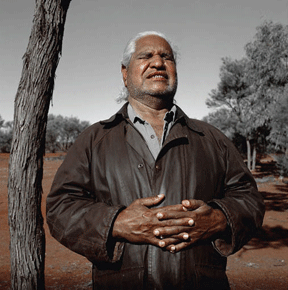 My father lost his eyesight because of nuclear weapons testing, but he has never lost his vision of a cleaner and safer future free of nuclear threats from weapons and waste. It’s time this country and this state shared that vision.
Karina Lester is a Yankunytjatjara Anangu woman, who works with the University of Adelaide’s Mobile Language Team as the Aboriginal Co-Manager and Language Worker. She is a member of the Natural Resources Management Council
NO RADIOACTIVE WASTE ON AGRICULTURAL LAND IN KIMBA OR SOUTH AUSTRALIA!
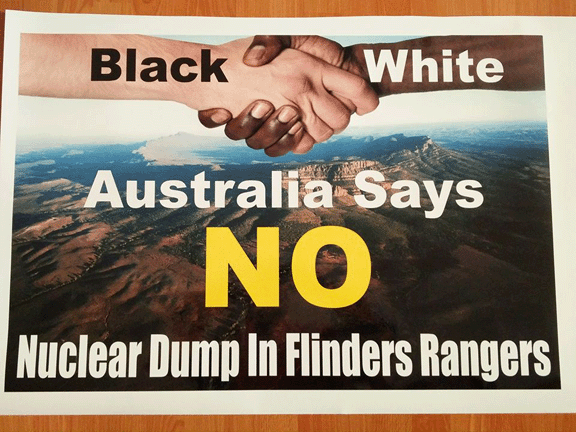 NO RADIOACTIVE WASTE ON AGRICULTURAL LAND IN KIMBA OR SA, President, Peter Woolford, Secretary Toni Scott, camandtoniscott@gmail.com 28 June 17, It is impossible to find words to properly describe how utterly disappointed we are that Minister Canavan has seen fit to progress the two current sites nominated in Kimba to house the National Radioactive Waste Facility to phase two of the selection process.
We trusted the Minister’s promise that he would not progress the sites without proof that broad community support existed, which he had numerous times referred to as needing to be in the vicinity of 65%, a figured which we firmly believed should be the lowest possible definition of “broad’.
Last weeks community ballot returned a result of 57% Yes – 42% No. This result clearly indicated what those of us living in Kimba already know all too well, that our community is completely divided over this issue. The Ministers decision shows a complete lack of understanding and consideration of the impact that this proposal has had on our community over the past two years, and that this division will now continue to escalate.
Minister Canavan has repeatedly promised that he will not impose this facility on a community that doesn’t want it, yet has progressed nominations in Kimba where it is proven that 42.2 % of us do not. Our Community has been lied to. more https://www.facebook.com/No-Radioactive-Waste-Facility-for-Kimba-District-643522385787637/
Minister For Nuclear and Coal, Matt Canavan pushes forward with Kimba radioactive trash dump plan
 SENATOR THE HON MATTHEW CANAVAN,Minister for Resources and Northern Australia 27 June 2017 KIMBA SITES TO PROCEED FOR CONSIDERATION FOR NATIONAL RADIOACTIVE WASTE MANAGEMENT FACILITY Two proposed sites for a radioactive waste management facility at Kimba will proceed to the next phase of assessment.
The Government has accepted the nominations of land at Napandee and Lyndhurst under the National Radioactive Waste Management Act 2012.
This decision was made after considering direct representations, the results of an independent postal ballot, and submissions in a more than 90-day consultation process.
Kimba voters were asked, in a poll conducted by the Australian Electoral Commission on behalf of the Kimba District Council, Do you support a nomination for a site being progressed to Phase 2 for further consultation for a National Radioactive Low/Intermediate Level Waste Management Facility?
The AEC declaration reported that of the 690 formal votes, there were 396 ‘Yes’ votes and 294 ‘No’ votes, giving a total in favour of proceeding of 57.4 per cent. The Department of Industry, Innovation and Science community consultation found widespread support from the direct neighbours of the nominated properties, with all but one direct neighbour supporting the assessment moving to the next phase.
In-depth consultation and technical assessments of the Kimba sites will now be undertaken.
Phase Two will engage people with all views. The Kimba community will have another chance to express their views before a decision is made about the suitability of either of the sites to host a National Radioactive Waste Management Facility.
This does not change the Phase Two consultation that continues at Wallerberdina Station in South Australia after the community earlier demonstrated broad support for the discussion.
 This next phase in Kimba will include:
- Progression of a $2 million Community Benefit Package to fund local projects;
- Employment of a Local Community Liaison Officer who will act as a conduit between the Government and community;
- Creation of a Kimba Consultative Committee who will gather views about the project; and
- The extension of the local project office, with staff continuing to be onsite regularly to answer questions as the site process progresses.
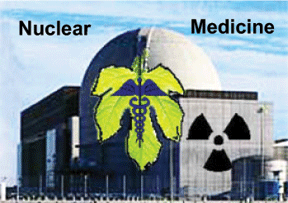 “Nuclear medicine is needed by one in two Australians on average, for diagnosis and treatment of heart, lung and skeletal conditions and a variety of cancers, and along with that comes radioactive waste,” Minister Canavan said.
“Radioactive waste is currently stored in more than 100 locations around the country, and international best practice is that it be consolidated into a single, safe and national facility.
“Progression to Phase Two does not constitute a final decision, rather, we now know that across the community there is broad support for continuing this conversation, and that is what we will do.
“I would like to thank everyone in Kimba for their involvement in this nationally significant discussion.”
At Wallerberdina Station, a process including a heritage assessment, technical studies and community consultation is continuing.
In line with the relevant legislation, the Federal Government can continue to accept and assess any new nominations until a final decision is made on the location of the facility.
For more information on the National Radioactive Waste Management Facility and site selection process, go to www.radioactivewaste.gov.au
Australia’s nuclear lobby ramps up its propaganda
Surely it is no coincidence that, as the federal government – Resources Minister Matt Canavan – touts a further stage in the plan to park radioactive trash in rural South Australia, and the Liberals introduce a Bill  to expand Australian Nuclear Science and Technology’s activities – our favourite pro nuclear shill, Ben Heard, joins others to promote the nu clear industry – in Adelaide Thurs 29 June
- Ben Heard, Founder & Executive Director, Bright New World Ben is recognised as a leading voice for the use of nuclear technologies to address our most pressing global challenges
- Nick Byrne, Chief Financial Officer, Heathgate Resources, – Uranium mining company, owned by USA weapons maker General Atomics
- Kyra Reznikov, Special Council, Finlaysons Lawyers, part in a study tour in the footsteps of the Royal Commission to visit nuclear sites in Finland, France and the UK
What tests go on at Woomera – ‘the largest land testing range in the world’ ?
What IS the army testing in the South Australian desert? Mysterious mushroom cloud erupts over historic Woomera range just after a drone flying near the secretive site was ‘forced to the ground’ http://www.dailymail.co.uk/news/article-4616616/Mystery-mushroom-cloud-erupts-Woomera-range.html By Bryant Hevesi For Daily Mail Australia
A man has captured image of ‘mushroom cloud’ near Lake Hart, South Australia Jason Wright said loud explosion occurred after his drone was forced to ground . The cloud formed over the Woomera Prohibited Area, used for military testing The prohibited area is known as ‘the largest land testing range in the world’
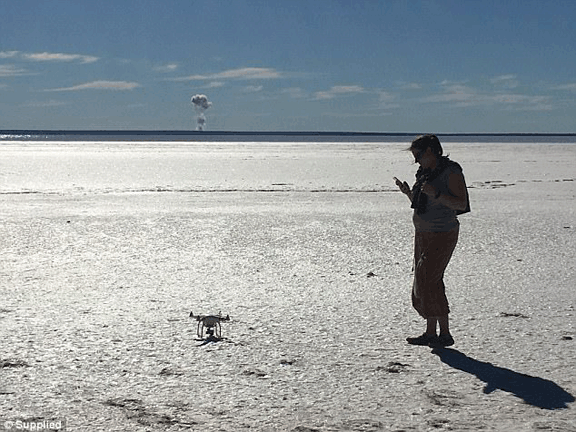
Jason Wright snapped images of the cloud shortly after he says his drone was forced to the ground prior to hearing a loud explosion while he was near the testing range.
Mr Wright told Daily Mail Australia he had stopped off along the Sturt Highway with his partner and children to see Lake Hart on Saturday when the unusual incident occurred. The experienced drone flyer had set-up his drone to take photos near the Lake Hart tourist rest area on the edge of the salt lake when he says it came down out of his control and made a hard landing.
Mr Wright, who lives in Coober Pedy, believes the drone’s GPS-based tracker may have been interfered with. About a minute after the drone fell, a ‘fireball’ erupted in the far distance, estimated to be as high as a 30-storey building, with the ‘mushroom cloud’ forming.
‘It was quite a spectacular explosion. It was very bright and there was a lot of heat in it,’ he said.
Mr Wright said despite criticisms he should not have been flying a drone in the area, he said the Civil Aviation Safety Authority’s ‘Can I fly there?’ app showed was able to have a drone up to 45 metres where he was standing.
The Woomera Prohibited Area ‘is used for the testing of war materiel’ and is ‘the largest land testing range in the world’.
Exclusion zones are in place at various locations within the prohibited area at different times of the year while military equipment is tested.
One is currently in place until June 30.
In a statement to Daily Mail Australia, the Department of Defence said: ‘No weapons were being tested; the activity was a demolition of war materiel’.
Defence did not carry out any action to impact the unmanned aircraft,’ the statement said.
‘Defence carries out operations for the testing of war materiel within the Woomera Prohibited Area. This includes capability being developed and tested for use for defence purposes. The photograph was the result of the demolition of war materiel.
‘An unauthorised person must obtain a permit or approval to enter the Woomera Prohibited Area.
‘In addition to the entry requirements, all unmanned aerial vehicle or remotely piloted aircraft operators must comply with the requirements of Part 101 of the Civil Aviation Safety Regulations 1998, this includes requirements associated with operating within a designated restricted area (for the purpose of regulation 6 of the Airspace Regulations 2007).
‘The Woomera Prohibited Area includes restricted areas for the purposes of the Airspace Regulations 2007 and these areas may be active during periods of defence testing activities.’
Kimba community divided over federal nuclear waste dump plan – fairly narrow “yes” vote
Kimba votes yes to radioactive waste dump in Eyre Peninsula http://www.adelaidenow.com.au/news/south-australia/kimba-votes-yes-to-radioactive-waste-dump-in-eyre-peninsula/news-story/96ca27ddaa0f67519b60a366584156bc, Polly Haynes, The Advertiser, June 22, 2017
RESIDENTS of Kimba have voted in favour of building a radioactive waste dump in their Eyre Peninsula district. Posted on the council’s website, the interim results for the postal ballot on the National Radioactive Waste Management Project show 698 ballot papers were received by the Australian Electoral Commission.
Of those, 396 voted for and 294 voted against, while eight ballot papers were informal votes.
The Federal Government is considering two properties near Kimba, in addition to a previously short-listed block of land at Barndioota, near Hawker in the Flinders Ranges.
In March, the Kimba Council called in the Australian Electoral Commission to run a postal vote of the 1100-strong community on the options. At the time, Mayor Dean Johnson said he believed there was strong support in the community for the two local sites to be formally considered. This morning he said: “The numbers are what they are… in the end the people have voted.”
However, a group opposing the dump — No Radioactive Waste on Agricultural Land in Kimba or SA — said the results of the vote showed the community was still divided.
“There has been no shift in community sentiment over the past two years,” a statement said. “Despite the Working for Kimba’s future group’s claims of a large swing toward support … results from three rounds of consultation and surveying show sentiments much the same as previously recorded.”
“This last consultation has resulted in a waste of government time, money and resources. Not to mention unnecessary pressure and stress on our already fractured community.”
The Federal Government is expected to make a decision early next year on the location for the centre, which will host radioactive waste currently held at sites around Australia.
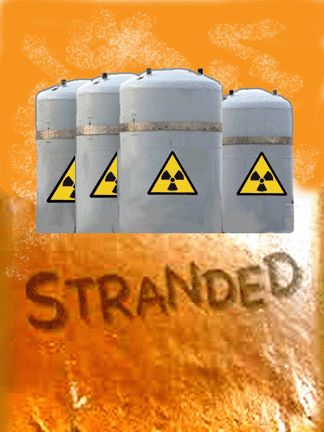 The centre will initially store low and medium-level waste before a second purpose-built centre is opened for the medium-level waste.
Opponents of the waste dump say Australia’s radioactive waste should be centrally stored at the Lucas Heights nuclear reactor campus in Sydney.
Conservation and anti-nuclear groups have petitioned the Federal Government to scrap any plans for a dump at Kimba.
The groups, including Conservation SA, Friends of the Earth and the Australian Conservation Foundation have lodged a submission with the federal Department of Industry, Innovation and Science calling on the government to abandon any plans for a dump at Kimba.
Friends of the Earth campaigner Jim Green says the process to find a dump site had been flawed and divisive.
“The Federal Government has consistently misled Kimba residents about its intentions. Residents have been repeatedly told that the above-ground store for long-lived intermediate-level waste (including spent nuclear fuel reprocessing waste) would hold waste for ‘several decades’ until a deep underground disposal facility is available,” Mr Green said.
“But in fact, several documents from the national regulator ARPANSA indicate long-term storage for 100 years or more. Moreover the Federal Government has no idea what sort of deep underground disposal facility might be built, where or when it might be built, and ‒ incredibly ‒ the Federal Government is doing next to nothing to progress the matter.”
“All Australians have a right to be involved to help make sure that this difficult issue is given the best possible consideration,” he said. “What is planned is a national radioactive waste facility so while local community consultation is useful, an evidence based, national conversation is essential.”
Mark Parnell on South Australia’s budget
 Mark Parnell MLC, Parliamentary Leader, Greens, 22 June 17
 The Government is spending two thirds of their $550 million energy security fund on fossil fuels. This includes a $360 million gas fired power station and $48 million to gas companies for exploration, including in high value farm land in the South East. These priorities are all wrong. We need to phase out fossil fuels and move to a more reliable and affordable renewable energy future with battery storage, such as the proposed solar thermal plant at Port Augusta.
Every budget in the last decade has cut funding to the Environment Department. This budget is no exception, cutting 43 full-time jobs at a time when the urgency of climate change requires even more attention than ever.
Kimba vote to investigate nuclear waste facility, but opposition to this is strong
Kimba votes to investigate nuclear waste facility on Eyre Peninsula, The Australian, June 23, 2017, MEREDITH BOOTH, Reporter, Adelaide, @MeredithBooth
The thought of having a nuclear waste dump in your backyard would be a step too far for many.
But for wheat farmer Andrew Baldock and the majority of his fellow residents in the shrinking rural South Australian town of Kimba, the promise of a $10 million community fund and better internet was enough to convince them that the positives outweighed the negatives.
Mr Baldock, a father of two, hopes Kimba’s “yes” vote for a nuclear waste dump on South Australia’s Eyre Peninsula will kickstart the town’s shrinking rural economy, which has seen a steady exit of businesses and people over the past two decades.
Kimba’s 700 residents have for years been divided on whether to allow a waste dump near the town, but this week voted 396 to 294 in favour of advancing consultation on building a low- and medium-level facility on the town’s edge.
Mr Baldock and his brother stand to inherit from their parents one of the two farms nominated to house the nuclear waste dump……..
A series of rejected sites was put forward between 1991 and 2004 and the Northern Land Council put forward Muckaty Station in the Northern Territory in 2005. But nine years of opposition, including a Federal Court challenge, saw the NLC withdraw its nomination in 2014 and a fresh search began.
The result of the Kimba vote, reported by the Australian Electoral Commission yesterday, is in line with the opinion polls that have pitted neighbour against neighbour in the rural service centre over the past two years.
Farmer Peter Woolford, part of opposition group No Radioactive Waste on Agricultural Land in Kimba or SA, said the vote had not changed anything and he expected continued railing against the project. “The opposition is still strong,” he said. “The results of the vote showed the community was still divided.”http://www.theaustralian.com.au/news/nation/kimba-votes-to-investigate-nuclear-waste-facility-on-eyre-peninsula/news-story/dab04e32a1be76f1e48ecb2f26fe37ae
Strong calls to have Kimba nuclear dump plan dumped
Groups call for nuclear dump to be dropped, http://www.9news.com.au/national/2017/06/20/22/22/groups-call-for-nuclear-dump-to-be-dropped Conservation and anti-nuclear groups have petitioned the federal government to scrap plans for a low-level nuclear waste dump on South Australia’s Eyre Peninsula.
The groups, including Conservation SA, Friends of the Earth and the Australian Conservation Foundation have lodged a submission with the federal Department of Industry, Innovation and Science calling on the government to abandon any plans for a dump at Kimba.
Farming land near Kimba is one of two sites being targeted for the dump, the other near Hawker in SA’s Flinders Ranges.
He says most of the waste is located at the Lucas Heights reactor site south of Sydney and that is where it should stay.
Australian Conservation Foundation campaigner Dave Sweeney said radioactive waste was a national issue that demanded the highest level of inclusion and scrutiny.
“All Australians have a right to be involved to help make sure that this difficult issue is given the best possible consideration,” he said.
“What is planned is a national radioactive waste facility so while local community consultation is useful, an evidence based, national conversation is essential.”
South Australians very definitely dumped the nuclear dump plan, but a new battle looms.
Australia’s handful of self-styled ‘ecomodernists’ or ‘pro-nuclear environmentalists’ united behind a push to import spent fuel and to use some of it to fuel Generation IV fast neutron reactors. They would have expected to persuade the stridently pro-nuclear Royal Commission to endorse their ideas. But the Royal Commission completely rejected the proposal
Another dump proposal is very much alive: the federal government’s plan to establish a national nuclear waste dump in SA, either in the Flinders Ranges or on farming land near Kimba, west of Port Augusta.
How the South Australians who dumped a nuclear  dump may soon have another fight on their hands http://www.theecologist.org/News/news_analysis/2989048/how_the_south_australians_who_dumped_a_nuclear_dump_may_soon_have_another_fight_on_their_hands.html 15th June, 2017 The rejection of a plan to import vast amounts of high-level nuclear waste from around the world for profit was a significant result for campaigners but that threat is still far from over, writes JIM GREEN
Last November, two-thirds of the 350 members of a South Australian-government initiated Citizens’ Jury rejected “under any circumstances” the plan to import vast amounts of high-level nuclear waste from around the world as a money-making venture.
The following week, SA Liberal Party Opposition leader Steven Marshall said that “[Premier] Jay Weatherill’s dream of turning South Australia into a nuclear waste dump is now dead.” Business SA chief Nigel McBride said: “Between the Liberals and the citizens’ jury, the thing is dead.”
And after months of uncertainty, Premier Weatherill has said in the past fortnight that the plan is “dead”, there is “no foreseeable opportunity for this”, and it is “not something that will be progressed by the Labor Party in Government”.
So is the plan dead? The Premier left himself some wriggle room, but the plan is as dead as it ever can be. If there was some life in the plan, it would be loudly proclaimed by SA’s Murdoch tabloid, The Advertiser. But The Advertiser responded to the Premier’s recent comments, to the death of the dump, with a deafening, deathly silence.
Royal Commission
It has been quite a ride to get to this point. Continue reading
Senator Scott Ludlam probes the Australian government’s plan to dump Lucas Heights’ nuclear waste on rural South Australia
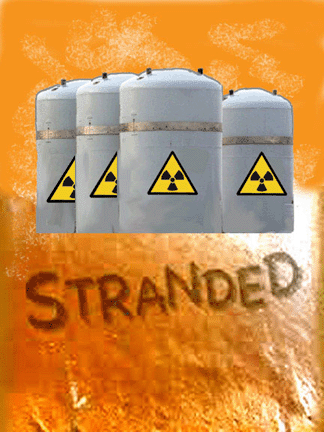 Assuming that the long-lived intermediate-level stuff does go to the sites that you are busy characterising at the moment, how long is it envisaged that it actually stays there before it gets taken somewhere else?
Mr B Wilson: We cannot give a definitive answer on that because we have not commenced a process to identify a permanent disposal solution for the long-lived intermediate-level waste—
Senator LUDLAM: Ouch!
if the really dangerous intermediate-level stuff is to be stored there you cannot tell them how long it is meant to be there for
so we kind of do not really know what is going on there or how long it is meant to be there for.
 ECONOMICS LEGISLATION COMMITTEE, Department of Industry – RADIOACTIVE WASTE 1st June 2017
Full Transcript here: http://parlinfo.aph.gov.au/parlInfo/download/committees/estimate/e3ddf88b-3e9c-4546-9d90-8f646689a98c/toc_pdf/Economics%20Legislation%20Committee_2017_06_01_5134.pdf;fileType=application%2Fpdf
Senator Canavan: I have been to Hawker and I am going there again tomorrow, and I would like to put on record my thanks to many in the Hawker community who engage in this process. Some have certainly changed their mind as they have come to have more understanding of it. I think you have probably been to Lucas Heights, and it I think it makes a big difference to people when they see it. There is a lot of misinformation spread about this, and we are trying to engage with people in a genuine way in good faith to give them the information to make informed decisions.
Senator LUDLAM: Who is spreading this information, Senator Canavan?
Senator Canavan: I hear it from time to time. I do not have any particular allegations to make about individual groups here, but you do hear lots of information from time to time about the potential danger of this material. But, of course, as you would probably know, much of the low-level waste is stored safely at Lucas Heights, a place where people go to and from work every day.
Senator LUDLAM: That begs the question of why it needs to move. ……
Senator LUDLAM: Staying in South Australia: has there been any consideration at all—this is for the department or the minister, whoever wants to take this one on—of the tension between the proposed national radioactive waste facility and the existing South Australian legislation, which would be the Nuclear Waste Storage Facility (Prohibition) Act 2000? The tension between the fact that your entire project is presently illegal under South Australian law: what is being done about that?
Mr B Wilson: We are certainly aware of the South Australian prohibition under their law. However, the National Radioactive Waste Management Act that we operate under overrides South Australian law.
Senator LUDLAM: And that is it? You are just going to squash them? Or are there discussions progressing with the South Australian government?….
Senator LUDLAM: Is the department, or you, Senator Canavan, or any of the federal agencies or other actors in communication with the South Australian government environment or heritage departments, or representatives of any body, actually, in relation to the tension between the two acts?
Senator Canavan: I have raised it with the South Australian government. They have indicated that they may seek to make changes. I am not aware of the status of that at the moment. Obviously, they have their own process, which is a separate to ours, on radioactive waste. Certainly, the issue has been raised. Mr Wilson is also right that we are confident that is not a barrier to this project. But Mr Wilson will be giving you that.
Mr B Wilson: We engage—I would have to characterise it as infrequently—with the South Australian government. It is more in the line of updating where we are. We have not had any recent engagements. They are certainly very well aware of the prohibitions under their law about what the South Australian government and its officials can do in this space….
When I said that the National Radioactive Waste Management Act overrides South Australian law, that is the fact. But what we are trying to do in the development of this project is to develop it and act in a way that is consistent with requirements under other South Australian legislation. For instance, in terms of Indigenous heritage protection and other aspects. While we are not necessarily bound by those laws we want to act in a way that is consistent with them.
Senator LUDLAM: With waste that is as dangerous as this, I am very glad to hear it! Is the department still accepting site nominations?
Senator Canavan: The government remains open to further nominations, as we announced on selecting the Hawker site last year. But the ones we have announced are those that we are proceeding with at this stage.
Senator LUDLAM: Wallerberdina and two at Kimba. Continue reading
1 This month

of the week – Australians for War Powers Reform (AWPR)
To see nuclear-related stories in greater depth and intensity
 Antinuclear