 Industrial bulk-buy could open path for more wind and solar projects, REneweconomy
By Giles Parkinson on 21 April 2017 A ground-breaking initiative from some of South Australia’s biggest industrial users of electricity could pave the way for more wind and solar farms in the state, and finally open the Australian market for more corporate deals with wind and solar farm developers.
The South Australian Chamber of Mines and Energy (SACOME) this week won approval from the Australian Competition and Consumer Commission for 19 big industrial users to band together to negotiate long-term electricity contracts, having grown tired of the soaring prices and short-term contracts being offered by the state’s retail oligopoly.
The companies – which include Nyrstar, Arrium, Oz Minerals, and a collection of high profile auto groups, food companies, retailers, wineries and universities (see full list below) – account for 15 per cent of the state’s electricity demand.
Most have been hit with electricity price rises of between 30 and 80 per cent in the last year, and are now paying between 8c/kWh and 15c/kWh for their electricity, and are unable to get any long-term contracts.
SACOME’s Rebecca Knol says the tender is not designed to favour one technology or another, and they would welcome either renewables or gas. “We are not predicting the outcome,” she told RenewEconomy. “We don’t have a preference.”
The move, she says, is more about challenging the pricing power of the retail oligopoly. “By aggregating their load, they will improve their individual bargaining position and be able to establish more cost-competitive supply contracts,” Knol said.
But a quick glance at prices for new wind and solar farms, and for gas generation, puts renewables in the driving seat.
Wind and solar farms are being delivered for around 7c/kWh, but even the short-run marginal cost of gas generators (i.e.. the fuel and maintenance cost) ranges from 7c/kWh to more than 12c/kWh………
The total load of 19 industrial users (19 companies, 24 installations) is 246MW at peak, and represents annual demand of 1,957GWh. Most interestingly for the wind and solar plants, the businesses are offering an 11 year contract – a length of contract that has been all but impossible to secure from large retailers.
“We are looking for opportunities to improve the electricity price so our businesses can stay competitive,” Knol says. “What we are hoping is that they do see this as opportunity to change the wholesale market. It could bring on a new generator, or it could be with an existing generator.”
Australian corporates have been slow to engage with renewable energy developers – possibly given the fact that the fall in wind and solar costs below the prevailing wholesale price of electricity is only very recent.
Queensland zinc refiner Sun Metals, that state’s largest single energy user, is one exception, having decided to build its own 116MW solar farm, rather than commission a third party. The Sunshine Coast Council is also building its own 15MW solar farm in south-east Queensland…..
The original application included: Nyrstar, Arrium, OZ Minerals, Hillgrove Resources, Rex Minerals, Seeley International, SMR Automotive, Thomas Foods and Intercast & Forge.
Since the application was made in January 2017, Peregrine Corporation, Foodland, Independent Grocers of Australia (IGA), Pernod Ricard Winemakers, Orora Glass, Brickworks, Flinders University and the University of South Australia have also come on board. http://reneweconomy.com.au/industrial-bulk-buy-could-open-path-for-more-wind-and-solar-projects-22023/
April 22, 2017
Posted by Christina Macpherson |
energy, South Australia |
Leave a comment
 Beetaloo Valley residents to fight against planned $500 million solar and wind farm by Neoen Erin Jones, Regional Reporter, The Advertiser April 17, 2017 SOUTHERN Flinders Ranges residents are vowing to stop a 50-turbine wind farm from ruining the landscape, fearing the project will be fast-tracked because of the state’s energy crisis.
The group of residents at Beetaloo Valley, 20km north of Crystal Brook, are outraged at a proposal by French company, Neoen, to create an “energy park” in their backyard.
The $500 million project would create 150 jobs during construction and include a battery storage facility, solar farm and 50 wind turbines, which would power 145,000 homes with renewable energy.
The turbines have been earmarked for a section of the 1200km Heysen Trail, on the ranges extending north of Crystal Brook to Beetaloo Valley and Colby Hill.
Group spokesman John Birrell feared the State Government would support the project to secure its energy supply network before summer, despite its development plan saying it was an area where “wind farms were not explicitly envisaged”.
“We have the suspicion that they (Neoen) have tapped on their solar and battery projects to push their wind farm,” Mr Birrell said.
“So if the South Australian Government is prepared to back a wind farm here, they should also be prepared to support opening up the Mt Lofty Ranges for similar developments.”
Mr Birrell said they were not against a battery or solar facility but the wind farm straddled two council areas, which had identified the area as being protected for its “natural character and scenic features”…..Neoen http://www.adelaidenow.com.au/news/south-australia/beetaloo-valley-residents-to-fight-against-planned-500-million-solar-and-wind-farm-by-neoen/news-story/b6c49f9a42c11f4a7e77ad64d534862f
April 19, 2017
Posted by Christina Macpherson |
South Australia, wind |
1 Comment
Leading the transformation, though, is the city of Port Augusta in South Australia……Nothing highlights the clean energy transformation more dramatically than what is happening in that city.
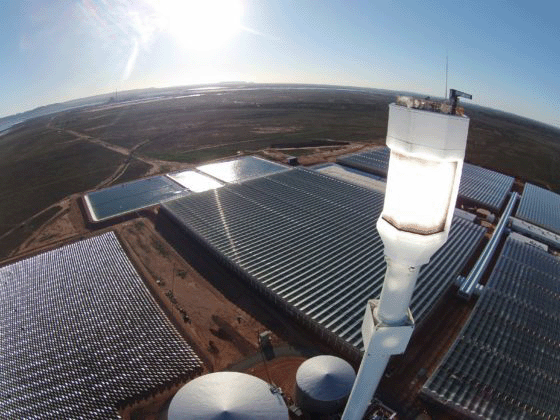
Tide turns as solar, storage costs trump ideologues and incumbents, REneweconomy, By Giles Parkinson on 13 April 2017
But there is no doubt that the transition is happening. Over the last few months, small but significant gains have been made as key politicians, regulators, market operators and many incumbents realise just how quickly the cost of new competition technologies are falling, and how quick the transition to a smarter, cleaner, more reliable and cheaper grid might be.
Awareness about the plunging costs of wind energy, solar energy and battery storage, along with the enabling software that could lead to a complete redesign of the way we generator, share, transport and use energy, is growing each day.
Politicians – both to the left and the right – are starting to embrace this change. The public is supportive, while the fossil fuel incumbents are slowly and surely losing their social licence, both due to the pollution levels of their plant and their manipulation of prices. Even the regulatory barriers that currently protect their business models are starting to unwind.
This is not to say that victory is at hand, or that this transformation will suddenly be complete within a few years. It won’t. But change is starting to happen quickly, old plant is being replace by new, rules are being changed, industry leaders are starting to talk of a new energy vision. Consumers are picking up new technology with increasing speed.
And here are a bunch of key developments in Australia over the last few months that indicate that the plunging cost of key technologies costs will trump the resistance of conservative ideologues and fossil fuel incumbents: Continue reading →
April 15, 2017
Posted by Christina Macpherson |
AUSTRALIA - NATIONAL, energy, South Australia |
Leave a comment
South Australian energy users club together for energy purchasing, AFR, by Angela Macdonald-Smith Simon Evans, 13 Apr 17, Cement maker Adelaide Brighton, steelmaker Arrium and 22 other major energy users in South Australia have won draft clearance from the competition regulator to jointly purchase electricity in a significant move that looks set to change the balance of power in the state’s fragile energy market. Continue reading →
April 15, 2017
Posted by Christina Macpherson |
energy, South Australia |
Leave a comment
 Mrs Woolford said she and other members of the No Radioactive Waste on Agricultural Land in Kimba or SA group had tried to organise a community forum with all sides represented but said the government did not want to participate.
“A debate with everyone represented would be a fair way for the government to allow people in the community to make up their minds, not just a continuous sell of the alleged benefits.
“People should have the right for their government to provide all sides not just one to suit its purpose,” Mrs Woolford said. .
Neighbours in Kimba are still opposed to nominated nuclear waste facility sites, Eyre Tribune, 10 Apr 2017, DISTRUST in the federal government and the process of nominations in the search for a national low to intermediate radioactive waste site are just some of the reasons Austin Eatts is against the facility being placed at Kimba.
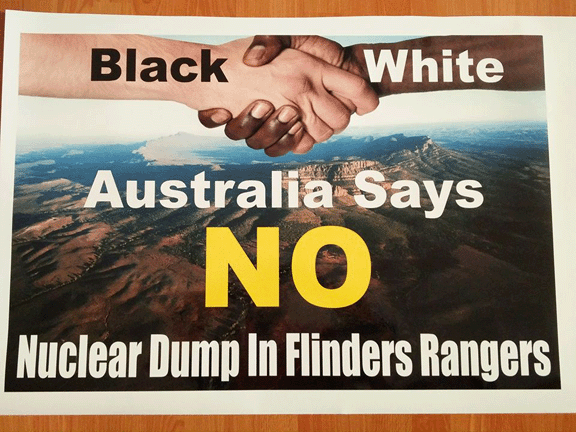
Mr Eatts is a direct neighbour to one of the newly nominated sites in the Kimba district and said the national nuclear waste facility was not something rural or regional people should be responsible for.
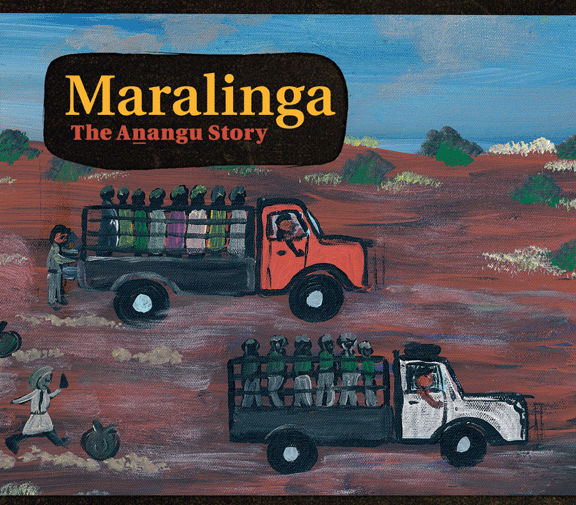
He said Eyre Peninsula had a long memory for the impact of politicians’ “dishonesty” during and after nuclear bombs were tested at Maralinga, to the north west of Eyre Peninsula “There is a long history of dishonesty about politicians, they told us then and after that Maralinga was safe. “This is the same message they are giving us now, things will be safe, why should we believe them?“My feelings about Eyre Peninsula and the state having anything nuclear has not changed since then,” Mr Eatts said.
He said he did not want the responsibility of making a decision that would impact generations for hundreds of years not only for Kimba or Eyre Peninsula residents but statewide.
“Once we accept this site here, we have opened the door to further nuclear activity.”
Mr Eatts said the vote to be undertaken by the South Australian Electoral Commission would settle the issue for him however he was concerned if the vote was against further progression it would not be the end of the matter.
“Will it be the end of it for those who want it? “They have already brought it back once after we settled it as a community we didn’t want it,” he said. “Two million dollars (offered to the community by the government) is a lot of money to you and I but for a community it is not much and no amount of money will fix the division in the community.” Continue reading →
April 14, 2017
Posted by Christina Macpherson |
Federal nuclear waste dump, South Australia |
Leave a comment
Australian tolerance of the British and their obsessive secrecy may be explained by the deference and loyalty to the ‘motherland’. Prime Minister Menzies identified so strongly with Britain that he considered British national interest as Australia’s national interest.
Another factor which underlay Australian deference during the course of the testing program was the role of Sir Ernest Titterton.
The full legal and political implications of the testing program would take decades to emerge. The secrecy which surrounded the British testing program and the remoteness of the tests from major population centres meant that public opposition to the tests and awareness of the risks involved grew very slowly.
 Wayward governance : illegality and its control in the public sector / P N Grabosky
Canberra : Australian Institute of Criminology, 1989
“…..Admittedly, in the 1950s knowledge of radiation hazards was not as advanced as it is today. At the time it was not generally recognised that small doses of low level radiation might increase the risk of cancer years later. But even in the light of knowledge of the time, the information on which Menzies based his decisions was seriously deficient.
There seems little doubt that the secrecy in which the entire testing program was cloaked served British rather than Australian interests. Continue reading →
April 12, 2017
Posted by Christina Macpherson |
aboriginal issues, AUSTRALIA - NATIONAL, reference, South Australia, weapons and war |
Leave a comment
 Isn’t this a brilliant outcome? For the last few years, the nuclear lobby has been touting Port Augista as the place for a nuclear power station. Following the absolute defeat of the shonky South Australian Nuclear Fuel Cycle Royal Commission, and thanks to all those who fought against it, so brilliantly – South Australia now could become a world leader in modern clean energy.

REneweconomy, By Giles Parkinson on 11 April 2017 The first two stage of a 300MW solar farm – Australia’s biggest – has begun construction near Port Augusta in South Australia after its developers last Friday reached financial close on the project, and agreed to sell it to two of Europe’s biggest investors in renewables, Italy’s Enel Green Energy and the Dutch Infrastructure Fund.
The first two stages, totalling 220MW, of the Bungala project is being built around 12kms from Port Augusta, where the state’s last coal fired generator closed last May. Ironically, project developer Reach Energy is headed by Tony Concannon, the former head of the owners of the Hazelwood brown coal generator in Victoria which closed late last month.
The two first stages of Bungala will be completed late in 2018, and will be built by Spanish company Elecnor, which recently completed the 57MW Moree project in NSW and the smaller 21MW Barcaldine project in Queensland.
Bungala will be built “battery storage ready”, and will also likely be the first major solar farm to participate in Australia’s FCAS market (frequency control and ancillary services), using SMA inverter technology to provide voltage control for the grid.
Concannon says the remaining 80MW of capacity could be built – along with battery storage – should the company win a South Australian government tender for 25 per cent of its electricity needs with “dispatchable” renewables.
Reach has submitted proposals for both 20MWh of battery storage and 100MWh, although it did not participate in the other tender for a separate 100MWh battery unit. If the tender is not successful, there are also discussions with other potential off-takers in train…….
The new plant, he says, will be designed to provide FCAS – even at night, after the sun has gone down. “What a number of people don’t realise is that you can design ancillary services for solar plants to operate at night time.
“We can draw in power from the grid at night, and use the inverter technologies to regulate voltage, and that helps stabilise the system, even when the sun is not shining.”
Unlike battery storage in households, which he describes as mostly “passive” and focused on converting the output of solar panels from DC power to AC power so it can be put into the grid, utility-scale inverter technologies are able to shape voltage and current very quickly and in a very flexible manner. Modern wind farms are also using the same technologies.
“The inverter changes phase between the voltage and current … inverters can pull the current in, and change the phase to what grid wants.”
Concannon, a power engineer, says it is a tricky subject to try and explain, but says a lot of the articles he has read in the media – about wind and solar not being able to provide grid services – are wrong……..http://reneweconomy.com.au/huge-300mw-solar-farm-begins-construction-near-port-augusta-63411/
April 12, 2017
Posted by Christina Macpherson |
solar, South Australia, storage |
Leave a comment
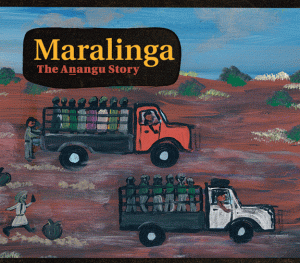 Australia’s hospitality, largesse and loyalty to Britain were not without their costs. Moreover, the sacrifices made by Australians on behalf of the ‘motherland’ were not equally borne. Whilst low population density and remoteness from major population centres were among the criteria for the selection of the testing sites, the Emu and Maralinga sites in particular were not uninhabited. Indeed, they had been familiar to generations of Aboriginal Australians for thousands of years and had a great spiritual significance for the Pitjantjatjara and Yankunytjatjara people.
A variety of factors underlay the harm to public health, Aboriginal culture and the natural environment which the British tests entailed. Perhaps most significant was the secrecy surrounding the testing program.
During the entire course of the testing program, public debate on the costs and risks borne by the Australian public was discouraged through official secrecy, censorship, misinformation, and attempts to denigrate critics
Wayward governance : illegality and its control in the public sector / P N Grabosky
Canberra : Australian Institute of Criminology, 1989 “……. In 1950, Labor Prime Minister Clement Atlee sent a top secret personal message to Australian Prime Minister Menzies asking if the Australian government might agree to the testing of a British nuclear weapon at the Monte Bello Islands off Western Australia. Menzies agreed in principle, immediately; there is no record of his having consulted any of his Cabinet colleagues on the matter.
The Monte Bello site was deemed suitable by British authorities, and in a message to Menzies dated 26 March 1951 Atlee sought formal agreement to conduct the test. Atlee’s letter did not discuss the nature of the proposed test in minute detail. He did, however, see fit to mention the risk of radiation hazards:
6. There is one further aspect which I should mention. The effect of exploding an atomic weapon in the Monte Bello Islands will be to contaminate with radio activity the north-east group and this contamination may spread to others of the islands. The area is not likely to be entirely free from contamination for about three years and we would hope for continuing Australian help in investigating the decay of contamination. During this time the area will be unsafe for human occupation or even for visits by e.g. pearl fishermen who, we understand, at present go there from time to time and suitable measures will need to be taken to keep them away. We should not like the Australian Government to take a decision on the matter without having this aspect of it in their minds (quoted in Australia 1985, p. 13).
Menzies was only too pleased to assist the ‘motherland’, but deferred a response until after the 195 1 federal elections. With the return of his government, preparations for the test, code-named ‘Hurricane’, proceeded. Yet it was not until 19 February 1952 that the Australian public was informed that atomic weapons were to be tested on Australian soil. On 3 October 1952 the British successfully detonated a nuclear device of about 25 kilotons in the Monte Bello Islands. Continue reading →
April 10, 2017
Posted by Christina Macpherson |
aboriginal issues, AUSTRALIA - NATIONAL, history, reference, South Australia, weapons and war |
Leave a comment
 Tim Bickmore Fight To Stop Nuclear Waste Dump In Flinders Ranges SA
Don’t get sucked in by the “medical gloves & gowns” Canberra con-job:
FACT 1 – South Australia’s current hospital waste storage regimen WILL REMAIN in-situ;
FACT 2 – Radioactive metal from the 1940’s British Montebello Atom Bomb Tests IS DESTINED for the suppository;
FACT 3 – Radioactive concrete & steel from the de-commissioned Lucas Heights HIFAR reactor WILL ALSO be supposited;
FACT 4 – If/when the 10,000 Woomera barrels arrive, Radon gas WILL LEAK. This heavy invisible radioactive odourless & poisonous gas flows like water & accumulates in low-lying areas;
FACT 5 – The so-called Intermediate Level Waste ALSO RELEASES invisible radioactive odourless gasses;
FACT 6 – The lowest area in the Wallerberdina precinct is the Hookina Creek line;
FACT 7 – GLOVES & GOWNS WILL BE A MINOR FRACTION OF THE LOW LEVEL WASTE INVENTORY.https://www.facebook.com/groups/344452605899556/
April 8, 2017
Posted by Christina Macpherson |
Federal nuclear waste dump, South Australia |
Leave a comment
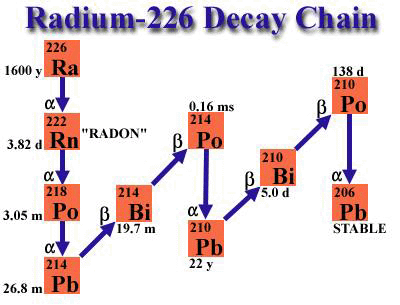 Fight To Stop Nuclear Waste Dump In Flinders Ranges SA In April 2016 ARPANSA discovered that Radium had leaked from the 10,000 barrels stored at Woomera. http://www.arpansa.gov.au/…/inspections/2016/R16-05292.pdf This means that Radon gas is being released into the environment. Radon is heavy & tends to flow to the lowest point & accumulate. After about 4 days it transforms into a solid & infects the ground surface. As time passes more & more Radon converts to a solid that builds up & continuously increases the radioactivity wherever it may happen to land – which is at the place it arrives at after about 4 days. This will continue to happen for at least 16,000 years. https://www.facebook.com/groups/344452605899556/
April 8, 2017
Posted by Christina Macpherson |
environment, South Australia, wastes |
Leave a comment
the biggest unanswered question is whether the planned facility is the best way to manage Australia’s radioactive waste. Extraordinarily, that question has never been asked.
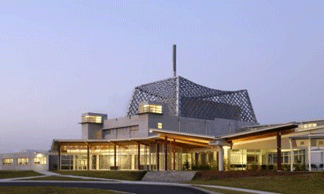 ANSTO [in Sydney] is better placed than a pastoral station or the back paddock of a wheat farm to house this material.
Advantages of storing it at the ANSTO facility include that
- it enjoys assured tenure there;
- has a secured site with a high-level Australian Federal Police presence;
- is currently building new storage capacity;
- has already received reprocessed spent nuclear fuel returns from Europe;
- has the best radiation monitoring and nuclear response capacity in the nation; and
- the fact that the waste is there now answers double handling and transport concerns.
Importantly, the Federal nuclear regulator – Australian Radiation Protection and Nuclear Safety Agency (ARPANSA) – has confirmed there is no regulatory constraint to the waste continuing to be managed at ANSTO “for decades“.
Picking the postcode for a radioactive wasteland https://independentaustralia.net/environment/environment-display/picking-the-postcode-for-a-radioactive-wasteland,10177 Dave Sweeney 5 April 2017, ‘The Federal focus on finding a postcode for a [nuclear waste] facility has been at the expense of independently testing the assumptions behind the need for one.’
ACCORDING to the fridge magnets and stickers in the shop beside the ageing Big Galah sculpture, the small farming town of Kimba in South Australia’s Eyre Peninsula is the half way point on the east-west journey across Australia.
But right now, the local talk is more about half-lives, following the recent decision by Federal Minister for Resources Matt Canavan to further explore two places in the region as possible sites for a national radioactive waste facility.
The search for a place for Australia’s radioactive waste has been in train – and often off the rails – for more than 20 years. Over that time, successive Federal governments have had multiple fights at multiple sites — mainly across South Australia and the Northern Territory. Currently, there are three South Australian sites under consideration.
For the better part of a year, a site near Hawker in the Flinders Ranges has been under examination. The site, on a pastoral station leased by former Liberal senator and long-time nuclear facility supporter Grant Chapman has been strongly contested by many in the wider community. Critical voices include local Adnyamanthanha Traditional Owners, pastoralists and people concerned about the impacts of the region’s steadily growing tourism sector.
Now the inclusion of two parcels of agricultural land at Kimba has seen new tension in a town that has previously been highly divided over the Federal plan.
Last year, two previously nominated Kimba land options were not taken further by then Minister for Resources Josh Frydenberg because of a lack of community support.
However, supporters of a facility have made a new pitch and have found an ear in the new minister.
The planned facility would be in two parts — a repository for the disposal of low-level radioactive waste (LLW) and an above ground store to hold the more serious and problematic long-lived intermediate level waste (ILW). The store would operate for 100 years, at which time a decision would be made about how and where to future manage this long-lived waste, which needs to be isolated from people and the wider environment for thousands of years.
For a project that has had many configurations over many years, there remains considerable uncertainty about the plan.
Part of the series of unanswered questions include:
- final facility design;
- acceptance criteria;
- employment and governance arrangements; and
- longer term plans for managing Australia’s highest level radioactive waste.
Continue reading →
April 7, 2017
Posted by Christina Macpherson |
AUSTRALIA - NATIONAL, Federal nuclear waste dump, South Australia |
Leave a comment
Who’d want to dump Australia’s nuclear waste here? Well, this guy. At Kimba in the heart of the country, a community is divided – in one case literally so – over a plan to deposit the national stockpile of radioactive waste, Guardian, Max Opray, 4 Apr 17 “…..Hefin Griffiths, chief nuclear officer at the Australian Nuclear Science and Technology Organisation, says the facility is needed for the organisation’s gradually accumulating stockpile of radioactive waste at Lucas Heights, where measures are being rolled out to temporarily increase storage space at the 70-hectare site, which is reaching capacity this year.
According to Griffiths, most the waste earmarked for the new facility would be of low-level radioactivity, such as clothes worn by people working in nuclear medicine, or soil now stored at Woomera.
That would only be hazardous for a “short period”, he says, but the intermediate-level waste needs to be 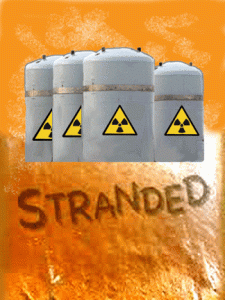 stored for far longer. “We’ve got reprocessed residues that have come back from France which will remain radioactive for many thousands of years,” he says.
The returned waste consists of 20 canisters containing 170 litres each, generated by the High Flux Australian reactor, which ran for nearly 50 years before being decommissioned in 2007.
Intermediate-level waste will continue to be generated by the Open Pool Australian Lightwater research reactor and the under-development Synroc waste treatment plant.
The proposed nuclear waste management facility would hold this intermediate waste above-ground for a few decades until a longer term solution can be found. Griffiths says another structure along the lines of the $5.3bn deep-storage facility in Finland will eventually need to be built.
As for the facility that would hold the waste in the meantime, Griffiths says only a detailed technical assessment could confirm Kimba’s suitability, but proximity to agricultural land and the 1,700km journey from Lucas Heights would not be insurmountable obstacles.
Craig Wilkins, the chief executive of the Conservation Council of South Australia, argues a study should be undertaken on the prospect of storing the waste at Lucas Heights, close to nuclear experts, rather than “out of sight, out of mind”.
“We also have concerns about how incredibly divisive this process is on communities already doing it tough,” he says. “When you have individual landowners putting it forward to kickstart the local conversation it pits neighbour against neighbour.
“Last time it nearly tore Kimba apart. It is clear from last time there is significant community opposition.”
Successive federal governments over decades have failed to lock down a remote-area site to store nuclear waste because of regional opposition, and in a separate process the SA Labor government has struggled to sell a plan to develop a high-level nuclear waste storage facility, with a citizen’s jury last year resoundingly rejecting the concept.
Kimba was first floated as a potential location by the Liberal federal member for Grey, Rohan Ramsay, who in 2015 volunteered his property near the town before it was rejected owing to perceived conflict of interest………..https://www.theguardian.com/environment/2017/apr/04/whod-want-to-dump-australias-nuclear-waste-here-well-this-guy?CMP=share_btn_tw
April 7, 2017
Posted by Christina Macpherson |
AUSTRALIA - NATIONAL, Federal nuclear waste dump, South Australia |
Leave a comment

 Off The Record: Orchestra now in baton race to replace young gun, The Advertiser April 1, 2017 “…….Hitting voters with ion fist OUR atomic adventure might be dead and buried, but a series of targeted nuclear strikes are about to be launched by the Liberals.
Having last November torpedoed Premier Jay Weatherill’s half-hearted push for an international nuclear waste dump, the Libs will now attack him for secret plans to put the dump in various sites across the state, Off the Record has learned.
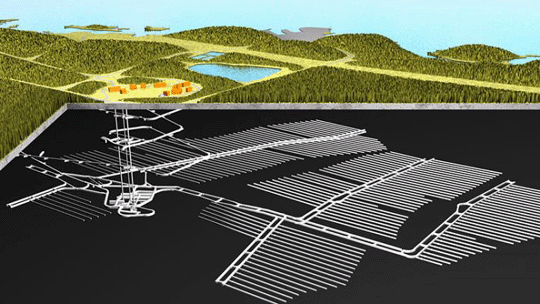
A localised digital and leaflet campaign will accuse Mr Weatherill and his high-level waste dump of risking the destruction of agricultural industry and the environment through toxic nuclear leaks.
The advertising blitz will expand closer to next March’s election.
Regional areas likely to host a dump will be the focus, along with women worried about their children’s futures and those once known as “doctors’ wives” – affluent inner-city Liberal types concerned about the environment and social issues.
Of course, as no site was earmarked by the nuclear royal commission in its final report last May, the Liberals have fertile ground to declare any community could be at risk from the nuclear ogre…… http://www.adelaidenow.com.au/news/opinion/off-the-record-orchestra-now-in-baton-race-to-replace-young-gun/news-story/22c63df9efeb84f31fe3adf21ca65aa9
April 7, 2017
Posted by Christina Macpherson |
NUCLEAR ROYAL COMMISSION 2016, politics, South Australia, wastes |
Leave a comment
The potential location of the proposed National Radioactive Waste Management Facility at Wallerberdina Station near Hawker would have no impact on the World Heritage proposal for the Flinders Ranges.
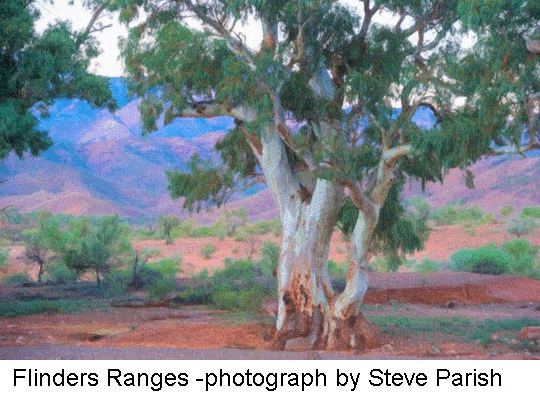
World Heritage for the Flinders Ranges Natural resources, SA Arid lands Over 600 million years old, the Flinders Ranges is one of Australia’s magnificent landscapes. This diverse landscape is world-renowned for its wealth of natural, cultural, historic and scenic values making it an iconic tourism destination with unparalleled visitor experiences.
Particularly extraordinary are the fossils and geology of the Flinders Ranges, which display the history of our planet and the evolution of life on Earth. Some of this critical evidence spans more than 300 million years and includes the world’s finest example of the Ediacaran explosion of life, when the earliest forms of complex multicellular animal life evolved. It is these outstanding geological and palaeontological forms within the Flinders Ranges that make it an important site to pursue for World Heritage Listing.
Pursuing World Heritage Listing for the Flinders Ranges provides an exciting opportunity to recognise this site on a global scale, to celebrate these outstanding values and create economic benefits for the region. Continue reading →
April 7, 2017
Posted by Christina Macpherson |
environment, South Australia |
Leave a comment








 Antinuclear