Your Say: brand South Australia to be irrevocably smirched by nuclear waste dump
 adrian hill 04 Sep 2016 Safety isnt what we should be worrying about
Our brand is more at risk. We want to be known for our great food and wine. While there is not risk at all the waste will reach anywhere near our food chain, we know the how the media can paint a city. I’m concerned that SA will be rebranded as the waste dump state which could affect our tourism. It wouldnt bother me if we could redraw the boarders so the area is not our state. Could it be an independant state like canberra? Or do we name a town where the dumping will occur and push the name of that town rather than associate with SA….google ‘snowtown important.
http://nuclear.yoursay.sa.gov.au/get-invol…/statewide-survey
Your Say: Comments on safety in importing nuclear wastes
 Lachlan Childs 14 Sep 2016 We are not a rich country, we don’t have money to just throw in the air. A Nuclear waste dump would not only harm the environment, and radiate the land for future generations, but it would put the country into bankruptcy. The nuclear waste dump may in fact cost millions of dollars just to set up and manufacture. I understand that the government will then say “Oh! but if we go forward with the Nuclear Waste Dump, a total of $279 billion dollars with be made,” Yea but at the risk of thousands being affected by radiation and if the shipping makes a mistake which could possibly happen, Australia would become another wasteland.
Marisol Da Silva 12 Sept 16 People predicted the Fukushima accident could happen years before it did happen. Chernobyl had it’s disaster because of human error. Because, as humans we do get it wrong. Years after both of these major catastrophes it is still costing money to maintain, clean up, not to mention the health issues of the people and children left behind to live with nuclear devastation. To this date there has been no real solution on how to store nuclear waste. It has been proven that it costs way to to much to plan, build, maintain now and far into the future as this stuff is going to stick around for what is essentially a forever (far beyond several human lifespans and our imaginations into the future). With all the information out there on radiation sickness and the unpredictability of natural disasters occurring, how can anyone hold a straight face and claim nuclear waste, power, mining, bombs are safe? Because ultimately all these things are linked. If you feel you have forgotten then ask the children of Chernobyl and the former USSR, Fukushima, the Marshall Islands, the survivors of the atomic bomb, British Maralinga SA tests, the tribals in Jagugoda Jharkhand India, and the list goes on. We don’t learn. Why don’t we learn from their stories? Why do you think South Australia suddenly will solve what no one has solved? Do you think future children are ever going to thank you for even entertaining this idea? It is a shame that a few greedy people can ruin the earth for the rest of us. We can’t let this happen. We wont let this happen here.
Craig Gordon 01 Sep 2016 I have a question relating to sea transport and geology.
When I stopped at a “Know Nuclear” stand recently the person I spoke to mentioned that with 10km’s of the coast lost cargo would be retrievable.. but past that it wouldn’t be accessible/safe/whatever to bring the waste back to the surface.
She wasn’t quite sure how to answer my follow up question though.. (her expertise was physics, not geology).
My (limited) understanding is that unlike continental crust, which is stable, oceanic crust is constantly being subducted into the core of the earth into the mantle… I understand the rate of this is slow.. but I was wondering how that process might relate to any high level waste that was lost at sea?
http://nuclear.yoursay.sa.gov.au/get-invol…/statewide-survey
With careful planning, Kangaroo Island could be independent with renewable energy
A balanced local electricity supply solution and a transition to 100% renewable power could deliver a range of economic development and other benefits to the local community.
 Kangaroo Island’s choice: a new cable to the mainland, or renewable power, The Conversation, Chris Dunstan September 16, 2016 South Australia’s iconic Kangaroo Island, the site of Australia’s first free settled colony, could pioneer a new age of renewable energy, according to our new research.
The first hardy settlers in 1836 had to decide whether to go it alone with a settlement on the island or revert to the mainland. Today, the 4,400 or so people who call the island home face a similarly stark choice: energy independence, or continued reliance on the mainland.
On one hand, the ageing existing cable could simply be replaced, at a cost of between A$22 million and A$50 million. This is the “preferred network option” proposed by the local electricity distribution network, SA Power Networks (SAPN).
On the other hand, SAPN is also currently considering an alternative mix of local wind, solar and biomass generation, complemented by diesel generation, battery storage and demand management. Continue reading
Your Say: Immoral and illegal for Jay Weatherill to spend taxpayer money to promote nuclear waste dump
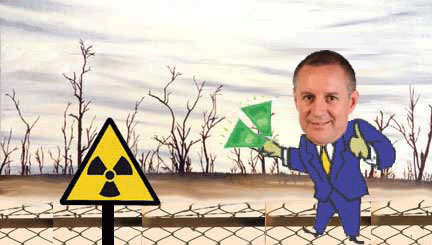 Peter Lazic 12 Sep 2016 What consent does Jay Weatherill have to spend $600 million dollars of taxpayer money to plan a nuclear waste dump, when the proposed dump may never get approved. This and the money spent to date on the Royal Commission, the road show, now TV advertisements, etc, is obscene and immoral
Ed note : Especially as the SA Law says:
13—No public money to be used to encourage or finance construction or
operation of nuclear waste storage facility Nuclear Waste Storage Facility (Prohibition) Act 2000https://www.legislation.sa.gov.au/LZ/C/A/NUCLEAR%20WASTE%20STORAGE%20FACILITY%20(PROHIBITION)%20ACT%202000/CURRENT/2000.68.UN.PDF
http://nuclear.yoursay.sa.gov.au/get-invol…/statewide-survey
When will Premier Weatherill admit that the nuclear bonanza is a really bad idea.
an illusion http://www.adelaidenow.com.au/news/opinion/margaret-beavis-claims-south-australia-will-make-a-fortune-out-of-nuclear-waste-are-just-an-illusion/news-story/de432ce34d9deac7cfbfab406ec32c71 Margaret Beavis, The Advertiser September 13, 2016 THE acclaim around the pot of gold to be made importing nuclear waste into South Australia increasingly feels more like an illusion.There are so many invisible parts making up this story, it is probably only a matter of time before Premier Jay Weatherill finds the courage to say the nuclear bonanza is a really bad idea.
So what are these invisible items?
Firstly, there are no high level nuclear waste facilities anywhere in the world. None. Anywhere.
Both Germany’s efforts have leaked radiation into the water table, and they are currently spending billions pulling the waste out again.
 In Nevada, the US government has spent over US$10 billion building a site, only to find multiple problems including deliberately falsified data about the water table, and massive community opposition. It will never open. The Waste Isolation Pilot Plant in New Mexico closed two years ago after a fire and later an explosion exposed 22 workers and contaminated the whole site. Official investigation found cost cutting, corner cutting and human error was to blame, with a “loss of safety culture”.
The high level nuclear sites in Sweden and Finland were described by the recent Nuclear Fuel Cycle Royal Commission in South Australia as “successful”.
These locations have been researched for 40 years, and will not even start taking waste for at least another six years and, in the Swedish case, well over a decade. It is easy to succeed when there is no radioactive stuff to actually deal with.
 For the last forty years we have counselled pregnant women to avoid X-rays as we know their babies have much higher rates of leukemia.
Evidence from Hiroshima and Nagasaki, from vast human trials literally involving hundreds of thousands of nuclear workers to research about Cat scans and nuclear heart scans, all point to significant harms with additional radiation.
There is no evidence of a safe lower dose; the higher the exposure the higher the risk.
And recent large research trial found rates of stroke and heart attack are also increased.
There is a good reason why countries want so badly to be rid of this material, which is toxic for over 100,000 years.
Thirdly, we have nowhere to put it.
The plan is to import it, and then find some poor remote community to take it.
The problem with that theory is that for almost twenty years the government has been looking for a site for Australia’s own intermediate level waste, without success.
 Aboriginal communities have been disproportionately targeted. We clearly already have more nuclear waste than we know what to do with.
Finally the promised billions, so pivotal to the whole proposal, are risky.
They have been modelled by a firm that works in this area and has potentially a strong vested interest in this venture going ahead
They have not allowed for potential competition, which would massively reduce the prices paid. They have included countries like Ukraine as clients, when Ukraine is looking into building its own facility at Chernobyl.
They have included countries like Bangladesh, which does not even have a reactor yet.
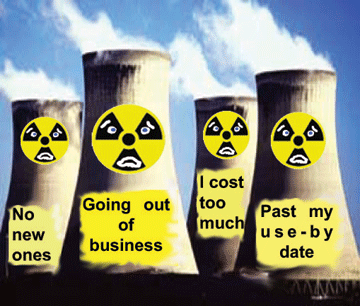 And it has made assumptions about the viability of the nuclear power industry, when plants in places like the US are closing down as they cannot compete financially.
Nuclear waste facilities are very expensive to build, and historically costs inevitably blow out. For example, in the current French waste construction project costs have doubled in the last decade.
There has been no independent financial modelling done by the government, which is extraordinary given the enormous financial risks and the extraordinary time frames.
And the income to cover the clean up — decommissioning and other costs — does not start until 2042.
In essence, this proposal is startling in its optimism.
The likely outcome if it goes ahead is a whole lot of highly toxic radioactive waste lasting for 100,000 years in South Australia, and billions of taxpayers’ money spent trying to find a way that works to get rid of it.
If it is such a financial bonanza, many countries would be racing to do it.
The reality is that a royal commission, lots of clever marketing, 100 consultation sites and a couple of citizens’ juries still don’t make this a smart idea.
Margaret Beavis is president of the Medical Association for Prevention of War
South Australian govrenment sucked in by the Small Modular Nuclear Reactor lobby?
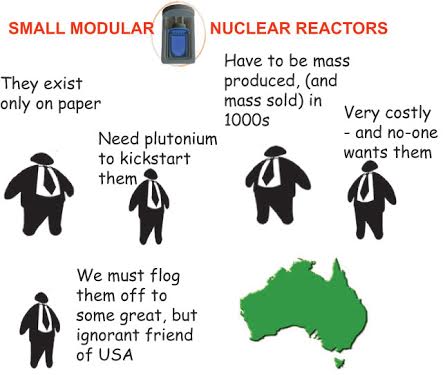 The SA Government’s “Energy Market Transition Plan”, obtained by Freedom of Information request, has revealed that prospects for small modular nuclear reactor deployment in South Australia have been explored.
SA government probes nuclear option as Premier Jay Weatherill promises cheaper power https://au.news.yahoo.com/video/watch/32558838/sa-government-probes-nuclear-option-as-premier-jay-weatherill-promises-cheaper-power/#page2
7News Adelaide September 7th, 7 News can reveal a top level report clearly indicates small scale nuclear reactors have been on the short term radar. Mike Smithson reports
An expert witness to the Nuclear Citizens Jury – sceptical of the “economic bonanza”
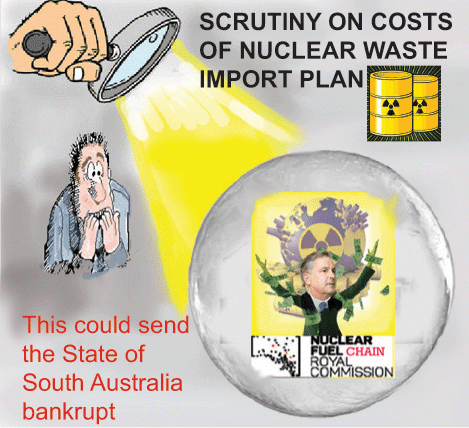 The price is a guess; there is no market price for accepting dumped waste at the present time.
The cost of shipping the waste to South Australia seems also to be a notional allowance in Appendix J ($0.20m/tonne heavy metal). Where this comes from is not obvious.
far from being a financial bonanza, as proposed by the Royal Commission, the project could make minimal returns, and be a real distraction from alternative paths to the economic future of the state
The SA economy, the nuclear waste dump and democracy Richard Blandy INDaily, 12 Sept 16 ANALYSIS As TV messages encourage South Australians to become informed about a proposed nuclear waste dump, Richard Blandy argues the project could prove a distraction from exploring alternative solutions to the state’s economic challenges.
Several times in recent days I have seen a brief message on our TV in which a South Australian mother advises her small daughter that everyone must become informed about the proposed high-level nuclear waste dump in the state. Her daughter looks suitably mystified.
No doubt this is part of the exercise in citizens’ democracy that is currently underway to determine whether there is a “social licence” to proceed with such a dump. Other elements in this process include two meetings of citizens’ juries (one of which has already been held), as well as citizens’ information meetings.
The TV message could have come from the satirical 1970 movie The Rise and Rise of Michael Rimmer, in which conman Rimmer (Peter Cook) eventually becomes British Prime Minister. …….
my experience of the first citizens’ jury, which I attended as an expert witness on July 9, was very positive. I was invited principally as a result of my InDaily articles opposing the dump.
There was one other expert economics witness present questioning the economics of the dump: Rod Campbell, research director of the Australia Institute in Canberra.
Several of the expert witnesses present who supported the economics of the dump had been involved in undertaking the economic/financial analysis for the Nuclear Fuel Cycle Royal Commission.
The citizens’ jury operated as a free-flowing discussion rather than with set pieces presented by the witnesses followed by questions from the jurors. The issues are difficult and technical, but the jurors were great. They made me think that if I am ever in deep trouble with the law, I will always opt for trial by jury.
The 54 South Australian citizens on the jury were sensible, common-sense people who asked pertinent questions. They quite properly insisted that the business case for the dump should be made watertight – or the dump abandoned. Continue reading
Taxpayers up for huge costs in South Australia – just for the PLANNING for nuclear waste importing
 Political Reporter Sheradyn Holderhead, The Advertiser September 11, 2016 THE State Government will need to find up to $600 million to plan a nuclear waste dump even if the project never gets off the ground, a consultant working on the Royal Commission has revealed.
Jacobs Engineering Group project manager Tim Johnson told a parliamentary committee investigating the project that the total cost prior to the decision to proceed and sign contracts with client countries would likely be $300 million to $600 million.
Premier Jay Weatherill said precommitment from participating countries could reduce the risk for taxpayers.
But Dr Johnson questioned the likelihood of doing that earlier than year six of the project, at which time up to $600 million would already have been spent.
Late last week, the committee visited a dump site in Nevada where more than $10 billion has been spent by US government. The project has stalled for years as the state and federal governments fight over approvals.
Liberal MLC and committee member Rob Lucas said the large costs were “a potential deal breaker”.
“I don’t speak for the committee or my party at this stage. Personally, I would find it very hard to support any proposal which meant we could spend $600 million and then decide we wouldn’t proceed with the project,” he said.
“That would simply mean taxpayers had wasted $600 million for nothing.” Continue reading
South Australia, Australia’s most secretive state
 Daniel Wills: Welcome to South Australia, the nation’s most secretive state
IT crept up with such stealth that few people noticed it was even happening, but South Australia can now make fair claim to being the most secretive state in the country.
The Advertiser revealed two stories this week that should deeply concern lovers of open debate and informed democracy, and leave them demanding big changes.
After a period of welcome sunlight as court suppression orders sank to relative lows, they’ve spiked in the past two years and are running at their highest rate in a decade.
On top of that, a Monash University study admonished our Freedom of Information laws as the worst in the country and found the system was “designed to block, delay and obfuscate”.
But this viscous culture of secrecy isn’t isolated to those two important areas.
It seeped so far into the foundations of our Independent Commission Against Corruption that even the man running it has complained to lawmakers that the public is shielded from important information………
SA also trails other states in the protections offered to whistleblowers and any journalists they contact in an honest bid to get important stories of public interest into the light of day. This has a chilling affect on political debate, and makes it more likely that bad practices will survive.There are a few decent theories that help explain why SA stands out so darkly in the crowd………
When the ICAC legislation was drawn up the balance fell on the side of minimising the risk that people of standing would have their reputations unfairly smeared, rather than a bias towards ensuring the public had maximum access to information about what they were up to………. http://www.adelaidenow.com.au/news/opinion/daniel-wills/news-story/10735e85a9e26eeea142501aa6985f25
Hawker in the middle of the earthquake hazard zone south Australia
 Greg Wurn to Nuclear Fuel Cycle Watch South Australia Earthquake Hazard Zones of South Australia. Hawker in the middle of the earthquake hazard zone, well the proposed nuclear fuel waste dump is just a little to the west of Hawker at a place called Wallerberdina, a station near Barndioota, this property just happens to be under a long term lease to ex SA liberal senator Grant Chapman, he also while in politics served on several Senate Select Committees to do with uranium mining and milling, and another on the Lucas Heights Reactor.I will never know if he acquired that property with some sort of insider knowledge, but I do know the land is not geologicaly stable, and it also appears to drain into lake Torrens, which seams to drain south towards Port August and the Spencer Gulf.
David Noonan bad siting for national waste dump and shows that proposed Inter waste dump will be sited somewhere west of Port Augusta… https://www.facebook.com/groups/1021186047913052/
South Australian govt makes a change- to purchase 75 per cent of its long-term electricity needs
 SA Government to purchase 75 per cent of its long-term electricity needs, ABC News, 7 Sept 16 By Nick Harmsen and staff The South Australian Government says it will launch a tender to buy 75 per cent of its long-term electricity needs in an effort to increase competition.
SA has been hit hard by spiralling electricity costs over recent years and the Government wants to introduce a new competitor to the market.
Premier Jay Weatherill said current rules allowed private electricity companies to drive “prices higher by withholding supply”. “A small number of energy suppliers in South Australia have too much power,” he said. “If we increase competition, we will put the power back into the hands of consumers.”
South Australia’s electricity provider, the Electricity Trust of South Australia, was privatised in 1999.It changed its name to SA Power Networks in 2012……..
Carbon emissions scheme on the cards The SA Government also wants to “explore” an Emissions Intensity Scheme (EIS) that would trade credits between energy companies at a national level…….
“[This] means no coal-fired power generation and the only way you’re going to do that is through an emissions trading scheme or an emissions intensity scheme,” he said.
Independent senator for SA Nick Xenophon said an EIS was a “breakthrough” that would increase power reliability, reduce costs and bring about good environmental outcomes. He said that under an EIS, “dirty generators” that emit above a baseline emission rate would have to pay for the pollution while those below it would be credited.
Senator Xenophon said he proposed it at a federal level with the then opposition leader Malcolm Turnbull in 2009. “It seems that after seven long years of skyrocketing power prices that the ‘mongrel scheme’ that I proposed with Malcolm Turnbull has now become the ‘top dog’,” he said.
Yesterday, Port Augusta residents lobbied Mr Weatherill to commit to purchase the power from a proposed solar thermal project in the state’s north.
Mr Weatherill said the tender would not specify which power plant technology should be used…….http://www.abc.net.au/news/2016-09-08/sa-government-to-purchase-75pc-of-electricity-needs/7825852
Confusion about the two South Australian nuclear waste dump plans
 Are these 2 proposals really so separate, or is the Federal dump choice of South Australia planned so as to soften up South Australians and Australia at large, to view South Australia as a suitable radioactive trash toilet? South Australian Liberals, and the Federal Liberal and Labor are all staying quiet about the Scarce Nuclear Commission plan – but are they secretly in support of it?
Two nuclear proposals ‘confusing discussion’ about potential waste dumps in South Australia, ABC News 2 Sept 16 By Lauren Waldhuter Two separate proposals for storing nuclear waste in South Australia have caused widespread confusion in communities and the Premier has conceded public consultation was badly timed.
The State Government has launched a state-wide public consultation program on royal commission recommendations to store the world’s high-grade nuclear waste in SA.
But at the same time the Federal Government hasshort-listed Wallerberdina station, near Hawker in the Flinders Ranges, as a preferred site for Australia’s first storage facility for low-to-intermediate level radioactive waste.
Hawker Community Development Board chairperson Janice McInnis said SA’s public consultation was clouding discussion about the federal plan.
“I’ve had phone calls from friends in Adelaide who said, ‘what’s this about a waste dump at Hawker?’, thinking it was the state one and they hadn’t heard about the federal one at all,” she said.
| March 2015 | Nuclear Fuel Cycle Royal Commission established. |
May 2015 |
Landholder nominations to host Australia’s Radioactive Waste Management Facility close. |
| May 2015 |
Royal commission releases four issues papers. Public consultation period begins. |
November 2015 |
Six sites around Australia identified for further assessment, including three in SA. Consultation period begins. |
| February 2016 |
Royal commission releases tentative findings. It suggests SA builds a dump for the world’s high-level nuclear waste. |
April 2016 |
Federal Government announces Wallerberdina station as its preferred site. |
| May 2016 | Final report released and consultation continues. | Present | Consultation continues until next year. |
Premier Jay Weatherill admitted the timing could have been better.
“Certainly we would’ve preferred if the federal process had have waited until our process had been underway,” he said.
“There’s no doubt there’s been confusion between the federal process and the South Australian Government process.
“We’ve detected that as we’ve gone out and spoken to people.
“I think the Commonwealth support the approach that we’ve taken but we’re going to have to find a way to bring those two decision-making processes together.”……..
Two sets of conversations ‘insulting’ Despite disagreeing with both government plans to pursue a nuclear future for SA, environmental groups agree the issue has become too confusing.
The Conservation Council of SA held an expo in Port Augusta on Friday to highlight concerns about both proposals as well as their differences.
“It’s actually insulting to have two sets of governments having two sets of conversations on two different proposals at the same time,” chief executive Craig Wilkins said.
“No wonder the community is confused. “It’s incredibly important that these two plans are kept separate because the impacts are very, very different.” http://www.abc.net.au/news/2016-09-04/nuclear-proposals-confusing-discussion-in-sa/7812646?pfmredir=sm
South Australia’s Premier Weatherill is proud that his nuclear waste import plan is RISKY!
 Voters will reward my courage, Weatherill insists, INDaily, 1 Sept 16 Tom Richardson
 Tom Richardson “……….the Premier believes the South Australian public will reward his own Government at the 2018 election for courting “political risk” with contentious changes to the state’s healthcare system and a royal commission into the nuclear fuel cycle………
I think ultimately people will give credit to people that are taking on the big decisions,” he insisted.
“There will always be complaints around the edges, but in their heart of hearts they understand somebody’s got to tackle these big questions.”……
On the nuclear issue, acting Liberal leader, Vickie Chapman said: “Weatherill scans the world and tries to find an idea, then thinks, ‘I’ll be bold and brash about this’ – but he’s years late, so it just becomes a sideshow.”……http://indaily.com.au/news/politics/2016/09/01/voters-will-reward-my-courage-weatherill-insists/
Geothermal energy – not necessarily renewable, nor environmentally benign.
Dennis Matthews, 3 Sept 16 It’s important to understand that what companies such as Geodynamics, and organisations like the SA Centre for Geothermal Energy Research at Adelaide Uni have been trying to do is a special sort of geothermal energy, commonly known as “Hot Rocks”. This type of geothermal energy is not renewable in the normal sense of the word, and it is not environmentally benign.
Hot Rocks geothermal requires the expenditure of large amounts of energy to drill 5km underground and to pump liquid under pressure in order to fracture rocks (fracking) 5 km underground. for which it uses a large amount of water to do this.
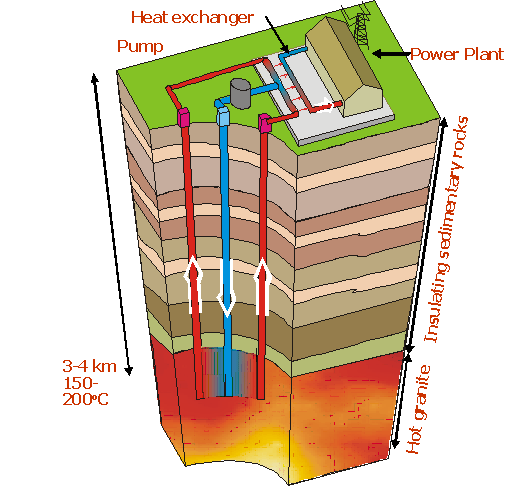
In SA, where most of the hot rocks projects were being pursued, the eventual market for the electricity would have been mining companies especially uranium mines such as Roxby Downs and Beverley. This is no coincidence. The rocks are hot, not because of heat from the earths interior, but because they are radioactive.
By fracking the radioactive rocks and pumping water through them, radioactive radon gas is released and the water becomes radioactive through a host of radioactive isotopes that have built up over millions of years. In principle, during operation the water is not released to the environment but this is the ideal scenario. Accidents and maintenance work is highly likely to rel;lease radioactive water. The water used in fracking is not recycled. I assume it is put into tailings dams and allowed to evaporate leaving behind a concentrated radioactive waste. Often this occurs in areas, such as near the Cooper, which are subject to flash flooding.
Each hot rocks site has a very limited life (approx 20 years), because the rate of heat replacement is much less than the rate of extraction. This means that the project has to constantly move from one set of 5km holes and the exhausted holes will not be viable for “many hundreds of years”. This is not renewable energy. Growing trees for biomass is quicker. Solar is instantaneous in the sense that the sun is essentially an infinite source of energy; using solar energy in no way diminishes the amount available.
Despite several attempts, I was never able to get an answer on the energy payback time, or on greenhouse gas emissions and payback time, or water consumption. For the last 20 years these projects have been powered by govt subsidised diesel and have received very generous Govt funding, both State and Federal, including for the Centre for Geothermal Energy Research. Up to April 2010, public funding totalled approx $300 million.
When these projects were first proposed with backing from the SA mines and energy dept I publicly stated that they were economically and environmentally risky. I see no reason to now change that position.
Unions ready to oppose South Australian Premier Jay Weatherill on nuclear waste dump plans
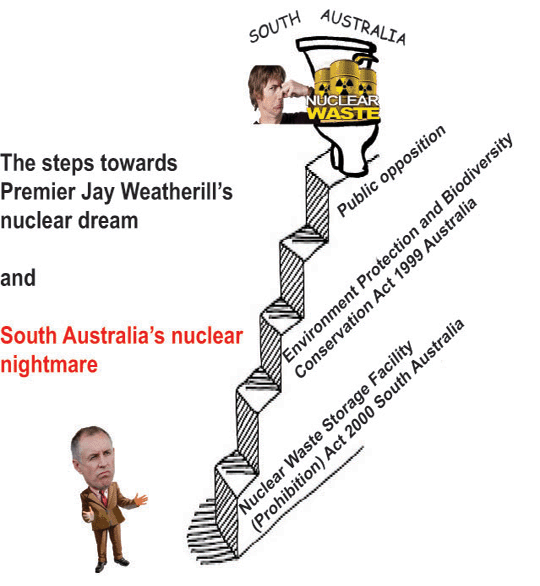 Unions ready to dump on Jay Off the Record: SA’s home of political, business and legal gossip http://www.adelaidenow.com.au/news/opinion/off-the-record-sas-home-of-political-business-and-legal-gossip/news-story/d4d7206f85a8cf5ff5a628158157ef66The Advertiser September 2, 2016 POWERFUL forces within the Labor movement are bracing for an intense union campaign against Premier Jay Weatherill if he goes ahead with plans for a high-level nuclear waste dump.
Off the Record can reveal some are talking about a repeat of the union campaign against Mike Rann, which boiled over in 2010 when he needed a police escort through protesters at Labor’s state conference.
Labor figures have drawn our attention to Maritime Union of Australia state secretary Jamie Newlyn’s public backing of the No Dump Alliance, a broad coalition of environmentalists, indigenous groups and academics.
Newlyn, also SA Unions president, says on the group’s website that the MUA has “a long history of opposing expansion of the nuclear industry including nuclear waste dumps”.
“We fear that the economic assumptions pale in insignificance to the unknown safety and environmental implications of such plans,” says Newlyn.
Wharfies clearly would be required to unload any imported high-level waste, so the union’s support would be critical.
SA Unions vice-president (women) and nurses’ union state secretary Elizabeth Dabars also is backing the anti-dump campaigners, ambiguously declaring her union is pleased “to join the No Dump Alliance to actively participate in community debate on this very important issue for the South Australian community”.
Rann discovered, to his peril, the risks of putting off-side powerful union leaders, such as Australian Workers’ Union state secretary (now president)Wayne Hanson. The AWU, however, is said to be more onside with the dump, because of the potential for jobs and investment.
Perhaps Weatherill will have to worry about his hitherto smooth relations with the union movement being disrupted when he delivers, by the end of the year, the government’s response to the nuclear royal commission.
1 This month

of the week – Australians for War Powers Reform (AWPR)
To see nuclear-related stories in greater depth and intensity
 Antinuclear