Indigenous opposition to the international waste dump plan
 Nuclear waste dump case unravels, World News Report, 13 July 16 , Green Left By Renfrey Clarke “……..Yankunytjatjara Native Title Aboriginal Corporation chairperson Karina Lester told a packed venue at a June 16 meeting: “The overwhelming majority of traditional owners … continue to speak out against establishing an international waste dump.”
Indigenous spokespeople have condemned the project since it was first mooted. In May last year, soon after the royal commission on South Australian involvement in the nuclear cycle began its work, representatives of 12 Aboriginal peoples met in Port Augusta.
 The gathering issued a statement that said: “South Australian Traditional Owners say NO! We oppose plans for uranium mining, nuclear reactors and nuclear waste dumps on our lands.
“We call on the Australian population to support us in our campaign to prevent dirty and dangerous nuclear projects being imposed on our lands and our lives and future generations.”
The prime site for the long-term waste repository is on the lands of the Kokatha people, near the towns of Woomera and Roxby Downs.
The Transcontinental Railway crosses the region and, as the Australian explained on June 27, the ancient rocks of the underlying Stuart Shelf are “considered by experts to have the best geological conditions for a nuclear dump”.
Early this year Dr Tim Johnson of the nuclear industry consulting firm Jacobs MCM told the royal commission his company envisaged a new port being built on the South Australian coastline to service the project. An interim storage facility nearby would hold newly-arrived wastes above ground for some decades, until they had cooled sufficiently to be transported by rail to the permanent dumpsite.
The only practical location for the port and above-ground repository would be on the western shore of Spencer Gulf, south of the city of Whyalla. Spencer Gulf is a shallow, confined inlet whose waters mix only slowly with those of the Southern Ocean. Any accident that released substantial quantities of radioactive material into the gulf would be catastrophic for the marine environment. Profitable fishing, fish-farming and oyster-growing industries would be wiped out, and the recreational fishing that is a favourite pastime of local residents would become impossible.
To connect the above-ground repository to the rail network, a new line would need to be built from the present railhead at Whyalla. Taking wastes north for permanent storage, trains would pass by the outskirts of Whyalla and Port Augusta.
Initially, the materials transported would be large quantities of low and intermediate-level waste, also planned for importation and burial. But after several decades, transport of high-level wastes would begin and would continue for another 70 years.
Awareness is growing in the Spencer Gulf region of the dangers posed by the nuclear industry. On June 24 in Port Augusta about 80 people took part in a protest against the federal plans to site a separate dump, for Australian-derived low-level radioactive wastes, near the Flinders Ranges’ tourist area………..https://world.einnews.com/article/334731841/OM4SBscz5Dp42697
South Australia Nuclear Energy Systems in talks with govt on a different nuclear waste import plan
 Mr Hundertmark said his firm’s plans were quite advanced and had already included talks with state and federal governments.
Push for high-level nuclear waste storage at Maralinga, former British atom bomb test site PAUL STARICK, CHIEF REPORTER, The Advertiser February 16, 2016 DUMPING imported high-level nuclear waste at Maralinga after shipping it through a deepwater port south of Whyalla is being pushed by a high-powered company.
In a multibillion-dollar plan similar to that recommended by the Nuclear Fuel Cycle Royal Commission, radioactive waste would be taken by rail to the former British atomic bomb test site.
SA Nuclear Energy Systems is proposing to bury the waste in giant pits, where soil and equipment contaminated during the British tests was stored in the 1990s, while the Royal Commission recommends underground storage.
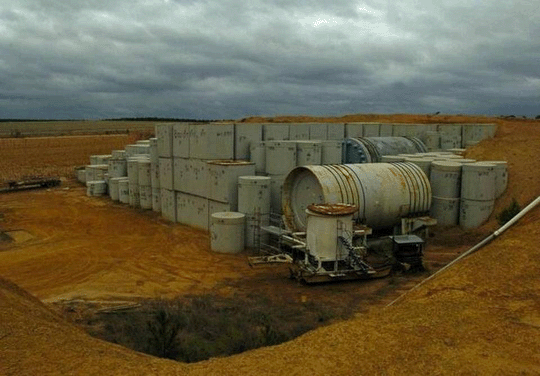
But the site criteria, such as its arid location free from seismic activity, is similar to that proposed by the Royal Commission, as is a dedicated port.
Where could a site go?
The company’s board includes former Premier’s Department chief Ian Kowalick, two Adelaide  University scientists and a former US nuclear industry executive. It is chaired by businessman Bruce Hundertmark……..In a submission to the Nuclear Fuel Cycle Royal Commission, Mr Hundertmark also highlights the fully operational air strip at Maralinga which is capable of receiving the heaviest transport aircraft……
Mr Hundertmark said his firm’s plans were quite advanced and had already included talks with state and federal governments, along with the area’s Aboriginal people, but would require state and federal legislative change.
He said his company’s plan could start far sooner than the late 2020s, because of the existing infrastructure, but did not specify a precise time frame…….http://www.couriermail.com.au/news/national/push-for-highlevel-nuclear-waste-storage-at-maralinga-former-british-atom-bomb-test-site/news-story/65d14a0d7c2f0daf90d7a5ef89da5e9f
South Australian Labor’s push for nuclear waste importing is unravelling already
The case presented by the nuclear dumpsters is dissolving. Outspoken opposition from traditional owners is exposing, as a racist charade, the government’s attempts to manufacture “consent”.
The people of the upper Spencer Gulf cities will not be reconciled to having trainloads of lethal wastes rumbling past their doors for the next century. And the economic case for the dump scheme would merit an “F” in any respectable business course.
 Nuclear waste dump case unravels, World News Report, 13 July 16 , Green Left By Renfrey Clarke Armed with the findings of the Nuclear Fuel Cycle Royal Commission, South Australian Labor Premier Jay Weatherill is pressing ahead with plans to import as much as a third of the world’s high-level nuclear reactor waste and store it in the state’s outback.
There are compelling reasons to reject it. The project, it now emerges, could go ahead only over resistance from Indigenous traditional landowners, some of whom took part in the Lizard Bites Back convergence in early July.
There are serious environmental dangers in unloading the wastes, maintaining them above ground for decades while they cool and transporting them for final burial. Tens of thousands of people would be at risk.
Several devastating critiques have also shown that the economic case for the scheme is largely guesswork. Conceivably, the project would run at a loss — while burdening South Australians with the costs and dangers of tending to the world’s greatest single radiation hazard, effectively forever…….
Consultation?
Another element of the pro-nuclear “educational process” is to be the work of a “Nuclear Consultation and Response Agency” that will visit “all major regional centres, more than 50 remote towns and all Aboriginal communities” in a “dedicated program to ensure all South Australians can have their say about the state’s future involvement in the nuclear industry”.
There is no guarantee, however, that the massaging will work. For all the loot promised by the Advertiser, public opinion for and against the waste dump plan seems evenly split and active resistance is growing.
In mid-May Indigenous, health, union, faith and conservation groups joined in setting up a No Dump Alliance. On June 25, some 80 protestors heckled Weatherill as he arrived to address the opening session of his first “citizens’ jury”.
A 200-strong July protest at Roxby Downs, Lizard Bites Back, also condemned the government’s plan for a nuclear waste dump on Indigenous land. Spokesperson Nectaria Calan said the convergence was focused on the connections between uranium mining and nuclear waste. “A responsible approach to managing nuclear waste would begin with stopping its production”, she said.
The case presented by the nuclear dumpsters is dissolving. Outspoken opposition from traditional owners is exposing, as a racist charade, the government’s attempts to manufacture “consent”.
The people of the upper Spencer Gulf cities will not be reconciled to having trainloads of lethal wastes rumbling past their doors for the next century. And the economic case for the dump scheme would merit an “F” in any respectable business course. https://world.einnews.com/article/334731841/OM4SBscz5Dp42697
Enice Marsh at the Nuclear Citizens’ Jury – about the Federal nuclear waste dump
 “……..JUROR: Enice, you are representing all of the Adnyamathanha people.
Nuclear Waste Business Plan from Hell – South Australia
Blandy conveyed his objections to the royal commission — which substantially ignored them. Instead, the commission continued putting its trust in Jacobs MCM, which it had engaged to perform its financial modelling.
Jacobs, The Australia Institute notes, “consult extensively to the nuclear industry and have an interest in its expansion and continuation”
Nuclear waste dump case unravels, World News Report, 13 July 16 , Green Left By Renfrey Clarke “…….That the environmental and health risks posed by the international waste scheme are alarming and the economics could well be prohibitive are being ignored by the scheme’s supporters.
In its February “tentative findings” and in its May 9 final report, the state government’s royal commission set the hucksters drooling with its view that a high-level waste dump “could generate more than $100 billion income in excess of expenditure over the 120-year life of the project”.
Even this sum was too modest for the Murdoch-owned Adelaide Advertiser as it sought to herd public opinion behind the government’s plans. Working only from revenues and ignoring costs, the newspaper declared on February 17 that “a gigantic $445 billion would be pumped into the state’s finances over at least 70 years”.
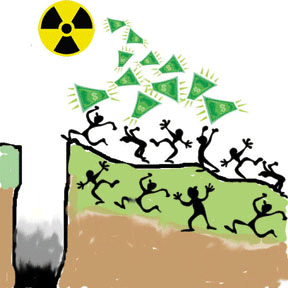
The truth is that the economic case for the project rests on such wild assumptions that any competent entrepreneur would view it as a business plan from hell.
Hopes of a monster pay-out were savaged during March when The Australia Institute published a detailed analysis of the waste dump scheme.
Retired professor of economics Richard Blandy, the economic commentator for the Independent Daily, exploded the royal commission’s guesswork still more definitively on June 7.
The figure for net income of $100 billion, Blandy explained, was based on a completely fanciful estimate of the price that South Australia could expect to obtain for storing spent reactor fuel.
To obtain this estimate, of $1.75 million per tonne of heavy metal, the commission had assumed that the South Australian authorities of the future would have perfect knowledge of the maximum price that potential customers were willing to pay and that the state would face no competitors in the waste storage market-place.
The reality, as Blandy pointed out, is that India and China — to name just two countries — have extensive nuclear power industries and are highly likely to create their own waste repositories.
For these countries to add extra capacity to accommodate international customers would be relatively cheap — and much cheaper than could be managed by an Australian dump relying exclusively on imported waste.
The “$100 billion” figure also reflected an estimate that 37 countries that now have nuclear power industries — or that might someday set them up — would contract with South Australia to store 50% of their reactor waste.
But what if this estimate was grossly inflated?
If South Australia’s dump attracted only a quarter of the wastes targeted, Blandy calculated, and if the price received equalled the costs of building storage capacity in Sweden or Finland (costs, we must assume, that would be high compared to those in India or China) then the South Australian dump would lose money.
Blandy conveyed his objections to the royal commission — which substantially ignored them. Instead, the commission continued putting its trust in Jacobs MCM, which it had engaged to perform its financial modelling.
Jacobs, The Australia Institute notes, “consult extensively to the nuclear industry and have an interest in its expansion and continuation”…… plans.https://world.einnews.com/article/334731841/OM4SBscz5Dp42697
Big Business and right-wing Labor are backing nuclear waste project, despite its dodgy economics
 Nuclear waste dump case unravels, World News Report, 13 July 16 , Green Left By Renfrey Clarke “……….Business backing The waste dump project may not have good arguments, but it certainly has powerful friends. “We’re absolute advocates,” Nigel McBride, CEO of the industry and commerce peak body Business SA told the Independent Dailyon June 17. “We’re now absolutely saying this is not only feasible but absolutely viable.
“I can tell you Business SA is overtly advocating for a high-level nuclear waste facility in SA, subject to an educational process that will get social consent.”
If this typifies the business skills of South Australia’s moneyed elite, then the state’s economic woes are no mystery.
The Weatherill government has made no formal commitment to the waste dump project, and will not do so before a process of “consultation” with South Australians ends in November.
But few people take the premier’s claim of open-mindedness seriously. Influential figures within the state Labor Party’s dominant right faction are on record as enthusiasts for the waste scheme and big business is cracking the whip.
Weatherill made his views clear when he defied the anti-nuclear thrust of federal Labor policy to set up the royal commission and named the conservative-technocratic retired rear-admiral and former state governor Kevin Scarce as commissioner.
More recently, the government has funded two “citizens’ juries” to hear the testimony of (mainly) pro-nuclear figures and to deliver reports that can be claimed as indicating popular agreement to the nuclear-waste plans……..https://world.einnews.com/article/334731841/OM4SBscz5Dp42697
South Australian Premier Jay Weatherill’s deception about the Nuclear Citizens’ Jury
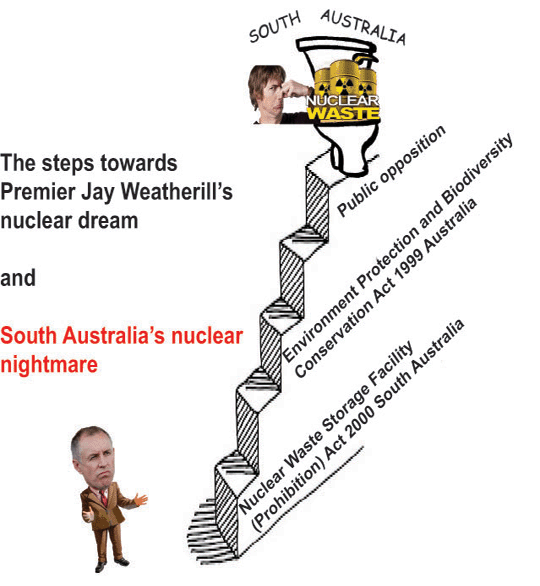
The Citizens’ Jury has delivered exactly what Jay Weatherill wanted- a summary of the Royal  Commission recommendations, with enough uncertainty to justify the nuclear lobby’s next step.
(I’m correcting a previous version of this post, here) The South Australian government already rushed through legislation that overturned South Australia’s legislation against spending money on nuclear industry development, (making this retrospective of course – to cover the $millions already spent)
The next step is to overturn the whole Act, or at least those parts of it which prohibit importing a nd storing foreign wastes.
Weatherill is quoted in THE AUSTRALIAN today as saying ”
“they (the Citizens’ Jury) are asking us to also change the legislation to undertake that work”.
That is a lie. The jury was merely repeating what the Nuclear Royal Commission said. The jury kept to their brief – no decisions or recommendations – just regurgitate what the Commission said.
Nuclear waste – Interim storage containers not necessarily safe
 LobbyistsRule, – comment on The Advertiser, 11 July 16
The temperatures inside these casks normally sit at 200 to 300 degrees Celcius – but if the vents of the concrete overjacket get blocked the temperature can rise to 500 degrees Celcius.
These casks have only been around for twenty years – they should start popping all over the USA in a decade or two.
All this information is available from the USA’s Nuclear Regulatory Commission web site for anyone to read. http://www.adelaidenow.com.au/news/south-australia/citizens-jury-on-sa-nuclear-waste-dump-releases-initial-report/news-story/e76096fa7ec07edcbe18ae0b989683dd
Important questions for the South Australian Nuclear Citizens’ Jury
 Dan Monceaux, 11 July 16

1) Jury should ask for access to all submissions made to the Parliamentary Committee currently considering responses to the NFCRC’s Final Report.
2) Jury should realise that future consideration is for a multi-lateral nuclear fuel centre, which could involve enrichment, reprocessing, fuel fabrication etc. Waste storage is an entry point: see “Nuclear Fuel Leasing” in the NFCRC’s Report for details.
3) Jury should ask: What is the defence sector’s interest in the nuclear fuel cycle? If defence wants it, how important is the economic case for further processing? Could these proceed without a commercial proposition?
4) Jury should consider the USA’s Energy Employees Occupational Illness Compensation Program and discuss why this was not considered in the NFCRC’s Final Report. it was submitted to the Commission as evidence.
5) Jury should consider the USA’s Radiation Exposure Compensation Act and discuss why this was not considered in the NFCRC’s Final Report. it was submitted to the Commission as evidence.
6) The jury should ask the question: what evidence did the Commission receive and choose NOT to include in its Final Report? Particularly on the topic of safety.
Citizens jury concerned about economics of nuclear waste dump plan
 Citizens’ jury questions economics of SA nuclear dump THE AUSTRALIAN JULY 11, 2016 Rebecca Puddy The bid to establish a nuclear waste storage facility in South Australia has suffered a further setback, after an independent “citizens’ jury” raised concerns about the economic viability of the project.
A citizens’ jury of 50 people met over two weekends to discuss the nuclear royal commission report, handing a nine-page summary to Premier Jay Weatherill last night.
But after hearing from experts, the jury questioned the economic underpinnings of the commission’s findings.
“There were varying views between expert witnesses on the economic viability of this project and therefore questions remain relating to the economic modelling by the royal commission report to feel comfortable progressing to further involvement,” the jury report said.>Mr Weatherill accepted the report from the jury, describing it as “commonsense”.
But he confirmed there was extra work to be done on the estimated size of the economic benefit. “They want some more work on the assumptions so they can be clear on what the benefits are and those assumptions are really what is the actual price an overseas country is prepared to pay for storing their waste in our country and that will only be known if we undertake that work,” Mr Weatherill said.
“That will require expenditure and they are asking us to also change the legislation to undertake that work, so it’s a commonsense recommendation and one we will work on.” Another 350 people will meet in October in another citizens’ jury to look at feedback from the statewide consultations………The South Australian Labor government’s examination into the merits of engaging in the nuclear fuel cycle has so far cost the state’s taxpayers $11.8 million.
This is despite Labor’s national platform, updated last year, strongly opposing establishment of nuclear power plants and any stages of the nuclear fuel cycle, other than uranium mining, in Australia. The platform states strong opposition to the importation and storage of nuclear waste from overseas.
In his opening speech to the citizens’ jury, Mr Weatherill said the group was not meant to arrive at a decision but “to actually arrive at a decision about whether the government can make a decision”……..Varying expert views on the economic benefits of storing nuclear waste have already prompted the government to review work already undertaken by its $7.2 million royal commission.
Opposition spokesman Rob Lucas questioned the value of the citizens’ jury to government. “If that is all there is it has been a massive waste of money which hasn’t clarified anything or progressed the debate at all.”
Mr Weatherill has committed to providing a response to the royal commission by the end of the year. The report royal commission’s recommended pursuing a waste dump. http://www.theaustralian.com.au/national-affairs/state-politics/citizens-jury-questions-economics-of-sa-nuclear-dump/news-story/07e997242e2cb7e71daa0dd45d866a51
Citizens’ jury questions safety concerns surrounding dump proposal
Nuclear royal commission: Citizens’ jury questions safety concerns surrounding dump proposal, ABC News, By Daniel Keane, 10 July 16 A grassroots report into a proposal to build a high-level nuclear waste dump in South Australia has identified safety as a major concern.
The report by a citizens’ jury of 50 randomly selected South Australians also found “significant additional research” is required before residents can make an “informed decision”.
The report, presented to Premier Jay Weatherill on Sunday afternoon, followed four days of intense discussions and meetings with experts both for and against the proposal.
Timeline: SA’s nuclear dump debate Plans for a national nuclear waste dump have been on the agenda for decades, and for much of that time SA’s outback has been touted as a possible site.
“The jurors recognise there are potential economic benefits, but there are also substantial risks to consider,” the report stated. “There is a degree of uncertainty around both the benefits and risks associated with establishing such a facility…….
Nuclear radiation a concern to people, environment Continue reading
Losing faith in Nuclear Citizens’ Jury process – today’s hearings
Unfortunately, despite the genuine hard work of the jury members, it could all be a bit of a waste, or worse. The Nuclear Fuel Chain Royal Commission NFCRC was over months ago. But whaddya know – the NFCRC seems to be well in control of the jury proceedings.
DemocracyCo people are trying hard, but are they the patsy in all this?
Dan Monceau reports on Facebook https://www.facebook.com/groups/1021186047913052/:
At the session I observed yesterday, Lucinda Byers (of the NFCRC) was a major participant in the conversation about ‘Trust’.
Geordan Graetz, a Royal Commission staff member who was first disclosed in the Royal Commission’s final report was hanging around.
I notice today that Ashok Kaniyal, another Royal Commission staff member appears to be present.
The media manager for CARA (the Department of Premier & Cabinet’s new reponse agency) is Jenny Turner, who was previously Senior Communications officer, employed by the Royal Commission.
DPC is “in charge” of the process, but the Commission’s staff are clearly and quite intimately involved in this current Citizens Jury process.
South Australia Nuclear Citizens Jury afternoon session 9 July
 In this session, facilitator (probably Emily Jenke from DemocracyCo) was asking the jury to discuss and develop a consensus on the wording of their reports on several topics.
I hope that there will be a transcript of this – (a) because I missed quite a lot and (b) because the to and fro of questions between jurors is hard to follow in an attempted transcript such as I’m doing.
In fact, I learned only some of the discussion on subjects of Education, Community Consent and Trust, and Safety.
Parts that I found particularly significant –
- On Economics – how much investment does the State of South Australia have to put into development of nuclear waste importing facilities? Some jurors felt that there was not enough economic modelling. on education: when will a yes or no answer be acceptable?
- on Trust : it was stressed that this is important because the current South Australian legislation prohibits import and storage of foreign nuclear waste. We need to decide if South Australia, as producer of uranium, has a moral and ethical obligation to take back wastes. Apparently Haydn Manning in a previous hearing has suggested that there is this obligation. However, one juror stated that this was not the finding of the old Ranger Inquiry. International standards state that the society that generates the waste (i.e in nuclear reactors) has that obligation, (not the society that provides the uranium). The Royal Commission Report also states this.
- on Safety – a comprehensive report was given on this, outlining many questions. Here one juror complained that the risks had been emphasised, rather than safety. He referred the jurors back to then evidence given the previous week on radiation risks. At this point my live-stream reception cut out – just as it was getting interesting, seeing that last week’s Citizens’ jury speakers produced a whole lot of trivial nonsense on this topic.
Nuclear Citizens Jury discusses Community Consent
Enice Marsh from the Adnyamathanha Camp Law Mob led off with a clear and passionate statement on the fact that, despite the friendliness and courtesy of the Nuclear Commission’s Jon Bok, their group utterly rejects nuclear waste importing.
This discussion focused mainly on Aboriginal issues. Of course, mainly white people talking. But it is encouraging to note that these jurors showed real concern for the interests of Aboriginal people.
Some interesting discussion on whether the question of importing nuclear waste is an “ethical question or an economic question”
One juror answered firmly –
“If you read the Royal Commission’s report, it’s all about the money”
Nobody disputed that , and the facilitator moved the discussion on quickly.
A juror questioned the lack of information amongst the ordinary public, including the jurors, about radiation. This matter was not followed up.
Proposals were made that there should be no further discussion, until all potential native landowners be fully consulted, before there is any further progress in the State discussion on nuclear. waste importing. It doesn’t look as if that proposition will be taken up. It was knocked on the head by another Aboriginal speaker – Harry?
The group ended up working out a paragraph for their Final Report. – along these lines:
“We have confidence that the best consultation must be what works for the people being consulted. It should not be rushed, and this must be clear from the start.”
South Australian Greens leader shows up folly of Jay Weatherill’s nuclear waste boondoggle
| Throwing good money after bad – How the nuclear waste dump folly could wreck the State Budget | ||||
The additional $3.6m allocated in the SA State Budget to advance the case for an international nuclear waste dump means that $13m will have been spent on this deeply flawed proposal by the end of the year, according to Greens SA Parliamentary Leader, Mark Parnell MLC.
“If the Government decides at the end of this year to proceed further with the nuclear waste dump, then this amount must be budgeted for. There will be no revenue, only costs. “On the other hand, if the Government abandons this nuclear waste dump folly now, then we can cut our losses and re-allocate that money to genuinely benefit South Australians rather than impose a toxic legacy for countless future generations”, said Mr Parnell. Here are some better uses to which $600m could be spent: · Finish electrification of the Gawler line and new tram lines to make AdeLink a reality · Better cycling infrastructure · Solar panels on all public housing · Better rural health services and mental health services · Reducing payroll tax for wages paid to apprentices and trainees |
||||
1 This month
7 April – WEBINAR – Australia and the Doomsday Clock – Preventing nuclear war through NoFirstUse and other policies
Online | Tuesday April 7, 4:00-5:30pm, Australian Eastern Time / 8:00-9:30am Central Europe Time
– Access the registration link
15 April – Zoom –Nuclear Power is Not the Solution
Apr 15, 2026 01:00 AM in Canberra, Melbourne, Sydney

Join the International Physicians for the Prevention of Nuclear War (IPPNW) on Tuesday, April 14th for a timely webinar exploring the risks associated with nuclear power and challenging the myth that it offers a simple, safe, carbon-free solution to the climate crisis

21 April Webinar: No Nuclear Weapons in Australia
Start: 2026-04-21 18:00:00 UTC Canberra, Melbourne, Sydney (GMT+10:00)
End: 2026-04-21 19:30:00 UTC Canberra, Melbourne, Sydney (GMT+10:00)
Event Type: Virtual
A virtual link will be communicated before the event.
Host Contact Info: australia@icanw.org

of the week – Australians for War Powers Reform (AWPR)
To see nuclear-related stories in greater depth and intensity
 Antinuclear