David Noonan’s Nuclear waste security brief, in brief
 Nuclear waste security brief by David Noonan, Independent Environment Campaigner, June 16
“Proposed International nuclear waste storage exposes Australia to risks of terrorism”
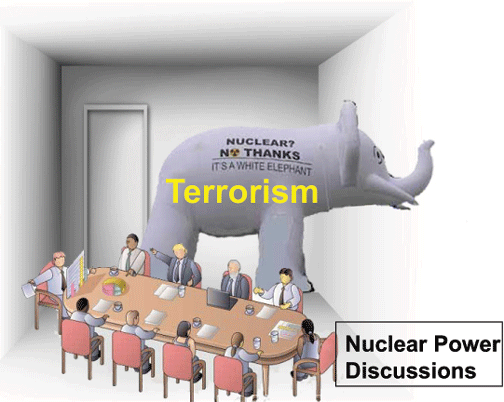
An International nuclear waste storage agenda exposes Australia to a range of potential profound adverse impacts through nuclear insecurity as a target for terrorism.
Claims by the Nuclear Commission Findings Report (Feb 2016, p.16-20) that SA “offers a safe long term capability” for the storage and disposal of high level nuclear waste are contradicted by the fact that Australia will be exposed to significant and developing threats in terrorism over decades of proposed Nuclear port and above-ground waste storage operations.
The UK Nuclear Free Local Authorities are concerned a determined terrorist group could be able to pierce nuclear waste transport and storage casks in use around the world and states that transport of nuclear materials should be limited as much as practical, with safe on-site storage facilities developed instead.
The Nuclear Commission’s nuclear waste transport and storage plans face fast emerging and unexpected nuclear security threats as lethal technology gets ever more destructive. Rocket propelled grenades, demolition charges and innovative available technology like the use of small drones by non-state actors are of increasing concern.
Attacks could seriously compromise operations of a nuclear port or an above-ground nuclear waste storage facility and the extent of impacts could conceivably require the site to be abandoned.
Security dangers in Nuclear Royal Commission’s plan
Nuclear Waste Brief (June 2016) by David Noonan, Independent Environment Campaigner
 Proposed International nuclear waste storage exposes Australia to risks of terrorism “In the event of a major nuclear accident, adverse impacts on the tourism, agriculture and property sectors could potentially be profound.” Nuclear Royal Commission Finding 155 Feb 2016, Impacts on other Sectors p.28
An International nuclear waste storage agenda exposes Australia to a range of potential profound adverse impacts in major nuclear accidents and in nuclear insecurity as a target for terrorism.
The SA Nuclear Royal Commission Final Report (9 May 2016, 16 Mb) flagged risks in proposed high level nuclear waste transport and storage and concluded that terrorist attack scenarios are conceivable and rocket attack has the greatest potential to cause a release of radiation from impacted waste transport and storage casks (Appendix L – Transport risk analysis p.312).
In an age of terrorism following the devastating September 11th 2001 attacks there is no room for denial on the real security risks society faces in nuclear and radiological terrorism. Continue reading
Why a referendum is needed on South Australian govt’s nuclear waste import plan
 john jasson, Your Say 17 June 16 Chapter 6 page 122 [Nuclear Fuel Chain Royal Commission Recommendations] states:
“Because of these shifts, a public vote on a proposal is not a reliable indicator of ongoing social consent: A vote for or against a proposal one day may not result in the same level of social consent one month later. ”
The two paragraphs that precede this unsubstantiated opinion as declared by the commission are in my view irrelevant because they relate to changes in public consent for matters of technological change that are easily reversible and have risk profiles that are minimal by comparison to a nuclear storage or transportation accident.
For this reason I have no trust in this process as I believe this to be a blatant attempt to circumvent the people of SA having a true say in this matter. A referendum is the only acceptable way to achieve public consent on a matter that has such significant commercial, safety and social implications for the public of SA. http://yoursay.sa.gov.au/discussions/nuclear-community-conversation-comment-on-the-specific-recommendations-in-the-final-report
View South Australia Nuclear Citizens Juries Saturday 25 June and Sunday 26 June
Citizens’ Jury Viewing Your Say Nuclear Register to be an “Observer” for the first upcoming nuclear Citizens’ Jury
There are a number of sessions in which 10 randomly selected South Australians will be able to sit in and watch proceedings, hear what the Jury hears and observe how democracy works in this important discussion.
While sessions will be broadcast publicly via media organisations and live streaming on the YourSAy website, at any time the jury reserves the right to deliberate privately and can ask for the jury room to be cleared.
Please note that photographers will be present to take photographs and capture film at this event. This material will be published in both printed and electronic (including Internet-based) media used by the South Australian Government to promote the consultation process on the Nuclear Fuel Cycle Royal Commission report. In some cases, the media in which this material is published may be administered by a third party……
Registration for the first two days of the Citizens’ Jury (Saturday 25 June and Sunday 26 June) will close at 5pm Wednesday 22 June, 2016. Registrations for the last two days (Saturday 9 July and Sunday 10 July) will close at 5pm on Wednesday 6th July. All applicants’ names will be sorted into a random stratification process which will be facilitated independently by newDemocracy Foundation. To allocate seats, a random number draw will be conducted.
Successfully drawn applicants for the first weekend of the Citizens’ Jury will be notified by telephone or email on Thursday 23 June. Successfully drawn applicants for the second weekend will be notified by telephone on Thursday 7 July.
Senator Nick Xenophon not keen on nuclear waste importing
 Xenophon “can’t see benefits” of nuke dump, InDaily, Tom Richardson, 17 June 16 Influential senator Nick Xenophon has come down against the establishment of an international nuclear repository in South Australia, arguing “I can’t see the benefits are there that outweigh the risks”.
It comes as the state’s chamber of commerce, Business SA, nailed its own colours firmly to the mast, with chief Nigel McBride saying the organisation was now “advocating actively and positively for a high-level waste repository here in SA”.
InDaily revealed in March that McBride would be joining a business delegation organised by the  Committee for Adelaide to tour nuclear sites in Europe, but at the time he insisted he was there to observe and learn, not to advocate…… with a public information campaign gearing up in the wake of the Scarce Royal Commission’s bullish final report, McBride says he is now prepared to take a lead in pushing for the repository to become a reality.
He said “thought leaders” in the community, rather than politicians, should step up to play a prominent role in the debate.
“We’re absolute advocates,” he said of Business SA…….
Business SA is overtly advocating for a high-level nuclear waste facility in SA, subject to an educational process that will get social consent.”
But the influential lobby group’s enthusiasm was not reciprocated by Xenophon at an election forum, co-hosted last night by a range of interest groups including the Wilderness Society and Conservation SA in the marginal electorate of Hindmarsh.
In a packed Glenelg Football clubroom, Karina Lester from the Yankunytjatjara Native Title Aboriginal Corporation pressed Xenophon on where his fledgling party stood on high-level nuclear waste imports.
“Would your party listen to us and support the overwhelming majority of traditional owners who continue to speak out against establishing an international nuclear waste dump?” Lester asked.
Xenophon said: “The short answer is yes, I don’t support importation of high-level waste.”
He has previously endorsed a referendum on the issue, explaining last night that “it seems to me you might get a consensus between the two major parties here in SA and it might be seen as a a done deal [so] it’s important to get the consent of the community”.
However, he added, “if a referendum were held tomorrow I can’t see myself supporting it”.
“I can’t see the benefits are there that outweigh the risks,” he said.
The debate is set to dominate the state political scene in the latter half of the year, with two Citizens’ Juries headlining a broader community consultation………http://indaily.com.au/news/local/2016/06/17/xenophon-cant-see-benefits-of-nuke-dump/
Australian Greens plan for a solar South Australia
 Australian Greens announce plan to fund solar panels for 48,000 SA homes
 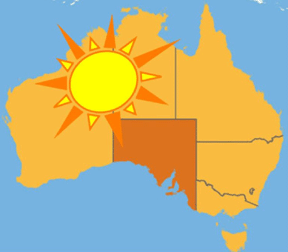 June 16, 2016 http://www.adelaidenow.com.au/news/national/federal-election/australian-greens-announce-plan-to-fund-solar-panels-for-48000-sa-homes/news-story/fd62f39d9131861e539f9a674 Political Editor Tory Shepherd, Advertiser MORE than 48,000 South Australian homes would get solar panels and energy efficient measures under an Australian Greens plan to reduce electricity costs and reduce emissions.
Deputy Leader Larissa Waters and SA Senator Robert Simms has announced in Adelaide today a plan to spend $2000 on each public and community housing home, which they say could save renters as much as $1075 a year.
The plan would cost $60 million a year, and would not be finished until 2030. By that point homes would be retrofitted with energy-saving and water efficient devices, with solar on every roof.
Senator Simms said it would also boost jobs, employing thousands of South Australians.
“This initiative would not only provide South Australians with more jobs in the renewable energy and green housing sector, but it would save the average household $780 per year in electricity bills from installing solar alone,” he said.
Senator Waters said nationally it would help about 800,000 people. More than 2400 deaths a year are associated with cold weather, she said.
“We have an unequal system where our lowest earners are paying the highest price for power, many in ageing houses that are inefficient to run, hot in summer and freezing in winter,” she said.
The Greens will not be able to form Government but they may share the balance of power in the Senate after the July 2 election, which could give them leverage over the major parties.
One response to the recommendations of the South Australian Nuclear Fuel Chain Royal Commission
john jasson 09 Jun 2016Recommendations 1, …. Strongly disagree with removal of State powers on these matters. This is contrary to the interests of South Australians
Recommendations 2,3,4…….Agree with these recommendations as they apply to mining generally.
Recommendation 5 is an absolute nonsense and I strongly disagree as it is not practical and realistically enforceable. This appears to me be a hollow and deceptive assurance to gain support for recommendations 8 through 12. The recommendation overlooks the appalling history of contamination in this State that has already occurred and can not be economically remediated.
Recommendation 7 Agree subject to this activity NOT contravening the original intent and purpose of this facility. Priority should at all times support the fundamental purpose for which this facility was created.
Recommendation 8 Strongly disagree.
Recommendation 9 Agree with the intent of this recommendation but subject to the removal of Nuclear.
Recommendations 10, 11, 12 Strongly disagree. http://yoursay.sa.gov.au/discussions/nuclear-community-conversation-comment-on-the-specific-recommendations-in-the-final-report
Why South Australians should say NO to the nuclear waste importing plan
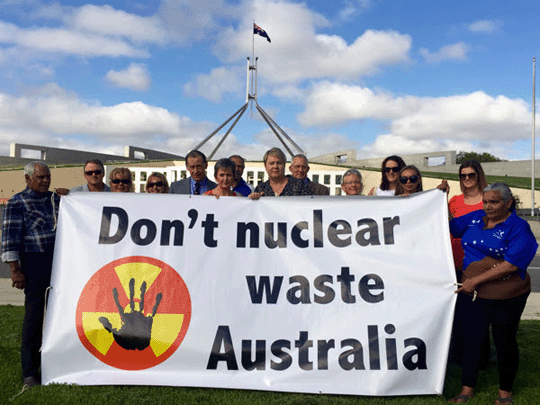 Penny Kleemann 08 Jun 2016 To Jay and the state Labor Party:
 As I type, I’m looking at a photo of Mike Rann celebrating with the Kupa Piti Kungka Tjuta when they defeated the Howard nuclear dump proposal. Do the words “Judas” and “betrayal” mean anything to you?
Do you really think South Australians are so stupid? This state dump proposal is so full of lies and so obviously about greed, money before the planet, and the rich getting richer. The bias of the Royal Commission is gob-smacking. Let’s start with Kevin Scarce:
He appointed three nuclear advocates to the Committee and only one person who was opposed. Wow – unbiased. Sounds like the work of a nuclear lobby group to me.
We are leading the country in renewables. Why touch poison when we can be clean, green?
The supposed financial benefits are based on very shakey modeling, and if it all goes wrong, it will bring the opposite of financial windfall and could bankrupt the state.
And, the state Labor government embezzled 9.1 million plus of OUR public money on a Royal Commission when they could have just asked The Australia Institute to do it. For that money we could be well on the way to building our solar thermal plant at Port Augusta. http://yoursay.sa.gov.au/discussions/nuclear-community-conversation-comment-on-the-specific-recommendations-in-the-final-report
The ‘pie in the sky’ financials of the South Australian Nuclear Royal Commission’s Report
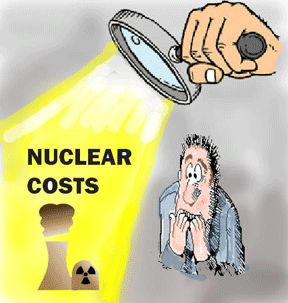
What happens when the private public partnership goes wrong, the private company can just declare bankruptcy and go back to whatever tax haven they more than are likely based in?
David Richards, Commenting on the specific recommendations in the Royal Commission’s Report, 12 June 16 http://yoursay.sa.gov.au/discussions/nuclear-community-conversation-comment-on-the-specific-recommendations-in-the-final-report
 The real weakness for this report is the ‘pie in the sky’ financials: The numbers may add up, however their basis in fact is largely illusory… Completion of the construction of the underground storage facility is by use of the money collected after many thousands of tonnes of waste has been collected and stored on the S.A surface. The proposal’s model is supposed to be simple: we start collecting the used fuel for which we will be paid $1.2 million a tonne, we store it on the surface for 10 plus years while the repository is prepared under the surface, and then inter it permanently underground. The weakness of this financial model is that it relies upon our potential customers providing a constant supply of waste at a premium price that we nominate for a sustained period.
What happens if not all of our customers is prepared to continue to pay the $1.2 million a tonne? They might send, 100 tonne, say, at the nominated price to get things started, and then ask for a discount. The potential suppliers will know the score, once the canisters are on the surface; the clock in S.A is ticking: success will rest upon this timeline for permanent storage below the surface, achieved by the sustainability of the cash flow generated by maintenance of the waste stream at the nominated price. The overseas suppliers will have done their sums, some of them have held on to this waste for the last 50 years, holding back for a little while longer to get a cheaper price is good business sense. Paying our initial asking price may free up enough space in their local repositories to allow them to absorb new waste until we offer them disposal at a reduced rate. They will have a good idea of the breakeven point of disposing of this waste, and will if they are feeling generous offer this price. Once the waste is accumulating on the South Australian surface, who will be the most desperate, those getting rid of the stuff, them that have been stock piling it for years, or us with a partially built facility and waste in temporary storage on the surface? Continue reading
Some even more disturbing numbers on folly of South Australia nuclear waste import plan
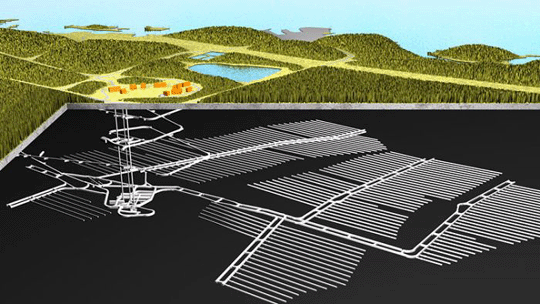
Kim Mavromatis 10 June 16 MORE NUMBERS – 138,000 tonnes of high level nuclear waste in 69,000 high level radioactive waste canisters equates to a permanent underground nuclear waste dump size of around 112 square kms or 5,500 Adelaide ovals, 400 metres underground – and that’s not taking into consideration the 470,000 m3 of low and intermediate level nuclear waste.
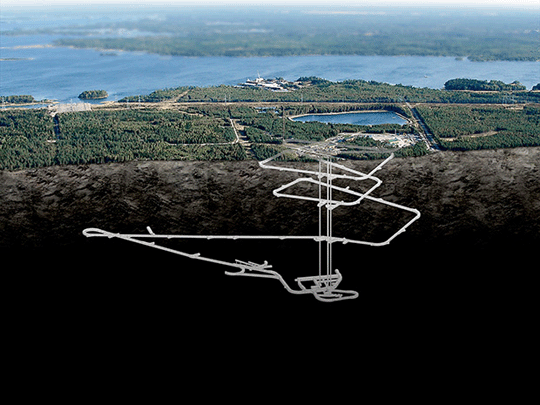
You can’t seriously tell me they will be able to build one nuclear waste dump that big?? in ground where there is no seismic activity in SA. Say yes to one and we will have many – say yes to one and we will end up with a toxic white elephant that will do us in or an economic white elephant that will do us in.
South Australia’s proposed nuclear waste import dump would be massively larger than Finland’s
Kim Mavromatis, 10 June 16 THE NUMBERS TELL A STORY
At the Royal Commission NFC event at the Hawke Centre in Adelaide (Wed June 1), Kevin Scarce made reference to Finland’s permanent underground high level Nuclear Waste dump, currently being built at Onkalo, which will have a capacity of 5,000 to 10,000 tonnes. Onkalo is featured in the must see doco “Into Eternity”(https://vimeo.com/111398583). The Royal Commission NFC final report specifies a capacity of 138,000 tonnes of high level nuclear waste for the proposed Nuclear Waste dump in SA and Kevin Scarce highlighted this figure at the Hawke Centre Nuclear event.
Comparing the Nuclear Royal Commission numbers with Onkalo, it’s clear that the proposed Nuclear Waste dump in SA will be of mammoth proportions.
Onkalo (Finland), permanent underground high level Nuclear Waste Dump :
• Capacity 5,000 to 10,000 tonnes high level nuclear waste,
• or 2,500 to 5,000 high level nuclear waste canisters.
Proposed SA Nuclear Waste Dump :
• Capacity 138,000 tonnes high level nuclear waste or 69,000 high level nuclear waste canisters.
• Capacity 390,000 m3 intermediate nuclear waste.
• Capacity 81,000 m3 low level nuclear waste.
• Above Ground Temporary facility Capacity 72,000 tonnes high level nuclear waste.
• Above Ground Temporary facility Capacity 175,000 m3 Intermediate nuclear waste.
Just for high level nuclear waste alone, it will require a waste dump 14 to 28 times the size of Onkalo (69,000 high level nuclear waste canisters). And for decades, half of the high level nuclear waste will be stored above ground in a temporary facility. Imagine the risk of nuclear holocaust with all that high level nuclear waste in the one location?
And the preferred site for the proposed Federal govnt’s low and intermediate level nuclear waste dump, in the Flinders Ranges, is in an area where there is regular earthquake activity.
How smart are these people?????
I suspect if the state govnt say yes to one Nuclear Waste Dump (low, intermediate, high), the floodgates will open and there won’t just be one Nuclear Waste Dump site in South Australia, there will be many (50, 100 ????). And saying yes in SA will also open the floodgates to the rest of Australia. And I question whether they’ll stop at 138,000 tonnes (69,000 canisters) of high level nuclear waste????? If the state govnt takes us down this path and we become the world’s nuclear waste dump, there is no turning back
South Australia’s Labor and Liberal leaders for nuclear jaunt together to Finland
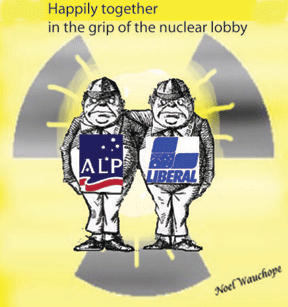 Weatherill, Marshall to make bipartisan trip to permanent nuke waste dump in Finland June 9, 2016 , Daniel Wills and Luke Griffiths,The Advertiser
PREMIER Jay Weatherill and Opposition Leader Steven Marshall will make a bipartisan trip to Finland in August and visit the world’s first long-term nuclear waste storage facility……
The bipartisan delegation to Finland will also include members of the Nuclear Fuel Cycle Royal Commission Consultation and Response Agency Advisory Board, which is overseeing statewide consultation on the proposal as the State Government considers whether to proceed.
It will visit the Onkalo nuclear waste facility in northern Finland, where the country plans to bury its own spent fuel in a labyrinth of tunnels 520m under the ground for permanent storage. Onkalo is expected to accept fuel for 100 years before being sealed for eternity. The facility is currently under construction is expected to become operational within a decade.
Mr Weatherill said it was critical to see first-hand the kind of facility SA could build.
“The research and evidence shows SA can safely deepen its involvement in the nuclear fuel cycle,” he said. “I want to see first-hand what this might look like and see what lessons Finland can share with us, should this be something South Australians want to consider.”
“To make an informed decision later this year, it’s important that I understand the concept of deep geological disposal. This bipartisan visit to the Onkalo site will allow us to learn valuable lessons from the Finnish experience, which we will share with the SA community.”
Mr Marshall said it’s important there is a bipartisan investigation of the opportunity and co-operation during the community consultation process.
Also on the panel was Greg Ward, chief of staff to the Nuclear Royal Commission…….http://www.adelaidenow.com.au/news/south-australia/weatherill-marshall-to-make-bipartisan-trip-to-permanent-nuke-waste-dump-in-finland/news-story/8a1be359682fb154b4fdccd48cc36dca
Record wind energy output last month kept electricity prices down
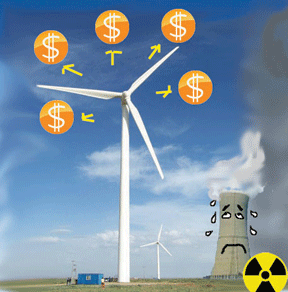 Wind energy’s biggest month, and how it keeps prices down REneweconomy, EBy Giles Parkinson on 8 June 2016 Wind energy in Australia has enjoyed its biggest every month in May, producing nearly a quarter more electricity than its previous record month, and overtaking hydro to provide 8.5 per cent of electricity demand in the country’s main grid.
The record output came, coincidentally, in the same month that the last coal fired power station in South Australia was closed (May 9). And a new analysis from energy consultants Pitt & Sherry points to how wind generation is keeping a lid on wholesale electricity prices.
The Pitt & Sherry analysis notes that four states recorded record monthly totals in May – South Australia (where wind met 49 per cent of demand), Victoria, New South Wales and Tasmania. (There is only one very small wind farm in Queensland and Western Australia operates on a separate grid).
The 3.9GW of wind generation in the month of May operated at a capacity factor of 49 per cent, according to Pitt & Sherry, meaning that it produced 22 per cent more than it did in its previous record month (July, 2015). (See this story for more details, and how most wind farms in NSW operated at a higher capacity factor than some of the biggest coal plants).
South Australia has the biggest share of wind farms, with 1.5GW, and this accounted for 49 per cent of its electricity demend in the month. On some occasions, wind energy provided more than 100 per cent of electricity demand in the state.…….http://reneweconomy.com.au/2016/wind-energys-biggest-month-and-how-it-keeps-prices-down-69687
South Australia’s nuclear waste dump money mirage
Real juries hear both the Prosecution and Defence cases in open court. What I fear is that my fellow citizens selected for citizen’s jury duty will get to read and hear only what the State Government wants them to read and hear, so that they will give Premier Weatherill the “social licence” he wants in order to proceed with the dump.
South Australians do not need to mortgage their descendants’ future by building a high level nuclear dump in order to make ends meet. The alleged riches that the dump has been claimed to bring are a mirage, but the long-term risks are not.

How a high-level nuclear waste dump could lose money http://indaily.com.au/business/analysis/2016/06/07/how-a-high-level-nuclear-waste-dump-could-lose-money/ June 7 2016 The economic case for a high level nuclear waste facility in South Australia is far from convincing, writes Richard Blandy.
The Nuclear Fuel Cycle Royal Commission delivered its report early in May. I submitted my InDaily article on the Royal Commission’s tentative findings to the inquiry for its consideration. I received no acknowledgement, but I know that the article was discussed within the royal commission’s processes. It does not appear to have had any substantive effect on the report.
Having read the relevant sections of the report, I continue to believe that South Australia should not use part of its land mass as a dump for highly radioactive used fuel from overseas nuclear reactors (sp-called “high level waste”) which, in the royal commission’s own words, “requires isolation from the environment for many hundreds of thousands of years”.
The only reason why most South Australians would give a high level nuclear waste dump even a second’s thought is because it is being sold to them as a financial bonanza – a no-risk economic lifeline to a state down on its luck. Something for nothing.
In the summary of its report, the royal commission says that a high level waste dump “could generate more than $100 billion income in excess of expenditure over the 120-year life of the project (or $51 billion discounted at 4 per cent)”. Note that the report says “could”, not “would”.
But, in Appendix J, the report says that “applying a commercial pre-tax discount rate of 10 per cent the net present value of profits to the State would amount to $11.5 billion”. This is a big reduction from the headline number in the summary of $100 billion. Continue reading
Rushing the South Australian nuclear waste discussion will be a failure
Royal commission engagement expert says nuclear opportunities will disappear if decision is rushed http://www.adelaidenow.com.au/business/royal-commission-engagement-expert-says-nuclear-opportunities-will-disappear-if-decision-is-rushed/news-story/f1bc0cf254e6b9d934669704a1b7196c June 8, 2016 Luke Griffiths The Advertiser THE person responsible for the Nuclear Royal Commission’s regional engagement says that if community consultation is rushed to meet political deadlines, the whole process will fall over.
Jon Bok, a former stakeholder engagement adviser to Santos, visited more than 50 SA communities over the course of 12 months. He told attendees at an Australasian Institute of Mining and Metallurgy uranium conference in Adelaide yesterday that if the State Government is to develop a high-level nuclear waste repository, the “fundamental threshold issue of safety has to be addressed”.
“For many people, it’s going to take a long time to get from where they are now to have a sufficient level of trust and confidence in government and industry that this can actually be done safely and taken forward,” he said.
Resistance remained strong in many areas, which Mr Bok said can be attributed in part to legacy issues that include the British government’s nuclear tests in Maralinga and issues at Radium Hill uranium mine in the state’s far east.
Royal Commission head Kevin Scarce delivered his final report to Premier Jay Weatherill in early May. His key finding was that a high-level waste storage facility would generate economic benefits in excess of $250 billion and that its development should be pursued by the State Government.
Mr Weatherill has since established a consultation and response agency, overseen by an advisory board, and a citizens’ jury to facilitate further community feedback.
He told Parliament on May 17 that, guided by the outcomes of this engagement, he will provide the Government’s response to the Commission’s report by the end of the year.
While unwilling to criticise the Government, Mr Bok said a timeline must not be set on the education of “dubious and curious” residents.
“There’s simply not going to be enough information in the public domain to make a yes or no decision in the next 12-18 months,” he said.
“The Government wants to be in a position to know where to take this by the end of the year, which is a very short time frame. But all of the international evidence suggests that rushing this process will lead to failure — it cannot be rushed. Continue reading
1 This month
7 April – WEBINAR – Australia and the Doomsday Clock – Preventing nuclear war through NoFirstUse and other policies
Online | Tuesday April 7, 4:00-5:30pm, Australian Eastern Time / 8:00-9:30am Central Europe Time
– Access the registration link
15 April – Zoom –Nuclear Power is Not the Solution
Apr 15, 2026 01:00 AM in Canberra, Melbourne, Sydney

Join the International Physicians for the Prevention of Nuclear War (IPPNW) on Tuesday, April 14th for a timely webinar exploring the risks associated with nuclear power and challenging the myth that it offers a simple, safe, carbon-free solution to the climate crisis

21 April Webinar: No Nuclear Weapons in Australia
Start: 2026-04-21 18:00:00 UTC Canberra, Melbourne, Sydney (GMT+10:00)
End: 2026-04-21 19:30:00 UTC Canberra, Melbourne, Sydney (GMT+10:00)
Event Type: Virtual
A virtual link will be communicated before the event.
Host Contact Info: australia@icanw.org

of the week – Australians for War Powers Reform (AWPR)
To see nuclear-related stories in greater depth and intensity
 Antinuclear