Uncertainty created by Australian govt’s new Clean Energy Fund
 Clean Energy Fund creates uncertainty for existing renewable proposals, SA Energy Minister says ABC News 24 Mar 16 Changes to the Federal Government’s energy agencies have created uncertainty in South Australia’s renewable energy industry, State Energy Minister Tom Koutsantonis says.
Key points:
- Changes ‘turn grants into loans’
- Business models to be affected, SA Energy Minister warns
- Union says clean energy fund is ‘too little, too late’
Prime Minister Malcolm Turnbull yesterday announced he would retain the Clean Energy Finance Corporation and the Australian Renewable Energy Agency, which former prime minister Tony Abbott tried to dismantle.
The agencies will manage a $1 billion Clean Energy Innovation Fund (CEIF) using money previously allocated to them.
But Mr Koutsantonis said the changes meant funds administrated as grants would now be considered loans.
He said this would affect business models for proposals such as solar, wind, tidal or hot rocks energy generation.
“That has to be changed now because the money has to be paid back, so they [the Federal Government] are creating a lot of uncertainty,” Mr Koutsantonis said.
Clean energy fund ‘too little, too late’
The Australian Services Union said the clean energy fund was “too little, too late” to help SA’s Alinta Energy workforce………http://www.abc.net.au/news/2016-03-24/clean-energy-fund-changes-creates-uncertainty-sa-energy-minister/7272472?section=environment
Valdis Dunis – a caution on #NuclearCommissionSAust’s enthusiasm for nuclear waste importing
Valdis Dunis comments on important aspects of #NuclearCommissionSAust’s enthusiasm for importing nuclear wastes and storing them in South Australia – on soil behaviour, seismic risks, poor history of waste disposal world-wide, delays and cost overruns, and problems of financing and insurance.
“Limited Financing and Insurance Sources for Nuclear Projects: As nuclear programs in Europe, Japan, China and USA have shown, commercial banks usually decline funding nuclear programs due to the risk factors of repeated technical problems, delays and construction and maintenance cost rises seen in many projects involving nuclear fuel. Funding thus falls to government, government-linked banks and the companies building the projects themselves (such as EDF in China and Europe). This limits who funds can be sourced from.
Similarly, commercial insurance companies do not insure nuclear installations, with the risk falling on governments”
Valdis Dunis’ Response on NFCRC’s Tentative Findings, 17 Mar 16 “………My comments below apply to the one area where your initial findings found that our state has a chance to have a significant profitable business, namely storage of high-level nuclear waste from other countries. Continue reading
South Australian voters will not be taken in by nuclear lobby spin
if South Australia will commit to taking international nuclear waste, it will be easier to sell new nuclear programs to investors, and easier to renegotiate the debts of existing nuclear companies. The nuclear industry will make more sales and pay lower interest rates up front, if South Australia is willing to spend $145 billion and have nuclear waste stored in ‘temporary’ storage for the next hundred years
SA’s media and political elite think it’s a great idea. Fortunately, South Australia’s voters are not quite so easy to spin.
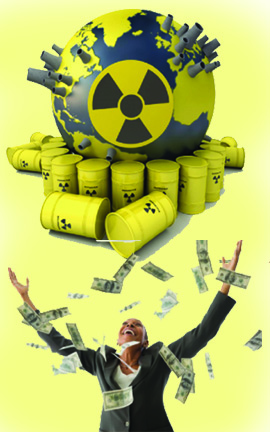 A Hundred Years Of Ineptitude And A Century Of Nuclear Spin https://newmatilda.com/2016/03/24/a-hundred-years-of-ineptitude-and-a-century-of-nuclear-spin/ By Rod Campbell on March 24, 2016 The numbers around a nuclear waste economy don’t add up, writes Roderick Campbell. And then there’s the history….
The idea of a nuclear waste dump in South Australia is sold as a saviour for South Australia’s economy. SA’s former governor and Royal Commissioner Kevin Scarce has joined the chorus:
Financial assessments suggest that [a nuclear waste facility in SA]could generate total revenue of more than $257 billion, with total costs of $145 billion.
Wow, that means we’ll make over $100 billion! Break out the Banrock Station! Have a holiday in Hahndorf! Take trams to Mt Gambier!
But what if this was just a little too good to be true? What if the benefits of this proposal go not to ordinary South Australians, but to the big companies involved in the nuclear industry?
The Royal Commissioner’s numbers are based on a study by Jacobs MCM, a company:
With more than fifty years of experience across the complete nuclear asset lifecycle, we support client delivery and the associated infrastructure requirements at every stage of a project.
The SA Royal Commission unquestioningly repeating the findings of a consultant with a deep interest in the nuclear industry is just the latest in South Australia’s rich tradition of nuclear propaganda.
Guess what year this was written in the Adelaide Advertiser:
It must be seen by any moderate thinking person that the radium mining field of Olary [South Australia] must eventually become the greatest and richest mining centre of the globe, and the sooner  the Commonwealth Government awake to this fact the sooner will the positive prominence of Australia, be recognised by the nations of the world.
That was written in 1913. A century later, the ‘tizer is still glowing on about nukes:
BILLIONS of dollars from the nuclear industry could deliver free power to all South Australians and the abolition of state taxes, [SA Liberal Senator Sean Edwards] says.
Hardly anyone actually reads economic reports like the one Jacobs wrote, even commentators and ‘experts’ and probably not the Royal Commission. These reports are hundreds of pages long, full of impressive graphs, jargon and econobabble – they’re meant to be hard to read.
But if you can wade through the mud, you find gems/radioactive waste like this: Continue reading
Dispute in South Australia, as Labor govt wants to scrap law against expenditure towards nuclear waste dumping
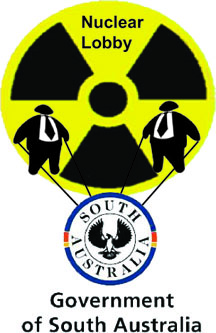 State Parliament has backed removing a law against investigating nuclear dumping, with dispute over when it should take effect, The Advertiser, March 22, 2016 Daniel Wills State Political Editor The Royal Commission’s tentative findings were that a nuclear dump could be constructed safely in SA STATE Parliament has taken its first step toward supporting nuclear waste storage, with bipartisan support to repeal laws that ban spending money on investigating its establishment.
However, a dispute has emerged over State Government plans to make the changes effective as of several weeks ago amid Opposition questions about if the law has already been broken.
Premier Jay Weatherill a fortnight ago announced plans to change laws enacted under the former Liberal government which stop public money being spent on encouraging a dump.
He said the move did not signal support for a dump in SA, but the laws could prevent robust debate and investigations once the final Nuclear Fuel Cycle Royal Commission report is released.
The existing law states: “no public money may be appropriated, expended or advanced to any person for the purpose of encouraging or financing any activity associated with the construction or operation of a nuclear waste storage facility in this state”.
Mr Weatherill said legal advice found the Commission did not break existing law……..
Greens MP Mark Parnell has previously told Parliament he believes the law may have been broken by commissioning telephone interviews with citizens seeking their views on storage.
Conservation SA today released a report from left-leaning think-tank The Australia Institute which cast doubts on the economic benefits of nuclear storage in SA.
Conservation SA chief executive Craig Wilkins said it “confirms what many South Australians suspect”, in that “the dump proposal being pushed seems way too good to be true”.
“Because there is no international market for high level nuclear waste, any prices, or costs underpinning any possible return for our state are pure guesswork based on assumptions and modelling,” Mr Wilkins said. “The consultants have made some extraordinarily optimistic assumptions about the price other countries will be willing to pay.
“They assume South Australia will be able to do something that even experienced nuclear countries have never managed to do, at a cheaper price.
“They also ignore the very real possibility that SA could take a cut in its GST revenue if this project did manage to make money.
“A project with this level of risk to future South Australians needs to stack up on economic grounds as well as safety and ethical ones. Our concern is that this fails on all three.” http://www.adelaidenow.com.au/news/south-australia/state-parliament-has-backed-removing-a-law-against-investigating-nuclear-dumping-with-dispute-over-when-it-should-take-effect/news-story/a9bb5ee604fc4f7e850e4a9116cbdd0d
Turnbull suggests Port Augusta solar thermal plant for federal clean energy plan
 Port Augusta solar thermal plant likely to be funded by $1 billion federal clean energy fund March 23, 2016 PETER JEAN POLITICAL REPORTER The Advertiser A LARGE solar thermal plant at Port Augusta is likely to be one of the first projects supported by a $1 billion Clean Energy Innovation Fund, to be announced by the Federal Government today.
Prime Minister Malcolm Turnbull and Environment Minister Greg Hunt will today reveal plans for the fund, which will invest up to $100 million per year in emerging technologies.
The announcement comes after the federal and state government were urged to back the development of a solar plan at Port Augusta, where hundreds of jobs will be lost when two coal-fired power stations close in May.
It is likely to cause tension with conservative elements in the Coalition, particularly those who have aligned themselves with former prime minister Tony Abbott.
“We are promoting innovation and new economic opportunities, enhancing our productivity, protecting our environment and reducing emissions to tackle climate change,’’ Mr Turnbull said last night.
“An example of a project could be a large scale solar facility with storage in Port Augusta.
“By offering innovative equity and debt products, the Clean Energy Innovation Fund can accelerate the availability of new technologies to transform the energy market, and deliver better value for taxpayers.”
American company SolarReserve had been seeking support for the development of a large solar thermal plant at Port Augusta.
Similar projects in the United States have created about 1000 construction jobs, 50 ongoing roles and 4000 indirect jobs.
A delegation of federal MPs visited a large solar power station built by SolarReserve in the American state of Nevada last year…….http://www.adelaidenow.com.au/news/south-australia/port-augusta-solar-thermal-plant-likely-to-be-funded-by-1-billion-federal-clean-energy-fund/news-story/7be66ebf70e864e8a1a9cb9a95bd83bc#load-story-comments
Nuclear waste import idea – economic optimism is unjustified
Nuclear waste storage plan based on optimistic assumptions, Australia Institute warns ABC News, 891 ABC Adelaide 22 Mar 16 A South Australian proposal to build a storage facility for nuclear waste is being based on very optimistic assumptions, an economic think-tank has warned.
Key points:
- Australia Institute warned any benefits to taxpayers were speculative
- It questioned stockpiling waste for years if the business ran into future financial issues
- Business SA said royal commission’s role was not to analyse the economics in detail
The Australia Institute, backed by funding from Conservation SA, analysed the waste storage proposal raised in the early findings of SA’s Nuclear Fuel Cycle Royal Commission.
“If you get into the waste disposal business in the way proposed at the moment, what you’re going to get is a big loss to taxpayers in the short term and the potential, but not certain, benefits in the future,” the institute’s chief economist Richard Denniss told 891 ABC Adelaide.
“They’re based on very optimistic prices that the world will be willing to pay for nuclear waste.”Dr Denniss urged South Australians to think carefully about where future taxpayer dollars were spent.
“What I’m anti is people who need to exaggerate the economic benefits of mines in order to convince taxpayers to fund them,” he said.”I’m not anti-mining, I’m anti-propaganda being pushed as economic fact.
“If you spend billions of dollars on this project then that’s billions of dollars you won’t put into schools, roads, hospitals, transport — it’s up to you as residents of SA how you want to invest your money.”
Stored waste might create future worries The economist questioned what might happen if a waste storage project ran into future economic problems. “The question is what happens to SA if, after stockpiling high-level nuclear waste above ground for 20 years, what happens if the project falls over after you’ve imported all the waste?” he said.
Dr Denniss also said the storage of nuclear waste might only create a few hundred local jobs……..http://www.abc.net.au/news/2016-03-22/australia-institute-questions-nuclear-waste-storage-plan/7265744
Unlike Britain,Australia is, at present, easily able to avoid a very bad nuclear deal
Secret deals: Australia’s nuclear waste plan and the UK’s Hinkley project, Independent Australia 21 March 2016, The South Australian Government scheme to import international nuclear waste has a major flaw in common with the UK’s Hinkley Point C project — secret contracts with foreign organisations, writes Noel Wauchope.
THESE TWO PLANS have something in common. Both the UK’s Hinkley Point C plan and South Australia’s nuclear waste plan are grandiose and very expensive to set up.
But, more than that, they both require the involvement of foreign governments and companies, in secret arrangements.
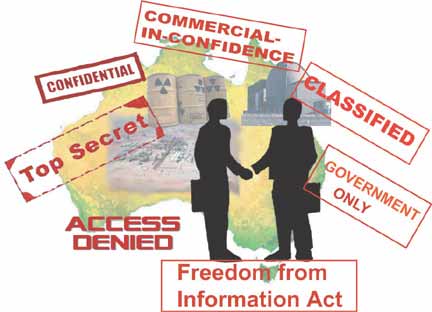 The South Australian Nuclear Royal Commission‘s plan for importing international wastes already involves confidential communications from foreign companies. Put into operation, the plan will mean secret contracts — South Australia being beholden to the provisions of foreign laws regarding disclosure, shipping and transport security, insurance and other matters relating to a client nation’s high level nuclear wastes (HLNW).
Plans have been suggested for foreign companies paying up front towards the setting up of the waste facility, in exchange for “ironclad contracts”to later set up “Generation IV” nuclear reactors. With foreign governments and companies involved, South Australia is very likely to become locked in to a deal from which it cannot escape. A later decision to pull out of the scheme would certainly entail heavy compensation payments to foreign companies.
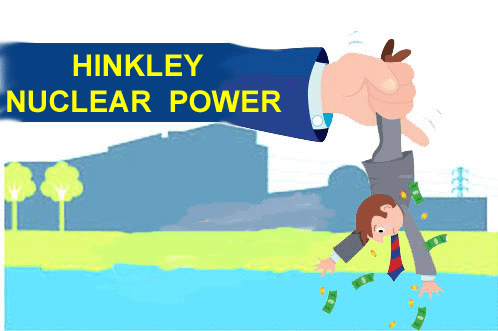 Britain’s Hinkley Point C nuclear project is thoroughly embroiled in complicated negotiations with the government-owned companies of China and France. The major backer, Electricite De France(EDF) is in grave financial trouble and its financial director Thomas Piquemal has resigned, over this Hinkley project. EDF is being bailed out by the French government, so that the £18bn plan can go ahead. UK has had to agree to a contract with EDF, amounting to about £40bn in real terms, and providing State guarantees on insurance, among other matters. The plan locks the UK in, with compensation costs in the event of it being shut down, as shown in an unpublicised departmental “minute“:…….
Professor Catherine Mitchell, an energy policy expert at the University of Exeter, comments in The Guardian:
The £22bn “poison pill” effectively reduces the risk to zero for EDF and its backers, which is great for them. But from an outside perspective, it smacks of desperation.
There could be so many reasons over 35 years that you would want to close the plant, including rising costs, changes to the UK’s energy system or loss of public confidence……..
However, in two important ways, the Australian situation is very different from that of the UK.
Firstly, although the UK Hinkley project is big, the South Australian nuclear waste plan is ginormous. Potentially sourcing high level nuclear wastes (HLNW) from around the world – USA, Canada, Europe, Asia – would be a massive operation, many decades in the setting up, many thousands of years in carrying it out. The money involved would be not dozens of billions of dollars in costs but hundreds of billions.
Secondly, for all the millions in dollars now being spent on the Royal Commission project – the trips abroad, forums, research, public relations and so on – the plan is nowhere near the point of agreement, whereas the UK plan is well advanced…….
It is vitally important for Australia to pay attention to the Royal Commission plan and to the scrutiny of South Australian radiation expert Paul Langley. and others. Unlike Britain, Australia has the opportunity to prevent this plan, while it’s still only a gleam in the eyes of Royal Commissioner Kevin Scarce and the nuclear lobby. https://independentaustralia.net/politics/politics-display/secret-deals-australias-nuclear-waste-plan-and-the-uks-hinkley-project,8797

NO TO NUCLEAR WASTE DUMP – say women and Labor voters
Women and Labor voters opposed to international nuclear waste dump in South Australia, poll finds Adelaide Now, March 21, 2016 PREMIER Jay Weatherill will need to win the support of women and his own Labor voters if the State Government decides to back the construction of an international nuclear waste storage facility in South Australia.
The results of a new opinion poll show almost 60 per cent of women and most Labor voters are opposed to a global nuclear waste facility being located in the state.
The ReachTEL Poll of 1077 SA residents conducted on March 10 found that 37 per cent of voters supported of voters supported an international nuclear waste dump, 48.5 per cent were opposed and 14 per cent were undecided.
The poll was commissioned by left-wing think tank The Australia Institute, which will tomorrow release a report critical of the international nuclear waste proposal.
Australia Institute executive director Ben Oquist said South Australians were increasingly aware of the risks posed by the project, including the damage it could do to the state’s reputation.
“I think people are increasingly wise to the projects that are jobs-rich, versus those that are expensive, likely to involve a large upfront government subsidy and won’t produce long-term jobs,’’ Mr Oquist said.
Those industries that are jobs-intensive are potentially put at risk by South Australia’s brand being threatened by a global nuclear waste dump.’’
Almost 49 per cent of Liberal, 28 per cent of Labor, 12 per cent of Greens voters backed the proposal.
But 52 per cent of Labor, 38 per cent of Liberal and 71 per cent of Greens were opposed……http://www.adelaidenow.com.au/news/south-australia/women-and-labor-voters-opposed-to-international-nuclear-waste-dump-in-south-australia-poll-finds/news-story/35d4ad38cadbaae4798ca89e91c74f5f
The ethics of burdening future South Australians with nuclear wastes?
A high-level nuclear waste dump for SA What is our moral obligation?

The argument goes: surely SA has a moral obligation to import nuclear waste…
…because we mine uranium?
…because we are more geologically and politically stable than other places?
…because we benefit from x-rays?
If we want this decision to include moral considerations (as it should), we might ask ourselves about the ethics of burdening thousands of generations of future South Australians with the cost and risk of managing highly radioactive waste, when any economic benefits are long gone.
Royal Commission comment period ends but Aboriginal resistance to radioactive dump grows ever stronger
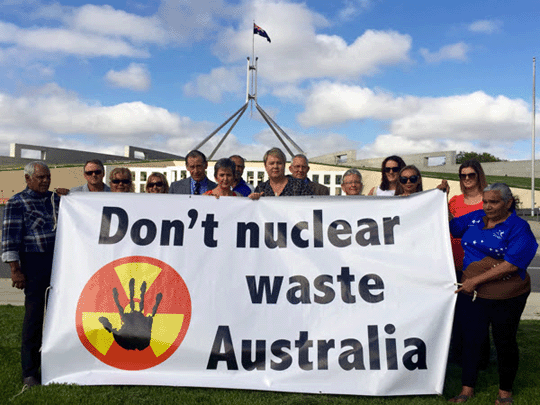
18 Mar 16 Traditional Owners and members of the Aboriginal-led Australian Nuclear Free Alliance (ANFA) have today reaffirmed their opposition to the suggestion that South Australia should host a high level international nuclear waste dump. This announcement comes as the submission period closes for comments on the tentative findings of South Australian Nuclear Fuel Cycle Royal Commission
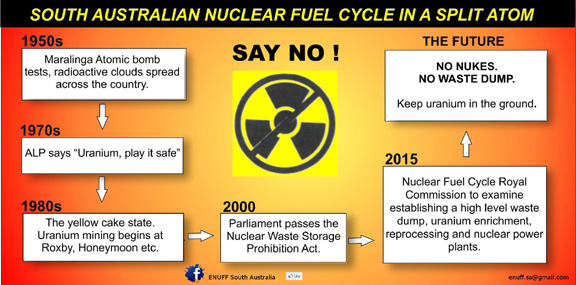
A major recommendation of the Commission to date has been that South Australia could host an international waste storage and disposal facility. This suggestion is strongly rejected by Aboriginal people across the state because of the risks posed to country and culture. Several Aboriginal communities throughout South Australia live with the negative impacts of the nuclear industry through uranium mining and nuclear weapons testing and are committed to resisting any further nuclear proposals.
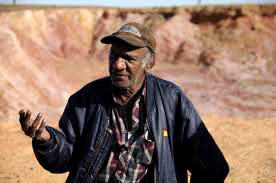 “We have long memories; we remember the atomic weapons tests at Maralinga and Emu Fields and the ongoing denial around the lost lives and health impacts for Aboriginal people. We don’t want any nuclear projects here in South Australia and we won’t become the world’s nuclear waste dump,” said Arabunna elder and Australian Nuclear Free Alliance president Kevin Buzzacott.
Enice Marsh, senior Adnyamathanha woman and Australian Nuclear Free Alliance member said:
“Any kind of radioactive waste dump would put our groundwater at risk. Groundwater is about survival; we don’t want to be faced with another huge risk like this.”
Sue Coleman-Haseldine is a Kokatha-Mula woman and co-chair of the Australian Nuclear Free Alliance. She has recently travelled to Vienna to share her family’s experience with the nuclear industry: “They’ve poisoned us once and there’s no way in the world they’re going to do it again.”
“This problem doesn’t stop at South Australia’s border, there is nowhere that should be designated an international waste dump,” Ms Coleman-Haseldine concluded.
For comment contact: Sue Coleman-Haseldine: 0458 544 593
Kevin Scarce dodges the vital questions of debt & safety from #NuclearCommissionSAust plan
 NuclearCommissionFerret, 18 Mar 16 A meeting was organised by ALP MPs Frances Bedford and Tom Kenyon for their constituents in the north east suburbs of Adelaide. Royal Commissioner Kevin Scarce was the only speaker, there was no balance with a nuclear critic speaker.
Kevin Scarce was asked the question:
” what happens if we accept high level nuclear waste for interim storage, then don’t have enough money when it comes time to build the deep geological dump. We’ll either end up with waste we can’t store to the safest extent possible, or a debt.”
A South Australian Labor MP has the guts to speak out against nuclear waste dump plan
“I don’t want nuclear dump”: Labor MP http://indaily.com.au/news/local/2016/03/18/i-dont-want-nuclear-dump-labor-mp/, Tom Richardson, 18 Mar 16
Jay Weatherill could face a divided party if he forges ahead with a proposal to establish a high level nuclear waste dump in South Australia, with a long-time Labor MP telling InDaily the idea is “quite worrying” – and suggesting several colleagues share the same view.
The tentative findings of Kevin Scarce’s nuclear royal commission handed down last month found an unambiguous economic case to establish a repository, with the Premier already moving to amend the law to facilitate broader debate on the issue.
 But the debate is heating up in the corridors of parliament, with former Labor minister and Ashford MP Steph Key joining Greens MLC Mark Parnell – a vocal opponent of increasing SA’s nuclear involvement – in sponsoring a briefing for interested MPs by a noted critic of the waste dump push.
An email went out to all MPs this week, reading: “Dear colleagues, there’s been so much said about an economic bonanza from building a global nuclear waste facility – but what if the economics don’t stack up?”
“Come and hear from Dr Richard Denniss, Chief Economist, The Australia Institute,” it concluded.
The briefing will be held on Tuesday, after a public briefing by Denniss together with economist and InDaily columnist Richard Blandy, both of whom have argued against the economic case for a waste dump.
“I think it would be fairly well known that I’m an anti-nuclear person,” Key said when contacted by InDaily. “I have been for the last 40 years, and I still am.” She said she was “interested to know what [Denniss and Blandy] have to say about the costings that have been put forward so far”.
“People are saying it could help us economically [but] I don’t actually want to have a dump at all,” she said. “I’m just interested to know whether these billions of dollars cited actually stack up – Mark and I decided we’d try and offer something to people that can come along.”
Key says she believes SA should “store our own waste [and] I do have some sympathy for low level or intermediate level repository”, but she has grave misgivings about a high-level global storage facility.
“I want to know all about it… the study I have done, I think it’s quite worrying,” she said, citing concerns over transportation. “We keep getting things across the sea and then by train, presumably, and truck… what does all that mean? What’s the risk analysis of all that? There’s quite a bit to consider.”
Labor right-winger Tom Kenyon has argued passionately in favour of the repository, but Key – a Left-faction stalwart – says: “I want to have a look at all the facts before I come out and argue in a very public way about this issue.”
“And I want to talk to my colleagues, but I get the impression that quite a few of them have a lot of sympathy for my way of thinking,” she said. “I’ve spoke quite passionately at both convention and state council – and national conference – over the years, so I don’t think anyone would be surprised that I don’t think this is a good idea.
“I just remember Fukushima – five years on and there’s still just people helping with the cleanup, let alone the natural disaster that it was… it just seems like a very big risk to me, and if it doesn’t stack up financially I think people are starting to run out of arguments.”

Greens call on Nuclear Royal Commission to “get real”
 The Greens SA’s submission to the Nuclear Royal Commission’s Tentative Findings rejects the suggestion that an economic bonanza awaits our State if South Australians would only resign ourselves to becoming the world’s nuclear garbage bin.
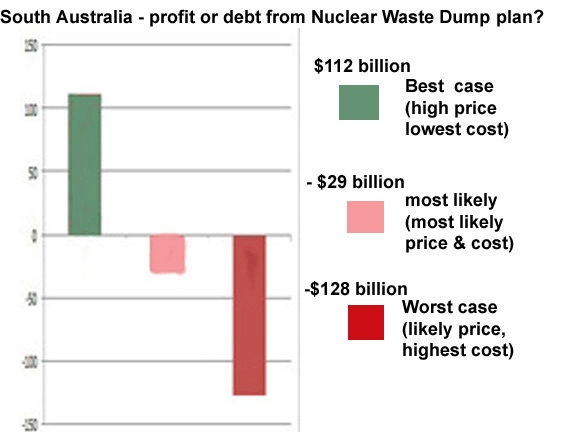
“The Royal Commission has been blinded by imaginary wealth and sucked into believing that a project that has never succeeded anywhere else in the World is South Australia’s for the taking”, said Greens SA Parliamentary Leader, Mark Parnell MLC.
“The most obvious question is being ignored: If this is such a great deal, how come no other country has grabbed it before now?
“The Greens are urging the Royal Commission to “get real” and critically examine the supposed economic benefits alongside the ongoing economic, social, environmental and reputational costs.
“Washing your hands of responsibility for a toxic legacy left to future generations is just immoral.
“The solution to South Australia’s current unemployment problems won’t be solved with mythical jobs that are decades into the future with the creation of toxic liabilities that last hundreds of thousands of year.
On releasing the “Tentative Findings” Report to the media on 15th February 2016, Commissioner Kevin Scarce stated, “The community needs to understand the risks and the benefits.” The Royal Commission’s “Tentative Findings” highlights many purported benefits but is scant on detail when it comes to the profound risks.
According to the Greens’ submission, the “Tentative Findings” suffer from:
1.Unrealistic expectations of the magnitude of the project;
2.Failure to appreciate 6 decades of international failure to solve the nuclear waste problem;
3.Missing costs, unfunded liabilities, missing contingencies and failure to recognise inevitable cost blow-outs
4.Heroic assumptions of other countries’ willingness to pay for SA to take their nuclear waste;
5.Lack of recognition of the potential for irrecoverable sunk costs and unlimited future liabilities;
6.Failure to address reputational damage and impact on other sectors of the economy; and
7.Naïve expectations that South Australia would get to keep all the profits from a nuclear waste dump in our State, without having to share them with other States.
“The Commission’s final report due on 6th May should recommend that the folly of South Australia’s increased involvement in the nuclear industry be abandoned.
“In relation to the other Terms of Reference, increased uranium mining, uranium processing or nuclear power were never really an option for SA and the Royal Commission was an expensive way to tell us what we already knew”, concluded Mark Parnell.
Is there REALLY profit in nuclear waste importing industry?
Conservation Council South Australia 18 Mar 16 A high-level nuclear waste dump for SA
Should we do it for the money?
The Nuclear Royal Commission claims some eye-popping revenue figures to take the world’s high-level nuclear waste.
Labor, Liberal unite to support high-level nuclear waste dump in South Australia
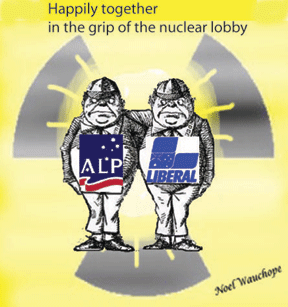 Labor, Liberal unite to support high-level nuclear waste dump in South Australia February 16, 2016 Paul Starick and Daniel Wills The Advertiser UNPRECEDENTED political support is being thrown behind South Australia becoming the global storage facility for high-level nuclear waste in return for a $445 billion bonanza.
Forging a historic united front on a decades-old issue of bitter division, Labor Premier Jay Weatherill and Liberal federal Resources and Energy Minister Josh Frydenberg are encouraging debate on a Royal Commission proposal, unveiled on Tuesday, for SA to store and dispose of hundreds of thousands of tonnes of spent nuclear fuel and waste…….http://www.adelaidenow.com.au/news/south-australia/labor-liberal-unite-to-support-highlevel-nuclear-waste-dump-in-south-australia/news-story/683296ab45e53c73432c66bbe0358e34
1 This month
15 April – Zoom –Nuclear Power is Not the Solution
Apr 15, 2026 01:00 AM in Canberra, Melbourne, Sydney

Join the International Physicians for the Prevention of Nuclear War (IPPNW) on Tuesday, April 14th for a timely webinar exploring the risks associated with nuclear power and challenging the myth that it offers a simple, safe, carbon-free solution to the climate crisis

21 April Webinar: No Nuclear Weapons in Australia
Start: 2026-04-21 18:00:00 UTC Canberra, Melbourne, Sydney (GMT+10:00)
End: 2026-04-21 19:30:00 UTC Canberra, Melbourne, Sydney (GMT+10:00)
Event Type: Virtual
A virtual link will be communicated before the event.
Host Contact Info: australia@icanw.org

of the week – Australians for War Powers Reform (AWPR)
To see nuclear-related stories in greater depth and intensity
 Antinuclear