#NuclearCommissionSAust hearing – is the Small Modular Reactor (SMR) a lemon?
 Plough your way through the transcript of the October 7th hearing of the South Australia Nuclear Fuel Chain Royal Commission, and amidst all the technical hype, you will find some sobering points.
The speaker was Mr Thomas Marcille, of Holtec International, developer of the SMR-160, who enthused about that SMRs future, and explained its safety features etc.
Yet there were bits that would make even a greedy Australian nuke enthusiast pause:
“COMMISSIONER: Would it be fair to say that you’re expecting SMR or the 30 application of them outside the US more than inside?
MR MARCILLE: No question ……As a data point, I think that would suggest that the vast market is outside of the United States………, it’s possible for a national regulator outside the United States to first licence the SMR-160.”
He goes on to explain that the USA’s now more rigourous licensing process “part 52 or design certificate” is “far too arduous in terms of time and cost and risk.”
[translation – nobody in USA wants to buy the SMR, and it can’t get licensing there]
“our concept is to develop a preliminary design specification and a preliminary safety analysis report and to then achieve an opportunity with a commercial client to submit that preliminary safety analysis report under the review of a competent regulator for consideration of granting a construction permit. At such time the design will matriculate through the engineering specifications, the procurement specifications and the construction drawings. It’s unlikely that Holtec will continue to develop towards final safety analysis and final design unless a client steps forth.”
[translation – we’re not going ahead with licensing until after we’ve signed up an overseas buyer, such as Australia] [Holtec will] “continue the investment in the business and the technology if and as the marketplace develops”
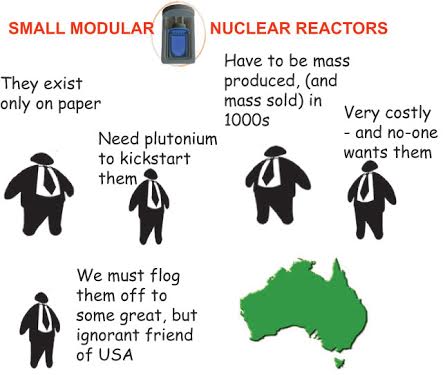
The Commissioner asked Mr Marcille about “ comparison to larger plants the cost economies and the advantages of small modular reactors.” and about “the extent to which companies expect to have an order book of plants to manufacture and the extent to which they can enjoy economies of scale 25 because they’re manufacturing multiple versions of the same item “.
MR MARCILLE: Let me help by saying that – let me liken a large light-water reactor to a large apple and suggest that a lot of people think of small modular reactors as little apples. I would ask you to think of a small modular reactor like the SMR160 not as a little apple but a little orange. So now I’m comparing a big apple to a little orange and they’re entirely different. The apple is sweet, 40 the orange is sour. You get the picture…….
Mr Marcille continued with a lengthy and complex answer to this question, which included stressing the large costs of large reactors. I did not find it convincing .
Today’s Royal Commission Hearings – on financial viability of nuclear operations
Today’s royal commission hearings are about the financial viability of enrichment, electricity and a waste dump.
South Australia as radioactive trash dump our best nuclear bet – Kevin Scarce
 Nuclear power option years away: royal commissioner Kevin Scarce http://www.theaustralian.com.au/national-affairs/state-politics/nuclear-power-option-years-away-royal-commissioner-kevin-scarce/story-e6frgczx-1227556819827?sv=631d9f761d476c7a142e1be7add844b1
OCTOBER 5, 2015 Michael Owen SA Bureau Chief Adelaide There is a decade of regulatory and legislative change required before any real work can begin on establishing a nuclear energy industry in Australia, royal commissioner Kevin Scarce says.
Those changes would require federal and state bipartisanship, meaning tangible economic benefits of expanding nuclear activity would not be apparent until at least 2030. We need to be realistic about what the opportunities will be,” Mr Scarce, a former South Australia governor, told The Australian. “If we do decide to participate (in the nuclear cycle), you’d want to grow some jobs, some expertise, and grow the technical know-how to go into other elements of nuclear — it has to have some economic benefits, and part of this royal commission is to look 10-15 years into the future and see what else is being developed to see if there is a need for nuclear in our power-generation mix.”
The Nuclear Fuel Cycle Royal Commission was established by Labor Premier Jay Weatherill to look at South Australia’s involvement in the mining, enrichment, energy and storage phases in the life cycle of nuclear fuel, given the state has one of the world’s biggest uranium deposits and has been involved in uranium production for more than 25 years.
Mr Weatherill’s government is grappling with the worst unemployment rate of any state amid the decline of manufacturing. The Premier is keen to explore the economic benefits of a deeper involvement in the nuclear sector.
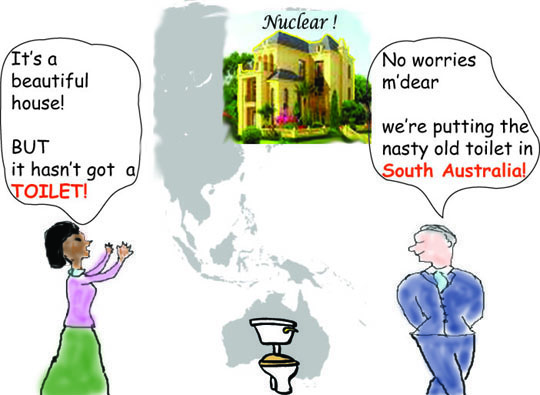
Mr Scarce said it might be that, given Australia’s energy demand was decreasing, coupled with an abundance of renewables, nuclear generators were not necessary. This would leave a nuclear waste dump as the most likely source of economic benefit.
Mr Scarce said it was “absolutely” the case that there was a decade of bipartisan legislative and regulatory change that had to occur before any nuclear industry could be up and running. “One should not think that if we turn the switch on at the end of this royal commission after the government has had a look at it that benefits will be delivered within the decade — they won’t be,” he said.
“In order to provide the investment certainty that would be required, because of the length and cost of this industry, if you don’t have bipartisan support at both the state and federal level, an industry will not go anywhere.”
Mr Scarce said the state opposition had been very supportive, as had the government, which established the inquiry. However, there could be major hurdles under any future federal Labor government. A decision to change the ALP national platform opposing a nuclear industry has been delayed until after the release of the commission’s report, due on May 6.
Former prime minister Tony Abbott has said there was no need for Australia to pursue nuclear energy because of the nation’s large coal and gas reserves, although he said nuclear energy would help cut carbon pollution.
Mr Scarce, who has visited several countries on fact-finding missions this year, will begin 30 days of public hearings until December.
#NuclearCommissionSAust – An Aboriginal group slams its processes
monetary compensation via Native Title is not the solution – don’t insult us by simply hying to buy our consent and silence our concerns
SUBMISSION TO THE NUCLEAR FUEL CYCLE ROYAL COMMISSION.
FROM: ANGGUMATHANHA CAMP LAW MOB
Extract Why we are not satisfied with the way this Royal Commission has been conducted: Yaiinidlha Udnyu ngawarla wanggaanggu, wanhanga Yura Ngawarla wanggaanggu?
always in English, where’s the Yura Ngawarla (our first language)?
The issues of engagement are many. To date we have found the process of engagement used by
the Royal Conuuission to be very off putting as it’s been run in a real Udnyu (whitefella) way.
The lack of an intelpreter service means we are forced to try and engage using English (or rely on the goodwill of caring community members), and often this means we cannot be part of the engagement process. Even a Plain English summary of the four papers would have been helpful, and more opportunity for people to give oral submissions in their first language with a translator to interpret. We say that govemment and industry have a moral and ethical obligation to include us as citizens of Australia, and as Traditional Owners of our Country. We suspect that many other Australians would have benefited from a Plain English version of the papers and this was suggested by many people who went to the first lot of community meetings held by Kevin Scarce and his team. Not everyone has good English literacy.
Requiring a JP’s signature is a barrier to participation and suggests that ordinary people cannot
be trusted; not everyone has easy access to a JP, and the timeline puts pressure on people to do
this. We feel this is likely to intimidate people and discourage many from participating.We strongly recommend that the Royal Commission do more work on the following issues:
- Provide the public with better understanding of the health, cultural, and social impacts in other
countries of an expanding nuclear industry (including public anxiety, contaminated areas, effects 0n public health); - Provide adequate resources to enable all Australians to be part of an informed process – put
people before profit; - The lack of advertising, and very short notice on several occasions suggests that government and
industry and not serious about wanting to engage with public opinion and don’t value our input. - Many people think this suggests the proposal is ‘a done deal’ and that it will go ahead anyway.
- Timelines are short, information is hard to access, there is no interpreter service available, and
the meetings have been very poorly advertised. - Engagement opportunities need to be fair and equitable (readily available to all people) and the Native Title interest is no more important than the wider community.
- A closed and secretive approach makes engagement difficult for the average person on the street, and near impossible for Aboriginal people to participate.
- Government continue to use an assimilatory process; they ignore us by refusing to translate
information into our first language, and they make no effort to understand our views in our
languages as the First Australians. The lack of a well-thought out engagement strategy tells us that our views are not important, that government and industry will do what they want regardless of public wishes. - Develop a compensation package for the likely economic impacts from the negative associations of nuclear industry on local and regional economy – ego Loss of prices in crops, housing, land, as a result of contamination threats, accidents and breaches of EPA regulations;
- Develop actual measures to counter threats from terrorist organisations re: protection to avoid nuclear site attacks, and local capacity to deal with emergency situations;
- Tell the public what risk management plans need to be developed for communities impacted by transportation along the travel routes – for example, who will respond to a truck accident and are they equipped to deal with it; Informed awareness among communities that live along the designated travel routes so they can make decisions about their future.
- The nuclear industry must find ways to show respect for the rights of Traditional Owners who are concerned about or opposed to the nuclear industry – monetary compensation via Native Title is not the solution – don’t insult us by simply hying to buy our consent and silence our concerns;
 Provide means for ongoing and independent monitoring of dangerous levels of airbome and water-based contaminants in groundwater, along transportation routes, after accidents, and among food sources used by Aboriginal people ego Nguri, urdlu and warratyi varlu, awi. We have a right to measure and monitor levels of radiation like other people do in countries such as the USA. We know from the Kakadu mine in NT that there is a major problem there with water management that is yet to be resolved.
Dr Arjun Makhijani explains why Small Modular Nuclear Reactors (SMRs) are doomed to fail
PUBLIC HEARING, SA NUCLEAR FUEL CYCLE ROYAL COMMISSION DR ARJUN MAKHIJANI, Institute for Energy and Environmental Research ADELAIDE , THURSDAY, 1 OCTOBER 2015
Excerpt “…….the core idea of an SMR is that you have smaller reactors. Of course you lose the economies of scale, reactors are big because cost of materials goes according to surface area, and power production goes according to volume, and the larger the reactor the smaller the material needed per kilowatt.
That is the theory and that is why there were small reactors in the fifties, they were proposed and we went to bigger reactors because they were cheaper, all other things being equal. So you go back to smaller reactors, the underlying technology will tell you that the costs per kilowatt, in terms of materials and labour, the number of wells you need per kilowatt, the amount of steel you need per kilowatt will all go up.
The proposal is that all of these costs would be offset by assembly line manufacturing. So you won’t have to set it up on site. And in theory it is a fair idea to evaluate and you ask what is the size of the assembly line you need? And who is going to create this assembly line and the required supply chain, the vessels and the pumps and valves and all of it? So if you look at what the Department of Energy has said, what the industry itself has said is that you can’t – so you are really displacing the heavy capital cost upstream from the reactor sites……
so now instead of having a 10 billion dollar problem, you have got a 50 or a 100 million dollar problem because to .SA Nuclear 01.10.15 P-431 Spark and Cannon set up a supply chain for say 100 or 150 reactors a year, you need that scale of investment……
you need a supply chain investment that is about the same order of kind of an assembly line for airbuses or (indistinct) So it’s very, very huge. So who is 5 going to make all of these orders that will cause some private party to make that investment in the assembly line? With airbuses we know they get advance orders of hundreds of aircraft and they set up their assembly lines. The answer to that question is, no one other than governments…….
How you would handle such a system from a regulatory point of view is 15 mysterious to me because when you have assembly lines, as I note in my paper, you have recalls. Today we have got an 11 million car recall, one of the most reputable companies from perhaps the most technologically reputable country in the world, Germany. What are we going to do if we have 2,000 assembly line reactors that are found to have a fault through design? By design I mean 20 as not properly conceived, or through some cover up, like what happened with Volkswagen. How are we going to deal with it? Are we going to shut them down? Are we going to send them to the manufacturer? Are we going to – it’s unclear…..
the fine 25 print of small module reactors is much, much more complicated economically and in terms of the risks and investments, than their performance have led you to believe. That’s why they’re not – I mean I think – at least two of the four companies that are embarked on it, are already not pursuing it in the United States. Fallen apart before anything was built…. ” http://nuclearrc.sa.gov.au/app/uploads/mp/files/videos/files/151001-topic-4-day-2-transcript-full.v2.pdf
The pro nuclear front group Breakthrough Institute joins push for nuclear power in South Australia
The Breakthrough Institute (BI) was notorious for its attacks on Al Gore and climate scientists.It has a long history of trying to discredit renewable energy, in particular, attacking Germany’s Energiewende. More recently, BI has discovered climate change, as that is a useful tactic in their long-running promotion of new nuclear technology
the promoters of new nuclear reactors for South Australia certainly include idealistic and altruistic people, some of whom have bought the BI’s message.
Who wants to be a nuclear billionaire? Independent Australia, 1 Oct 15 Noel Wauchope navigates the complex web of ambiguity behind submissions to South Australia’s Nuclear Fuel Chain Royal Commission.. Some promoters of nuclear industry expansion have very altruistic motivations.
Just who are the people who want South Australia to be a nuclear industry hub? The submissions to the Royal Commission give some indications, though it is not easy to work this out……
The pro nuclear submissions on the whole, come from interested parties, where a commercial or career motive can be discerned: that is often clearly shown, but sometimes is not apparent. There are also some pro nuclear submissions that are quite cautious about promoting development, and a few who are inclined towards sitting on the fence.
Of the 94 pro nuclear submissions published, 46 come from companies or organisations connected with the nuclear industry. But who knows how many nuclear companies really did send in submissions, as theirs were allowed to not be published, due to ‘commercial in confidence’?
….most favoured topic, as with the organisations, was Issues Paper 3, “ELECTRICITY GENERATION”…
Their backgrounds? 20 of the [pro nuclear] 48 individuals are now, or were formerly, employed in a nuclear or nuclear-related company, government or university department.(1) In some cases they state this clearly, in other cases it is not apparent…..
Then there are the 2 career politicians, Sen Sean Edwards and MP Tom Kenyon, who have hitched their political future to the nuclear star.
Then there are nuclear publicists, who are not necessarily engineers or involved in the nuclear industry, but who have become well known for their pro nuclear articles or lobbying. There are only 4 listed names that could be described as pro nuclear publicists (2)
….the majority of the pro nuclear submissions enthuse about new nuclear reactors – “Generation IV” Small Modular Reactors” “Liquid Fluoride Thorium Reactors”.
When you add those individual submissions to the 46 from nuclear-related organisations, it looks as if the overwhelming support for new nuclear reactors comes from interested parties – nuclear related companies, or individuals connected to the industry, who seek profit or career advancement. Continue reading
#NuclearCommissionSAust paying lip service only to renewable energy as “low carbon’ option
South Australia’s Nuclear Fuel Cycle Royal Commission seems to be focused on electricity generation from low carbon sources, but is paying lip service only to renewable energy, Noel Wauchope 30 Sept 15 - Climate Change and Energy Policy
- National Electricity Market
- Geology and Hydrogeology of South Australia,
- Low Carbon Energy Generation Options,
- Estimating Costs and benefits of Nuclear Activities
- Environmental Impact: Lessons Learnt from Past SA Practices
- EXPLORATION EXTRACTION AND MILLING
- FURTHER PROCESSING AND MANUFACTURE
- ELECTRICITY GENERATION
- MANAGEMENT STORAGE AND DISPOSAL OF WASTES.
- Mr Donald Hoffman, President and CEO of EXCEL Services Corporation, which provides specialist advice and support services to nuclear facilities in the US and internationally. Mr Hoffman served as President of the American Nuclear Society from 2013-2014. He currently provides presentations on the benefits of nuclear science and technology to the US Congress and is chairing a committee to support all the US Governors on implementing the US Clean Energy Act and addressing the Climate Control Acts.
- Mr Andrew Stock, director of energy companies Horizon Oil Limited and Alinta Holdings, and past director of Silex Systems, Geodynamics, Transform Solar and Australia Pacific LNG
- Mr Arjun Makhijani, Institute for Energy and Environmental Research, President of the IEER and holds a Ph.D. in Engineering, specialising in nuclear fusion
- Dr Keung Koo Kim and Dr Kyun S. Zee, Korea Atomic Energy Research Institute . The Institute (KAERI) has a history of over 50 years of research and development in nuclear energy. . Dr Kim is the Director of Advanced Reactor Development.
- Mr Thomas Marcille, of Holtec (US) Holtec International is an energy technology company with a focus on carbon-free power generation, specifically commercial nuclear and solar energy. Mr Marcille is Vice President and Chief Nuclear Officer at Holtec International and is involved in the development of Holtec’s small modular reactor, the SMR-160. He has provided nearly three decades of service in senior engineering positions in the nuclear industry in the US.
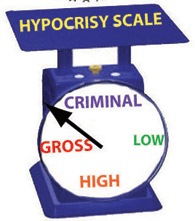 A while back, nuclear power was being touted as “renewable”. That was patently untrue, and the phrase went out of fashion as far as nuclear power was concerned. It seems that it has been replaced now by “low carbon”. The nuclear lobby still quite often condemns renewable energy as inadequate, as “not a base load source”, as too expensive, etc. However, nuclear promotion today is more sophisticated, and will include renewable energy, along with nuclear, as “part of the energy mix”. So “low carbon” is the preferred term for nuclear promotion, and it looks to me as if this is the way in which the Royal Commission is using that term, and paying only lip service to renewable energy. .
New nuclear energy is an expensive fantasy – Dr Mark Diesendorf
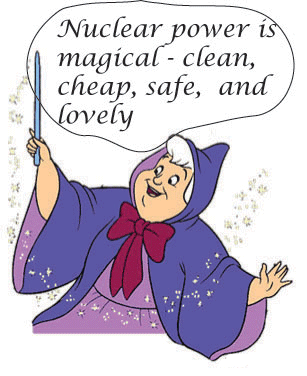 The fantasy of cheap, safe nuclear energy http://indaily.com.au/opinion/2015/09/28/the-fantasy-of-cheap-safe-nuclear-energy/ Back in the 1970s and 80s, solar and wind energy were expensive and their supporters were criticised by the nuclear industry for dreaming of a renewable energy future.
Nowadays the situation is reversed. Several countries are well on their way to their targets of 80-100 per cent renewable electricity while global nuclear energy generation ceased growing nine years ago.
In northern Europe and the USA wind energy is about half the price of nuclear. In South America contracts to deliver electricity from big solar photovoltaic (PV) power stations are being signed at 8 US cents per kilowatt-hour, already less expensive than nuclear, and the price of solar PV is still declining. In many places, including mainland Australia, rooftop solar is much less expensive than retail electricity from the grid.
The current fantasy is that nuclear energy is cheap, safe, CO2-free and necessary, and that South Australia could make a profit storing the world’s nuclear wastes. All of these claims by enthusiasts for the nuclear fuel cycle, made in submissions to the current Nuclear Fuel Cycle Royal Commission, are poorly based.
In theory, the geologically stable regions of South Australia could provide a location for storing high-level nuclear wastes. But as yet there are no permanent repositories operating anywhere in the world. It would be crazy for Australia to attempt build one when the USA has failed.
Apparently recognising this, South Australian Liberal Senator Sean Edwards has proposed an even greater fantasy: that South Australia could earn huge revenue from storing the world’s high-level wastes temporarily in dry casks. He claims that the revenue would be sufficient to fund a nuclear power station.
Unfortunately, this scheme fails under basic economics. Why would a nuclear power country pay the additional costs of shipping and storing high-level waste in Australia when it can store its own wastes temporarily in dry casks? Indeed, several nuclear power countries are already doing this.
Senator Edwards’ fantasy is that Australia could convert the long-lived component of the nuclear wastes into nuclear fuel in an Integral Fast Reactor. However, this technology is not commercially available. It has only ever existed as a pilot plant in the USA. Proposing that SA buy unproven technology at huge expense is a poor prescription for the economy.
Australia could not convert the contents of the dry casks to nuclear fuel. We would be stuck with managing them while they corrode and release their deadly contents. It’s far better to leave the source countries to handle the huge costs and risks of managing their nuclear wastes for 100,000 years or more.
Turning to nuclear power stations, both the Australian Energy Market Operator and our own research group at UNSW have shown independently that the National Electricity Market, which includes South Australia, could be operated reliably and affordably on 100 per cent renewable energy. The UNSW research uses only scaled-up commercially available renewable energy technologies. The results of the computer simulations, now spanning eight years of hourly data, are supported by practical experience in South Australia where at times renewable energy provides up to three-quarters of electricity.
Nuclear power is very inflexible in operation, unable to follow the variations in wind and solar PV output. It would be an inadequate partner for a SA electricity supply system that will soon be predominantly renewable. Instead, flexible peak-load plants are required: biofuelled gas turbines, concentrated solar power with thermal storage, and, in appropriate locations, pumped hydro.
Furthermore, under current market rules, wind and solar, with their tiny operating costs, would have priority in supplying base-load demand. Nuclear power would be displaced from operating as base-load power, just as coal is currently being displaced in SA. Then, nuclear energy would have even greater difficulties in repaying its already exorbitant capital costs.
Dr Mark Diesendorf is Associate Professor in Interdisciplinary Environmental Studies at UNSW. He gave evidence to a hearing of the Nuclear Fuel Cycle Royal Commission on 14 September.
Professor John Quiggin dismisses the CANDU nuclear reactor at the #NuclearCommissionSAust
 SA NUCLEAR FUEL CYCLE ROYAL COMMISSION PROCEEDINGS, WEDNESDAY, 23 SEPTEMBER 2015, Excerpts from the transcript
Prof Quiggan: “……..I think we’ll go back to carbon pricing and we’ll go down essentially a renewable (indistinct) perhaps already well-established industry. With popular acceptance – there’s obviously a little bit of objection to wind but broad 40 popular acceptance and essentially all we need is the price signal and some policy certainty and that’s the path we’ll take……..
Coober Pedy gets another visit from #NuclearCommissionSAust
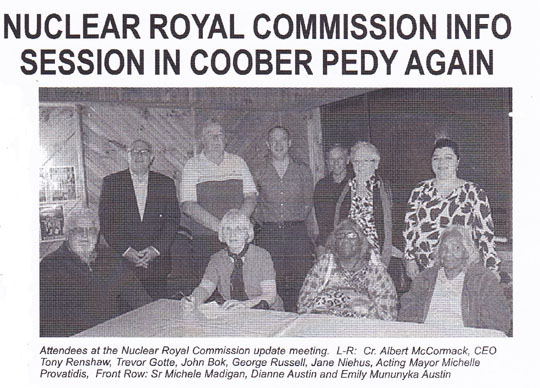
https://cooberpedyregionaltimes.files.wordpress.com/2014/05/coober-pedy-regional-times-24-09-2015.pdf , Noel WauchopeThe South Australian Nuclear Fuel Chain Royal Commission went to Coober Pedy again, on September 18th. John Bok, Regional Engagement Manager for the Commission was there to make a presentation about the Royal Commission. Bok stressed that he was there only to provide information about the Commission’s processes, and also that the Commission’s findings would be evidence based..
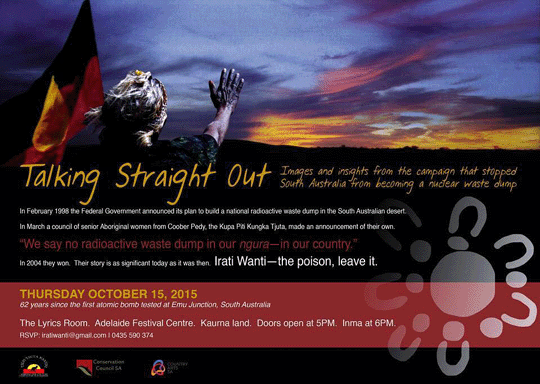
We are the Aboriginal Women. Yankunytjatjara, Antikarinya and Kokatha. We know the country. The poison the Government is talking about will poison the land. We say, “No radioactive dump in our ngura – in our country. It’s strictly poison, we don’t want it.”
We do not want nuclear anything on our Land – Anangu Pitjantjatjara Yankunytjatjara Law and Culture
APY LAW & CULTURE – CONCERNS FOR NUCLEAR WASTE, Coober Pedy Regional Times, 24 Sept 15, Anangu Pitjantjatjara Yankunytjatjara Law and Culture is declaring its intention to move away from the APY Administration. For a long time our committee has been worried about the direction the APY Administration is taking.
On several occasions we have been told Law and Culture is a side committee, that it is second to the APY.
Law and Culture comes first. It always has. The administration needs to understand this. All Anangu know that our Law and Culture comes first, our Law and Culture must be at the heart of decision making. We have decided to stand alone. Our Law and Culture will come first. Our lives depend on it. We will source alternate funding.
One of our big concerns is the Royal Commission into Nuclear Energy. Law and Culture says no to APY Lands being used to mine uranium or dump the waste.
Renewable Energy way ahead of nuclear – Rebecca Keane’s Submission to #NuclearCommissionSAust
 http://nuclearrc.sa.gov.au/app/uploads/2015/09/Rebecca-Keane-23-07-2015.pdf I am astonished that South Australia is even being considered as a site for nuclear power plants and/or radioactive waste dumps. Australia’s rapid and widespread progress in the harnessing of our virtually unlimited solar energy resource is evident in the fact that currently 1.4 million households have rooftop solar installations!. The huge potential for expansion in this field negates any need for the pursuit of such a highly dangerous enterprise as nuclear power generation.
Solar thermal energy supply, where solar energy is stored as heat is also highly efficient and offers
tremendous opportunities in this country. Moreover, our nation’s geographical conditions are extremely favourable to the massive development of other renewable sources such as wind, hydro and wave power. Wind energy is emerging as a highly cost-effective resource and vertical axis wind turbines are particularly effective and create no noise issues.
The West Australian coast is subject to the world’s strongest wind system (The Roaring Forties) with the energy released each year from the pounding of the waves influenced by this system, equating to five times Australia’s annual total energy usage2. Over 85% of Australians live in close proximity to the
coast.
A combination of the utilisation ofrenewable intermittent sources such as solar, wind
and wave energy with back-up hydro and gas-driven turbines is recognized by experts throughout the world as being highly comparable in terms of both adequacy and reliability of supply, to existing coal-driven technology. Over 24,000 people are employed in Australia’s renewable energy industries compared to 10,000 in coalmining for the domestic market 3 Continue reading
South Australian govt removes regulatory hurdle on renewable energy
If South Australia were a nation, it would be second only to Denmark in regard to wind energy. It’s no slouch on solar power either. While it may not host the largest number of solar panel systems in Australia; it leads the nation based on the percentage of households with home solar installed.
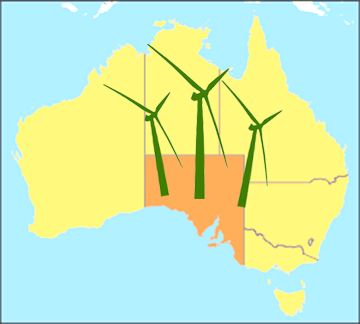 More Of South Australia Opened Up To Renewable Energy Projects http://www.energymatters.com.au/renewable-news/south-australia-renewables-em5081/ September 22, 2015 Energy Matters The South Australian Government has reduced regulatory burdens on renewable energy projects on state Crown lands; a move it says will provide greater certainty to investors and make South Australia even more competitive.
The proclamation of the Pastoral Land Management and Conservation (Renewable Energy) Amendment Act 2014 means wind farm developer can now apply for 25-year licences on Crown land; subject to pastoral lease tenure. Developers will also be given the option to renew for another 25 years.
“Securing investor confidence is key to the long-term future of the renewable energy industry, and this Act serves to cement South Australia’s position as the preferred destination for renewable energy development,” said Climate Change Minister Ian Hunter.
Additionally, the Act will expedite access for the development of solar farms and also ensure local communities reap the benefits of renewables investments; with 95 per cent of licence payments flowing through to pastoral lessees and native title holders. Continue reading
Electrical trades Union of Australia dispels the hype about Generation IV Nuclear Reactors
Electrical Trades Union, Graham Glover Submission to South Australian Government Nuclear Fuel Cycle Royal Commission http://nuclearrc.sa.gov.au/app/uploads/2015/09/Electrical-Trades-Union-03-08-2015.pdf

Adelaide Hills site suitable for nuclear reactor – #NuclearCommissionSAust
Nuclear Fuel Cycle Royal Commission hears Adelaide Hills site earmarked as suitable for nuclear reactor http://www.adelaidenow.com.au/news/south-australia/nuclear-fuel-cycle-royal-commission-hears-adelaide-hills-site-earmarked-as-suitable-for-nuclear-reactor/story-fni6uo1m-1227533674218 September 18, 2015 CHIEF REPORTER Paul Starick The Advertiser SITES in the Adelaide Hills and Port Augusta have been earmarked as suitable for a nuclear power plant should one be built in South Australia, a royal commission has heard.
The operator of the state’s high-voltage electricity network said the existing power station site at Port Augusta, which is slated for closure, would be suitable for a nuclear reactor.
ElectraNet executive manager asset management Rainer Korte also said this was among four suitable sites in the network – the others in Adelaide and the Hills. Those in Adelaide were unlikely to be used for a nuclear power plant, he said.
Mr Korte was responding to a question by Chad Jacobi, counsel assisting the Nuclear Fuel Cycle Royal Commission, about where a 1000-megawatt nuclear power plant could be connected to the SA electricity network. He said: “One of them is at Davenport, which is near Port Augusta, which is where essentially the current northern power station is connected.
“The other two are in Adelaide, in the Adelaide metropolitan area where you arenot likely to see any major development of a power station for environmental reasons and others.
The royal commission, headed by former governor Kevin Scarce, is conducting public sessions to inform a final report due by May next year. It is investigating the potential for SA to be involved in nuclear power, waste storage, enrichment and further exploration and milling.
An Adelaide Hills site described as in the Mt Lofty Ranges or just east was previously identified as a possible place for a nuclear reactor in a 1997 federal Cabinet submission, leaked in 2006. Sites at Woomera and Olympic Dam also were among 14 places across Australia detailed in the submission, prepared for then science minister Peter McGauran.
In other royal commission evidence on Friday afternoon, SA Power Networks senior manager Mark Vincent said forecasts predicted solar energy would be used by two-thirds of SA households in about 20 years. In the same period, it was predicted about 100,000 electric cars would be using SA roads – for which Premier Jay Weatherill is planning new road laws.
1 This month

of the week – Australians for War Powers Reform (AWPR)
To see nuclear-related stories in greater depth and intensity
 Antinuclear