Danger of nuclear stations to coastal communities, Aboriginal people and to water
 The ongoing impact of mass dispossession of Anangu people because of nuclear testing on their traditional homelands has very real consequences today, for many residing on the Far Coast of SA
Maralinga is also raised because of the interest it attracts as a potential nuclear waste dump location. The logic appears to be that it is already contaminated, so it perfect for more radioactive waste. CBAA dismiss this logic outright.
Clean Bight Alliance Australia Submission to: Nuclear Fuel Cycle Royal Commission SA
Clean Bight Alliance Australia is a local community group based in Ceduna on the far west coast of SA. Members have a strong interest in the ongoing health of the marine and coastal areas of the Great Australian Bight and the Eyre Peninsular. CBAA advocate for appropriate use of the region’s natural marine resources and educate the community on the risks associated with industrialization of the marine environment.
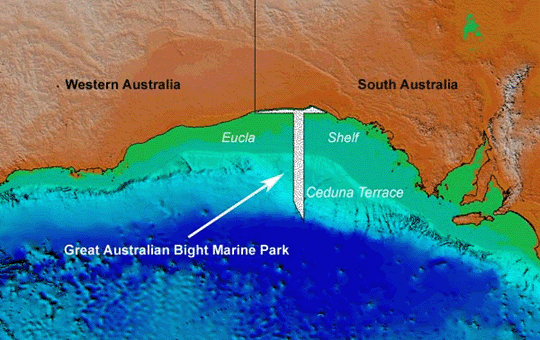
Extract “……CBAA take the position that there are no suitable areas in South Australia for a nuclear reactor. Currently our position is supported by legislation as Nuclear Power generation in South Australia is prohibited by the Environment Protection and Biodiversity Conservation Act 1999 Act and the Australian Radiation Protection and Nuclear Safety Act 1998. CBAA strongly encourages the Royal Commission to appreciate the background to these important pieces of legislation and implications if these were to be further altered or weakened.
Furthermore Nuclear power generation requires large quantities of water for cooling – typically 36.3 to 65.4 million liters per reactor per day. 1 South Australia is known as one of the driest states on one of the driest continents. No inland areas are suitable for the establishment of a nuclear reactor for generating electricity. The amount of water needed can definitely not be sourced with current reservoirs and transportation of the large amounts of sea water required would be unfeasible and costly. Locating a Nuclear Reactor in South Australia is restricted to coastal areas.
However this is also highly unsuitable as siting a nuclear reactor would conflict with other key industries Continue reading
Kevin Scarce off to S Korea, later will conduct public hearings
Nuclear royal commissioner Kevin Scarce about to start public hearings, The Advertiser August 29, 2015 PAUL STARICK CHIEF REPORTER Sunday Mail (SA) DISTINGUISHED economist Ross Garnaut will be among the first expert witnesses at the nuclear  royal commission’s public sessions, as the inquiry reaches the business end.
From September 9, Royal Commissioner Kevin Scarce will question experts on topics such as long-term demand for electricity, along with the cost benefits and safety risks of expanding nuclear activity in South Australia.
Determining electricity demand for up to 40 years will effectively produce detailed predictions of the state’s economic future, aided by Professor Garnaut, because this will be required to determine predicted energy supplies.
The electricity market study will consider whether nuclear power will be economically viable and where it fits in the mix of renewable energy, gas and coal……..
……..would conduct 30 to 40 public sessions — two to three per day of about 90 minutes each — aided by counsel assisting, Chad Jacobi.
The topics and his questions will be guided by more than 250 public submissions sent to the  inquiry………..
Mr Scarce, a former SA governor, left yesterday for what is expected to be the commission’s final overseas study tour, visiting South Korean nuclear power plants and speaking to the country’s nuclear regulator…….
……….we need to learn what’s worked well overseas and how that process can be managed.” [ note: S Korea is in a chaotic dilemma about its nuclear wastes]
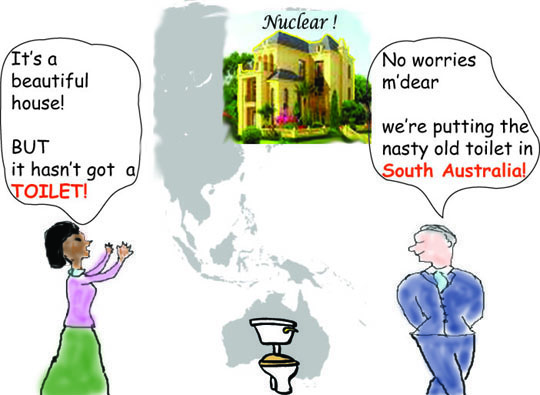
Mr Scarce has repeatedly faced criticism that the royal commission is an expensive and time-consuming bid to mask state and federal governments’ desire to again impose a nuclear dump on SA.
The State Budget has set aside $1.83 million for the royal commission this financial year……….
Three leading environment groups — Conservation SA, the Australian Conservation Foundation and Friends of the Earth — this month said the axing of hundreds of jobs from the Olympic Dam uranium mine raised huge questions about the nuclear industry’s growth potential.
“SA’s future lies in renewable energy, not nuclear. It’s cheaper, safer and quicker to roll out,” Conservation SA chief Craig Wilkins said.
“With renewables, we can be in charge of our own destiny, not dependent on decisions made in corporate boardrooms on the other side of the world.”
Mr Scarce expects to release tentative findings, including detailed recommendations, in a report in February. After five weeks of public consultation, the final report is due by May 6. Policy decisions about whether to adopt any recommendations, should they call for a nuclear dump or other changes, will be taken by the State Government. http://www.adelaidenow.com.au/news/south-australia/nuclear-royal-commissioner-kevin-scarce-about-to-start-public-hearings/story-fni6uo1m-1227504415906
No place for nuclear power in Australia – economist warns
 Nuclear power is an expensive, inferior resource that has no place in Australia’s future energy mix, a US economist has warned.http://www.theaustralian.com.au/national-affairs/state-politics/nuclear-power-a-costly-relic-us-economist-warns-commission/story-e6frgczx-1227500265740?sv=f70611a9445ad64e9d33b11dcffd7050 27 Aug 15
Vermont Law School senior fellow for economic analysis Mark Cooper has called on South Australia’s Nuclear Fuel Cycle Royal Commission to reject nuclear power on the grounds that natural gas-fired generation is more cost-competitive.
The former Fulbright fellow’s submission to the royal commission argues that the rapid development of renewable energy technology renders nuclear power a 20th-century “relic” that will be outdated before a reactor can be built in Australia.
“Nuclear power is an inferior resource that has no place in a least-cost portfolio to meet the need for electricity in a low-carbon environment,” he says. “Before a new nuclear reactor could be brought online, efficiency, renewables, other distributed resources and the deployment of the physical and institutional infrastructure to build an intelligent electricity system should well be on their way towards creating a new 21st-century system.”
Nuclear reactors can take up to 15 years to build before becoming operational. Dr Cooper said the huge capital investment required over a long period of time to build a nuclear power plant meant investors would be exposed to “significant risk”.
Royal commissioner Kevin Scarce has acknowledged the rapid development of renewable energy technology could quickly change the goalposts for assessing the economic viability of nuclear energy. Because of this, “heavy assumptions” were being built into the royal commission’s report to government, he said.
#Nuclear waste will be NO bonanza for South Australia
CHRISTINE ANDERSON SUBMISSION TO THE NUCLEAR FUEL CYCLE ROYAL COMMISSION HEALTH EFFECTS OF IONISING RADIATION
“……..The economic costs of nuclear reactor decommissioning are a negligible component of lifetime nuclear reactor costs when a decision is made to build a nuclear reactor, largely because these costs are so far into the future and have been heavily discounted to net present values.
When it comes to actually decommissioning a nuclear plant, the experience of the UK Nuclear Decommissioning Authority at Sellafield is costs are rapidly escalating with actual experience at the site – from 25.1 billion pounds in 2009-2010 to 47.9 billion pounds in 2013-2014 according to the UK Audit Office report at http://www.nao.org.uk/report/progress-on-the-sellafield-site-an-update/ .
WASTE STORAGE
Payments for waste storage might well be in the billions, but nowhere in the world have payments ever come close to meeting the full costs of storage so far, let alone for half a million years. It is definitely not a bonanza when the costs are higher than any income. I think it highly unlikely that any company or country will pay South Australia the money needed to identify a site, design and construct the storage facilities , and presumably operate it for many years and maintain it securely until it is full, and presumably totally closed off for at least 250,000 years. Even if any waste storage facility was restricted to Australia’s own nuclear waste, this will include reprocessed fuel rods from Lucas Heights , including small amounts of plutonium.
These wastes are from Australian government facilities, and although the federal government might pay some upfront design and construction costs, I can’t see them paying SA for the full costs, let alone a bonanza.. The Advertiser published an article on 11 April 2015 about Yucca Mountain, Nevada which was intended to be permanent storage for 70,000 tonnes of hazardous waste in casks in 8 kilometres of tunnels 305 metres underground. Funding was cut off in 2007 because Nevadans oppose the site. The US government has already spent somewhere between $15 billion and $100 billion in drilling and testing this site so far. A federal court ordered the US Nuclear Regulatory Commission to resume the licensing process for the site, and it seems likely Congress will support it again in the next few years.
Australia has already been through at least 4 series of processes over the last 30 years for identifying and building a waste storage site for its own wastes, mainly for Lucas Heights fuel. I doubt if anyone has attempted to calculate the public cost to date. Most of the likely sites will be aboriginal land or pastoral lease or Crown land subject to native title claims, and I believe most aboriginal groups will oppose further and effectively permanent loss of control and poisoning of their lands.
If we receive the waste, we are not going to be able to get rid of it. Continue reading
Abbott government onside with South Australia’s pro Nuclear Royal Commission
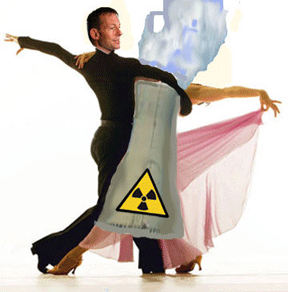 The federal government has reaffirmed its support for South Australia’s royal commission into nuclear energy. Source: http://www.sbs.com.au/news/article/2015/08/26/govt-backs-nuclear-inquiry AAP 26 AUG 2015
Industry Minister Ian Macfarlane says Australia needs an informed debate about nuclear energy industry and the royal commission is a good start.
He says any increased involvement must come with a robust, stable and predictable regulatory system to give the community confidence that risks can be managed effectively.
“Some of the activities being investigated by the royal commission would require change in commonwealth legislation and the establishment of supporting regularly and policy frameworks,” the minister told a resources conference in Port Augusta on Wednesday.
“While the government’s submission does not advocate any change in commonwealth policy, it has committed to seriously consider the royal commission’s report in 2016.”
SNC Lavalin charged with corruption (advisor to South Australia’s Nuclear Fuel Chain Commission?)
 Is the Royal Commission considering SNC Lavalin’s technology for South Australia? Did SNC Lavalin put in asubmission? (we won’t know, because commercial submissions are “in confidence”)
South Australia’s Nuclear Fuel Chain Commission visited Toronto on 14tth July and had discussions on the CANDU reactor design and technology. That CANDU technology is owned and marketed by SNC Lavalin.
RCMP charges SNC-Lavalin with fraud and corruption linked to Libyan projects Graeme Hamilton, Financial Post Staff | February 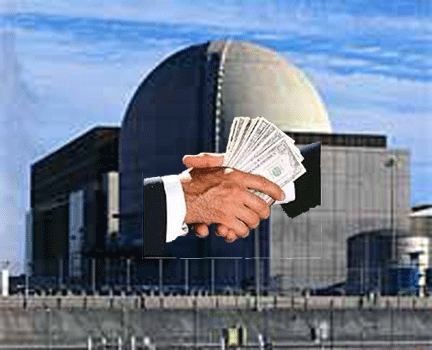 19, 2015MONTREAL – Once a jewel of the Quebec business establishment, SNC-Lavalin Group Inc. now stands criminally accused of fraud and corruption after the RCMP announced charges against the engineering giant Thursday.
The case against SNC and two of its subsidiaries stems from the company’s dealings in Libya between 2001 and 2011, when a senior executive established close ties with Saadi Gaddafi, son of dictator Muammar Gaddafi.
Court documents allege the company offered bribes worth $47.7 million “to one or several public officials of the ‘Great Socialist People’s Libyan Arab Jamahiriya,’” as Gaddafi called the nation he ruled until he was overthrown and killed in 2011.
SNC and its subsidiaries SNC-Lavalin Construction Inc. and SNC-Lavalin International Inc. are also alleged to have defrauded various Libyan public agencies of approximately $129.8 million. Continue reading
Twisting the public’s perception about ionising radiation
In Muller’s previous presentations on his YouTube show Veritasium, he has consistently confused the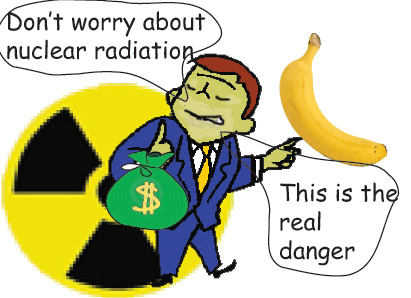
naturally occurring radioactive potassium K, with the nuclear fission produced radioactive isotopes…..Muller seems to have no understanding of the way in which bananas are used in the body
What Muller and Thomas are doing is following the script from the tobacco and asbestos industries.
This documentary “Uranium – twisting the Dragon’s Tail” is just Series One. I would love to know who helped to fund Gene Pool Productions for PBS and SBS to produce this. I’m betting that Series Two will follow before long, with a glossy and positive story about Generation IV nuclear reactors.
The half lie of the Dragon’s Tail. Online opinion, By Noel Wauchope Thursday, 27 August 2015 The documentary “Uranium – Twisting the Dragon’s Tail” is the latest glossy and highly sophisticated soft sell for the nuclear industry. It’s also, if you look at it closely, rather confusing.
I will start from the end, because that’s where the main message of this film comes out clearly “Just imagine a world where reactors can produce immense amounts of clean, safe, energy. There is no such thing as a future without uranium.” These final words are said against a background of soaring celestial choirs.
This seems to be the formula now, in nuclear promotion. The 2013 propaganda film “Pandora’s Promise” carried the same positive message – an ever rocketing energy demand to be met by ever increasing, indeed limitless, electrical energy provided by new nuclear reactors.
But, like ‘Pandora’s Promise’, this new documentary devotes the first two thirds of its series to discussing the negative aspects of the nuclear industry. Episode One covers its history, ill effects of radiation, the atomic bomb and its use. Episode Two continues this, with a sympathetic attitude to Australian Aboriginal concerns.
Unlike “Pandora’s Promise” this film does not denigrate anti-nuclear activists, and there is no attempt to ridicule Dr Helen Caldicott, as “Pandora’s Promise” did.
Indeed, the first two episodes are beautifully clear and accurate, as well as entertaining. Really, I couldn’t criticise them.
With the final episode – that’s when the message kicks in, and also when it gets confusing…….
Muller consistently mixes up “natural” radiation with ionising radiation from nuclear fission. He talks about background radiation as “natural”. There’s no mention of the increased ionising radiation in the biosphere as a result of the atomic bomb testing in the 1950s and 60s.
In Muller’s previous presentations on his YouTube show Veritasium, he has consistently confused the naturally occurring radioactive potassium K, with the nuclear fission produced radioactive isotopes, such as caesium 137 and strontium 90. As part of this confusion he constantly uses bananas as a comparison .comparison https://www.youtube.com/watch?v=TRL7o2kPqw0
Cesium-137 is 12 million times more radioactive than potassium-40. Another highly-radioactive fission product, strontium-90, releases almost 20 million times more radiation per unit mass than does potassium-40. Muller seems to have no understanding of the way in which bananas are used in the body. The human species has had thousands of years of experience with bananas and other foods containing potassium 40 (K40). We have a natural trace level of K40 in our bodies. When we eat bananas, our bodies excrete the extra cesium, so by the natural process of homeostasis, our K40 level remains the same. This is not the case with the very recently created radioactive isotopes from nuclear fission; they remain….., there is absolutely no mention of the effects of internal emitters of radiation – that is, the radioactive isotopes breathed in or ingested, that can sit in a body’s organs for years, decades, emitting high dose gamma radiation..
Moving on to the Fukushima nuclear accident, we are told that the psychological effects are the serious ones. What a great piece of spin this is! Of course the psychological effects are extremely serious. Wouldn’t you be worried, if you were a pregnant woman, or if you feared that your child might later get leukaemia, because you decided to return to a radioactive environment? It is the reality of increased risk of fatal illness that accentuates the other disastrous consequences of that accident.
Prof Thomas assures us “The most important studies will be those on the mental effects”. In the context of this documentary, that just makes me envisage more documentaries like this one – with more spin about how we mustn’t worry about ionising radiation…….
The documentary appeared in Australia at a very convenient time for the South Australian Royal Commission. Dr Muller often covers his back with remarks about nuclear weapons “the most savage thing that man has ever built” and like his “feeling that renewables are going so fast – perhaps we can use alternatives”. But ultimately, his is a message of confidence in nuclear power. He says “Every year uranium saves more lives than it has ever destroyed” Really? Where are the facts to back up these kinds of statements? And all is spoken with guru like solemnity, and the backing of soaring holy choral music……..
What Muller and Thomas are doing is following the script from the tobacco and asbestos industries. They know full well that the toll of cancers, heart conditions, birth defects, from persistent exposure to ionising radiation will not become apparent for decades. They would have us believe that it will be impossible to establish ionising radiation as the cause of this toll of suffering and death…….
We are living in a strange time, where science is valued if it brings a benefit to corporations. Dr Derek Muller and Professor Geraldine Thomas are comfortably ensconced in that world. But there must be some scientists out there who are like Sir Richard Doll, and whose work is motivated by the public good.
And we desperately need those scientists.
This documentary “Uranium – twisting the Dragon’s Tail” is just Series One. I would love to know who helped to fund Gene Pool Productions for PBS and SBS to produce this. I’m betting that Series Two will follow before long, with a glossy and positive story about Generation IV nuclear reactors. http://www.onlineopinion.com.au/view.asp?article=17624
Climate system changing more rapidly than expected: new report

 A STUNNING new Climate Council report that reveals the climate system is changing more rapidly than expected and with larger and more damaging impacts paints a stark picture of the urgent need for action, Professor Tim Flannery said today.
Climate Change 2015: Growing Risks, Critical Choices provides the most up-to-date, comprehensive synthesis of climate science in Australia and exposes the extent of the dramatic changes in the climate system worldwide.
“In short, the more we know about climate change, the riskier it looks,” Prof Flannery said.
“Heatwaves, sea level rise and ice loss are all increasing as the air, the ocean and the land continues to warm strongly. Extreme weather events like dangerous bushfire weather are becoming more severe and frequent.
“But this is a future we don’t have to have. Tackling climate change and moving to clean, renewable energy is the right thing to do. It’s the right thing to do to protect our health and wellbeing. The right thing to do to protect us from economic shocks from worsening extreme weather and opening new opportunities for jobs and investment in new industries. Unfortunately the barriers to action are political.”
The report found:
Australia:
- SEA LEVEL RISE: Australian sea levels are projected to continue to rise through the 21stcentury at a rate faster than that over the past four decades or over the 20th century as a whole. More than $226 billion of buildings and infrastructure are vulnerable to 1.1m of sea-level rise.
- EXTREME HEAT: Hot days have doubled in the last 50 years and heatwaves have become hotter, longer and happen more often. The number of deaths in summer in Australia has steadily increased over the last 40 years. In the future extreme heat increases are very likely with more frequent and hotter hot days and longer and more severe heatwaves.
- BUSHFIRE: Extreme bushfire weather has increased in the south east of Australia in the last 30 years and a “Catastrophic” category was added following Black Saturday bushfires. Longer and hotter fire seasons in eastern and southern Australia are likely in the future.
SOUTH AUSTRALIA:
- HEATWAVES: In Adelaide, the number of heatwave days has nearly doubled since 1950 and the average intensity of the peak heatwave day has increased by 4.3°C. In 1995, Adelaide experienced 20 days above 35°C. By 2090 it could experience up to 47 per year. Deaths from heatwaves in Australian cities are projected to double over the next 40 years.
- BUSHFIRES: Climate change is already increasing the risk of bushfires in southern South Australia; extreme fire weather has increased over the last 30 years in South Australia. The fire season in South Australia is starting earlier and lasting longer. In 2014 the bushfire season started earlier in seven of 15 districts in South Australia. By about mid-century, the total economic costs of South Australian bushfires are projected to almost double, potentially reaching $79 million.
- COASTAL FLOODING: In Adelaide, today’s 1-in-100–year flooding event would occur every year or so by 2100 under a high emissions scenario. A sea level rise of 1.1 m exposes a significant amount of infrastructure to the impacts of flooding and erosion in South Australia, including between $5 billion-$8 billion worth of residential buildings
Globally:
- Arctic sea ice retreat over the past three decades was unprecedented in at least the last 1,450 years.
- The 1980s, 1990s and 2000s were all hotter than any other decade in recorded history.
- Sea level rise is accelerating – the average rate of sea-level rise between 1901 and 2010 was 1.7 mm per year, increasing to 3.2 mm per year between 1993 and 2010.
The report underscored that Australia’s post 2020 emissions reduction targets were too weak to protect Australians from worsening climate change impacts, Professor Will Steffen said.
“As the escalating risks of climate change have become clearer and more disturbing, other countries have started to heed the warnings, putting in place tangible and ambitious policies,” he said.
“But Australia’s response to meeting the challenge of Paris is disappointingly weak; it is out of step with the science and out of step with most of the developed world.”
Professor Lesley Hughes said Australia had critical choices to make as country.
“We can embrace the range of solutions to climate change, which are more feasible and less costly than ever before, and build a healthier and more economically viable future or we can continue to pay the many costs that come from delaying action on climate change,” she said.
The Climate Council is an independent, crowd-funded organization providing quality information to climate change to the Australian public. For media enquiries, please contact Senior Media Advisor Jessica Craven on  0400 424 559.
BHP wants to remove Federal and State laws on uranium mining
 BHP cool on hot uranium demand, The Weekend Australian p.2 REBECCA PUDDY, 22 Aug 2015 BHP Billiton has warned that the future doubling of global demand for uranium will not necessarily lead to increased investment at its Olympic Dam mine.
The mining company said the commercial return from the Olympic Dam deposit in the north of South Australia was driven primarily by copper production, together with a combination of commodity prices and other market factors.
“Therefore increased demand for uranium may not in and of itself lead to increased investment in the Olympic Dam deposit,” the company said in its submission to South Australia’s Nuclear Fuel Cycle Royal Commission.
BHP Billiton’s warning comes after it announced this month that 380 workers would be sacked as part of an operational review to cut costs.
An expansion plan for Olympic Dam was put on hold three years ago, although South Australian Premier Jay Weatherill hinted this month that a modified plan to expand the mine remains on the cards, with trials of an alternative heap-leaching technology progressing more rapidly and successfully than expected. This comes as demand for uranium is tipped to increase.
The International Energy Agency world energy outlook states that there are currently 437 operating nuclear power reactors in the world with 378 gigawatt capacity.
With a further 68 reactors being built, the agency forecasts nuclear capacity will increase to 624GW by 2040. “In the long run, additional supply of primary uranium will be required to meet the expected demand,” it says.
“With steady demand increases, the market deficit is expected to be filled by a range of potential projects.”
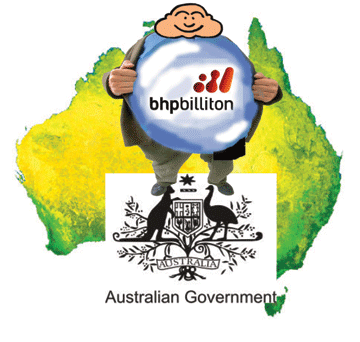
BHP Billiton’s submission to the royal commission focuses its attentions on the regulatory burdens placed on it by state and federal governments. It recommends the removal of uranium mining from the list of Matters of Environmental Significance in the federal Environment Protection and Biodiversity Act.
The commission is due to report early next year.
South Australian govt warned by atomic test veteran not to expand nuclear industry
Maralinga British atomic test veteran warns State Government against nuclear expansion in SA, ABC News By Mike Sexton, 22 Aug 15 A veteran of the British atomic tests at Maralinga has warned the South Australian Government against flirting with a nuclear fuel cycle.
Avon Hudson served with the RAAF at Maralinga during the so-called minor trials when radioactive material including plutonium was atomised and, in the process, spread across the sandy desert country.
“It is alright when everything goes okay, but we know they don’t,” he said.
“If we get more and more nuclear power stations then the law of averages is we will see more accidents.” In the 1970s Mr Hudson became a whistleblower by going public with what he knew of the secret trials.
He also became an advocate for the servicemen who had been exposed to radiation during weapons testing in the 1950s and 60s.
He said the men were given little or no protection against the harmful exposure.
“I was handed over like a pick and shovel would be handed over for someone to do a job,” he said.
“[There were] no safeguards, no nothing.”
Mr Hudson estimated of the 8,000 Australian servicemen at Maralinga fewer than 500 remained alive today.
Now in his late seventies he is retired and living in the South Australian town of Balaklava, but continues to agitate against the use of nuclear energy and weapons……..Mr Hudson believed the dangers posed by nuclear energy outweighed the advantages, including the possibility of nuclear fuel being used to manufacture weapons……http://www.abc.net.au/news/2015-08-20/veteran-warns-sa-government-against-nuclear-expansion/6711642
No “Nuke State” for South Australia – say Josephite SA Reconciliation Circle

Josephite SA Reconciliation Circle
Royal Commission into the Nuclear Fuel Cycle
SUBMISSION TO ISSUES PAPERS 1 – 4
The Josephite SA Reconciliation Circle is a group of concerned citizens with a deep and
abiding interest in the health and well-being of Aboriginal peoples who have already been particularly impacted by the nuclear industry in Australia. We have seen great suffering in Aboriginal communities in the name of progress. The very fact that State funds are being invested in this Royal Commission is deeply disturbing.
We see investment in the nuclear cycle is a backward step and are alarmed by the prospect of
any form of nuclear proliferation. Like many in our community we are shocked that the South
Australian Government could consider going down the path under consideration by the Royal
Commission into the Nuclear Fuel Cycle. We want to continue to be proud to be South
Australian, not ashamed. We do not want South Australia to become ‘The Nuke State’.
There is a need for continued social and economic development of South Australia. We
welcome positive change and development and are excited by the potential energy
opportunities for our State. Most recently, we have been buoyed by reports that renewables
expert Dr. Mark Diesendorf from the University of NSW has completed a report showing that
South Australia could be run on 100% renewable energy is just 15 years! There is a way
forward.
We offer the following responses to questions posed in the Issues Papers………
Ambivalence in Port Adelaide Enfield Council about trucking radioactive trash
 Trucking nuclear material could clog LeFevre roads, Port Adelaide Enfield Council says, Kurtis Eichler, Portside Messenger August 19, 2015 TRUCKING nuclear material through the Lefevre Peninsula would add “significant” pressure to already clogged transport routes, Port Adelaide Enfield Council says.
Councillors voted last week to send a four-page submission to the State Government to be considered by its Royal Commission into nuclear energy.
Issues raised in the submission included transporting uranium from northern mining areas through Outer Harbor…….In February, contentious climate commentator Professor Ian Plimer pushed for a nuclear reactor in Port Adelaide, saying it would create jobs and make electricity cheaper.
The idea was rejected by Mr Johanson and Port Adelaide MP Susan Close. http://www.adelaidenow.com.au/messenger/west-beaches/trucking-nuclear-material-could-clog-lefevre-roads-port-adelaide-enfield-council-says/story-fni9llx9-1227489550161
Nuclear stooge MP Rowan Ramsey touting radioactive trash dump for his electorate
Concern over radioactive storage, Port Lincoln Times, By Olivia Barnes Aug. 20, 2015, THE potential for a low to medium grade radioactive waste management facility in the Kimba and Buckleboo district has some local families concerned.
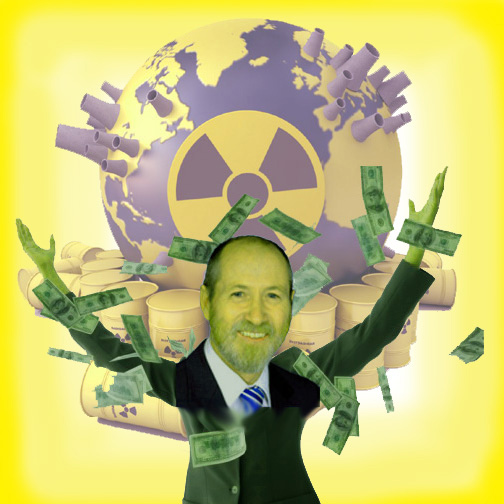 After an information session in April and a call for voluntary nominations from landholders, two families with properties to the north of Kimba expressed interest in volunteering land for the facility.
The project is still in its early planning stages but a number of residents and landowners who are strongly opposed to the idea of the facility being placed anywhere in the district have decided to act.
Among these families’ concerns are the potential health effects a storage facility could have as well as future property values and the impact it could have on grain prices in years to come.
Cameron and Toni Scott said after their neighbours told them they had expressed interest in volunteering land for the facility, they were immediately concerned.
“When the information session was held in April it was the middle of seeding and a lot of us couldn’t make it,” Mr Scott said.
“Our concern is this facility could be near our farms and homes and we don’t know what the consequences could be in the future.”
Mr Scott said his family’s concerns were that there was no precedent to compare the proposed facility to and so much was unknown. “We don’t know what it could do to the district’s reputation, what it could mean for our grain in the future, we don’t know what the outcomes will be for future generations,” he said…….
Federal Member for Grey Rowan Ramsey is hoping the Kimba district doesn’t “wipe off” the opportunity for a radioactive waste management facility to be located somewhere in the area. http://www.portlincolntimes.com.au/story/3290460/concern-over-radioactive-storage/?cs=1500
Federal Member for Grey Rowan Ramsey will be holding an information session at the Kimba Hotel on Monday, August 24 at 8pm, similar to the one earlier this year
—
A top Submission on Nuclear Waste Importing for South Australia
The Commission’s whole aim is to further the drive to make South Australia the World’s nuclear toilet. So, the Submissions on this topic of importing nuclear wastes are especially important.
NGOPPON TOGETHER INC sent in a top Submissions on all 4 Issues papers
Excerpts from NGOPPON TOGETHER INC – Submission on Issues Paper 4 – Management, Storage and Disposal of Wastes.
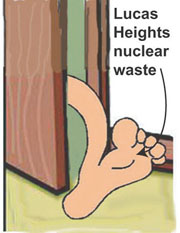 “…..Ngoppon Together’s answer [to Australia’s Lucas Heights wastes] – leave it where it is, where the expertise is, in Lucas Heights where it won’t be out of sight, out of mind; so that we avoid the hope of the pro-nuclear lobby and the consequent burgeoning of high and intermediate level waste in having finally established a repository, nuclear power will be far more possible (and the pressure to establish a nuclear power reactor thus increase.)
Measured by radioactivity, spent nuclear fuel reprocessing waste from Lucas Heights reactors accounts for over 90% of the waste the Government wants to dump … Although the volume of this waste is relatively small – some tens of cubic metres – it is by far the most radioactive material “ANSTO is capable of handling and storing wastes for long periods of time. There is no difficulty with that.” Dr Ron Cameron, ANSTO.(Lucas Heights (quoted in ‘Nuclear Freeways ‘)…….
 and waters, its people, its children? In such a vast country to discount the potential high level dangers of transport? Do we have no responsibility towards the future generations of South Australian and indeed Australian children?
 Ngoppon Together strongly refutes the muddled, quite fallacious so-called ‘ethics’ argument – We export and so are ethically bound to receive waste. This argument fails, as the people do not choose to export uranium but Governments and companies do. Aboriginal people oppose digging up uranium on their land in the first place and then to compound the burden, in the past at least are faced with the waste being imposed on them and their lands, waste that is up to one million times more reactive after enrichment. Our members point out the obvious realityif any government imports uranium then they import the responsibility for dealing with the implications of the purchase. Fewer than 1 in 6 South Australians are inclined towards reactors or waste dumps in S.A. We remind the Commission of their duties – to inform clearly and fully the SA Community of the facts and implications , rather than to persuade and cajole………
Radioactive trash storage would ruin South Australia’s vital fishing, agricultural and tourist industries

1 This month

of the week – Australians for War Powers Reform (AWPR)
To see nuclear-related stories in greater depth and intensity
 Antinuclear