The week in Nuclear News – Australia
 The focus this week has been on The Renewable Energy Target, (RET) currently under review by the Climate Change Authority. The RET has been very successful, facilitating $18 billion in investment in clean energy, bringing down wholesale energy prices, and enabling Australia to meet its Kyoto emission-reduction goals.
Predictably, utility companies and the media’s fossil fuel lobby mouthpieces are bleating loudly that the RET should be dumped, or weakened. A Senate committee found that high electricity prices are mainly the result of the utilities over-investment in poles and wires (gold-plating), but the right-wing ( including Labor’s Joel Fitzgibbon) blames the RET. It’s probably the fossil fuel lobby’s last ditch fight against the RET.
Meanwhile, decentralised energy, solar rooftops, grows apace, and along with energy efficiency, reduces demand for coal-fired energy. Wind power in South Australia, being a free fuel source, is pushing coal energy out of competition,
Prestigious Australian film-maker David Bradbury was arrested in India, and barred from visiting the Tamil Nadu are of anti-nuclear protest. Senator Scott Ludlam is pursuing the matter with India’s Ambassador.
Queensland. Warnings on the likely impact of uranium mining on Aborigines – following the pattern of restricting Aboriginal rights in other uranium States and Territory. Sad to see the uranium industry’s Aboriginal poster boy, Warren Mundine, being drawn into the charade of hyping the industry. Warnings also on the very real possibility of uranium being transported through the Great Barrier Reef. Opposition to uranium mining is alive and well in Queensland, including from the Electrical Trades Union, and the the Mayor of Rockhampton. Premier Campbell Newman advises critics to “Vote Green” – (first sensible thing I’ve heard him say) Caloundra’s privately funded solar array is up and running.
Uranium market. As one market analyst after another warns on the plummeting price of uranium, one has to admire the touching religious fervour of uranium company spokesmen, and Premiers of the uranium mining States. They keep banging on about the long-term prospects, but these are in serious doubt now.
Australian uranium company Paladin just can’t seem to stay out of trouble. As if losing $squillions wasn’t enough, Paladin has made itself extremely unpopular in Malawi, with not keeping to the agreed conditions at the Kayerekera Uranium Mine.
Launching of Robert Drewe’s new book “Montebello” reveals the shameful history of atomic bombing of the Montebello Islands.
The past week in Australian nuclear news
AUSTRALIA
Uranium prices continue to plummet – with no indication of a recovery any time soon. Nuclear industry in decline, with more reactors closing than new ones starting.
Martin Ferguson, our Minister for Promoting Nuclear Power, excelled himself this week, telling beaut furphies to salivating uranium executives, in Perth. He reassured them that nuclear power was clean, and getting cheaper all the time!
Senators John Madigan and Nick Xenophon have come to the rescue of all those ailing people, laid low by wind energy – with the Renewable Energy (Electricity) Amendment (Excessive Noise from Wind Farms ). What a relief! This Bill could help stop those evil wind farms. (But wait a minute – didn’t CSIRO find that they’re harmless?)
Kyoto Protocol – up for renewal. Australia, seen as a leader amongst the many countries acting on climate change, urged to join the new agreement.
Renewable Energy Target – under pressure from fossil fuel lobby, as the RET and carbon tax help to get Australia’s renewable energy up and running. Carbon tax not making much difference to prices. The first official consumer price figures show a far lower impact than predicted by the Treasury.
Falling demand for electricity highlights problems of utilities, and of regulation, and leads to suspension of Dalton coal-fired power station in NSW.
Australia joins a very wishy washy pact with New Zealand, supposed to strengthen the Comprehensive Nuclear-Test-Ban Treaty (CTBT ). What we really need is a Nuclear Weapons Convention and get some teeth into the movement to stop nuclear weapons.
Queensland. Uranium lobby, mainstream media, and some politicians were ecstatic, when Premier Campbell Newman ditched his pre-election promises, and his recent statements that Queensland’s uranium ban would stay. A few others, like farmers, environmentalists, and people interested in renewable energy – weren’t so keen. Some thought it a bit of a pity to turn the “sunshine state” into the “radioactive state”. Watch out now, as Newman and the nuke lobby turn their attention to the Nuclear Facilities Prohibition Act, which requires a federal plebiscite to allow nuclear power plants.
South Australia: after years of internecine fighting, the partners in the Four Mile uranium project boast that the mine is now to go ahead. Australian should hang their heads in shame to have ever let nuclear weapons maker General Atomics get into this country to almost fully own these 2 mines – Beverley and Four Mile.
Western Australia Aboriginal opposition to Wiluna uranium mine continues. Toro’s mine is far from becoming a reality.
Nuclear news that was this week – Australia
Australian media , naturally, came up with joyous stories about our new great uranium-inspired relationship with India, and also about Julia Gillard falling over, due to her high heeled shoes. Apart from one admirable editorial in The Age, Australians would never read/hear about India’s nuclear unsafety, and its frantic nuclear arms race.
By the way, on the subject of India’s nuclear unsafety, I was surprised that few readers of antinuclear.net took an interest in the story about Canada sending back to India the radioactive kitchenware that arrived in Montreal I wonder if Australia is getting any radioactive imports from India – India is notorious for its poor control of radiation safety – perhaps that would be a modern example of “Pig Iron Bob”?
In the Australian Senate, Greens Senator Ludlam put ANSTO chief Adi Paterson on the spot, as Paterson wriggled and writhed trying coverup, and deny the 2007 radioactive spill incident at Lucas Heights. ANSTO hastily puts out more propaganda about Lucas’ Heights “purpose” being nuclear medicine. Other questions to Senate committees raised embarrassing matters like the shambles that is Australia’s nuclear non proliferation policy, and India’s poor record.
In harmony with the pro nuclear propaganda about India, Paladin CEO John Borshoff dismissed concerns about Fukushima. (No doubt this was part of his desperate effort to save Paladin uranium, following its disastrous losses.)
South Australia is to hold a Solar Thermal Energy Parliamentary Enquiry – following huge community enthusiasm to replace Port Augusta coal generators with solar power.
Coal power is in trouble, 2 coal generators shutting down in South Australia, one in New South Wales, one in Victoria. The causes – downward pressure on wholesale electricity prices due slumping electricity demand, the carbon tax and Australia’s Renewable Energy Target. Victoria’s Premier Bailllieu, (friend of Bog Coal) is very annoyed at this.
Western Australia’s utility scale solar energy 10-megawatt Greenough River project up and running. Nevertheless, Premier Barnett has this week attacked the Renewable Energy Target , and approved the Wiluna uranium project, though it has no adequate water plan, nor closure and cleanup plan – as well as being uneconomic.
Now, something to be proud of – Antarctica: AUSTRALIA and France have developed a plan to protect 1.9 million square kilometres of east Antarctica as new marine parks.
The week that was in nuclear news – Australia
Well, as usual, quiet in Australian nuclear news. Well, quiet in all Australian news really, as media and politics focus on mud-slinging. At last, Prime Minister Julia Gillard has succumbed to the temptation to answer back, after many months of sexist mud-slinging from Tony Abbott and his supporters in shock jock radio. A pity, Gillard was doing well when she was just ignoring Australia’s infantile yobbos, and was talking about issues and policies.
But – nuclear spin and propaganda never rest. Australia has England’s Professor Chris Llewellyn Smith out here, telling us that Three Mile Island, Chernobyl, and especially Fukushima weren’t so bad, and what Australia needs is – nuclear power. The ABC’s TV program Catalyst has a plug for “Generation IV “- new nuclear reactors – Oh so safe!. All part of the nuke industry’s desperate bid to promote its piles of lethal wastes as a lucrative asset – fuel for planned new nuclear reactors.
Australian Nuclear Free Alliance marks 15 years of anti nuclear activism, planning its 2013 movement with a meeting in Alice Springs.
Australia likely to sign up to a USA “defence trade treaty” that would effectively censor our scientific researchers.
South Australian Native Title Services (SANTS) will challenge, in Federal Court, the Petroleum and Geothermal Energy (Transitional Licences) Amendment Bill, which effectively gives petrol and gas explorers priority over Aboriginal rights. Meanwhile the South Australian government is assuring mining companies that they’ll get speedy approvals, and appeals will be scrapped.
BUT – also in South Australia, free fuel – wind and sun – are lowering electricity prices. The Essential Service Commission of South Australian (ESCOSA), which regulates retail electricity prices, has released a draft price determination that proposes an 8.1% reduction in the electricity standing offer, (that is, the default retail price that must be offered to South Australians, at a minimum). The Australian Energy Market Operator (AEMO) has noted that the South Australian wholesale prices are lower than they have been since the start of the national electricity market, and that the wind “tends to depress the South Australian regional prices”.
Victoria Wind Alliance formed to counter the Baillieu government’s war on wind energy. However, there is progress now on new 1.5 megawatt solar power plant near Mildura.
The week that has been in Australian nuclear news
Federal. Julia Gillard is off to India, to seal the deal on selling uranium there, even though they won’t sign the Nuclear Non Proliferation Treaty. No doubt the government, especially Martin Ferguson, want this shameful deal to be done quietly – unhappy Labor Ministers to shut up about it. Australian Uranium Association’s Michael Angwin urges pressure on Ministers Stephen Conroy, Peter Garrett and Anthony Albanese to come into line on this issue. Greens Senator Scott Ludlam has urged the Prime Minister to raise the issue of human rights in India, as India is now repressing antinuclear protestors – 10,000 of them have been charged withsedition and waging war against the nation.
Lynas rare earths company faces more uncertainty, as the Malaysian court delays hearing on appeal against its reprocessing plan.
Rural and regional Australians adopting solar energy at a fast rate.
The world’s most notorious and secretive company, Glencore ia about to get a controlling share in Australian mining company Xstrata
The Green Party of the United States has joined Green Parties of Australia, Canada, and New Zealand in a “Joint Statement on Trans-Pacific Partnership Agreement” that strongly criticizes the proposed international trade pact.
South Australian Premier Weatherill mouths platitudes about not pandering to BHP Bulletin, possibly not extending their Indenture Agreement. At the same time, South Australian government is busy helping miners to beast any Aboriginal objections to new mines – ‘Mine project appeals set to be scrapped MINING companies are being promised speedy Aboriginal heritage approvals’ – says THE AUSTRALIAN -(subscription only, and I don’t subscribe).
Renewable energy cutting energy prices for South Australians. Australian Youth Climate Coalition leads a long march to lobby for repowering Port Augusta with solar thermal .
New South Wales. That pesky Sydney mayor, Clover Moore, and the City Council have a plan for making Sydney energy efficient, and produce energy locally with solar, wind and trigeneration technology. While the State government salivates at the thought of selling uranium to India, its in danger of getting a renewable energy capital city.
As an aside. Pro nuke propaganda is all over the place. ABC’s TV program Catalyst will next week ask us “Are we ready for New Generation nuclear reactors”. Nuclear isotopes are being used to develop better crops. Crystal Palace: In Sydney you can see The Great Exhibition Of The Works Of Industry Of All Nuclear Nations, at Artereal Gallery,.
Australia: the week in nuclear news
NATIONAL As two of Port Augusta’s coal-fired power stations are shuttering, a rally on Sunday 30/9 will highlight a strong community push for solar energy, encouraged by Greens senator Hanson Young
Australian government continues to feign ignorance, as newly released US Air Force documents prove that the USA govt classifies Julian Assange as an enemy of the State, in the same category as al Qaeda and Taliban terrorists.
In New York, Prime Minister Julia Gillard had quiet talks with Indian representatives. When she visits India soon, she will be signing Australia up to the first Australian country-to-country agreement to sell the yellow cake to a country outside the Nuclear Non-Proliferation Treaty.
Former Liberal Prime Minister Malcolm Fraser strongly criticises the Australian Government’s subservience to USA, and warns of the danger as Australia becomes locked in to USA’s militaristic policies of “containing China” in the Pacific region.
South Australia: Olympic Dam uranium mine. BHP wants to extend the South Australian government’s approval for the mine expansion for another 46 months. There’s absolutely no improvement in sight for uranium prices, or copper either. Is this all done to keep BHP’s “foot in door” and sweeten up SA govt for even more concessions whenever BHP wants them?
Wind energy causing a little windstorm, as one man finds he can set up a small (6 metre high) wind turbine at his home, without needing Council consent. The fossil fuel lobby’s favourite political Party, Family First, has sprung to the rescue, with an effort to prevent this.
Western Australia Aboriginal leaders of Western Australians Nuclear-Free Alliance (WANFA) gear up for a determined battle to stop uranium mining at Wiluna and Yeelirrie.
Queensland The Federal Government’s Climate Change Commission reports on Queensland’s special vulnerability to climate change, but that does not affect the Newman government’s war on renewable energy.
Australia is slow to cop on to the collapse of the uranium market
Australia’s nuclear/uranium lobby appears to live in a parallel universe. quite distinct from the real one.
Of course, the nuclear lobby world-wide is continuing to desperately hype the future of its now declining industry. And, of course, Australia’s greedy little nuclear entrepreneurs, like John White, Ron Walker and Robert Champion de Crespigny, and their politically minded hangers on , Martin Ferguson, Alexander Downer – all salivate at the thought of Australia becoming the world’s nuke waste dump.
 Still, I expected more self interest from Australia’s uranium lobby, and States politicians. Don’t they notice what is happening to the uranium market?. BHP Billiton and Cameco noticed, and acted to stop wasting shareholders’ money in developing new uranium mines.
But every day in Australia, the media is bombarded with the joy of new uranium mining – joy in Queensland, in NSW – today it’s Broken Hill looking to the golden future. – Christina Macpherson 22 Sept 12
Australia’s week of uranium news spin
Still under the radar, perhaps, but nuclear and uranium news are alive and well, here. Well, perhaps not exactly well. The promoters of the uranium industry keep getting all this positive news spin published – about the prospects in Queensland and New South Wales. But the facts are conveniently forgotten – BHP’s pullout from uranium mining, Paladin’s disastrous losses, Cameco selling uranium below the cost of production. Toro undecided, now that Western Australia has made stricter environmental regulations. THE AUSTRALIA in particular continues its spin – also about SILEX laser uranium enrichment, about how Australia ‘needs’ nuclear submarines.
The Australian government dishes out more money for Lucas Heights nuclear reactor – for its fig leaf medical radionuclides. (Never mind that this is last century’s technology, while non nuclear cyclotrons can produce those same medical radionuclides)
Lynas rare earths corporation has applied to Australian Radiation Protection and Nuclear Safety Agency (ARPANSA) to import radioactive waste back to Australia,
Renewable Energy: Renewable Energy Target under fire from Australian utilities (understandably – they will need help as renewable energy succeeds) Canberra going for 90% renewable energy by 2020 . Hepburn Council asks the Victorian government to ease its effective ban on wind farms, to allow their small community wind farm project.
Despite the failing nuclear and uranium industries – their hype goes on in Australia
In corporate Australia, in political leaders, and mainstream media there is, of course, no shame in being completely unethical in pursuit of the business dollar. As far as the uranium industry goes, they’re all happy to be sanctimonious about the supposed ‘benefits’ of our exports.
The amazing part is in the way – with all evidence to the contrary, the uranium industry is hyped as a wonderful investment, and uranium mining as a benefit to the local area, in whatever State it might be developed. (Never mind about BHP pulling out of uranium mining, ERA and Paladin’s losses). The latest uranium-hyping headlines include: ‘Uranium mining back on the political agenda’ (Herald Sun), ‘State wants to get a piece of the action’ (The Australian), ‘NSW open to uranium exploration’ , (Financial review.)
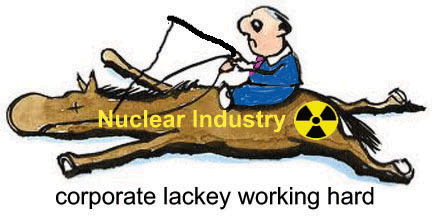
The hyping doesn’t stop at uranium mining. There’s ‘SILEX beams on technology success’, (The Australian). Not a word, in this sickeningly enthusiastic article, about the fact that this SILEX laser uranium enrichment technology is known to be a very dangerous avenue for allowing the spread of nuclear weapons fuel. (Controversial nuclear technology alarms watchdogs http://www.smartplanet.com/blog/intelligent-energy/controversial-nuclear-technology-alarms-watchdogs/18138 )
The Australian government gives ANSTO a boost – more money for ANSTO and the Lucas Heights nuclear reactor. This is for ‘worthy’ reasons – medical radionuclides – even though those can be made by other means, as Canada is now doing with its medical radiopharmaceuticals, – going for a non nuclear cyclotron.
And in today’s Australian there’s the ‘ call for nuclear submarines – the only sensible solution’
But – Australia is not alone in this promotion of the nuclear industry. Global nuclear corporations now rejoice that their pressure on the Japanese government has resulted in Japan’s government backtracking on its commitment towards zero nuclear power. In France, EDF is vigourously attacking the government’s plan to shut down Fessenheim, the country’s oldest nuclear power plant.
Meanwhile the global nuclear lobby’s campaign that “low level radiation is quite good for you’ rumbles on. As does the promotion of all sorts of new geewhiz untested nuclear reactors. As does the continued attack on renewable energy.
Still – all this pro nuclear pro uranium propaganda does not seem to be working with ordinary people. Perhaps it is all the desperate cries of a dying industry Christina Macpherson 21 Sept
Lucas Heights medical nuclear reactor is unnecessary, a fig leaf on dirty dangerous nuclear power
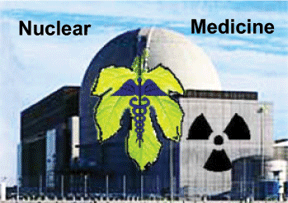 The nuclear lobby is sure working hard, globally, to improve its very unpopular image.
In Australia pro nuclear hypocrisy reaches a peak today, as Senator Chris Evans bleats out a whole lot of nauseous spin about expanding the role of ANSTO (Australian Nuclear Science and Technology Organisation) and the Lucas Heights nuclear reactor. His media release is full of sanctimonious blather about the benefits to the sick, Australia having a leading role in the world, and wonderful Synroc ( a waste disposal technology that was discredited decades ago.
There are drawbacks – expense is one, – but these drawbacks can be overcome: research to this end is going on in Canada – scientific teams in Alberta Saskatchewan, Manitoba and Quebec.
The Alberta team was able to produce viable quantities of high-quality technetium-99m using a 19-mega-electron-volt cyclotron, a circular particle accelerator, said Sandy McEwan, a researcher with the University of Alberta and medical director with Alberta Health Services’ Cross Cancer Institute in Edmonton, in a news release.
“This means there is now a potentially valid alternative to reactor-produced medical isotopes,” he said. June 1012.
The real problem with medical isotopes such as those produced in Australia, at Lucas Heights, is that this really functions as a fig leaf over nuclear power. The ‘medical’ nuclear reactor is a foot in the door for the nuclear industry. It should be shut down, and replaced by a cyclotron. – Christina Macpherson, 20 Sept 12
Australia – a media backwater

Some elements of the mainstream media do try hard.
But this week, I’m amazed at the news that is NOT in the media – anywhere.
I agree that the anti USA protests around the world, and here in Sydney – ARE news.
But – the Duchess of Cambridge being photographed topless – what a crime! I don’t think so.
Of course, it IS footee final week in Australia – we all know that this takes precedence over anything, local or international.
But WHY – no mention of the brave fight of Indian villagers against the Kudankulam and other nuclear power projects? The repression of their protest by government-ordered violent police tactics? The support of their protest from leading scholars?
Is it because Australia is to sell uranium to India? Is it because we might offend the USA, who is desperate to flog off their nuclear technology to India? Or is it just a case of our slack media?
Disposal of rare earths’ radioactive wastes: Lynas mucked this up
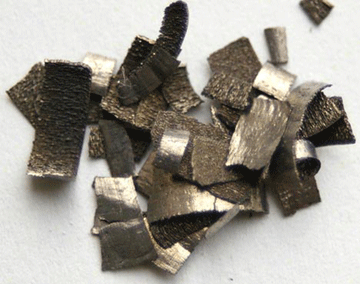 Christina Macpherson, 15 Sept 12, It’s Lynas’ own fault. Hastening to set up rare earths reprocessing in Malaysia, with no plan for disposal of radioactive wastes. They could have been smart, like Globe Metals and Mining, who are sending their rare earths to China for reprocessing. China, having learned the hard way, is now the expert on rare earths reprocessing. Lynas didn’t bother to take note of Malaysia’s disastrous history.
Unfortunately, rare earths are needed, even for the cleaner, renewable energy technologies. Preferable to nuclear power, but still, disposal of end radioactive wastes is a challenge.
Nuclear news – under the radar in Australia
Again – seemingly quiet on the nuclear front in Australia. Yet, again, under the mainstream media radar, things are happening. The pro uranium hype continues, with Uranium SA’s chairman’s report talking up the industry’s prospects, (despite all evidence to the contrary), spruiking its environmental advantages, and promoting Generation IV nuke reactors (even though they use little uranium, and the most hyped one – thorium reactor, is designed to replace uranium. Meanwhile BHP retreated from all uranium exploration in South Australia.
On that point, thorium versus uranium, there’s a call from a “New South Wales “jury”s report about nuclear power for Australia. It recommends “discussion”” on nuclear power – especially in the light of NSW’s ban on uranium mining. You see, THORIUM mining is not banned in NSW.
Australia participated in two regional agreements favouring nuclear power. The Association of Southeast Asian Nations (ASEAN) will explore nuclear power as a long-term option for the region’s energy needs, and the Asia-Pacific Economic Cooperation (APEC) agreed to “ensure the safe and secure use of nuclear energy as a clean energy source in interested economies.”
Wind energy from South Australia reached amazing levels – a week of average 55% of electricity supplied, at one point, 85%, and some exported to Victoria. New South Wales came up with a renewabl eenergy plan that looks good, but turns out to be a dud. Queensland’s Campbell Newman’s budget was a renewable energy massacre, axing 16 climate change and renewables projects.
Naturally, news of India’s turmoil over anti nuclear protests and police violence did not appear in the Australian media. But well, look, it IS the football final week.
Australia’s mainstream media mindlessly regurgitates Uranium SA’s media release
 The Australian media mindlessly regurgitates corporate media releases. Yesterday’s Herald Sun provided a glowing account of Uranium SA’s Annual Report, by its chairman Alice McCleary. But – did any mainstream media look into that report, and its claims?
I was fascinated by Alice McCleary’s mention of “stripped of emotion” – nuclear processes are 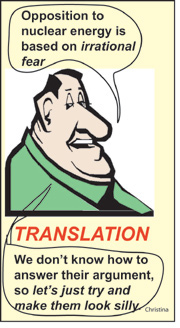 environmentally OK etc. . That is the traditional nuclear spin way of answering any claims of danger, environmental damage, health damage, nuclear weapons risk and so on. Nuclear’s opponents are “emotional” “not rational” – so no need to answer their arguments.
Then she goes on to “Generation IV nuclear reactors which consume 100% of the energy in the uranium fuel, plus the depleted uranium from the enrichment process”. What Is she talking about? There are at least 6 different types of “Generation IV nuclear reactors’ – all still in the design stage. They all use uranium in lesser quantities only. In the case of the much-touted Thorium reactor, uranium is used in small amounts to set off the fission process. But really thorium reactors are being touted as a “welcome” alternative to uranium powered ones.
Anyway, the whole promotion for most the Gen IV reactors is to use up the world’s embarrassing piles of plutonium as fuel – hardly a recipe for expanded uranium mining.
The optimism of the report is in fact, in contrast to the reality of the uranium industry’s prospects. Even BHP’s cancelling of expansion of Olympic Dam has not helped the uranium industry’s market forecast. Paladin Energy made a huge loss on uranium , as did ERA last year.
Nuclear news in Australia for the past week
It has been a seemingly quiet week in Australian nuclear news. But then, in the Australian media, it’s always a quiet nuclear week. I have got a bit of a shock, in studying the media as a theme for September, that in fact – the norm for Australia is just to not know anything about nuclear issues. That’s how the nuclear lobby, government and mainstream media like it.
That doesn’t mean that nothing is going on. Alas no. The nuke lobby keeps on. A whole lot of hype about the great future for uranium mining – (despite all the evidence to the contrary). Then there’s the subtle move for nuclear power in Australia. For example, in today’s news Utility Products praises “low carbon” (not necessarily renewable) energy.
– “For non-renewable energy technologies, combined cycle gas and nuclear power are considered the cheapest and will stay cost competitive with the lower cost renewable technologies also up until 2050.”
considered by whom? I’d like to know. On the less subtle pitch, Barry Brook continues his promotion of nuclear power for Australia, also despite evidence that this would be economically disastrous, as well as environmentally.
In Western Australia the great walk against uranium mining continues – the nuke lobby would never admit it, but such brave protests have their impact, as they did with Olympic Dam, too, in South Australia. Lynas rare earths company is jubilant about getting a temporary operating license in Malaysia. But no mention of whether their radioactive waste plan is yet accepted by Malaysia.
In Queensland, New South Wales, and Victoria the Liberal governments clamp down on renewable energy while in South Australia over 50% of electricity is being supplied currently, through wind energy. The federal government disappoints in its backdown on closing down dirty coal plants.
1 This month
17 October, Free Public Talk on Nuclear Issues in South Australia
David Noonan will speak on public interest concerns over the new Roxby Downs Indenture Act 2026 on BHP copper-uranium mining and ore processing in SA, and on how AUKUS may face SA with a High-Level nuclear waste agenda.
Dr Jim Green will discuss international developments in the field of nuclear power including ‘small modular reactors’ and Generation 4 ‘advanced’ nuclear reactor concepts.


Help Aunty Sue Protect Her Land and Sacred Sites From Destructive Rocket Testing.
.

Australians deserve the truth
about
AUKUS – https://aukuspublicinquiry.com/

PETITION – To: Prime Minister Anthony Albanese and the Australian Labor Government

of the week – Australians for War Powers Reform (AWPR)
To see nuclear-related stories in greater depth and intensity

