The long-awaited results of a $25 million National Institutes of Health study on the effects of cellphone radio frequency radiation exposure on animals is out, and the results are mixed. They showed a higher risk of tumors, DNA or tissue damage and lower body weight in some groups of rodents, but no obvious ill effect in others and no clear implications for human health. Continue reading
Mixed messages in research results on health effects of mobile phone electromagnetic radiation
Cellphone radiation study finds mixed effects in rodents without clear implications for human health, WP,
Adani’s threat to Australia’s most valuable water source
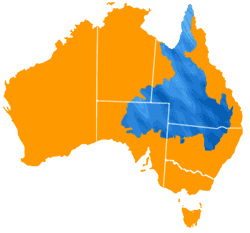 Margaret Gleeson, 2 Feb 18, ‘Last year almost 90% of Queensland was drought declared.
For farmers and graziers struggling for survival this meant increasing reliance on groundwater. …
‘The impact of Adani’s Carmichael coalmine, in Queensland’s Galilee Basin, on groundwater
and the Great Artesian Basin were key aspects of the objections to the mining approvals. …
‘The impact of water use in the development and operation
of the mine is significant by virtue of its sheer scale. …
‘In April last year, Adani was granted an unlimited water licence for 60 years. …
‘Local farmers were outraged. “It’s bloody-minded and barbaric,” said Bruce Currie,
a grazier who lives in the region and has joined legal action against Galilee mines.
“This is going to definitely impact on the integrity of [the Great Artesian Basin].” …
‘Carmel Flint, a campaigner for anti-mining group Lock the Gate, said
the open-ended water licence for Adani amounted to a “free kick” to take water
from important aquifers such as the Dunda Beds and Clematis Sandstone formations.
‘Water from the Great Artesian Basin “is just essential for farming communities” she said.
“Without the water, their businesses are basically finished.” … ‘
Read more of MargaretGleeson‘s informative, insightful, interesting & well-researched article here:
www.greenleft.org.au/content/adani-threat-great-artesian-basin
Keep Lucas Heights nuclear waste at Lucas Heights, for the safety of all Australians
 Paul Waldon Fight To Stop Nuclear Waste Dump In Flinders Ranges SA, Security of nuclear waste is being eroded, now is the time to beef it up, and Lucas Heights is the safer venue than outback South Australia for holding radioactive waste.
Over the years there have been explosives found at reactor sites, arson with many millions of dollars damage, a guerrilla band had taken control of one reactor site, incendiary device detonated at another, bombs explode that were planted at one site, and even a person walk past a security check point with a bazooka while with a group of tourists, not to mention a derelict reactor had uranium fuel rods stolen, and it doesn’t seem to end.
The Rosenbaum report, “In recent years the factors which make safeguards a real,imminent and vital issue have changed rapidly for the worse.Terrorist groups have increased their professional skills, intelligence networks, finances, and levels of armaments throughout the world.”
Security is failing and to place radioactive waste in a region of poor security is the wrong measure to be taking.
Keep it at Lucas Heights for the safety of all Australians. https://www.facebook.com/groups/344452605899556/
Australia way behind on low carbon action – UN investor expert warns
Australia cops UN investor slap on climate policy as ‘green paradox’ looms, The Age , Peter Hannam, 1 Feb 18
Fiona Reynolds, UNPRI’s managing director, said investors needed to take the lead in forcing companies to reveal their exposure to fossil fuels and to step up pressure on governments to meet their Paris climate commitments.
“Investors have a huge, huge role to play on climate change,” Ms Reynolds told Fairfax Media, citing their ability to influence the companies they own, including steering them away from fossil fuels to renewable energy. “This a really urgent issue.”
While countries in Europe of all political persuasions were tackling the need to switch to a low-carbon future, the debate in Australia 10 years behind, she said.
Carbon price
The Abbott government’s scrapping of a carbon price in 2014 – and the kryptonite reaction to another policy since – went against the global trend. Some 40 nations had introduced some form of carbon pricing and major international investors were generally supportive, Ms Reynolds said…….http://www.theage.com.au/environment/climate-change/australia-cops-un-investor-slap-on-climate-policy-as-green-paradox-looms-20180129-h0qc0f.html
Weatherill Government opposition to all nuke waste dumps in SA welcomed
 The state’s peak environment body has strongly welcomed the announcement by the SA Premier Jay Weatherill that his government now ‘opposed any further involvement in the nuclear fuel cycle, including waste repositories’ whether high or low level, and his willingness to consider legal action against the Federal Government if they imposed a dump on SA.
The news comes after a controversial two-year federal process targeting three potential radioactive waste facility sites in South Australia – two near Kimba, on the Eyre Peninsula, and Wallerberdina Station, near Hawker in the Flinders Ranges – that has divided communities.
“We strongly welcome the statement by Premier Weatherill that SA Labor will oppose any attempt by the Federal Government to impose nuclear waste from Lucas Heights on our state,” said Chief Executive of Conservation SA, Craig Wilkins.
“SA Labor have a long and proud tradition of opposing similar moves in the past, most notably Mike Rann who famously won a High Court challenge against the Howard Government over a decade ago.
“The current Federal Government process has torn communities and neighbours apart.
“We continue to call on the federal government to put an end to this flawed and divisive process and take a responsible approach to the management of Australia’s most hazardous waste.
In response to earlier federal moves to dump radioactive waste in SA, Parliament passed the Nuclear Waste Facility (Prohibition) Act 2000. The objects of this Act are ‘to protect the health, safety and welfare of the people of South Australia and to protect the environment in which they live by prohibiting the establishment of certain nuclear waste storage facilities in this state’
“This statement by Premier Weatherill will help reassure a community that was disturbed and disappointed by his government’s previous push to explore opportunities in the nuclear fuel cycle.
“We commend Premier Weatherill for standing up for our state and the communities of Kimba and Flinders Ranges” he said.
Kazakhstan has gained by dismantling its nuclear arsenal – no longer is it a target
Former nuclear power Kazakhstan shares lessons for North Korea, Nikkei Asian Review, January 30, 2018 UN ambassador highlights benefits of denuclearization, harm suffered by testing, ARIANA KING, UNITED NATIONS –– Few nuclear powers have ever volunteered to dismantle their arsenals, but Kazakhstan’s U.N. ambassador makes the case that a country stands only to gain by such a dramatic gesture.
Kazakhstan, which once held the fourth-largest nuclear stockpile with over 1,400 warheads, relinquished all of these Soviet-era weapons by April 1995.
“With the time passing, we more and more are convinced that that was a very right decision at the right moment,” Kairat Umarov, the ambassador and current president of the Security Council, told the Nikkei Asian Review in a recent interview. “And today we are very much proud of this decision,” he said, because Kazakhstan “gained a lot from this step.”……….
“The nuclear-free status of Kazakhstan may serve as an example and as practical guidance for other countries,” Nazarbayev said at that meeting, noting the “high international standing” his country gained by renouncing nuclear weapons. “We call upon all other states to follow our example. We called upon Iran to do so. Now we call upon North Korea to do so.”
“One thing we know for sure: Nuclear capability is not a good defense,” Umarov told The Nikkei. “It’s not a good way to protect a country.”
Possessing such weapons makes a country a target for other nuclear-armed nations, the ambassador added. “So that’s our experience, and we think that anything can be avoided if there is enough political will,” he said.
Umarov said attempts to persuade his North Korean counterparts of the merits of denuclearization have not been fruitful. “But at the end of the day, we think that it is political courage of leaders which really makes things different,” he said. A decision by North Korea to denuclearize would be “received with applause in the international community.”
For Kazakhstan, however, the voices of the victims of nuclear testing at the Semipalatinsk site also led Nazarbayev to dismantle the country’s nuclear program, Umarov said. Though decades have passed since the former Soviet republic closed Semipalatinsk, the legacy of nuclear testing continues.
“We right now have 1.5 million people who are suffering from the nuclear testing site,” Umarov said, citing genetic deformities that have plagued the population and continue to affect newborn children — three generations later.
“It is a very acute, sensitive issue for us,” Umarov asserted, recalling his work for a nongovernmental group in which he fought to shut Semipalatinsk. “So it’s not just we are playing with the politics, or trying to show that we are so principled because of political reasons. It is a very real thing with our population, with our people, and we are reflecting here the will of the people on that issue.”……….https://asia.nikkei.com/Politics-Economy/International-Relations/Former-nuclear-power-Kazakhstan-shares-lessons-for-North-Korea
Thanks to North Korea and Donald Trump, accidental nuclear war could easily happen
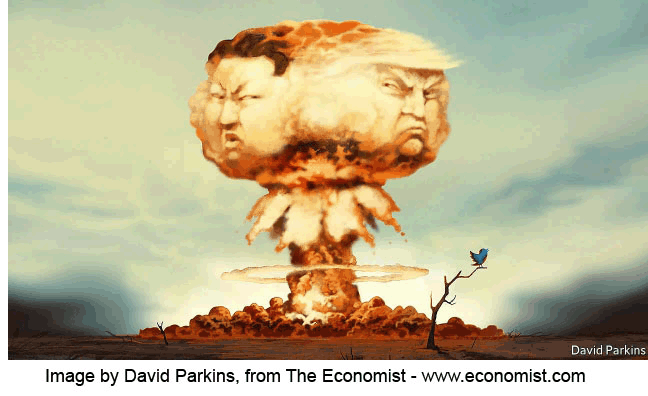 North Korea and Donald Trump may be a recipe for accidental nuclear war — here’s how it could happen, Business Insider, DAVE MOSHER, JAN 29, 2018
Pacific islanders’ high incidence of birth deformities where population was exposed to French nuclear bomb tests
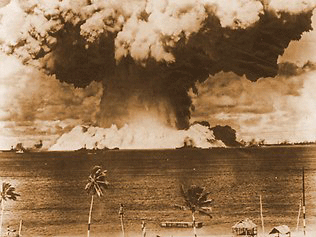 French overseas minister open to nuclear study https://www.onepng.com/2018/01/french-overseas-minister-open-to.html, 1/26/2018
The French overseas minister says she is not opposed to calls for a study into the possible genetic consequences of the French nuclear weapons tests in French Polynesia.
Annick Girardin has told journalists in Tahiti that there will be an answer to the recently raised calls for such a study.
Last week, a child psychiatrist, who had worked in French Polynesia for years, suggested that an independent investigation be carried out after noticing a high incidence of disturbed and deformed children among the off-spring of people exposed to radiation from the atmospheric tests.
Girardin has acknowledged the concerns, saying it has to be established how to deal with the question and to see if it is possible to work on it with other countries.
The minister has restated that the former president Francois Hollande recognised two years ago in Papeete the French legacy and assumed responsibility.
She has also launched a project in Papeete to build an institute of archives and documents related to the tests.
She has also frozen the sale of land in the city previously used by the navy for its command for it to be able to be used for a memorial site.
She has also frozen the sale of land in the city previously used by the navy for its command for it to be able to be used for a memorial site.
The head of the nuclear test veteran’s organisation Roland Oldham is dismissive, saying this will only see the light of day once people are dead.
He has continued to urge Paris to compensate the nuclear test victims suffering from poor health.
Until 2009, France claimed its weapons tests were clean but then passed a law accepting compensation demands.
Hundreds of applications have been filed since but almost all have been thrown out.
Poor labeling of food in Australia leaves people stumped to know its origin.
Paul Waldon Fight To Stop Nuclear Waste Dump In Flinders Ranges SA, 29 Jan 18,
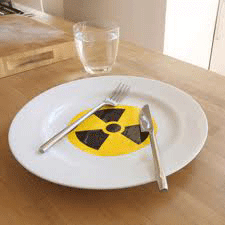 The NRC and DOE and their plans to resurrect failed policies to deregulate large amounts of radioactive materials (14,00+ tonnes), and allow them into the general consumer market place.The last time they tried this, with a policy called “Below Regulatory Concern.” Nuclear Information and Resource Service (NIRS) and other groups mounted a national campaign that tapped public outrage and led to the 1992 revocation of the policy by the the U.S. congress. It was reported that this recycled material would end up in your pot and pans, belt buckles, tins and every other consumer good.
Less than two years ago while on a shopping expedition I came across a item that was radioactive at a large local supermarket, without opening the can I couldn’t say if the food or the receptacle was the source of the high reading.
The promotion of a radioactive waste dump at Hawker or Kimba has already had a impact with the stigma, relationships and more. Anyone that would consider abandoning radioactive waste in a environment know for cereal crops or livestock which will find its way onto the kitchen table for the children or anyone else, is irresponsible and reckless.
Donald Trump will propose $716 billion in defense spending in his fiscal 2019 budget
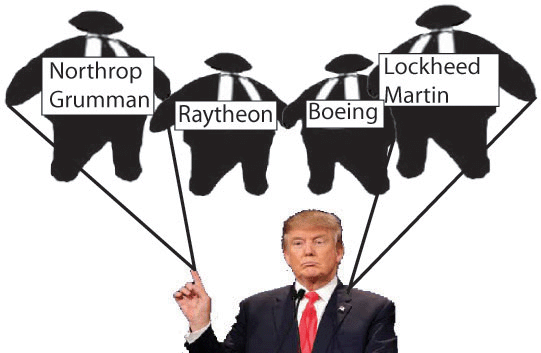 Pentagon Wins as Trump Readies a $716 Billion Budget Request, Bloomberg, By
-
Big increase for Pentagon would deepen the U.S. deficit
-
-
Mattis has raised alarm over U.S. ‘competitive edge’ eroding
President Donald Trump will propose $716 billion in defense spending in his fiscal 2019 budget request, a 7.2 percent from his request for this year that backs the Pentagon’s push for a major buildup, a U.S. official said.
The funding would include $597 billion for the Defense Department’s base budget, with the rest going for its war-fighting account and to other government programs such as the Energy Department’s nuclear weapons program, said the official, who spoke on condition of anonymity in advance of the release of Trump’s second proposed budget next month.The amount is a sharp increase from the $668 billion total Trump proposed last year for fiscal 2018 and also offered as a placeholder for fiscal 2019. Currently, the Pentagon is operating under stopgap funding at fiscal 2017 levels, which totaled $634 billion. The plan, reported earlier Friday by the Washington Post, represents a victory of defense hawks over those trying to constrain deficit spending.
The U.S. official confirmed Trump’s next proposed budget will include major increases on procurement spending over the $124 billion sought this year.Mattis’s PushDefense Secretary Jim Mattis has pushed for a jump in defense spending to match the breadth of the new National Defense Strategy he released this month……….
-
- Ultimately, Trump’s proposal will be measured by the amount it exceeds the caps in the Budget Control Act of 2011.
Unless Congress waives the budget limits, as it’s done three times in the past, the cap for fiscal 2019, which begins Oct. 1, is $563 billion for defense-related spending, including $534 billion for the base defense budget.
War-Fighting Fund
The official said more than $90 billion of Trump’s budget proposal would come from the war-fighting fund — known as Overseas Contingency Operations — that’s exempt from caps. While the fund is supposedly for pressing war needs, it’s often used as a tool to bulk up overall defense funding. Trump’s war-fighting budget for the current year includes $10 billion for weapons acquisition……..https://www.bloomberg.com/news/articles/2018-01-26/trump-is-said-to-seek-716-billion-for-defense-in-2019-budget
Renewable Energy is Clearly the Way Ahead: Dispelling the Myths of the Nuclear Propaganda Machine

Renewable Energy Is Much Faster To Install & More Scalable Than Nuclear Power https://cleantechnica.com/2018/01/28/renewable-energy-much-faster-install-scalable-nuclear-power/ January 28th, 2018 by Jake Richardson
This article is part of our “CleanTechnica Answer Box” collection. For some reason, there are certain anti-cleantech talking points that get thrown around over and over again that are absolute bunk. We got tired of dealing with the same myths repeatedly and also saw that many other people could use some support responding to these untruths — in discussions on CleanTechnica and elsewhere. So, at the suggestion of a reader, we created this resource in the same vein as Skeptical Science’s responses to global warming & climate change myths.
Myth: We need to build more nuclear power if we want to cut electricity emissions quickly and turn off coal and natural gas power plants.
Short answer: Renewables can grow fast because they can be installed practically everywhere rapidly and simultaneously. Renewable capacity in the magnitude of 1 TW can in principle be added every year. Germany installed 3 GW of PV in one single month in December 2011. Germany has roughly 1% of the world’s population. So, if the entire world installs only 20% the amount of PV that Germany did 5 years ago, it would be at 720 GW per year. At a single utility-scale-PV plant, 120 MWp per month was installed. If only 10% of all cities worldwide installed utility-scale-solar at this scale at the same time, it would lead to approximately the same number just for utility-scale-solar (the world has 4,412 cities with a population of at least 150,000). In fact, if the world only installs one PV module per person per year, this already leads to 1,850 GW per year. Nuclear power plants, meanwhile, take several years to build — and are much more expensive.
One major advantage renewable energy has over nuclear power (and fossil fuels) is that it can typically be installed much faster. Nuclear power plants can require 5–15 years to complete and some have taken 20 or more. (Constructing a new coal power plant cantakes 4 years or more. Building a new gas-powered plant generally takes several years as well.)
Installing a solar power farm can be completed in a number of months, depending upon the size and complexity of the project. Obviously, the much larger ones will require more time, but even they often can be finished in a year or less.
The same is true of wind farms. A 10 MW wind farm can be built in about 2 months and a 50 MW in approximately 6 months.
The speed at which renewables can be built and made operational is impressive. In the year 2017 alone, China installed about 52 GW of solar power. When it comes to wind power, China may install about 403 GW over the next 10 years. As with a large number of any type of construction project, the limiting factor in speed is generally one of financing, will, and labor, and that is certainly no less true with highly distributed wind and solar power projects.
The cost of renewables will likely continue to decrease with greater adoption and acceptance, especially as fossil fuel usage declines. Greater demand and adoption can spur further innovation to make renewables even more efficient, which enhances their effectiveness and the speed at which you can get large amounts of power onto the grid. With renewables, it is possible to have a virtuous cycle which drives increasing affordability and performance, whereas with fossil fuels we have a vicious cycle of climate change emissions, air pollution that harms and kills humans, rising seas, more severe weather, massive coral die-offs, and the contamination of air, soil, water, and food. Nuclear power costs, meanwhile, have risen in recent decades and are priced out of any free market or semi-free market.
Another advantage is that installing solar and wind power is not nearly as dangerous as building a nuclear or coal power plant. In India, an accident at a construction site for a new coal plant killed 32 people and injured many others. A similar accident in China killed 74. Installing solar power and wind power farms almost never results in fatalities.
Renewable energy is more scalable and a better fit to address global warming than nuclear because it costs much less, takes less time to install, and doesn’t carry the burden of potentially causing catastrophic damage — which also comes with sophisticated safety guards that take much time to implement, monitor, and keep up to date.
Electricity produced from sunlight and wind are scalable because these sources are abundantly available and will never run out. In order to combat climate change, we all need clean, renewable energy that can be quickly built and put into operation, but that will also never run out of the primary fuel source.
Another reason why renewables are scalable is their portability and ability to fit the scale needed, no matter how small or how large. Renewable energy systems can be sized precisely to the needs, whether at the small scale where people might use diesel generators or at the gigawatt scale. Community solar projects only require a capital investment and some land near the place where the electricity will be used. Renewables can easily power one community, one home, or even one device (like a light). Consumers can get solar power systems for their RVs, vans, or boats as well.
Because solar power costs have declined dramatically, more and more homeowners are going solar, and they will save money over the long term. (Home energy storage is making this scenario feasible for even more homeowners year by year.) While individual projects are not notable amongst a large grid and generation fleet, the aggregation of small projects that can go up in a matter of weeks or months is considerable.
On a bit of a larger scale, many companies are choosing to install solar power for cost-saving as well as environmental reasons and have shown that sensible, fast renewable energy installations can save huge amounts of money. Again, these projects can go up in a matter of weeks or months — unlike nuclear — and the aggregate of them means a large and quick increase in the amount of clean power on the grid. There’s a reason or two why large corporations don’t install nuclear power plants instead.
Mainstream American companies like PepsiCo, General Motors, Apple, Facebook, Amazon, and Walmart have been using more renewable energy and saving billions of dollars in the process while cleaning up the air and atmosphere.
Renewable energy can be employed by just about anyone at any time if they have the means to do so. Sunlight and wind are free. Installations can be on a watt scale or a gigawatt scale. If we want clean power added to the grid quickly, nothing can come online faster than renewables. In certain places, depending on market penetration and infrastructure, transmission lines or energy storage may be an important complement, but that still doesn’t change that renewables are the quickest option for new and cheap clean power capacity.
California scare – Fire at Rickety Diablo Canyon Nuclear Plant
Fire at Rickety Diablo Canyon Nuclear Plant Gives California a Scare — Shutdown Slated for 2025 bureau EnviroNews Headline News by Shad Engkilterra January 27, 2018 , (EnviroNews USA)
Corrupting influence of Adani spreads
Photo: ‘Activists from Frontline Action Against Coal joined Townsville residents in protesting outside a meeting of Townsville Council on January 23.’
View Photo: www.greenleft.org.au/content/corrupting-influence-adani-spreads
Margaret Gleeson January 27, 2018
‘The continued support for the project by Labor and Coalition forces in Queensland and Canberra,
in the face of the growing likelihood of the project achieving “stranded asset” status
as sources of financing dry up, raises the question: “What is in it for the pollies?” …
‘Townsville resident David Lowe told Green Left Weekly:
“Council would be surprised how many people in Townsville oppose the Adani mine.
There are high levels of scepticism about how many jobs would be generated
and the timing of these alleged jobs.
“Locals well understand the impact the mine would have on the Great Barrier Reef
and are determined to do what they can to protect the reef and
the nearly 70,000 jobs dependent upon a healthy reef.
“Climate experts have told us we can have the reef or the mine; we can’t have both.
Throwing money at imaginary ‘reef fixes’ is pointless if Australia
continues to allow the main cause of the problem — fossil fuels — to be used.” ‘
Read more of Margaret Gleeson‘s informative, interesting & well-researched article:
www.greenleft.org.au/content/corrupting-influence-adani-spreads
Black, white – whoever – fight against poisonous nuclear dump for South Australia
 Mitji Wukantha Fight To Stop Nuclear Waste Dump In Flinders Ranges SA
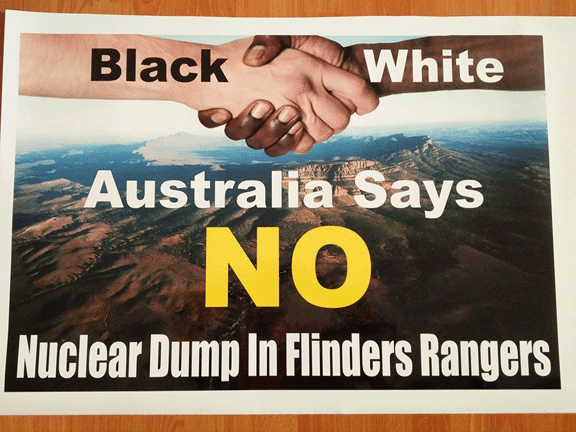
We must never give up fighting against the nuclear waste dump on yarta, I hope more people regardless of colour or nationality, can get involved and stand up, in stopping poison been put into country, otherwise our children their children and generations to come will be stuck with the poison on country forever. I say #DumpTheDump #NoDumpingOnYarta#SATOOGOODTOOWASTE #NoDumpingInTheFlindersRanges #ISayNo
Fraudulent nuclear project in Nigeria
INVESTIGATION: At Nigeria’s abandoned nuclear centre, failed projects, idle staff and ‘fraud’ [Part 2] Premium Times, Kemi Busari Awarded at over N400 million in 2009, what was supposed to be a radioactive waste management facility at Nigeria’s Nuclear Technology Centre never came to life.
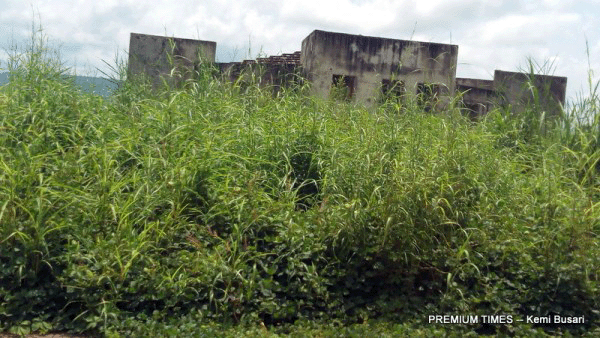
Instead, a building overgrown with scrubs lies east of the gamma irradiation facility. Waste management plants and equipment comprise various devices and machines used for treating, converting, disposing and processing wastes from various sources.
The construction of low/medium radioactive waste management facility was awarded at the contract sum of N401.4 million to Commerce General Limited and so far, N312 million has been paid to the contractor, the Nigeria Atomic Energy Commission (NAEC) said in response to a Freedom of Information request made over a month ago.
The project, according to NAEC, was 78 percent complete and has “only suffered delays.”
“The project was not abandoned. It only suffered delays due to factors outside the control of the commission,” the agency said.
The delays, NAEC said, include; “inadequate funding of capital projects generally, over the years, modification of the original design, as recommended by IAEA experts, which has resulted into changes in the BOQ figures and this development is being discussed with the contractor,” and also, “no outstanding Interim Payment Certificate on the project.”
A staff of the NTC, who was privy to the contract and execution since 2009, said the project had been used to embezzle money from government since the time of award.
“It is true that they changed the plan of the plant but they’ve never done anything meaningful there since they mounted these blocks,” he said.
“The contractor is not qualified and along the line, he got stuck in the project and we’ve not seen or heard about him for many years now.”
PREMIUM TIMES’ efforts to reach the management of Commerce Nigeria Limited were unsuccessful as the company has no website or any visible record.
Its recorded address at Plot 3, Railway Avenue, Kachia Road, Kakuri, Kaduna South, Kaduna, does not exist, this paper found out during a visit there.
“We’ve never heard of that place,” several residents of Kachia told this reporter after attempts were made to locate the company.
In Nigeria, it is not uncommon for ‘brief case’ contractors, most times in connivance with the awarding entity, to register a company for the sole purpose of bidding for contracts and making quick money.
As alleged by staff of the centre, this may be the case as even the figures quoted in FOI response by NAEC are contradictory.
While the commission said the project was 78 percent complete, a visit to the facility told a different story: an expanse of land overgrown with weeds and a construction no way near half-way complete which, in no way, justified the commission’s claim of paying almost 80 percent of the total contract sum to the contractor.
If the contract was awarded at N401. 4 million and N312 million had been paid so far, the balance should be about N89 million. But NAEC quoted N329 million.
‘Abandoned’ nuclear instrumentation laboratory
One of the components of the masterplan of the centre is the nuclear instrumentation laboratory which is supposed to serve as workshop for students, researchers and others in the nuclear field.
The project was awarded at the cost of N829.6 million to Trois Associate Limited in 2012 and it is 68% complete, NAEC’s response to an FOI stated………….
Nigeria joined IAEA, an international body for cooperation in the nuclear field in promoting safe, secure and peaceful use of nuclear technologies, in 1964.
The IAEA safety standards, was enshrined to ensure protection of people and the environment against radiation risks, safety of facilities and activities that give rise to radiation risks. The world body recognised this to include, safety of nuclear installations, radiation safety, the safety of radioactive waste management and safety in the transport of radioactive material.
The world body listed some fundamentals which must be observed by member states in section 3.30 of the safety standard………
As presented in the first part of this story, PREMIUM TIMES investigation has revealed that the centre has violated the core of safety principles expected at the centre and thus, risk withdrawal of its license……..https://www.premiumtimesng.com/news/headlines/256828-investigation-nigerias-abandoned-nuclear-centre-failed-projects-idle-staff-fraud-part-2.html
1 This month
7 April – WEBINAR – Australia and the Doomsday Clock – Preventing nuclear war through NoFirstUse and other policies
Online | Tuesday April 7, 4:00-5:30pm, Australian Eastern Time / 8:00-9:30am Central Europe Time
– Access the registration link
15 April – Zoom –Nuclear Power is Not the Solution
Apr 15, 2026 01:00 AM in Canberra, Melbourne, Sydney

Join the International Physicians for the Prevention of Nuclear War (IPPNW) on Tuesday, April 14th for a timely webinar exploring the risks associated with nuclear power and challenging the myth that it offers a simple, safe, carbon-free solution to the climate crisis

21 April Webinar: No Nuclear Weapons in Australia
Start: 2026-04-21 18:00:00 UTC Canberra, Melbourne, Sydney (GMT+10:00)
End: 2026-04-21 19:30:00 UTC Canberra, Melbourne, Sydney (GMT+10:00)
Event Type: Virtual
A virtual link will be communicated before the event.
Host Contact Info: australia@icanw.org

of the week – Australians for War Powers Reform (AWPR)
To see nuclear-related stories in greater depth and intensity
 Antinuclear