Chris McGirr, Bathurst, Western Advocate, 8 Sept 17 WIDESPREAD research indicates that 2017 is the cut-off point for preventing runaway climate change. Carbon emissions are required to be ground to a halt by the end of this year if we wish for our planet to remain safely habitable into the future. This clearly won’t happen.
The majority of the rest of the world are implementing strategies to mitigate the effects of climate change.
Australia is currently the world’s highest carbon emitter per capita; the world leader in destructive practices and ignorant policies, with NSW being the most profligate offender. Bathurst has clearly taken a ‘gloves off’ approach to the future, daring it with macho bravado to ‘do its worst’.
The majority of government websites worldwide have information regarding pending climate change threats, regardless of the fact they won’t tell you this to your face.
The Bathurst region is predicted to experience an extra 30 days of extreme heat per annum. Rainfall will become even less reliable, and extreme weather events more common. Population displacement from coastal and remote areas will be headed our way.
Any person holding or seeking to hold public office who is not considering these outcomes is negligent, and will be responsible for the failure of this region to adapt and to become a morally responsible and sustainable city.
For centuries it was widely accepted that the merchant class should not be allowed to hold the reins of power due to their obvious self-serving, profit-driven motives. These rules were eroded, and the Great Depression happened. Rules were reinstated, things improved. The rules were eroded again – the Global Financial Crisis happened. ….he Great Inland Penrith that Bathurst has become over the past few years will not have a sustainable future given its current trajectory. Now is our only chance to get it right.
The next 50 years will see the environmental conditions of our region transform so dramatically that we can’t wait.
We have a federal member voting away our right to a fair rate of pay; a state member staring forlornly at what may perhaps one day possibly become an extra parking spot; and local representatives burying their heads in the potholes. Governments and corporations worldwide are preparing. Why aren’t we?
Intelligence and vision are required here like never before.
Hurricane Irma, like Hurricane Harvey, was not caused by climate change. But the horrifying destruction it has sent across the Atlantic might have been.
“It’s being fought by security site fire crews, with help from a helicopter able to detect any aerial release of radiation.” Like monitoring is going to help or they’re going to share their data. Not a peep about the radiation numbers during the fires in and around Los Alamos even though they were “monitoring” – comment by Helen Helen Mary Caldicott and Henry Peters
Wildfire burning in former Nevada nuclear site, Daily Mail UK By Associated Press 1 September 2017 RENO, Nev. (AP) – The Latest on wildfires burning across the western United States
An official says firefighters are battling a lightning-sparked wildfire in a remote part of the vast former national nuclear proving ground north of Las Vegas. Nevada National Security Site spokeswoman Tracy Bower said Thursday that the fire covers almost 4 square miles (10 square kilometers) in the western part of what used to be the Nevada Test Site.
More than 1,000 nuclear detonations occurred at the 1,360-square-mile (3522-square-kilometer) secure federal reservation from 1951 to 1992. It now hosts non-nuclear experiments and safety training.
Bower didn’t have immediate information about the exact location of the fire or what tests may have taken place in the burn area in the past.
She says the fire started Monday and isn’t considered a threat to people or buildings.
Both islands were blasted by Hurricane Irma, one of the strongest ever to charge across the Atlantic Ocean, packing winds of 180 miles per hour (290 kilometers per hour).
Irma damaged 95 percent of Barbuda’s properties and left the island covered in rubble and “barely habitable,” said Prime Minister Gaston Browne.
“These storms are more ferocious, they are coming in greater frequency — evidence that climate change is real,” Browne said in an interview with CNN.
“We’re living the consequences of climate change.”
Irma has packed sustained winds of over 180 mph (295 kph) for more than 33 hours, making it the longest-lasting top-intensity cyclone ever recorded, France’s national weather service said.
It comes on the heels of Hurricane Harvey, which drenched Texas with deadly floods.
The next big storm, Hurricane Jose, is already churning in the Atlantic behind Irma.
“Those who do not believe in climate change, we’re hoping that when they would have looked at these natural disasters that they’ll change (their) position,”
Browne said. “All of us need to believe in it and take collective action.”
Greenland: How rapid climate change on world’s largest island will affect us all The ice sheet is melting and permafrost is thawing. What’s happening in Greenland will speed up climate change across the world, The Independent, 7 Sept 17, Kathryn Adamson
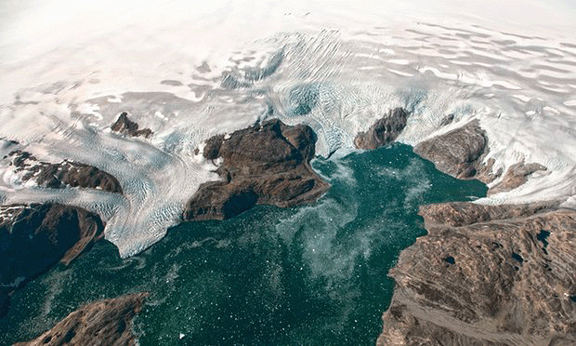
The largest wildfire ever recorded in Greenland was recently spotted close to the west coast town of Sisimiut, not far from Disko Island where I research retreating glaciers. The fire has captured public and scientific interest not just because its size and location came as a surprise, but because it is yet another sign of deep environmental change in the Arctic.
Greenland is an important cog in the global climate system. The ice sheet, which covers 80 per cent of the island, reflects so much of the sun’s energy back into space that it moderates temperatures through what is known as the “albedo effect”. And since it occupies a strategic position in the North Atlantic, its meltwater tempers ocean circulation patterns.
But Greenland is especially vulnerable to climate change, as Arctic air temperatures are currently rising at twice the global average rate. Environmental conditions are frequently setting new records: “the warmest”, “the wettest”, “the driest”.
Despite its size, the fire itself represents only a snapshot of Greenland’s fire history. It alone cannot tell us about wider Arctic climate change.
But when we superimpose these extraordinary events onto longer-term environmental records, we can see important trends emerging.
The ice sheet is melting
Between 2002 and 2016 the ice sheet lost mass at a rate of around 269 gigatonnes per year. One gigatonne is one billion tonnes. One tonne is about the weight of a walrus.
During the same period, the ice sheet also showed some unusual short-term behaviour. The 2012 melt season was especially intense – 97 per cent of the ice sheet experienced surface melt at some point during the year. Snow even melted at its summit, the highest point in the centre of the island where the ice is piled up more than 3km above sea level………
In Greenland, like much of the Arctic, rising temperatures are thawing the permafrost. This means the active layer is growing by up to 1.5cm per year. This trend is expected to continue, seeing as under current IPCC predictions, Arctic air temperatures will rise by between 2.0°C and 7.5°C this century.
Arctic permafrost contains more than 1,500 billion tonnes of dead plants and animals (around 1,500 billion walrus equivalent) which we call “organic matter”. Right now, this stuff has been frozen for thousands of years. But when the permafrost thaws this organic matter will decay, releasing carbon and methane (another greenhouse gas) into the atmosphere.
In advertising blitz, nuclear industry seeks reset, AXIOS.com , Amy Harder, Sep 5
The beleaguered nuclear industry is launching an advertising campaign Tuesday that casts the decades-old electricity resource in a new light…. The campaign, by the Nuclear Energy Institute, will try to reset nuclear’s appeal in Washington as an electricity source but also more broadly, such as its role in space exploration and medical care.
Advertising on social media sites, radio and TV will run in the Washington, D.C., area, though the group is considering expanding to states later.
The group isn’t buying any print advertisements, in a sign of the changing media landscape.
The campaign costs about $800,000, which the group says will go further than advertising in prior stints because the buy is hyper targeted. NEI will bid for space in real time on digital platforms, a spokesman said……
Between the lines: Most of the headlines these days are about how the industry is struggling to compete against cheap natural gas and, to a lesser extent, renewable energy. Nothing is pending in Washington that would drastically improve the outlook for nuclear power, but as lawmakers consider new policies, the industry’s leaders hope this campaign helps brighten their perspectives on the fuel.
Bigger picture: The Trump administration has positive words to offer about nuclear energy, but is unlikely to push any policies that could really provide a boost to the sector, like a carbon tax that would make carbon-emitting energy sources more expensive. The industry is also not asking for anything like that, realizing it’s a non-starter with this administration….https://www.axios.com/in-advertising-blitz-nuclear-industry-seeks-reset-2479707165.html
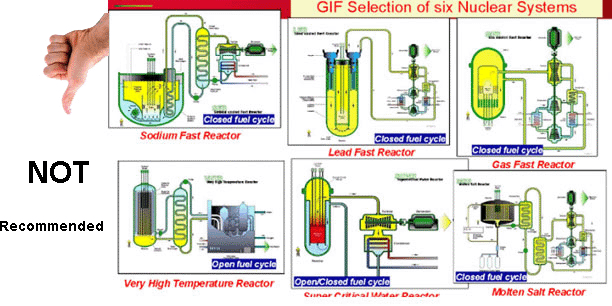
DOE Advanced Nuclear Reactor Program Deemed Ineffective, American Institute of Physics , 7 Sept 17, According to a new report, the Department of Energy’s program to develop advanced nuclear reactors has shifted priorities too often and overspent on facility upkeep. After $2 billion in expenditures, no advanced design is ready for deployment.
The Department of Energy’s Office of Nuclear Energy (NE) is unlikely to fulfill its mission of developing and demonstrating one or two advanced nuclear reactor technologies by mid-century, according to a new review of the program. In a report published in Environmental Research Letters in August, researchers at Carnegie Mellon University, the Brookings Institution, and the University of California, San Diego, found fault with, among other things, NE’s overemphasis on light-water-reactor technologies…….
For advanced reactor and advanced fuel research over the 1998 to 2015 period reviewed by the authors, NE spent $2 billion, an amount they said is insufficient to ready even one advanced reactor design for commercial deployment. The authors estimated the cost of designing and licensing an advanced reactor to be $1 billion; demonstration at full scale would cost between $4 billion and $13 billion.
The report blamed NE’s ineffectiveness on a lack of “programmatic discipline.” The program’s funding focus has shifted frequently over the 18-year span, supporting a dozen different technologies at funding levels that were “too low to be relevant to actual commercialization.” Many of those efforts were discontinued during the review period………
Advanced reactor and fuel test facilities at Idaho National Laboratory consume up to half of NE’s budget. Some of those facilities, the report argued, are defense related and only marginally support NE’s core mission. But Lyons says NE doesn’t fund defense programs, and he notes that the U.S. Navy pays half the cost of operating Idaho’s Advanced Test Reactor.
The largest sustained NE R&D program during the review period was the $750 million Nuclear Power 2010, which supported development of two enhanced light-water-reactor designs through licensing and siting. Funding for that program was 57 percent greater than what was devoted to the Next Generation Nuclear Plant (NGNP), NE’s largest non-light-water advanced reactor program. The NGNP has effectively been terminated due to disputes over site location and the selection of a private-sector partner. ….
Lyons points out that the NGNP was conceived at a time when natural gas prices were at twice today’s levels and the economics of nuclear power was more compelling. He says the project failed mainly due to the unwillingness of industry to share its cost.
Most of the advanced reactor designs that NE has funded couldn’t use the tristructural-isotropic (TRISO) nuclear fuels that the DOE office spent $450 million to develop during the review period, the report stated. Consisting of tiny pellets of low-enriched uranium oxide encapsulated in four layers of carbon, pyrolytic carbon, and silicon carbide, TRISO fuel is more resistant to melting or rupture than today’s fuels are. But TRISO isn’t coupled to a specific reactor R&D program, and it is unclear what role the fuel would play in a transition to advanced reactors, the report said……https://www.aip.org/fyi/2017/doe-advanced-nuclear-reactor-program-deemed-ineffective
Mattis reportedly threatened Sweden with retaliation over signing a nuclear-weapons ban, Business Insider CHRISTOPHER WOODY, SEP 6, 2017 US Defence Secretary Jim Mattis reportedly warned Sweden of severe consequences if the country followed through on signing a UN treaty banning nuclear weapons.
The Scandinavian country is one of 122 states backing the treaty, and Stockholm also recently signed a statement of intent to increase military cooperation with the US.
But a letter from Mattis reportedly warned Sweden’s defence minister, Peter Hultqvist, that signing on to the treaty could affect US-Sweden military cooperation as well as US military support in the event of war.
Mattis’ letter also suggested signing the treaty could have an impact on the country’s ties to NATO, of which it is a Gold Card program member, meaning it has some privileges within the defence alliance even though it is not a full member.
Sweden’s Gold Card program status faces renewal in October, and Mattis warned his Swedish counterpart that signing the treaty would foreclose the option of joining NATO, according to Defence News…….
The US, which adheres to a policy of nuclear deterrence, has criticised the nuclear-weapons ban, but Mattis’ letter is seen as an unusual step in bilateral relations, particularly between the US and Sweden.
A Pentagon spokesman told Defence News that while the US “values its defence relationship with Sweden,” it has discouraged countries from signing on to the ban, which has measures that “could potentially affect our ability to cooperate with parties to the treaty on issues of mutual interest.”…..
Allies seek to deploy aircraft carrier, strategic bomber in response to N.K. nuke test, Yonhap News, 2017-09- SEOUL, Sept. 4 — South Korea and the United States will seek to deploy a nuclear-powered aircraft carrier, strategic bombers and other powerful assets to the Korean Peninsula as a response to North Korea’s latest nuclear test, Seoul’s defense ministry said Monday.
In its report to the National Assembly’s defense committee, the ministry also said that its military will stage a unilateral live-fire drill, which involves Taurus air-to-surface guided missiles mounted on its F-15K fighter jets, this month. The missile with a range of 500 kilometers is capable of launching precision strikes on the North’s key nuclear and missile facilities.
“We will push for the option of deploying strategic assets such as the U.S. carrier strike group and strategic bombers after consultation with the U.S.,” the ministry said.
The show-of-force measures were unveiled a day after Pyongyang conducted what it claims to be a test of a hydrogen bomb mountable onto an intercontinental ballistic missile, sharply raising military tensions.
At the parliamentary session, Defense Minister Song Young-moo said that during his recent talks with U.S. Defense Secretary James Mattis, he demanded that the U.S. deploy its strategic assets to Korea on a “regular” basis. He made the demand, citing local politicians’ calls for the redeployment of U.S. tactical nukes.
Robin des Bois 30th Aug 2017, Within a few days, unless an accident occurs, the Pacific Egret will enter the North Korean missile influence area. The Pacific Egret carries 8 tons of MOX, a nuclear fuel made in France containing 8 to 10% of plutonium mixed with enriched uranium.
This civil bomb left the French port of Cherbourg on July 5, 2017. After having sailed down the Atlantic Ocean, passed off South Africa, crossed the Indian Ocean and the Pacific Ocean, the MOX is expected to be unloaded in the small private port of the Japanese nuclear power plant in Takahama, facing North Korea.
Once again, the French government, Areva and the Nuclear Safety Authority have taken the irresponsible risk of permitting and undertaking a nuclear expedition bound for an unsteady zone in all political, geological and climatic respects. http://www.robindesbois.org/en/moxquitue-n2/
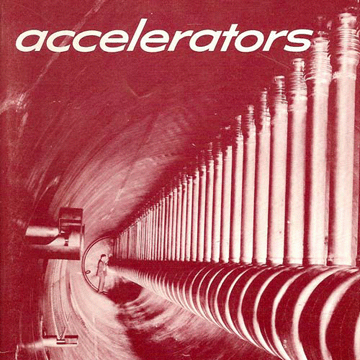
ARTMS Products, Inc., a Vancouver-based medical technology company, is pleased to announce that it has entered into a strategic partnership with Alliance Medical to enable and demonstrate an alternative, non-reactor supply of technetium-99m (Tc-99m) within the United Kingdom. ARTMS will provide to Alliance the hardware, know-how, and proprietary consumables to gain regulatory marketing approval within the UK and subsequently implement commercial supply of accelerator-, or cyclotron-produced Tc-99m. This technology will enable a reduction in the reliance in the UK of foreign, subsidized, reactor-based medical isotope production; enhancing supply reliability and eliminating the use of enriched uranium as a source of life-saving medical isotopes.
Tc-99m is used in over 80% of all nuclear medicine imaging procedures in areas such as cardiology, oncology, and neurology. Typically sourced from an ageing fleet of global nuclear reactors, this important isotope has been subjected to significant supply disruptions in recent years. ARTMS’s technology to produce Tc-99m using medical cyclotrons is a viable alternative and forges a path to securing a safe, reliable, and environmentally sound supply of a critical medical isotope for the future. Continue reading →
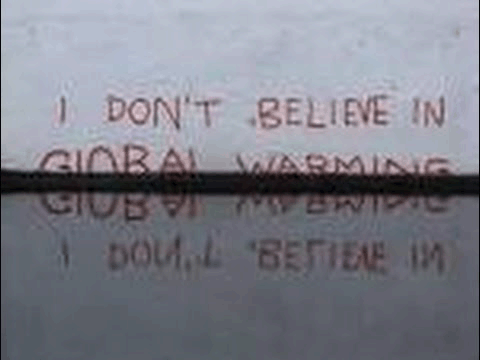
But what about those 3% of papers that reach contrary conclusions? Some skeptics have suggested that the authors of studies indicating that climate change is not real, not harmful, or not man-made are bravely standing up for the truth, like maverick thinkers of the past. (Galileo is often invoked, though his fellow scientists mostly agreed with his conclusions—it was church leaders who tried to suppress them.)
Not so, according to a review published in the journal of Theoretical and Applied Climatology. The researchers tried to replicate the results of those 3% of papers—a common way to test scientific studies—and found biased, faulty results. Continue reading →
Florida officials begin ordering evacuations as Hurricane Irma intensifies to a Category 5 storm, WP Post Nation By Francisco Alvarado, Mark Berman and Sandhya Somashekhar September 5 KEY WEST, Fla. — Another monster storm is hurtling closer to the United States, this time threatening Florida, where officials announced mandatory evacuations Tuesday in advance of what forecasters say could be the most powerful hurricane to strike the Atlantic coast in more than a decade.
Even as millions across Texas picked up the pieces after Hurricane Harvey, which battered that region with record-setting rain last week and was blamed for at least 60 deaths, Hurricane Irma gathered strength in the ocean, registering as a Category 5 with winds in excess of 180 miles per hour.
Concern centered particularly on the Florida Keys, a chain of islands at the southern tip of the state that is a tourist hot spot and home to more than 80,000 residents. It is in the direct path of the storm as currently forecast, leading local officials there to announce that the area would be under mandatory evacuation orders beginning Wednesday.
Nuclear Power: Caveats for Energy Policy, Speaker: Prof. Derek Abbott, University of Adelaide, 1st Sept 2017. Is nuclear power globally scaleable? World energy consumption is 15TW. Energy efficiency could save perhaps 13TW. Consider 10 billion light bulbs in the world and replacing them with LEDs.
This could save 50GW – the output of 50 nuclear plants. Just the IEA countries alone in 2015 saved energy equivalent to the power consumption of the whole of Japan. If we were to seriously scale up to 15,000 nuclear stations we would only have 25 years worth of uranium left.
Nuclear power is affordable, says the Minerals Council. But the market (and power companies) beg to differ. Crikey 2 Sept 17 Bernard Keane, Politics Editor
Apr 15, 2026 01:00 AM in Canberra, Melbourne, Sydney
Join the International Physicians for the Prevention of Nuclear War (IPPNW) on Tuesday, April 14th for a timely webinar exploring the risks associated with nuclear power and challenging the myth that it offers a simple, safe, carbon-free solution to the climate crisis
21 April Webinar: No Nuclear Weapons in Australia
Start: 2026-04-21 18:00:00 UTC Canberra, Melbourne, Sydney (GMT+10:00)
End: 2026-04-21 19:30:00 UTC Canberra, Melbourne, Sydney (GMT+10:00)
Event Type: Virtual A virtual link will be communicated before the event.













 Antinuclear