Are Small Nuclear Reactors REALLY better?
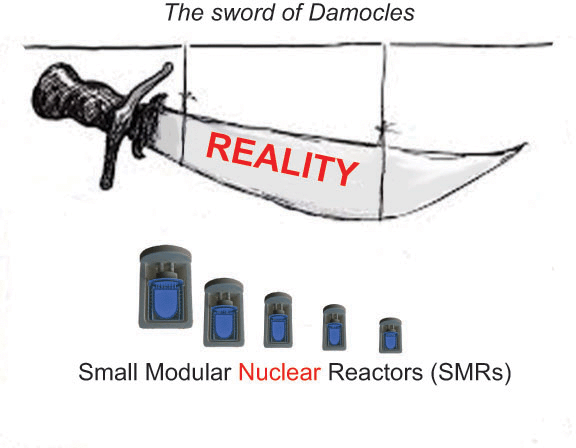
The Smaller Is Better Movement in Nuclear Power, Are miniature reactors really safer?  Mother Jones LOIS PARSHLEY, 8 Mar 20,
Huge computer screens line a dark, windowless control room in Corvallis, Oregon, where engineers at the company NuScale Power hope to define the next wave of nuclear energy. Glowing icons fill the screens, representing the power output of 12 miniature nuclear reactors. Together, these small modular reactors would generate about the same amount of power as one of the conventional nuclear plants that currently dot the United States—producing enough electricity to power 540,000 homes. On the glowing screens, a palm tree indicates which of the dozen units is on “island mode,” allowing a single reactor to run disconnected from the grid in case of an emergency.
Government advisers warn Britain against costly new nuclear reactors

 Times 7th March 2020, Net Zero Report. Plans for nuclear plants in Britain face fresh uncertainty after government advisers warned against backing costly new reactors. The nuclear industry wants the government to commit to a funding system to back the construction of reactors, including EDF’s proposed Sizewell plant in Suffolk.
However, the National Infrastructure Commission, set up in 2015 to provide impartial advice to the government, reiterated concerns in a report about backing more nuclear plants. It noted that there had been cost reductions in renewable power technologies such as wind and solar over the past ten years, but “costs of building and running nuclear power stations have not
fallen consistently, even in countries that have built fleets of similar reactors”. Given the potential for other non-intermittent technologies to complement renewables, it said that this “weakened the case for committing to a new fleet of nuclear power stations”.
https://www.thetimes.co.uk/article/advisers-raise-doubts-over-new-nuclear-plants-8hd85cr6d
Keeping the global plastic calamity going – by Big Oil and Big Soda

“They really sold people on the idea that plastics can be recycled because there’s a fraction of them that are,”..“It’s fraudulent. When you drill down into plastics recycling, you realize it’s a myth.” …… “Recycling delays, rather than avoids, final disposal,” the Science authors write. And most plastics persist for centuries. …….
We are all guinea pigs in this experiment, as plastics accumulate in the food web, appearing in seafood, table salt, and ironically even in bottled water. Many plastics are mixed with a toxic brew of colorants, flame retardants, and plasticizers.
PLANET PLASTIC, How Big Oil and Big Soda kept a global environmental calamity a secret  for decades, Rolling Stone, By TIM DICKINSON, MARCH 3, 2020
Every human on Earth is ingesting nearly 2,000 particles of plastic a week. These tiny pieces enter our unwitting bodies from tap water, food, and even the air, according to an alarming academic study sponsored by the World Wildlife Fund for Nature, dosing us with five grams of plastics, many cut with chemicals linked to cancers, hormone disruption, and developmental delays. Since the paper’s publication last year, Sen. Tom Udall, a plain-spoken New Mexico Democrat with a fondness for white cowboy hats and turquoise bolo ties, has been trumpeting the risk: “We are consuming a credit card’s worth of plastic each week,” Udall says. At events with constituents, he will brandish a Visa from his wallet and declare, “You’re eating this, folks!”
With new legislation, the Break Free From Plastic Pollution Act of 2020, Udall is attempting to marshal Washington into a confrontation with the plastics industry, and to force companies that profit from plastics to take accountability for the waste they create. …….
The battle pits Udall and his allies in Congress against some of the most powerful corporate interests on the planet, including the oil majors and chemical giants that produce the building blocks for our modern plastic world — think Exxon, Dow, and Shell — and consumer giants like Coca-Cola, Nestlé, and Unilever that package their products in the stuff. Big Plastic isn’t a single entity. It’s more like a corporate supergroup: Big Oil meets Big Soda — with a puff of Big Tobacco, responsible for trillions of plastic cigarette butts in the environment every year. And it combines the lobbying and public-relations might of all three………
Massive quantities of this forever material are spilling into the oceans — the equivalent of a dump-truck load every minute. Plastic is also fouling our mountains, our farmland, and spiraling into an unmitigatable environmental disaster. John Hocevar is a marine biologist who leads the Oceans Campaign for Greenpeace, and spearheaded the group’s response to the BP oil spill in the Gulf. Increasingly, his work has centered on plastics. “This is a much bigger problem than ‘just’ an ocean issue, or even a pollution issue,” he says. “We’ve found plastic everywhere we’ve ever looked. It’s in the Arctic and the Antarctic and in the middle of the Pacific. It’s in the Pyrenees and in the Rockies. It’s settling out of the air. It’s raining down on us.”
More than half the plastic now on Earth has been created since 2002, and plastic pollution is on pace to double by 2030. At its root, the global plastics crisis is a product of our addiction to fossil fuels. The private profit and public harm of the oil industry is well understood: Oil is refined and distributed to consumers, who benefit from gasoline’s short, useful lifespan in a combustion engine, leaving behind atmospheric pollution for generations. But this same pattern — and this same tragedy of the commons — is playing out with another gift of the oil-and-gas giants, whose drilling draws up the petroleum precursors for plastics. These are refined in industrial complexes and manufactured into bottles, bags, containers, textiles, and toys for consumers who benefit from their transient use — before throwing them away. Continue reading
Cancer in US Navy Nuclear Powered Ships
 They reported the results of their own epidemiology study which they carried out on the Ronald Reagan sailors. This compared the illness yield (including cancers) of the 4,843 RR sailors with a matched control group of 65,269 sailors on nuclear powered ships that were not anywhere near Fukushima.
 Cancer in US Navy Nuclear Powered Ships https://www.counterpunch.org/2020/03/06/cancer-in-us-navy-nuclear-powered-ships/ by CHRIS BUSBY Here is a good one. In 2011, the nuclear-powered aircraft carrier USS Ronald Reagan was about 100km off the coast of Japan at the time of the Tsunami and the subsequent Fukushima reactor explosions. It was directed by the US government to ride to the rescue in what was later called Operation Tomodachi (friendship)–to provide assistance to the victims of the floods. What no-one on board was told was that the reactors had exploded and a plume of highly radioactive material was blowing east from the site into the path of the vessel. Of course, when this arrived, all the radiation monitors on the boat started screaming, and the planes and helicopters that had flown the rescue sorties were contaminated.
In 2014, following all the publicity about the cancers, a number of US Senators and important people were asking pertinent questions—the Navy had to do something to answer the accusations that the Fukushima radiation was killing those who sailed on Operation Tomodachi. They panicked. A big report was prepared by the US Defense Threat Reduction Agency (DTRA), entitled: Final Report to the Congressional Defense Committees in Response to the Joint Explanatory Statement Accompanying the Department of Defense Appropriations Act, 2014, page 90, “Radiation Exposure” [2]. Never use one word when ten will do Continue reading
The secret “dark money” that funds nuclear subsidies in USA

Dark money dominated Ohio’s nuclear subsidy saga ENERGY NEWS NETWORK, Kathiann M. Kowalski, March 5, 2020
FirstEnergy Solutions paid nearly $2 million to at least one group, but most other data remains hidden.
After-the-fact filings show that FirstEnergy’s generation subsidiary paid nearly $2 million to Generation Now, one of the special interest groups that orchestrated ads, political donations and other efforts behind Ohio’s nuclear and coal bailout.
But legal loopholes make it harder to find out the total spent and who else was behind xenophobic advertising, dueling voter petitions, alleged intimidation and other claims of foul play. And none of those actions fully disclosed who was behind them.
The scant public filings that are available show additional connections to FirstEnergy Solutions (now Energy Harbor), as well as the law firm of an outspoken legislator who has long fought the state’s clean energy standard, and others with high-level political influence.
House Bill 6 gutted Ohio’s renewable energy and energy efficiency standards while putting ratepayers on the hook for nearly $1 billion in subsidies for nuclear power plants, plus an additional amount for aging coal plants. Multiple groups spent heavily to promote HB 6 and prevent a referendum on the law following its passage.
In some cases, nonprofit and for-profit organizations funded each other or shared the same spokesperson. Groups active in the HB 6 campaign also had links to some of the same lobbyists and consultants who acted for companies that stood to benefit from HB 6, or unions with workers at their plants. But only limited amounts of funding could be traced.
ON ORIGINAL – INTRIGUING INTERACTIVE DIAGRAM HERE _ shows interrelationships of individuals and groups Continue reading
Fight for nuclear justice continues in the Marshall Islands
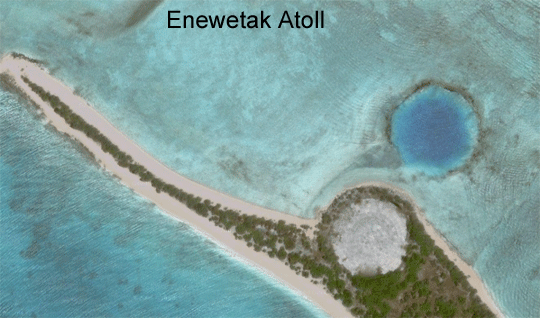 Fight for nuclear justice continues in the Marshall Islands https://www.rnz.co.nz/international/pacific-news/410871/fight-for-nuclear-justice-continues-in-the-marshall-islands
The fight for nuclear justice continues in the Marshall Islands where people have been gathering to call for the US to atone for its legacy of testing.The country marked National Nuclear Victims Remembrance Day on Monday, the 64th anniversary of the Castle Bravo hydrogen bomb test that exposed thousands of people to downwind effects.At a ceremony in the capital, Majuro, a tribute was paid to 22 living survivors from the communities affected by the nuclear testing.
This comes as the Marshall Islands and the United States have begun preliminary talks on a new agreement to address the legacy of testing.
The compact of free association, which guarantees relations and funding for the Marshalls from the US, expires in two years.
Last year, it was revealed the US withheld information about nuclear waste it left behind when the Marshalls gained independence, and the extent of the tests it carried out.
Washington previously said there would be no replacement compact. But the chair of the Marshall Islands Nuclear Commission, Rhea Moss-Christian, said nuclear issues were a key, ongoing aspect of negotiations.
“Well we are coming up on renegotiating the economic provisions of the compact, and we’ve had some initial discussions with the US officials.
“So yes internally we are working on our strategy and pulling together all the key issues to include in those negotiations, including the nuclear legacy.”
Ms Moss-Christian, who said formal talks should start later in the year, vowed that the fight for nuclear justice for Marshall Islanders would continue.
“Really it comes down to compensation for loss of land. It’s about health care for those who might be having medical issues,” she said.
“It’s about livelihoods and how much their lifestyles were forced to change when they were moved from their land. These are just a few examples.”
Meanwhile, an essay competition for high schoolers was held as part of Monday’s commemoration programme.
The winner was a senior at Marshall Islands High School on Majuro, Rosie Ammontha, who wrote:
“They had the choice to test those bombs, we didn’t. They had the choice to be truthful about the consequences that awaited us, we didn’t. They had the choice not to endanger innocent lives, we didn’t. They had the choice to help protect our oceans and environment, we didn’t. At the end of the day, nuclear justice means righting what was wronged.”
Nuclear testing left a signature of radioactive carbon all around the world
Even after childhood, bomb radiocarbon chronicles the history of our body.
 Your Inner H-Bomb Nuclear testing left a signature of radioactive carbon all around the world—in trees and sharks, in oceans and human bodies. Even as that signal disappears, it’s revealing new secrets to scientists. The Atlantic, Story by Carl Zimmer, 2 Mar 20,
 A Brief Study of Molten Salt Nuclear Reactors
A Brief Study of Molten Salt Reactors https://nonuclearpowerinaustralia.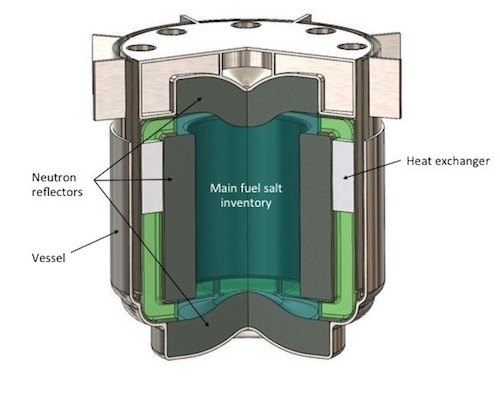 wordpress.com/2020/03/01/a-brief-study-of-molten-salt-reactors/ 3 Mar 20,
Source:
Burning waste or playing with fire? Waste management considerations for non-traditional reactors, Lindsay Krall &Allison MacfarlanePages 326-334 | Published online: 31 Aug 2018 Bulletin of the Atomic Scientists, Volume 74, 2018. Issue 5 at https://www.tandfonline.com/doi/abs/10.1080/00963402.2018.1507791?scroll=top&needAccess=true&journalCode=rbul20
Author information:
Lindsay Krall is a post-doctoral Macarthur fellow at the George Washington University Institute for International Science and Technology Policy. Her research focuses on policies for the back end of the nuclear fuel cycle, particularly as they pertain to radionuclide transport in the environment, systems and organizations for waste storage and disposal, and the long-term behavior of spent fuels from advanced reactors. Allison Macfarlane is Professor of Public Policy and International Affairs at the George Washington University’s Elliott School of International Affairs. She directs the school’s Institute for International Science and Technology Policy Program and is the former chairman of the US Nuclear Regulatory Commission. Macfarlane was a member of the Blue Ribbon Commission on America’s Nuclear Future from 2010-2012.
“Abstract:
Nuclear energy-producing nations are almost universally experiencing delays in the commissioning of the geologic repositories needed for the long-term isolation of spent fuel and other high-level wastes from the human environment. Despite these problems, expert panels have repeatedly determined that geologic disposal is necessary, regardless of whether advanced reactors to support a “closed” nuclear fuel cycle become available. Still, advanced reactor developers are receiving substantial funding on the pretense that extraordinary waste management benefits can be reaped through adoption of these technologies. Here, the authors describe why molten salt reactors and sodium-cooled fast reactors – due to the unusual chemical compositions of their fuels – will actually exacerbate spent fuel storage and disposal issues. Before these reactors are licensed, policymakers must determine the implications of metal- and salt-based fuels vis a vis the Nuclear Waste Policy Act and the Continued Storage Rule.” end quote.Emphasis added for clarity. Mr. O’Brien and Mr. Bernardi need to consider the scientific and technical reality behind the gloss they want to disseminate.
International Atomic Energy Agency, run by 5 nuclear weapons nations, backs Fukushima water emptying to the Pacific
UN SC P5 nuclear nations is a fully integrated system inclusive of the Military-Industrial Complex.
An ecosystem that includes weapons of mass destruction, for peace, a leadership group in a state of cultural cognitive dissonance.
Who as a group know gene sheering radionuclides, have an effect on DNA X10 times half-life of any alpha particles out of nuclear reactors.
IAEA backs release of Fukushima water into sea, AsiaTimes, 27 Feb 20,
Most of the radioactive isotopes have been filtered out, but one – tritium, which has long half-life – remains, The world’s nuclear watchdog gave its backing Thursday to Japanese plans to release contaminated water from the damaged Fukushima nuclear plant into the ocean.
Japan has around a million tonnes of contaminated water stored in tanks at the site of the Fukushima Daiichi plant, whose reactors went into meltdown after a huge tsunami in 2011.
A government panel last month recommended the water be released into the ocean or vaporized, but no final decision has been taken, with all solutions deeply unpopular with sections of the Japanese public.
International Atomic Energy Agency (IAEA) director Rafael Grossi told journalists in Tokyo the panel’s recommendations both appeared suitable…….
“Releasing into the ocean is done elsewhere, it’s not something new, there is no scandal here,” Grossi added.
“But what is important is to do it in a way that is not harmful and you need somebody to monitor before, during and after release, to check that everything is okay.”
The radioactive water comes from several different sources – including water used for cooling at the plant, and groundwater and rain that seeps into the plant daily – and is put through an extensive filtration process.
Most of the radioactive isotopes have been removed by the filtration system, but one – tritium, which has a long half-life – remains…….. https://asiatimes.com/2020/02/iaea-backs-release-of-fukushima-water-into-sea/
Climate action? – you simply couldn’t build enough nuclear reactors
 New Scientist 26th Feb 2020, Paul Dorfman, University College London Energy Institute, UK; Tom Burke,E3G; Steve Thomas, University of Greenwich, UK; Jonathan Porritt,
environmental campaigner; and David Lowry, Institute for Resource and
Security Studies. Reporting the decline of nuclear power generation, you
quote Michael Shellenberger’s view that nuclear power is necessary to
prevent climate change (8 February, p 20).
This view is truly dangerous. Climate change poses a number of unique challenges to humanity. One of the most difficult is that the world not only needs to get to a specific place
– a carbon-neutral global energy system – but also must get there by a specific time – the middle of the century. Otherwise the policy fails.
You simply couldn’t build enough nuclear reactors fast enough, even to
replace the existing reactors that will reach the end of their life by
2050, let alone to replace fossil fuels in the existing electricity system
or in the more electricity-intensive global economy we are currently
building. This would be true even if we were willing and able to overcome
all the other unsolved problems that nuclear reactors face. These include
their affordability, accidents, waste management, nuclear weapons
proliferation, the scarcity of talent and system inflexibility.
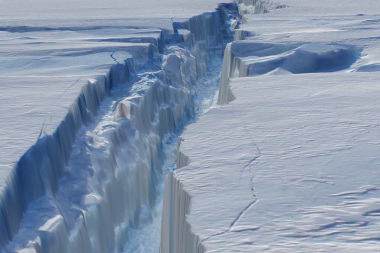
Antarctic ice walls protect the climate
|
Antarctic ice walls protect the climate, EurekAlert 27 Feb, UNIVERSITY OF GOTHENBURG Inland Antarctic ice contains volumes of water that can raise global sea levels by several metres. A new study published in the journal Nature shows that glacier ice walls are vital for the climate, as they prevent rising ocean temperatures and melting glacier ice.The ocean can store much more heat than the atmosphere. The deep sea around Antarctica stores thermal energy that is the equivalent of heating the air above the continent by 400 degrees.
Now, a Swedish-led international research group has explored the physics behind the ocean currents close to the floating glaciers that surround the Antarctic coast. “Current measurements indicate an increase in melting, particularly near the coast in some parts of Antarctica and Greenland. These increases can likely be linked to the warm, salty ocean currents that circulate on the continental shelf, melting the ice from below,” says Anna Wåhlin, lead author of the study and professor of oceanography at the University of Gothenburg. “What we found here is a crucial feedback process: the ice shelves are their own best protection against warm water intrusions. If the ice thins, more oceanic heat comes in and melts the ice shelf, which becomes even thinner etc. It is worrying, as the ice shelves are already thinning because of global air and ocean warming”, says Céline Heuzé, climate researcher at the Department of Earth Sciences of Gothenburg University. The stability of ice is a mystery Inland Antarctic ice gradually moves towards the ocean. Despite the ice being so important, its stability remains a mystery – as does the answer to what could make it melt faster. Since the glaciers are difficult to access, researchers have been unable to find out much information about the active processes. More knowledge has now been obtained from studying the measurement data collected from instruments that Anna Wåhlin and her researcher colleagues placed in the ocean around the Getz glacier in West Antarctica. The ice’s edge blocks warm seawater……https://www.eurekalert.org/pub_releases/2020-02/uog-aiw022720.php |
|
New Zealand super fund renounces all fossil-fuel investments
On Sunday, Commerce Minister Kris Faafoi announced the country’s ‘KiwiSaver’ accounts would be going green. From next year, default funds will no longer be able include ‘fossil fuel production’ companies in their portfolios.
“This reflects the Government’s commitment to addressing the impacts of climate change and transitioning to a low-emissions economy,” Mr Faafoi said.
“It also makes sense for the funds themselves, given that there is a risk of investing in stranded assets as the world moves to reduce emissions.”
KiwiSaver is New Zealand’s superannuation-style scheme, in which Kiwis are encouraged to put a fraction of their income in a savings deposit, which is then topped by employers and the government…….
Simon Sheikh, chief executive officer of Future Super, Australia’s first fossil fuel-free super fund, said the decision would safeguard the investments of New Zealanders.
“They’ve taken a moral stand but also an important risk stand,” he said.
“The decision is going to protect New Zealand savers, and it’s the same sort of protection that Australians should be looking for.”
With around $A12.2 trillion in funds worldwide that have pledged to sell out of fossil fuel assets, Mr Shiekh said the Australian government should change its own settings to do similarly.
“It makes sense because the vast majority of Australian superannuation savers don’t want to invest in fossil fuels but they unwittingly do,” he said.
“The government has been rather unconcerned … but regulators have all expressed strong concerns about the impact that climate change on Australia’s financial systems.”……“It makes sense because the vast majority of Australian superannuation savers don’t want to invest in fossil fuels but they unwittingly do,” he said.
“The government has been rather unconcerned … but regulators have all expressed strong concerns about the impact that climate change on Australia’s financial systems.”…..https://thenewdaily.com.au/life/science/environment/2020/03/01/nz-super-fund-drops-fossil-fuels/
Radiation oncology still neglects stray radiation
 Facing up to friendly fire: why radiation oncology still neglects stray radiation Physics World, 28 Feb 2020 Whole-body exposure to stray radiation can now be calculated accurately and efficiently for patients undergoing radiotherapy. Researchers in the US and Germany modified a treatment planning system (TPS) – the software used to predict patient dose distribution – to include unwanted doses from scattered and leaked radiation. The additional calculation, which adds an average of 7% to the computation time required for a standard treatment plan, could lead to better radiation treatments that avoid radiogenic secondary cancers and other side effects later in life. This is especially important for survivors of childhood cancer (Med. Phys. 10.1002/mp.14018)………
as post-treatment lifespans grow longer, late side effects of radiotherapy – such as damage to the heart, fertility issues and secondary cancers – are becoming increasingly prevalent. These side effects can be caused by radiation that is delivered to non-target tissue outside of the main therapeutic beam, much of which is not modelled by clinical TPSs.
To address this shortcoming and model the stray-radiation dose for the whole body, Lydia Wilson at Louisiana State University (LSU) and colleagues (also from LMU Munich, PTB and BsF) set out to modify the research TPS CERR (Computational Environment for Radiotherapy Research)…………
“The biggest challenge to commercialization has been the continuation of a historical focus on short-term outcomes,” says Newhauser. “As disease-specific survival rates gradually continue to increase, patient, clinicians and vendors will eventually become more interested in treatment-planning features that improve long-term outcomes. We could begin to see basic capabilities appear in commercial systems in two to three years.” https://physicsworld.com/a/facing-up-to-friendly-fire-why-radiation-oncology-still-neglects-stray-radiation/
The Planet Is Screwed, Says Bank That Screwed the Planet
 The Planet Is Screwed, Says Bank That Screwed the Planet, The New Republic The Planet Is Screwed, Says Bank That Screwed the Planet, The New Republic A report from two economists at JP Morgan Chase pushes back against traditional economic wisdom on climate change. By KATE ARONOFF, February 25, 2020 JP Morgan Chase is the world’s leading financer of fossil fuel projects. And according to a report from within the company, recently leaked to the press, the world is seriously underestimating the adverse effects of climate change.
The 22-page report, entitled “Risky Business: the climate and the macroeconomy” and dated January 14, 2020, has been reported by multiple outlets since Friday as containing a gloomy assessment of the risk presented by climate change in the near future. But it also offers a withering takedown of how economists in particular have tended to think about the climate crisis, criticizing findings from several of the field’s experts by name, including a recent winner of the Nobel Prize in economics.
“We cannot rule out catastrophic outcomes where human life as we know it is threatened,” the report concludes. It’s a stunning bit of cognitive dissonance from a bank that is doing so much to fuel the crisis. It also shows a growing push for a more grounded assessment of the crisis than mainstream economics has offered in recent decades….
Essentially an informational document, the report—written by U.K.-based JP Morgan economists David Mackie and Jessica Murray—reviews a battery of academic literature on climate change. It examines several predictions of climate change’s impact on gross domestic product, including economist Richard Tol’s 2018 survey of 26 different climate models—one of the more comprehensive recent works. While Tol has links to organizations that have cast doubt on the scientific consensus around the climate crisis, as his own research has, the findings listed are not especially controversial. But the JP Morgan Chase report authors push back on those and other prominent predictions. “Most likely,” the authors conclude, “these estimates of the income and wealth effects of unmitigated climate change are far too small.”……..
The JP Morgan report doesn’t include clear recommendations for what the company’s own risk analysts should do with the information presented. “Most likely,” it states, “business as usual will be the path that policymakers follow in the years ahead”—something its authors say “opens the earth to a greater likelihood of a catastrophic outcome” than previously estimated. The report does not discuss the bank’s support for polluting industries, which have spent handsomely to block climate action at virtually every level of government.
“It is depressing that JP Morgan are trying to evade responsibility for this thorough and useful report that restates what climate scientists, Greta Thunberg, and Extinction Rebellion alike have been saying for some time now: that our very future as a species is at stake,” Rupert Read, who originally obtained the report, wrote in an email. “It would be so much better if they owned up fully to what is in this report. But then, that would of course require them to completely transform their business model.”
All that dissonance may be starting to wear thin. Ahead of its annual investor day Tuesday and under persistent pressure from Gwich’in Steering Committee and green groups, JP Morgan Chase said it would stop any new financing of drilling in the Arctic National Wildlife Refuge and expand restrictions on financing coal projects. https://newrepublic.com/article/156657/planet-screwed-says-bank-screwed-planet
|
|
Facing Extinction: The Hope for Human Survival
 At the present time, there are seven billion people on this planet pursuing a vision that is devouring the earth. Medium.com Violet Bee, Nov 15, 2019
In a recent post, William E. Rees laid out the case that humanity is on a direct path toward destruction. He sums it up neatly at the end of his post as follows:
Disastrous climate change and energy shortages are near certainties in this century and global societal collapse a growing possibility that puts billions at risk.
It’s an uncomfortable notion, and enticing to write him off as a zealot, but a truth that many scientists are warning we’re perilously close to passing the point of no return. …….
Accept & Adapt
Rees’ recommended course to resolve these problems is nothing less than remaking of life as we know it. I urge you to read the original post, but I’ve included his full list here, with the addition of my own headings for each (in bold)……….
Accept the End of Growth
Perpetual, exponential growth has been the basis of our civilization for the past 10,000 years. GDP, population, consumption, everything. We’ve long been sold the myth that our economy and civilization cannot function without growth, but that is a lie built on greed and power.
Accept a Lower Level of Consumption
To feed our perpetual growth is the requirement of ever-increasing consumption. We’ve been turned from Humans to Consumers. A new way of life, focused on other than the lure of material wealth, is our only chance.
Accept Renewable Energy Limitations
Fossil fuels are an amazing source of power. Their abuse has made modern civilization possible. Renewables have their place in a post-carbon world, but we must remember that renewables are not a panacea. Wind turbines, solar panels, geo-thermal systems and all the others require fossil fuel and rare element inputs for construction and maintenance. Beyond that, we have yet to reach the point of their being distributable and transportable the way we’re used to consuming energy.
The Work of Acceptance
If the world is saved, it will be saved by people with changed minds, people with a new vision.
- Our work then, is to accept. Not superficially, but deep within us, accept that our entire world must change. The hopes and dreams we’ve had for ourselves and our children must change. The values deeply ingrained in us must change. Our path forward cannot start until we let go of the old system that is dragging us down. Accept, grieve, hope. ……. https://medium.com/radical-hope/facing-extinction-the-hope-for-human-survival-98c44d5b5b7
1 This month

of the week – Australians for War Powers Reform (AWPR)
To see nuclear-related stories in greater depth and intensity
 Antinuclear