International Monetary Fund says the world needs a massive carbon tax
 The world needs a massive carbon tax in just 10 years to limit climate change, IMF says The international organization suggests a cost of $75 per ton by 2030, WP, By Chris Mooney and Andrew Freedman, October 10A global agreement to make fossil fuel burning more expensive is urgent and the most efficient way of fighting climate change, an International Monetary Fund study found on Thursday.
The group found that a global tax of $75 per ton by the year 2030 could limit the planet’s warming to 2 degrees Celsius (3.6 degrees Fahrenheit), or roughly double what it is now. That would greatly increase the price of fossil-fuel-based energy — especially from the burning of coal — but the economic disruption could be offset by routing the money raised straight back to citizens.
“If you compare the average level of the carbon tax today, which is $2 [a ton], to where we need to be, it’s a quantum leap,” said Paolo Mauro, deputy director of the fiscal affairs department at the IMF.
In the United States, a $75 tax would cut emissions by nearly 30 percent but would cause on average a 53 percent increase in electricity costs and a 20 percent rise for gasoline at projected 2030 prices, the analysis in the IMF’s Fiscal Monitor found.
But it would also generate revenue equivalent to 1 percent of gross domestic product, an enormous amount of money that could be redistributed and, if spread equally, would end up being a fiscally progressive policy, rather than one disproportionately targeting the poor.
The impact of a $75-per-ton tax would also hit countries differently depending on burning or exporting coal, which produces the most carbon emissions per unit of energy generated when it is burned.
In developing nations such as China, India and South Africa, a $75 carbon tax reduces emissions even more — by as much as 45 percent — and generates proportionately more revenue, as high as 3.5 percent of GDP in South Africa’s case, the IMF found………
the latest science suggests the world will sustain massive damage, such as the loss of nearly all coral reefs, even if it holds warming to, or just under, 2 degrees Celsius. To keep warming to just 1.5 degrees Celsius, the carbon tax would have to be even higher, the IMF’s Mauro noted, though he said he is not sure how high because the group did not do that analysis.
“The climate crisis is so dire, and public/popular determination to attack it is suddenly so strong and unquenchable, that even $75/ton by 2030 seems far too moderate a target,” wrote Charles Komanoff, director of the Carbon Tax Center, in an emailed response to the IMF study…….. https://www.washingtonpost.com/climate-environment/2019/10/10/world-needs-massive-carbon-tax-just-years-limit-climate-change-imf-says/
Bushfires continue burning across Australia, destroying homes
Bushfires continue burning across Australia, destroying homes https://www.sbs.com.au/news/bushfires-continue-burning-across-australia-destroying-homes Police capture footage of residents being forced to evacuate their homes as bushfires sweep across NSW and Queensland.
Danger of drones attacking nuclear facilities
 Korea Times 6th Oct 2019, National infrastructure sites are vulnerable to possible drone strikes, with a growing number of intrusions at nuclear power plants here using the small unmanned aircraft being confirmed, according to a lawmaker, Sunday.
Rep. Lee Sang-min of the ruling Democratic Party of Korea (DPK) said the
Nuclear Safety and Security Commission (NSSC) reported 13 cases of the
illegal flying of drones near the power plants from 2015 to 19. Ten of the
13 cases occurred just in 2019 ― and six took place near the Kori Nuclear
Power Plant in northern Busan in August.
https://www.koreatimes.co.kr/www/tech/2019/10/133_276717.html
Japan’s corrupt “Nuclear Village” is still thriving
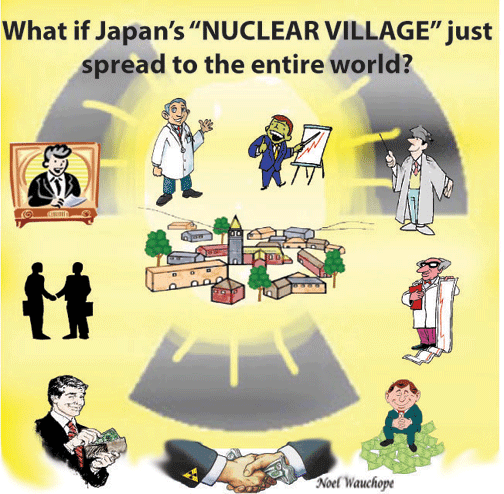
It’s an example of how big business and small towns work together, sometimes at the expense of corporate governance.
The payments to senior management at Kansai Electric Power Co included hundreds of millions of yen, US currency, vouchers for tailored suits and even gold coins hidden in a box of candy.
To make matters worse, the official in question was close to – and received money from – a company that won construction work from the utility.
The news is a blow to an already deeply unpopular industry as it seeks to resume operations at plants that were shuttered after Fukushima. It’s likely to have an impact beyond Kansai Electric, with the government’s top spokesman, who called the payoffs “murky,” vowing to investigate whether there are similar cases at other companies.
It’s also a headache for Prime Minister Shinzo Abe, who has set his stall as a proponent of nuclear power, a cheaper source of energy than imported fuels such as oil, coal and natural gas. And questions in Parliament about the scandal may delay Mr Abe’s efforts to pass a US trade deal and proceed towards changing the country’s pacifist Constitution.
…….The scandal is the latest exposure of governance issues at Japanese companies, which include the arrest last year of Nissan Motor Co’s chairman for concealing more than US$140 million (S$193 million) in compensation and Kobe Steel’s indictment in 2018 for falsifying quality data.
Kansai Electric chairman Makoto Yagi and president Shigeki Iwane bowed in apology at a three-hour public briefing last week as they detailed how they and 18 other executives received almost 320 million yen (S$4.12 million) in cash and presents from 2006 to 2018 from Mr Eiji Moriyama, the former deputy mayor of Takahama town, where a nuclear power plant is located. Mr Moriyama died at the age of 90 in March……..
The immediate risk for Kansai Electric is that the issue may delay the restart of three of its reactors, including two in the town in question, Takahama. Every month a reactor stays offline saddles the utility with extra fuel costs of 3.6 billion yen ……….
Kansai Electric’s investigation will leave no stone unturned to determine the cause and events surrounding the payments, the company said in an e-mailed response. The utility will also make efforts to ensure that this type of incident doesn’t happen again, it said.
In a sense, the goings-on at Kansai Electric suggest things haven’t changed in the nuclear industry. They mirror what independent investigators said in a 2012 report led to the scale of the Fukushima meltdown: collusion between government officials and a power company.
“This is the nuclear village at its worst,” Temple University’s Mr Kingston said, referring to the nexus of companies, politicians, bureaucrats and others that promote atomic power. “The cosy and collusive ties are a hotbed of corruption and raise questions about other plants.” https://www.straitstimes.com/asia/east-asia/hidden-gold-murky-payoffs-threaten-japan-nuclear-revival
France’s “flagship”nuclear project Falamanville – more costs, more delay
 EDF adds further €1.5bn to Flamanville nuclear plant costs https://www.ft.com/content/fc6a8610-ea5e-11e9-a240-3b065ef5fc55 French energy group also confirms latest delay to opening of long-awaited project.
David Keohane in Paris 9 Oct 19, French energy giant EDF announced increased costs to its long-troubled flagship nuclear project at Flamanville on Wednesday as it confirmed delays to the opening of the plant due to faulty weldings. The company said construction costs would rise by €1.5bn to €12.4bn and the loading of nuclear fuel would be delayed until the end of 2022, which had previously been scheduled for the end of 2019 with commercial activity starting in 2020. The group, which is 83.7 per cent owned by the French government, had flagged the delays at the plant in north-western France to the end of 2022 during its half-year results in July. Flamanville was originally expected to cost €3.3bn and start operations in 2012. Continue reading
Time that USA Congress faced up to the problem of nuclear wastes
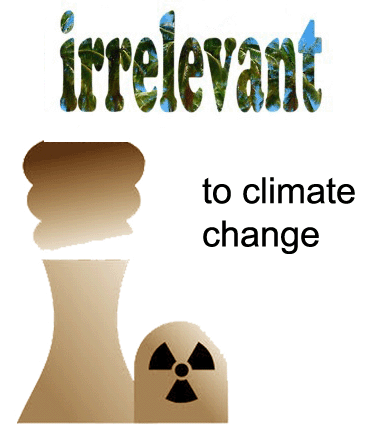 nuclear and climate change. While many argue that we have to do everything in our power to bolster nuclear energy in order to effectively fight the climate crisis, bluntly, nuclear energy is not a realistic solution.
 The price tag for new nuclear is too high and the timeline for expansion too long—Plant Vogtle and VC Summer show us that. And while nuclear reactors may not directly emit greenhouse gases, that doesn’t mean that it’s a clean energy source. There are significant traditional environmental impacts from nuclear energy, primarily regarding radiation risks and impacts to water quality. Then there’s the effects climate change will have on the functioning and safety of nuclear plants themselves. The more we look at the issue, the more we see that sea level rise and heat waves risk the safety and dependability of nuclear plants.
It’s Time to Bury These Nuclear Waste Talking Points https://www.nrdc.org/experts/caroline-reiser/its-time-bury-these-nuclear-waste-talking-points
This year we’re seeing yet another attempt from Congress to address the fifty-year problem of what to do with the 80,000 tons of nuclear waste sitting across the country, with approximately 2,000 more tons produced every year by the 96 operating U.S. nuclear reactors. Unfortunately, the multiple nuclear waste bills that sprung up in both the House and Senate (including H.R.2699 which just cleared an Energy and Commerce subcommittee) simply offer the same worn out ideas. Continue reading
UN officials call nuclear power “Irrelevant” to climate action
Nuclear Called Irrelevant in Climate Fight Without Lower Costs, Bloomberg,October 8, 2019,
|
|
Bill Gates is wrong. Nuclear power will not save the climate.
according to the International Energy Agency (IEA), the largest share of this [needed greenhouse gas] reduction – almost 40 percent – could come from improved energy efficiency….One third of that could be covered by renewable energies, while in this scenario, nuclear power would account for five percent.
..Indeed, in order to actually deliver on such a contribution, hundreds of new reactors would have to be built. “It would involve a gigantic  nuclear dimension just to make a minimal contribution to the climate,”
One of the questions that has received very little attention so far is how reliable nuclear power plants will be in a warmer world……This year, reactors were again disconnected from the grid in Europe as a result of heat waves.
|
Bill Gates is wrong. Nuclear power will not save the climate. Beyond Chernobyl and Fukushima, there’s too much speaking against it, German Times, By Christoph von Eichhorn October 2019 Nuclear power? No, thank you! “That chapter is over,” a spokesperson recently proclaimed. Nuclear power isn’t even a topic anymore, she argued. And this spokesperson wasn’t from some environmental organization or the like; she was representing RWE, one of three large corporations in Germany that still produces electricity from nuclear energy. The two other companies, EnBW and Eon, have issued similar sentiments, pointing to the fact that their priority is now the decommissioning of nuclear power plants and the switch to renewable energies…….One of the most prominent advocates of a nuclear renaissance is Bill Gates. ….
In the United States, the question of what to do with nuclear energy is particularly acute. Nuclear fission currently accounts for roughly 11 percent of global electricity, and for around 20 percent in the United States. As the Union of Concerned Scientists (UCS) points out in a recent study, one in every three of the approximately 60 nuclear power plants in the US might have to be shut down in the next few years because they are either too old or are already losing money today…… The decline in the price of renewables is seen as one of the major reasons why nuclear energy is less and less viable. Some states in the US, including Illinois, New Jersey and New York, have nonetheless subsidized unprofitable nuclear power plants in order to secure their operations. This is by all means a daring investment. The UCS estimates that it takes an average of $4 billion to make an unprofitable power plant profitable again. Equipping nuclear reactors to continue running only 20 years longer than planned usually requires expensive modernization measures designed to keep the aging technology in good condition, says Frank Peter, co-head of the think tank Agora Energiewende. “These investments often make no economic sense.” UCS researchers advise against the construction of any new power plants due to the high investment costs. “The fundamental problem is the cost,” says a recent report by the Massachusetts Institute of Technology on the future of nuclear energy. While technologies such as photovoltaics and wind power have consistently become cheaper, new nuclear power plants have become more expensive. The MIT researchers calculated the costs of nuclear energy for several regions and came up with very clear results: In terms of the cost of generating energy, wind and photovoltaics always beat nuclear power. Continue reading |
No need for nuclear reactor, with now a new process to supply molybdenum-99 (Mo-99)

Nuclear fusion process could create US supply of Mo-99 https://www.dotmed.com/news/story/48759, by Lisa Chamoff, Contributing Reporter | October 04, 2019 A new nuclear fusion process may shore up supply of the rapidly-decaying, cancer-detecting radioisotope molybdenum-99 (Mo-99) without the need for reactor facilities.
Nuclear technology company Phoenix and SHINE Medical Technologies, a medical isotope production company, this week announced that in July it surpassed a record for a nuclear fusion reaction in a steady-state system.
The reaction at SHINE’s medical isotope production facility produced 46 trillion neutrons per second, surpassing the previous record set at a California facility by nearly 25 percent.
Currently, only a handful of government-owned nuclear research reactors produce Mo-99, which has a 66-hour half-life, and none of them are in the U.S., which uses half the global supply.
The companies say the eight Phoenix systems will help address limited accessibility to nuclear reactors for producing medical isotopes, used for cardiac stress testing and cancer detection, and meet a third of the global demand.
The companies expect to produce 20 million doses per year once the plant is up and running. SHINE has already sent Mo-99 samples produced by this method to GE Healthcare to be tested and verified.
Mo-99 is created by accelerating a particle beam into a target and generating a nuclear fusion reaction. The company developed a proprietary nuclear fusion process that uses a gaseous target instead of solid one, said Evan Sengbusch, president of Phoenix.
Bribery scandal among Japan’s nuclear industry executives
Executives in Japan Nuclear Scandal Blame Dead Local Official,By Aaron Clark, Stephen Stapczynski, and Shiho Takezawa, October 3, 2019,
-
Kansai Electric officials took $3 million in cash and gifts
-
Payments came from deputy mayor of town hosting nuclear plant
Top Japanese utility executives who admitted to taking illicit payments related to their nuclear business sought to deflect blame onto a deceased local official and vowed to stay in their roles, potentially deepening the nation’s latest corporate governance scandal.
Kansai Electric Power Co.’s Chairman Makoto Yagi and President Shigeki Iwane spent more than three hours Wednesday detailing in a public briefing how they and 18 other executives received nearly 320 million yen ($3 million) in cash and gifts, including suits and gold, from a former deputy mayor in the western town Takahama, which hosts the company’s biggest nuclear plant. They didn’t return the payments because the official, who died in March at the age of 90, wielded influence and intimidated employees, they said.
The Kansai Electric payments are the latest-high profile exposure of corporate malfeasance in Japan, which include the arrest last year of Nissan Motor Co.’s chairman for concealing more than $140 million in compensation and Kobe Steel Ltd.’s indictment in 2018 for falsifying quality data. It also follows the acquittal last month of executives charged with negligence related to the Fukushima meltdown, which has loomed in the background of the nation’s worst nuclear scandal since the 2011 disaster…….
Nuclear Nerve
That the drama is playing out in the nuclear power industry touches a raw nerve in Japan, where the technology has been shunned since the trauma of Fukushima. Public opinion has consistently been opposed to restarting the nation’s reactor fleet, once the biggest source of atomic power in Asia, as trust in the both the industry and regulators hasn’t recovered………
Gold, Suits, Cash
The company also revealed new details Wednesday of the gifts and cash Moriyama gave to executives from 2006 to 2018. Satoshi Suzuki, director of the utility’s nuclear power division, received the most at 123.7 million yen, which included 500 grams of gold and 14 suits, as well as $35,000 in U.S. currency.
Kyodo News also reported that Yoshida Kaihatsu, a local company that paid Moriyama money that was funneled to officials, won contracts worth at least 2.5 billion yen for work at Kansai’s nuclear power plant. Moriyama was also a part-time adviser for a Kansai Electric unit from 1987 through December last year. https://www.news.com.au/technology/environment/climate-change/climate-action-summit-greta-thunberg-rips-into-leaders-over-mass-extinction/news-story/2c8d4aac13cb60507a41b48c2ef3d8f2
UK Energy chief advises scrapping Hinkley nuclear energy project, going for renewables instead

Telegraph 28th Sept 2019 Scrap Hinkley Point: nuclear plant is expensive and out of date, says Ovo Energy chief, Britain’s next nuclear power plant should be scrapped because it is wastefully expensive and out of date, according to the boss of Ovo Energy. The industry should instead look to the future with ever-cheaper renewable energy, said Stephen Fitzpatrick, the founder and chief executive of the group that will soon be the UK’s second-biggest supplier as Ovo acquires SSE’s consumer business.
“We should just call it a day. I thought at the time the deal was struck at £92.50 per megawatt
hour (MWh), inflation-linked, that it was a bad deal for customers. Unfortunately the technology, the design it is based on, is unproven,” he said. “Looking at the cost for customers of renewables, solar, and wind, the cost just keeps coming down. The cost for nuclear keeps going up.
It strikes me that this does not represent value for money for consumers, never more so than this week when the cost went up by £2.9bn.” The Hinkley Point C reactor will cost up to £22.5bn to build as costs keep rising above initial plans.
Mr Fitzpatrick would prefer the industry to invest in restructuring the energy network to handle more renewables, including the variable supply of wind and solar. This could be handled in
part with a “smart network” using batteries to handle shifting supply and demand.
“If you think about the £39/MWh that was achieved at the last auction for offshore wind, and when Hinkley Point goes live it is going to be about £100 more per MWh some time in the late 2020s,” he said. “If we make smart decisions and focus on value for money and what is best for the end consumer, I am quite sure we can keep costs [of decarbonising thenetwork] under control.” https://www.telegraph.co.uk/business/2019/09/28/scrap-hinkley-point-nuclear-plant-expensive-date-says-ovo-energy/
The 2019 World Nuclear Industry Status Report
with a summary on page 19, and a country by country analysis p 200 – 208, closing with a devastating conclusion on SMRs.
Climate Crisis – Why nuclear is not helping
www.global2000.at/events/conference-climate-crisis
A mix of solar, wind and batteries threatens the future of nuclear power
A mix of solar, wind and batteries threatens the future of nuclear power, Stars and Stripes By WILL WADE | Bloomberg September 28, 2019
The natural gas boom is killing America’s nuclear industry. Wind and solar may finish the job…….
Battery prices have plunged 85% from 2010 through 2018, and huge storage plants are planned in California and Arizona. Meanwhile, science is advancing on new technology — including chemical alternatives to lithium-ion systems — with the potential to supply power for 100 hours straight, sun or no sun.
“All signs point to the acceleration of renewable energy that can out-compete nuclear and fossil fuels,” said Jodie Van Horn, director of the Sierra Club’s Ready for 100 campaign, a group seeking a grid powered solely by renewables.
The drive for grids that are 100% emissions-free is being pushed by a growing number of U.S. states citing increasingly aggressive time frames. In July, New York mandated that 70% of the state’s power come from renewables by 2030, and 100% by 2040. Seven other states, including California, have similar mandates, and Virginia’s governor this month announced an executive order calling for 100% clean energy there by 2050. ….
By 2050, BNEF expects renewables to account for 48% of the U.S. power system, paired with multiple types of supplemental, peaking plants that can supply electricity when needed…… Meanwhile, over the same period, nuclear will wane, as high costs force most reactors to just shut down.
The U.S. isn’t the only place where the nuclear industry is struggling. Some nations that rely heavily on the technology, including France and Sweden, are reducing nuclear’s load as old reactors retire, and diversifying into cheaper solar and wind power. ……
The first modular nuclear reactors in the U.S. aren’t set to go into service until 2026, and the salt technologies are still largely in the research stage. At the same time, installed capacity of nuclear in the U.S. is forecast to fall to 6 gigawatts by 2050, down from 101 gigawatts now, according to BloombergNEF. ……. https://www.stripes.com/news/us/a-mix-of-solar-wind-and-batteries-threatens-the-future-of-nuclear-power-1.600949
Nuclear Radiation Emergency Planning
 ICRP (accessed) 28th Sept 2019 The International Commission on Radiological Protection (ICRP) is having anconsultation on a new document: “Radiological Protection of People and the
Environment in the Event of a Large Nuclear Accident”. It is an update of
the pre-Fukushima iCRP Publications 109 on “Protection of people in
emergency exposure situations”, and 111 on “Protection of people living in
long-term contaminated areas after a nuclear accident or a radiation
emergency”. The consultation is open until October 25.
http://www.icrp.org/consultation.asp?id=D57C344D-A250-49AE-957A-AA7EFB6BA164
Grim collapse of uranium industry (thorium’s not looking good, either)
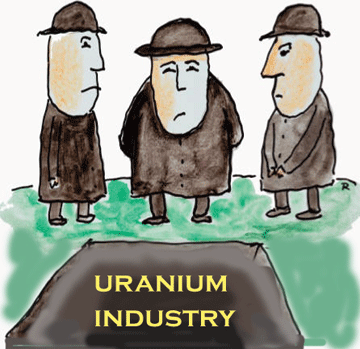 Uranium Sector Won’t Catch A Break, Share Cafe, By Rick Mills September 23, 2019 One week ago Cameco announced it will maintain low output levels until uranium prices recover. The Canadian uranium miner also said it might cut production further, having already closed four mines in Canada and laid off 2,000 of its workers in the uranium mining hub of Saskatchewan.
No end to supply glut
“We are not restarting mines until we see a better market and we may close more capacity, although no decision has been taken yet,” Cameco CEO Tim Gitzel told Reuters recently at the World Nuclear Association’s annual conference.
Just over a year ago Cameco made the difficult decision to close its MacArthur River and Key Lake mines, in response to low uranium prices, leaving the company’s flagship Cigar Lake facility as its only operating mine left in northern Saskatchewan, home to the world’s highest grade uranium deposit.
The mine closures by Cameco were preceded by 20% production cuts in Kazakhstan, the number one uranium-producing country. The former Soviet bloc country has said 2020-21 output will not rise above 2019 levels. In Canada, the second largest U producer, 2018 production was cut in half to 7,000 tonnes.
An estimated 35% of uranium supply has been stripped from the market since Kazakhstan’s supply reductions in December 2017…..
Eight years later, only nine of 33 remaining reactors have been re-started, and Japan’s nuclear operators are reportedly starting to sell their uranium fuel, as the chances fade of more reactors coming online, and adding to the six currently operating. Long-term contracts are also being canceled.
In another blow to the industry, Japan’s new environment minister, Shinjiro Koizumi, has said he wants all reactors shuttered to avoid a repeat of the Fukushima catastrophe that leaked radiation and forced 160,000 people to flee the area, many of whom have not returned.
As reactors close in the United States, Germany, Belgium and other countries, “traders and specialists say the market is likely to remain depressed for years,” Reuters reported in August.
Germany has pledged to shut down all its reactors by 2022 and the Belgian government has agreed to a new energy pact that will see nuclear power phased out over the next seven years…….
(makes case for thorium)….As far as disadvantages, thorium takes extremely 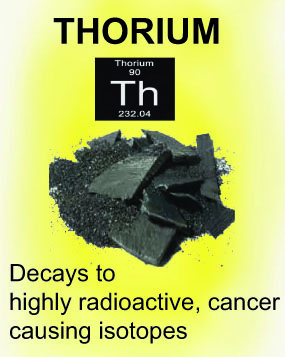 high temperatures to produce nuclear fuel (550 degrees higher than uranium dioxide), meaning thorium dioxide is expensive to make. Second, irradiated thorium is dangerously radioactive in the short-term.
Detractors also say the thorium fuel cycle is less advanced than uranium-plutonium and could take decades to perfect; by that time, renewable energies could make the cost of thorium reactors cost-prohibitive. The International Nuclear Agency predicts that the thorium cycle won’t be commercially viable while uranium is still readily available………… https://www.sharecafe.com.au/2019/09/23/uranium-sector-wont-catch-a-break/
1 This month

of the week – Australians for War Powers Reform (AWPR)
To see nuclear-related stories in greater depth and intensity
 Antinuclear