Like King Canute, Wyong Council behaves as if the sea level will not rise
 Actually – that headline is not really fair to King Canute. The Canute story is that his courtiers believed that King Canute had god-like powers, and could stop the tide coming in. Canute, in order to educate them, went down to the beach, and ordered the tide not to come in. However, as he expected, the tide did come in, and he got wet.
And the Wyong mayor and councillors might get we one day.
Sea level rise recommendation rejected http://www.abc.net.au/news/2013-07-05/sea-level-rise-recommendation-rejected/4802480, 6 July 13
A sea-level rise recommendation for building heights in Wyong has been rejected by the Tuggerah Lakes Estuary and Flood Plain Management Committee.
Wyong Council staff had recommended that an increase to floor level building heights of 400 millimetres was needed to allow for any future
sea level rises. Wyong Mayor Doug Eaton says the recommendation was rejected five votes to one.
“That recommendation of the committee now has to go to council to be either endorsed or changed by it my view it will almost certainly be
endorsed,” he said.
World Meteorological Organisation’s critical report on Climate Change


The WMO says droughts affect more people than any other kind of natural disaster because of their large scale and long duration. The decade saw droughts across the world, with some of the longest and most severe in Australia (2002 and other years),
Clear upward trend’ in global temperatures: WMO ABC News, ALEX KIRBY, 5 July 13, In the first decade of this century extreme weather, global temperatures and sea level all continued a trend in a “clearly upward direction”, says a new report from the World Meteorological Organisation.
If you think the world is warming and the weather getting nastier, you’re right, according to the United Nations agency committed to understanding weather and climate.
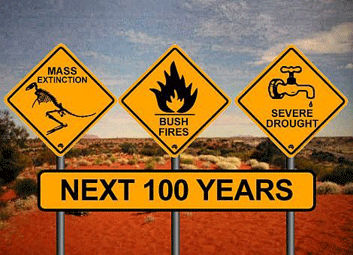
The World Meteorological Organisation says the planet “experienced unprecedented high-impact climate extremes” in the ten years from 2001 to 2010, the warmest decade since the start of modern measurements in 1850.
Those ten years also continued an extended period of accelerating global warming, with more national temperature records reported broken than in any previous decade. Sea levels rose about twice as fast as the trend in the last century.
A WMO report, The Global Climate 2001-2010: A Decade of Climate Extremes, analyses global and regional temperatures and precipitation, and extreme weather such as the heat waves in Europe and Russia, Hurricane Katrina in the US, tropical cyclone Nargis in Myanmar, droughts in the Amazon basin, Australia and East Africa, and floods in Pakistan. Continue reading
Australia’s recent “angry summer” was most likely caused by climate change
Manmade Emissions Led to the Heat Wave That Baked Australia Motherboard, By Jason Koebler, 27 June 13 Scientists are 90 percent sure this year’s Australian heat wave couldn’t have happened without manmade influence. Photo: CIA
Surprise, surprise: The record-breaking heat wave that plagued Australia earlier this year with temperatures that reached up to 121 degrees was almost certainly caused by humans, according to a new study.
The study, published in Geophysical Research Letters by scientists at the University of Melbourne and Australia’s ARC Centre of Excellence for Climate Systems Science, highlights how humans have heightened drought effects on the continent. According to the authors, “human contribution to the increased odds of Australian summer extremes like 2013 was substantial, while natural climate variations alone, including El Niño Southern Oscillation, are unlikely to explain the record temperature.”
The so-called “angry summer” was easily the hottest on record, with temperatures hitting more than 27 degrees above average in some parts of the country during the first week of January. When it was happening, meteorologists with the Australian government said that though “Australia has always experienced heat waves … the event affecting much of inland Australia has definitely not been typical.”…..”The model experiments also show that these types of extreme Australian summers will become more severe and more frequent in the future, with further global warming,” she said. “Extreme summers occur 8 times more frequently in the climate model simulations that include human influences, such as greenhouse gases, compared to the climate model simulations with only natural climate variations.” http://motherboard.vice.com/blog/manmade-emissions-led-to-the-heat-wave-that-baked-australia-1#ixzz2XZtGQ5uR
Institute of Public Affairs vilifies climate scientists
 Much of the climate change scepticism in Australia can be traced back to the free-market think tank the Institute of Public Affairs (IPA), a prominent news source and intellectual role model for conservative politicians, industry magnates, religious leaders and opinion makers in the media.
The mining industry is a major IPA sponsor and occupies senior positions on its board of directors. The IPA opposes regulations on GHG emissions and rejects the scientific consensus on climate change. It vilifies climate scientists, environmentalists and the political left.
Think tank a false climate prophet, SMH June 20, 2013 – Elaine McKewon A free-market think tank has  been heavily pushing climate change scepticism. “…….What began as an almost universal acceptance of the science and the need for action has become a false debate between climate change scientists and ideologically driven climate change “sceptics”.
On one side, we have 97 per cent of climate scientists who endorse the empirically based reality that Earth has been warming since the mid-20th century, that human-induced greenhouse gas (GHG) emissions are the main cause, and that deep and rapid reductions in global emissions are necessary to avoid the worst impacts.
Then there’s the alternative reality in which there’s no scientific consensus and the idea that human-induced GHG emissions cause global warming is either a hoax, a religion or a scare tactic cooked up to justify higher taxes and restrictions on personal freedoms. This is the “reality” in which many Australians, including several of our political and religious leaders, appear to live. Continue reading
Australia’s mainstream media actively promotes climate change denialism
 How Australia’s old media sows doubt about climate change Independent Australia 20 June 13, Australia’s corporate media does not properly hold politicians accountable or give the public the full picture — and is most especially remiss concerning climate change, says Brad Farrant, David Holmes and Assistant Professor Mark G Edwards. “…….
Why are they getting away with it?..….You would think most journalists would be forensically questioning any politician who denied the science or failed to devise and support adequate policies to address this threat.
Unfortunately, very few, if any, of our mainstream journalists have ever really challenged climate-science-denying politicians.
In fact, the opposite has been true. According to research by Robert Manne, many major media outlets – notably the Murdoch media, and particularly The Australian – have actively created doubt about the science. They have misreported the science and supported inaction among politicians who should be developing climate policies and offering national and international leadership on the issue. Continue reading
Climate change predicted to bring bushfires to Canberra
Scorching increase in bushfire danger June 17, 2013 Scott Hannaford The Sunday Canberra Times editor.Canberra could be facing a nearly 70 per cent increase in dangerous bushfire weather in less than seven years as the result of climate change, according to Australia’s Climate Commission.
The report, The Critical Decade 2013, to be released on Monday, paints a grim picture of the future for the ACT as a result of unchecked climate change, including a rising death toll from extreme-heat days, dwindling inflows to the city’s major water storages and further reductions in winter and spring rainfall.
”The decisions we make from now to 2020 will largely determine the severity of climate change our children and grandchildren experience,” the report states.
The CSIRO and the Bureau of Meteorology predict the number of days where the temperature climbs above 35 degrees in Canberra will rise from the current long-term average of 5.2 days a year to eight by 2030 and between 10 days and 18 days by 2070, depending on the action taken.
One of the report’s two authors, Professor Will Steffen, said many of the predictions climate scientists made in the 1970s and ’80s were becoming reality as communities began to suffer more-damaging storms, major bushfires and prolonged droughts.
”Canberrans hardly need reminding about the devastation bushfires can cause. If you look at the data since about 1973, 16 of the 38 observation stations show the fire danger rating has increased, while the remainder haven’t gone down. Of particular importance for Canberra is that most of those 16 stations are in the south-east corner and Canberra’s right in the middle of that,” Professor Steffen said……
Changes in rainfall meant summer rains could increase in Canberra, but in terms of the number of extreme-heat days the ACT was already experiencing nearly double the long-term average. http://www.canberratimes.com.au/act-news/scorching-increase-in-bushfire-danger-20130616-2ocpf.html#ixzz2WdnhEcMF
Climate change action by religious groups
 Climate change gets religious SMH, 19 June 13 Few religious communities have gone as far in fighting climate change as a church in Queensland which has 24 solar panels bolted to the roof in the shape of a Christian cross. “It’s very effective. It’s inspired some members of our congregation to install panels on their homes,” Reverend David Lowry said of the “solar cross” mounted in 2009 on the Caloundra Uniting Church, which groups three Protestant denominations.
Many religions have been wary of moving to install renewable energy sources on their places of worship, from cathedrals to mosques – or of taking a strong stand on climate change in general – despite teachings that people should be custodians of nature.
But slowly, that may be changing, thanks to new religious leaders including Pope Francis, the head of the Roman Catholic Church.
Australians buying up big, in electricity guzzling appliances
Rise in appliance sales prompts fears of a climate time bomb The Age, June 19, 2013 Peter Hannam Australia’s rush to acquire airconditioners and fridges is creating a greenhouse gas time bomb, which the Greens and environmental groups say existing regulations, including the carbon tax, are ill equipped to defuse.
The country has at least 45 million cooling devices, up from about 30 million in 2007, with 1 million airconditioners alone sold each year for home use and a similar number in new passenger vehicles.
The vast bulk of the equipment uses fluorocarbon coolants which, though small in weight – about 600 grams per car or more than 1 kilogram per airconditioner – can pack as much as 10,890 times the global warming impact of carbon dioxide when released, either through leakage or when the device is disposed of. The deliberate release of such gases has been illegal since 1989, but with as little as 25 per cent of the gases recovered each year from discarded devices, the rest of the gas is vented with impunity.
The replacement coolants, mostly hydrofluorocarbons (HFC), don’t deplete ozone but are potent greenhouse gases……. http://www.theage.com.au/environment/climate-change/rise-in-appliance-sales-prompts-fears-of-a-climate-time-bomb-20130618-2ogq3.html#ixzz2WhGlp0fs
Australian public brainwashed into climate scepticism, by Murdoch media?
Sceptics put heat on climate change BY:DAVID UREN, The Australian, June 10, 2013
CLIMATE change sceptics outnumber believers, according to an OECD study that shows how the debate has sharply divided Australians
The study into household attitudes towards the environment shows Australians are more sceptical than any of the other 10 nations examined, with the exception of The Netherlands… (subscribers only) http://www.theaustralian.com.au/national-affairs/climate/sceptics-put-heat-on-climate-change/story-e6frg6xf-1226660995986
Greens push to cease Future Fund’s investments in fossil fuel industries
 Greens push to end Future Fund fossil fuel investment http://www.smh.com.au/opinion/political-news/greens-push-to-end-future-fund-fossil-fuel-investment-20130606-2nr45.html#ixzz2VVM2J100 Peter Hannam Carbon economy editor, 6 June 13,
The Greens will on Thursday launch a campaign to get the $85 billion Future Fund to sell its holdings in fossil-fuel industries, starting with coal. The fund’s energy holdings now total about $3 billion, and are exposed to a ”carbon bubble” as nations shift towards low-carbon fuels, Greens leader Christine Milne said. The International Energy Agency last year estimated that two-thirds of proven fossil-fuel reserves would have to remain in the ground if the world is to avoid global warming of 2 degrees above pre-industrial levels.
”It’s good for the planet, good for people and good for long-term financial management to get out of coal,” Senator Milne said.The Greens are hoping to match the success of the anti-tobacco push, which led to the Future Fund deciding in February to dump its $222 million holdings of tobacco-related investments.
The Future Fund ”takes a very serious approach to environmental, social and corporate governance issues”, spokesman Will Hetherton said. However, exiting coal or other fossil fuels ”is certainly not on the current agenda”.
Senator Milne is hoping the campaign will spread to other superannuation funds, mimicking the push among US universities and other institutions to divest fossil-fuel investments. Tom Swann, a spokesman for Fossil Free ANU, said his university’s council recently discussed plans to set up responsible investment guidelines and will seek public input.
ANU has more than $80 million invested in coal, coal seam gas and other fossil investments out of about $260 million in equities, he said.
“The divestment campaign has really taken off in the USA, with campuses and city governments as large as Seattle and San Francisco dropping their investments in fossil fuels because people understand that if it’s wrong to wreck the climate, it’s wrong to profit from the wreckage,” said US environmentalist, Bill McKibben, ahead of a speech at ANU on Wednesday. ”Divestment had a real impact in the fight against apartheid, something Nelson Mandela and Desmond Tutu recognise, and it’s an important part of tackling climate change
Victorian government decides that climate change is a low priority
THE Victorian Government has abandoned key agricultural climate change programs. Weekly Times, 5 June 13 It comes as environment groups this week claimed rural communities were being left to “fend for themselves”. Opposition water spokesman John Lenders criticised the move. ”If Peter Walsh thinks that providing farmers with vital drought support packages is purely a climate-related matter he is living in a fantasy land.
“Labor’s $205 million Future Farming Strategy focusing around research and development initiatives was cut back to $60 million by the Napthine Government in 2012 and attempted to dress it up as a boost……Victorian Budget papers reveal a significant cut in climate change work and a continued withdrawal from the Brumby Government’s $205m Future Farms Strategy.
The Budget papers say the lower 2013-14 target “reflects the refocusing of Department of Environment and Primary Industries into higher priorities”……
“Since being elected, they have abolished nearly all state climate programs,” Mr Wakeham said.
“Deciding not to talk about or develop policy on climate change unfortunately won’t make it go away as we’re set to learn the hard way.”
The Climate Commission recently said Victoria had entered a critical decade in the race to adapt to the stresses of climate change.
Professor Tim Flannery said Victoria was very vulnerable to large swings in climate.
Meanwhile, 13 DEPI bio scientists have been made redundant. The cuts were flagged in March but the Community and Public Sector Union said staff were told last week…..http://www.weeklytimesnow.com.au/article/2013/06/05/572284_politics-news.html
Port Fairy, Victoria, vulnerable to sea level rise
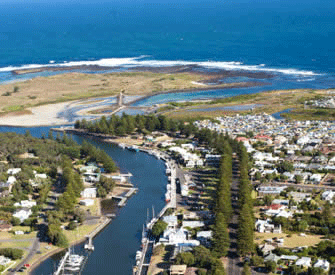 Report says hundreds of buildings vulnerable to flooding from rising sea levels at Port Fairy
http://www.abc.net.au/news/2013-05-28/report-says-hundreds-of-buildings-vulnerable-to-flooding-from-r/4716588
May 28, 2013 A report has found potentially disturbing effects of rising sea levels on the popular tourist town of Port Fairy, in south-western Victoria.
The consultants found if the sea level rises 80 centimetres by 2080, up to 390 buildings could be vulnerable to flooding.
The consultants say some of the report’s findings are disturbing and a huge amount of adaptation planning is needed.
Moyne Shire councillors will decide whether to release the full document for community consultation.
Australia to cop it most in Climate Change
Predictions Australia will be hardest hit by climate change http://www.abc.net.au/news/2013-05-17/predictions-australia-will-be-hardest-hit-by-climate-change/4695718 A national conference on mining and coal seam gas in the Hunter Valley this weekend will hear the world is past the point of preventing climate change.
Community leaders and experts in energy policy, health and renewables are gathering for the three day forum in Kurri Kurri this weekend.
Ian Dunlop is a former senior Executive of Royal Dutch Shell and a former chair of the Australian Coal Association. He says the coal industry has known since the 1980’s climate concerns will limit its primacy.
He says the world has already left it too late to prevent the onset of major climate change, pointing to the ominous milestone reached in the last week that saw the atmospheric concentration for carbon dioxide surpassing levels not seen in millions of years. The conference will hear from community groups that have successfully opposed coal and CSG developments in NSW, Queensland and the United States.
Mr Dunlop, who’s now with the Association for the study of Peak Oil and Gas, says Australia will be one of the hardest hit by a rise in global temperatures.
“I mean this is what people don’t seam to get, you cannot continue to operate businesses of any kind in a world where the average temperature has gone up 4 degrees, it’s just not feasible for people to work in those conditions,” he said.
“We’re one of the driest continents on the earth and the effects on Australia will be more severe than elsewhere.”
Mr Dunlop says climate change will also have a negative impact on Australia’s agricultural industry.
“The much longer term problems of the sustainability of things like agriculture because if we keep on going where we’re going large parts of the country are either going to be moving back into deserts or alternatively they’ll end up subject to extreme flooding and conditions that aren’t particularly conducive to agriculture anyway,” he said.
97% of scientific opinion supports human-caused global warming: no real “debate” on the science
Not much climate change doubt, science says : http://www.theage.com.au/environment/climate-change/not-much-climate-change-doubt-science-says-20130515-2jmup.html#ixzz2TV6hLn4F Peter Hannam Carbon economy editor, 16 May 13,
Having doubts over climate change and the role of humans? You’re unlikely to find many scientists who share your uncertainty. That is the finding of a University of Queensland-led study that surveyed the abstracts of almost 12,000 scientific papers from 1991-2011 and claims to be the largest peer-reviewed study of its kind. Of those who a stated a position on the evidence for global warming, 97.1 per cent endorsed the view that humans are to blame. Just 1.9 per cent rejected the view.
The report’s lead author, John Cook, a fellow at the University of Queensland’s Global Change Institute and founder of the website skepticalscience.com, said the scientific consensus was overwhelming, growing and had been around since the early 1990s.
He said that while the number of papers rejecting the consensus was “vanishingly small”, his research suggested the public was under the impression the debate was split 50-50. Continue reading
44 Indigenous Carbon Funding projects approved – ready to go
Successful Indigenous Carbon Farming Fund projects announced http://www.investinaustralia.com/news/successful-indigenous-carbon-farming-fund-projects-announced-12c3 24 April 13 Environment Minister Tony Burke and Parliamentary Secretary for Climate Change, Industry and Innovation Yvette D’Ath today announced the 44 successful applications under the Australian Government’s Indigenous Carbon Farming Fund Capacity Building and Business Support stream.
Mr Burke said through this program, the Australian Government is helping Indigenous Australians access carbon farming specialists, business development expertise and legal advice for their carbon farming projects. “These projects are spread across Australia and range from undertaking feasibility assessments to developing carbon farming project ideas and existing carbon farming businesses,” Mr Burke said.
“This program will not only provide benefits for our environment but also provide employment opportunities in indigenous communities.”
Other successful proposals include feasibility assessment of carbon projects, community education, and the development of businesses to provide services or undertake carbon abatement and sequestration activities under the Carbon Farming Initiative (CFI).
Mrs D’Ath said the projects have received funding to assist Indigenous communities to benefit from the Carbon Farming Initiative.
“The Research and Development stream of this initiative provides funding to underpin CFI methodologies and the development of tools for estimating and reporting on emissions,” Mrs D’Ath said. “Up on Cape York Peninsula, where the project area covers an area of up to 2,300,000 ha in Aurukun, one group aims to avoid emissions of approximately 30,000 tonnes CO2 per year.”
The Fund will provide $22.3m over five years to assist Aboriginal and Torres Strait Islander people to participate in the CFI. The CFI enables Indigenous landholders and land managers to earn carbon credits by undertaking projects to reduce emissions or store carbon. Types of projects include early season savannah burning and environmental plantings.
For more information, including a list of successful projects, go tohttp://www.environment.gov.au/cleanenergyfuture/icff/index.html.
1 This month

of the week – Australians for War Powers Reform (AWPR)
To see nuclear-related stories in greater depth and intensity
 Antinuclear