New Resources Minister Keith Pitt ignores renewables, pushes for more coal, gas and uranium exports
 New Resources Minister calls for more coal, gas and uranium exports, Brisbane Times, By David Crowe, February 11, 2020 Australia will need more coal, gas and uranium exports to pay for essential services and lift living standards, incoming Resources Minister Keith Pitt has declared in a warning shot to activists trying to block new projects.Mr Pitt vowed to use his new job to make Australia an even bigger energy exporter and sent a message to state governments to open up new coal seam gas fields to drive down the price of energy for households…… New Resources Minister calls for more coal, gas and uranium exports, Brisbane Times, By David Crowe, February 11, 2020 Australia will need more coal, gas and uranium exports to pay for essential services and lift living standards, incoming Resources Minister Keith Pitt has declared in a warning shot to activists trying to block new projects.Mr Pitt vowed to use his new job to make Australia an even bigger energy exporter and sent a message to state governments to open up new coal seam gas fields to drive down the price of energy for households……
An advocate of nuclear power in the past, Mr Pitt said he would not be making any decisions about nuclear energy given this was the responsibility of Energy Minister Angus Taylor, but he backed more uranium exports……. https://www.brisbanetimes.com.au/politics/federal/new-resources-minister-calls-for-more-coal-gas-and-uranium-exports-20200211-p53zu5.html |
|
Zali Steggall’s climate Bill, Labor’s befuddlement on coal
|
Mike Cannon-Brookes says Zali Steggall’s bill could repair Australia’s reputation on climate
Guardian, Atlassian co-founder says the MP’s bill is the exact type of action we need and deserves bipartisan support, Katharine Murphy and Adam Morton, Tue 11 Feb 2020 Atlassian co-founder Mike Cannon-Brookes has thrown his support behind a climate action bill proposed by the independent Zali Steggall and has urged the major parties to put down the cudgels and support it.And the Australian Energy Council, representing major electricity and gas businesses, said the Steggall bill deserved to be seriously considered as it had the potential to deliver certainty and a path forward for the national economy. Cannon-Brookes said on Tuesday the Steggall proposal, unveiled this week, was “a smart bill, and the exact type of action we need to change Australia’s international reputation on climate”. The bill includes a proposal for a net zero emissions target by 2050, a carbon emissions budget, and assessments every five years of national climate change risk. The MP has called on the major parties to bring the bill to the floor and allow a conscience vote. Cannon-Brookes said the proposal contained all the elements of a viable settlement to the climate wars. “The legislated 2050 target and five-year increments are precisely what is required, and the bill deserves bipartisan support.” ……. It follows a declaration by the Business Council of Australia that Australia should work to achieve net zero emissions by 2050……. Steggall’s bill will not be brought on for debate unless either the government or Labor supports it reaching the floor of the House. The government has not yet made a decision but it is unlikely to support it. On Tuesday morning, the Labor leader Anthony Albanese said it was highly unlikely the bill would be voted on “because that’s what happens with private member’s bills in the House of Representatives, unless the government agrees to allocate time for the bill, it will not be voted on”. Albanese said the proposal was very well intentioned, and he “respected” Steggall for bringing it forward, but told the ABC “we are unlikely to have a conscience vote on climate change. What we’ll do is support action on climate change.” The Labor leader said the opposition would commit to a long-term emissions reduction target “very soon” and, referencing an internal split within the Coalition about taxpayer backing for new coal plants, said: “I don’t think there is a place for new coal-fired power plants in Australia. Full stop.” On Sunday, Labor’s deputy leader Richard Marles, in a particularly awkward interview, did not rule out the party supporting new coal developments, saying it would be a decision for the markets despite previously declaring it would be a “good thing” if the thermal coal market collapsed. https://www.theguardian.com/australia-news/2020/feb/11/mike-cannon-brookes-says-zali-steggalls-bill-could-repair-australias-reputation-on-climate |
|
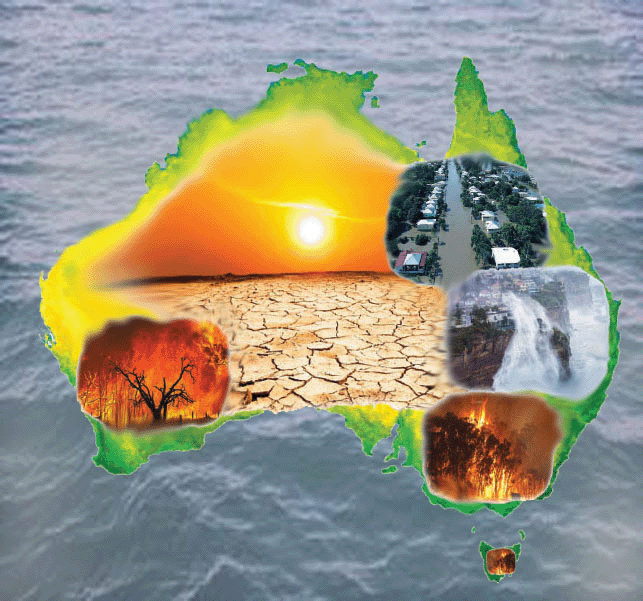
Fires and floods: Australia already seesaws between climate extremes – and there’s more to come
|
Fires and floods: Australia already seesaws between climate extremes – and there’s more to come
Neville Nicholls, Guardian 10 Feb 20, Australians take pride in winning against the odds but we have to move quickly to slow global warming and the extreme weather it creates
Mon 10 Feb 2020 ”Unprecedented” is the word that keeps being tied to the apocalyptic weather Australia has faced over the past few months. Bushfires have always been a reality in Australia, but never recorded on this scale with such widespread damage. It’s estimated that more than 60,000 sq km have been scorched in New South Wales and Victoria alone. Days of smoke have shrouded Sydney, Canberra and Melbourne. And after the fires, flooding at the weekend in NSW and parts of Queensland left thousands without power and dozens of schools closed on Monday. While the country is still grappling with the economic reality and human devastation caused by the fires, it’s easy to think the worst of this disaster is over. But unfortunately other extreme weather may yet occur this summer and these will also require safety preparations and rapid responses. Continental floodsLast year was the driest and hottest year on record in Australia. Some parts of the country have had several years of drought in a row. But all droughts end eventually. At the weekend devastating storms swept through eastern NSW, causing flooding, power outages and commuter chaos. The Bureau of Meteorology says 391.6mm of rain fell over Sydney in the past four days, the most since 414.2mm fell from 2 to 5 February 1990. Historically Australian continental-scale droughts are often broken by widespread heavy rain, leading to an increased risk of flooding, including potentially lethal flash floods. The flood risk from the heavy rains is exacerbated by the bare soil and lack of vegetation caused by the drought and by bushfires that destroy forest and grassland. When a decade-long drought ended in 2009, what followed were two extremely wet years with serious flooding. Flooding also brings the risk that ash might contaminate water supplies. The heavy rain falling on bare soil can also lead to serious erosion……. |
|
Coalition compares wind and solar to “dole bludgers”, pushes for coal, nuclear
Coalition compares wind and solar to “dole bludgers”, pushes for coal, nuclear https://reneweconomy.com.au/coalition-compares-wind-and-solar-to-dole-bludgers-pushes-for-coal-nuclear-41714/ Giles Parkinson, 10 February 2020 The wind and solar industries are bracing for another verbal assault and an extended period of policy indifference from the federal government, after a senior Coalition MP likened renewable energy to “dole bludgers’, the government funnelled $4 million into a study for a new coal fired power station in Queensland, and so-called government “moderates” declared their support for nuclear.
Despite the plunging costs of solar, wind and storage, the war against renewables is accelerating dramatically as the government comes under pressure to improve its climate policies, and even consider re-instating the long term zero carbon pledge for 2050 that it scrapped, along with the carbon price, in 2014, and which all states have since adopted.
But the language against wind and solar is now being scaled up to levels not seen since the Abbott government, when the prime minister, the then Treasurer Joe Hockey and others railed against the sight of wind farms, including on their drive down to Canberra.
Barnaby Joyce, the former deputy prime minister whose electorate of new England hosts some of the state’s biggest wind and solar projects, ranted against both wind and solar last week after losing his bid to regain the leadership of the LNP.
Matt Canavan, the former resources minister who backed Joyce in that failed leadership bid, and resigned after revealing his membership of a sports club that received a $20 million loan from a government fund that Canavan had responsibility for, went one step further on Monday.
“Renewables are the dole bludgers of the energy system, they only turn up to work when they want to,” Canavan wrote in an opinion piece in the Courier Mail that also got a page one headline. The opinion piece – from the man who likes to describe himself as “Mr Coal” – argued that only coal would support Australia’s mining and manufacturing industries.
The views of the LNP and the hard right of the Liberals are well known, but even so-called “moderate” Liberals are now arguing that wind and solar cannot be relied upon to power a modern economy, and nuclear should be open as a low carbon choice.
Katie Allen,the MP for Higgins, wrote as much in Nine Media over the weekend, repeating a claim she made in her parliamentary debut. Those views are reportedly supported by other Liberals also described as moderates, including Trent Zimmerman, and Tim Wilson, whose previous job was climate policy director for the climate-denying Institute of Public Affairs.
The demonisation of wind and solar also extends to the media. The Murdoch position against wind and solar is well established, but it is infused also into the ABC, which – appallingly – ran as its headline story on radio National on Monday morning a split in the Coalition between “cheap” coal and low emissions technology, as though it was matter a fact.
This is either the result of ignorance, or stupidity. In either case, it is inexcusable, although sadly not atypical. There is no study that points to new coal generators being the cheapest option to replace Australia’s ageing coal, polluting and increasingly decrepit fleet.
AEMO, in its Integrated System Plan, also makes it clear that renewables can power Australia’s modern economy and manufacturing sector. Its 20 year blueprint assumes a 74 per cent share of renewables in Australia’s grid as a minimum by 2040, and up to 90 per cent – a level that will dramatically reduce emissions – by around 90 per cent. The lights will stay on.
The ability of wind and solar to lower prices is now being witnessed in Australia’s main grid, with AEMO citing a 39% increase in wind and solar output in the last quarter, along with a fall in coal output due to outages and coal shortages, for a significant fall in prices to their lowest level since 2016.
The claim that renewables cannot power industry also flies in the face of the experts, including chief scientist Alan Finkel, who has mapped out a hydrogen strategy that could, and should, be fuelled by wind and solar. Others point to the potential of the country going “700 per cent renewables” to give it a global advantage in clean fuel exports and “green metals”.
Those supporters include Professor Ross Garnaut, who says Australia could likely reach 100 per cent reenables by the early 2030s, thereby slashing electricity costs and creating the base for more industrial growth.
Billionaires Mike Cannon-Brookes and Andrew “Twiggy” Forrest are investing tens of millions in one of several massive projects designed to export solar, or wind, to Asia countries. Forrest’s iron ore company Fortescue is investing huge amounts adding solar and battery storage to the Pilbara grid to lower the cost of electricity for his mines and improve reliability.
But it is impossible to name a single federal Coalition MP that recognises the potential of wind and solar, even though the state Liberal government in South Australia, for instance, has a target of “net 100 per cent renewables” by around 2030, and sees its economic future built on becoming a wind and solar energy powerhouse.
UNSW scientist Matt Edwards laments the government’s insistence that lower emissions could only be accompanied by either higher taxes or higher electricity costs. In an opinion piece for the Sydney Morning Herald, he said the Coalition is being “wilfully blind” to the economics of renewables, which “wipe the floor” compared to coal, gas and nuclear.
Edwards pointed to the conclusions of the CSIRO and AEMO studies mentioned above.
“One of the greatest frustrations as a scientist is to see interpretations of data misrepresented by politicians,” he writes. “Unfortunately in Australia, much of this bluster has come from the far-right side of conservatives, part of our broad church, whose members have traditionally prided themselves on prudence and level-headedness.
“We must fight the political expediency of appealing to a voter base spooked by fossil fuel scare campaigns and the denialists in the media, while avoiding getting rolled by rogue elements within the party, those whom Malcolm Turnbull labelled “terrorists” at our Climate Conversations event on Wednesday night, “willing to blow the joint up if they don’t get their way”.
“Our conservative politicians should ideally act according to conscience, free market principles and prudence. They should also seize upon the opportunity for Australia to become a renewables export powerhouse, alleviating global emissions reduction well beyond the 1.6 per cent often quoted as our share, and providing vast economic stimulus at the same time.”
We’ve been waiting for that to happen for more than two decades. There’s still no sign of it.
Zali Steggall , independent MP for Warringah, luring Liberals towards climate action
A matter of conscience’: Zali Steggall unveils plans for climate change act, https://thenewdaily.com.au/news/national/2020/02/10/zali-steggall-plans-climate-change-act/ Samantha Maiden She stole Tony Abbott’s blue-ribbon seat out from under the Liberal Party’s nose and now Zali Steggall is hoping to lure party dissidents to cross the floor and vote for climate change action.
|
The legislation is modelled on the UK’s Climate Change Act and is designed to provide a national framework for action and mandatory annual reporting of Australia’s trajectory towards meeting reduction targets. “We need to set out a road map for Australia to become a low-carbon economy without all the fear-mongering and misinformation,” Ms Steggall said. “The big question all sensible Australians are asking is how? This is why we need a climate change act to set out a legislative framework.” |
|
Private investors won’t touch new Coalition-backed coal plant, Labor says
Private investors won’t touch new Coalition-backed coal plant, Labor says, Morrison government to spend up to $4m in grant for feasibility study into coal-fired power plant in Queensland, Guardian, Australian Associated Press, Sat 8 Feb 2020 The federal Labor opposition says private investors will not touch “with a barge pole” the Morrison government’s plan to support a coal-fired power plant in Queensland.
The government says it will spend up to $6m in grants for two new Queensland electricity generation projects, including a coal-fired power plant, as part of a bid to lower power prices……..
Labor’s climate change and energy spokesman, Mark Butler, said private investors would not touch a new coal-fired power station “with a barge pole”.
“The government still has no energy policy – just ideological flights of fantasy,” he said in Adelaide on Saturday. The private investment sector had made it very clear it had no appetite for building expensive coal-fired power stations, he said.
Adam Bandt, The new Australian Greens leader looks to hopeful action on climate catastrophe

“There is no point in telling people there may be jobs in unspecified industries in the future. It is incumbent on us to explain how we will look after people in this transition”. …….
He has opened his period of leadership by talking about a Green New Deal, which he characterises as “a government-led plan of investment and action to build a clean economy and a caring society”.
Adam Bandt: the Greens must provide hope there is an exit strategy from climate catastrophe The new Australian Greens leader says the party has to connect with coal communities if it wants to be taken seriously, Guardian Katharine Murphy Political editor @murpharoo, Fri 7 Feb 2020 For the first time in the party’s history, the leader of the Australian Greens sits in the House of Representatives, not in the Senate. If you have to hold a lower house seat at every election, Adam Bandt says, you have to listen, and you have to be plugged in to the practical concerns of your constituents. Continue reading
Liberal politicians jump on the climate bandwagon to promote nuclear power
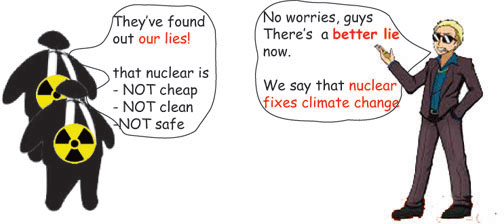
Goldstein MP, Tim Wilson and North Sydney MP Trent Zimmerman spoke in favour of nuclear power, commending MP Ted O’Brien for his parliamentary inquiry into the issue, which was tabled in December, and advocating for it to be further explored.
|
Coalition MPs clash over climate policy in first party room meeting of 2020
Scott Morrison faces difficult task of repositioning on climate change after assuring voters policies would ‘evolve’ Guardian, Sarah Martin @msmarto, Tue 4 Feb 2020 The prime minister, Scott Morrison, faces a fresh internal row over climate change policy, with MPs clashing over the issue in the first Coalition party room meeting of the year. Continue reading |
Australians will cringe, when our govt gives its climate-denialist policy in Glascow
The Coalition’s climate policy is an international embarrassment https://independentaustralia.net/politics/politics-display/the-coalitions-climate-policy-is-an-international-embarrassment,13559
AT A RECENT Press Club lunch, Prime Minister Scott Morrison dug deep to defend the Coalition’s response to the national and global climate emergency by defending a policy which is essentially that of former Prime Minister Tony Abbott’s in 2013. Continue reading
Flooding events highlight the danger to proposed uranium mining sites Yeelirrie and Wiluna

K-A Garlick at Nuclear Free WA |
6 Feb 20, In an area where two uranium mines are proposed ~ Yeelirrie and Wiluna, there have been massive rain influx, leading to widespread floods across the Goldfields country.
Toro Energy Wiluna uranium project expands over two lake systems and over 100 kms. The project includes four uranium deposits – Lake Way, Centipede, Millipede and Lake Maitland.
The project proposal includes a high risk inappropriate site to attempt disposal of up to 50 million tonnes of radioactive tailings that would be stored in mined out pits on the edge of Lake Way in a floodplain and in the drainage channel of a creek.
The company’s studies of hydrogeology, hydrology and geochemistry were all heavily criticised in Peer Reviews submitted as part of the environmental assessment. With these floods today, the planned emplacement of 50 million tonnes of long-lived radioactive mine waste in a floodplain poses a very serious risk to the environment and public health.
#ScottyFromMarketing “won’t be bullied” by climate science
Mr Morrison’s comments echoed those of his deputy prime minister during the height of the bushfire crisis.
In November, Mr McCormack attacked those who were linking climate change to the severity of the bushfires, labelling them “inner-city raving lunatics”
 Scott Morrison says he won’t be ‘bullied’ on climate by inner city voters, https://www.sbs.com.au/news/scott-morrison-says-he-won-t-be-bullied-on-climate-by-inner-city-voters Prime Minister Scott Morrison says he “won’t be bullied” into changing his government’s position on climate change as National MPs renew demands for more investment in coal. Scott Morrison says he won’t be ‘bullied’ on climate by inner city voters, https://www.sbs.com.au/news/scott-morrison-says-he-won-t-be-bullied-on-climate-by-inner-city-voters Prime Minister Scott Morrison says he “won’t be bullied” into changing his government’s position on climate change as National MPs renew demands for more investment in coal.
5 Feb 20, BY TOM STAYNER
Prime Minister Scott Morrison has declared he won’t be “bullied” by inner-city voters as he downplayed concerns of a fresh climate war inside the Coalition. Continue reading
|
Adani about to receive criminal conviction over false documents
 Adani agrees to plead guilty to giving ‘false or misleading documents to an administering authority’, may be fined up to $3m
Key points:
- The company’s Australian arm, Adani Mining Pty Ltd, is listed for sentencing in the Brisbane Magistrates Court
- It belatedly declared clearing land on its mine site after environmentalists complained to the government
- The company says it has been prosecuted for an “an administrative error”
Adani has agreed to plead guilty to giving “false or misleading documents to an administering authority”, according to the court file and sources familiar with the case.
The company’s Australian arm, Adani Mining Pty Ltd, is listed for sentencing today in the Brisbane Magistrates Court.
It faces a fine of up to $3 million if convicted under the Environmental Protection Act.
According to notes in the court file made by Magistrate Stephen Courtney and seen by the ABC, the matter is “to be [a] plea of guilty”.
In court papers, the Department of Environment and Science (DES) says Adani filed its annual return in March 2018 with a graph declaring it cleared no land on the Carmichael mine site, north-west of Clermont, in 2017-18.
The DES alleged it became aware of the offence six months later. It alleged Adani “knew or ought reasonably to have known [the document] was false or misleading” because it had planned and carried out land clearing before and during the reporting period.
On September 6, 2018, conservation group Coast and Country raised land clearing allegations with the State Government, citing satellite imagery.
State and federal environment department officials then inspected the site within days……..https://www.abc.net.au/news/2020-02-06/adani-to-plead-guilty-court-qld/11932640
Greens leader Adam Bandt vows to hold torch to Coalition on climate
|
Greens leader Adam Bandt vows to hold torch to Coalition on climate, The New Daily, 3 Feb 20, Adam Bandt has been elected unopposed as Greens leader following the surprise resignation of Richard Di Natale
The only Greens member in the lower house, Mr Bandt was formally endorsed by his federal party room colleagues in Canberra on Tuesday morning. He has promised to pursue a “Green New Deal” focused on including dental treatment in Medicare, making education free by abolishing public school fees, and replacing fossil fuels with renewable energy. Mr Bandt aims to win the balance of power in the upper and lower houses of federal parliament at the next election. In the meantime, he intends to pressure the Morrison government to take stronger action on climate change. Mr Bandt labelled the Coalition government “criminal” for abolishing the carbon price under Tony Abbott and argued climate inaction was fanning the ongoing bushfire crisis. He also claimed big businesses were “killing people” by contributing to a “climate catastrophe”. Mr Bandt said the Greens would provide “real opposition” and hold the government to account He said the major parties were “singing from the same song sheet” on coal mining. “I’m not one of those people who says that Labor and the Liberals are the same,” he said, shortly after his election to the leadership. “But when it comes to coal, Labor is now using exactly the same terminology as the Liberals.” Queensland senator Larissa Waters will remain co-deputy of the party and will share the role with Tasmanian senator Nick McKim. Senator Waters will also be the Greens leader in the Senate……https://thenewdaily.com.au/news/politics/australian-politics/2020/02/04/adam-bandt-greens-leader/ |
|
#ScottyFromMarketing has no climate target, because he is controlled by climate denialists
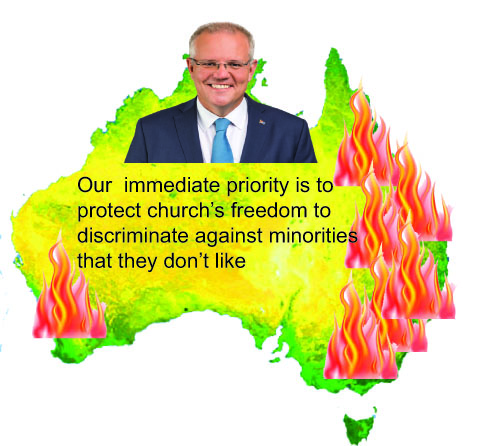
|
Scott Morrison’s missing target: climate https://www.afr.com/policy/energy-and-climate/scott-morrison-s-missing-climate-target-20200203-p53x5g
If he is going to appease noisy climate change denialists, it would be better if the Prime Minister left emissions reduction policy to the states. Richard Denniss Columnist Scott Morrison loves long-run targets for everything except climate policy.The federal government has long-run targets for inflation (2 to 3 per cent), the budget surplus (1 per cent of gross domestic product) and net debt (zero). It’s got a long-run target for defence spending (2 per cent of GDP) and countless long-run targets when it comes to Indigenous disadvantage, education performance, aged care quality and foreign aid. But when it comes to reducing the amount of coal, oil and gas Australia burns, apparently long-run targets are an unnecessary distraction for an “action man” like Scotty from Marketing. Targets give business, consumers and other levels of government something clear to work towards. Energy sources, especially the coal and nuclear power stations that the Prime Minister likes the sound of, take years to plan, years to build and decades to pay for themselves. Targets give business more certainty but they also make governments accountable for performance, which is presumably why the Prime Minister is so determined to avoid them when it comes to carbon emissions. In his sermon to the National Press Club last week, he avoided committing to net zero emissions by 2050 on the basis that his “climate action agenda is a practical one, it goes beyond targets and summits”. But you can’t go “beyond” long-run targets without having first set them.
Morrison knows targets matter. That’s why his government targeted so many sports grants to marginal electorates, and it’s why he spends so much time talking about meeting and beating Tony Abbott’s 26 to 28 per cent Paris target. Scott knows that if you set the bar low enough you can easily clear it, and if you don’t set the bar at all you can do nothing at all. After six years in office, continuing to avoid long-run emissions targets makes the government’s job easier and the energy industry’s harder. The Prime Minister’s real problem with long-run climate targets is the long-run climate change deniers in the party he’s trying to lead. For 10 years the only way for a Liberal leader to survive has been to publicly promise to do something about climate change while privately promising not to. Morrison waved a lump of coal in Parliament when he wanted to destabilise Malcolm Turnbull, but today he waves his “climate action now” slogan to stabilise his slide in the polls. Ultimately, like the last five Liberal leaders, he will be impaled on the fence his party insists he sit on. Morrison’s new-found interest in hazard reduction is no substitute for spending his prime ministerial capital in international forums, trying to steer the world away from the 3 degrees of warning we are currently on track to experience. The state premiers are perfectly capable of raking the leaves, but only the federal government can negotiate on the nation’s behalf for more ambitious action. Which brings me back to targets. Back in 2016, the ACT set a target to source 100 per cent of its electricity from renewable sources by 2020, and it’s already “meeting and beating” that goal and providing some of the cheapest electricity in Australia. The City of Sydney will be 100 per cent renewable by the end of this year and the state Coalition government of Gladys Berejiklian has committed NSW to net-zero emissions by 2050. In fact, every state in Australia is committed to carbon neutrality by 2050 – which, whether Scott Morrison likes it or not, means that Australia has committed to being carbon neutral by 2050. But rather than using those targets as leverage on the international stage, Morrison is undermining them on the domestic stage. If the Prime Minister was as interested in appeasing the quiet Australians as he was in appeasing the noisy climate denialists, he would welcome the bear hug the state premiers have wrapped him in and take credit for their ambition on the world stage while holding the premiers to account for their commitments back home. While a national approach to emissions reduction would be nice, the federal Coalition has shredded every initiative that has been put forward. Rather than take over more responsibilities from the states, Morrison would do better to leave climate and energy policy to them. The only thing stopping him from showing up at the next global climate talks and putting the states’ target of net zero by 2050 on the table is his backbench. |
|
|
A clear path to climate action for Australia
 The Princes Highway to climate action, SMH, Jono La The Princes Highway to climate action, SMH, Jono La Nauze 2 Feb 2020 In the past few weeks a clear path to real action on climate change has emerged. State and territory governments are aligning on the need for stronger climate policy.If the states act decisively and act together on setting emissions targets they can reduce pollution through an alternative route. Let’s call it the Princes Highway to climate action, because, like the famous road, it passes through the eastern capitals and deliberately avoids Canberra. Nauze 2 Feb 2020 In the past few weeks a clear path to real action on climate change has emerged. State and territory governments are aligning on the need for stronger climate policy.If the states act decisively and act together on setting emissions targets they can reduce pollution through an alternative route. Let’s call it the Princes Highway to climate action, because, like the famous road, it passes through the eastern capitals and deliberately avoids Canberra.
The biggest barrier to action has been a lack of political will and outright climate denialism in Federal Parliament, mainly from the Liberal and National parties. Even after the bushfires, the Prime Minister has tried to deflect attention from his party’s failure by focusing the debate on how we can “adapt” to a hotter, more chaotic climate, rather than cutting the pollution that causes it. But at the state level, things have been different. In recent weeks, senior Liberals have been speaking out about the need to cut pollution and have called for stronger climate policy – including the South Australian Premier, the outgoing and incoming Tasmanian premiers, the Victorian Opposition Leader and the NSW Climate and Energy Minister. In South Australia, the Liberal Party shifted a long time ago. When a freak storm toppled transmission lines and blacked out the state, the federal Coalition rolled out an aggressive misinformation campaign blaming the then Labor government’s renewable energy leadership. But when the Liberals came to power they didn’t follow their federal counterparts in trashing wind and solar – instead, they embraced it. “A lot of people thought when I got elected that we would be scaling back the state’s focus on renewable energy, when in fact we are putting the foot to the floor,” said Liberal Premier Steven Marshall on Friday. South Australia is now on track for 75 per cent renewable energy by 2025, and the Premier has linked the recent bushfires to climate change. Every single state and territory in the country has now set a goal of net zero emissions by 2050 – a long-term target the Prime Minister has so far rejected. Of course, the reality is that emissions cuts in the next five and 10 years will count the most. That’s why it’s critical that premiers such as Gladys Berejiklian and Daniel Andrews seize this moment to work with their fellow premiers on a national climate change strategy…….. This is a critical moment that could shift the national debate. If Victoria adopts emissions targets in line with the Paris Agreement, it is possible for other states to follow suit, passing similar legislation and creating a de-facto national climate change strategy – whether Scott Morrison decided to help out or not. In a few years, rather than being stuck in a stalemate at the federal level while temperatures rise and the country burns, we could have agreement between states and territories to get on with the job of lowering emissions and creating a safer future. https://www.smh.com.au/national/the-princes-highway-to-climate-action-20200131-p53wg6.html |
|
|
1 This month

of the week – Australians for War Powers Reform (AWPR)
To see nuclear-related stories in greater depth and intensity
 Antinuclear