8 December REneweconomy news
 RenewEconomy
-
AusNet, Deakin Uni to build 7.25MW solar, storage micro-gridAusNet and Deakin Uni to build solar and storage micro-grid on Geelong campus, to act as R&D for similar projects.
-
The Community Grid Project launches with a ‘Local Energy Hero’ competitionMornington Peninsula Shire were joined by representatives from electricity network provider United Energy and technology company GreenSync to officially launch the Community Grid Project at the Eco Living Display Centre, at the Briars in Mount Martha.
-
Improper creation of STCs results in compliance actionFollowing recent enforcement action against one of Australia’s largest solar retailers, the Clean Energy Regulator has taken enforcement action against one of the largest registered agents, Emerging Energy Solutions Group Pty Ltd.
-
The Australian utility first to embrace era of “base-cost renewables”West Australia’s regional utility Horizon Power has become the first major Australian utility to embrace the concept of “base-cost renewables”, recognising that the plunging cost of solar and wind is set to turn traditional theories of energy supply on their head.
-
Acciona supports Australian manufacturing as Mt Gellibrand transformer deliveries beginAcciona Energy is about to take delivery of critical components for its 132 MW under-construction wind farm at Mt Gellibrand in Victoria.
-
The climate effect of the Trump administrationOver its first year, the Trump administration has taken extreme steps to unravel progress on U.S. climate action domestically.
-
Tesla battery and “hidden demand” added to popular NEM-WatchThe popular NEM-Watch facility now includes the Tesla big battery, state demand levels and “hidden demand” from rooftop solar PV.
-
Polluting robots win big, clean energy workers get screwed in Trump tax billThe Trump tax bill will devastate the renewable industry and jobs, while incentivising automation, and the manufacture of polluting, unprofitable robots.
-
Five ways that cities can slash carbon pollution right nowA new report from the Rocky Mountain Institute lists 22 policies that could help get the job done.
6 December REneweconomy News
RenewEconomy-
5B plans module pre-fab facility in Adelaide, “gigafactory” in AsiaAustralian solar plant innovators 5B have announced plans to set up a production facility in Adelaide, and potentially a “gigawatt” production line in Asia.
-
Burning coal for power “like burning dollar notes” in era of cheap solarBurning coal to generate electricity in era of solar at 1c/kWh makes as about as much economic sense as “burning dollar notes”, says leading researcher Martin Green.
-
Energy regulator smashes illusion of “cheap” coal power in NSWAER report absolves big generators of predatory bidding during demand peaks, but they hardly need to: The cost of “baseload” coal supply in NSW has jumped so high that there is no such thing as “cheap” coal generation.
-
Blockchain App that pays households to cut energy use wins Future Cities HackathonHeld at UTS, the hackathon brought together some of the best and brightest from the fields of sustainability, design and technology, the corporate and academic world, and the start-up community.
-
WOMADelaide announces the 2018 planet talks programWOMADelaide today announced the full program of speakers and presenters for The Planet Talks, its renowned series of political, social and planetary discussions hosted as part of the festival from March 10 – 12.
-
Enphase Energy roars into Indian market with the company’s largest solar installation in the Asia-Pacific regionOccupying 67,000 square feet over six rooftops in multiple orientations, the landmark installation overcomes shading challenges to power a large, fast-moving consumer goods company.
2 December REneweconomy News
RenewEconomy-
ASX top 20 companies for climate change reporting in 2017We’ve looked at the top 20 companies listed on the ASX to see what they actually said about climate change in their latest annual report.
-
Developing nations are driving record growth in solar powerEmerging markets now account for the majority of growth in solar power, according to new data from Bloomberg New Energy Finance .
-
How to find a site for a solar farm in less than 10 minutesWant to know where to connect a local solar farm to the grid? Now you can, in 10 minutes or less.
Hot weather in South Australia: Tesla battery turned on a day ahead of schedule
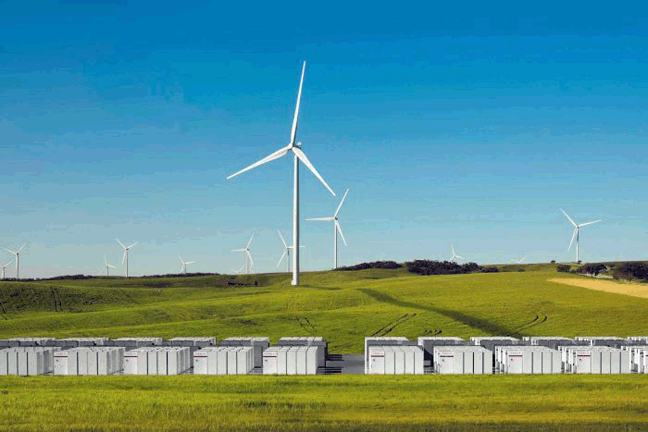 South Australia’s Tesla battery called on a day ahead of schedule as hot weather takes hold, ABC News 30 Nov 17 By politics reporter Nick Harmsen, South Australia’s giant Tesla battery has begun dispatching stored wind power into the electricity grid a day ahead of its scheduled switch-on.
Premier Jay Weatherill will visit the battery site — alongside the Hornsdale windfarm near Jamestown in the state’s mid north — on Friday, to mark its official opening on the first day of summer.
But with temperatures across South Australia and Victoria hitting the mid 30s, and output from the state’s wind farms low, the battery was called upon early to help meet Thursday afternoon’s peak demand.
The battery dispatched a maximum of 59 megawatts of power. The 100MW/129MWh battery is capable of powering about 30,000 homes for a little over an hour.
The manufacturer, Tesla says the lithium-ion device — made up of PowerWall 2 batteries — is both the “largest” by storage and “most powerful” of its type in the world……..http://www.abc.net.au/news/2017-11-30/sa-tesla-battery-begins-producing-power-a-day-ahead-of-schedule/9212794
1 December REneweconomy News
-
 It’s 30 years since scientists first warned of climate threat to AustraliaIn November 30, 1987 Australian scientists officially sounded the climate alarm. No one can say we haven’t been warned.
 -
Wind power prices have plummeted again in GermanyThe predicted price of onshore wind in Germany is now half the EU’s projections for 2030, following an auction in Germany this week.
-
Tesla big battery shows off its flexibility in final testingTesla battery goes through final testing with a rapid series of charging and discharging – never seen before on Australia’s ageing dumb grid.
-
Finkel’s frustration: Everyone else has a strategy, but not AustraliaFinkel vents his frustrations in final energy speech of the year, dumping on six biggest myths about electricity market, and delivering brick-bats to both policy makers and regulators.
-
Aera Energy and GlassPoint to build California’s largest solar energy projectAera Energy to install first-of-its-kind solar project to reduce oilfield emissions.
-
Vestas, CWP get serious about plan to export Pilbara solar and wind to AsiaSceptics might call it crazy to run a clean power ‘extension cord’ all the way to Indonesia, but the ELEXI plan to export Pilbara generated renewable energy to Asia has a serious team behind it.
Australian Energy Market Operator (AEMO) – Australia has enough electricity for summer
Australia has enough power for summer: AEMO, The Age, Cole Latimer, 28 Nov 17,
The chance of major summer blackouts has been cut as energy operators have found extra power for the east coast.
The Australian Energy Market Operator has added almost 2000 megawatts of additional power for the summer ahead, which it says will more than replace the 1600 megawatts taken offline after Victoria’s Hazelwood brown coal-fired power station closed in March…….
AEMO has now secured additional power to plug these forecast energy holes, and prepared the National Electricity Market – comprising Tasmania, South Australia, Victoria, Queensland, and NSW – for the summer ahead.
 “AEMO is confident that we have taken all the necessary actions – and then some – to make sure we are ready,” AEMO chief executive Audrey Zibelman said. “We now have a range of dispatchable resources that can be used to strategically support the market as required, including battery storage, diesel generation and demand resources,” she said…….
More than 1000 megawatts of generation has been secured through demand response programs and the Reliability and Emergency Reserve Trader (RERT) mechanism, which encourage major power users to reduce their energy consumption during peak demand times.
Home consumers have also been encouraged to reduce their consumption, although AEMO expects demand to stay stable…….. http://www.theage.com.au/business/energy/australia-has-enough-power-for-summer-aemo-20171127-gztzfn.html
29 November REneweconomy News
- Know your NEM: Why AEMC needs a fresh view of policy mess
-
AEMC chief John Pierce has had a long run, perhaps long enough. And why sale of Loy Yang B is good for competition.NAB, Origin help Aussies make the switch and save with solarHomeowners will be able to make a positive impact on their finances as well as the environment, through a new solar initiative launched this week by NAB and Origin.
-
Kidston solar project set to start sending power to the gridThe first stage of huge solar and “water battery” storage project in an old gold mine in Queensland about to start exporting to grid.
-
Tesla big battery ramps up, AEMO seems happy so farTesla battery testing shows major charging and discharging – a novelty to the grid. Both AEMO and SA government sound pretty happy.
Australia can meet its 2030 greenhouse emissions target at zero net cost
 What’s the net cost of using renewables to hit Australia’s climate target? Nothing https://theconversation.com/whats-the-net-cost-of-using-renewables-to-hit-australias-climate-target-nothing-88021, Andrew Blakers, Professor of Engineering, Australian National UniversityPhD Candidate, Australian National University, Research Fellow, ANU College of Engineering and Computer Science, Australian National University, November 27, 2017 Australia can meet its 2030 greenhouse emissions target at zero net cost, according to our analysis of a range of options for the National Electricity Market.
Our modelling shows that renewable energy can help hit Australia’s emissions reduction target of 26-28% below 2005 levels by 2030 effectively for free. This is because the cost of electricity from new-build wind and solar will be cheaper than replacing old fossil fuel generators with new ones.
Currently, Australia is installing about 3 gigawatts (GW) per year of wind and solar photovoltaics (PV). This is fast enough to exceed 50% renewables in the electricity grid by 2030. It’s also fast enough to meet Australia’s entire carbon reduction target, as agreed at the 2015 Paris climate summit.
Encouragingly, the rapidly declining cost of wind and solar PV electricity means that the net cost of meeting the Paris target is roughly zero. This is because electricity from new-build wind and PV will be cheaper than from new-build coal generators; cheaper than existing gas generators; and indeed cheaper than the average wholesale price in the entire National Electricity Market, which is currently A$70-100 per megawatt-hour.
Cheapest option
Electricity from new-build wind in Australia currently costs around A$60 per MWh, while PV power costs about A$70 per MWh.
During the 2020s these prices are likely to fall still further – to below A$50 per MWh, judging by the lower-priced contracts being signed around the world, such as in Abu Dhabi, Mexico, India and Chile.
In our research, published today, we modelled the all-in cost of electricity under three different scenarios:
- Renewables: replacement of enough old coal generators by renewables to meet Australia’s Paris climate target
- Gas: premature retirement of most existing coal plant and replacement by new gas generators to meet the Paris target. Note that gas is uncompetitive at current prices, and this scenario would require a large increase in gas use, pushing up prices still further.
- Status quo: replacement of retiring coal generators with supercritical coal. Note that this scenario fails to meet the Paris target by a wide margin, despite having a similar cost to the renewables scenario described above, even though our modelling uses a low coal power station price.
The chart below [on original] shows the all-in cost of electricity in the 2020s under each of the three scenarios, and for three different gas prices: lower, higher, or the same as the current A$8 per gigajoule. As you can see, electricity would cost roughly the same under the renewables scenario as it would under the status quo, regardless of what happens to gas prices.
Balancing a renewable energy grid
The cost of renewables includes both the cost of energy and the cost of balancing the grid to maintain reliability. This balancing act involves using energy storage, stronger interstate high-voltage power lines, and the cost of renewable energy “spillage” on windy, sunny days when the energy stores are full.
The current cost of hourly balancing of the National Electricity Market (NEM) is low because the renewable energy fraction is small. It remains low (less than A$7 per MWh) until the renewable energy fraction rises above three-quarters.
The renewable energy fraction in 2020 will be about one-quarter, which leaves plenty of room for growth before balancing costs become significant.
The proposed Snowy 2.0 pumped hydro project would have a power generation capacity of 2GW and energy storage of 350GWh. This could provide half of the new storage capacity required to balance the NEM up to a renewable energy fraction of two-thirds.
The new storage needed over and above Snowy 2.0 is 2GW of power with 12GWh of storage (enough to provide six hours of demand). This could come from a mix of pumped hydro, batteries and demand management.
Stability and reliability
Most of Australia’s fossil fuel generators will reach the end of their technical lifetimes within 20 years. In our “renewables” scenario detailed above, five coal-fired power stations would be retired early, by an average of five years. In contrast, meeting the Paris targets by substituting gas for coal requires 10 coal stations to close early, by an average of 11 years.
Under the renewables scenario, the grid will still be highly reliable. That’s because it will have a diverse mix of generators: PV (26GW), wind (24GW), coal (9GW), gas (5GW), pumped hydro storage (5GW) and existing hydro and bioenergy (8GW). Many of these assets can be used in ways that help to deliver other services that are vital for grid stability, such as spinning reserve and voltage management.
Because a renewable electricity system comprises thousands of small generators spread over a million square kilometres, sudden shocks to the electricity system from generator failure, such as occur regularly with ageing large coal generators, are unlikely.
Neither does cloudy or calm weather cause shocks, because weather is predictable and a given weather system can take several days to move over the Australian continent. Strengthened interstate interconnections (part of the cost of balancing) reduce the impact of transmission failure, which was the prime cause of the 2016 South Australian blackout.
Since 2015, Australia has tripled the annual deployment rate of new wind and PV generation capacity. Continuing at this rate until 2030 will let us meet our entire Paris carbon target in the electricity sector, all while replacing retiring coal generators, maintaining high grid stability, and stabilising electricity prices.
Queensland election is critical for solar energy, and for electricity consumers

 Queensland poll could be a show-stopper for solar, and consumers http://reneweconomy.com.au/queensland-poll-could-be-a-show-stopper-for-solar-and-consumers-11958/ By Giles Parkinson & Sophie Vorrath on 24 November 2017 Dirty versus clean; old versus the new; fossil fuels verses renewables; expensive energy versus cheap. There has rarely been so much at stake for an industry as there is in Saturday’s state election in Queensland, and the result is far from clear.
Current polling from Galaxy puts the ALP on track to win the required 47 seats for a majority, but as the Brisbane Courier-Mail reports, this will hinge on a number of factors, including unpredictable preference flows from One Nation supporters.
As at the federal level, politics in Queensland has been heavily focused on energy in the run-up to Saturday’s poll.
The Labor Palaszczuk government – which has a 50 per cent RET by 2030 for the state – has been campaigning strongly around renewables, with a particular focus on increasing rooftop solar uptakeas a way to cut power costs for businesses and homes around the state.
The new policies, launched in late October as part of the Palaszczuk government’s $2 billion Affordable Energy Plan, will offer no-interest loans to consumers wishing to invest in rooftop solar and battery storage, but lacking the up-front capital to do so.
They will also work to give landlords and renters equal access to solar, through a trial initially involving 1000 rental households. Queensland energy minister Mark Bailey said the rental solar scheme had the potential to save tenants up to 10 per cent off their annual bill, or up to $150 a year, while landlords could get a rebate of up to $520 per year.
On large-scale renewables, as we reported here, Labor, has promised to follow through on a program already underway to underwrite 400MW of renewable energy projects.
Following on from this, it has committed to support a further 1000MW of renewable energy projects via a new government power company; and to look to construct new transmission infrastructure in Northern Queensland that would unlock a vast new province of wind, solar and hydro power projects.
On the other side of the political divide, the LNP conservative coalition that is seeking to replace the current Labor government has made its intentions on energy clear: the end of renewables incentives; government money for a new coal generator in north Queensland; and support for the Adani coal mine.
The LNP is also claiming a huge reduction in consumer bills: $160 a year for two years, followed by savings of up to $460 a year in 2020.
But this is largely a mirage, as energy analyst Hugh Grant has pointed out. He noted that the only parties with policies that would deliver price reductions were the Greens, and Labor.
Not that Queenslanders got to read about that anywhere – apart from RenewEconomy, the local media refused to publish the results, as Michael West points out in this piece.
In the Conservative corner in the fight for new coal is federal minister for resources and northern Australia, Matt Canavan, who – recently restored to his portfolio – is as keen as ever to use the federal government’s Northern Australia Infrastructure Facility to help fund a new coal-fired power plant in Queensland’s north, as well as to get the Adani coal mine and port project off the ground.
One Nation is also keen to build a coal-fired power station west of Townsville, with party leader Pauline Hanson pledging to commit $1.5 billion to the project, which she wants built in Collinsville – a former coal hub of the state that is more recently turning to large-scale solar.
In fact, according to data gathered for RE’s Renewable Energy Index, the North Queensland region has more power generating capacity under construction than the entire state of NSW, and almost as much as Victoria, South Australia and Western Australia combined.
Meanwhile, Queensland home and business owners are leading the country – which in turn is leading the world – in rooftop solar uptake.
A Climate Council report last month showed that almost one third (31.6 per cent) of all Queensland homes now have solar panels, which puts the state ahead of South Australia, at 30.5 per cent, and Western Australia at 25.4 per cent.
What’s more, there are 14 postcodes in the Sunshine State alone where more than 50 per cent of households have rooftop solar, including the the Moreton Bay region town of Elimbah, where an impressive 63 per cent of homes have PV panels on their roofs.
The Australian Solar Council – newly rebranded as the Smart Energy Council – aren’t resting on their laurels, though. The peak solar industry body is spooked enough about a possible LNP victory that is has launched its own major election campaign, urging voters to put the Coalition last.
“Queensland voters face a stark choice at the election tomorrow,” the SEC said in an email to members on Friday:
“A new polluting coal-fired power station or a solar thermal plant providing 24-hour solar power; no new large-scale renewables and massive job losses or 1,000 megawatts of new large-scale renewable projects in regional Queensland; and a National Energy Guarantee that delivers the longest solar eclipse in history or sensible national energy policy.”
Wind Energy – a brave new world for New South Wales farmers
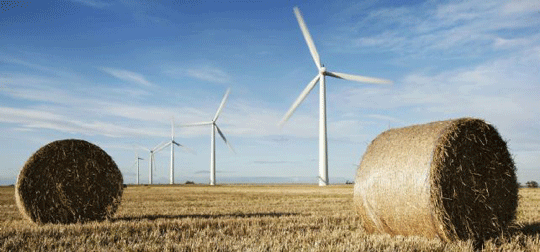 Wind Alliance to host public forum for landholders in Kentucky to bust myths about living with turbines http://www.northerndailyleader.com.au/story/5074983/farmer-busts-the-myths-behind-living-with-turbines/ Rachel Baxter , 24 Nov 17
Millions of dollars are being injected into the New England for large-scale renewable projects every year.
And while it might be daunting for many farmers, it’s a brave new world we have to get used to, Wind Alliance NSW organiser Charlie Prell says.
He said a major issue is when neighbouring properties are left with no say and no money while next door gets the benefits. “It’s really easy to solve,” he said. “The Wind Alliance has been promoting this thing called benefit sharing.” It’s all about strategic options for delivering ownership for wind farms in NSW, Mr Prell said.
“It’s so most people are not excluded from projects,” he said. “They probably won’t get paid as much as a host but at the moment there’s a cliff face where the host gets paid a lot and the neighbours get paid nothing.“Obviously they become disillusioned and skeptical by that process.”
Mr Prell said if neighbours are paid on a sliding scale depending on their proximity to the turbines, instead of a “cliff face” there’s a gradual decline.
“There’s no economic precedent for doing that but in small regional communities it actually makes a whole lot of social sense,” he said. Continue reading
Northern Territory to unveil plan for 50% renewables
 Northern Territory to release 50% renewables plan next week http://reneweconomy.com.au/northern-territory-release-50-renewables-plan-next-week-18260/ By Giles Parkinson on 24 November 2017 As Australia’s national energy policy enter a new hiatus – as the industry awaits some text to be inserted into the thought bubbles around the proposed National Energy Guarantee- some states and territories are getting on with their own plans.
The Labor government in the Northern Territory is expected next week, and possibly as early as Monday, to unveil the detail of its roadmap to a 50 per cent renewable energy target.
The government last year commissioned a special panel to put together the plan, which could result in some 400MW or more of mostly solar capacity in the territory over the next decade – not a huge sum by any means, but still significant given the potential investment droughts elsewhere.
As in other states, Labor has a diametrically opposite view to the conservative parties. Former LNP leader and chief minister Adam Giles was an ardent critic of renewables, and now works for Australia’s richest person, the mining magnate Gina Rinehart.
Victoria’s Labor government, meanwhile, has legislated a 40 per cent renewable energy target by 2025, and is conducting a 650MW auction – the largest ever in Australia – while the ACT has already contracted with some 700MW of wind and solar to meet its 100 per cent renewable energy target by 2020.
South Australia’s Labor government has already met its 50 per cent renewable energy target, and is keen on adding more, with numerous large scale solar, wind and storage projects lining up in the state.
The Northern Territory is almost entirely reliant on gas and diesel, and has three small grids – around Darwin, Tennant Creek and Alice Springs, and a host of stand alone systems and micro-grids in its many remote communities.
Alice Springs has made a major push into solar – including 12MW of rooftop solar and the 4MW Uterne solar system (the first large scale system in Australia) – and is installing a 5MW battery storage unit to help allow more solar into its small grid.
The Department of Defence is also making a major push into solar, announcing tenders for a total of 12.5MW of utility-scale solar for the RAAF base and barracks in and around Darwin.
The advisory panel was appointed by the government last December and asked to deliver a roadmap by mid year.
It was chaired by remote power system expert Alan Langworthy, and including Katherine Howard, former Australian Renewable Energy Agency chair Greg Bourne, Climate Council CEO Amanda McKenzie, and Lyndon Frearson, the head of solar and storage specialists Ekistica.
Australian Capital Territory’s energy policy could be damaged by Turnbull’s National Energy Guarantee
A National Energy Guarantee could be bad news for the ACT, Canberra Times, Katie Burgess , 24 Nov 17, A National Energy Guarantee could risk years of ACT energy policy and force Canberrans to pay more, ACT climate change minister Shane Rattenbury has warned.
The Greens minister met with his state and federal counterparts at the COAG Energy Council meeting in Hobart on Thursday and Friday.
Federal energy minister Josh Frydenberg had intended to ask state and territory leaders to give in-principle support to the energy guarantee, but instead sought approval to undertake further analysis of the proposal.
But Mr Rattenbury said he was concerned that the guarantee would “stymie” new sources of renewable energy, the emission targets were too low, the agreement too short and the modelling was tailored to “inflate the apparent cost-savings”.
He also said an “artificially suppressed” wholesale price would impact on the contract-for-difference model the ACT used as part of its plan to go 100 per cent renewable by 2020.
However when wholesale prices are higher than the feed-in tariff, the generator pays ActewAGL and the savings are passed onto customers.
That model has insulated Canberra customers from future price rises.
But if the wholesale price was pushed down, Mr Rattebury said the ACT could pay more.
“We are concerned it will suppress artificially prices in the wholesale market and we believe the wholesale market is an effective means of driving good energy outcomes so the transition across to a certificate-based approach we think distorts the price signalling effect the labour wholesale market is designed to operate,” Mr Rattenbury told a stakeholder meeting.
“As a jurisdiction it’s particularly problematic for us because we have set ourselves on a pathway that’s premised on having an effective wholesale price. For our consumers it’s going to represent a potentially significant cost increase because of the way our electricity contracts are set for the next 20 years.”………
The federal government chose not to adopt the Clean Energy Target recommended by Chief Scientist Alan Finkel, instead opting for a National Energy Agreement which would require energy retailers to meet a reliability and emissions guarantee.
The reliability guarantee compels retailers to make a proportion of electricity available from “dispatchable” sources like batteries, hydro or gas, that can be switched on when demand is high.
The emissions guarantee requires retailers to cut their greenhouse emissions by 26 per cent on 2005 by 2030.
The energy guarantee won’t apply to Western Australia and the Northern Territory, meaning those two jurisdictions will have no federal emissions reduction policy after the Renewable Energy Target is scrapped in 2020.
The ACT and South Australia called on the federal government to model the cost of a Clean Energy Target and a Renewable Energy Target as well but they refused.
Mr Rattenbury that was “deeply concerning”.
“We know the National Energy Guarantee is the fourth or fifth best choice because that’s what the backbench watered it down to.
“[The refusal to model other options] says to me it’s not going to stack up.” http://www.canberratimes.com.au/act-news/a-national-energy-guarantee-could-be-bad-news-for-the-act-20171123-gzryin.html
Turnbull govt’s National Energy Guarantee inadequate and confusing
 Hard to overcome the impression that energy plan guarantees only more confusion http://www.theage.com.au/federal-politics/political-news/hard-to-overcome-the-impression-that-energy-plan-guarantees-only-more-confusion-20171124-gzs1x9.html Peter Hannam
It is notable that as late as two days before Australia’s energy ministers gathered in Hobart, the Turnbull government was still hoping to secure in-principle support for its national energy guarantee.
“Expecting us to sign up was a ridiculous proposition,” Lily D’Ambrosio, Victoria’s energy minister told Fairfax Media, adding there was a “massive pushback” against such undue haste.
So it’s perhaps no wonder the resulting COAG communique was unusually thin.
Indeed, the first pass at modelling the vaguely outlined policy was only completed and shared a few days earlier. Modelling can be made to do almost whatever you want it to do. That’s especially the case when the modeller – in this case, Frontier Economics – wasn’t commissioned to compare outcomes for other schemes.
While on the face of it a reasonable request, the bid stirred anger from at least one other state because Josh Frydenberg, the environment and energy minister, would never have got such a proposal near his partyroom for approval.
More number crunching in any case may not be the answer – at least, not until the design of the two elements of the guarantee to curb emissions and boost reliability are better defined.
A better approximation of the market distortions caused by relying on the electricity retailers to carry the guarantee obligations – rather than generators, as other programs such as an emissions intensity scheme, would require – may also reveal smaller savings for consumers than being touted.
Closer scrutiny of the guarantee modelling to date only fans doubts.
As South Australia’s Tom Koutsantonis notes, renewable energy schemes of Victoria and Queensland have largely been ignored, while the massive Snowy 2.0 pumped hydro scheme that hasn’t passed a feasibility study is assumed as operating.
The emissions trajectory also falls far short of what has otherwise been projected for the electricity sector – an industry that accounts for about a third of Australia’s carbon pollution.
As Dylan McConnell of Melbourne University notes, the modelling to date has been based on sector emissions for the National Electricity Market, totalling 1352 million tonnes of carbon-dioxide equivalent for 2021 to 2030.
Separate work by the government’s Climate Change Authority last year, however, projected electricity sector emissions of 1600 MT of CO2 for the whole 2020-50 period, and included Western Australia and the Northern Territory in that total.
Compared with the Authority’s work then, the national energy guarantee would leave less than two years’ of current power sector emissions for the entire 20 years after 2030, he says.
It really does look like there’s a lot more work to be done.
24 November More REneweconomy news
RenewEconomy-
Forget COAG – how durable is Coalition support for the NEG?When the NEG was nebulous, its boosters were able to promise all things to all people. Now, with slightly more detail out, it will be a really hard sell.
-
Tesla big battery – world’s biggest – charges up for first timeWorld’s biggest battery charges up for first time as testing begins ahead of its formal commissioning next week.
-
COAG agrees to put wind and solar sectors in no-man’s landCOAG agrees to commission more design work on the Turnbull government’s proposed National Energy Guarantee, forcing the renewable energy industries in Australia into yet another period of policy uncertainty.
-
Queensland poll could be a show-stopper for solar, and consumersAs Queensland prepares to vote in the state election on Saturday, we look at what’s at stake for the renewables industry – particularly if Labor loses.
-
Northern Territory to release 50% renewables plan next weekNorthern Territory government expected to unveil roadmap for 50 per cent renewable energy target next week.
-
Delta Energy Systems charges EV convoy to top of Cradle MountainThis is the first event where electric vehicles demonstrated that the drive from Devonport to Cradle Mountain, a popular tourist destination, is entirely possible using standard production EVs currently available in Australia.
-
Andrew Dillon appointed new CEO of Energy Networks AustraliaEnergy Networks Australia is pleased to announce Mr Andrew Dillon’s appointment as its new Chief Executive Officer.
-
Push for second Tasmania Basslink wins new ARENA fundingAustralian Renewable Energy Agency tips another $20m into feasibility and business case for second interconnector across Bass Strait.
-
NEG is supposed to be better than nothing. But is it?The NEG is yet another case of Australian exceptionalism in energy, typical of the toxic mix of muddled thinking and ideology that dominates regulatory oversight of this industry.
-
HOWZAT! Adelaide over on front foot with project putting energy efficiency up in lightsAdelaide Oval has unveiled a world class audience experience created through a CEFC-financed major lighting upgrade that goes all out to put substantial runs on the energy efficiency scoreboard.
24 November REneweconomy news
-
How tech nerds can reinvent electricity before it’s too lateThere’s a growing mob that thinks it can reinvent electricity, from old to new, and from a supply-dominated industry-based model to consumers-in-control.
-
Here are 4 essential fixes for the National Energy GuaranteeA policy that doesn’t encourage additional generation capacity won’t reduce high power prices. Here are four essential fixes for the NEG.
-
Australia corporate solar market ready to boom, says New Energy SolarThe head of what will be Australia’s largest listed specialist solar investment fund is looking to tap the booming corporate solar sector.
-
BNEF: Turnbull’s NEG akin to joining gym and not lifting weightsBNEF says NEG under current targets would achieve little, and be akin to finally signing up to a gym, and then refusing to lift any weights.
-
CEFC targets energy hungry shopping centres, with $200m finance dealCEFC tips $200m debt finance into QIC’s Global Real Estate flagship Shopping Centre Fund, in deal expected to deliver energy savings of between 30-40% using solar and energy efficiency.
-
Alinta dives back into coal with purchase of Loy Yang BAlinta dives back into coal, paying top dollar for Loy Yang B generator, suggesting it expects high prices and limp climate policies to continue.
-
First Australian corporate bulk-buy to deliver new 80MW wind farmAn 80MW wind farm to be built near Ararat after first-of-kind contract with powerful consortium of 14 universities, corporations and Councils.
-
Is NEG just an elaborate plan to fund Turnbull’s vanity project?Latest advice from Energy Security board makes it clear that on current policy settings the NEG will not reduce emissions, cut costs or invite new wind and solar investment. But there may be something else afoot – Malcolm Turnbull’s vanity project.
-
1414 plans two “gigawatt hour” silicon storage plants in S.A.South Australian company opens new manufacturing facility and says it plans to build two grid scale 1GWh silicon storage systems in the state.
-
Tesla big battery on track to be “energised” in coming daysTesla big battery fully installed and on time in South Australia, and about to be “energised” and tested by regulators and market operators.
1 This month

of the week – Australians for War Powers Reform (AWPR)
To see nuclear-related stories in greater depth and intensity
 Antinuclear