Renewable Energy Target – a small cost for a big gain
this time, the renewable industry has grown and is planning to fight back with a marginal seats campaign and a public appeal to save the current Renewable Energy Target.
 Is $15 a year really too much to pay for renewable energy? The Conversation, AUTHOR Dylan McConnell Research Fellow, Melbourne Energy Institute at University of Melbourne,11 Feb 14 Australia’s Renewable Energy Target looks likely to be weakened or even axed, with the Prime Minister saying the scheme needs to be reviewed because it is causing “pretty significant price pressure”.
But does $15 a year sound like a “pretty significant” cost to you? Continue reading
Australia’s solar energy up against attack from Tony Abbott
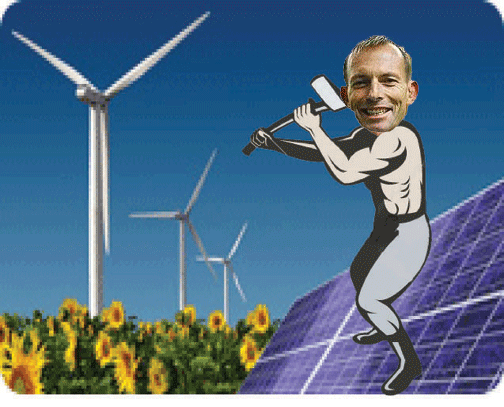 Australia’s solar industry prepares for battle, pvmagazine 06. FEBRUARY 2014 | BY: EDGAR MEZA The government of Prime Minister Tony Abbott looks set to gut the country’s Renewable Energy Target program. Critics accuse Abbott of having misrepresented his stance on renewables. Australia’s renewable energy sector is feeling increasingly threatened by the government of Prime Minister Tony Abbott.
In a report on Thursday in U.K. newspaper The Guardian, opposition Labor Party environment spokesman Mark Butler took Abbott to task. Butler accused the prime minister of having pretended to support the renewables industry before the election but said he was now “launching a full-frontal attack” on the sector…….
The Labor environment spokesman said Abbott had taken control of a scheduled review of the country’s Renewable Energy Target (RET), adding that the current ruling coalition may reassess the program due to increases in power prices.
Butler said Labor would continue to oppose the repeal of the country’s carbon tax when parliament resumes this month and added that the party was also preparing “to ramp up a community campaign in support of renewable energy.” The renewable energy sector has become increasingly alarmed at the possibility of the government drastically reducing or even abolishing the RET.
The Australian solar council has already launched a “save solar” campaign out of fear the government review will immobilize the industry by eliminating the target, which requires 45,000 gigawatt hours of power to be sourced from renewables by 2020 and provides a subsidy to people who install solar systems. http://www.pv-magazine.com/news/details/beitrag/australias-solar-industry-prepares-for-battle_100014143/#ixzz2se7wYtKC
Solar air conditioning, solar power the clean way to keep cool
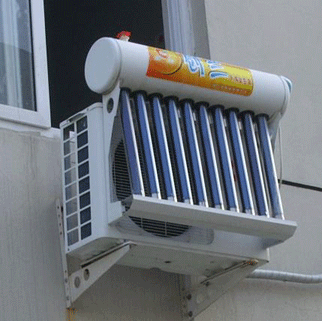 Over one million Australian homes now have solar and our power pricing doesn’t handle them well either
under the status quo, those without air conditioning and with solar are being slugged unfairly.
Matthew Warren: The way we pay for electricity is out of date and urgently needs reform MATTHEW WARREN THE ADVERTISER FEBRUARY 03, 2014 THE recent intense heatwave across south-eastern Australia stretched many things to breaking point.Heatwaves provide a rare, but important examination of the power system.On a normal summer’s day in South Australia the peak load is around 1890 megawatts. In the heatwave it topped 3000 megawatts for almost three days straight. That put the network right at the edge of its capacity.
There is one key reason for these spikes in demand: increased deployment of airconditioners. On the hottest of days they are all turned on at once and this sends demand skyrocketing……
A large part of your household power bill is to pay for these infrequent events. It would make sense if those households with large air conditioners paid more than those who have only a small unit or none at all.
But they don’t. Continue reading
How vested interests exploit rural communities about “wind turbine syndrome”
a community that is well-informed, consulted and empowered is much more likely to welcome the development of clean technology, and reject the offerings of anti-wind groups selling a narrative of fear and danger..
The theory of wind turbine syndrome was not sourced from empirical scientific investigation – it was borne of a heady mix of human nature and vested interests,
 stew of sentiment and pseudoscience bubbles below the surface, and the link need only be completed by motivated and well-funded lobby groups with no desire to adhere to the bounds of scientific inquiry
Consultation is the key to curing wind turbine syndrome KETAN JOSHI ABC Environment3 FEB 2014 Joshi 7 MAY 2013 Wind turbine syndrome is a symptom of a community that feels it has lost control. It has very little to do with wind farms and ‘infrasound’. PRIME MINISTER TONY ABBOTT’S intention to open a fresh investigation into the vexed issue of ‘wind turbine syndrome’ hasn’t impressed many.
Mick Vagg, SeniorLecturer at Deakin University wrote that ‘there is no scientific justification for any further investigation of ‘wind turbine syndrome'”.
Meanwhile the anti-wind Waubra Foundationsupports the plan……. Continue reading
Community ownership of wind farms in Australia
Consultation is the key to curing wind turbine syndrome, KETAN JOSHI ABC Environment 3 Feb 14 “…….In Australia, community ownership is gaining traction. My employer, InfigenEnergy, is looking to enable community ownership of one of the wind turbines at the Flyer’s Creek development in NSW, through theCentral NSW Renewable Energy Cooperative (CENREC).
The Hepburn Wind Farm, a two-turbine community-owned wind farm in Victoria, has generated 27,809 megawatt-hours since commencement — enough to power an average Australian home for 4,209 years, and the proposed Fremantle Co-operative wind farm project in WA recently hit a $10,000 crowd-funding target to produce myth-busting videos on wind energy. The Coonooer Bridge Wind Farm development utilises a community benefit model that is the first of its kind, and has been welcomed by locals.
These initiatives are, simply, the circuit-breakers needed to lessen the influence of lobby groups working against the integration of renewable technology into our energy system, and empower communities. Abbott’s research will likely be ineffective in lessening the spread of wind energy health fears in communities.
The deployment of clean technology across Australia as a means of reducing our reliance on fossil fuels will be stewarded by tight-knit Australian communities. The companies that develop, operate and maintain large-scale generation assets fuelled by renewable resources can only benefit from community ownership and engagement.
It seems the only ones who will lose out from this shift will be those who professionally stoke anger and feed fear. The demand for their resource will run swiftly dry.http://www.abc.net.au/environment/articles/2014/02/03/3935067.htm
Australia’s largest solar plant – construction begins
Construction begins on Nyngan, Australia’s largest solar PV plant REneweconomy, By Sophie Vorrath on 28 January 2014 Construction of AGL Energy’s $300 million solar PV plant in central NSW is set to begin, with the head contractor, First Solar, going on-site on Tuesday.
The ARENA-backed Nyngan Solar Plant – with more than 1,350,000 PV modules expected to be installed on a 250 hectare site – will be the largest PV plant in Australia, and the largest of its kind in the Southern Hemisphere, once finished.
Construction is expected to take around 18 months to complete, with the 102MW plant slated to be fully operational by June 2015. Continue reading
Repost: Peter Cosgrove spruiks “clean” nuclear for BHP Billiton
Lack of Australian nuclear plant almost immoral: Peter Cosgrove Amanda O’Brien : The Australian * February 04, 2010 “…………….The former Australian of the Year said he anticipated there would be an outcry but there was no cleaner energy source than nuclear power.(!!)..………General Cosgrove pulled no punches in his speech to the breakfast at the University of Western Australia, which was hosted by major coal producer BHP Billiton.

Lack of Australian nuclear plant almost immoral: Peter Cosgrove | The Australian
Australia’s solar pioneers predict a world powered by solar energy
Australia Day honours for solar pioneers CHRISTOPHER DOYLE, ABC, 26 JAN 14 Two Australian scientists who have paved the way for solar thermal power plants worldwide have been honoured with Australia Day medals.
A WORLD POWERED BY solar energy is inevitable according to two distinguished scientists being honoured this Australia Day. Continue reading
New South Wales’ biggest wind farm on the way
Foundations poured for NSW biggest renewable energy projecthttp://www.abc.net.au/news/2014-01-24/wind-project/5216572 Fri 24 Jan 2014 Foundations have begun to be laid at the Monaro site in the New South Wales south east of what will become the State’s biggest wind farm project. Continue reading
Solar panels soon stand alone says Australia’s biggest power company
 Power company says solar panels can soon stand alone ANNABEL HEPWORTH THE AUSTRALIAN JANUARY 25, 2014 AUSTRALIA’S largest energy retailer is predicting that solar rooftop electricity panels will be competitive without subsidies in the next few years, adding to pressure on the federal Coalition to scale back the renewable energy target in this year’s review of the scheme.
The Weekend Australian can reveal that ahead of the RET review this year, Origin Energy — which has 4.3 million customers — thinks photovoltaic panels will be able to compete without subsidy in the next few years and wants this conclusion investigated as part of the review…..(subscribers only) http://www.theaustralian.com.au/national-affairs/policy/power-company-says-solar-panels-can-soon-stand-alone/story-e6frg6xf-1226810029021#
Solar energy brings profits to Cairns
 Sun powers hot returns as Cairns takes a shine to solar power for profitable asset CAIRNS is reaping the benefits of tropical sunshine, with annual returns on investment in local solar power more than twice those of most other assets.http://www.cairnspost.com.au/lifestyle/sun-powers-hot-returns-as-cairns-takes-a-shine-to-solar-power-for-profitable-asset/story-fnjpuwet-1226808318516 24 Jan 14
The city has been revealed as one of the top performers in Australia for giving the best return on solar investment when compared with shares, property, gold, global fixed interest and fine art.
National solar provider Energy Matters recently used consumer feedback to rank each town for solar viability.
Cairns came in fifth on the national list, with a 20.1 per cent investment return per year for almost a quarter (23 per cent) of solar-eligible homes that had invested in the power source as of last March.
Townsville ranked the country’s top solar town with a 21.8 per cent annual return on investment, closely followed by Gladstone (21 per cent), and Brisbane and Mackay (both 20.2 per cent).
The figures took into account each city’s sunshine hours, the cost of a solar system for that region, local electricity rates and the region’s level of government support.
According to the report, returns from solar lie well ahead of the average returns for Australian shares (9.8 per cent), residential investment property (9.5 per cent), global fixed interest (8.5 per cent), fine art investment (8 per cent) and gold (4.1 per cent).
“Australians are constantly looking for the best place to invest their money, yet they’re overlooking one of the best, and it’s right above their head,” said Energy Matters co-founder Nick Brass.
He pointed to the initial outlay costs and consumer confusion around available government support for preventing more people seeking out solar.
Wade Allen, managing director ofNaked Energy, said Cairns’ solar consumers were still on the rise, despite a dip in numbers after July 1 last year when the solar grid feed-in tariff dropped from 44 to 8.
“It’s no longer a ‘plug and play’ situation,” he said. “We’re sizing solar systems perfectly for what people can use … and that’s how we’re able to help them achieve a good return.”
Will Abbott carry his war on renewables to attack rooftop solar power
Abbott urged to cut rooftop solar in national renewables revamp http://reneweconomy.com.au/2014/abbott-may-cut-rooftop-solar-national-renewables-revamp-83883 By Giles Parkinson on 23 January 2014 The Australian rooftop solar PV industry may have to prepare for a future with no federal government incentives. There is growing speculation that the small scale renewable certificate may be cut in a revamp of the national renewable energy target.
RenewEconomy understands that there is a renewed push by utilities and generators – particularly but not exclusively the state-owned ones – to close the small scale renewable energy scheme (SRES) and cease issuing renewable energy certificates for rooftop solar. Others suggest cutting the price cap on the certificates.
The renewable energy target is already under threat from utilities and generators, state governments, and sympathizers within the Abbott ministry to either remove, or severely dilute, the 20 per cent target. Continue reading
Community microgrids the renewable energy opportunity for rural Australia
“The stand-alone approach would give electricity network companies the opportunity to sell assets that they can no longer afford to maintain, and creates the potential to unwind cross-subsidies from urban to regional consumers,”
Unplugging Australia From The Mains Grid http://www.energymatters.com.au/index.php?main_page=news_article&article_id=4136 Regional towns and new housing estates in Australia have the potential to dump mains grid electricity supply quite soon according to a new report.
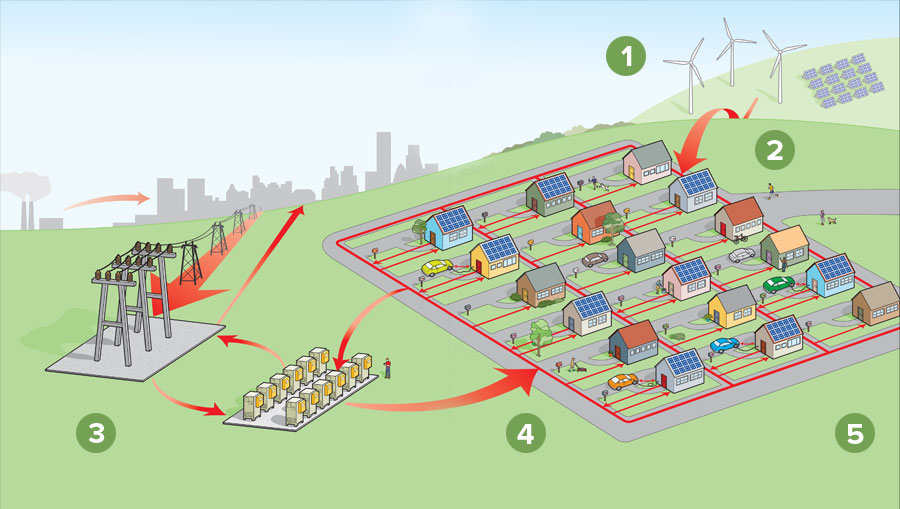
The document, prepared by Energy for the People and the ATA might initially send shivers down the spine of Big Energy; one that is already quivering from the impact of the home solar revolution in Australia.
This doesn’t necessarily mean households would be reliant on whatever panels they could fit on the roof. It could also involve “micro-grids” where communities buy back their local energy grid and invest in local energy generation and storage says Tosh Szatow, director of Energy for the People. Continue reading
Solar energy microgrid viable for rural towns in Victoria
Australia’s micro-grid opportunity, Business Spectator, Tristan Edis, 21 Jan 14 A new report released today suggests that the improving economics of solar and battery technology mean that by 2020 it would be cost-effective for greenfield housing
What’s highly surprising is that the authors of the report suggest that it could be economically viable for some Victorian regional towns to move to self-contained solar micro-grids today.

The study was prepared by the Alternative Technology Association and the organisation Energy for the People, which is focused on developing community clean-energy power projects. It looked at three alternative Victorian locations for assessing the viability of stand-alone power solutions: the regional town of Bendigo; Werribee – a fringe suburb of Melbourne experiencing rapid greenfield housing estate growth; and inner urban Melbourne. Continue reading
Renewable Energy Target enabled Musselroe Wind Farm
the jobs and investment in Tasmania would not have been possible without the Renewable Energy Target, which is supporting the development of new clean energy projects right across Australia.
This year sees yet another review of the RET, with initial signals from Prime Minister Abbott being less than encouraging – a situation that is negatively affecting investment in new major renewable energy projects in Australia.
 Tasmania’s Musselroe Wind Farm Opens, Renewable Energy News, 20 Jan 14 Tasmania’s largest wind farm was officially opened on Wednesday by Premier Lara Giddings. The 168-megawatt Musselroe Wind Farm consists of 56 Vestas wind turbines and is joint venture operated by Shenhua Clean Energy and Hydro Tasmania.
According to Hydro Tasmania, the wind farm is generating enough energy to supply the needs of up to 50,000 homes; equivalent to the residential power needs of Burnie and Devonport combined…..Clean Energy Council Chief Executive David Green –
“The $394 million Musselroe Wind Farm has employed Tasmanians in construction jobs since 2011, and the steel towers for the project were manufactured locally in Launceston,” he said. Continue reading
1 This month



Help Aunty Sue Protect Her Land and Sacred Sites From Destructive Rocket Testing.
.

Australians deserve the truth
about
AUKUS – https://aukuspublicinquiry.com/

PETITION – To: Prime Minister Anthony Albanese and the Australian Labor Government

of the week – Australians for War Powers Reform (AWPR)
To see nuclear-related stories in greater depth and intensity

