Australia’s 9 news papers gave Navy chief a platform for a resounding attack the doubters on AUKUS nuclear submarine
‘Hand-wringers’ under attack as Navy chief and Nine round on AUKUS doubters
Australia’s chief of Navy believes AUKUS is one of the country’s greatest nation-building projects. And Nine papers were happy to give him a rooftop to shout from.
Crikey, DAVID HARDAKER, APR 17, 2023
The Nine mastheads have continued their full-throated backing of all things AUKUS, allotting prime weekend front-page space to Australia’s chief of Navy Mark Hammond, who — blow me down — laid out why the nation must get behind the Navy’s submarine project.
In a tour de force of military reasoning, the 37-year Australian Defence Force veteran also picked up some of the talking points advanced by the political class to defend the $368 billion decision sprung on the nation just a few weeks ago.
Hammond lamented that AUKUS was not being hailed as one of the great nation-building projects, such as the Snowy Mountains Hydro-Electric scheme. ……………. (registered readers only)
Washington Says “Journalism Is Not A Crime” While Working To Criminalize Journalism

There is no greater threat posed to world press freedoms than the one the US is presenting with its persecution of Julian Assange
Caitlin Johnstone https://caitlinjohnstone.substack.com/p/washington-says-journalism-is-not?utm_source=post-email-title&publication_id=82124&post_id=113393100&isFreemail=true&utm_medium=email 9 Apr 23
After a certain point criticizing the hypocrisy and contradictions of the US-centralized empire starts to feel too easy, like shooting fish in a barrel. But hell let’s do it anyway; the barrel’s right here, and I really hate these particular fish.
Russian security services have formally filed espionage charges against Wall Street Journal reporter Evan Gershkovich, who has been detained in Russia since his arrest last month. Gershkovich reportedly denies the spying allegations and says he was engaged in journalistic activity in Russia.
This news came out at the same time as a joint statement was published by Senate Majority Leader Chuck Schumer and Senate Minority Leader Mitch McConnell condemning Gershkovich’s detention as a violation of press freedoms.
“Let there be no mistake: journalism is not a crime,” the senators write. “We demand the baseless, fabricated charges against Mr. Gershkovich be dropped and he be immediately released and reiterate our condemnation of the Russian government’s continued attempts to intimidate, repress, and punish independent journalists and civil society voices.”
The use of the phrase “journalism is not a crime” is an interesting choice since the most common individual case you’ll hear it used in reference to is surely that of Julian Assange, who has been locked in a maximum security prison for four years while the US government works to extradite him for the crime of good journalism. Every pro-Assange demonstration I’ve ever been to has featured signs with some variation of the phrase “journalism is not a crime,” and any Assange supporter will be intimately familiar with that refrain.
So as an Assange supporter it sounds a bit odd to hear that slogan rolled out by two DC swamp monsters who have both enthusiastically supported the persecution of the world’s most famous journalist.
“He has done enormous damage to our country and I think he needs to be prosecuted to the fullest extent of the law. And if that becomes a problem, we need to change the law,” McConnell said of Assange after WikiLeaks published thousands of diplomatic cables in 2010.
“Neither WikiLeaks, nor its original source for these materials, should be spared in any way from the fullest prosecution possible under the law,” Schumer said in 2010.
“Now that Julian Assange has been arrested, I hope he will soon be held to account for his meddling in our elections on behalf of Putin and the Russian government,” Schumer tweeted when Assange was dragged from the Ecuadorian embassy in London almost exactly four years ago. (Assange has not been charged with anything related to Russia or the 2016 election, and allegations of collusion with Russia remain completely unsubstantiated to this day.)
These are two of the most powerful elected officials in the world, puffing and posing as brave defenders of press freedoms after having actively facilitated their government’s attempts to destroy those very press freedoms. Their government is working to extradite and imprison Assange under the Espionage Act for engaging in what experts say is standard journalistic activity, which will allow them to set a legal precedent in which any journalist anywhere in the world can be extradited and prosecuted for exposing US war crimes like Assange did.
There is no greater threat posed to world press freedoms than the one the US is presenting with its persecution of Julian Assange, a persecution which has been fervently endorsed by Schumer and McConnell and all the other Washington swamp creatures who are melodramatically rending their garments about Evan Gershkovich today.
Which is of course ridiculous. You don’t get to say “journalism is not a crime” while literally working to criminalize journalism. Those positions are mutually exclusive. Pick one.
It’s worthwhile to point out the hypocrisy of US empire managers, not because hypocrisy in and of itself is some uniquely grave evil but because it shows that these people do not stand for what they pretend to stand for. The US empire does not care about press freedoms, it cares about power and domination, and the noises it makes in support of journalism are only ever made as a cynical ploy with which to bludgeon disobedient foreign governments on the world stage.
Assange exposed many inconvenient facts about the US empire in his work with WikiLeaks, but none have been so inconvenient as what he’s exposed by forcing them to come after him and reveal their true face in their brazen persecution of the world’s greatest journalist.
Has the USA captured Australia’s media?
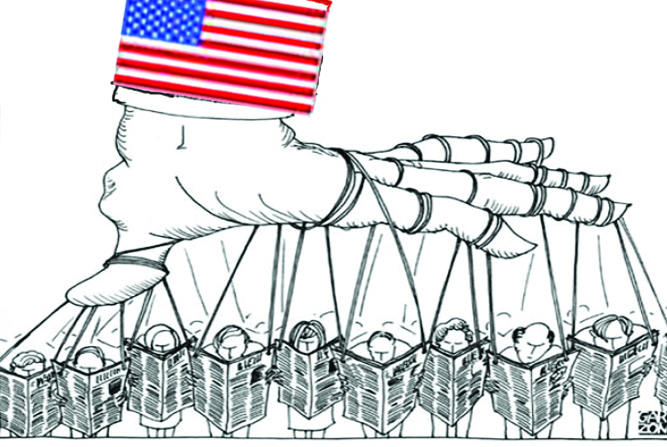
Australia is now on a strategic risk escalator controlled by Washington. Yet our media presents Beijing as the protagonist.
By Mike Gilligan, Mar 29, 2023, https://johnmenadue.com/has-the-usa-captured-australias-fourth-estate/
The uniformly negative reaction of the national press gallery to former PM Paul Keating’s views on Australia’s security raises questions not just of its intellectual adequacy but of whether the media has been captured by and is knowingly serving the United States at Australia’s expense.
How might one distinguish commentary which knowingly favours US objectives which increase risk and cost for Australia from incompetence having the same result? Perhaps case studies of commentators’ past writings could reveal patterns to help readers judge.
Let’s take a prominent journalist. Peter Hartcher, political and international editor for the Sydney Morning Herald, is richly experienced. A long-standing opinion writer at the national level who has spent years in the US. One assumes such a figure would inform Australians authentically and perceptively of developments in the United States which affect Australia as a major security partner, from an Australian perspective. Not only should we expect insightful knowledge to reside in such a figure but that this be evident in published work.
Undoubtedly, since the signing of the ANZUS treaty in 1951 the decisive shift affecting our security relationship has been the influence on US foreign policy of “neo-conservativism”.
Spawned in Chicago academia and arriving in Washington following the Soviet invasion of Afghanistan in 1979, “neocons” contrived the unfounded invasion of Iraq in 2003. Their ethos prevails to this day. In a nutshell, the neocon ethos espouses pre-emptive action to prevent any nation becoming a challenge to US hegemony, by identifying potential rivals early and countering with force as necessary. Anything goes, including truth. That allies should bear the burden for US dominance is axiomatic.
It is in this context that China has been declared by the US to be the principal threat to its global domination. Based on the neocon algorithm, China is deemed to be the priority political and economic competitor, to be diminished to insignificance, employing military force as necessary.
The neocon policy mindset in America is profoundly different from that which Australia experienced in San Francisco seventy years ago when negotiating ANZUS. One would expect a half-competent Australian international editor to pick up on that shift. And embed this new reality in writing on US/China security matters. To thus shape the tone of the issues and conclusions. Assessing Hartcher’s writing for even a hint of this quality goes to the competence of the correspondent. Readers can judge whether such an attribute resides in Hartcher’s commentary. Which says nothing necessarily of motive, however.
Closer to home and more recently, Australia’s security architecture has been destroyed by America pursuing domination of China. The destruction has passed unnoticed, without debate. Here media incompetence generally is so sustained and glaring that questions of motive automatically arise.
Who would know that the ANZUS treaty has been buried in practice? Whilst it failed to offer Australia a binding security guarantee it did support us in valuable ways to build our own self- reliant defence, using our own money for our own priorities. Now that self-reliance is done. America has insinuated its forces onto Australian territory and into our defence resources and our foreign and defence policy – for its own objectives against China.
How? The takeover was formalised through a document known as the Force Posture Agreement, compliments of former US Secretary of State John Kerry visiting us in 2014. Embraced by the Abbot government and fertilised by every government since. Therein, Australia agrees to provide the real estate and support for American military operations against China, under American control and command, at America’s pleasure. It is expandable, again at America’s pleasure, without limits.
Hereby, Australia has taken on acutely elevated geostrategic risk – with no end in sight, willingly. Australia is now on a strategic risk escalator controlled by Washington. Yet our media presents Beijing as the protagonist.
Worse, as with ANZUS, America has not provided any guarantee of armed response when Australia is attacked. The Australian government is now subsidising the US to attack China from our sovereign territory whenever the US chooses, with no insurance.
Overturning of Australia’s security superstructure should have been serious grist to a foreign correspondent’s mill. Yet Hartcher has not even scratched that surface in commentary. Really, could mere incompetence explain this void, not just in Hartcher’s coverage but across the entire fourth estate? Ignorance is an unlikely explanator given Hatcher’s deep, relevant background. Clearly it is to America’s benefit that Australians remain uninformed of the hazards being imposed, and our extra costs, with our governments’ encouragement.
Australians are forced to entertain purposeful manipulation of their right to know, to America’s advantage.
All the while, some earnest Australians have been working for change so that Parliament has the say on Australia going to war. What good is that when America has free rein to wage war from Australia whenever it suits Washington? American operations mounted from here against China will automatically render us at war in China’s eyes. What any Australian parliament or government might say would be of no practical consequence to a China under attack from B52 bombers based at Tindal.
Then there was Hartcher’s “red alert” series on war with China, recently run by the Herald. That paper’s editorial advised readers that “fighting with China could come as early as 2026”. A professional editor would have demanded authoritative evidence. It’s easy enough to come by, publicly. The US Secretary of Defence intelligence report to Congress for 2022 advises that China’s military plan is to be able to restrain US forces on its periphery by 2027. That is, China is focussed on dealing with American military pressure on its sea and air surrounds. And Australian forces are involved now in that pressure on China. So the fact is that China is trying to deal with attack on its territory by forces which include Australia’s. That destroys the foundation of Hartcher’s “red alert” construct.
In short, Hartcher has a habit of misleading Australians on their security, and the enormous risk being dumped on Australia by our friend America. Not by China. Both by commission and omission this commentator’s work exhibits a pattern of serving US interests while denying Australian readers. Whether this is purposeful servitude to American interests at Australian’s expense is for readers to decide.
More surely, from one who surely knows, Henry Kissinger once said: “To be an enemy of the United States is dangerous, but to be a friend is fatal”. No Australian government has had the ticker to look for other ground.
The Road to War: latest film by David Bradbury
By Sandi KeaneMar 28, 2023, https://johnmenadue.com/the-road-to-war-latest-film-by-david-bradbury/?fbclid=IwAR3lvD8het8Z3qvYDpluqiSqJSvMP8KfDvzJZ26FS6xlMQ54bPTslzldOfA
As international tensions rise to a new level, with the Ukraine war passing its first anniversary and the Albanese Government set to announce its commitment of hundreds of billions of dollars to new weaponry, nuclear propelled subs, stealth bombers etc, The Road to War brings into sharp focus why it is not in Australia’s best interests to be dragged into an American-led war with China.
The Road to War is directed by one of Australia’s most respected political documentary filmmakers, David Bradbury. Bradbury has more than four decades of journalistic and filmmaking experience behind him having covered many of the world’s trouble spots since the end of the Vietnam war — SE Asia, Iraq, East Timor, revolutions and civil war in Central and South America, India, China, Nepal and West Papua.
“I was driven to make this film because of the urgency of the situation. I fear we will be sucked into a nuclear war with China and/or Russia from which we will never recover, were some of us to survive the first salvo of nuclear warheads,” says the twice Oscar-nominated filmmaker.
“We must put a hard brake on Australia joining in the current arms race as the international situation deteriorates. We owe it to our children and future generations of Australians who already face the gravest existential danger of their young lives from Climate Change,” says Bradbury.
There is general concern among the defence analysts Bradbury interviews in the film that Australia is being set up to be the US proxy in its coming war with China. And that neither the Labor nor LNP governments have learnt anything from being dragged into America’s wars of folly since World War II — Korea, Vietnam, two disastrous wars in Iraq and America’s failed 20 year war in Afghanistan which ripped that country apart, only to see the Taliban warlords return the country and its female population to feudal times.
“Basing US B52 and Stealth bombers in Australia is all part of preparing Australia to be the protagonist on behalf of the United States in a war against China. If the US can’t get Taiwan to be the proxy or its patsy, it will be Australia,” says former Australian ambassador to China and Iran, John Lander.
Military analyst, Dr Richard Tanter, fears the US military’s spy base at Pine Gap near Alice Springs, will be the first target of any direct confrontation between the US and Russia or China.
“The US military base at Pine Gap is critical to the US military’s global strategy, especially nuclear missile threats in the region. The generals in Moscow and Beijing would have it as a top priority on their nuclear Hit List,” says Dr Tanter whose 40 years of ground-breaking research on Pine Gap with colleague, Dr Des Ball, has provided us with the clearest insight to the unique role Pine Gap plays for the US. Everything from programming US drone attacks to detecting the first critical seconds of nuclear ICBM’s lifting off from their deep underground silos in China or Russia, to directing crippling nuclear retaliation on its enemy.
“Should Russia or China want to send a signal to Washington that it means business and ‘don’t push us any further’, a one-off nuclear strike on Pine Gap would do that very effectively, without triggering retaliation from the US since it doesn’t take out a US mainland installation or city,” says Dr Tanter.
“It’s horrible to talk about part of Australia in these terms but one has to be a realist with what comes to us by aligning ourselves with the US,” Tanter says.
“Studies show in the event of even a very limited nuclear exchange between any of the nuclear powers, up to two billion people would starve to death from nuclear winter,” says Dr Sue Wareham of the Medical Association for the Prevention of War.
“The Australian Government, Prime Minister, Anthony Albanese, and Minister for Defence, Richard Marles, have a serious responsibility to look after all Australians. Not just those living in cities. Were Pine Gap to be hit with even one nuclear missile, Health Minister Mark Butler would be hard pressed to find any volunteer nurses and doctors willing to risk their lives to help survivors in Alice Springs, Darwin and surrounding communities from even one nuclear missile hitting this critical US target,” says Dr Wareham.
Further information or interviews with David Bradbury: david@frontlinefilms.com.au
Media enquiries:
Sandi Keane: 0427 260 319 keanesandi@gmail.com, Twitter: @jarrapin
In Australian conventional media, when it comes to discussion on AUKUS, only certain limited views are permissable.
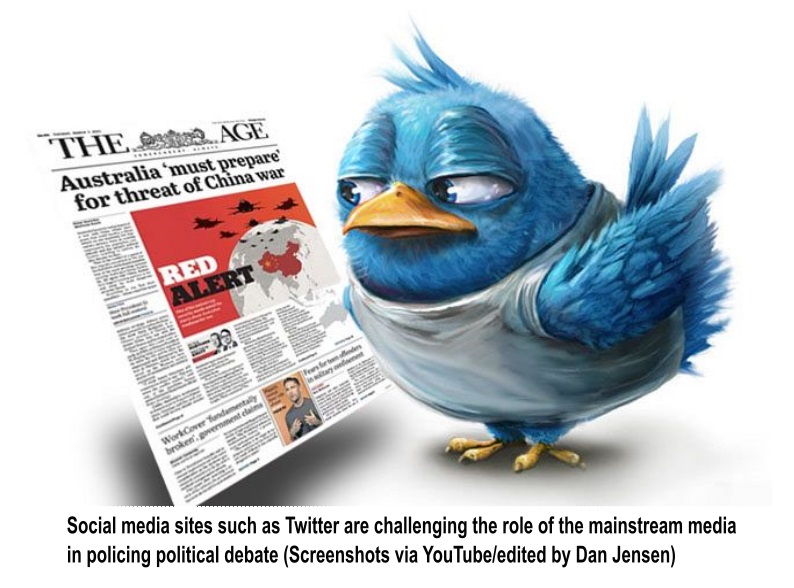
Social media and independent news sites have had a significant effect on opening up the political debate over the AUKUS deal, writes Professor John Quiggin.
Social media and independent news sites have had a significant effect on opening up the political debate over the AUKUS deal, writes Professor John Quiggin.
Opening the Overton window. Independent Australia, by John Quiggin | 24 March 2023
ONE OF THE MOST useful ideas in thinking about political debate is that of the Overton window, named after American political scientist Joseph Overton. The Overton window is the range of ideas considered permissible in public discussion at any given time.
Overton’s crucial insight was that, while active participants in political debate could only take positions within the window of acceptable views, outside bodies like think tanks could help to shift it.
……………………………….The Overton window provides a way of thinking about current policy debate, particularly the treatment of the AUKUS deal by the mass media. At one end of the Overton window is the hyperbole of warmongers like Matthew Knott gushing that Australia is ‘no longer a middle power’ to the more cautious view that perhaps we should have had some public discussion before such a major change.
The mass media has been vigorous in policing even the slightest dissent within the political class, such as the questions raised, cautiously, by a handful of Labor backbenchers. It has responded with fury to criticism from those it can’t control like Paul Keating and Malcolm Turnbull. And, as usual, it has done its best to ignore criticism from outside the Overton window.
Although think tanks like the Australia Institute still play a role, the biggest challenge to the mainstream media’s role in policing debate has come from social and alternative media. The ease of communication through the internet is reflected in social media sites like Facebook, Twitter and more recently Mastodon, which have largely displaced older models of blogging. Equally important has been the proliferation of online magazines like Independent Australia and Crikey, and the rise of single-author newsletters distributed through Substack and Medium.
At least regarding issues like AUKUS, there is an Overton window for social and alternative media. Almost all opinions are critical, with the dominant viewpoint being that the project is economically wasteful and puts Australia in danger of being dragged into war. The most positive views to be found on Twitter are “Labor inherited this from Morrison” and “cheer up, it will probably never happen”. The only point of contact with the political class Overton window is the view that we need to discuss this further.
Traditional mass media still has a greater reach than online alternatives. But it can no longer constrain debate within the Overton window defined by the political class.
AUKUS, the Australian Labor Party, and Growing Dissent
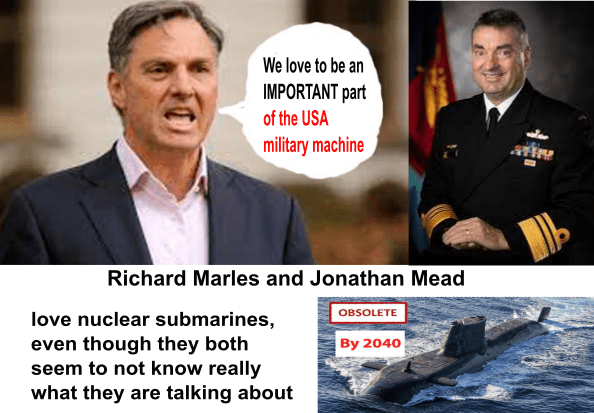
the Royal Australian Navy would be far better off acquiring between 40 to 50 of the Collins Class submarines to police the coastline rather than having nuclear powered submarines lying in wait off the Chinese shoreline.
March 25, 2023, by: Dr Binoy Kampmark https://theaimn.com/aukus-the-australian-labor-party-and-growing-dissent/
It was a sight to behold and took the wind out of the bellicose sails of the AUKUS cheer squad. Here, at the National Press Club in the Australian capital, was a Labor luminary, former Prime Minister of Australia and statesman, keen to weigh in with characteristic sharpness and dripping venom. Paul Keating’s target: the militaristic lunacy that has characterised Australia’s participation in the US-led security pact that promises hellish returns and pangs of insecurity.
In his March 15 address to a Canberra press gallery bewitched by the magic of nuclear-propelled submarines and the China bogeyman, Keating was unsparing about those “seriously unwise ministers in government” – notably Foreign Minister Penny Wong and Defence Minister Richard Marles, unimpressed by their foolish, uncritical embrace of the US war machine. “The Albanese Government’s complicity in joining with Britain and the United States in a tripartite build of a nuclear submarine for Australia under the AUKUS arrangements represents the worst international decision by an Australian Labor government since the former Labor leader, Billy Hughes, sought to introduce conscription to augment Australian forces in World War One.”
In terms of history, this was chilling to Keating. The AUKUS security pact represented a longing gaze back at the Mother Country, Britain, “shunning security in Asia for security in and within the Anglosphere.” It also meant a locking alliance with the United States for the next half-century as a subordinate in a containment strategy of Beijing. This was a bi-partisan approach to foreign policy that saw the US dominating East Asia as “the primary strategic power” rather than a balancing one.
For Keating, the impetus for such madness came from a defence establishment that dazzled the previous Prime Minister, Scott Morrison. That effort, he argues, was spearheaded by the likes of the US-funded Australian Strategic Policy Institute and Andrew Shearer of the Office of National Intelligence. They even, he argues, managed to convince PM Albanese, Marles and Wong to abandon the 20-month review period on the scope of what they were seeking.
The steamrolling Keating was also unsparing in attacking a number of journalists for their ditzy, adolescent belligerence. The sword, once produced, was never sheathed. Peter Hartcher, most notably, received a generous pasting as a war infatuated lunatic whose anti-China campaign at the Fairfax presses had been allowed for years.
In terms of the submarines themselves, Keating also expressed the view that the Royal Australian Navy would be far better off acquiring between 40 to 50 of the Collins Class submarines to police the coastline rather than having nuclear powered submarines lying in wait off the Chinese shoreline.
As we all should know, submarine policy is where imagination goes to expire, often in frightful, costly ways. For all Keating’s admiration for the Collins Class, it was a nightmarish project marred by fiascos, poor planning and organisational dysfunction within the defence establishment. At stages, two-thirds of the Australian fleet of six submarines was unable to operate at full capacity. The lesson here is that submarines and the Australian naval complex simply do not mix.
The reaction from the Establishment was one of predictable dismissal, denial and distortion, typical of what Gore Vidal would have called deranged machismo. Instead of being critical of the powers that are, they have turned their guns and wallets on spectres, ghosts and devilish images. The tragedy looms, and it will be, like many tragedies, the result of colossal, unforgivable stupidity.
At the very least, the intervention by Keating, notably in the Labor Party, has not gone unnoticed. Within the Labor caucus, tremors of dissatisfaction are being recorded, breaches growing. West Australian Labor backbencher Josh Wilson defied his own party’s dictates by telling colleagues in the House of Representatives how he was “not yet convinced that we can adequately deal with the non-proliferation risks involved in what is a novel arrangement, by which a non-nuclear weapons state under the NPT (Non-proliferation of Nuclear Weapons Treaty) comes to acquire weapons-grade material.”
Wilson’s views are not outlandish to the man. He is keen to challenge the notion of unaccountable executive war powers, a problem that looms large in the Westminster system. “To assume that such decision-making is already perfect, immutable, and beyond scrutiny,” he wrote in December last year, “puts Australia at risk of making the most dangerous judgments without the best institutional framework for doing so.”
A gaggle of former senior Labor ministers have also emerged, even if they initially proved sluggish. Peter Garrett, former environment minister and front man of Midnight Oil, while proving a bit squeamish about Keating’s invective, found himself in general agreement. “The deal stinks with massive cost, loss of independence, weaking nuke safeguards & more.”
Kim Carr, who had previously held ministerial positions in industry and defence materiel, revealed that the matter of AUKUS had never been formally approved in the Federal Labor caucus, merely noted. Various “key” Labor figures – again Marles and Wong – agreed to endorse the proposition put forth to them on September 15, 2021 by the then Coalition government.
He also expressed deep concern “about a revival of a forward defence policy, given our performance in Vietnam.” For Carr, the shadow cast by the Iraq War was long. “Given it’s 20 years since Iraq, you can hardly say our security agencies should not be questioned when they provide their assessments.”
For former foreign minister, Gareth Evans, there were three questions: whether the submarines are actually fit for purpose; whether Australia retained genuine sovereignty over them in their use; and, were that not the case, “whether that loss of agency is a price worth paying for the US security insurance we think we might be buying.”
Will these voices make a difference? They just might – but if so, Australia will have to thank that political pugilist and Labor veteran who, for all his faults, spoke in terms that will be considered, in a matter of years, treasonous by the Empire and its sycophants.
Australian Strategic Policy Institute (ASPI) flexes its muscles – forces the ABC to back down on a Media Watch show that dared to criticise ASPI
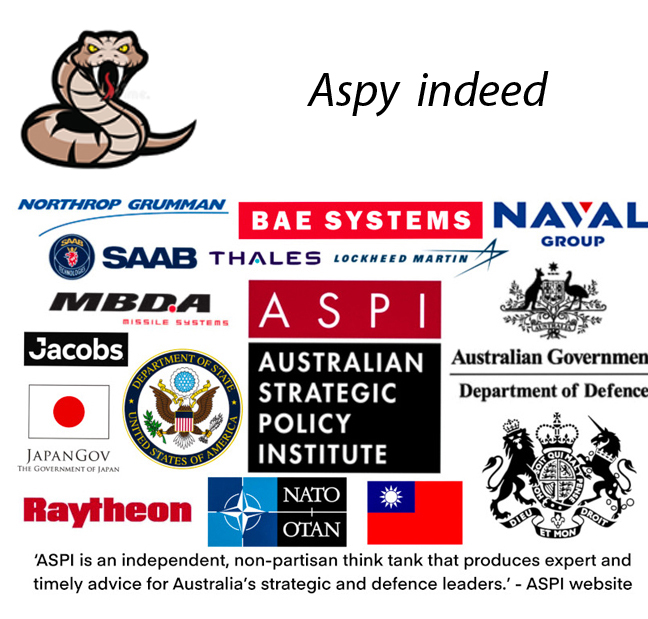
Despite ASPI telling Media Watch it only has four defence industry sponsors, page 143 of its latest annual report clearly lists five. Since its establishment, ASPI has enjoyed the financial largesse of a dozen weapons makers, which collectively picked up $51 billion in Defence contracts between 2011 and 2021.
ASPI conveniently classifies sponsors who make billions of dollars supplying mainly high-tech services to the military as “private sector” companies.
ASPI takes exception to media scrutiny, By Ainslie Barton, https://johnmenadue.com/aspi-takes-exception-to-media-scrutiny/ 25 Mar 23,
ABC’s Media Watch backs down, following complaint from Australian Strategic Policy Institute, after it aired a segment of Channel Nine political reporter Chris O’Keefe berating both ASPI and Nine Newspaper over the Red Alert series.
Two weeks ago, ABC’s Media Watch carried the banner “Hysterical reporting stokes fears of war with China” aimed at Nine Newspapers’ three-part Red Alert series in the Sydney Morning Herald and The Age. Host, Paul Barry took them to task for gathering a one-sided China hawk panel upon which to base its report. The program included comments from a host of experts who strongly disagree with the proposition that China is poised for war.
It also quoted from mainstream media, including a clip from Nine’s Today Show in which political correspondent Chris O’Keefe had this to say, “The reporting this morning is hysterical, now if you’ve got the Australian Strategic Policy Institute [ASPI] who are saying ‘Oh well, we are the ones who could be going off to war in three years’, well they’re funded by the Australian Defence Force, Lockheed Martin, Thales and Boeing.”
Barry later brought up one of Nine’s China experts, former ASPI boss Peter Jennings, making it clear he was no longer the think tank’s executive director.
This week, Media Watch again picked up the China threat and nuclear submarine debate, following former prime minister Paul Keating’s National Press Club appearance. In summary, Barry argued instead of mainstream journalists just launching into Keating for opposing AUKUS, they should have been doing their actual jobs. That job is not being cheerleaders for our massively hawkish foreign and defence policies, it’s asking questions about the government’s rationale to commit hundreds of billions of dollars to nuclear submarines.
However, at the end of the episode, it was Barry himself coming up with explanations, saying this, “And finally, a clarification about last week’s show. When discussing Nine’s Red Alert series on China we played a short clip of Chris O’Keefe linking Peter Jennings to the Australian Strategic Policy Institute. ASPI says Jennings no longer plays an active role with the institute and it was not involved in the framing of The Age and Herald’s report. ASPI also says it receives funding from only four defence manufacturers and it’s two percent of its budget.”
Even though the hot war may not have yet started the fog created by ASPI abounds.
Jennings is synonymous with ASPI, outside of Canberra he was a little-known Liberal ministerial adviser and a Defence Department policy wonk. It wasn’t until he took up the role at ASPI that he became the go to China hawk for mainstream media.
He might have vacated the executive director’s office but the views he expressed in the Nine Newspapers series are entirely consistent with his views at ASPI, and indeed the views of his successor Justin Bassi.
Despite ASPI’s constant claim of independence, Bassi walked right out of the office of Liberal Cabinet Minister Marise Payne into ASPI’s office, just a few blocks from Parliament House. He was a ‘captain’s pick’ with it widely reported then Defence Minister Peter Dutton intervened to veto the ASPI board’s preferred candidate, instead installing China hawk Bassi. The appointment of the ASPI executive director has to be ratified by the Cabinet, indeed a very broad interpretation of the term “independent”.
What constitutes no active role?
Jennings might have vacated his corner office but, the simple fact is, immediately upon the completion of his tenure, he assumed the position of “ASPI Senior Fellow”. His profile is on the ASPI website, his phone number is included, and that number is the ASPI direct line.
As ASPI complained, it might not have framed the Nine Newspapers report, but it absolutely framed the narrative. No single group has done more to portray China as a military threat than ASPI. There is an argument, had ASPI not spent years laying the China threat groundwork, this Nine Newspapers series would not have hit the front pages.
While Bassi had nothing to do with the Red Alert series, one could hardly argue he didn’t support it, after all he Tweeted a link to the SMH story the day of publication.
Far more egregious than this and the nature of Jennings’ ongoing connections with ASPI are those of Nine Newspapers’ gang of five experts. One in particular is Lavina Lee, who Nine described as a “geopolitics guru” and “senior lecturer in the Department of Security Studies and Criminology at Macquarie University”.
What both Nine in its publications, and presumably ASPI in its demands to Media Watch, did not disclose is Lee’s position as a member of the ASPI Council. This is not an honorary role, as the ASPI Annual Report reveals, it is a paid position.
The issue with Lee is not so much the freedom to express her opinions outside of her role at ASPI. It’s the fact she was peddling a narrative indistinguishable from ASPI’s, under the guise of being an independent academic, and did so without disclosing her formal paid role with the think tank.
Breaching the defences
Despite ASPI telling Media Watch it only has four defence industry sponsors, page 143 of its latest annual report clearly lists five. Since its establishment, ASPI has enjoyed the financial largesse of a dozen weapons makers, which collectively picked up $51 billion in Defence contracts between 2011 and 2021.
ASPI conveniently classifies sponsors who make billions of dollars supplying mainly high-tech services to the military as “private sector” companies.
One of its, non-defence industry, backers is the multi-billion dollar US engineering and systems integration company Leidos which has a substantial defence division. According to figures published on the Department of Finance website, since July 2021, it has been awarded more than 140 contracts, with the Department of Defence and security agencies, worth over $1 billion. The classification of Leidos as a run of the mill private sector player seems to be a loose definition.
Other, non-defence, supporters include engineering company Jacobs (107 Defence contracts worth $154 million); cybersecurity company Quintessence Labs, which has been awarded one small Defence contract; Palo Alto Networks which supplies multi-billion dollar network security systems for the military; Splunk Technologies, yet another military supplier; Senatas, a maker of military encryption systems; and software company Oracle, one of the biggest ICT service suppliers to the US military.
That adds up to 12 current sponsors who either make weapons or provide services supporting military infrastructure. The lesson is you can’t take anything ASPI says at face value.
Australian corporate papers call for war with China, nuclear weapons and mass conscription
Oscar Grenfell, SEP candidate for NSW Legislative Council, 10 Mar, 2023, https://www.wsws.org/en/articles/2023/03/10/tutm-m10.html

In a militarist barrage, Nine Media and its main mastheads—the Sydney Morning Herald and the Age—published a major series this week insisting that Australia must prepare to fight an imminent war against China.
“Red alert” called for the stationing of nuclear weapons and long-range missiles in northern Australia, the introduction of mass conscription and preparations for the country to host as many as 200,000 US military personnel.
The articles are a demand for total war, not far off in the future, but as an immediate practical order of business. The series stressed that a war will be fought in the Indo-Pacific, not in twenty years or a decade, but within the next three years.
The multi-part series was not published in response to any specific development. Over the past week, there has not been a major geo-political occurrence in the region. China has not carried out any acts of aggression.

Instead, “Red alert” is part of a coordinated onslaught by those sections of the US and allied media that speak directly for the American military-intelligence apparatus. In concert, publications such as the Wall Street Journal and the Washington Post have published frothing condemnations of China. It is as though someone in the White House, the Pentagon or both flicked a switch that sent out an alert to their lackeys in the media.
The provocative attacks on Beijing come as the US and NATO escalate their proxy war against Russia in Ukraine. It is becoming ever more open that the war effort in Eastern Europe is one prong of a far broader militarist project. The US is seeking to inflict a crippling military defeat on Russia, as the essential prelude to war with China, which is viewed as the chief threat to American imperialist interests.
“Red alert” was couched as an “independent” review by five “experts” of Australia’s capabilities to fight a major war over the coming years. It was timed to precede the release of an official review commissioned by the federal Labor government, due out later this month. The claims of “independence” are a violation of the most basic journalistic ethics and standards related to disclosure.
One is employed directly by the Australian government, four are employed by or contribute to the Australian Strategic Policy Institute, one of the most hawkish government-funded think tanks, or the Centre for Strategic and International Studies, which is among the most militaristic Washington think tanks. In other words, they could not be any less independent. They are mouthpieces of the state apparatus, as well as of private arms manufacturers that are making a fortune on the back of the military build-up.
The contents of the “Red alert” review are no less false than its purported independence. The series is a compendium of the lies, double speak and incendiary accusations used by Washington and its allies in the Australian political establishment to justify an aggressive military encirclement of China.
The timeline featured by “Red alert,” of a war with China within three years, comes straight from the American military. It is simply a promotion of views advanced by US Air Force General Michael Minihan, who earlier this year forecast an American war with China by 2025.
The supposed cause of such a war advanced by “Red alert” is identical to that put forward by Minihan. The Chinese government would purportedly launch an invasion of Taiwan, compelling US intervention and rapidly spiralling into an all-out war.
“Red alert” tries to present the US, as well as its allies, such as Australia, as engaging in a defensive effort on behalf of “little Taiwan,” as they have supposedly done in defence of “little Ukraine.” This depiction is a fraud on every level.
The US has been carrying out a vast military build-up throughout the Indo-Pacific since it unveiled the “pivot to Asia” in 2011. The Pentagon has outlined an “Air Sea Battle” plan as to how an aggressive US war against China would be waged. Chief US strategists have openly acknowledged that this is motivated by fears of China’s economic rise, and American imperialism’s relative decline.
Taiwan is simply a pretext. The US and its allies have sought to transform it into a flashpoint. Successive US governments, beginning with Obama, have undermined the status quo. Since the 1970s, the international community, including American administrations, de facto acknowledged the Chinese Communist Party as the sole legitimate government of all of China, including Taiwan, located just 160 kilometres from mainland China.
But now, Biden has repeatedly declared that the US would fight a war to defend Taiwanese “independence.” His administration has tripled US forces on the island, while directly providing military aid and expanding diplomatic ties with Taipei. The aim is to provoke a Chinese response, which would serve as the justification for longstanding US war plans.
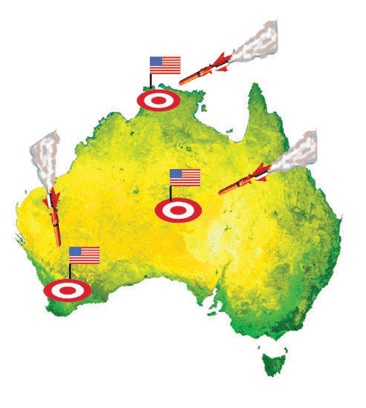
“Red alert” asserts that such a war would immediately become region-wide. Australia would be involved from the outset and within 72 hours of such a conflict, there would be Chinese attacks on Australian cyber networks and critical infrastructure. The US Pine Gap spy and military coordination base in central Australia would be a target, as would other Australian-US installations.
The series declares that in the event of such a war, as many as 200,000 American troops would descend on Northern Australia. That is, 47,000 less than the entire population of the Northern Territory, meaning the entire region would be transformed into a massive US base.
“Red alert” links this scenario to a call for the acquisition of major missile systems and other offensive weaponry. This is in line with a rapid build-up already underway, which is being dramatically accelerated by the Labor government. Virtually every week, there is a new announcement of military acquisition, be it sea mines, US HIMARS or naval strike missiles.
Conscious of the historic opposition to war among workers and young people, the document cites the necessity to break the “taboos” of conscription and nuclear weapons.
Perhaps the one note of truth in the series is its description of what a major war in the Indo-Pacific would involve. It would be a “whole of nation” effort, essentially requiring the militarisation of the entire society.
Along these lines, the “Red alert” series calls for the introduction of conscription. This would involve not only teenagers and young adults, but potentially anyone required for the war effort in what would be a war economy and the militarisation of society.
The series also advocates the stationing of US nuclear weapons in Northern Australia, on long-range missile systems that could fire them into the Indo-Pacific. As is the case whenever such proposals are made, the “experts” assert that this would serve as a “deterrent.” But they contradict themselves because in the previous parts of the series, the “experts” insisted that war is inevitable. The inescapable conclusion is that they are calling for nuclear war.
“Red alert” serves several purposes. It comes amid a debate within the Australian ruling elite, over Australia’s full alignment with the US war drive against China. A minority wing has voiced concerns over the implications of this. It is not anti-war or anti-imperialist, but fears that war with Australia’s largest trading partner will devastate the economy while provoking mass social and political upheavals.
The dominant sections of the political establishment, however, are all the way with the US. Australia, as a middle-order power, has always functioned under the umbrella of the dominant power of the day to prosecute its own imperialist interests. Australia, moreover, is completely integrated into the US war machine, meaning its participation in a conflict with China would be automatic.
This integration is only deepening. Next week, Labor Prime Minister Albanese will stand alongside President Biden in San Diego, as they announce that Australia will purchase US nuclear-powered submarines. The Labor government has already permitted nuclear-capable American B-52 bombers to “rotate” through northern Australia, meaning American nuclear weapons may already be stationed here.
The primary target of the “Red alert” series is the population itself. Its authors write about the need to change Australian “psychology.” They know that their mad plans for war are deeply opposed by the vast mass of workers and young people.
Conscription provoked massive social upheavals, both in World War I and during the Vietnam War. There is likewise a long history of broad opposition to nuclear weapons.
The propaganda blitz is aimed at bulldozing these popular sentiments by asserting that there is no alternative but to fight a war. A conflict is inevitable, so the population will simply have to accept it.
But the response to “Red alert” itself shows that this will not happen. The series has received a torrent of hostile commentary on social media. The Sydney Morning Herald posted the final part, containing the recommendation for nuclear weapons and conscription, to its Twitter account yesterday. The tweet has been viewed by 161,000 people. But only 20 of them hit the like button. While proclaiming the need for an “open” and “bold” discussion, the Herald has hidden all responses to its Twitter post.
The type of war that “Red alert” advocates is incompatible with democracy. That is the real meaning of the comments by the “experts” on the “Zelensky test.” They are referencing Ukrainian President Volodymyr Zelensky, a front man for the US and NATO. The “Zelensky test” is a willingness to place the entire country on a war footing. In Ukraine, this has involved the banning of all opposition parties and the promotion of fascist and Nazi forces.
The working class must take a sharp warning from the “Red alert” series and the broader turn to war with China. Longstanding plans for a catastrophic conflict are being activated. Governments and their mouthpieces are not only asserting that war is near. They are making it so.
This is a product of the deepest crisis of the profit system since the 1930s. The alternative to the catastrophe that is being prepared is the fight to build an international anti-war movement of the working class directed against the capitalist system itself and fighting for the socialist reorganisation of society.
Meet the man who uncovered the scandal of nuclear testing in South Australia
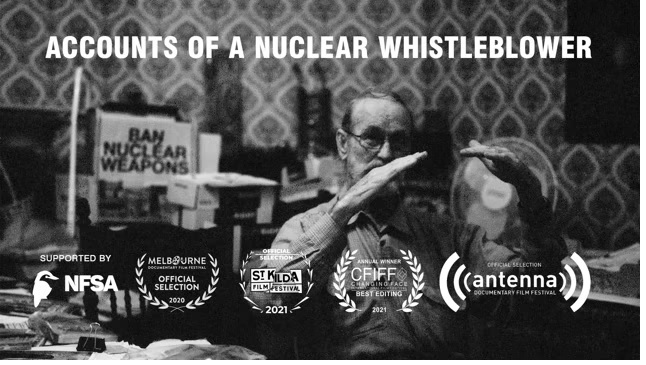
https://aeon.co/videos/meet-the-man-who-uncovered-the-scandal-of-nuclear-testing-in-south-australia
In the 1950s and ’60s, the British government conducted nuclear tests in Maralinga, a remote region of South Australia, with little understanding or forethought of the public health problems the fallout might cause. The harmful, sometimes deadly impact of these tests not only affected military conscripts, roped in without any real warning of the potential dangers, but private Australian citizens as well – and especially Indigenous peoples. Accounts of a Nuclear Whistleblower details this dark, somewhat forgotten chapter in Australia’s history via a firsthand account from Avon Hudson who, as a member of the Royal Australian Air Force, was stationed in dangerous proximity to these detonations, and later worked to expose their devastation and enduring threat. Hudson’s activism would ultimately help to precipitate the establishment in 1984 of the Royal Commission into British Nuclear Tests in Australia.
Via Director’s Library Director: Naveed Farro 7 March 2023
Australian Media Are Outright Telling Us They Are Feeding Us War Propaganda About China
Caitlin’s Newsletter, 8 March 23
The mass media in Australia have been churning out brazen propaganda pieces to manufacture consent for war with China, and what’s interesting is that they’re basically admitting to doing this deliberately.
Australians are uniquely susceptible to propaganda because we have the most concentrated media ownership in the western world, dominated by a powerful duopoly of Nine Entertainment and the Murdoch-owned News Corp. Both of those media megacorporations have recently put out appalling propaganda pieces about the need for Australians to rapidly prepare to go to war with China in defense of Taiwan, and in both of those instances have straightforwardly told their audiences that there’s an urgent need to effect a psychological change in the way all Australians think about this war.
Nine Entertainment’s Sydney Morning Herald and The Age have been busy flooding the media with testimony from a panel of war machine-funded “experts” who say Australia must hasten to get ready to join the United States in a hot war with China in the next three years. Yesterday’s dual front-page propaganda assault featured imagery of Chinese war planes flying straight at the reader, awash in red and emblazoned with the words “RED ALERT” to help everyone understand how evil and communist China is.
“Today’s Sydney Morning Herald and Age front-page stories on Australia’s supposed war risk with China represents the most egregious and provocative news presentation of any newspaper I have witnessed in over 50 years of active public life,” former Australian Prime Minister Paul Keating opined in response to the publications.
“Apart from the outrageous illustrations of jet aircraft being shown leaving a profiled red-coloured map of China, the extent of the bias and news abuse is, I believe, unparalleled in modern Australian journalism,” he added.
In the first installment of their “Red Alert” propaganda series, SMH and The Age share that their empire-funded panelists believe there’s a need to bring about a “psychological shift” in the public’s attitude toward war with China, with one panelist asserting that “the nation’s leaders should trust the public enough to include them in what can be a confronting discussion” about the need to prepare for that war.
In the second “Red Alert” installment, this same message is repeated, saying that “Australia’s vulnerabilities are not only physical, but psychological,” and again repeating the need to get everyone talking and thinking about the possibility of war with China.
“It is a real national taboo to think about the likelihood of a conflict in anything other than the most remotely theoretical perspective,” says Peter Jennings of the war machine-funded propaganda firm Australian Strategic Policy Institute, countering that “we will sleepwalk into disaster unless we openly discuss unpalatable scenarios.”
Saying that the real threat is “complacency rather than alarmism,” think tanker Lavina Lee urges Australia to confront “the possibility that we might go to war and what would happen either way. We should talk about what the world would look like if we win and what it would look like if we lose.”
Over and over again they are telling us that something must be done to change the way Australians think and talk about a war with China, in articles designed to change the way Australians think and talk about war with China. They are doing the exact thing they say must be done, while explaining why it needs to be done. They are brainwashing us with propaganda while explaining why it is necessary to brainwash us with propaganda.
Last month Murdoch’s Sky News Australia released an astonishingly propagandistic hour-long special titled “China’s aggression could start new world war,” which in its attempts to show “China’s aggression” hilariously flashed a graphic of all the US military operations currently encircling China. The segment features footage of bayonet-wielding Chinese forces overdubbed with ominous cinematic Bad Guy music, and in Sky News’ promotions for the special all the footage from China was tinged red to help viewers understand how evil and communist China is.
Toward the end of the special, Sky News’ empire-backed “experts” tell their audience that Australia needs to double its military spending, and that those in power need to explain to them why this is so important…………………………………….
Again, they’re saying there’s a desperate need to explain to Australians why they need to make sacrifices to prepare for war with China, while explaining to Australians that they need to make sacrifices to prepare for war with China. They are openly telling us that we need to be propagandized for our own good, while filling our heads with propaganda.
They’re not just filling our minds with war propaganda, they are openly telling us that war propaganda is good for us.
………………………….. This latest propaganda piece says that in the event of a hot war with China, our nation may be struck with intercontinental ballistic missiles, we may find ourselves cut off from the world while the fuel supplies we rely on dry up in a matter of weeks, and we may find our infrastructure rendered useless by massive Chinese cyberattacks.
The empire-funded “experts” acknowledge that this will not be because China is just randomly hostile to Australia, but because we are a US military and intelligence asset who will support the US empire in its war:
But why would China use its limited resources to attack Australia instead of focusing solely on seizing Taiwan? Because of the strategically crucial role Australia is expected to play for the United States in the conflict.
“Our geography means we are a southern base for the Americans for what comes next,” Ryan says. “That’s how they’re seeing us. They want our geography. They want us to build bases for several hundred thousand Americans in due course like in World War II.”
Interestingly, the article contains a rare acknowledgement in the mainstream press that the presence of the American surveillance base Pine Gap makes Australia a legitimate target for ICBMs:
At no time is it ever suggested that the fact that going to war with China could cost Australia its shipping lanes and infrastructure and even get us nuked means we should probably reconsider this grand plan of going to war with China. At no time is it ever suggested that riding Washington’s bloodsoaked coattails into World War Three against our primary trading partner might not be a good idea. At no time is it ever suggested that de-escalation, diplomacy and detente might be a better approach than rapidly increasing militarism and brinkmanship.
And at no time is it ever suggested that we should reconsider our role as a US military/intelligence asset, despite the open admission that this is exactly what is endangering us. We’re not being told to prepare for war with China because China is going to attack us, we’re being told to prepare for war with China because our masters in DC are planning to drag us into one. We’re not being told to prepare for war to defend ourselves, we’re being told to prepare for war because our rulers plan to attack China.
We see this in the way Australia is assembling its war machinery, buying up air-to-ground missiles that cannot possibly be used defensively because their sole purpose is for taking out an enemy nation’s air defenses. We see it in the way Australia is buying up sea mines, which as journalist Peter Cronau has noted is less suitable for protecting our 34,000 km of coastline than for blockading the shipping lanes of an enemy nation you wish to lay siege to. We see it in the fact that China’s military budget remains steady at around one and-a-half percent of its GDP, while the US spends 3.4 percent and Australia is being persuaded to double our share from two to four percent.
We’re not being prepared for a war to defend ourselves, we’re being prepared for a war of aggression to secure US unipolar hegemony — one that has been in the works for many years. We must resist this, and we must resist the tsunami of mass media propaganda that is designed to manufacture our consent for it. China https://caitlinjohnstone.substack.com/p/australian-media-are-outright-telling?utm_source=post-email-title&publication_id=82124&post_id=107109488&isFreemail=true&utm_medium=email
Movie Premiere -“The Road to War”- Australia is being set up to be the US proxy in its coming war with China.
As international tensions rise to a new level, with the Ukraine war passing its first anniversary and the Albanese Government set to announce its commitment of hundreds of billions of dollars to new weaponry, nuclear propelled subs, Stealth bombers etc, The Road to War brings into sharp focus why it is not in Australia’s best interests to be dragged into an American-led war with China.]]

The Road to War is directed by one of Australia’s most respected political documentary filmmakers, David Bradbury. Bradbury has more than four decades of journalistic and filmmaking experience behind him having covered many of the world’s trouble spots since the end of the Vietnam war — SE Asia, Iraq, East Timor, revolutions and civil war in Central and South America, India, China, Nepal, West Papua.
“I was driven to make this film because of the urgency of the situation. I fear we will be sucked into a nuclear war with China and/or Russia from which we will never recover, were some of us to survive the first salvo of nuclear warheads,” says the twice Oscar-nominated filmmaker.
We must put a hard brake on Australia joining in the current arms race as the international situation deteriorates. We owe it to our children and future generations of Australians who already face the gravest existential danger of their young lives from Climate Change,” says Bradbury.
There is general concern among the Defence analysts Bradbury interviews in the film that Australia is being set up to be the US proxy in its coming war with China. And that neither the Labor nor LNP governments have learnt anything from being dragged into America’s wars of folly since World War II — Korea, Vietnam, two disastrous wars in Iraq and America’s failed 20 year war in Afghanistan which ripped that country apart, only to see the Taliban warlords return the country and its female population to feudal times.
We must put a hard brake on Australia joining in the current arms race as the international situation deteriorates. We owe it to our children and future generations of Australians who already face the gravest existential danger of their young lives from Climate Change,” says Bradbury.
There is general concern among the Defence analysts Bradbury interviews in the film that Australia is being set up to be the US proxy in its coming war with China. And that neither the Labor nor LNP governments have learnt anything from being dragged into America’s wars of folly since World War II — Korea, Vietnam, two disastrous wars in Iraq and America’s failed 20 year war in Afghanistan which ripped that country apart, only to see the Taliban warlords return the country and its female population to feudal times.
“Basing US B52 and Stealth bombers in Australia is all part of preparing Australia to be the protagonist on behalf of the United States in a war against China. If the US can’t get Taiwan to be the proxy or its patsy, it will be Australia,” says former Australian ambassador to China and Iran, John Lander.
Military analyst, Dr Richard Tanter, fears the US military’s spy base at Pine Gap near Alice Springs, will be the first target of any direct confrontation between the US and Russia or China.
“The US military base at Pine Gap is critical to the US military’s global strategy, especially nuclear missile threats in the region. The generals in Moscow and Beijing would have it as a top priority on their nuclear Hit List,” says Dr Tanter whose 40 years of ground-breaking research on Pine Gap with colleague, Dr Des Ball, has provided us with the clearest insight to the unique role Pine Gap plays for the US. Everything from programming US drone attacks to detecting the first critical seconds of nuclear ICBM’s lifting off from their deep underground silos in China or Russia, to directing crippling nuclear retaliation on its enemy.
Military analyst, Dr Richard Tanter, fears the US military’s spy base at Pine Gap near Alice Springs, will be the first target of any direct confrontation between the US and Russia or China.
“The US military base at Pine Gap is critical to the US military’s global strategy, especially nuclear missile threats in the region. The generals in Moscow and Beijing would have it as a top priority on their nuclear Hit List,” says Dr Tanter whose 40 years of ground-breaking research on Pine Gap with colleague, Dr Des Ball, has provided us with the clearest insight to the unique role Pine Gap plays for the US. Everything from programming US drone attacks to detecting the first critical seconds of nuclear ICBM’s lifting off from their deep underground silos in China or Russia, to directing crippling nuclear retaliation on its enemy.
“Should Russia or China want to send a signal to Washington that it means business and ‘don’t push us any further’, a one-off nuclear strike on Pine Gap would do that very effectively, without triggering retaliation from the US since it doesn’t take out a US mainland installation or city,” says Dr Tanter.
“It’s horrible to talk about part of Australia in these terms but one has to be a realist with what comes to us by aligning ourselves with the US,” Tanter says.
“Studies show in the event of even a very limited nuclear exchange between any of the nuclear powers, up to two billion people would starve to death from nuclear winter,” says Dr Sue Wareham of the Medical Association for the Prevention of War.
“The Australian Government, Prime Minister Anthony Albanese and Defense Minister Richard Marles, have a serious responsibility to look after all Australians. Not just those living in cities. Were Pine Gap to be hit with even one nuclear missile, Health Minister Mark Butler would be hard pressed to find any volunteer nurses and doctors willing to risk their lives to help survivors in Alice Springs, Darwin and surrounding communities from even one nuclear missile hitting this critical US target,” says Dr Wareham.
The Road to War. Latest Film by David Bradbury
Premiere in Melbourne March 22 at the Carlton Nova cinema
Hobart screening State Cinema March 23 with special guest Bob Brown
Adelaide screening Capri cinema March 29
Further information or interviews with David Bradbury:
Mobile 0409925469
Former Prime Minister Keating lashes Nine newspapers over ‘news abuse’ in China coverage

He said Taiwan was a “civil issue” for China, and “not a vital Australian interest”.
“We have no alliance with Taipei. There is no piece of paper sitting in Canberra which has an alliance with Taipei,” he said.
The New Daily@TheNewDailyAU, Mar 7 23 https://thenewdaily.com.au/news/politics/australian-politics/2023/03/07/paul-keating-smh-china/
Former prime minister Paul Keating has unleashed on the Nine newspapers over their coverage of the threat posed by China.
In an incendiary letter, Mr Keating accused the Sydney Morning Herald and Age newspapers of unparalleled “bias and news abuse” after they splashed on Tuesday with a special feature titled “Red alert”.
“Australia faces war threat with China within three years. We’re not ready,” read the headline.
Inside, editorials asked: “Are we prepared for war? The public has a right to know”.
Mr Keating blasted the coverage of “Australia’s supposed war risk with China” as “the most egregious and provocative news presentation of any newspaper I have witnessed in over 50 years of active public life” in an open letter on Tuesday.
“It is way worse than the illustrated sampans shown to be coming from China in the build up to the war in Vietnam in the 1960s,” he wrote.
“Apart from the outrageous illustrations of jet aircraft being shown leaving a profiled red-coloured map of China, the extent of the bias and news abuse is, I believe, unparalleled in modern Australian journalism.”
The former Labor leader also took personal aim at the SMH‘s political and international editor, Peter Hartcher, who was one of the authors of the coverage. Mr Keating described Hartcher as the “arch villain” and a “provocateur and warmonger”, and accused Nine’s editors of being “compliant”.
Tuesday’s coverage included a panel of five China experts who said they believed Australia “faces the prospect of armed conflict in the Indo-Pacific within three years” – most seriously “a Chinese attack on Taiwan that sparks a conflict with the US and other democracies, including Australia”.
They pointed to Chinese President Xi Jinping’s aggressive stance and rapid military buildup. The experts said Australia unprepared for conflict, and the federal government was “reluctant to openly identify the threat we face: An increasingly aggressive Communist China”.
“The thinness of the narrative is built around five supposed ‘experts’, three of whom are regular anti-China commentators – each firmly and long identified with the strategic interests of the United States,” Mr Keating wrote.
“Their views form the basis of this exclusive ‘Red alert’. Not any one of the so-called ‘experts’ has any comprehensive knowledge of China – especially in matters of war and peace. A point Hartcher and his editors well know.”
Keating is a long-standing critic of the bipartisan consensus on Australia’s national outlook and policies such as AUKUS. In an address to the National Press Club in November 2021, he urged Australia not to be drawn into a military engagement over Taiwan – sparking another clash with Hartcher.
He said Taiwan was a “civil issue” for China, and “not a vital Australian interest”.
“We have no alliance with Taipei. There is no piece of paper sitting in Canberra which has an alliance with Taipei,” he said.
In response, a spokesperson for Taiwan’s ministry of foreign affairs told The Guardian that Taiwan and Australia were important partners, sharing universal values and common strategic interests and that China’s aggression had far-reaching implications.
“The crisis in the Taiwan Strait is by no means a domestic matter between Chinese, and the security of the Taiwan Strait involves the stability and prosperity of the Indo-Pacific region, but also the global peace, stability and development,” Joanne Ou said.
Mr Keating finished Tuesday’s letter by declaring “the illegitimacy of the [Nine newspapers] is manifest even to a moderately informed reader”.
“The management and board of Nine Group will have much to answer for should it allow further publication of this wantonly biased and inflammatory material,” he said.
Murdoch Propaganda Pushes Australia To Double Its Military Budget For War With China – The time to start resisting is now.

And at 45:50 we finally get to the real purpose of this Sky News special: the need to “dramatically increase” the Australian military budget, and the need to manufacture consent for that increase.
I always get people complaining that I focus too much on the US war machine when I live in Australia, but anyone who’s paying attention knows the behavior of the US war machine is as relevant to Australians as it is to Americans. They are beating the drums for a future war of unfathomable horror all to please a dark god known as unipolarism, and it threatens to destroy us all.
The time to start resisting is now.
Caitlin Johnstone, Feb 16 2023,
In the latest escalation in Australia’s increasingly forceful campaign to manufacture consent for war with China, the Murdoch-owned Sky News Australia has aired a jaw-droppingly propagandistic hour-long special which advocates a dramatic increase in the nation’s military spending.
Australians are uniquely vulnerable to propaganda because our nation has the most concentrated media ownership in the western world, the lion’s share of it by Rupert Murdoch, who has well-documented ties to US government agencies going back decades. The propaganda campaign against China has gotten so aggressive here in recent years that I’ve repeatedly had complete strangers start babbling at me about the Chinese threat in casual conversation, completely out of the blue, within minutes of our first meeting each other.
The Sky News special is one of the most brazenly propagandistic things I have ever witnessed in any news media, with its opening minutes featuring footage of bayonet-wielding Chinese troops marching while ominous cinematic Bad Guy music plays loudly over the sound of the marching. In its promotional clip for the special, Sky News Australia tinged all footage pertaining to China in red to show how dangerous and communist they are. These are not decisions that are made with the intention of informing the public, these are decisions that are made with the intention of administering war propaganda.
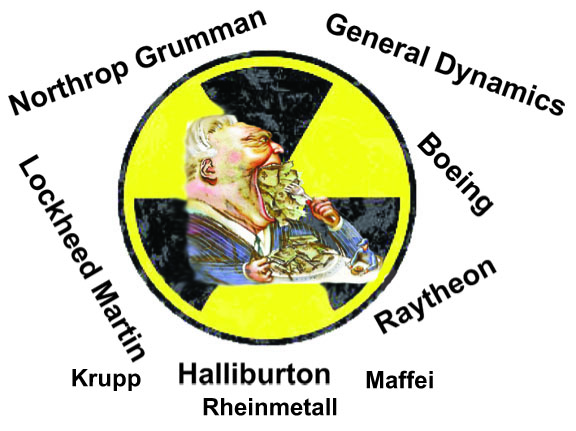
The first expert Sky News brings on to tell viewers about the Chinese menace is Mick Ryan, an Adjunct Fellow at the Center for Strategic and International Studies, which is funded by military-industrial complex entities like Raytheon, Boeing, Lockheed Martin and Northrop Grumman, and is also directly funded by the US government and its client states, including Australia and Taiwan. Sky News of course makes no mention of this immense conflict of interest while manufacturing consent for increased military spending, calling Ryan simply a “former major general.” This is on the same level of journalistic malpractice as running an article by Colonel Sanders on the health benefits of fried chicken but calling him “Harland David Sanders, former fry cook.”
The next expert Sky News presents us with is Australian former major general Jim “The Butcher of Fallujah” Molan, who oh-so-sadly passed away last month. I’ve written about Molan previously specifically because the Australian media love citing him in their propaganda campaign against China, last time when he was pushing the ridiculous claim that China is poised to launch an invasion of Australia.
The other experts Sky News brings in are former CIA Director and US Secretary of Defense Leon Panetta, Taiwan’s Foreign Minister Joseph Wu, Taiwan’s Director of Chinese Affairs Dr Lai Chung, Japan’s ambassador to Australia Yamagami Shingo, Australian Shadow Defense Minister Andrew Hastie, and John Coyne of the Australian Strategic Policy Institute, a virulent propaganda firm which is once again funded by US-aligned governments and military-industrial complex war profiteers.
So it’s about as balanced and impartial a punditry lineup as you’d expect.
At the 8:15 mark of the special, Sky News repeats the unevidenced propaganda claim that former Chinese president Hu Jintao was politically purged during the 20th Communist Party Congress last year.
At 19:15 Jim Molan talks about the need to fight and die with our allies the Americans while patriotic cello music plays in the background.
At 21:30 we are shown images of Australia being bombed alongside the Chinese flag (very subtle, guys).
At 24:25 Sky News accidentally does a version of the “look how close they put their country to our military bases” meme with a graphic display of all the US war machinery that surrounds China. The US would never tolerate being encircled by the Chinese military like that and would immediately wage war if China tried; it’s clear that the US is the aggressor in this conflict and China is reacting defensively.
“The United States plays a major strategic role in the Indo-Pacific,” says Sky News anchor Peter Stefanovic as the screen lights up with graphics showing the military presence surrounding China. “With 375,000 personnel, there’s a vast network of operations that extend from Hawaii all the way to India.”
At 26:30 we are shown a digital representation of China’s satellite systems in space, with the Chinese satellites colored red to help us all appreciate how evil and communist they are.
At 27:45 we are shown illustrations of how much smaller Australia’s military is than China’s or America’s to help us understand how important it is to increase the size of our nation’s war machine, ignoring the fact that Australia’s total population is a tiny fraction of either of those countries.
At 32:45 we are told that the AUKUS pact will “beef up America’s military presence in the north of Australia,” and that “America has long used Australia as a key strategic outpost,” showing images of Pine Gap and other parts of the US war machine which dot this continent. “Now, there’s more to come,” says Stefanovic, with US Secretary of Defense Lloyd Austin describing the surge in US military presence we’re to expect in Australia.
At 34:10 the Australian Strategic Policy Institute guy explains why the US is so keen to use Australia in its planned confrontation with China, saying the continent’s geography puts it in “the Goldilocks location” of being close enough to China to be meaningful but far enough away that its war machinery can’t be easily struck.
At 35:15 Stefanovic warns that “our nation could quite literally be brought to its knees” if a war to the north sees shipping lanes cut off since Australia is so heavily dependent of imports. You would think this is an argument about the importance of maintaining a peaceful relationship with China, but instead it’s used to foment fear of China and argue for the need to be able to defeat it in a war.
And at 45:50 we finally get to the real purpose of this Sky News special: the need to “dramatically increase” the Australian military budget, and the need to manufacture consent for that increase. Australia currently has a military budget of $48.7 billion, a little less than two percent of the nation’s GDP. The late Butcher of Fallujah tells Sky News that “we need to at least double our defense expenditure” to four percent, and the special’s pundits openly discuss the need for Australians to be persuaded to accept this using narrative management…………………….
To be clear, this is not just a call to increase military spending, this is a call to propagandize Australians into consenting to more military spending. It’s not very often that the propaganda comes right out and explains to you why it is propagandizing you.
I always get people complaining that I focus too much on the US war machine when I live in Australia, but anyone who’s paying attention knows the behavior of the US war machine is as relevant to Australians as it is to Americans. They are beating the drums for a future war of unfathomable horror all to please a dark god known as unipolarism, and it threatens to destroy us all.
The time to start resisting is now. https://caitlinjohnstone.substack.com/p/murdoch-propaganda-pushes-australia?r=pf4vw&utm_campaign=post&utm_medium=web&fbclid=IwAR2-MoxPsyKvcurWfgwc2Qd8aFn6YwgGaG4clg0wgUKO7NYQypg76A-zLUY
Sky News presents rubbishy programme on “preparing Australia for war against China”
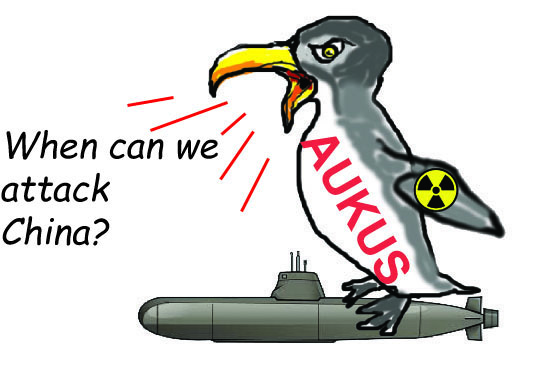
National Times 15 Feb 23 Now Hear This Now Hear This – Pauline Hanson has Spoken ( Eric Remarque for the National Times and Isaac Floyd on Twitter)
SKY TV News has a special Wednesday night program ( shock horror) about preparing for war with China.
REALLY !
Pauline Hanson a noted expert on Foreign Affairs and International Relations is obligingly feeding into this right wing war mongering propaganda.
But it appear that it is NewsCorp who’s on the warpath, not China, not Australia.
How soon before the likes of Pauline Hanson and others on the right side of politics start advocating for conscription.
The question is – do these people really understand that China is a Nuclear Power or that the key to Australia is trade.
Maybe SKY-TV News should understand that their favoured Political Party the Liberals lost the election because the people were sick and tied of the incompetence of the Morrison Government.
Its also worth noting that Lockheed Martin is a sponcor of SKY -TV News.
All things considered companies like this should not be permitted to sponsor news outlets.
So lets treat this SKY-TV News Special for what it is – RUBBISH
7.30 Report: Sarah Ferguson Opens Up New Perspectives on the AUKUS Nuclear Submarine Deal
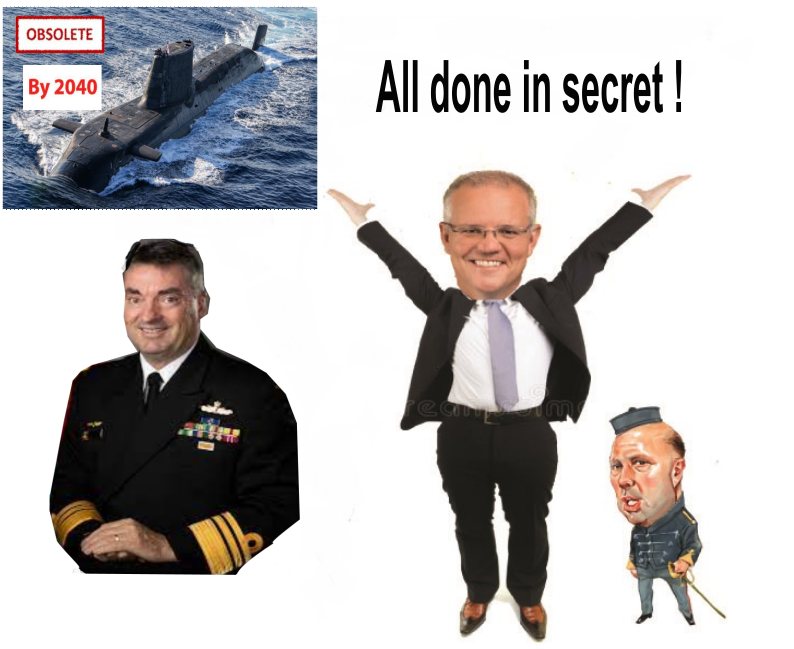
The secrecy associated with the formation of the Submarine Taskforce should be of great concern to Australians of all persuasions as our partners in France had no clues about what was happening behind the scenes as they made preparations to supply the contracted diesel submarines that more fully complied with commitments to the South Pacific Nuclear Free Zone with the support of New Zealand and other island states. No wonder that President Macron had little respect for Scott Morrison. (The video and the news clip of the French President’s remarks are available here.)
February 14, 2023 By Denis Bright
Sincere appreciation must be extended to the Albanese Government for allowing Vice Admiral Jonathan Mead AO to be interviewed in some depth on the 7.30 Report (13 February 2023). Sarah Ferguson was up to speed again in her interviewing skills with a seasoned naval officer who was assigned to active service in the Persian Gulf in 2006 as Captain of HMAS Parramatta.
The Vice Admiral’s understanding of nuclear technology being applied in the selection of the new submarine options was of course beyond reproach through his involvement with the clandestine Nuclear Submarine Taskforce established by the Morrison Government. Our US allies are great salespersons for the Anglo-American military industrial complexes in the post-Brexit era.
At least Britain’s BAE Systems as potential manufacturers of the AUKUS Submarines paid some tax in 2020-21 with a payment of $26.293 million to the ATO on a revenue base of $1.062 billion and a declared taxable income of just $123.484 million. The US military and aerospace giant Lockheed Martin kept its tax bill to $14.891 million on an income take of just over half a billion and a taxable income of $53.056 million (ABC News Taxation List, 2 November 2022).
The concerns of ordinary Australians about the financial and security costs of the AUKUS Submarine deal extend well beyond concerns about the technical capacity of those sealed reactors which are expected to operate for 30 years for the full life of the submarines until the year 2070 approaches.
The secrecy associated with the formation of the Submarine Taskforce should be of great concern to Australians of all persuasions as our partners in France had no clues about what was happening behind the scenes as they made preparations to supply the contracted diesel submarines that more fully complied with commitments to the South Pacific Nuclear Free Zone with the support of New Zealand and other island states. No wonder that President Macron had little respect for Scott Morrison. (The video and the news clip of the French President’s remarks are available here.)
…………………………………………………….. The Naval News video admitted that the Émeraude had transited the South China Sea in stealth mode. This was confirmed by coverage from France 24 (12 February 2021). Perhaps the stealth mode was to test the awareness of Chinese vessels and shore installations. Other military French vessels have done navigation runs through the Taiwan Straits which is always provocative when the current Democratic Party (DPP) holds power in Taipei and is calling for a formal declaration of independence from China to cheers from far-right global opinion.
…………….For China, the Taiwan Straits are definitely disputed waters as most countries in the US Global Alliance supported a One China Policy fifty years ago. This should have ended the US practice of using Taiwan for propaganda purposes throughout the Cold War.
……………………….. Just imagine the outrage in the Murdoch press if Chinese submarines made jaunts into Bass Strait to annoy the naval officers at HMAS Cerberus or to scare students at the Vice Admiral’s old secondary school at St. Bede’s in Mentone if the remnants of the federal LNP tried to establish Tasmania as an Independent Nationalist State with the support of a friendly US Administration.
Annoying China as well as alienating some ASEAN nations and members of the Pacific Island Forum will not assist with the current repair work on trading and investment relations with China.
The proposed AUKUS submarine deal imposes frightful financial burdens on Australia during inflationary times in which costs estimates for the AUKUS submarines extends into the 2040s (The Guardian 14 December 2021). Losses on trade and investment opportunities with China would of course extend these costs with 43 per cent of our exports destined to China at present (Latest data from Trading Economics).
Taiwan can assist to defuse tensions by giving a guarantee that it is not about to make a declaration of independence from the mainland. Relations between Taiwan and the Mainland seem to be improving again as China reverts to commercial diplomacy over displays of military strength. This style of diplomacy at least ensures that the economy of Taiwan is more fully integrated with the Mainland. Over 12,000 Taiwanese students were studying in Chinese academic institutes prior to the COVID-19 epidemic.
Despite all the negative media coverage of China in the Murdoch press, 42 per cent of Taiwan’s exports went to China in 2021-22 and 22 per cent of Chinese imports originated in either China or Hong Kong (CNBC 4 August 2022). Many Taiwan-based companies and services operate in China and Hong Kong.
With President Tsai Lng-wen unable to seek a third term as President in 2024, the popularity of the DPP seems to be on the wane. The opposition KMT gained 50.14 per cent of the vote at the recent local government elections on 26 November 2022 and controls fourteen local government areas to five held by the Democratic Progressive Party (DPP).
The Taiwanese electorate is undoubtedly evaluating the sustainability of nationalist rhetoric favouring a declaration of Taiwanese independence while the Australian government is negotiating those AUKUS submarine deals.
Signs of some thawing in cross-strait relations include a recent visit by the vice-chairman of the KMT to China and the restoration of more frequent fast ferry services between China’s Fujian Province and the adjacent Taiwanese islands of Kinmen and Matsu which are just a few kilometres off-shore.
There is great scope for the 7.30 Report to extend its coverage of the upsurge in regional strategic tensions with China after election cycles in Taiwan which bring the DPP into office. Re-election of the KMT in Taiwan in 2024 may totally defuse the current situation and leave Australians to bear the financial costs of the AUKUS submarine deal.
Opportunities exist to invite guest speakers onto future 7.30 Report programs to consider the impact of nuclear-powered submarines on the South Pacific Nuclear Free Zone which was ratified by all South Pacific nations as well as differing viewpoints on commercial ties with China.
Extending the South Pacific Nuclear Free Zone Treaty to coverage ASEAN Countries, the South China Sea and Taiwan might be a logical extension for consideration.
Toning down provocative visits by unfriendly naval vessels can be part of a Win-Win Deal to avoid future flyovers by Chinese jets.
Even the jellyfish in Moreton Bay are not very welcoming about the prospects of nuclear-powered ships:
According to a leading marine biologist and jellyfish expert Lisa-ann Gershwin, if the fleet is based in Brisbane, which is one of the shortlisted sites of the Australian government, the nuclear-powered submarines may be forced into an emergency reactor shutdown by swarms of jellyfish.
Gershwin added that Brisbane is “close to the absolute worst place” for a nuclear submarine base, due to the conditions in Moreton Bay and the usual jellyfish blooms.
Safety protocols for nuclear powered ships which sometimes carry nuclear weapons into Australian ports have been prepared by all states and territories as the ACT has its Jervis Bay facility which is separated from land-locked Canberra. The Queensland Government has made its precautions public in the publication Nuclear Powered Warship Visits to the Port of Brisbane.
Perhaps more public discussion as presented on the 7.30 Report can give the Australian government more wriggle room before the contracts are signed to initiate the AUKUS submarine deal. Payment of $835 million has already been made by the Albanese Government to France for breach of contract on the previous arrangements as negotiated by Malcolm Turnbull’s Government.
Appeals from our US allies for more military commitment from Australia and more use of the Pine Gap electronic base for offensive operations have landed Australia in compromising situations for decades from interventions in Vietnam to Afghanistan. The nostalgia for a return to the Cold War era with new military bases in the Philippines is an unfortunate regression. The ASEAN region to our north is better off left as a zone of peace and sustainable development.
By the time Australians discuss these issues, there may be a KMT Government in Taipei, and peaceful Win-Win scenarios may make the AUKUS deal redundant. Cheers then to the 7.30 Report’s contribution to strategic sanity. This style of reporting offers guest speakers who are saturated in knowledge of their specialist topics. I can only promote discussion and would be a real novice in head-to-head discussions with the Vice Admiral.
1 This month

of the week – Australians for War Powers Reform (AWPR)
To see nuclear-related stories in greater depth and intensity
 Antinuclear