Why did ANSTO shut down National Medical Cyclotron, that made medical isotopes without nuclear waste?
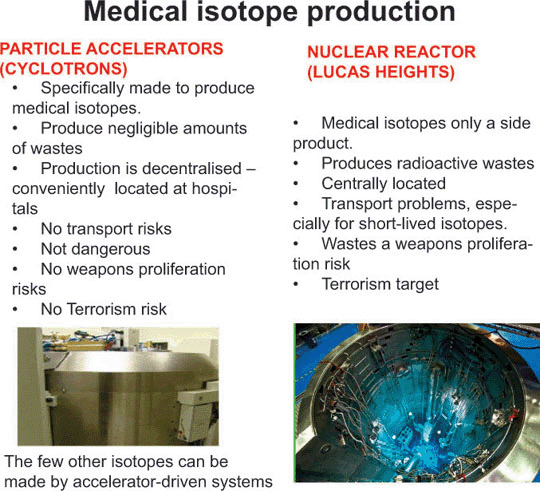
ANSTO gets a blank cheque for its nuclear waste production at Lucas Heights?
 Greg Phillips, No nuclear waste dump anywhere in South Australia , 13 Jan 2021, Congratulations Canada! “Cyclotron-produced technetium-99m approved by Health Canada”. Why rely on a global network of aging, unreliable, toxic spewing nuclear reactors when you can have a local network of clean, reliable cyclotrons? Especially when pandemics hobble global freight networks. From the article: “The process is safe and precise, employing stable targets and producing little to no long-lived radioactive waste. And, with the right target and extraction systems, these cyclotrons can be used to reliably create technetium-99m regionally and without the need for reactor-based materials.”
Because ANSTO shut down cyclotron, Australia has the problem of importing a short-lived medical isotope

|
“……..Australia lost the capacity to make the radioactive isotope iodine-123 – used in the diagnosis and treatment of cancer in the nerve cells of children – just over a decade ago with the closure of the National Medical Cyclotron in Camperdown, NSW. ………
But according to Ansto, iodine-123 is needed in clinical settings by about a dozen patients around Australia at any one time – most of them children with neuroblastoma. This means Australia now relies on imports from Japan. But with a half-life of just over 13 hours – meaning the levels of radioactivity halve every 13 hours – this isotope needs to be distributed to Australian hospitals and health centres very quickly. It expires within 33 hours of being manufactured in Japan. “The challenge with transporting nuclear medicine is the products have a short half-life,” Ian Martin, the general manager of Ansto Health, told Guardian Australia. “We need to get the isotopes from point A to point B before they decay too much to be effective, a complex task when B is in another hemisphere.” ………. https://www.theguardian.com/australia-news/2020/aug/11/australias-nuclear-medicine-agency-chartered-flights-to-deliver-childrens-cancer-treatment?fbclid=IwAR3o8Da64-dDpv0mwYL0K5jaPZreOGOaQCmDdh4ChzfwQLjsv0sFdBBVBVo 11 Aug 2020,
|
|
Clean-up plan for Ranger uranium mine is ”woefully inadequate”
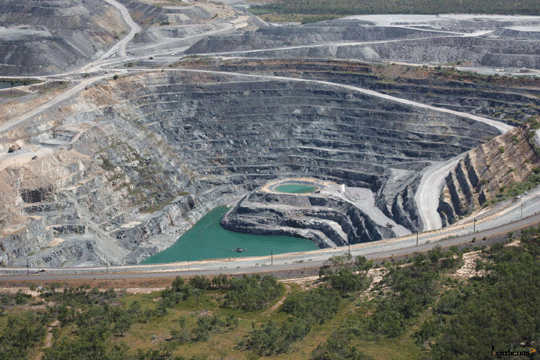
Gundjeihmi and ERA enter negotiations to extend Ranger Uranium Mine rehabilitation
By https://www.abc.net.au/news/2021-01-09/gundjeihmi-era-negotiate-ranger-uranium-mine-rehabilitation/13043076 Matt Garrick
An Aboriginal group in Kakadu National Park says the rehabilitation plan for a decommissioned uranium mine is “woefully inadequate”, and is calling for a 26-year extension to the process.
Key points:
- Mining at the Ranger Uranium Mine wound up yesterday after more than 40 years
- Traditional owners in Kakadu are now calling for an extension of the project’s rehabilitation phase
- The company that runs the mine has signalled its support for the move
Production at the Ranger Uranium Mine, on the outskirts of the national park, drew to a close yesterday after more than 40 years of operation.
Gundjeihmi Aboriginal Corporation, which represents Mirarr traditional owners, has used the closure to demand owner Energy Resources Australia (ERA) rehabilitate the site beyond its current lease expiry in 2026.
Within that timeframe, the company is required to restore the site to its previous pristine state.
“That’s not long enough,” the corporation’s CEO, Justin O’Brien, said.
“We are now awaiting a drafting from the Commonwealth Government for amendments to the Atomic Energy Act such that you can actually put in place an extension to the rehabilitation period.”
Mr O’Brien said traditional owners were pushing for the rehabilitation period to be extended by an additional 26 years, which would carry the process through until 2052.
He said ERA and its parent company, Rio Tinto, had signalled their support for an extended term of rehabilitation — but the timeframe and details of that extension are still being negotiated.
In a statement, the company said it was committed to “achieving all documented rehabilitation outcomes in its Mine Closure Plan (MCP) by January 2026”.
It confirmed negotiations were underway with traditional owners to “determine an appropriate mechanism” to extend the company’s tenure at the Ranger site, which would allow it to continue rehabilitation beyond 2026.
Environmental group the Australian Conservation Foundation yesterday welcomed the end of production at the site, the last active uranium mine in the Northern Territory.
The foundation’s Dave Sweeney, who is an anti-nuclear campaigner, said he was supportive of the push to extend the rehabilitation period.
“The company should not be approaching clean-up asking itself what it can do in five years,” he said.
“It should be approaching clean-up asking ‘What is the best possible way to reduce and address the damage that has happened?’
“What’s the best outcome — not the best outcome we can do in five years.”
The wind-down of production at the mine is expected to prompt an exodus from the nearby town of Jabiru, where ERA holds the lease for about 300 houses.
One hundred and twenty-five ERA staff were made redundant this week.
Government’s Kimba nuclear waste dump slush fund – benefit goes straight to Kimba’s mayor
 Community grants from the National Radioactive Waste slush fund..
Of particular interest in Kimba is the 2nd largest amount allocated = $141,667 – apparently for the Mayor to get a commercial bakery in his supermarket.
Whilst in the Flinders it appears that no $ allocations were given to any individual/family owned commercial premises.
(From: National Radioactive Waste Management Facility New Community Benefit Program 2019-2022 https://www.business.gov.au/grants-and-programs/national-radioactive-waste-management-facility-community-benefit-programme/grant-recipients-2019-2022 )
Judge’s refusal to extradite Julian Assange is still part of cowardly process to deny freedom of information
The personal conveniently distracts from the political in the Assange story, https://www.theage.com.au/national/the-personal-conveniently-distracts-from-the-political-in-the-assange-story-20210107-p56siu.html
Elizabeth Farrelly Judge Vanessa Baraitser’s refusal to extradite Julian Assange for “mental health” reasons may look humanitarian but is in fact a deft political move. In reducing what should be an argument of law and principle to a test of personality, Baraitser managed at a blow to impugn Assange’s stability, repudiate any suggestion of innocence and open the door for America to prove the comforts of its solitary confinement and thereby win his extradition.
It’s a story of many twists and turns but underlying it throughout is a profound and widespread moral cowardice.
Baraitser’s 132-page ruling found that although the UK-US Extradition Treaty of 2003 specifically prohibits extradition for “political offence”, this provision never became law in the UK and therefore has no effect. In essence, the treaty is worthless.
The court also supported all 18 of the espionage charges against Assange, arguing that WikiLeaks’ hacking and publication “would amount to” offences in English law. Baraitser identified eight charges under the UK Official Secrets Act that would be, she said, equivalent.
Interestingly, this “would have” construction does not apply to the treaty question. Had Assange engaged in the same conduct in America, targeting British government information, he could not have been extradited because America’s “monist” system regards any treaty as law once signed. So it’s ironic that undermining this particular protection is a key US argument.
Anyone who saw the 2019 docudrama Official Secrets, chronicling the leakage by GCHQ analyst-turned-whistleblower Katharine Gun of information on US-UK dirty dealing in drumming up UN support for the Iraq war, will understand just how murky and terrifying such prosecutions can become.
This fear, and the persistent cowardice of yielding to it, is the theme of Assange’s story. I’ve written about Assange several times. I visited him in Ecuador’s embassy. Yet each time, I’ve found myself reluctant.
Seven years ago, when I met him, Assange was ebullient and hopeful, even funny. Now, as Baraitser says, he is “a depressed and sometimes despairing man who is genuinely fearful about his future”. Assange, she said, was at “high risk of serious depression leading to suicide if he were to be extradited and placed in solitary confinement for a long period”.
Baraitser noted the “bleak” conditions of Assange’s likely US confinement would include “severely restrictive detention conditions designed to remove physical contact and reduce social interaction and contact with the outside world to a bare minimum”, with family limited to one supervised 15-minute phone call a month. Detailing Assange’s mental state, she opined that his risk of suicide, in such conditions, was “very high”. This is the loophole she offers the appellant US prosecutor.
Those fears – his of 175 years in solitary (honestly, who wouldn’t top themselves?) and hers of his suicide – underpin her judgment. But there are other, more insidious fears at play here.
Such fears, I see now, feed my reluctance to revisit the Assange story: fear, in particular, of confronting the terrifying truth about our imperial system. Regardless of Assange’s innocence or guilt, the simple facts of what our controlling powers can do to you if you step out of line are terrifying.
But this small, individual fear also operates, very effectively, at nation level.
From the start, the case against Assange has contrived to turn issues of principle into questions of personality. The initial Swedish rape charges, since dropped for lack of evidence as the witness’s recollections after so long were clouded, were extremely personal, spinning off the cancellation of his credit cards upon his arrival in Stockholm, forcing him to accept hospitality; the seductions, the sex – which everyone agrees was consensual – his failure to wear a condom although asked and reluctance to take an STD test. Then the left turned against him because of the Clinton leaks – which one suspects would have been fine, had they been directed at the other side – and perceptions about Assange’s ego. He was vain, it was said, and narcissistic. As if that itself were a crime, reason enough to let him rot in solitary.
The personal and emotive nature of all this – the Swedish prosecutor’s refusal to interview him in London, Britain’s willingness to imprison him for a year on bail charges, America’s determination to prosecute him for exposing their war crimes (in the Iraq War Logs of October 2010 and the film Collateral Murder showing air crew shooting unarmed civilians from a helicopter) and the description of WikiLeaks by US Secretary of State Mike Pompeo as “a hostile non-state intelligence service” – all suggest a bigger picture, and smaller values, than mere truth or justice.
It’s often said that Assange endangered the lives of US informers but, as Baraitser notes, no causality has been shown. Even the Senate Committee on Armed Service said, “the review to date has not revealed any sensitive sources and methods compromised by disclosure”. It is said that Assange, by dumping hacked emails from Hillary Clinton’s campaign, gave us Trump. But if she was engaged in skulduggery as alleged, wasn’t it better for the world to make its own judgment?
When you look coldly at the facts it’s hard not to suspect that Sweden was coerced into the original charges and that Britain and Ecuador have been similarly pressured. Certainly Australia’s persistent refusal to intervene for Assange, an Australian citizen who has broken no Australian law, suggests a similar abject timidity in the face of US might.
That’s the fear that guys like Assange and Edward Snowden make us confront. And it’s why they deserve, at the very least, a fair and open trial.
End of an ERA: four decades of radioactive risk come to an end at Kakadu
Over 40 years of high-impact uranium mining and processing at Energy Resources of Australia’s (ERA) Ranger mine in Kakadu ends today.
Australia’s longest-running uranium operation was licensed to operate until January 8, 2021.
“This is a very good day for Kakadu, the Northern Territory and Australia,” Australian Conservation Foundation nuclear campaigner Dave Sweeney said.
“The Ranger mine has generated controversy, headlines and heartache for four decades. The focus must now be on ERA and parent company Rio Tinto doing comprehensive and credible site rehabilitation and supporting the transition to a post-mining regional economy.
“Today we should also acknowledge the sustained efforts of the Mirarr Traditional Owners and the Gundjeihmi Aboriginal Corporation to protect their country and culture from the impacts of mining.
“The Mirarr opposed the Ranger mine 40 years ago, led a successful campaign to stop ERA developing a further mine at nearby Jabiluka 20 years ago, and are now driving the re-shaping of a culture- and conservation-based local economy.
“Plans for cleaning up the site of the Ranger mine are being hampered by an unrealistic rehabilitation time frame, funding uncertainty, and fears about a tailings dam leaking toxic contaminants into the surrounding national park.
“Closing Ranger, protecting Kakadu, a recent report co-authored by ACF, also found data deficiencies and technical issues, particularly around groundwater and tailings management.
“Australia has a long history of sub-standard mine rehabilitation in both the uranium and wider mining sectors. A far better approach and outcome is needed at Ranger. This work is a key test of the commitment of ERA and Rio Tinto, as well as the NT and federal governments.”
Assange denied bail after extradition blocked, will appeal to UK High Court
 Assange denied bail after extradition blocked, will appeal to UK High Court, WSW Assange denied bail after extradition blocked, will appeal to UK High Court, WSW
Thomas Scripps, 6 January 2021 WikiLeaks founder Julian Assange has been denied bail and continues to be held on remand in Belmarsh maximum-security prison.
District Judge Vanessa Baraitser handed down the decision Wednesday in Westminster Magistrates Court, after ruling on Monday against Assange’s extradition to the United States on mental health grounds. Assange will remain in custody until the prosecution’s appeal of that ruling is heard. WikiLeaks editor-in-chief Kristinn Hrafnsson announced afterwards that Assange’s legal team would be taking the bail decision to the High Court. Baraitser’s refusal to grant bail confirms that her decision not to extradite was motivated by political considerations and not any genuine concern for Assange’s health. Assange will be kept in conditions which have had a grave impact on his mental health, during a massive escalation of the UK’s COVID-19 epidemic. Speaking to the Sydney Morning Herald Tuesday, Nick Vamos, former head of special crime and head of extradition at the Crown Prosecution Service, indicated that the appeal process would likely take two to three months. In her decision, Baraitser accepted the prosecution’s insistence that Assange’s flight into the Ecuadorian embassy in 2012—after a UK court had granted him bail in connection with Sweden’s trumped-up sexual assault investigation and extradition request—was proof of his willingness to abscond in the future. This is an absurd and vindictive position…….. Assange now has a court ruling in his favour. He is, regardless, prepared to submit to stringent bail conditions amounting to effective house arrest with a GPS tag—conditions which have allowed terror suspects to receive bail. His experience of claiming asylum in an embassy has proved it “unpleasant”, in Fitzgerald’s words, and led “to him being effectively confined for some seven years” before having his asylum revoked. “That is not something that he is ever likely to repeat.” Assange also now has a family, a partner and two children, in the UK. Besides being a reason for Assange not to abscond, Fitzgerald argued, his family provides significant human rights grounds for his release on bail. On account of COVID-19 restrictions in the prison, Assange “hasn’t seen his family in person since March 2020”. He has never been able to live with them, having spent 15 months held on remand pending his extradition hearing. Assange’s family, Fitzgerald noted, is highly relevant to the question of his mental and physical wellbeing. “The grant of bail”, he said, “would allow actual physical contact with his family, that would… alleviate mental distress”. Baraitser had acknowledged the benefit of his family’s support to Assange in her ruling on extradition, which described him as a “depressed and sometimes despairing man, who is genuinely fearful about his future.” Bail would also “considerably reduce” the risk of Assange’s exposure to COVID-19. Fitzgerald pointed to the “severe outbreak” of the virus suffered by Belmarsh Prison recently and said there had been 59 positive cases prior to Christmas. He added, “on any view, the position [the state of the UK’s epidemic] is worse now and, on any view, he would be safer isolating with his family than if he was in Belmarsh.” Baraitser dismissed these concerns, declaring “this prison is managing prisoners’ health during this pandemic in an appropriate and responsible manner.”………. https://www.wsws.org/en/articles/2021/01/07/assa-j01.html?pk_campaign=assange-newsletter&pk_kwd=wsws |
|
|
Australian govt has quiet nuclear deal with China, but condemns Victoria-China medical research

Double standards on research cooperation with China, Independent Australia 4 January 2021, The Government is hypocritical in its approval of Australia’s nuclear research body to work with China on the development of nuclear reactors, writes Noel Wauchope.
PRIME MINISTER Scott Morrison’s Liberal Coalition Government seems to remain in silent approval of the Australian Nuclear Science and Technology Organisation’s (ANSTO) partnership with a Chinese company to develop Generation IV nuclear technologies such as small nuclear reactors.
But it’s a different story when it comes to the Morrison Government’s concern to put a stop to the Victorian Labor Government’s cooperation with China in developing agricultural, communications and medical research.
We hear very little about the Australian Government’s research connections with China, managed under the Australia-China Science and Research Fund (ACSRF), which has the aim of ‘supporting strategic science, technology and innovation collaboration of mutual benefit to Australia and China’.
One remarkable collaboration between Australia and China is in the strategic partnership between ANSTO and the Shanghai Institute of Applied Physics (SINAP) to develop the Thorium Molten Salt Nuclear Reactor (TMSR) and other Generation IV nuclear reactor designs.
 In March 2019, Dr Adi Paterson, then CEO of ANSTO, welcomed renewal of this agreement and was reported as stating that it was “consistent with ANSTO and Australia’s interest in and support of Generation IV reactor systems”. This statement was made at a time when Australia’s federal and state laws clearly prohibited the development of nuclear reactors.
The Age quoted anonymous senior Federal Government sources who reveal that the Australian Government may use its powers to tear up a research agreement between the Victorian Government and China’s Jiangsu province. This agreement was signed in 2012 and renewed in 2019……….
The USA partly funds the Australian Strategic Policy Institute, which strongly advises against cooperative research with China. And, of course, Victorian Liberal Opposition leader Michael O’Brien was quick to join in the chorus, condemning the Labor Government for having the deal with China.
All this makes it all the more inexplicable as to why the Australian Government should have an agreement with China to develop nuclear reactors. Under federal law, Australia prohibits establishing nuclear installations. ……..
There has been virtually no media coverage of Dr Adi Paterson’s deal with China, which goes back to 2015. I have previously written about this and the secrecy under which it was conducted.
Indeed, ANSTO’s operations and its funding have been conducted in secrecy, under the comfortable shroud of national security.
Right now, there is a move to corporatise the nuclear medicine facility at Lucas Heights as a separate entity to ANSTO. At the same time, the Government is in an unseemly rush to set up a nuclear waste dump near Kimba in South Australia. In the midst of all this came the sudden unexplained resignation of the CEO, Dr Adi Paterson.
The silence on all this is disturbing. It must be especially so for the small rural community of Kimba and for the Indigenous Title Holders as they wait in limbo for the vexed question of the nuclear waste dump to be solved. For the rest of South Australia, that is a concern, too. Victorians may well wonder why their medical research cooperation with China is seen as so dangerous. Meanwhile, is it okay for Australia’s nuclear research body, ANSTO, to work with China on the development of small nuclear reactors? https://independentaustralia.net/politics/politics-display/double-standards-on-research-cooperation-with-china,14664
Treaty – a step on the long path towards nuclear disarmament.
 Australia: The UN Treaty on the Prohibition of Nuclear Weapons: Corrs Australia: The UN Treaty on the Prohibition of Nuclear Weapons: Corrs  Human Rights Day event recap https://www.mondaq.com/australia/human-rights/1019602/the-un-treaty-on-the-prohibition-of-nuclear-weapons-corrs-human-rights-day-event-recap Human Rights Day event recap https://www.mondaq.com/australia/human-rights/1019602/the-un-treaty-on-the-prohibition-of-nuclear-weapons-corrs-human-rights-day-event-recap23 December 2020 Corrs Chambers Westgarth On 10 December 2020, Corrs marked Human Rights Day with an ‘In Conversation’ event focused on the UN Treaty on the Prohibition of Nuclear Weapons (Treaty).
The event brought together leading experts in the field of nuclear disarmament and the humanitarian impacts of a nuclear event, including;
Discussion between the panellists focused on the significance of the Treaty and how it may shape future obligations of states and corporates in connection with nuclear weapons and nuclear disarmament. The Treaty currently has 51 parties and 86 signatories and is set to enter into force on 22 January 2021, cementing a categorical ban on nuclear weapons, 75 years after their first use. Australia has yet to ratify the Treaty. A number of themes that emerged from the conversation are explored below. Why is this conversation so critical?The panellists agreed that the prohibition of nuclear weapons is perhaps more urgent now than ever before. In early 2020, the Doomsday Clock – which symbolises the gravest existential dangers facing humankind – was moved to 100 seconds to midnight, indicating that humankind was closer to the apocalypse than ever in history. This movement was attributed to the increased threats of nuclear war and the continued global failure to address climate change. The adjustment was described as indicative of ‘the most dangerous situation that humanity has ever faced’. This is unsurprising. Today, there remain around 13,500 nuclear weapons in the hands of only a few states. Many are in a high operational readiness, and have the ability to be rapidly deployed. It is well understood that the use of even a fraction of these weapons would result in unimaginable loss of human life and have long-term effects on human health, the environment and global food supplies. The World Health Organisation (WHO) has consistently found that all the world’s health resources would not be effective in responding to even a singlenuclear attack. A paradigm shiftThe Treaty was born out of a shift in focus from the assumed defence and international security benefits of nuclear weapons to the catastrophic humanitarian consequences they would incur. The Red Cross, ICAN and members of civil society played a vital role in shaping that discussion. Dr Durham noted that this shift in momentum began when then President of the ICRC Jakob Kellenberger addressed the Geneva Diplomatic Corp in the lead up to the Non Proliferation Treaty Review Conference in 2010, declaring that the debate on nuclear weapons must be guided not by ‘military doctrine and power politics’, but by ‘human beings, . the fundamental rules of international humanitarian law, and . the collective future of humanity’. The humanitarian focus of the discourse continued its momentum with a series of conferences convened to consider the humanitarian impact of nuclear weapons in Norway (2013), Mexico (2014) and Austria (2014). Dr Durham and Dr Ruff reflected on their respective involvement in these conferences, observing how they provided a platform to discuss the humanitarian consequences of nuclear weapon use at the international level, significantly shifting the debate and bringing to bear increased urgency in the need to ban nuclear weapons. Legal significance and relationship with other treatiesWhen the Treaty enters into force, it will be the first international legal instrument which makes nuclear weapons illegal, prohibiting their development, testing, production, acquisition, stockpiling, use, deployment or threat of use. The Treaty will also prohibit the provision of assistance to any state in the conduct of prohibited activities. It is notable that, even with all their destructive power, nuclear weapons are the last form of weapons of mass destruction to be prohibited. The Treaty will only bind those states which have formally signed and ratified it, which means that non-parties (such as Australia) do not have any formal obligations under the Treaty. Other nuclear weapons treaties, including the nearly universal Treaty on the Non-Proliferation of Nuclear Weapons (NPT) which has been in force since 1970, will continue as a cornerstone in the international legal framework governing nuclear weapons. In this regard, Dr Durham observed that the NPT and the Treaty are complimentary rather than conflicting in their shared aspiration to eliminate nuclear weapons. Legal ramifications for the commercial sectorFor businesses, the Treaty will begin a process of stigmatisation of companies that are involved in the production of nuclear weapons. It may also render their operations unlawful. Tara Gutman observed that the impact of the Treaty’s prohibitions is already being felt, noting that:
In addition, state parties to the Treaty are expected to make the manufacture of nuclear weapons or their components unlawful under domestic laws in their territories. How these matters impact the commercial sector in the coming years will be interesting to follow. What’s next?The panellists reminded us that the entry into force of the Treaty is but a step on what has been a long path towards nuclear disarmament. Other nuclear weapons treaties, including the nearly universal Treaty on the Non-Proliferation of Nuclear Weapons (NPT) which has been in force since 1970, will continue as a cornerstone in the international legal framework governing nuclear weapons. In this regard, Dr Durham observed that the NPT and the Treaty are complimentary rather than conflicting in their shared aspiration to eliminate nuclear weapons. Legal ramifications for the commercial sectorFor businesses, the Treaty will begin a process of stigmatisation of companies that are involved in the production of nuclear weapons. It may also render their operations unlawful. Tara Gutman observed that the impact of the Treaty’s prohibitions is already being felt, noting that:
In addition, state parties to the Treaty are expected to make the manufacture of nuclear weapons or their components unlawful under domestic laws in their territories. How these matters impact the commercial sector in the coming years will be interesting to follow. What’s next?The panellists reminded us that the entry into force of the Treaty is but a step on what has been a long path towards nuclear disarmament. |
|
The decay of mainstream media in Australia – and the rise of new independent media
Faustian Pact: no way back from public relations for News and Nine, Michael West Media by Michael West | Dec 31, 2020 Old media caps off annus horribilis 2020 with its traditional horrible week. Michael West, standing in for Michael Tanner, looks at the fall of Fairfax, PR masquerading as journalism, who guards the Guardian, Seven News’ calls for war with China and how Scott Morrison’s media team has the game sown up.
Independent. Always.
Ahem …
How about Independent. Sometimes.
As annus horribilis 2020 shudders to its Covid-ridden close, the once venerable Australian media properties, the Sydney Morning Herald and The Age, have spruced up their advertising.
We refer not to their advertising for the Liberal Party, or even the heavy editorial influence of their beloved corporate sponsors, but rather the advertising of their own unseemly decline.
The shining example of the week was this Op-ed piece penned by a Liberal Party PR person and lobbyist Parnell Palme McGuinness.
Your humble essayist was once, long ago, a cadet at Fairfax – now Nine Entertainment. Reading this slavering panegyric to Gladys Berejiklian, which kicked off with a gratuitous swipe at Jacinda Adern, approximated the feeling one gets when scraping one’s fingernails across a blackboard.
It wasn’t just the tacky story. More the creepy incursion of political PR people into what purports to be independent journalism.
Since when is it de rigueur for a media organisation to run propaganda clickbait by Liberal lobbyists who benefit from limited-tender contracts from the Liberal Government? Answer: since Fairfax (now Nine newspapers) installed Liberal editorial management.
To be fair, the decline has been afoot for more than a decade – well before the Nine Entertainment takeover. And many fine journalists remain there – albeit cowed and interfered with – and feeble management and the global decline of a business model are largely to blame. Still …
Two days later, The Age sallied forth with a piece by a sociology professor who writes for The Australian and Quadrant claiming Dan Andrews was “heading the most incompetent Australian administration in living memory”.
This bloke must have a very short living memory. Incompetence is endemic to government and there are plenty worse than Dan Andrews.
Mainstream media train wreck
If the basic task of a media organisation is to hold both sides of politics to account, particularly the side in government, most of the mainstream media in this country has failed miserably.
Rupert Murdoch’s News Corp gave it up long ago. The Australian, the state tabloids and Sky News are little more than agitprop – their daily daggy a capellas to government merely the thing of a propaganda machine to further the power and financial interests of a US billionaire.
And although still insisting forlornly it is independent, still touting the “Independent. Always.” slogan on its mastheads, replete with emphatic full stops, Fairfax has now joined the choir; the shrill descants of the News Corp sopranos ringing above the melodic Fairfax bass, all perfectly complemented by the altos of talk-back radio and the reliable tenors of commercial TV – together as one – singing the praises of the most corrupt government in Australian history.
Independent. Always.? What a clear breach this is of Trade Practices law; truth in advertising, if anybody could be bothered to prosecute the case………….
By changing the law to allow Nine to take over Fairfax, former Minister for Communications Mitch Fifield did a big favour for his government, as well as News, Nine and Fairfax.
Now “Mitchell Peter Fifield is the Permanent Representative of Australia to the United Nations”. Thanks Mitch, job well done – for the Coalition, which relies on an obsequious and beaten Fourth Estate to stay in power.
It is a symbiotic relationship to be sure; a marriage counsellor would call it co-dependent. So tightly in the clutches of Murdoch is Mitch’s successor, Paul Fletcher, that he and his office can’t, or wont’, answer questions about where Rupert Murdoch has taken control of Foxtel.
Neither can his regulator ACMA, the Australian Communications and Media Authority. Undaunted, ACMA pinged Four Corners earlier this month for its investigation into the dodgy Murray Darling Basin Authority because government refused to be interviewed – and because they refused to be interviewed, the show was not balanced, according to ACMA.
Elsewhere, Fletcher was busy harassing anybody at ABC who would listen, even browbeating chairman Ita Buttrose over the Four Corners episode, which exposed a couple of ministers for engaging in the act of extra-marital canoodling.
All this punctilious intervention and regulatory fussing over nothing while Rupert, the world’s dominant media mogul, took his government grants and scurried off to Delaware with Foxtel. To the sound of crickets from Fletcher and ACMA.
Where will it all go this year? What will the Government do to protect its machinery of public relations? If the trend is any indication, mainstream media will get even closer to governments and their corporate sponsors. It will get worse.
The formula is simple: you tickle my feathers, I’ll tickle yours………….
Doing journalism was an old-fashioned formula that seemed to take Fairfax by surprise. As its new, even more hopeless and sycophantic, editorial leadership under Nine tripped over themselves firing journalists such as Michael Pascoe, Peter Martin and yours truly and replacing them with pro-business toadies from News Corp, devising new ways to kowtow to governments and corporations, the biggest winner has been The Guardian. ………….
What then does 2021 hold for media? Younger Australians have deserted mainstream media in droves. Commercial TV, newspapers, MSM websites; they simply don’t trust them. It’s mutual.
For its part, the mainstream operators have clearly picked sides; they have picked the side of governments and corporate advertisers, and in so doing, cannot improve the public interest value or the authority of their products. This is immensely frustrating for the real journalists among them, and although the management agendas will continue to be interspersed with bona fide stories by reporters doing the right thing, the cultural malaise cannot be reversed.
The Faustian Pact has been struck. There is no turning back. Credibility can only ebb further as they rely on fewer larger advertisers to survive. The government will continue to come up with schemes to subsidise friendly media such as the attack on the digital platforms. The bright news is that, where there is demand, there will be supply. There is demand for the truth, demand for courageous and uncontaminated journalism, and that will be supplied as new independent sources of media flourish. https://www.michaelwest.com.au/faustian-pact-no-way-back-from-public-relations-for-news-and-nine/
Assange hearing outcome could set an “alarming precedent” for free speech
|
Assange hearing outcome could set an “alarming precedent” for free speech https://www.indexoncensorship.org/2020/12/assange-hearing-outcome-could-set-an-alarming-precedent-for-free-speech/ Benjamin Lynch
People need to “forget what they think they know” about WikiLeaks founder Julian Assange and recognise that if he is extradited to the USA, it would set a worrying precedent for media freedom. We speak to his partner about the case. Assange’s partner, Stella Moris, is remaining resolute despite his extradition hearing decision being less than a month away and him being held in a prison that has recently had a Covid-19 outbreak.
Speaking over the phone to Index, Moris discusses the hearing’s details and what it could mean for the future of freedom of expression. And she talks about the deep implications it has had for her and her young family. “Obviously it is very difficult. I speak to Julian on a daily basis unless there is a problem. [But] he is in prison. Soon to be for two years. He has been there for longer than many violent prisoners who are serving sentences. All in all, he has been deprived of his liberty for ten years now,” she told Index. She adds: “The kids speak to their father every day; we try to normalise it as much as we can for them. But of course, this is not a normal situation and our lives are on hold. It is inhumane and shouldn’t be happening in the UK.” The current hearing – which will decide whether there are grounds for Assange to stand trial in the USA – should reach a conclusion on 4 January. A trial in the USA (should the decision go against Assange) will have major ramifications for free speech and whistleblower journalism. The WikiLeaks founder is charged with conspiring with US intelligence analyst Chelsea Manning and hackers from groups such as Anonymous and LulzSec to obtain and publish classified information. Each of the 18 charges laid by US authorities, if Assange is extradited and convicted, carry a maximum penalty of 10 years. The allegations brought forward under the 1917 Espionage Act, alongside one other under the Computer Fraud and Abuse Act, mean Assange could face up to 175 years in prison – effectively a life sentence. Manning was initially sentenced to 35 years, but under the Obama administration her sentence was commuted to less than seven years. It is easy to get sidetracked about the current extradition hearing and get into arguments about whether Assange is a journalist, whether he is guilty of other crimes or whether the publication of the documents brought harm to anyone involved. Instead people’s attentions should focus on the precedent that will be set should the case go to trial in the USA. As it stands the case is unprecedented. No publisher has ever been tried under the Espionage Act, which itself was essentially created for spies imparting official secrets either for profit or otherwise. This is perhaps a direct contradiction of rulings of the courts in the UK. In December 2017, the UK’s information tribunal recognised WikiLeaks as a media organisation, in direct contradiction to the view of the US State Department. Australia’s media union, the Media, Arts and Entertainment Alliance, also presented an honorary member card to Assange’s Melbourne-based lawyer. Amidst the noise of the separate matters around the case, Moris insists people need to “forget what they think they know” and assess the issues involved. “There are a lot of assumptions being made over what this case is really about. There are all these sideshows. It is not about people being harmed because the US has admitted it has no evidence to make this argument. It comes down to the fact that the material published was classified. People who care about free speech and press freedom need to forget what they think they know about this case and look at it afresh and understand Julian is in prison for publishing. This is not something that democracies do.” “Are they saying what he published was not in the public interest? They say that is irrelevant. They can’t deny [what he published] wasn’t in the public interest because he was publishing information and evidence of state crimes, of state abuse, torture, of rendition, blacksites and of illegal killings. What they are arguing is that Julian published information that was secret and therefore he can be prosecuted over it.” ournalists publishing secret information is not new (nor is pressure for them not to publish) and can often be key to upholding democracy and ensuring states act properly. The Watergate revelations relied heavily on news organisations pressing on with publication despite attempts by the USA to stop them, including the threat of jail time. It proved a significant victory for free speech. If Assange is extradited and tried the case will impact journalists and the media “for years to come”, says Rebecca Vincent, director of international campaigns at Reporters Without Borders (RSF). “It feels like many in the media do not see the implications of this case as something that will possibly affect them,” she told Index. “This case will have ramifications on the climates for journalism and press freedom internationally for years to come.” “This is the first time we have seen the US government prosecute anybody for publishing leaked information. If they are successful, they will not stop with Assange and WikiLeaks. This could be applied, in theory, to any media outlet.” It’s common for journalists and publishers to cite a public interest defence for disputed documents. It is a centrepiece of a defence case against libel, for instance. “The information published was certainly in the public interest; it served to inform extensive public interest reporting that exposed war crimes and other illegal actions by states,” said Vincent. “The Espionage Act lacks a public interest defence. He cannot use it if he is sent to the United States and tried.” Essentially, what this means is that Assange is being treated as a spy not a publisher. If Assange is extradited and loses his case against the US government, any time classified information is published by a journalist there will be a precedent set that they can be charged and tried as a spy in the same way. “These sorts of cases are really highlighting the need for more robust legislation that cannot be manipulated to be used against journalists, whistleblowers and other sources. Ultimately, it is the public’s right to access information that is being impacted,” Vincent added. “You can see this for what it is; this very much feels like a political prosecution by states that are not meant to engage in this behaviour. The reason our states can get away with this is because of a lack of public pressure. A lack of public sympathy has resulted in a lack of widespread public pressure to hold our governments to account.” |
|
Rupert Murdoch’s News Corpse rises in ABC Insiders !
 What’s happening with ABC ‘Insiders’? Independent Australia, By Alan Austin 2 January 2021 The capture of ABC Insiders by Murdoch’s minions was a topic of debate all year, with this April Alan Austin piece attracting in excess of 35,000 unique views.
…………Has the ABC’s Insiders program become a vehicle for the promotion of News Corp? Alan Austin has been watching with interest and alarm.
AN INTRIGUING development in Australia’s media landscape this year is that it appears ABC’s Insiders, a substantial television program paid for by taxpayers, has become a vehicle for the rehabilitation and promotion of Rupert Murdoch’s tawdry media empire.
The first 12 Insiders episodes since Speers’ arrival as host, have featured 36 guest appearances. Of these, 12 have been current News Corp employees and another four, recent departees. So 44 per cent of all guests from one stable.
There is no need for the ABC to reference anything from News Corp — certainly not as the key source of information. Australia has more than 30 important media organisations. It is itself a well-resourced generator of news and news analysis. Murdoch’s minions are entirely dispensable.
News Corp a legitimate news organisation?
News Corp is not a reliable source of information. It has long since abandoned any commitment to media codes of ethics. The Australian Press Council routinely finds News Corp outlets violate media codes of ethics. Fact-checkers in the UK and the USA have found the same.
Murdoch’s Fox News in the USA is the go-to outlet for President Donald Trump whenever he wishes to share his fabrications and falsehoods. According to the Washington Post, the U.S. President told 16,241 clearly identified lies in his first three years in office. Many of these were Fox exclusives.
In Australia, several senior Murdoch employees have been found guilty of serious falsehoods — and were then rewarded by their employer.
In the celebrated racial discrimination case Eatock v Bolt, Murdoch’s Andrew Bolt was found to have concocted at least 19 damaging false assertions against the Indigenous people he was attacking.
In the wrongful dismissal case of former editor Bruce Guthrie, the judge found two senior News Corp executives had been untruthful in their testimony before the court.
In Britain, Murdoch’s publications have lied, cheated, bribed police and engaged in an extensive range of criminal misconduct. A British Parliamentary Inquiry in 2012 found that Rupert Murdoch was ‘not a fit person’ to run a company in Britain.
As a result of police investigations into Britain’s phone-hacking scandal, a large number of News Corp personnel were arrested and convicted of criminal offences.
Political bias and the ABC
News Corp outlets spruik the commercial interests of the owners, which almost inevitably means supporting right-wing political parties. Normally this is not a great problem. Political biases are fine, provided they are balanced by other political biases. The issue with News Corp is much more insidious than just bias, as shown above.
Ruthless and remorseless
Among Australia’s most profound wrongdoings in recent times have been The Australian’s malicious condemnations of men and women who have served the nation well.
Professor Robert Manne of La Trobe University wrote this of the recent campaign against the Australian Human Rights Commission and its former president:
The attack launched by The Australian on Gillian Triggs and the Human Rights Commission has been obsessive, petty, relentless, remorseless and ruthless. In ‘Bad News‘ I documented similar campaigns – against Larissa Behrendt and Julie Posetti. But neither reached either the level of malevolence or the cultural significance of the current anti-Triggs campaign … What is happening to Gillian Triggs – a fine lawyer, a fine Australian, a fine human being – must be resisted with all the moral and rhetorical muscle liberal Australians can muster.
Other prominent people The Australian has sought to tear down with its frenzied campaigns of hate, include Carmen Lawrence, Joan Kirner, Wendy Bacon, Natasha Stott Despoja, Margaret Simons, Christine Nixon, Roz Ward, Clover Moore, Margo Kingston, Anna Bligh, Kristina Keneally, Julian Disney, Emma Husar, Yassmin Abdel-Magied, Julia Gillard and Jacinda Ardern. ……… https://independentaustralia.net/politics/politics-display/4-top-story-of-2020-whats-happening-with-abc-insiders,14657
Absurdity of Napandee as nuclear waste dump – impossible to meet safety licence?

1 This month.
20 September –National Day of Action in Melbourne on the International Day of Peace


Help Aunty Sue Protect Her Land and Sacred Sites From Destructive Rocket Testing.
.

Australians deserve the truth
about
AUKUS – https://aukuspublicinquiry.com/


PETITION – To: Prime Minister Anthony Albanese and the Australian Labor Government

of the week – Australians for War Powers Reform (AWPR)
To see nuclear-related stories in greater depth and intensity
 Antinuclear