Long-term research shows ocean acidification ramping up on the Reef
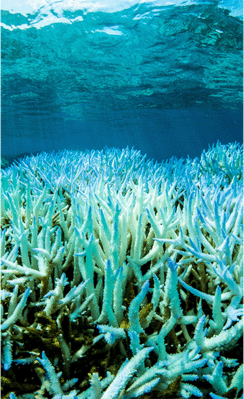 The future is now: long-term research shows ocean acidification ramping up on the Reef The future is now: long-term research shows ocean acidification ramping up on the Reef
A new study has shown ocean acidification is no longer a sombre forecast for the Great Barrier Reef but a present-day reality AUSTRALIAN INSTITUTE OF MARINE SCIENCE https://www.eurekalert.org/pub_releases/2020-10/aiom-tfi102820.phpResearch News Ocean acidification is no longer a sombre forecast for the Great Barrier Reef but a present-day reality, a new study reveals. The study, published in the international Journal Scientific Reports, shows carbon dioxide (CO2) and ocean acidification are rapidly increasing on the Reef. Seawater CO2 has risen 6 per cent over the past 10 years and matches the rate of CO2 increases in the atmosphere, confirming the influence of atmospheric CO2 on seawater CO2 levels. “People talk about ocean acidification in terms of 50 years’ time, but for the first time our study shows how fast ocean acidification is already happening on the Reef,” said Dr Katharina Fabricius, lead author and Senior Principal Research Scientist at the Australian Institute of Marine Science (AIMS). The research, a collaboration between AIMS and CSIRO, drew on over a decade of observations collected as part of Australia’s Integrated Marine Observing System (IMOS) to conclude that the Reef’s rich carbonate seafloor is not buffering against ocean acidification as previously thought. “Our research shows that acidification is rapidly changing the conditions that support the growth of coral on the Reef. It’s never been more important to address ocean acidification in plans to manage the Reef”, said Dr. Bronte Tilbrook, a Senior Principal Research Scientist at CSIRO who leads IMOS’ observational projects for CO2 and ocean acidification. Ocean acidification results from seawater absorbing excess CO2 that has been emitted into the atmosphere. The CO2 dissolves in the seawater where it changes the chemistry. This includes decreasing the water’s pH, and reducing the aragonite saturation state, which is critical for building the skeletons of reef-building coral and other marine organisms. Under reduced pH conditions, their calcium carbonate skeletons take longer to form and weaken, leaving them more susceptible to damage and erosion. While long-term data exist for CO2 and ocean acidification trends in open oceans, there have been very few long-term data on these trends in coastal waters around the world, including the Great Barrier Reef. Biological and physical processes like respiration create large fluctuations in CO2 in coastal areas, making the detection of trends more difficult. The study has filled this important knowledge gap by analysing 10 years of CO2, pH and aragonite saturation state data (2009-2019). These data were collected as part of Australia’s IMOS network at two long-term monitoring stations, located 650 kilometres apart at contrasting locations. The researchers found the minimum CO2 concentrations measured today were likely to already have passed the highest CO2 levels expected 60 years ago, even after accounting for the effects of temperature, nutrients, salinity, and daily and seasonal changes. “We know now that oceans are taking up about 23% of the excess CO2 from the air. They actually provide a service to humanity by slowing climate change. But the price to pay is that the seawater’s carbon chemistry is changing, and we didn’t know it was happening in dynamic coastal waters at such fast rates,” Dr Fabricius said. In another research first, AIMS and CSIRO scientists have used data from 1384 Reef sites to show coastal acidification’s negative impacts on three important indicators of Reef health:
The study, published earlier this year in the journal Global Change Biology, found these baby coral and coralline algae also decreased and seaweed increased as fine suspended sediment increased across the Reef — with the greatest sediment concentration and organism changes observed closer to the shore. The researchers highlighted effective water quality management as an achievable solution to reduce coastal acidification’s impact on the Reef. ### Australia’s Integrated Marine Observing System (IMOS) is enabled by the National Collaborative Research Infrastructure Strategy (NCRIS). It is operated by a consortium of institutions as an unincorporated joint venture, with the University of Tasmania as Lead Agent. |
|
Adani hires spying on activist’s daughter on way to school
|
Private investigator hired by Adani secretly photographed activist’s daughter on way to school
Exclusive: investigator’s affidavit shows he surveilled and followed anti-Adani activist Ben Pennings’ wife and daughter, Guardian, Ben Smee @BenSmee – 28 Oct 20, A private investigator working for Adani took covert photographs of an environmental activist walking his nine-year-old daughter to primary school, court documents have revealed.The affidavit of the investigator – who was instructed by lawyers representing Adani in its civil case against activist Ben Pennings – also revealed he surveilled Pennings’ wife, trawled her Facebook page and followed her to work. Guardian Australia can reveal documents detailing the surveillance of Pennings and his family were tendered to the Queensland supreme court in a recent “Anton Piller” case, in which Adani had sought permission to conduct an unannounced search of the activist’s family home. The Queensland supreme court and court of appeal both rejected the move, saying the search could result in “humiliation and family distress”. An email from the law firm representing Adani against Pennings, Dowd and Co, instructed a private investigator, Garry Andrew Sweet, to conduct surveillance for “the consideration of vulnerable persons … at the time of execution of any search warrant”……… Pennings said: “This is Adani all over. This is what Labor and the LNP actively support. Politicians would go berserk if anyone followed the partner and kids of a mining executive. Adani takes photographs of my daughter walking to primary school but unless anything changes this election Labor and the LNP will still allow them to operate in Queensland. “Queensland Labor has had plenty of opportunity to stand up against Adani’s intimidation of scientists and concerned citizens. It’s absolutely appalling they’ve given Adani a royalty holiday instead.”……. The mining company building the controversial Carmichael coalmine is suing Pennings, from the group Galilee Blockade, for conspiracy, intimidation and breach of confidence. …..https://www.theguardian.com/business/2020/oct/28/private-investigator-hired-by-adani-secretly-photographed-activists-family |
|
|
Labor aims to amend the Nuclear Waste Bill, removing Napandee as the stipulated dump site
Penny Wong office reply to Josephite SA Reconciliation Circle letter before the last Senate session 27 October 2020
From: “Wong, Penelope (Senator)” <Senator.Wong@aph.gov.au>Subject: RE: We plead with Labor Senators to vote NO to the undemocratic, unfair National Radioactive Waste Management Amendment Bill 2020
Date: 26 October 2020Dear Michele,
RE: NATIONAL RADIOACTIVE WASTE MANAGEMENT FACILITY PROPOSALThank you for your correspondence on the proposal for a national radioactive waste management facility in South Australia and the National Radioactive Waste Management Amendment (Site Specification, Community Fund and Other Measures) Bill 2020.Senator Wong is aware of different views in the community about this proposed facility.It is clear the Government’s proposal gives rise to issues surrounding Indigenous heritage, environmental concerns, public safety, as well as differing opinions on necessity of such a facility, all of which must be adequately resolved.Australians depend on nuclear technology for medicines used in the diagnosis of heart disease, skeletal injuries, as well as a range of cancers. Radioactive substances and wastes must be handled safely and with care.One effect of the Bill would be to amend the National Radioactive Waste Management Act 2012 to set aside the existing site selection and approval process, and instead specify the site selected and enable the acquisition of additional land for the facility.On 11 June 2020, the Bill passed the House of Representatives. As you noted, Labor opposed the Bill in the House. As you are aware, the Senate Economics Legislation Committee completed an inquiry into the Bill, and now it is up to the Government to decide when this bill will be debated in the Senate. Senator Wong followed the progress of the committee inquiry, in which Labor senators actively participated. We are pleased to see that you quoted from Labor senator Jenny McAllister’s dissenting report in your correspondence.Senator Wong encouraged members of the South Australian community to engage with the Senate Economics Legislation Committee inquiry in order to ensure committee members and parliamentarians more broadly are aware of community attitudes. Along with consultation that has taken place with stakeholders, as well as community views expressed to Labor parliamentarians in community meetings and through organised petitions and campaign emails, this informed Shadow Cabinet and Caucus as they finalised Labor’s position on the legislation.Labor has decided move an amendment to the legislation in the Senate that will remove the section of the Bill that nominates the site at Napandee, near Kimba, as the location of the national radioactive waste management facility, whilst maintaining the Community Fund established in the Bill for whatever community eventually hosts the site. Should our amendment be unsuccessful, we will oppose the Bill in the Senate.Labor’s proposed course of action does not prevent the Government from nominating the site under the existing legal process, something it could do today. However, retaining the existing process ensures this significant decision will be subject to judicial review so that the community can be assured the decision about where to locate the facility was reached as a result of a fair and properly conducted process. This is something we are aware that the representatives of the Barngarla People have expressed is particularly important to them.Ten years ago, Federal Labor deliberately amended the current legislation to include judicial review so that an affected party could challenge a decision made by the relevant minister. This is a contentious issue and should have the highest levels of scrutiny to ensure that the principles of procedural fairness and natural justice have been applied given the national significance of this matter.Thank you again for your correspondence.Yours sincerely,OFFICE OF SENATOR THE HONOURABLE PENNY WONG
Australia should stop selling uranium to nuclear weapon states and not sell uranium into unstable regions.


—
South Australian Upper House reaffirms the State’s law opposing nuclear waste dump

Mark Parnell MLC , It was a great day back in 2016 when we won the campaign to stop the ill-conceived proposal to turn South Australia into the World’s dumping ground for deadly high-level radioactive waste. However, domestic nuclear waste and other radioactive subjects are still on the agenda of State Parliament.
Proposed Kimba Nuclear Waste Dump
Whilst the Federal Liberal Government seeks to push this unnecessary and divisive project through the Senate, the South Australian Upper House has reaffirmed its commitment to State law by opposing a domestic nuclear waste dump at Kimba or anywhere else in South Australia. Dangerous long-lived radioactive waste currently stored under guard at Lucas Heights should stay there until a permanent solution is found, not shipped 1700kms to another temporary storage site in SA. If this project proceeds, the Greens will ensure that a South Australian Parliamentary inquiry is held that properly consults all stakeholders, including the Barngarla Traditional Owners who were shamefully excluded from the original community ballot.
Banning Nuclear weapons
State Parliament has recognised the 75th anniversary of the dropping of atomic bombs on Hiroshima and Nagasaki. This horror has inspired 47 countries to ratify a 2017 UN Treaty that would ban nuclear weapons forever. Only 3 more nations are needed for the Treaty to become International Law. So far, Australia is refusing to sign, for fear for offending our US allies. You can add your voice here: https://icanw.org.au/
STOP PRESS: We’ve just learnt that the 50th nation has ratified the Treaty, which will now come into effect in 90 days.
Radiation Regulation
The State Government has re-written South Australia’s radiation protection laws. Whilst most changes were administrative, there are still some fundamental problems, not least of which is that BHP’s Olympic Dam mine at Roxby Downs continues to be exempt from most State laws. Both Liberal and Labor joined forces to ensure that BHP’s special treatment continues with their “Indenture” overriding laws that all other mining companies must comply with.
On a more positive note, a number of Green amendments to increase accountability and transparency were accepted. We also secured an amendment that allows South Australia to set its own safety standards for radiation exposure and not be limited to outdated and weak standards applied elsewhere.
The Greens had a remarkable win in Australian Capital Territory elections
 The Green wave that swept the 2020 A.C.T. Election, Independent Australia, By Chris Mordd Richards | 26 October 2020, In a result almost none saw coming, the A.C.T. Greens have tripled their seat count in the A.C.T. Legislative Assembly following the Election on 17 October.
Going from two seats to six, stealing two seats each from A.C.T. Labor and the Canberra Liberals in the process……..
Clearly any party which manages to increase its representation by 300% in a single election has done an excellent job, appealing to the voters not only as a party but as credible individual candidates as well.
Newly elected MLA Johnathan Davis, who was in a very tight race for Brindabella but emerged the victor at the final count, had this to say on behalf of the Greens:
“The A.C.T. Greens are so grateful for the support we’ve received from Conder to Kippax, from Forde to Fraser. Every single Canberran is now represented by the Greens. We commit to working hard and honouring the support offered to us. Together, we’ll work every single day to build a better normal.”….
While Labor did reasonably well in retaining government, it was instead the Greens’ message which most struck a chord with a particular key segment of voters across the entire Territory this time. …….
The Australian Greens will certainly be examining in detail how the local party pulled it off to see how they might replicate this result in other parts of the country. For now, the A.C.T. is once more the greenest jurisdiction in Australia. https://independentaustralia.net/politics/politics-display/the-green-wave-that-swept-the-2020-act-election,14448
Businesses and State governments lead the transition to renewable energy
 Guardian 26th Oct 2020, Future historians will no doubt remember 2020 as the year of Covid-19. But according to veteran climate campaigner Bill McKibben, they may also view it as a turning point, the year the world moved decisively towards “the transition everyone knew we needed to make”. McKibben told the recent Global Smart Energy Summit 2020 has been a year of “extraordinary convergence”, from the images of Australia’s bushfires, seen around the world on New Year’s Day – “like something out of Hieronymus Bosch” – to unprecedented developments such as China’s commitment to achieve net zero emissions by 2060, the EU’s pledge to make its Green Deal and Є100bn Just Transition Fund the centrepiece of post-Covid recovery, and the US $15tn divested from fossil fuels.
Closer to home, there’s extraordinary convergence between business and state governments on the need to speed up Australia’s energy transition.
Tim Reed, president of the Business Council of Australia, wants a “national, bipartisan commitment to net zero emissions by 2050”. Most states have already made this commitment, and South Australia is leading the pack. The state’s energy and mining minister, Dan van Holst Pellekaan, says SA will aim for 100% net renewable generation by 2030. Rapidly expanding wind, solar and battery storage capacity in SA’s Upper Spencer Gulf region will play a key role in achieving that aim.
But energy transitions are not just about panels, turbines and targets. They’re processes of social as well as technological change. Unless local people see jobs and other benefits for their communities, there’s a danger support will falter, and the legitimacy of Australia’s energy transition will be undermined.
South Australia’s global milestone -100 per cent of energy demand met by solar panels alone
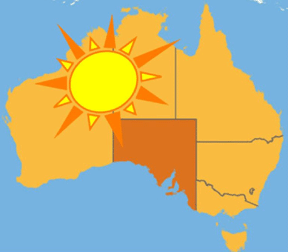 ABC 25th Oct 2020, South Australia’s renewable energy boom has achieved a global milestone. The state once known for not having enough power has become the first major ABC 25th Oct 2020, South Australia’s renewable energy boom has achieved a global milestone. The state once known for not having enough power has become the first majorjurisdiction in the world to be powered entirely by solar energy. For just over an hour on Sunday, October 11, 100 per cent of energy demand was met by solar panels alone. “This is truly a phenomenon in the global energy landscape,” Australian Energy Market Operator (AEMO) chief executive Audrey Zibelman said. https://www.abc.net.au/news/2020-10-25/all-sa-power-from-solar-for-first-time/12810366 |
|
|
The pandemic and the prospect of zero interest present a massive opportunity for clean energy development.
 The tantalising promise of ultra-cheap power South Wind, 27 October 2020 by admin The tantalising promise of ultra-cheap power South Wind, 27 October 2020 by admin
The pandemic and the prospect of zero interest present a massive opportunity for clean energy development. The story of 2020 has really been two stories, deeply interwoven, in which what happens in one keeps playing on the other and causing general mayhem. One is about the virus; the other the economy…….. Solar panels are getting steadily more efficient and cheaper to make, but Quiggin sees their greatest potential in the fact that they last three or more decades and cost virtually nothing to operate. The cost of a solar project today arises almost entirely from the need of investors to get a return on the capital they put into the project’s construction and grid connection. Solar’s low capital cost is stretching the “payback period” of projects – the time available for investors to be repaid in full – so far into the future that the power generated is virtually free. Quiggin calculates that over a module’s lifetime the cost could drop as low as 2c per kilowatt-hour. Yields from current Australian government bonds are lower than likely inflation. European countries are offering bonds maturing after 50 or 100 years, and the US government is selling similar bonds at negative interest rates. Given all this, Quiggin believes that governments should issue perpetual bonds yielding inflation-adjusted returns of zero. “In the world of zero real interest rates that now appears to be upon us… governments can, and should, invest in projects whenever the total benefits exceed the costs, regardless of how those benefits are spread over time.” If there is a powerful case for public investment in renewable energy, the case for doing the same for transmission, says Quiggin, is even stronger. “Electricity transmission lines have the same cost structure as renewables (low operational cost and long lives), if anything more so, meaning that the cost of transmission depends primarily on the need to secure a return to the capital invested.” This is where Quiggin’s interesting idea really starts to sing. A modern, smart, efficient electricity grid over a wide area like eastern Australia can make intermittent solar and wind power work well for us, rapidly switching demand to where the sun shines and the wind blows and minimising calls on alternative generators or energy stored in batteries or hydro schemes. Opposition leader Anthony Albanese proposes to spend $20 billion on transmission infrastructure to allow the national grid to fully integrate new renewable sources. The government could go one further by investing in both transmission and renewable generation. But it is still in pre-pandemic mode, offering just low cost finance for private transmission investment. The pandemic has disrupted everything we knew, killing the old economy and its ideological stereotypes. In these times of upheaval and flux, as John Quiggin says, there are huge opportunities for large-scale public investment in a new, cleaner economy. Our recovering economy will need a lot of public investment. All we ask of the Morrison government is the vision to see what’s possible and the courage to act. http://southwind.com.au/2020/10/27/the-tantalising-promise-of-ultra-cheap-power/ |
|
As coronavirus cases plummet, it’s time to ask: Is Australia ready for the third wave?


“They are so beaten up by the lockdowns and by the fear messages that they are saying “I don’t want to do anything”.”
Yet notwithstanding the testing, the tracing, the social distancing, masking, mathematical modelling, quarantining and investment in public health, Australians will continue to live with COVID-19 for the foreseeable future.
As coronavirus cases plummet, it’s time to ask: Is Australia ready for the third wave? https://www.abc.net.au/news/2020-10-25/coronavirus-preparing-for-the-third-wave/12802070 By Catherine Taylor
An uncomfortable question looms over Australia’s steady exit from its second major outbreak of coronavirus: are we ready for the third wave?
Health experts say it’s a question with an equally uncomfortable answer: a third wave remains a real threat and without a tested vaccine all we have is our self-control, and luck, standing between us and a fresh outbreak.
“We should not expect that we can beat this wave, and then it’s done. It’s the beginning of the next phase,” says Professor Jodie McVernon, an expert in epidemiology, vaccinology and public health at the Doherty Institute, who has been working in isolation for months “like a princess in a castle” from the front room of her Melbourne home.
Professor Raina MacIntyre — head of the Kirby Institute’s biosecurity program — goes further: “The only really feasible exit strategy at this stage is vaccination otherwise we’ll continue to face the risk of third, fourth, fifth and sixth waves.
There is a recipe for reducing risk
Australia’s submarine deal with a corrupt French company

 Meanwhile, in Australia, the submarine deal continues. In February last year, after two years of negotiations, the government signed a ‘strategic partnership agreement’ with Naval Group. The signing took place despite the emergence of two more investigations into Naval, including alleged corruption on a 2009 submarine deal with Brazil and a significant security breach where complete plans of the new Scorpène submarines Naval had provided to India were apparently leaked from within Naval.
Strong anti-corruption measures essential
Vast amounts of Australian taxpayers’ money are being handed to military industrial companies, including Naval Group, in contracts. Yet the perennial lack of transparency in defence procurement, blanket secrecy surrounding Australian weapons exports, and a pervasive “culture of cosiness” between government and industry all continue.
|
Murder, corruption, bombings – the company at centre of Australia’s submarine deal, Michael West Media by Michelle Fahy | Oct 24, 2020 The arms company at the centre of a deadly criminal saga and numerous global corruption scandals, Naval Group, was selected by the Australian government to build our new fleet of submarines – a deal heralded as ‘one of the world’s most lucrative defence contracts‘. How did this happen? In this special investigation Michelle Fahy discovers significant gaps in anti-bribery and corruption measures on this massive procurement project. The message communicated far and wide is that our standards are lax; grey areas are tolerated; and we’ll bend the rules and look the other way.
|
Nuclear waste storage in Australia
Japan plans to dump a million tonnes of radioactive water into the Pacific. But Australia has nuclear waste problems, too The Conversation,October 23, 2020 Tilman Ruff. Associate Professor, Education and Learning Unit, Nossal Institute for Global Health, School of Population and Global Health, University of Melbourne, Margaret Beavis, Tutor Principles of Clinical Practice Melbourne Medical School .
|
Nuclear waste storage in Australia This is what happens at our national nuclear facility at Lucas Heights in Sydney. The vast majority of Australia’s nuclear waste is stored on-site in a dedicated facility, managed by those with the best expertise, and monitored 24/7 by the Australian Federal Police. But the Australian government plans to change this. It wants to transport and temporarily store nuclear waste at a facility at Kimba, in regional South Australia, for an indeterminate period. We believe the Kimba plan involves unnecessary multiple handling, and shifts the nuclear waste problem onto future generations. The proposed storage facilities in Kimba are less safe than disposal, and this plan is well below world’s best practice. The infrastructure, staff and expertise to manage and monitor radioactive materials in Lucas Heights were developed over decades, with all the resources and emergency services of Australia’s largest city. These capacities cannot be quickly or easily replicated in the remote rural location of Kimba. What’s more, transporting the waste raises the risk of theft and accident. And in recent months, the CEO of regulator ARPANSA told a senate inquiry there is capacity to store nuclear waste at Lucas Heights for several more decades. This means there’s ample time to properly plan final disposal of the waste. The legislation before the Senate will deny interested parties the right to judicial review. The plan also disregards unanimous opposition by Barngarla Traditional Owners. The Conversation contacted Resources Minister Keith Pitt who insisted the Kimba site will consolidate waste from more than 100 places into a “safe, purpose-built, state-of-the-art facility”. He said a separate, permanent disposal facility will be established for intermediate level waste in a few decades’ time. Pitt said the government continues to seek involvement of Traditional Owners. He also said the Kimba community voted in favour of the plan. However, the voting process was criticised on a number of grounds, including that it excluded landowners living relatively close to the site, and entirely excluded Barngarla people. Kicking the can down the road Both Australia and Japan should look to nations such as Finland, which deals with nuclear waste more responsibly and has studied potential sites for decades. It plans to spend 3.5 billion euros (A$5.8 billion) on a deep geological disposal site.https://theconversation.com/japan-plans-to-dump-a-million-tonnes-of-radioactive-water-into-the-pacific-but-australia-has-nuclear-waste-problems-too-148337
|
|
|
BHP’s rejection of uranium is a sign of the future
 Wire 21st Oct 2020, The news this week that mining giant BHP will not continue with its long planned multi-billion dollar expansion of its Olympic Dam uranium and copper project is a sign that the market is turning against the controversial mineral.
It spells good news for the future of renewables but leaves the problem of leftover radioactive waste at Olympic Dam. There is no decision to change tack and mine the many many rare earths which also exist at the site.
http://thewire.org.au/story/bhps-rejection-of-uranium-a-sign-of-the-future/
South Australian Parliament rejected Kimba nuclear waste dump, but Morrison govt could still impose it

It sounds good that this Motion passed in SA Parliament Legislative Council – credit to Mark Parnell MLC & SA Greens.
Even though Mark Parnell’s motion in the South Australian Parliament was successful last week it may be an illusory outcome as it seems that the Commonwealth government will have the constitutional superiority to override state laws with regard to the nuclear waste facility at Kimba
This is because the Commonwealth will rely on the free trade provision under section 92 of the Constitution as to the transport interstate of the nuclear waste while its storage and disposal falls under the external affairs power of section 51(xxix) as the safe management and disposal of nuclear waste is regulated under international convention and treaty rights
Regrettably the High Court in recent years has based many of its decisions rejecting state legislation on a broad interpretation of the external affairs power which in some circumstances has lead to virtually nonsensical conclusions
For this reason it is still essential to prevent the government’s proposals being carried out by legislative action
The Guardian was grossly unfair to Julian Assange. They could still make up for this.
 The Guardian’s Silence Let UK Trample on Assange’s Rights in Effective Darkness https://consortiumnews.com/2020/10/21/the-guardians-silence-let-uk-trample-on-assanges-rights-in-effective-darkness/?fbclid=IwAR16w5kNgLGJ3jyFI6QvKZmxJ5tn_LjZcD90a7FOG-ZQ8jaGzUYKlhnRT8M
Jonathan-Cook.net WISE Up, a solidarity group for Julian Assange and whistleblower Chelsea Manning, is due to stage a demonstration outside The Guardian offices on Oct. 22 to protest the paper’s failure to support Assange as the U.S. seeks his extradition in an unprecedented assault on press freedom.
The date chosen for the protest marks the 10th anniversary of The Guardian’s publication of the Iraq war logs, leaked by Manning to Assange and which lie at the heart of the U.S. case to reclassify journalism exposing crimes against humanity as “espionage.”
Here is my full statement, part of which is due to be read out, in support of Assange and castigating The Guardian for its craven failure to speak up in solidarity with its former media partner:
Julian Assange has been hounded out of public life and public view by the U.K. and U.S. governments for the best part of a decade.
Now he languishes in a small, airless cell in Belmarsh high-security prison in London — a victim of arbitrary detention, according to a UN working group, and a victim of psychological torture, according to Nils Melzer, the UN’s expert on torture.
If Judge Vanessa Baraitser, presiding in the Central Criminal Court in London, agrees to extradition, as she gives every appearance of preparing to do, Assange will be the first journalist to face a terrifying new ordeal — a form of extraordinary rendition to the United States for “espionage” — for having the courage to publish documents that exposed U.S. war crimes and crimes against humanity.
The Guardian worked with Assange and WikiLeaks on vitally important documents – now at the heart of the U.S. case against Assange – known as the Afghanistan and Iraq war logs. The latter were published exactly a decade ago today. They were a journalistic coup of global significance, and the paper ought to be profoundly proud of its role in bringing them to public attention.
During Assange’s extradition hearing, however, The Guardian treated the logs and its past association with Assange and WikiLeaks more like a dirty secret it hoped to keep out of sight. Those scoops furnished by Assange and whistleblower Chelsea Manning enriched the paper financially, and bolstered its standing internationally. They also helped to pave its path into the lucrative U.S. market.
Unlike Assange and Manning, The Guardian has suffered no consequences for publishing the logs. Unlike Assange and Manning, the paper has faced no retribution. While it profited, Assange continues to be made an example of — to deter other journalists from contemplating following in his footsteps.
The Guardian owes Assange.
- It owes him a huge debt for allowing it to share in the journalistic glory of WikiLeaks’ revelations.
- It owes him a duty of care as its partner in publishing the logs.
- It owes him its voice loudly denouncing the abuse of a fellow journalist for doing the essence of journalism — holding the powerful to account.
- It owes him and its own staff, and the young journalists who will one day take their place, its muscle in vigorously defending the principle of a strong and free press.
- It owes him, and the rest of us, a clear profession of its outrage as the U.S. conducts an unprecedented assault on free speech, the foundation of a democratic society.
And yet The Guardian has barely raised its voice above a whisper as the noose has tightened around Assange’s — and by extension, our — neck. It has barely bothered to cover the dramatic and deeply disturbing developments of last month’s extradition hearing, or the blatant abuses of legal process overseen by Baraitser.
The Guardian has failed to raise its editorial voice in condemnation either of the patently dishonest U.S. case for extradition or of the undisguised mistreatment of Assange by Britain’s legal and judicial authorities.
The paper’s many columnists ignored the proceedings too, except for those who contributed yet more snide and personal attacks of the kind that have typified The Guardian’s coverage of Assange for many years.
It is not too late for the paper to act in defence of Assange and journalism.
Assange’s rights are being trampled under foot close by The Guardian’s offices in London because the British establishment knows that these abuses are taking place effectively in darkness. It has nothing to fear as long as the media abdicates its responsibility to scrutinize what amounts to the biggest attack on journalism in living memory.
Were The Guardian to shine a light on Assange’s case — as it is morally obligated to do — the pressure would build on other media organizations, not least the BBC, to do their job properly too. The British establishment would finally face a countervailing pressure to the one being exerted so forcefully by the U.S.
The Guardian should have stood up for Assange long ago, when the threats he and investigative journalism faced became unmistakable. It missed that opportunity. But the threats to Assange — and the causes of transparency and accountability he champions — have not gone away. They have only intensified. Assange needs the Guardian’s support more urgently, more desperately than ever before.
Jonathan Cook is a former Guardian journalist (1994-2001) and winner of the Martha Gellhorn Special Prize for Journalism. He is a freelance journalist based in Nazareth. If you appreciate his articles, please consider offering your financial support.
This article is from his blog Jonathan Cook.net.
1 This month.
20 September –National Day of Action in Melbourne on the International Day of Peace


Help Aunty Sue Protect Her Land and Sacred Sites From Destructive Rocket Testing.
.

Australians deserve the truth
about
AUKUS – https://aukuspublicinquiry.com/


PETITION – To: Prime Minister Anthony Albanese and the Australian Labor Government

of the week – Australians for War Powers Reform (AWPR)
To see nuclear-related stories in greater depth and intensity
 Antinuclear