A duplicitous letter from Sam Chard, General Manager, Radioactive Waste Taskforce
 What a duplicitous letter from Sam Chard!
Nuclear assurance, by SAM CHARD, NRWMF taskforce general manager
I WRITE in response to the letter from Michele Madigan (“Nuclear vote”, The Advertiser, 11/11/19).
The National Radioactive Waste Management Facility will be for the permanent disposal of low-level waste, and temporary storage of intermediate-level waste.
A separate facility, likely a deeply geological one, will be found for the permanent disposal of the intermediate-level waste, but that’s a few decades off.
The transport of waste will be conducted safely, and examples in France and the UK demonstrate such a facility can coexist with a clean, green image and a successful export industry.
In the recent Kimba community ballot, more than 61 per cent of local residents supported hosting the facility, and now a ballot is under way for residents near Wallerberdina Station.
Traditional owner, neighbour, and business consultation is also being undertaken, and anyone else with an interest can make a submission
Australian Government report states that Lucas Heights spent nuclear fuel rods (for Kimba dump?) are High Level Wastes
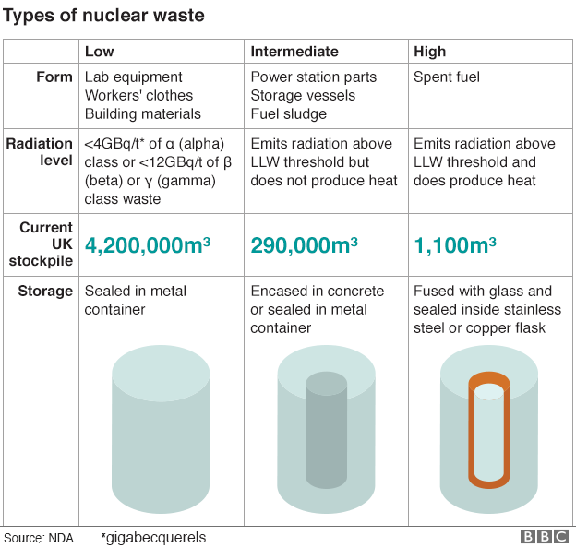
This is an extract from a government report from1993.
The report calls the nuclear fuel rods from the decommissioned Hifar reactor High Level waste.
This would be dumped in the Flinders or Kimba.
Stop the lies, stop the dump.
“The report of the Research Reactor Review examines, among many other things, the issue of the management of spent fuel rods from the HIFAR reactor, which had been accumulating at Lucas Heights since 1963. The Report says:
The spent fuel rods at Lucas Heights can only sensibly be treated as high level waste.
The pretence that spent fuel rods constitute an asset must stop’ (p. 216)
waste. … The pretence that spent fuel rods constitute an asset must stop.”
(McKinnon Review, Principal Conclusions p.xxiii, July 1993)
A cauldron of extreme heat developing in Western Australia is heading straight for the east coast bushfire zone
A cauldron of extreme heat developing in WA is heading straight for the east coast bushfire zone, ABC News, By Irena Ceranic 15 Nov 19, A build-up of intense heat that will see temperatures in WA soar into the mid 40s this weekend will be dragged across the country next week, right into parts of New South Wales and Queensland devastated by bushfires this week.
Key points:
- Four lives and hundreds of homes have been lost in NSW and Queensland fires
- Milder temperatures should provide some relief for NSW in the coming days
- But intense heat from WA is likely to be dragged across the country next week
The NSW and Queensland bushfires have already burnt through more than a million hectares of land, killing four people and destroying more than 300 homes.
Bureau of Meteorology spokesman Neil Bennett said milder temperatures were expected to provide some relief to parts of NSW where fires continue to burn over the next few days, but the bushfire threat was far from over with the heat expected to ramp up again.
The areas in dark red on the map below [on original] show parts of WA will bake in temperatures above 45 degrees Celsius over the weekend, before the hot air mass bears down on the east coast by Tuesday. ……. https://www.abc.net.au/news/2019-11-15/wa-hot-air-mass-will-head-to-the-east-coast-bushfire-zone/11705750
Federal Govt to decide on new radioactive waste storage facility next year
|
Federal Govt to decide on new radioactive waste storage facility next year, https://www.abc.net.au/radionational/programs/breakfast/federal-govt-to-decide-on-new-radioactive-waste-storage-facility/11706852?fbclid=IwAR0Ux4kgvx9WnXGWBNrmuAOxsLZEYDfanXY69yT7-ZRIbGIB009IAab5NPY Australia’s 40-year search for a site for a national radioactive waste storage facility could be coming to an end.The Federal Government says it’ll make a final decision early in the New Year on three sites under consideration in South Australia.
This week ballot papers are being sent to residents of Hawker in the Flinders Ranges to gauge local support. It follows a recent vote of the Kimba community on the Eyre Peninsula, which showed a majority in favour. Guests: Jeff Baldock, Kimba landholder and member, Working for Kimba’s Future group Producer: Cathy Van Extel |
|
Meterologist shocked at prospect of Australia’s coming summer of heat and drought

|
‘A horrible map to look at’: No rain as Australia enters grim summer, https://thenewdaily.com.au/news/national/2019/11/14/a-horrible-map-to-look-at-no-rain-as-australia-enters-grim-summer/
Robyn Wuth Australia is staring down the barrel of a horrific summer season that will drag scorching temperatures and extreme conditions well into the new year.Livio Remano has never seen such extreme conditions in the 20 years he has worked with the Bureau of Meteorology, comparing the long term seasonal outlook to a bad chest X-ray. “It’s horrible, it’s a horrible map to look at,” he said on Thursday. “I have never seen this before in my life … the entire country of Australia is covered in deep red.” That red colour means 70 to 80 per cent of the country is experiencing above-average temperatures, and is being blamed on something called an extremely positive Indian Ocean Diode. Westerly winds weaken along the equator and push warm water to shift towards Africa during a typical IOD. The wind changes allow cool water to rise from the depths of the ocean in the east, causing a temperature difference across the tropical Indian Ocean, with unusually cooler water in the east and warmer in the west. It means atmospheric moisture levels drop in Australia’s northwest, which alters the path of weather systems coming from Australia’s west. The result is less rainfall and higher than normal temperatures over parts of Australia. Queensland is moving into its wet season but there is little chance of significant rainfall until January. But eventually, Mr Remano says the rain will come. Whatever rain does fall will be isolated and could cause more harm than good with the threat of dry lightning strikes sparking new fires. “What we need is English rain, but it is not forthcoming – certainly not anytime soon,” he added. |
|
Rio Tinto drives ERA rehabilitation of Ranger uranium mine
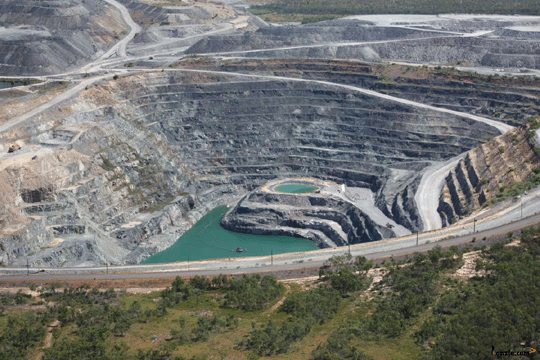 Rio Tinto drives ERA rehabilitation of Ranger, https://www.australianmining.com.au/news/rio-tinto-drives-era-rehabilitation-of-ranger/
The company has announced an offer of new fully paid ordinary shares to raise the rehabilitation funds, with support from majority owner Rio Tinto.
As ERA’s largest shareholder, Rio Tinto is subscribing to its full entitlement of approximately $326 million.
ERA is not able to secure third-party underwriting support, therefore Rio Tinto is also acting as the underwriter to ensure ERA secures the funds it needs.Rio Tinto energy and minerals group executive Bold Baatar said it was committed to ensuring ERA’s position to fund the rehabilitation.
“We take mine closure very seriously and ensuring ERA is able to fund the closure and rehabilitation of the Ranger project area, through participating in this entitlement offer, is a priority,” Baatar said.
The shares will be offered to all eligible shareholders for $0.15 per share, representing a 38 per cent discount to the $0.24 per share 10-day volume weighted average price (VWAP).
After the increase in the rehabilitation provision in 2018, ERA found it did not have sufficient existing cash resources or expected future cash flows to fulfil the Ranger rehabilitation.
ERA believes it will have an achievable plan for the Ranger rehabilitation with the completion of this entitlement officer.
As per the obligation with the Commonwealth and Northern Territory governments and the Traditional Owners, ERA will return the Ranger project area to an environment similar to the nearby Kakadu National Park.
Under its mining approval terms, ERA must end mining and processing at Ranger by January 2021 and finish final rehabilitation by January 2026.
ERA is not expected to generate any direct financial return from the Ranger rehabilitation expenditure.
Scott Morrison shuns Torres Strait Islanders worried about climate change
 Scott Morrison shuns Torres Strait Islanders worried about climate change, https://www.sbs.com.au/news/scott-morrison-shuns-torres-strait-islanders-worried-about-climate-change Scott Morrison has declined to visit the homes of a group of Torres Strait Islanders who are taking their complaint against government inaction on climate change to the UN.
A group of Torres Strait Islanders have accused the Morrison government of breaching their human rights over its failure to cut emissions and build defences such as sea walls.
After lodging an official complaint with the UN Human Rights Committee in May, they asked Mr Morrison to see for himself the effects of climate change on their low-lying homes.
But Mr Morrison has declined, as has Emissions Reduction Minister Angus Taylor to make the journey to Australia’s north.
Complainant Yessie Mosby said they were disappointed Mr Morrison would not visit.
“Just like those battling bushfires on the mainland, our islands are on Australia’s climate frontline.”
Mr Mosby said the complainants are demanding Australia increase its commitment to cut emissions under the Paris Agreement in the lead-up to COP 26 next year.
“We’ll wait and see what Canberra declares in coming months, as will our fellow islanders across the Pacific.
“This is not a problem for another country to sort out. Bushfires, floods, droughts, extreme heat and in our case rising seas – this is the reality of living in Australia now,” he added.
In their letter to Mr Morrison, the Torres Strait Islanders described how rising seas were threatening homes, swamping burial grounds and washing away sacred cultural sites.
The prime minister’s office has been contacted for comment.
Coal lobby wields power over Australian govt, like the National Rifle Association does in USA
 While Australia burns, the world watches our credibility go up in smoke, The New Daily, Damien Cave 14 Nov 19, When a mass shooting shattered Australia in 1996, the country banned automatic weapons.In its first years of independence, it enacted a living-wage law.
Stable retirement savings, national health care, affordable university education – Australia solved all these issues decades ago.
But climate change is Australia’s labyrinth without an exit, where its pragmatism disappears. The bushfires that continued raging on Wednesday along the country’s eastern coast have revealed that the politics of climate in Australia resist even the severe pressure that comes from natural disaster.
Instead of common-sense debate, there are culture war insults.
The deputy prime minister calls people who care about climate change “raving inner-city lunatics”. Another top official suggests that supporting the Greens party can be fatal.
And while the government is working to meet the immediate need – fighting fires, delivering assistance – citizens are left asking why more wasn’t done earlier as they demand solutions.
“We still don’t have an energy policy, we don’t have effective climate policy – it’s really very depressing,” said Susan Harris Rimmer, an associate professor at Griffith Law School. ……
in Australia, where coal is king and water is scarce, the country’s citizens have spent the week simmering with fear, shame and alarm……..
Even as the country’s emissions continue to soar, it’s been hard to reach a political consensus on energy and climate change policy because of Australia’s mining history and a powerful lobby for one product: Coal.
“Coal is our NRA,” said Dr Harris Rimmer, referring to the National Rifle Association, which has stymied changes to gun laws in the US even as mass shootings have become shockingly common.
“They have total control over Parliament.”……
For conservatives in particular, extraction of natural resources in rural areas is a stand-in for values worth fighting for against condescending urban elites.
Just a few days before the fires, for example, Prime Minister Scott Morrison told a mining group that new laws were needed to crack down on climate activists and progressives who “want to tell you where to live, what job you can have, what you can say and what you can think”.
“Climate change has become a proxy for something else,” said Robyn Eckersley, a climate politics expert at the University of Melbourne…….
Mr Morrison, who in the past has made it clear that Australia’s economic prosperity comes first, has repeatedly argued in recent days that now is not the time to discuss climate policy or politics.
Photographed hugging fire victims, he has sought to focus on emotional and financial support.
Joëlle Gergis, a climate scientist and author, said that “it wastes the opportunity to explain to the Australian public what we’re seeing in climate extremes”……. https://thenewdaily.com.au/news/2019/11/14/while-australia-burns-the-world-watches-our-credibility-go-up-in-smoke/
Dave Sweeney – on wining Nobel Prize, and on treaty on the Prohibition of Nuclear Weapons.
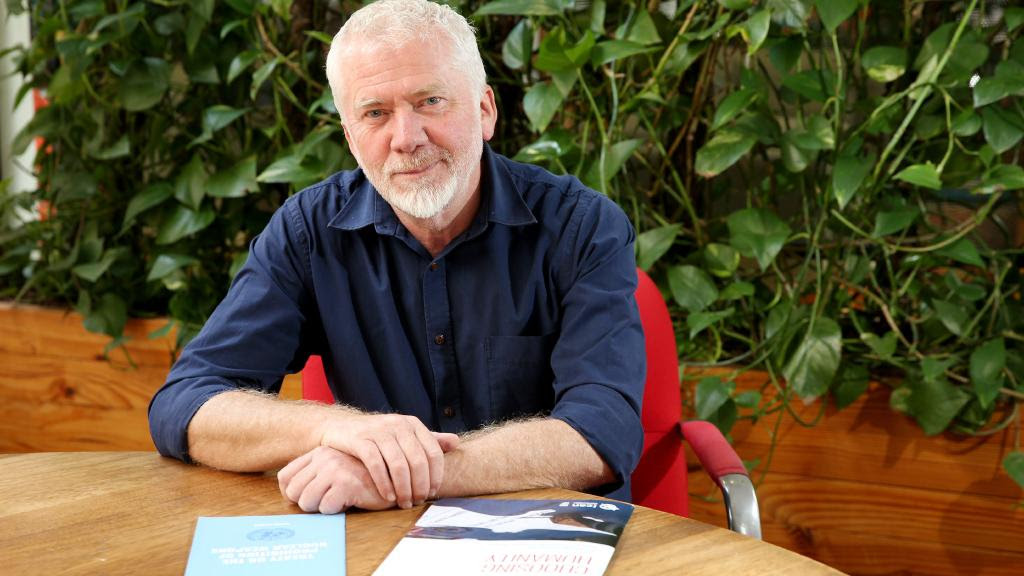
Dave Sweeney talks Nobel Prize and working against nuclear weapons https://www.weeklytimesnow.com.au/country-living/dave-sweeney-talks-nobel-prize-and-working-against-nuclear-weapons/news-story/02bae8fda0306529842b5e19bad835c2
A Nobel Prize winner who grew up on a farm has dedicated his life to one of humanity’s most important causes.
DAVE Sweeney’s story starts out like so many rural kids.
Growing up on a grazing property, east of Melbourne, he wanted to be a farmer, but his Dad wanted his son to achieve more skills.
So Dave dutifully got a degree, and a range of jobs, including as a teacher.
But then he went one better and got a Nobel Peace Prize.
 It was two years ago that Dave was one of the founding members of ICAN, the International Campaign to Abolish Nuclear Weapons, who travelled to Norway to receive the globally significant gong, which puts him in the same company as Mother Therese and Nelson Mandela.
“I didn’t actually go on the stage with the King of Norway,” the 57-year-old says.
“But I was in Norway for five days, for the formal reception, with the king and trumpets blowing, and a big party afterwards.”
It speaks volumes about Dave that he and his colleagues don’t run around promoting the fact they are Australia’s only Nobel Peace Prize winners.
Instead, he continues to knuckle down and get on with the job that won the prize in the first place.
“I don’t really talk about it much, only when people ask or I’m doing a presentation,” says Dave, who still speaks with a farmer’s easygoing attitude.
“I don’t have a T-shirt saying ‘Nobel winner’ or a screen saver.
“Winning hasn’t changed my daily life, but there’s been a sense of ‘the stuff this guy has been banging on about forever is actually important’ and ‘these people have done a significant thing’. It’s validation and it opens new doors to keep the momentum going.”
Working between his homes in Melbourne and South Gippsland’s Phillip Island, Dave is currently lobbying councils — including, most recently, Benalla — to get on board and pressure the Australian Government to ratify the Treaty on the Prohibition of Nuclear Weapons.
He says the ICAN Cities appeal is an initiative that is seeking to build a wider recognition of and support for the UN treaty. At its most basic, a council passes a version of a model resolution and writes to the prime minister and foreign minister urging them to support it.
“Other councils get more engaged — some have asked ICAN speakers to attend council and community events, profiled the issue and initiative on the websites and newsletters, flown an ICAN/Nobel flag from the town hall, hosted displays about ICAN and the issue in their libraries, commissioned murals and public artworks,” he said.
“There is much that can and could be done and it really depends on the people and place.
“An important part of the local government initiative, and of ICAN’s wider work, is that it is non-partisan. We don’t seek to score points – we want to make one: that there are no winners in a nuclear war.”
Since 1996 Dave has been the nuclear-free campaigner at the Australian Conservation Foundation, working to stop uranium mining and promote the responsible handling of radioactive waste.
His role also includes working to stop nuclear weapons. That’s how, in 2006, he was one of the voluntary founding members who met over a cup of tea and beer to nut out a strategy, which the following year led to the creation of ICAN.
Today, ICAN has spread to more than 500 groups in more than 100 countries, with its headquarters in Geneva.
According to the Nobel committee, ICAN was awarded the world’s most significant prize for “its work to draw attention to the catastrophic humanitarian consequences of any use of nuclear weapons and for its groundbreaking efforts to achieve a treaty-based prohibition of such weapons”.
“Often the deck feels stacked against us, that we can’t get a break and it’s not always fair. But this was awarded to a group of people who are not powerful or rich,” Dave says.
“It’s humbling and important recognition.”
He says just this year the Federal Government announced an inquiry into the nuclear energy industry, while in both NSW and Victoria there are pushes to examine the sector.
Dave says these are all under the guise of stopping climate change, even though science and industry are unanimous that renewables are the cheapest, fastest and easiest way to supply all our power needs.
“When you use a uranium fuel rod in a nuclear reactor you get a guaranteed three years of low- carbon electricity, and when you take the fuel rod out you get a guaranteed 100,000 years of toxic waste, which is poisonous to human life and the environment,” he says.
“There is a very poor risk-to- reward ratio.”
Yet despite setbacks, there are also breakthroughs.
He says just last week the Federal Environment Minister and the Northern Territory Government agreed with mining companies to transition out of uranium mining in Kakadu.
Dave says following Japan’s Fukushima disaster, the market for nuclear energy had dropped.
“In 2000, 22 per cent of global electricity came from nuclear energy, now it’s 11 per cent.
“Nuclear power is enormously expensive and slow. It would take 20 years to build a reactor in Australia and cost at least $20 billion.”
Dave says being raised in a rural farming family gave him a strong sense of the importance of social justice and caring.
“Mum and Dad were always decent, community-minded people. Mum would cut the sandwiches for the local emergency services and Dad would visit the sick,” he says.
“Even if I’d preferred to stay at home, it was always emphasised to me to put in.
“It’s a privilege to live in this country and so you give back, even if it’s something modest.”
He studied politics and literature, became a teacher, and later became an adviser at Oxfam, before former Prime Minister John Howard’s decision to mine uranium in Kakadu steered him into nuclear campaigning at ACF.
Given Dave has been campaigning on these globally-critical issues for more than two decades, what advice does he have for the younger generation, especially with the documented rise of eco-anxiety?
“I say to young people these problems aren’t of their making, so don’t feel guilt, otherwise you can’t get out of bed in the morning. But they do feel some responsibility and agency,” he says.
“Light a candle, say a prayer, put a sign saying ‘nuclear-free zone’ on your local school, do an act of kindness or a directed act of anger, write a letter to your council, the Prime Minister and the Foreign Minister saying we should ratify the Treaty.
“Yes, individual actions are small, but when you add the next action and the next and the next they really make a difference. Each action matters.”
Fire chief says Australia fires could be out of control for months
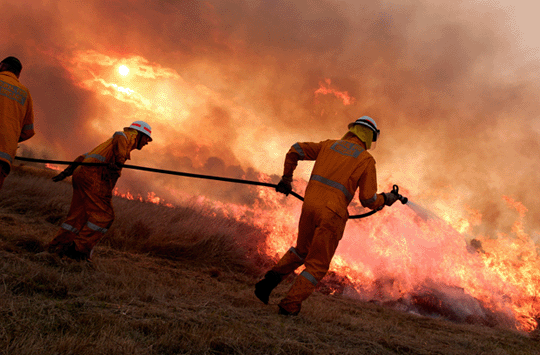 Australia fires could be out of control for months, says fire chief
Concern grows over wind changes and high temperatures forecast for later this week, Guardian, Ben Doherty in Sydney @bendohertycorro
Wed 13 Nov 2019 It could be months before eastern Australia has more than a million hectares of bushfires under control, the New South Wales fire chief has warned, as the country faces one of its worst bushfire outbreaks.After relief that no further lives were lost on Tuesday, concern was growing over unpredictable winds worsening fires in the neighbouring state of Queensland on Wednesday, with much hotter temperatures also predicted for the Sydney area in the coming days.
Gusty winds changing direction are predicted to fan flames in new directions and widen “catastrophic” fire fronts in Queensland and northern NSW, where more than 100 fires – one more than 150,000 hectares (370,000 acres) in size – are burning.
Forecasters warned that “dry lightning” strikes could ignite new blazes, with fires worsening when hotter temperatures arrive over the weekend. Temperatures in Queensland are currently up to 8C higher than average.
Shane Fitzsimmons, the commissioner of the NSW rural fire services, said: “The real challenge is we have an enormous amount of country that is still alight. They won’t have this out for days, weeks, months. Unfortunately the forecast is nothing but above-average temperatures and below-average rainfall over the next few months and we’ve still got summer around the corner.”
The current fires in NSW cover four times the land area that burned during the whole of 2018, according to Fitzsimmons. There are also fires in Western Australia, South Australia and the Northern Territory.
While the extent of the bushfires is less than those in New South Wales in 1974-75 , which destroyed 4.5m hectares (11m acres), forecasters and fire chiefs are concerned that so many fires are already under way before high summer………
Bushfires are a regular occurrence during Australian summers, but the intensity of this year’s fires, and how early in the season they have arrived, have unleashed an acute political debate over the impact of climate change in exacerbating Australia’s fire vulnerability.
The prime minister, Scott Morrison, whose conservative coalition government has been consistently criticised over its support for coal-mining and power plants, inaction on climate change, and Australia’s rising carbon emissions, has refused to answers questions on climate change worsening fires………
In one of the largest peacetime mobilisations of Australian forces, the defence minister, Linda Reynolds, is preparing to send army, navy and air force reserve forces – the equivalent of the UK’s Army Reserve – into the fire zone to assist with evacuations and logistics.
The military intervention might even include an unprecedented compulsory call-up of reserve forces, such is the scale of the fire damage. https://www.theguardian.com/australia-news/2019/nov/12/australia-fires-rage-out-of-control-catastrophic-day
23 fire and emergency services leaders from across Australia demand government action on climate change
 Ex-fire chiefs demand government find ‘urgent response’ to climate change, SBS, 14 Nov 19, A coalition of 23 fire and emergency services leaders from across Australia is demanding government action to cut emissions amid devastating bushfires. Ex-fire chiefs demand government find ‘urgent response’ to climate change, SBS, 14 Nov 19, A coalition of 23 fire and emergency services leaders from across Australia is demanding government action to cut emissions amid devastating bushfires.
Former fire chiefs from across Australia are calling on the federal government to act now against the “urgent threat” of climate change as bushfires devastate parts of the country. A coalition of 23 fire and emergency services leaders from every state and territory are insisting harder-to-control fires have broken out earlier-than-normal across New South Wales and Queensland because of global warming. The Emergency Leaders for Climate Action group is pressing for an urgent plan to phase out fossil fuels such as coal, oil, and gas, which they argue are “the root cause” of the problem…….. Former fire chiefs from across Australia are calling on the federal government to act now against the “urgent threat” of climate change as bushfires devastate parts of the country. A coalition of 23 fire and emergency services leaders from every state and territory are insisting harder-to-control fires have broken out earlier-than-normal across New South Wales and Queensland because of global warming. The Emergency Leaders for Climate Action group is pressing for an urgent plan to phase out fossil fuels such as coal, oil, and gas, which they argue are “the root cause” of the problem.https://www.sbs.com.au/news/ex-fire-chiefs-demand-government-find-urgent-response-to-climate-change |
|
Scientists refute Barnaby Joyce’s claim that sun’s magnetic fields cause bushfires
The former deputy prime minister told Sky News he accepted that the climate crisis was making Australia hotter and drier.
Barnaby Joyce’s claim that changes to the sun’s magnetic fields were linked to the bushfires burning out of control across NSW have been rubbished by climate scientists.
The former deputy prime minister told Sky News he accepted that the climate crisis was making Australia hotter and drier….. “There’s just the the oscillation of the seasons. There’s a change in the magnetic field of the sun.”
Associate Professor Nerilie Abram, a climate researcher at the ARC Centre of Excellence for Climate Extremes, called his comments “ludicrous and grossly ill-informed”.
Dr Abram said she was unaware of any study suggesting changes to the sun’s magnetic field could increase Australia’s bushfire risk.
“I don’t know of any scientific study that says that,” she said.
Dr Abram said changes to the sun’s magnetic fields had a tiny effect on the Earth’s climate.
“They are not causing climate change……
Associate Professor Pete Strutton, from the Institute for Marine and Antarctic Studies at the University of Tasmania, said it was difficult to analyse Mr Joyce’s claim because it was so bizarre.
“I don’t even know what he means. We know what causes climate change,” he said. “What exactly would the magnetic fields influence? I can’t even … Are they influencing the amount of solar radiation reaching the Earth? It is hard to respond to because it is so wacky.” https://www.brisbanetimes.com.au/national/barnaby-joyce-says-sun-s-magnetic-fields-cause-bushfires-science-says-20191112-p539xb.html
Enthusiastic (misplaced) call for tax-payer funded Mars colonisation research
 When will these starry-eyed enthusiasts wake up to the intimate connection between space-Mars research, and Donald Trump’s nuclear-war-in-space project?
 Mars Society Australia has renewed its push for a Mars research station simulation to be built in the Arkaroola Wilderness Sanctuary, in outback South Australia.
The site would replicate a future Mars community, complete with a fake rocket ship, laboratories, rovers and scientists in spacesuits doing field experiments in rocky outcrops.
“It will allow us to do a wide range of activities that support the vision of human presence on Mars,” the society’s president, Jonathan Clarke, said.
“We can train people in field science and space operations in the area, and we can do education and outreach programmes…….
It’s leveraging off the creation of Australia’s new space agency, as well as US president Donald Trump’s hasty plan for America to return to the Moon by 2024, and hopefully go on to Mars. ……
In September, the Australian government announced it would invest $A150 million ($NZ162m) for Australian businesses and researchers to join the US’s Mars exploration project……https://www.nzgeo.com/audio/calls-for-a-mars-research-station-to-be-built-in-outback-south-australia/?utm_source=Facebook&utm_medium=FacebookPost&utm_campaign=Mars_research_station&fbclid=IwAR3lVBPG2YK12lphwTL83BDs1YHyc7M-o0Y1JwLNQTPRUfa3YCsWG457it8
Australian Energy Market Operator predicts ‘completely new’ two-sided energy market
|
Australia told to prepare for ‘completely new’ two-sided energy market https://www.theguardian.com/australia-news/2019/nov/14/australia-told-to-prepare-for-completely-new-two-sided-energy-market
Consumers should be rewarded for buying and selling energy in real time, Australian Energy Market Commission says Katharine Murphy Political editor @murpharoo, Thu 14 Nov 2019 Australia needs to prepare the ground for a two-sided national energy market, where consumers are rewarded for buying and selling energy in real time, according to the Australian Energy Market Commission.In a new discussion paper to be released on Thursday, the AEMC says technology has previously limited consumer participation in the energy grid but the advent of smart devices and virtual power plants has created the opportunity for a fully fledged two-sided market. Comparing the opportunity in energy with disruptive platforms such as eBay or Airbnb, the AEMC chairman, John Pierce, says “digitalisation has progressed to the point where it is time to consider a completely new approach”. He says the Australian Energy Market Operator knows how much generation to expect from scheduled generators, but now attention needs to turn to virtual power plants which households are creating through solar PV and local battery storage. As well as creating incentives for households to invest in smart appliances and distributed energy infrastructure, Pierce says there is opportunity to utilise more demand management in the system, because batteries, pool pumps, air conditioners and electric vehicles can be set to consume power off peak and export power back to the grid at times when that is most remunerative. The commission has already released a draft rule for a demand-response mechanism allowing large commercial and industrial users to sell forsaken demand directly into the wholesale market for the first time. The rule would put demand response on an equal footing to generation for the first time, with energy users paid as if they are generators. Pierce says the Australian energy market is already in the process of becoming more decentralised. The grid is transitioning away from centrally controlled, big generators dominating the market. “Looking to the future – both the demand and supply sides of the energy market would be actively engaged in electricity scheduling and dispatch processes – while delivering all the services people expect like hot water, air-con and dishwashing,” the AEMC chair says. “Less generation and network capacity would be needed in a market with higher levels of consumer participation and responsiveness. Decisions to consume or not to consume would be valued digitally through any device that’s connected to the internet and remotely controlled. “Then all you will need are price signals to automatically switch your household or business power plant from grid import to export and back again delivering the services you want at least cost. It would also be cheaper for streets and suburbs to share local generation resources and storage devices.” The AEMC paper will be released to contribute to market design work being undertaken by the Energy Security Board, with reform options expected to be pursued in 2020. |
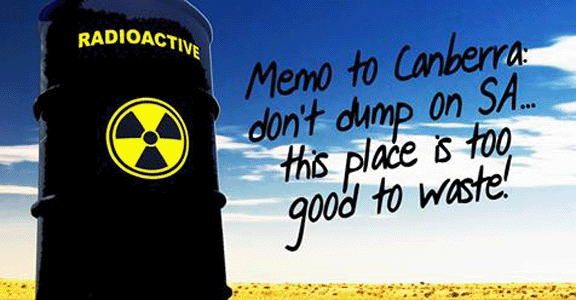
The vote of one town shouldn’t be the views of all people in South Australia.
1 This month.
20 September –National Day of Action in Melbourne on the International Day of Peace


Help Aunty Sue Protect Her Land and Sacred Sites From Destructive Rocket Testing.
.

Australians deserve the truth
about
AUKUS – https://aukuspublicinquiry.com/


PETITION – To: Prime Minister Anthony Albanese and the Australian Labor Government

of the week – Australians for War Powers Reform (AWPR)
To see nuclear-related stories in greater depth and intensity
 Antinuclear