Aboriginal group votes against nuclear dump, but government department warns that they cannot veto it
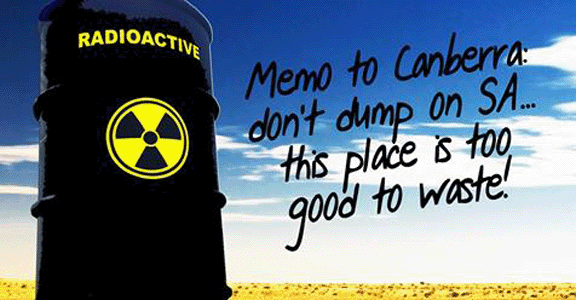 Barngarla ballot shows “no support” for facility https://www.eyretribune.com.au/story/6503108/barngarla-ballot-shows-no-support-for-facility/?fbclid=IwAR1RVmemtqtKZXMRSYPUS85sTAmPayhMAFzTL4b-uCB2YLHVA5FZL80fW8E, Rachel McDonald 20 Nov 19,
The Barngarla Determination Aboriginal Corporation (BDAC) have announced the result of a separate ballot on the two proposed Kimba sites for the National Radioactive Waste Management Facility (NRWMF).
The BDAC recently conducted a confidential postal ballot of its members through independent ballot agent Australian Election Company, asking voters the same question posed to residents of the Kimba District Council area in a ballot which concluded earlier this month.
The Kimba district ballot returned a 61.58 per cent ‘yes’ vote and 38.42% ‘no’ vote.
Of 209 eligible voters in the BDAC ballot, all Barngarla native title holders, 83 valid ‘no’ votes were counted, with zero yes votes returned.
“This unanimous “No” vote demonstrates that there is absolutely no support at all within the Barngarla community for the NRWMF,” the board said in a statement.
The BDAC has written to resources minister Matt Canavan advising him of the result.
“BDAC has requested that given the first people for the area unanimously have voted against the proposed facility that the minister should immediately determine that there is not broad community support for the project,” the board said.
“In light of this total rejection of the NRWMF by the Barngarla people, it is BDAC’s responsibility to continue to give voice to the profound concerns Barngarla traditional owners have regarding the NRWMF, and to take whatever steps are necessary to oppose the NRWMF being located on Barngarla Country.”
A spokesperson for the Department of Industry, Innovation and Science said the ballot would be considered alongside other consultation.
“We will consider the results of the Barngarla’s own ballot alongside the ballot of people who live in Kimba, as well as submissions received, neighbour and business surveys, and direct feedback including at our drop-in offices over several years.
“The department has said on numerous occasions that the facility will only be delivered alongside a community that broadly supports it, that no single metric or number will determine the level of support, and that no one group or individual will have a right to veto the facility.“
The spokesperson said the minister and the department had been working closely with relevant Indigenous representative groups throughout the consultation process and had previously offered to finance a ballot.
“Those conversations are in some instances ongoing.
“With respect to heritage, while native title on both of the Kimba sites has been extinguished, expert heritage consultants were engaged by the department to conduct an independent desktop assessment of Aboriginal cultural heritage, and confirmed no registered heritage sites in or surrounding them.”
Community submissions on the proposed facility will remain open until December 12.
Political manipulations- the Swedish allegations against Julian Assange
We need to ask ourselves why the focus is not on the crimes perpetrated by those involved in war crimes. Why is an Australian citizen being subjected to US espionage laws even though he was never on US soil? More importantly, why should an Australian citizen have allegiance to the US?
 The Swedish case against Assange was always political, https://www.theage.com.au/national/the-swedish-case-against-assange-was-always-political-20191120-p53cgs.html,By Greg Barns and Alysia Brooks, November 20, 2019 It is almost a decade since Julian Assange woke to discover, on the front page of a Swedish newspaper, that Swedish authorities had decided to pursue him on allegations of sexual misconduct. Immediately, Julian presented himself to the police station to make a statement and clear his name. After speaking with prosecutors, he was told he could leave the country; so he did.
Currently, Assange is held on remand in Belmarsh prison, in conditions that are exacerbating his already fragile health, and impeding his ability to prepare his defence. He is facing unprecedented charges under the US Espionage Act, for allegedly carrying out actions that journalists and publishers engage in as a part of their work. He is facing 175 years – an effective death sentence – for allegedly engaging in journalism.
And let’s not forget the material that was exposed by WikiLeaks. The releases included evidence of war crimes, including torture and unlawful killings, perpetrated during the Iraq and Afghanistan wars, and the Guantanamo files, which demonstrated that the majority of men, and children, were being held and tortured at the prison, even though they were innocent of any crime.
We need to ask ourselves why the focus is not on the crimes perpetrated by those involved in war crimes. Why is an Australian citizen being subjected to US espionage laws even though he was never on US soil? More importantly, why should an Australian citizen have allegiance to the US?
Greg Barns is a barrister and adviser to the Australian Assange Campaign. Dr Alysia Brooks is a human rights and due process advocate.
Journalists beware! Australia now a surveillance state
 Australia now a surveillance state with journalists as POIs under ASIO Act, Michael West.com, by John Stapleton — 21 November 2019 Will future historians see the Abbott/Turnbull/Morrison era as the period of governance when totalitarian instincts were unleashed? The targeting of journalists is just the beginning of a much greater disaster, writes journalist and author, John Stapleton. Australia now a surveillance state with journalists as POIs under ASIO Act, Michael West.com, by John Stapleton — 21 November 2019 Will future historians see the Abbott/Turnbull/Morrison era as the period of governance when totalitarian instincts were unleashed? The targeting of journalists is just the beginning of a much greater disaster, writes journalist and author, John Stapleton.
The #RighttoKnow movement barely touches on the intensity of media manipulation by the conservatives since they regained power in 2013; from blocking popular Facebook sites to harassing little-read authors like me. Imagine you’re writing something critical of the government. You know there are cameras in your home, a keylogger on your computer – every keystroke is observed or recorded. And then you hear cries of derision from a neighbouring house. I experienced this while completing the third and final book in a series on Australian life, Dark Dark Policing. The first two, Terror in Australia: Workers’ Paradise Lost and Hideout in the Apocalypse, may not have set the bestseller lists alight, but that is not the point. My lifetime in journalism never prepared me for so much abusive surveillance. My epiphany came post-retirement. Returning from years in Asia, I was jarred by the dilapidated state of Australia in contrast to the dynamic societies I had been in. And so began my work on a book initially titled Workers’ Paradise Lost. But it was impossible to ignore the biggest story of the day, terror, with the then Prime Minister, Tony Abbott, abandoning good government in favour of terrifying the population, pounding on about “the death cult” at every opportunity. This was despite repeated warnings from terror-messaging experts that his terminology was counterproductive, actually attracting recruits to Islamic State……. Among the most egregious laws passed by the Abbott and Turnbull governments were Journalist Information Warrants, issued entirely in secret. Journalists are not informed if a warrant is taken out against them and face jail if they publicise the fact. The laws have become so strict that journalists cannot write about security operations, or even surveillance of their reporting, without the risk of prison. I chose to use novelistic techniques. …….. The tranches of anti-journalist legislation introduced jail terms of up to ten years for journalists who disclose what are known as SIOs, Secret Intelligence Operations. Who decides what an SIO is? ASIO does…… The point is, the public narrative – thereby, the nation’s culture – is being controlled: from barely read authors like me, to the mainstream media, to Facebook warriors. Suppress dissent and you foment revolution. Thanks to the blizzard of poorly drafted legislation that the Liberals introduced to exploit the fear of terror, we now live in a country where, as the Inspector-General of Intelligence and Security recently pointed out, you can be jailed for five years for breaching orders you didn’t know existed; where children as young as ten can be incarcerated without charge. It doesn’t take the gift of prophecy to know that future historians will see the Abbott/Turnbull/Morrison era as the worst period of governance in Australia’s history, when totalitarian instincts were unleashed. The targeting of journalists is just the beginning of a much greater disaster. https://www.michaelwest.com.au/australia-the-surveillance-state-with-journalists-now-pois-under-the-asio-act/ |
|
Survey showed environment and climate to be Australian children’s top concerns
|
Environmental issues and climate change are Australian children’s top concerns, https://www.sbs.com.au/news/environmental-issues-and-climate-change-are-australian-children-s-top-concerns The environment has topped the list of concerns of Australians aged between 10 and 16 as children fight for a bigger say.
BY ROSEMARY BOLGER 21 Nov 19,The environment is the greatest concern for Australian children aged between 10 and 16, a national survey has found.
The results of the Unicef survey, released on Wednesday to mark World Children’s Day, showed 28 per cent of respondents named treatment of the environment as the most pressing issue for the world. The issue, which encompassed water and other forms of pollution, climate change and extinction rates, was also the number one concern when asked to consider what needed to be improved in their own lives, their local area and Australia. Unicef Australia’s young ambassador Josh Brittain said views on the environment tended to become bleaker as children got older. “You could track how their optimism falters as they get older,” he said. The 20-year-old said children and young people were asked to name the first thing that popped into their head when they thought of the environment. “As we were talking to younger kids they’d say things like animals, plants, turtles and as we talked to older kids, maybe around year 6 or 7, they’d say things like littering or sustainability,” he said. “And as we got to the later years like 11 or 12 exclusively like death destruction, hopelessness.” The 602 children and young people in Australia surveyed for the report strongly rejected the notion their views were manipulated or a regurgitation of their parents or teachers’ ideas. Eighty-five per cent said that they solidly held their own views, with 37 per cent saying adults encourage them to think for themselves. But Mr Brittain said many felt their views on issues like climate change were not taken seriously, particularly by political leaders, reflected in the massive climate strikes in Australia led by young people in September. “We needed to be included in the decision making because nobody is more invested than we are. This idea that young people are not capable of coming up with solutions or we do come up are just products of their parents … is an absolute fantasy,” he said. Unicef Australia director Nicole Breeze said the survey results reinforced the need for a national youth peak body to be funded to provide a channel for children and young people to directly influence policies that matter to them. “They are feeling frustrated by the political process and many of them are seeing that their last resort or only option is to step more into this strike mode,” Ms Breeze said. Unicef has conducted similar surveys in other countries. “What we do see is the level of disengagement and worry about the political level of engagement is very high in Australia in contrast to countries like Canada and elsewhere,” she said. Despite their concerns, the majority of children and young people said they enjoyed growing up in Australia. |
|
Climate change will make fire storms more likely in southeastern Australia
Climate change will make fire storms more likely in southeastern Australia https://theconversation.com/climate-change-will-make-fire-storms-more-likely-in-southeastern-australia-127225, Giovanni Di Virgilio, Research associate, UNSW, Andrew Dowdy, Senior Research Scientist, Australian Bureau of Meteorology, Jason Evans, Associate Professor, UNSW, Jason Sharples, Associate Professor, School of Physical, Environmental and Mathematical Sciences, UNSW Australia, UNSW, Rick McRae, Researcher, Bushfire Cooperative Research Centre, ACT Emergency Services Agency
November 20, 2019 Temperatures across many regions of Australia are set to exceed 40℃ this week, including heatwaves forecast throughout parts of eastern Australia, raising the spectre of more devastating bushfires.
We have already heard warnings this fire season of the possibility of firestorms, created when extreme fires in the right conditions form their own weather systems.
Firestorms are the common term for pyrocumulonimbus bushfires – fires so intense they create their own thunderstorms, extreme winds, black hail, and lightning.
While they are very rare, our research published earlier this year, found climate change is making it likely they will become more common in parts of southeast Australia.
We also identified certain regions in southern and eastern Australia, including near Melbourne’s fringe, that in the second half of this century will be far more vulnerable to these events than others. Continue reading
Australia as the salvation of the nuclear industry?
Australia is the great ‘white’ hope for the global nuclear industry, Independent Australia, By Noel Wauchope | 19 November 2019, The global nuclear industry is in crisis but that doesn’t stop the pro-nuclear lobby from peddling exorbitantly expensive nuclear as a “green alternative”. Noel Wauchope reports.
The global nuclear industry is in crisis. Well, in the Western world, anyway. It is hard to get a clear picture of Russia and China, who appear to be happy putting developing nations into debt, as they market their nuclear reactors overseas with very generous loans — it helps to have stte-owned companies funding this effort.
But when it comes to Western democracies, where the industry is supposed to be commercially viable, there’s trouble. The latest news from S&P Global Ratings has made it plain: nuclear power can survive only with massive tax-payer support. Existing large nuclear reactors need subsidies to continue, while the expense of building new ones has scared off investors.
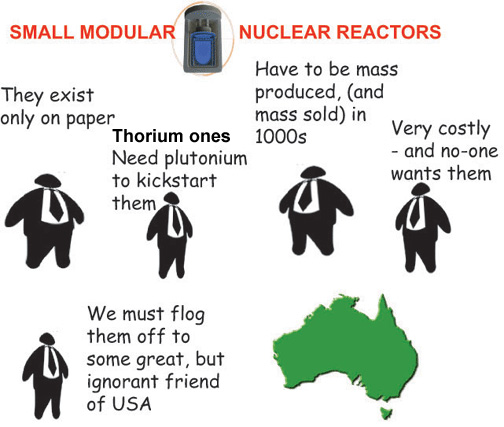
So, for the nuclear lobby, ultimate survival seems to depend on developing and mass marketing “Generation IV” small and medium reactors (SMRs). …..
for the U.S. marketers, Australia, as a politically stable English-speaking ally, is a particularly desirable target. Australia’s geographic situation has advantages. One is the possibility of making Australia a hub for taking in radioactive wastes from South-East Asian countries. That’s a long-term goal of the global nuclear lobby. …..
In particular, small nuclear reactors are marketed for submarines. That’s especially important now, as a new type of non-nuclear submarine – the Air Independent Propulsion (AIP) submarine, faster and much cheaper – could be making nuclear submarines obsolete. The Australian nuclear lobby is very keen on nuclear submarines: they are now promoting SMRs with propagandists such as Heiko Timmers, from Australian National University. This is an additional reason why Australia is the great white hope.
I use the word “white” advisedly here because Australia has a remarkable history of distrust and opposition to this industry form Indigenous Australians…..
The hunt for a national waste dump site is one problematic side of the nuclear lobby’s push for Australia. While accepted international policy on nuclear waste storage is that the site should be as near as possible to the point of production, the Australian Government’s plan is to set up a temporary site for nuclear waste, some 1700 km from its production at Lucas Heights. The other equally problematic issue is how to gain political and public support for the industry, which is currently banned by both Federal and state laws. SMR companies like NuScale are loath to spend money on winning hearts and minds in Australia while nuclear prohibition laws remain.
 Ziggy Switkowski, a long-time promoter of the nuclear industry, has now renewed this campaign — although he covers himself well, in case it all goes bad, noting that nuclear energy for Australia could be a “catastrophic failure“. ……
his submission (No. 41) to the current Federal Inquiry into nuclear power sets out only one aim, that
‘… all obstacles … be removed to the consideration of nuclear power as part of the national energy strategy debate.’
So the Environmental Protection and Biodiversity Conservation Act (EPBC Act) should be changed, according to Switkowski. In an article in The Australian, NSW State Liberal MP Taylor Martin suggested that the Federal and state laws be changed to prohibit existing forms of nuclear power technology but to allow small modular reactors.
Switkowski makes it clear that the number one goal of the nuclear lobby is to remove Australia’s national and state laws that prohibit the nuclear industry. And, from reading many pro-nuclear submissions to the Federal Inquiry, this emerges as their most significant aim.
It does not appear that the Australian public is currently all agog about nuclear power. So, it does seem a great coincidence that so many of their representatives in parliaments – Federal, Victorian, New South Wales, South Australia and members of a new party in Western Australia – are now advocating nuclear inquiries, leading to the repeal of nuclear prohibition laws.
We can only conclude that this new, seemingly coincidental push to overturn Australia’s nuclear prohibition laws, is in concert with the push for a national nuclear waste dump in rural South Australia — part of the campaign by the global nuclear industry, particularly the American industry, to kickstart another “nuclear renaissance”, before it’s too late.
Despite its relatively small population, Australia does “punch above its weight” in terms of its international reputation and as a commercial market. The repeal of Australia’s laws banning the nuclear industry would be a very significant symbol for much-needed new credibility for the pro-nuclear lobby. It would open the door for a clever publicity drive, no doubt using “action on climate change” as the rationale for developing nuclear power.
In the meantime, Australia has abundant natural resources for sun, wind and wave energy, and could become a leader in the South-East Asian region for developing and exporting renewable energy — a much quicker and more credible way to combat global warming. https://independentaustralia.net/politics/politics-display/australia-is-the-great-white-hope-for-the-global-nuclear-industry,13326
Kimba and Flinders Ranges communities do not know what nuclear wastes they are getting, and for how many decades
 Dump in decades, The Advertiser, GREG BANNON, Quorn, 19 Nov 19, REGARDING the National Radioactive Waste Management Facility, taskforce manager Sam Chard wrote a separate facility “will be found for the permanent disposal of intermediate level waste, but that’s a few decades off” (“Nuclear assurance”, The Advertiser, 16/11/19).
Temporary storage of intermediate-level waste is a major reason why some in the communities of Kimba and the Flinders Ranges are objecting so strongly to this proposal.
The Federal Industry Department acknowledges this material will need to be disposed of for 10,000 years to be considered safe. After four decades a disposal site has not been established and now we are being told it is still “a few decades off”.
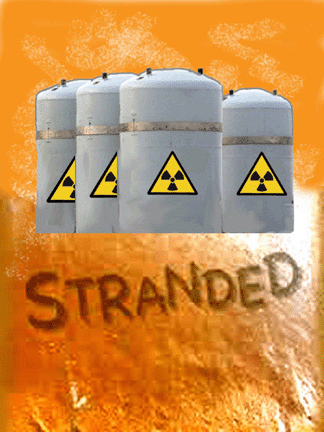
The Department acknowledges that intermediate-level waste is the most toxic nuclear waste in Australia. We have asked for, but have received no guarantees, that this material will not end up being stranded at whichever site is chosen at the end of this ballot process. Why should these communities be expected to accept all of Australia’s nuclear waste, on behalf of all Australians, when they don’t know what they are signing up for?
Record heat, catastrophic fire danger for South Australia – what a great place to plan transport and dumping of nuclear waste -NOT
|
Total fire bans declared across SA ahead of catastrophic conditions on Wednesday, ABC , 19 Nov 19 By Eugene Boisvert A total fire ban has been declared for South Australia on Tuesday ahead of catastrophic conditions expected on Wednesday.
Key points:
It is one of the first times the Country Fire Service (CFS) has declared a pre-emptive fire ban 24 hours before a hot and windy day, the agency’s head said. “It’s pretty unusual that we take a precautionary fire ban and I hope that people will realise we’ve done so in response to the severity of the conditions which are forecasted for Wednesday,” CFS chief officer Mark Jones said. Catastrophic fire conditions are expected on Wednesday for the lower Eyre Peninsula, the Yorke Peninsula, the Mid North and the Mount Lofty Ranges, when a total fire ban will also be in place All other regions have severe or extreme ratings, including the Adelaide metropolitan area. The Bureau of Meteorology has forecast a top of 42 degrees Celsius for Adelaide on Wednesday, after a high of 29C on Tuesday….. Fire season already started in SA The fire danger season has officially started in all of South Australia’s fire ban districts, apart from the lower South-East, where the season starts on Friday…… https://www.abc.net.au/news/2019-11-18/total-fire-bans-across-sa-on-tuesday-ahead-of-catastrophic-day/11713696 |
|
Journalism’s future in crisis – the case of Julian Assange
JOHN PILGER: Assange’s case will define the future of free journalism, https://independentaustralia.net/life/life-display/john-pilger-assanges-case-will-define-the-future-of-free-journalism,13324 By John Pilger | 18 November 2019 John Pilger describes the disturbing scene inside a London courtroom last week when the WikiLeaks publisher, Julian Assange, appeared at the start of a landmark extradition case that will define the future of free journalism.
Her face was a progression of sneers and imperious indifference; she addressed Julian Assange with an arrogance that reminded me of a magistrate presiding over apartheid South Africa’s Race Classification Board. When Julian struggled to speak, he couldn’t get words out, even stumbling over his name and date of birth.
When he spoke truth and when his barrister spoke, Baraister contrived boredom; when the prosecuting barrister spoke, she was attentive. She had nothing to do; it was demonstrably preordained. In the table in front of us were a handful of American officials, whose directions to the prosecutor were carried by his — back and forth this young woman went, delivering instructions.
Her knee in the groin was to announce that the next court hearing would be at remote Woolwich, which adjoins Belmarsh Prison and has few seats for the public. This will ensure isolation and be as close to a secret trial as it’s possible to get. Did this happen in the home of the Magna Carta? Yes, but who knew?
Who will then dare to expose anything of importance, let alone the high crimes of the West? Who will dare publish ‘Collateral Murder’? Who will dare tell the public that democracy, such as it is, has been subverted by a corporate authoritarianism from which fascism draws its strength?
Once there were spaces, gaps, boltholes, in mainstream journalism in which mavericks, who are the best journalists, could work. These are long closed now. The hope is the samizdat on the internet, where fine disobedient journalism is still practised.
The greater hope is that a judge or even judges in Britain’s court of appeal, the High Court, will rediscover justice and set him free. In the meantime, it’s our responsibility to fight in ways we know but which now require more than a modicum of Julian Assange’s courage.
How does the climate denialist Institute of Public Affairs (IPA) get away with being a “charity”?
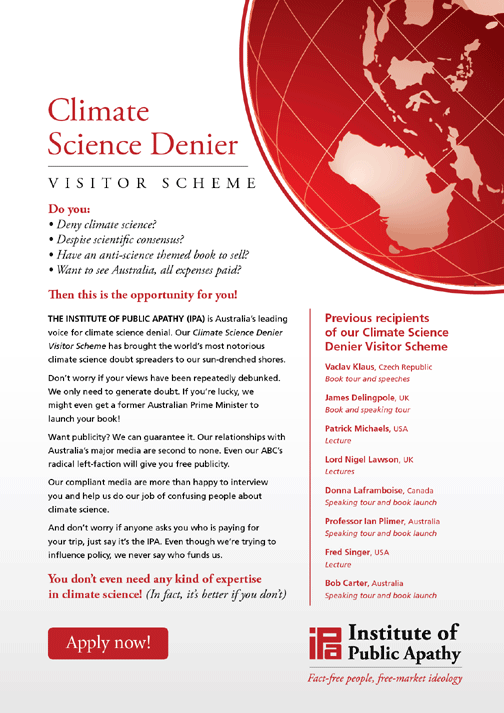
The climate denialist IPA and its ‘public interest’ charity status, Independent Australia, By David Paull | 19 November 2019, Since the IPA and CIS organisations argue against the scientific consensus on the climate change emergency isn’t that against the public interest? Why, then, are they classified as ‘charities’? David Paull reports.
The Prime Minister’s recent comments on the rights of individuals to undertake actions, such as boycotts, that may adversely affect “secondary” company interests raises questions of free speech and public interest.
But the increasingly shrill advocacy for climate denial in the public sphere in this country has reached a stage where it seems that substantive scientific arguments regarding future Earth scenarios are being drowned out.
The debate has descended – thanks in no small part to Murdoch media and political pundits – so that now it’s a “conspiracy” by the Bureau of Meteorology and NASA, or it’s “sun-spots”, which will initiate a new “ice-age”. Even the line, “We must take a balanced view” provides anti-science advocates with a platform.
Which raises the clear question: Is climate change denial of benefit to our community? Or, to put it another way, if some are still arguing against the scientific consensus on the climate change emergency we are confronting, isn’t that against the public interest?
What does it take to be a charity?
As it turns out, not if you are a “charity” registered with the Australian Charities and Not-for-profit Commission (ACNC). When talking about climate denialist organisations, key among those in Australia is the Institute of Public Affairs (IPA) and the Centre for Independent Studies (CIS). Both have generated substantial public communication, which is “climate sceptical” in nature and at deviance from the consensus scientific view. Yet both organisations – particularly the IPA – and through their front groups such as the Australian Environment Foundation, have been at the forefront of promoting the idea that global warming is a conspiracy. Examples are the recent book published by the IPA and edited by Dr Jennifer Marohasy who is working on releasing a new edition next year.
The CIS, while not being a loud advocate of climate scepticism, has certainly hosted talkfests which have articulated these views. Both organisations are also within the international Atlas Network, which channels money into groups around the world that seek to further the climate denialist and libertarian agendas. And both have registered charities with the Australian Charities and Not-For-Profits Commission (ACNC).
The IPA’s registered charity is called Trustee For Institute Of Public Affairs Research Trust, while the CIS has registered a charity under the name of, The Centre For Independent Studies Ltd……
Follow the money
The IPA receives only about ten to 20 per cent of its annual income through its charity, most of which is spent each year, amounting to some $800,000 in 2017-18. These are nearly all classed as “donations” under the ACNC disclosure requirements — though of course “donors” are not required to be identified…….
Both charities claim they are benefiting the “general community of Australia”. However, given the difficulty in matching a climate denialist agenda with a supposed community benefit, this simply does not stack up anymore.
The reviews by the ACNC in January 2014 of the charitable status of these two registered charities, in this light, needs to be reviewed again. This is particularly so of the IPA with its increasing focus on spreading misinformation (none of which stands up to proper scientific scrutiny) since 2014.
But there are also other issues which need clarification in order that better transparency occurs, such as better definitions of income and expenditure, the question of influence by foreign entities and perhaps what is key: whether charity funds being used by these organisations is for a purpose that may be deemed as being of detriment to the community. Charitable status should be relinquished under these circumstances.
I have written to the Australian Charities and Not-for-profit Commission (ACNC) to undertake a fresh review of these charities and await a response in anticipation. You can make a complaint to the ACNC HERE. David Paull is an Australian ecologist . You can follow David on Twitter @davesgas. https://independentaustralia.net/politics/politics-display/the-climate-denialist-ipa-and-its-public-interest-charity-status,13325
50 bushfires continue to rage across New South Wales
 Sydney smoke: city covered in thick haze as more than 50 bushfires burn across NSW People with asthma or respiratory illness should stay inside, health authorities warn, Guardian Australian Associated Press, Tue 19 Nov 2019 Sydney woke up to a thick blanket of smoke over the city on Tuesday as New South Wales headed into the first of two “tough days” this week, with temperatures likely to rise to the 40s and little-to-no rainfall forecast.Most of the state’s east coast was under severe or very high fire danger ratings, with more than 50 bushfires burning, of which 28 remained uncontained. Sydney smoke: city covered in thick haze as more than 50 bushfires burn across NSW People with asthma or respiratory illness should stay inside, health authorities warn, Guardian Australian Associated Press, Tue 19 Nov 2019 Sydney woke up to a thick blanket of smoke over the city on Tuesday as New South Wales headed into the first of two “tough days” this week, with temperatures likely to rise to the 40s and little-to-no rainfall forecast.Most of the state’s east coast was under severe or very high fire danger ratings, with more than 50 bushfires burning, of which 28 remained uncontained.
All were at “advice” level on Tuesday morning, with more than 1,300 firefighters on the ground. Six lives and 530 homes have been lost since NSW bushfire season hit, with more than 420 homes destroyed in the past fortnight alone. “More than 1,300 firefighters continue work on these fires tonight, ahead of forecast hot, dry and windy conditions tomorrow,” the Rural Fire Service said. Winds dragged smoke from a huge fire at Gospers Mountain north-west of the Sydney over the city on Tuesday morning, and the haze was not likely to dissipate until a southerly change in the afternoon…… Parts of the state under severe fire danger on Tuesday included Greater Sydney, Greater Hunter, Illawarra/Shoalhaven, Southern Ranges and Central Ranges fire regions. These regions, along with the Northern Slopes and North Western regions, were also under a total fire ban. Much of the rest of eastern NSW and the Australian Capital Territory were under very high fire danger. Some 1.6m hectares of land have been burnt so far – more than the entire 1993-94 bushfire season……https://www.theguardian.com/australia-news/2019/nov/19/sydney-smoke-city-covered-in-thick-haze-as-more-than-50-bushfires-burn-across-nsw |
|
Flood risk at proposed nuclear dump site at Wallerberdina.
 Barb Walker shared a post. Flinders Local Action Group Fight To Stop Nuclear Waste Dump In Flinders Ranges SA, 18 Nov 19
Last Thursday five members of FLAG met with James Rusk from AECOM, and Johnathon from DIIS to voice our concerns regarding the flood threat from the Hookina Creek to the proposed dump site at Wallerberdina.
James admitted that flood waters could cover the site up to a meter deep in a rare Possible Maximum Flood event, and that this could be easily mitigated by raising the surface area of the 40 hectare site by approximately one metre.
To put this in perspective: This would require the the mining of approximately 600,000 tonnes of top soil from a borrow pit close to the site,
the carting of 26,400 semi tipper loads and the spreading and compaction of this fill to a metre deep over the entire site. Huge amounts of water of would also be needed for the costruction.
The resulting massive desecration of the proposed area, containing many sites of cultural significance to the Adnyamathanha women was not perceived by either James or Johnathon to be a problem. – Bob. https://www.facebook.com/groups/941313402573199/
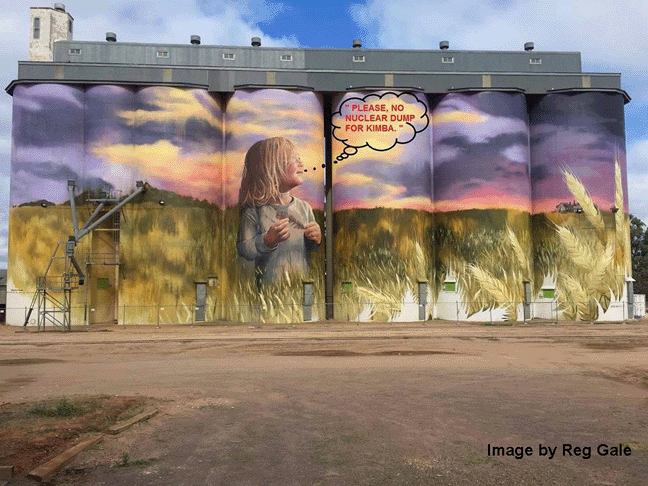
With 40% opposed to Kimba nuclear waste dump, is this “consensus”
|
What counts as consensus within a community? Stock Journal
15 Nov 2019 The results are back in from the AEC ballot, gauging opinion for a potential radioactive waste facility within the Kimba community.As with the original issue, the two sides of the debate are differing on if the results showing 61.58 per cent of the population would support the site proves consensus.
Third-generation Buckleboo farmer and No Radioactive Waste on Agricultural Land in Kimba or SA chair Peter Woolford said the ballot results were not surprising, but did show there was a considerable amount of opposition to the waste facility. “You can’t have 40pc opposed and say you’ve got clear support,” he said. “That’s nearly every second person in the street.”….. https://www.stockjournal.com.au/story/6495102/what-counts-as-consensus-within-a-community/?cs=4894&fbclid=IwAR0IEQ8Rwwq9vZ302Q30286nqpXmH9uwa–P28yTXoNHh6d9jZQbDZjlRuA |
|
Visionary Leaders Symposium: ‘Our planet is our patient.’
 Visionary Leaders Symposium: ‘Our planet is our patient.’ http://publichealthnewswire.org/?p=physicians-for-social-responsibility-visionary-leaders-symposium#.XdARGW8_6rw.twitter by Louise Dettman on 11/8/2019 Nearly 200 organizations representing medical, health care and public and environmental health professionals, including APHA, have so far endorsed the 2019 U.S. Call to Action on Climate Change, Health and Equity: A Policy Agenda.It challenges government, business, civil society and the health sector to recognize climate change as a public health emergency and to act now for climate, health and equity.
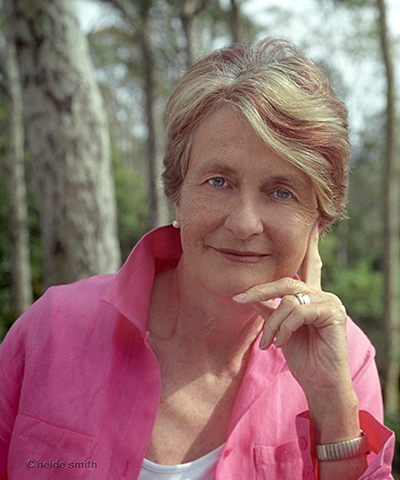
“Being health professionals, it’s important for us to realize that our planet is our patient, and it’s in the intensive care unit. We’re doctors to a dying planet and we have a job to do,” said Helen Caldicott, MD, keynote speaker at yesterday’s Physicians for Social Responsibility Visionary Leaders Symposium in Washington, D.C.
A PSR founder and former president, anti-nuclear activist, author and pediatrician from Australia, Caldicott has spent her life educating world leaders and the public about the medical hazards of the nuclear age. She urged those gathered at the Ronald Reagan Building for the symposium to “stop being polite and speak the truth loudly and clearly” about the need for action on climate change. As one of the drafters of the U.S. Call to Action, PSR is using it to mobilize and give voice to more health professionals.
It advocates for policies that promote a just transition to clean, safe renewable energy and energy efficiency; sustainable food production and diets; clean water; active transportation; and green cities. Such policies can lower climate pollution, reduce the incidence of communicable and non-communicable disease, improve mental health and realize significant cost savings in health care.
“I’m not being radical. I’m being a physician,” Caldicott said as she stressed the urgency of the situation; challenged attendees to question the role of politicians, corporations and the military in the production of greenhouse gases; and told everyone to contact members of Congress. “If you don’t use your democracy, they’ll swoop in and use it for you — for their own political and financial gain,” she said.
The U.S. Call to Action urges the health sector itself to reduce greenhouse gas emissions and — as a trusted voice — to effectively communicate the health threats of climate change and the health benefits of climate action. The symposium focused specifically on the role of women in the climate, health and equity movement and the importance of economic justice for the most vulnerable communities.
Heidi Hutner, PhD, a filmmaker, writer and professor at Stony Brook University, moderated an expert panel of women advocates discussing the health hazards of and solutions to nuclear power and climate change. Hutner opened the program with a trailer of her upcoming documentary about the women of Three Mile Island and, along with the other participants, questioned nuclear power as the answer for a just transition to clean energy.
Following the symposium, at the 2019 Visionary Leadership Awards, PSR presented Caldicott with a Lifetime Achievement Award for her work. It also recognized other individuals and organizations for their efforts in advancing nuclear weapons abolition and addressing environmental risks to human health, including the consequences of climate change.
A twisted and so-called religious view of bushfires and climate change
|
Israel Folau links bushfire crisis to same-sex marriage and abortion, SMH, By Megan Gorrey, November 17, 2019 Sacked rugby union star Israel Folau has linked the NSW bushfire crisis and drought to legalising same-sex marriage and abortion, warning the disasters are a “little taste of God’s judgment”.Speaking at his church in north-west Sydney, Folau said his remarks were a “message mainly for the people that are outside [the church], within the world”. The video footage was posted online on Sunday….
“Look how rapid, these bushfires, these droughts, all these things have come, in a short period of time. You think it’s a coincidence or not? God is speaking to you guys, Australia, you need to repent. “What you see right now in the world is only a little taste of God’s judgment that’s coming, it’s not even a big thing.” Folau said the natural disasters were “no coincidence” and the solution was for people to “turn from their wicked ways”…… https://www.smh.com.au/national/israel-folau-links-bushfire-crisis-to-same-sex-marriage-and-abortion-20191117-p53bf4.html?list_name=40_smh_newsalert&promote_channel=edmail&utm_campaign=smh-am-newsletter&utm_content=TOP_STORIES&utm_medium=email&utm_source=newsletter& |
|
1 This month.
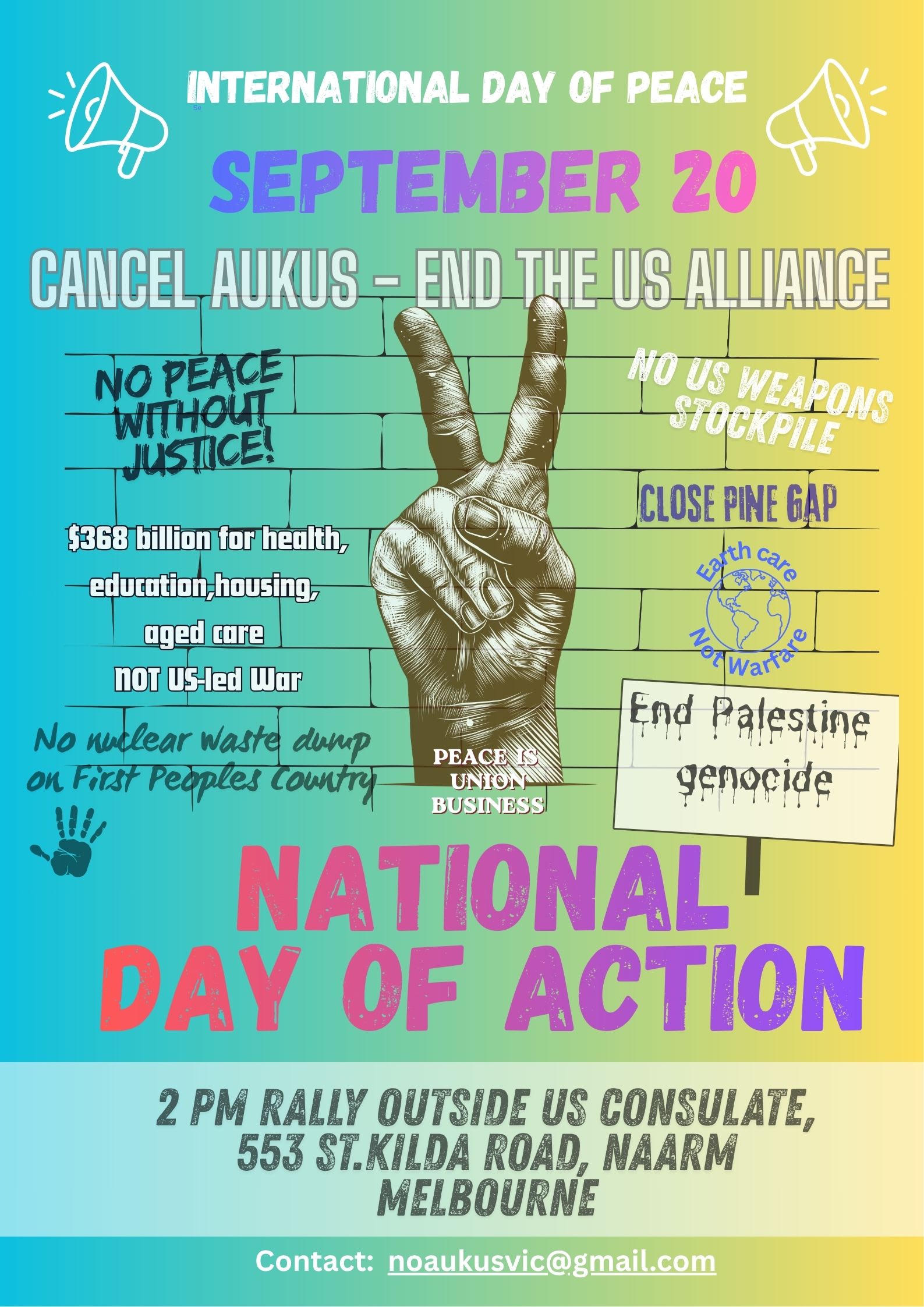
20 September –National Day of Action in Melbourne on the International Day of Peace

Help Aunty Sue Protect Her Land and Sacred Sites From Destructive Rocket Testing.
.

Australians deserve the truth
about
AUKUS – https://aukuspublicinquiry.com/
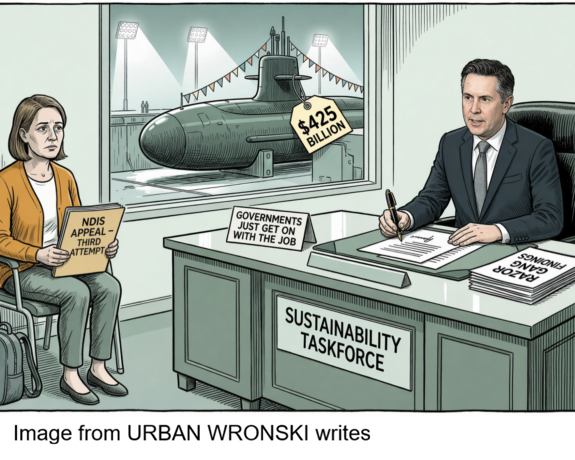

PETITION – To: Prime Minister Anthony Albanese and the Australian Labor Government

of the week – Australians for War Powers Reform (AWPR)
To see nuclear-related stories in greater depth and intensity
 Antinuclear