USA tried to make Iceland complicit, (like Australia is), in the persecution of Julian Assange
What is Australia doing? Isn’t Julian Assange an Australian citizen? However, I don’t see Australian authorities taking on the responsibility to protect their citizen. Australia shows, as far as I can see, the same indifference and hence complicity with the U.S. as is the case in most other lands. And may I add where is the world press, the same press which gratefully published the material WikiLeaks provided them with? Why are they quiet? In the end, we are all responsible. We are seeing an individual and an organisation taken to court, with 18 charges which could lead to 175 years in prison.
The FBI tried to make Iceland a complicit ally in framing Julian Assange https://independentaustralia.net/life/life-display/the-fbi-tried-to-make-iceland-a-complicit-ally-in-framing-julian-assange,13277
By Sara Chessa | 5 November 2019 Former Icelandic Interior Minister tells Independent Australia how he blocked U.S. interference in 2011 in order to defend WikiLeaks and its publisher Julian Assange. Sara Chessa reports.
Former Icelandic Interior Minister tells Independent Australia how he blocked U.S. interference in 2011 in order to defend WikiLeaks and its publisher Julian Assange. Sara Chessa reports.
A MINISTER OF THE INTERIOR wakes up one summer morning and finds out that a plane full of United States Federal Bureau of Investigation (FBI) agents has landed in his country, aiming to carry out police investigations without proper permission from the authorities.
How many statesmen would have the strength to say, “No, you can’t do this”, to the United States? Former Icelandic Interior Minister Ögmundur Jónasson, in fact, did this — and for the sake of investigative journalism. He understood that something wrong with the sudden FBI mission in Reykjavik, and that this had to do with the whistleblowing website WikiLeaks and its publisher Julian Assange. Continue reading
Kimba’s pro nuclear advocates seem unaware of the facts about medical radioactive wastes
 Jillian Marsh No Nuclear Waste Dump Anywhere in South Australia, 12 Nov 19, hi Andrew Baldock perhaps you are not aware that waste from nuclear medicine is deemed safe enough to dispose of in council waste depots – it does not need to be located in a high level waste facility as being proposed by Fed Govt. The reason they need a ‘remote location’ is about housing high level dangerous and long-lived waste. and it will be shipped in from hundreds of kilometres away, risking not only contamination of the actual site of the dump, but also the transport routes used to ship waste. this is a national issue that requires a national discussion. https://www.facebook.com/groups/1314655315214929/
Global heating: Australians must rethink planning for bushfires
Whatever the successes and failures in this crisis, it is likely that we will have to rethink the way we plan and prepare for wildfires in a hotter, drier and more flammable world.
Drought and climate change were the kindling, and now the east coast is ablaze, The Conversation, Ross Bradstock, Professor, Centre for Environmental Risk Management of Bushfires, University of Wollongong, Rachael Helene Nolan, Postdoctoral research fellow, Western Sydney University, November 11, 2019
Last week saw an unprecedented outbreak of large, intense fires stretching from the mid-north coast of New South Wales into central Queensland.
The most tragic losses are concentrated in northern NSW, where 970,000 hectares have been burned, three people have died, and at least 150 homes have been destroyed…….
What is unprecedented is the size and number of fires rather than the seasonal timing.
forests and shrublands can rapidly accumulate bushfire fuels such as leaf litter, twigs and grasses. The unprecedented drought across much of Australia has created exceptional dryness, including high-altitude areas and places like gullies, water courses, swamps and steep south-facing slopes that are normally too wet to burn.
Thus, the North Coast and northern ranges of NSW as well as much of southern and central Queensland have been primed for major fires. A continuous swathe of critically dry fuels across these diverse landscapes existed well before last week, as shown by damaging fires in September and October.
More people in harm’s way
Many parts of the NSW north coast, southern Queensland and adjacent hinterlands have seen population growth around major towns and cities, as people look for pleasant coastal and rural homes away from the capital cities.
These unprecedented fires are an indication that a much-feared future under climate change may have arrived earlier than predicted. The week ahead will present high-stakes new challenges.
The most heavily populated region of the nation is now at critically dry levels of fuel moisture, below those at the time of the disastrous Christmas fires of 2001 and 2013. Climate change has been predicted to strongly increase the chance of large fires across this region. The conditions for Tuesday are a real and more extreme manifestation of these longstanding predictions.
Whatever the successes and failures in this crisis, it is likely that we will have to rethink the way we plan and prepare for wildfires in a hotter, drier and more flammable world. https://theconversation.com/drought-and-climate-change-were-the-kindling-and-now-the-east-coast-is-ablaze-126750
G20 Report shows Australia is among the worst on climate policy
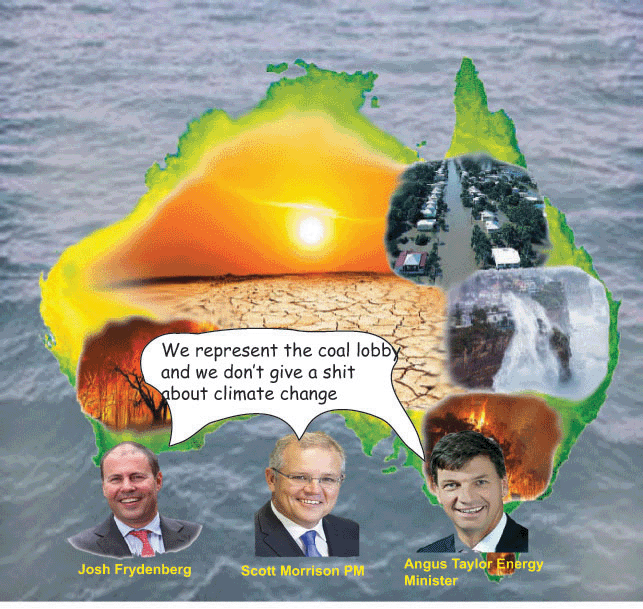
Brown to Green report highlights Australia’s poor response on deforestation, transport, energy supply and carbon pricing, Graham Readfearn @readfearn Mon 11 Nov 2019 Australia’s response to climate change is one of the worst in the G20 with a lack of policy, reliance on fossil fuels and rising emissions leaving the country exposed “economically, politically and environmentally”, according to a new international report.
Australia’s progress to meeting its already “unambitious” Paris climate targets was third worst, fossil fuel energy was on the rise and policies to tackle high transport emissions and deforestation were also among the worst across the G20 countries.
The Brown to Green report, now in its fifth year, takes stock of the performance of G20 countries on climate change adaptation and mitigation across key sectors, and in the finance sector.
The chief executive of Climate Analytics, Bill Hare, an Australian co-author of the report, told Guardian Australia: “Australia is behind [on] climate action in nearly every dimension. Australia’s emissions are increasing and there’s virtually no policy in place to reduce them.”
Some 14 non-governmental groups, thinktanks and research institutes compile the report, funded by the World Bank, the US-based ClimateWorks Foundation and Germany’s environment ministry.
Across the G20, the report said, limiting global heating to 1.5C would cut negative impacts by 70%, compared with allowing global temperatures to rise by 3C. Currently, extreme weather events were costing G20 countries about US$142bn annually.
While the report doesn’t provide an overall ranking, Australia appears consistently among the worst performers in the report’s analysis.
India and Australia were the only two G20 countries that had not introduced, or were not considering, policies to price greenhouse gas emissions, the report said.
Only South Korea and Canada were further away than Australia from meeting the pledges that formed their Paris climate commitments.
On deforestation, the report said Australia was the only developed country that was a “deforestation hotspot”, but had no policies to tackle it.
Australia was ranked third worst for transport emissions per capita, and the report found “Australia, in particular, lacking significant policy” in the transport sector. Per capita emissions from aviation were 53 times higher than India’s.
Australia, along with Russia, had no policies to move away from petrol-powered cars, no policies to decarbonise the heavy-duty vehicle sector and no policies to shift people onto public transport, the report said.
Referring to the current Liberal-led Coalition government, Hare said this was the same political party that had repealed climate legislation, such as the carbon pricing mechanism, and “since then has done all it can to undermine any level of action”.
Australia, along with the US and Saudi Arabia, had high emissions from the building sector. Australia had no building codes covering renovation of older buildings.
All this lack of action, Hare said, was leaving Australia and its people exposed on climate change “economically, politically and environmentally”.
Hare told Guardian Australia: “The leadership of the country is effectively telling lies about their performance, and contradicting their own government’s information.
“The country is led by politicians who in one way or another deny either the science or are de facto denying it, and actively and wilfully opposing or obstructing climate policies.”
He said the country’s position was in contrast with its opportunities in renewable energy, which it had not exploited as fully as it could.
“Australia has one of the best solar energy potential and wind potential in general of any of the G20 countries,” he said.
“Australia is not transforming its energy system and is focused on building coal and gas, and has not paid any attention to the need to transition to a zero-carbon economy.” Referring to the current Liberal-led Coalition government, Hare said this was the same political party that had repealed climate legislation, such as the carbon pricing mechanism, and “since then has done all it can to undermine any level of action”.
He said the country’s position was in contrast with its opportunities in renewable energy, which it had not exploited as fully as it could.
“Australia has one of the best solar energy potential and wind potential in general of any of the G20 countries,” he said.
“Australia is not transforming its energy system and is focused on building coal and gas, and has not paid any attention to the need to transition to a zero-carbon economy.”
The Brown to Green report, now in its fifth year, takes stock of the performance of G20 countries on climate change adaptation and mitigation across key sectors, and in the finance sector
Sydney Morning Herald up to date coverage of New South Wales bushfires
New South Wales braces for unprecedented fire danger | ABC News
Message from the Editor: Our bushfire coverage, SMH, By Lisa Davies,
“Catastrophic” is not a word used flippantly. The highest possible level of bushfire danger across NSW has led the Premier Gladys Berejiklian to declare a State of Emergency for the first time in six years.
As a result, the Herald will provide open access to our coverage – meaning that for the duration of this crisis, bushfire stories will be free for all readers…..
the conditions forecast for Sydney, the Hunter region, the Blue Mountains and Central Coast have worsened – similar to those experienced in Victoria on Black Saturday, which saw 173 people killed and thousands of homes lost.
Rural Fire Services Commissioner Shane Fitzsimmons said the predictions were unprecedented for the greater Sydney area.
“We could not find a time in history … where we saw indices reaching what we now know are catastrophic levels here in the Greater Sydney environment,” he said. “We are talking about something we haven’t experienced before in Sydney in the Greater Sydney environment.”
Education Minister Sarah Mitchell has announced 300 schools will be closed and expects the number to rise.
So what does a “catastrophic” fire emergency mean?
It means high winds and extreme heat can cause embers from existing fires to travel more than 20 kilometres ahead of the main firefront, Mr Fitzsimmons explained……..
We will be updating readers live via our blog and at smh.com.au……. https://www.smh.com.au/national/nsw/message-from-the-editor-our-bushfire-coverage-20191111-p539k7.html
Australia’s National Radioactive Waste Management Taskforce disingenuous about medical nuclear wastes
 Tim Bickmore No Nuclear Waste Dump Anywhere in South Australia 11 Nov 19, The Taskforce broadcasts minimal information about the type, amount, & location of facility bound radioactive wastes; including that % which SPECIFICALLY RESULTS FROM ACTUAL AUSTRALIAN MEDICAL USAGE.
According to ANSTO Waste Projects & Strategic Planning Manager Kapila Fernando in 2017:
“ANSTO holds about 50 per cent of the radioactive waste in Australia, and 85 per cent of the waste ‘stream’ is directly associated with this nuclear medicine manufacturing program – including the fuel used to power the reactor, the machines used in medicine production, and the gloves and gowns used in the manufacture or administration processes – the cycle to produce radionuclides produces nuclear medical waste.”When questioned by (then) Senator Scott Ludlam (Senate Economics Legislation Committee Session May 2017); ANSTO CEO Adi Paterson informed us that in the 2016 financial year 80% of ANSTO’s diagnostic medical isotope production consisted of Molybdenum 99. Of which only 28% was used in Australia whilst 72% was exported.
.
Let’s do the medical waste maths: – (50% x 85%) = 42.5 % of the national radioactive waste inventory results from medical isotope production. Currently (72% x 80%) = 57.6% of that results from Mo99 exports: which in future will triple, but at 2016 stood at (57.6% x 42.5%) = 24.5% of the total.
Therefore, only 18% (42.5%-24.5%) results from actual national use of medical isotopes: & not all of the 18% requires containment in the proposed facility.
PS ANSTO will not tell us the cost for producing OS exports vs economic return ~ but there is a very high probability (bordering on certainty) that the taxpayer is heavily subsidising OS usage…more https://www.facebook.com/groups/1314655315214929/
NUCLEAR WASTE DEBATE DIVIDING COMMUNITIES
 NUCLEAR WASTE DEBATE DIVIDING COMMUNITIES Fight To Stop Nuclear Waste Dump In Flinders Ranges SA The Transcontinental November 06, 2019, My name is Ken McKenzie. The Flinders Ranges and Port Augusta have always been my home. I now reside in Flinders House in Quorn.
I wish to say that the radioactive waste dump being proposed for our region is going to be very dangerous for all of us and for generations to come if it is allowed to go ahead.
This is something for all South Australians both black and white to be involved in as it will have an effect one way or another on every one of us.
The area where they want to put this dump is on my tribal land. My ancestors are buried here.
The area also holds a huge connection to our women as this is their land overall. The government do not listen when we say we don’t want it.
The earthquakes and flooding stories told to me in our language goes back into time itself.
This is not the place for a radioactive waste dump. If the Lord doesn’t come down in the next few years, this is going to be a threat to all of us and our future generations to come.
I am also very concerned for people over at Kimba who are going thru the same grief that’s happening to us and my family over here.
The money the government are throwing at us, trying to get us to forfeit our land is insulting and disrespectful to us all.
They have divided my family and our communities, and now we hear that without the much more dangerous intermediate radioactive waste being dumped here as well, that there is hardly any value to the community for putting it here.
Why didn’t they tell the communities all this in the first place. We didn’t want it four years ago and we certainly don’t want it now.
This whole process needs to be scrapped and the government needs to look at a new way to get people to ever trust them again.
Australia’s media fights for freedom of press – BUT NOT FOR JULIAN ASSANGE
 Mainstream Media Fights for Own Freedom, But Not for Assange’s, Sydney Criminal Lawyers, 02/11/2019 BY PAUL GREGOIRE Major Australian mainstream media outlets joined forces a fortnight ago to launched the Right to Know campaign. It aims to see public interest journalism decriminalised, and safeguards for whistleblowers enhanced.This unprecedented display of unity has seen The Guardian, the ABC, Nine, News Corp, SBS and the MEAA join forces in calling on the government to enact reforms. And this is rather significant, considering some of these organisations have been much criticised for towing the party line.
The Right to Know has six demands: exceptions so journalists can’t be prosecuted under national security laws, freedom of information reform, defamation law reform, a narrowing of the information classified as secret, protections for whistleblowers and the right to contest warrants.
Of course, the campaign was sparked by the June AFP press raids, which saw agents rifle through the house of a News Corp journalist, as well as the offices of the national broadcaster, in what was understood by many to be a warning to the media and whistleblowers to keep quiet.
However, a glaring campaign omission is the case of an Australian publisher who’s currently being remanded in the UK over charges that apply in the US, which relate precisely to public interest journalism. Yet, the Australian media has all but forgotten their colleague, Julian Assange.
Silenced by association
“The Right to Know campaign drives to the heart of the matter more than many journalists realise,” remarked Ian Rose, a member of the Support Assange and Wikileaks Coalition.
“While on the one hand, they’re right to finally be calling out the creeping incursions and restrictions into media freedoms,” he told Sydney Criminal Lawyers. “On the other, they don’t have the inner fortitude to stand up for Assange.”
According to Rose, there are two reasons that the Australian media has abandoned the Walkley award-winning journalist. One is that he’s “an egalitarian”, which “frightens the hell out of the ruling class”, as most of the work of WikiLeaks has been all about exposing their lies.
The second reason behind the silence is that the “oligarchs” are the “journalists’ paymasters”. And for this reason – which is underscored by the justifiable fear of losing their lives – journalists have refrained from “calling these people out”.
An excuse for silencing
Attorney general Christian Porter spoke out against the Right to Know campaign, claiming that by providing the media with the right to contest warrants could hinder criminal investigations. And he also asserted that the campaign demands could lead to national security threats.
As an example of how the media could become such a threat, Porter pointed to Assange having published leaked classified documents on WikiLeaks. The top lawmaker further set out that while this act of publication was widely condemned, the local industry still awarded Assange a Walkley……..
Neglecting an ally
And as for what the Australian media should be doing about one of its own locked away in isolation in circumstances that undermine the rule of law, Mr Rose says that it “ought to get over its jealousy and unite to support Assange”.
Indeed, the Right to Know campaign should embrace Assange’s cause, as it’s the quintessential example of the concerted crackdown on journalists that’s currently taking place across the western world. And there’s a clear correlation between his silencing and the local AFP raids.
“The way Assange is being treated is the way journalists are starting to be treated, and the way all of society will be treated if we don’t collectively call for a stop to the new dictatorial world order,” Rose warned.
And as an example of how this silencing of dissent is spreading beyond the media, Rose pointed to the recent assault on nonviolent climate activists, which has seen the application of ongoing arrests, draconian bail conditions, intimidatory procedures and the passing of restrictive laws……..https://www.sydneycriminallawyers.com.au/blog/mainstream-media-fights-for-own-freedom-but-not-for-assanges/
Sydney and surroundings – “Catastrophic” fire warning.
How near to Lucas Heights nuclear facility are the fires?
| Catastrophic’ fire warning a first for Sydney RFS raises Sydney fire warning to ‘catastrophic’, SMH Helen Pitt, Lisa Visentin, Laura Chung and Lucy Cormack, November 10, 2019 |
| Catastrophic fire danger is forecast for Sydney and its surrounds on Tuesday for the first time, as a statewide total fire ban is enforced today to help contain more than 60 fires across the state. |
| It’s the first time the NSW Rural Fire Service has issued the maximum level of warning for the city since the introduction of the “catastrophic” alert in 2009 in the wake of the Victorian Black Saturday blazes. |
| Yet both the Prime Minister Scott Morrison and NSW Premier Gladys Berejiklian have refused to be drawn on the contribution of climate change to the fires which have so far killed three, injured at least 35 and destroyed more than 150 homes. |
| The Sydney region is now drier than before the 2001 Black Christmas fires, as authorities warn more “lives and homes” will be at risk when the mercury soars to 37-38C tomorrow……. https://www.smh.com.au/national/rfs-raises-sydney-fire-warning-to-catastrophic-20191110-p5397q.html?list_name=40_smh_newsalert&promote_channel=edmail&utm_campaign=smh-am-newsletter&utm_content=TOP_STORIES&utm_medium=email&utm_source=newsletter&utm_ter |
False promises of lots of permanent jobs – from National Radioactive Waste Management agency
 Greg Bannon Fight To Stop Nuclear Waste Dump In Flinders Ranges SA, 11 Nov 19.
 -
- Rio Tinto operates driverless trains, hauling 28,000 tonnes of iron ore at a time.
- 3D laser scanning technology can separate humans from potentially dangerous operations, confined areas and boring or repetitive work.
- Remote cameras and sensors operate 24/7, recording and storing everything.

Australian Greens criticise Morrison government on bushfires and climate change
 Greens ramp up climate war as fires burn, Herald Sun, Colin Brinsden, Australian Associated Press, November 10, 2019 Greens Leader Richard Di Natale says while he is saddened by the loss of life from bushfires in NSW and Queensland, “thoughts and sympathies are not enough”. Greens ramp up climate war as fires burn, Herald Sun, Colin Brinsden, Australian Associated Press, November 10, 2019 Greens Leader Richard Di Natale says while he is saddened by the loss of life from bushfires in NSW and Queensland, “thoughts and sympathies are not enough”.
Dr Di Natale said for decades it has been known that burning climate changing fossil fuels would lead to more frequent and intense bushfires. “Yet with Queensland and New South Wales burning, the Coalition government refuses to acknowledge this scientific reality and instead wants to use taxpayer dollars to fund new coal-fired power stations.” he said in a statement on Sunday. “Every politician, lobbyist, pundit and journalist who has fought to block serious action on climate change bears responsibility for the increasing risk from a heating planet that is producing these deadly bushfires.” His climate change spokesman Adam Bandt made similar comments on Saturday, drawing a scathing attack from Deputy Prime Minister and Nationals Leader Michael McCormack, saying it was “despicable”…..https://www.heraldsun.com.au/news/breaking-news/greens-ramp-up-climate-war-as-fires-burn/news-story/42fad0f6e7a70492e1fa259514deba10 |
|
|
Climate reality needs more than thoughts and prayers
|
It has an eerily similar ring to it: “Thoughts and prayers”. Australians rightly mock this platitude when it’s rolled out by politicians after a mass shooting in the US, but now our own Prime Minister saw fit to present this meaningless line for victims of the bushfires on the mainland. Like how the US does nothing to end their deadly problem, our government also appears determined to cover its ears to the stark reality now facing us: Australia is drier than ever, hotter than ever, and less prepared than ever. This is no fault of our fire services. In fact, it appears to be in spite of our fire services. Former NSW fires chief Greg Mullins and 22 other former emergency chiefs were refused an urgent meeting with the PM multiple times this year, and NSW frontline firefighting has been slashed in the eternal quest for a surplus. In Tasmania, the TFS is well aware of the risks. In Launceston this year, their State Conference was titled “Not the Norm”: because the changing climate is putting humanity in a completely unpredictable position where every year is worse than the last. There is no “norm” anymore – as evidenced by the last fire season. Did we learn anything from that fire season? It waits to be seen, but a failure to enact all recommendations from a review into those fires would be reckless. Yet while Australia faces unprecedented fires (and this is not the only “unprecedented” weather event of recent times, with floods, drought and ocean heatwaves increasing in severity year on year), politicians continue to mislead on carbon emissions, or use rubbery accounting tricks to meet our emissions targets. Yet while Australia faces unprecedented fires (and this is not the only “unprecedented” weather event of recent times, with floods, drought and ocean heatwaves increasing in severity year on year), politicians continue to mislead on carbon emissions, or use rubbery accounting tricks to meet our emissions targets. And the similarities don’t end there.
|
|

Climate dispute between Scott Morrison and the Greens
Climate dispute breaks out as Scott Morrison visits bushfire-hit areas, SBS 11 Nov , “……war of words has broken out about the link between climate change and the unprecedented bushfire emergency that has hit NSW and Queensland.BY CLAUDIA FARHART Deputy Prime Minister Michael McCormack has lashed out at Greens MP Adam Bandt over “stupid and callous” comments linking the government’s inaction on climate change and bushfires that have claimed three lives in New South Wales.
On Saturday, Mr Bandt tweeted that “words and concern are not enough … the Prime Minister does not have the climate emergency under control”.
Bandt tweeted: I’m deeply saddened by the loss of life. Hearts go out to all affected & to brave firefighters. But words & concern are not enough. The PM does not have the climate emergency under control. Unless we lead a global effort to quit coal & cut pollution, more lives will be lost……
Prime Minister Scott Morrison and NSW Premier Gladys Berijiklian dodged more questions about climate change as they visited fire-hit areas in northern NSW on Sunday.
Mr Morrison was heckled by a climate change protester during a briefing from firefighters.
“Climate change is real, can’t you see,” the protester yelled, before being escorted out of the building. HTTPS://WWW.SBS.COM.AU/NEWS/CLIMATE-DISPUTE-BREAKS-OUT-AS-SCOTT-MORRISON-VISITS-BUSHFIRE-HIT-AREAS
The movement to save Julian Assange – his father in Ireland
Will you come and help?’ Father of Julian Assange on campaign to free his son, Irish Examiner, MICHAEL CLIFFORD November 09, 2019 At 80, John Shipton thought he would be enjoying his retirement, he tells Michael Clifford. Instead, he is touring European capitals campaigning for his son, Wikileaks founder Julian Assange.
A parent’s work is never done. John Shipton entering his ninth decade. He’d like to kick back, maybe learn a few recipes, stroll at a leisurely pace towards the declining years.
But his son needs him. His son’s health is in serious danger and his future looks dark, with the prospect of spending decades, if not the remainder of his life, in prison.
His son is Julian Assange. It’s a name that is familiar to most people, although many would, at this remove, find it difficult to couple his celebrity standing with his talent or achievement.
Assange is an Australian who has been a serious thorn in the side of the powerful. His Wikileaks organisation was responsible for disseminating information that showed what exactly the US and its allies were getting up to in foreign wars.
Wikileaks exposed war crimes. It was the receptor for whistleblower Chelsea Manning’s treasure trove of documents that painted a picture of torture and maltreatment by US forces in Iraq, among other crimes.
Vanity Fair described the resultant stories as “one of the greatest journalistic scoops of the last 30 years… they have changed the way people think about how the world is run”…….
Assange is a category B prisoner, which means he’s not considered an immediate danger to fellow human beings or society in general, but his conditions of detention are still onerous.
“He’s locked up 22 or 23 hours a day,” his father says. “It’s a grade A maximum security prison. Because those in it are treated like terrorists, that’s what Julian is being subjected to.”
Shipton was in Dublin recently on a flying visit that now forms part of his current “job”. That entails lobbying, meeting, and publicising on behalf of his son. Shipton is on a tour of European capitals trying to round up support……
Assange is in a bad way, there is no doubt about that. Both physically and psychologically, his condition is deteriorating. The prison conditions are onerous but they come following eight years cooked up in the embassy, at times under serious stress. The day before arriving in Dublin Shipton had been in to see his son.
“As you would expect after nine years of persecution, he’s a bit down in the dumps,” he says.
“The report of the UN rapporteur on torture says it all really, pointing out that he has every sign of having suffered torture with both physical and mental results…..
The UN rapporteur on torture, Nils Melzer, did visit Assange with two doctors in June in Belmarch and were highly condemnatory of the conditions in which he was being kept.
Last week, Melzer issued a further statement, saying Assange’s life was at risk and that he must not be extradited to the US as a consequence of “exposing serious governmental misconduct”…..
Melzer goes further and offers an opinion on what is driving the harsh treatment.
“In my view, this case has never been about Mr Assange’s guilt or innocence, but about making him pay the price for exposing serious governmental misconduct, including alleged war crimes and corruption,” he says. “Unless the UK urgently changes course and alleviates his inhumane situation, Mr Assange’s continued exposure to arbitrariness and abuse may soon end up costing his life.”…..
Since coming to power, Trump has railed against many forms of the free press. And his government has requested Assange’s extradition to stand trial for spying.
If he is extradited, his father doesn’t have much confidence in the prospects of a fair trial.
“The espionage law courts are held in Elizabeth, Virginia,” says Shipton. “It’s a town where all the constituents are from the intelligence community. Every judgement in the espionage courts they say just go to jail. It’s not theoretical. If he’s tried he will go to jail.”
The next hearing on extradition isn’t scheduled until February and on the basis that he previously did skip bail while awaiting an extradition hearing he is unlikely to get bail. For his family and close friends, the most immediate issue is his health rather than the political and legal vortex into which he has been drawn.
At a recent court appearance on October 21, he was described by eyewitnesses as appearing “distressed and disorientated”.
He is subject to a legal process, but few could argue that it is anything more than political. Assange published leaked material. In that he was performing an act of journalism.
Manning, for instance, was prosecuted and served seven years of what was originally a 35-year sentence. But Assange’s role was that of publisher.
Much of Wikileaks most serious material was presented in collaboration with leading global newspapers, including the New York Times and The Guardian.
His father believes that the attack on the press through Assange is not fully appreciated.
“It’s in the self interests of all journalists and news corporations to ensure that this is fought,” he says…… https://www.irishexaminer.com/breakingnews/views/analysis/michael-clifford/will-you-come-and-help-father-of-julian-assange-on-campaign-to-free-his-son-962776.html
Massive bushfires in New South Wales are NOT “part of a normal cycle” – fire-fighting expert.
This is not normal: what’s different about the NSW mega fires, SMH, By Greg Mullins, November 11, 2019 —I write this piece reluctantly, because there are still possible fire victims unaccounted for; people have lost loved ones; and hundreds of families have lost their homes. My heart goes out to them. I don’t want to detract in any way from the vital safety messages that our fire commissioners and Premier will be making about Tuesday’s fire potential.
In the past I’ve have heard some federal politicians dodge the question of the influence of climate change on extreme weather and fires by saying, “It’s terrible that this matter is being raised while the fires are still burning.” But if not now, then when?
“Unprecedented” is a word that we are hearing a lot: from fire chiefs, politicians, and the weather bureau. I have just returned from California where I spoke to fire chiefs still battling unseasonal fires. The same word, “unprecedented”, came up.
Unprecedented dryness; reductions in long-term rainfall; low humidity; high temperatures; wind velocities; fire danger indices; fire spread and ferocity; instances of pyro-convective fires (fire storms – making their own weather); early starts and late finishes to bushfire seasons. An established long-term trend driven by a warming, drying climate. The numbers don’t lie, and the science is clear.
If anyone tells you, “This is part of a normal cycle” or “We’ve had fires like this before”, smile politely and walk away, because they don’t know what they’re talking about..… https://www.smh.com.au/national/this-is-not-normal-what-s-different-about-the-nsw-mega-fires-20191110-p5395e.html
1 This month.
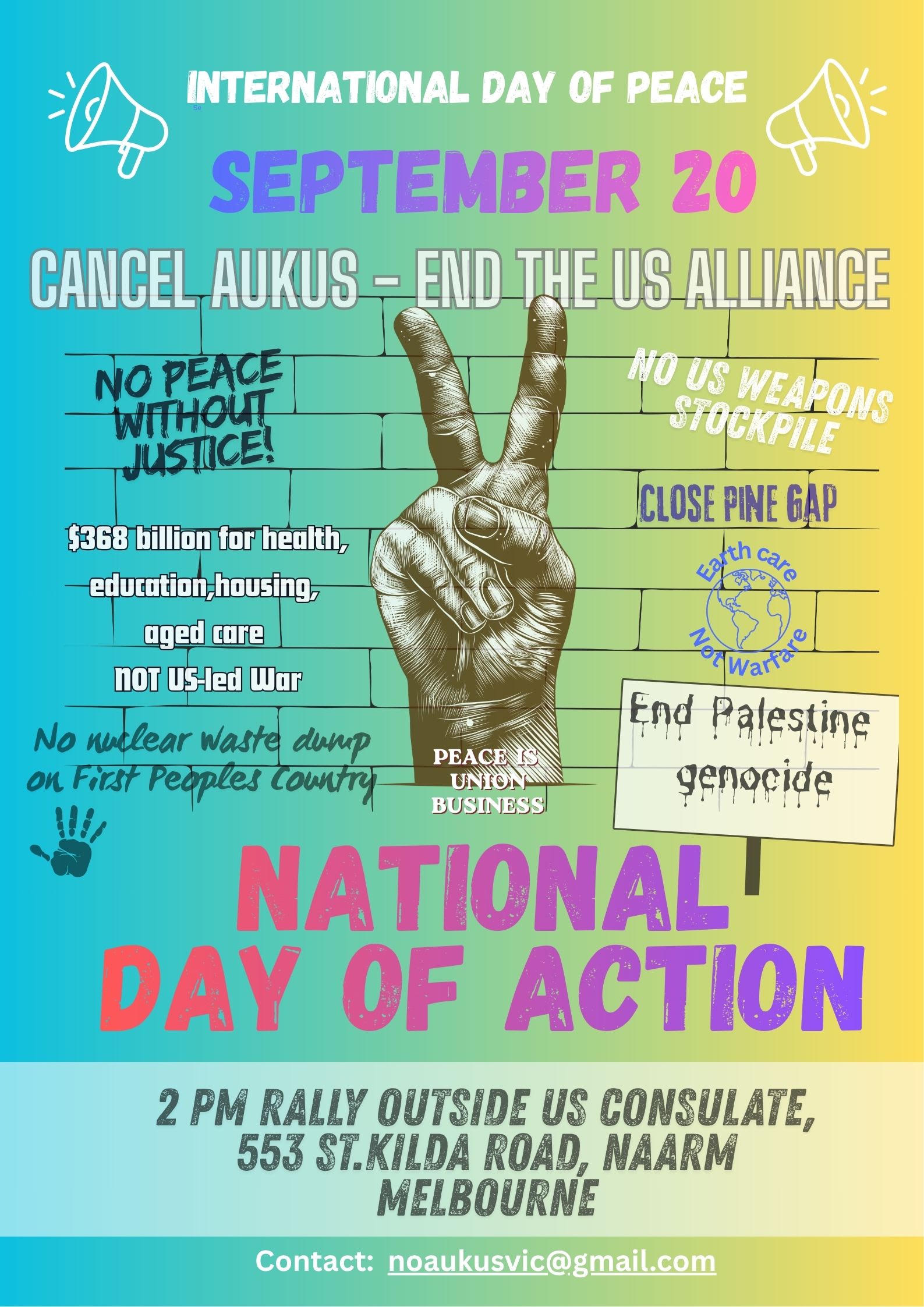
20 September –National Day of Action in Melbourne on the International Day of Peace

Help Aunty Sue Protect Her Land and Sacred Sites From Destructive Rocket Testing.
.

Australians deserve the truth
about
AUKUS – https://aukuspublicinquiry.com/


PETITION – To: Prime Minister Anthony Albanese and the Australian Labor Government

of the week – Australians for War Powers Reform (AWPR)
To see nuclear-related stories in greater depth and intensity
 Antinuclear