Submission To: Senate Standing Committees on Economics Regards “Selection process for a national radioactive waste management facility in South Australia”Ken and Carole Wetherby (Submission No. 12)
We live on a ‘hobby farm’ 10km east of Cleve which is outside the Kimba District Council.
Terms of Reference, our comments refer to items b, d and e. b)
“Broad community support”, the level of community support required for acceptance should be set at a 2/3 majority- then stick to this figure – don’t ‘waffle’.
d) Essentially the ‘community benefit program’ is a bribe and that is what it should be called.
e) This is the point which we have disagreed with from the outset. The establishment of a radioactive waste management facility at Kimba will have an effect on the whole of Eyre Peninsula, not just the Kimba Council area and we should all be allowed to have our say.
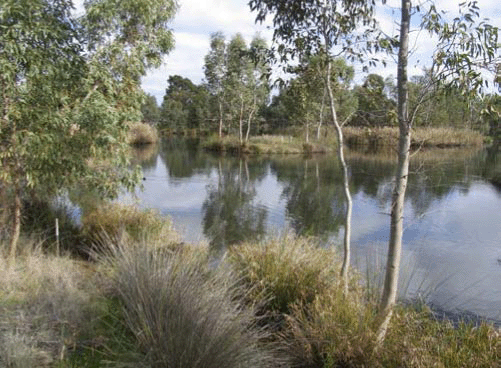
The ‘clean green’ reputation of the agricultural, fishing/aquaculture and tourism industries could be negatively affected. “Hobby farm’ values could also be affected – in our case we retired to our ‘hobby farm’ at Cleve because of Eyre Peninsula’s ‘clean green’ reputation. The agricultural zone on Eyre Peninsula is isolated from other farming areas by Spencers Gulf, the Nullarbor Plain and pastoral land to the north and as such it has a unique ability, as an entity, to claim and retain our “clean green’ reputation.
Of course you’d have to be pretty naive to think this isn’t step 1 to becoming the world’s nuclear waste dump?
Steven Marshall had previously said he would not support the facility and declared last year “a nuclear waste dump is now dead”.
Source: ABC News.
First posted 8 Jun 2017, 10:46am
Given deadlines are fast approaching and this seems as though its a foregone conclusion, it would seem our Premier Steven Marshall was unable to stay to his word and Malcolm Turnbull and Senator Matthew Canavan have been able to roll him. Embarrassing?
Then again when you’re offering 4 times property value to locals and offering other opposition segments houses and cars in exchange for their support, it’s hard to stop matters.
Hours before the doors swung open on the budget lock-up, the bright sparks on Twitter had already started a new meme. #KeepMyTenDollars was a reminder that Australians would gladly forgo an extra few bucks a week for to see the governments prioritise spending on health, education and renewables, not corporate and high-end tax cuts. It was certainly funnier than Scott Morrison’s bizarre attempt at humour.
“What have you achieved?” would have been an odd opening line to the government’s pre-election budget speech, were it not coming from the mouth of the man who famously waved a lump of coal around in Parliament to declare his love for the toxic fuel. The joke was lost on the rest of us, but it was the punch line that betrayed the confusion of the government.
The world’s leading economists have been warning for decades that the damage caused to the climate by burning coal, oil and gas poses one of the most serious threats to the global economy. The cost of destruction in agriculture, tourism, finance, insurance, property, and even mining caused by sweeping floods, droughts and bushfire caused by distorting the world’s life support systems is nearly unimaginable.
Indeed, it’s hard to imagine a sector that will not be severely impacted by climate change. But collapsing costs in renewables and a rising global movement against pollution is changing the headwinds – not that our Government seems to have noticed.
You would think that a Government that waxes lyrical about intergenerational equity would have at least a primary school grasp on climate change. Yet the forbidden words were nowhere to be seen in the budget speech, save for a small reference to the Government’s plans to walk away from innovation in the renewables sector (whatever happened to that dogged commitment to ‘jobs and innovation’). The devil, as always, was in the detail of the budget papers.
Budgets are a statement of values that mark the principles of legislators. In this year’s budget, the Government’s values were laid bare, with climate spending slashed by almost half, falling further to $1.2 billion by 2022. Analysis by the Australian Conservation Foundation found that the under-resourced Department of Environment and Energy will have an axe taken to its bottom line, with spending slated to plunge by 43 per cent on 2013 levels (when the Government took office) by 2022.
The Renewable Energy Target will be abolished by 2020. Taxpayer largesse will continue to flow to the Government’s friends in fossil fuel companies, with $30 billion in diesel tax subsidies pouring into private companies over the forecast period. No additional money for renewables or climate mitigation and adaptation will be forthcoming.
The opportunities that come from renewable energy, which are now cheaper as well as being cleaner and healthier, are being seized by the community of nations while Australia clings to a wheezing, out-dated economy.
On the same day the budget was delivered, the meter at Mauna Loa, Hawaii clocked 410 parts per million of carbon dioxide in the atmosphere – a level not seen in 800,000 years, well before humans developed agriculture, let alone donned suits and waved rocks around in Parliament.
The other critical budget, the carbon budget, is in obvious deficit.
The Government should keep my ten dollars, and use it to achieve real progress towards a coal-free, more liveable society. Most Australians would gladly chip in for wind and solar, and our vast weight of numbers will eventually prevail.
It’s clear after this budget that it will take concerted action from all Australians everywhere for the Government to regain its grip on reality.
‘Mostly Indigenous remote jobseekers still need to work more than double hours of non-remote jobseekers for same income’
‘An overhaul of the remote work-for-the-dole scheme announced in the federal budget
has been criticised for maintaining racist and discriminatory requirements
on its majority Indigenous participants. …
‘Adrianne Walters, a senior lawyer at the Human Rights Law Centre, said
it was “mind-boggling” that the difference in requirements remained,
albeit slightly modified.
‘“Equal pay for equal work is a core tenet of Australian society.
The federal government must eliminate the blatantly discriminatory requirement,
which sees people in remote Aboriginal and Torres Strait Islander communities
forced to work more hours for the same basic Centrelink payment as people in cities,”
Walters said. … ‘
Eddie Hughes Submission to Senate Inquiry on Nuclear Waste Dump Sit Selection Process (Submission No. 57My name is Eddie Hughes and I am the State Member for Giles. Please accept the speech I gave in Parliament on the 31 May 2017 as my submission for the Senate Inquiry into “The selection process for a national radioactive waste management facility in South Australia”.
I believe that the selection process is deeply flawed as a result of being based on an individual site nomination process.
NUCLEAR WASTE
GRIEVANCE DEBATE – 31 MAY 2017
Mr HUGHES ( Giles ) ( 15:23 ): I rise today to talk about the process that is on the way to determine whether a facility to accommodate domestic nuclear waste is built in South Australia. It is very strange, given the vastness of the Australian continent and, indeed, the concentration of nuclear expertise at Lucas Heights, that the only three sites being considered are all in the electorate of Giles. The reason all the sites are in Giles does not reflect any particular set of comparative advantages.
What it does reflect is a fundamentally flawed site selection process. It is a site selection process that has little regard for the impact on the communities that have been put in the spotlight and a site selection process that has absolutely no regard for the division that has been created.
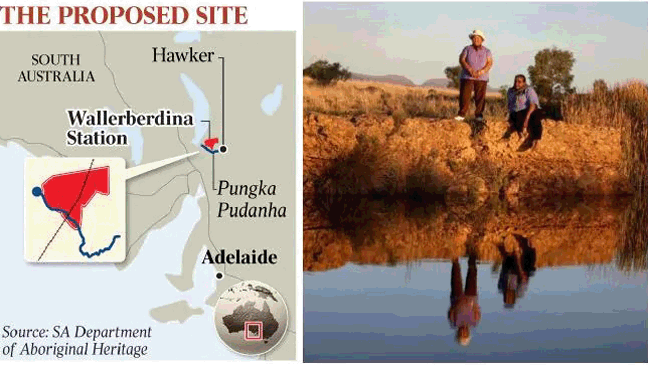
Let me be clear: we do need to manage our domestically-produced waste in a responsible fashion. The adoption of such a divisive process does not, however, represent a responsible approach. The trigger for the engagement process is at the heart of why this is a seriously flawed approach. If you look at Kimba and the surrounding district, and if you look at Hawker and its district, you will see the division that has been caused. The trigger for the Flinders Ranges site was totally centred on the action of one person. That person does not live in the region; he lives in Adelaide. He is an absentee landlord. This absentee landlord nominated Wallerberdina Station which is under a pastoral lease. The absentee landlord is Grant Chapman, a former Liberal Party Senator.
The process adopted by the Federal Government did not call for communities to nominate a site; it called for individuals with land tenure to nominate sites, a bizarre approach which then left communities to react. The absentee landlord did not consult with his neighbours prior to nominating his property. I understand that he did not discuss his intention with neighbouring pastoralists and he did not consult with the local Aboriginal people, some of whom live on the adjoining property at Yappala Station. I spent a night at Yappala, listening to the concerns expressed by the residents. They were shocked by the nomination and the arrogance of the absentee landlord. We now know that the presence of Aboriginal people in the Flinders Ranges dates back 40,000 years. They are not blow-ins, they are not absentee landlords, they have lived and walked the country for generations.
The nomination of Wallerberdina was marked and will always be marked by a complete lack of respect for the Adnyamathanha. The absentee landlord did not speak to his neighbours, neighbours whose connection to the land he obviously has no appreciation of. We are not all that far from terra nullius. His neighbours were invisible. The nomination and the ongoing process has generated division not just in the European community but also in the Aboriginal community. The nomination process in Kimba also centred on the actions of individuals and has also led to community division. In the lead-up to the Federal election, the people of Kimba were under the impression that the two sites nominated near Kimba had been taken off the table, only to magically reappear after the election.
Most of the waste generated comes from the Eastern States. Lucas Heights can easily accommodate the long-lived intermediate waste for decades to come. That is where the expertise is and that is where the more serious waste is generated. When it comes to that waste and other waste streams, we have ample time to get this right, and a starting point at a national level is to initiate a roundtable process involving all the various interests, including non-government environmental bodies. We have an obligation to do this properly and we can build a consensus about our long-term management of nuclear waste. What has happened to date should become a case study in how not to do it.
A law shielding South Australian journalists from liability for refusing to reveal their sources will be tabled in state parliament.
Whistleblowers may soon have stronger protections under a bill introduced to parliament in South Australia.
The Liberal government on Thursday introduced legislation to shield journalists from criminal or civil liability if they do not disclose the identity of their sources when the information is in the public interest.
“This legislation enhances the public’s right to know by encouraging whistleblowers to come forward on the understanding that journalists will not be forced to disclose their identity in a court of law,” Attorney-General Vickie Chapman said.
The proposed legislation would make the default rule that journalists cannot be compelled to answer a question or produce a document that may disclose the identity of an informant.
“I anticipate it will be a very rare day that a court will deem revealing the identity of the informant is necessary to protect the public interest,” Ms Chapman said.
SA Law Society President Tim Mellor said the legislation was an important step in the protection of a free press.
“Like an independent judiciary, the fourth estate of a free press is an integral part of an open and transparent society,” Mr Mellor said
South Australian and Queensland are the only two states without shield laws.
While Dr Wang and his team used data from seismic monitoring systems in China and the surrounding area, Australia has one of the best in the world, Professor Tkalcic said: the Warramunga monitoring station in the Northern Territory, near Tennant Creek.
It’s almost smack bang in the centre of the continent, in an incredibly quiet part of the world, seismically speaking; far from tectonic plate edges, cities and the shoreline, where waves crashing on the coast create seismic noise.
There is also an infrasound detection system at Warramunga station, which detects waves that travel through the atmosphere produced by bomb blasts.
The data is transmitted by satellite to the Comprehensive Nuclear-Test-Ban Treaty Organisation in Vienna, where it is monitored round the clock.
An underground North Korean nuclear test in September last year exploded with 10 times the energy of the atomic bomb that exploded over Nagasaki in 1945.
It also caused the overlying mountain peak to sink by half a metre and shift about 3.5 metres south.
Key points:
North Korea detonated a nuclear bomb under Mt Mantap on September 3, 2017
Using satellite measurements and seismic data, geophysicists calculated the strength of the test and its location — the first time satellite radar has been used this way
The blast was big enough to cause an earthquake and deform the mountain above
These are conclusions drawn by geophysicists, who used satellite radar and instruments that pick up waves travelling through the earth, to calculate the explosion’s depth and strength.
In the journal Science today, they also report signs that a subterranean tunnel system at the test site collapsed 8.5 minutes after the bomb detonated.
In the past, satellite technology — called synthetic radar aperture imagery — has mapped how the ground stretches and warps after earthquakes.
But this is the first time it has been used to examine a nuclear bomb test site, according to Teng Wang, study co-author and a geophysicist at Singapore’s Nanyang Technological University.
Since the United Nations General Assembly adopted the Comprehensive Nuclear-Test-Ban Treaty in 1996, nine nuclear tests have taken place.
Six of these were by North Korea, five of which were at its Mt Mantap facility in the country’s north.
The bombs were detonated in chambers tunnelled into the mountain itself — a granite peak that extends upwards just over 2,200 metres.
But this means the details of the tests, such as the energy produced by the bombs, have been largely unknown outside North Korea — until now.
Eye in the sky, ear to the ground
Dr Wang and his colleagues suspected they could deduce the strength and precise location of the bomb test on September 3 last year, which triggered a magnitude-6.3 earthquake.
Clandestine nuclear activities are tracked by a global monitoring system of sensors that pick up the faint shivers and shudders generated by distant underground blasts and earthquakes.
But while these instruments are capable of picking up the wave signature of a bomb blast thousands of kilometres away, more information is needed to pinpoint exactly where an explosion has taken place.
So in the weeks after the September North Korean bomb test, Dr Wang and his colleagues received images of the Mt Mantap terrain before and after the test, snapped by the German TerraSAR-X satellite.
To map the bumps and dips on the Earth’s entire surface, TerraSAR-X pings radar towards the ground and measures how long it before the signal is bounced back up again.
“As long as the ground is deformed, we can measure it from space using synthetic radar aperture,” Dr Wang said.
Combined with a bit of nifty mathematical modelling — the first time anyone’s modelled an underground nuclear test with radar data — he and his colleagues got a fix on the exact location of the detonation site.
This is a highlight of the work, said Hrvoje Tkalcic, a geophysicist at the Australian National University, who was not involved in the study.
“What’s always difficult is pinpointing an exact location [of a bomb test],” Professor Tkalcic said.
Dr Wang and his team calculated that the top of the mountain subsided about half a metre after the September test, and parts of it shuffled south.
To manage this deformation, the bomb released the energy equivalent to between 109,000 and 276,000 tonnes of TNT in a chamber 450 metres below Mt Mantap’s peak.
The “Fat Man” bomb that exploded over Nagasaki yielded an energy level equivalent to 20,000 tonnes.
Among the data, they found the seismic shivers of a second, smaller event — an aftershock that appeared 700 metres south of, and 8.5 minutes after, the explosion.
The waves produced by the aftershock weren’t consistent with an explosion; rather, it looked like the ground had imploded.
This, the geophysicists suggest, “likely indicates the collapse of the tunnel system of the test site”.
While Dr Wang and his team used data from seismic monitoring systems in China and the surrounding area, Australia has one of the best in the world, Professor Tkalcic said: the Warramunga monitoring station in the Northern Territory, near Tennant Creek.
It’s almost smack bang in the centre of the continent, in an incredibly quiet part of the world, seismically speaking; far from tectonic plate edges, cities and the shoreline, where waves crashing on the coast create seismic noise.
It uses an array of buried instruments to pick up waves that travel through the ground, acting as a giant antenna to amplify weak signals.
“They’re used in the same way as astronomers use arrays of antennas to look at deep space. It’s just that our antennas are pointed to the centre of the earth,” Professor Tkalcic said.
There is also an infrasound detection system at Warramunga station, which detects waves that travel through the atmosphere produced by bomb blasts.
The data is transmitted by satellite to the Comprehensive Nuclear-Test-Ban Treaty Organisation in Vienna, where it is monitored round the clock.
So how do geophysicists know if seismic waves are caused by bomb blasts and not, say, an earthquake or landslide?
In a subterranean explosion, the ground is pushed outwards and compressed, sending a particular type of wave through the ground, Professor Tkalcic said.
An earthquake’s seismic signature is different. If two plates collide, rub against each other or slip, they send out another type of wave.
“We can tell if the first motion was predominantly a compression or if it was a shear type of motion,” Professor Tkalcic said.
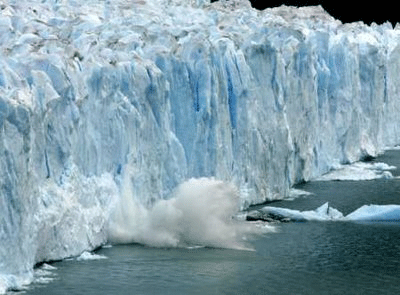
Global warming is melting Antarctic ice from below Warming oceans melting Antarctic ice shelves could accelerate sea level rise, Guardian, John Abraham, 9 May 18, “……With global warming, both of the poles are warming quite quickly, and this warming is causing ice to melt in both regions. When we think of ice melting, we may think of it melting from above, as the ice is heated from the air, from sunlight, or from infrared energy from the atmosphere. But in truth, a lot of the melting comes from below. For instance, in the Antarctic, the ice shelves extend from the land out over the water. The bottom of the ice shelf is exposed to the ocean. If the ocean warms up, it can melt the underside of the shelf and cause it to thin or break off into the ocean.
A new study, recently published in Science Advances, looked at these issues. One of the goals of this study was to better understand whether and how the waters underneath the shelf are changing. They had to deal with the buoyancy of the waters. We know that the saltier and colder water is, the denser it is.
Around Antarctica, water at the ocean surface cools down and becomes saltier. These combined effects make the surface waters sink down to the sea floor. But as ice melt increases, fresh water flows into the ocean and interrupts this buoyancy effect. This “freshening” of the water can slow down or shut down the vertical mixing of the ocean. When this happens, the cold waters at the surface cannot sink. The deeper waters retain their heat and melt the ice from below.
The study incorporated measurements of both temperature and salinity (saltiness) at three locations near the Dalton Iceberg Tongue on the Sabrina Coast in East Antarctica. The measurements covered approximately an entire year and gave direct evidence of seasonal variations to the buoyancy of the waters. The researchers showed that a really important component to water-flow patterns were ‘polynyas.’ These are regions of open water that are surrounded by ice, typically by land ice on one side and sea ice on the other side.
When waters from the polynya are cold and salty, the waters sink downwards and form a cold curtain around the ice shelf. However, when the waters are not salty (because fresh water is flowing into the polynya), this protective curtain is disrupted and warm waters can intrude from outside, leading to more ice melt.
Based on this study, we may see increased ice loss in the future – sort of a feedback loop. That concerns us because it will mean more sea level rise (which is already accelerating), and more damage to coastal communities. I asked the lead author, Alesandro Silvano about this work:
Lead author Alesandro Silvano.
We found that freshwater from melting ice shelves is already enough to stop formation of cold and salty waters in some locations around Antarctica. This process causes warming and freshening of Antarctic waters. Ocean warming increases melting of the Antarctic Ice Sheet, causing sea level to rise. Freshening of Antarctic waters weakens the currents that trap heat and carbon dioxide in the ocean, affecting the global climate. In this way local changes in Antarctica can have global implications. Multiple sources of evidence exist now to show that these changes are happening. However, what will happen in Antarctica in the next decades and centuries remains unclear and needs to be understood.
The proposed above ground Store in SA is primarily for ANSTO nuclear wastes
It is axiomatic that site selection at Kimba will require requisition of an Eyre Peninsula Port for decades of intended shipments of ANSTO nuclear fuel waste, first due from the UK in circa 2020-21.
The SA Nuclear Fuel Cycle Royal Commission (2016) concluded that terrorist attack scenarios are conceivable during the transport of nuclear fuel wastes & that if a cask was lost at sea and was irrecoverable the radioactivity that escapes is expected to affect thousands of cubic km of seawater.
ANSTO has produced irradiated nuclear fuel wastes & Intermediate Level Wastes at Lucas Heights for 60 years without any nuclear waste disposal capacity (or even a program to do so) and intends to continue this mal-practice for another 40 years under an OPAL reactor Operating License up to 2057.
It is an untenable fact that the proposed nuclear fuel waste Store in SA is intended to operate “above ground for approx. 100 years”, however responsible management of ANSTO irradiated nuclear fuel wastes requires isolation from the environment for 10,000 years.
A Store in SA is unnecessary given the safe option of Extended Storage at Lucas Heights
This Inquiry should find no manifest need for a nuclear waste Store in SA other than Federal agenda. There is no Safety, Licensing or technical reason to bring these nuclear wastes to SA.
the Federal Minister holds a draconian discretion under the National Radioactive Waste Management Act 2012 (NRWMA) to over-ride both Federal and State Aboriginal Heritage Acts.
Ending the process now is far preferable to “a final right of veto” which forces Aboriginal people through to the end of a divisive demanding site selection process that is harming their community.
An immediate adjoining property to the proposed NRWMF siting in the Flinders is an Indigenous Protected Area, a part of the National Reserve System that is supposed to be under Federal protection. AND the proposed sites and the broader area are part of a precedent registered Story
Line, values that must be respected, under the protection of the SA Aboriginal Heritage Act 1988
However: the Federal Minister holds a draconian discretion under the National Radioactive Waste Management Act 2012 (NRWMA) to over-ride both Federal and State Aboriginal Heritage Acts.
This ERC Inquiry should recognise that Aboriginal people’s ‘voice must be heard and their consent is essential’ as a core part of “broad community consent” and make a Finding that NRWMF siting on Adnyamathanha country in the iconic Flinders Ranges is inappropriate and must stop forthwith.
David J Noonan B.Sc., M.Env.St. Independent Environment Campaigner . Submission to Senate Economics References Committee Inquiry “Selection process for a national radioactive waste management facility in SA” (Submission No. 31)
RE: Flaws in site selection process, inappropriate indefinite storage floats best practice, failure to follow essential Nuclear Safety Committee advice, and serious threat to human & cultural rights.
Dear Secretary Please accept this public submission & consider my request to appear as a Witness at this Inquiry
This submission focuses on the “appropriateness and thoroughness of the site selection process” & associated matters for the proposed National Radioactive Waste Management Facility (NRWMF).
Specifically: on inappropriate Siting of a proposed indefinite above ground Store for primarily ANSTO irradiated nuclear fuel wastes & long lived Intermediate level reactor wastes in regional SA.
An Executive Summary and a few public interest & Safety Questions for this Inquiry to consider under your Terms of Reference are provided – along with an offer to expand on points raised.
Over the last two full years the Federal government has solely targeted regional communities in SA to site the nuclear waste Store & associated required nuclear Port and waste transport routes.
In doing so, the Federal process is unacceptably inadequate (rather than thorough) in failing to follow essential advice of the Nuclear Safety Committee to the regulator ARPANSA (NSC advice to the CEO, Nov 2016) on the NRWMF: for transparency in decisions and for “The ongoing requirement to clearly and effectively engage all stakeholders, including those along transport routes.”
My submission to the Minister (May 2017) on his decision under the National Radioactive Waste Management Act 2012 to assess two sites near Kimba as potential sites for the proposed NRWMF raised a range of issues that have not been thoroughly addressed since (see Attachment 1).
I request opportunity to appear as a Witness to provide evidence at a Hearing of this Inquiry, and was a Witness as an individual on nuclear waste issues at the SA Parliament Joint Committee Inquiry on the Findings of the Nuclear Royal Commission, held in 2016. Continue reading →
Gary Cushway 18 Feb 2018 Submission to Senate Inquiry on Selection Process for Nuclear Waste Dump Site. (submission no. 6) Cushway addresses these terms of reference:
b) how the need for ‘broad community support’ has played and will continue to play a part in the process
’Broad community support’ should reflect a large majority, both across the community and within stakeholder groups (including the indigenous community) in favour of moving to the next process advancement stage.
c) how any need for Indigenous support has played and will continue to play a part in the process, including how Indigenous support has been or will be determined for each process advancement stage;
It is not simply enough to say that consultation with indigenous stakeholders and neighbours has occurred, without elaborating on the results. The ‘Community sentiment survey’ conducted by DISI in April 2016 recorded 3% support from the indigenous community for the Barndioota site to proceed to the next stage. (p10 sec C)
A copy of this report has been attached to this emailed submission.
Given the presumably low sample size I would suggest that this likely represents support of one or perhaps two individuals. It is vital that the sample size of this survey is published.
Additionally, the process behind the decision to disregard the significantly low support in the indigenous community from this survey and to progress the Barndioota site to the next stage should be discussed publicly as a matter of importance.
d) whether and/or how the Government’s ‘community benefit program’ payments affect broad community and Indigenous community sentiment
Although making funds available for ‘community benefit’ is clearly welcomed for any reason, the inclusion of offers of money as a part of the consultation process has created a few potential problems with regard to whether support from the community can be measured as broad support for the actual proposal or as support for the community benefit money being offered. This could also create a disparity when trying to effectively gauge ‘broad support’ in the community when some may be receiving significant amounts of money while others may not.
There also could exist a perceived conflict of interest when bodies such as the Flinders Ranges Council are a recipient of this funding, when the Council may in future be required to make impartial planning decisions on, for example, infrastructure or local environmental policy that is related to any future facility in the area.
Although local community support is vital, in a proposal such as a National Radioactive Waste Management Facility a broader consent should be sought from across the country.
As the NRWMF is a part of national plan of radioactive waste management any proposed site should require a ‘broad support’ nationally as well as locally.
The current proposal involves the storage of radioactive waste from sites across the country as well as the interim storage of waste returning to Australia from overseas. Federal, state and international governments have a responsibility to ensure that their involvement in the movement of radioactive waste complies with all national, state and international laws, regulations and best practice meaning that these governments and their constituents have a stake in ensuring that the site selection meets their own requirements in terms of legislation and broader social values. Limiting the consultation to a small local community area inhibits the ability of these stakeholders to have a voice in the process.
Adani losses prompt mining company to shift away from imported coal, Guardian, Ben Smee , 7 May 18, Results show Carmichael mine in Queensland no longer a viable proposition, analysts say
Adani’s coal-fired power business has reported more heavy losses, prompting the Indian conglomerate to announce it would shift away from using expensive imported coal.
Analysts say the fourth-quarter financial results for Adani Power, a subsidiary of the Adani group, showed the proposed Carmichael mega-mine in Queensland was no longer a viable proposition.
Remarkably in the context of the Carmichael project, the billionaire Adani Groupboss, Gautam Adani, acknowledged in a statement that the cost of importing coal to India had contributed to Adani Power’s struggles.
“We expect to receive [domestic coal] for the Tiroda and Kawai plants in the near future, which will help reduce fuel costs and improve profitability of these projects,” he said.
“Under-recovery of fuel costs for Mundra project have impacted its financial viability, and we are in dialogue with key stakeholders for an early solution.”
When the Carmichael coal project was first proposed, Adani was pushing a “pit to plug” operational model under which it would mine coal to use at its own generators, making profits through efficiencies and cutting out middlemen.
The Mundra power plant, which operates on imported coal, was the planned destination for the spoils from the Carmichael project. After Mundra fell into financial trouble, Adani attempted unsuccessfully to sell the plant. It has not operated since February.
SMH, By Cole Latimer, Dairy farmers in the heart of Victorian coal country will soon be able to trade solar power using blockchain processes.
A virtual microgrid will be created in the the Latrobe Valley, exchanging energy generated from 200 Gippsland dairy farmers, 20 businesses and 150 households, powered by a decentralised, peer-to-peer blockchain energy trading platform called Exergy.
Ivor Frischknecht, the Australian Renewable Energy Agency’s chief executive, said the trial was the first step in transitioning the agricultural region – near the state’s coal-fired power stations – to renewable power. It would be the first major trial of a blockchain-based virtual microgrid in Australia.
“The ‘virtual microgrid’ concept brings an alternative approach to energy where the control remains with the customers, rather than retailers, who can choose to opt in depending on the current prices and energy types, or their willingness to provide demand response,” Mr Frischknecht said.
The project will be built by LO3 Energy, a New York-based company that created the world’s first local energy marketplace, in Brooklyn, which allowed participants to trade energy using blockchain technology.
…….. The Victorian virtual microgrid will comprise solar installations, battery storage, and demand response and enabling technologies combined with LO3’s Exergy peer-to-peer trading mechanism, which uses blockchain processes to allow those within the market to buy and sell locally generated renewable energy.
With the energy-hungry farming industry still recovering from the 2016 milk crisis, it promises a cost-effective and resilient solution for farmers to create and manage their own energy and profit from trading their excess generation,” LO3 Energy founder Lawrence Orsini said.
“Engaging with farms is a key part of the project as they have the capacity to install large solar generation and storage. Exergy makes it possible for them to become mini-power plants and gain revenue for energy they don’t use.”
The farms will be given loans to build solar installations by the Sustainable Melbourne Fund, which will be repaid through council fees.
ARENA will also provide $370,000 in funding for the $775,000 project.
“The local Latrobe Valley marketplace would allow Gippsland farmers to take greater control of their energy use, providing the opportunity to sell their power back to the grid,” the Australian Renewable Energy Agency (ARENA) said, “consumers will also be paid for choosing to conserve energy at peak times.”
Others however do not consider that the financial risks are adequate. Their concerns have been articulated in community discussions:
• The loss of value to the spectacular tourist lands of the Flinders ranges
• The damage to farming country near Kimba
• The harm to below surface water tables
• The adverse effect on the prices of livestock and crops, caused by proximity to radioactive waste
• The adverse effect on the prices of land adjoining the site
• The fear that the Commission’s case for a nuclear making a profit is based on inflated estimates of the income and deflated estimates of the costs and risks
The sites near Kimba are in a productive agricultural region. This is in conflict with the National Health and Medical Research Council’s Code of Practice on radioactive waste, which states that radioactive waste disposal sites should have “little or no potential for agriculture”
The question for all of us must be faced. What sort of planet will our children, grand children and great grand children inherit, if this land is used in the way proposed by the Government?
Josephite Justice Office, North Sydney NSW 2060, Submission to Senate Inquiry SELECTION PROCESS FOR A NATIONAL RADIOACTIVE WASTE MANAGEMENT FACILITY IN SOUTH AUSTRALIA Contact Jan Barnett rsj (Submission No. 68)
INTRODUCTION
This submission is presented on behalf of the Josephite Justice Office, a ministry of the Congregations of the Sisters of St Joseph. The Sisters of St Joseph and our Associates (numbering approximately three thousand women and men) were founded in the mid-nineteenth century by Mary MacKillop and Julian Tenison Woods to work with those suffering from poverty and social disadvantage. We educate, advocate and work for justice, for earth and people, especially those pushed to the margins.
We commend this Inquiry into the siting of national radioactive waste management facility (NRWMF) at Kimba and Hawker. It is particularly encouraging to note that the Government has stated unequivocally that it will not impose such a facility on an unwilling community. The controversy surrounding the siting of a NRWMF in any area of Australia over recent years indicates the strength of feeling and the contradictory evidence being argued. It is our belief that until these arguments can be resolved, then even the specific terms of reference nominated for the Inquiry will be grossly inadequate. Continue reading →
ANTI-NUCLEAR campaigners will increase their fight to stop South Australia from becoming the nation’s radioactive waste ground, ahead of a final vote by the community.
Hundreds of postcards will be sent to Federal Resources Minister Matt Canavan demanding cultural heritage sites, agricultural land and the environment be protected from nuclear waste.
The Federal Government is expected to decide in the coming months whether to build a low-level and intermediate-level waste facility at Kimba or Barndioota, in the Flinders Ranges.
The two-year site selection process has divided both communities, those in favour believed it would create economic opportunities, while those opposed said it would jeopardise industries.
Conservation SA nuclear waste campaigner Mara Bonacci said the government needed to be more transparent about the facility ahead of an August 20 community ballot.
“There is division in both communities, whether it’s people who are pro-nuclear waste or anti-nuclear, they both want what’s best for the community,” Ms Bonacci said.
“But the pro-waste people are saying it will create lots of jobs, but we haven’t got any clarity around the numbers or if they’re full-time.
“We also want to know what number the Minister wants in a community vote to show ‘broad community support’ for the facility.”
Before the government decides on the successful site, residents from both communities will be given a final chance to accept or reject the proposal.
The ballot will be held less than a week after findings of a Senate Inquiry into the site-selection process are to be released, on August 14.
Mr Canavan told the Sunday Mail the government would provide more detailed information on the project’s design, job creation, cost, community benefits and safety, ahead of the ballot.
He said a nuclear waste facility would not be imposed on an unwilling community and it would need “broad community support” – although no arbitrary figure was provided.
“As we have always said, a range of factors will be used to determine broad community support, including the results of a public ballot, public and private submissions, and feedback from stakeholders during community discussions, including neighbours, councils and local groups,” Mr Canavan said. “The consultation process is engaging people on all sides of the discussion, and all views – supportive, neutral and opposed – are taken into account.”
The ballot will include residents of the Flinders Ranges Council and within a 50km radius of the Barnidoota site, and the Kimba District Council.
Vivianne C McKenzieShame on ANSTO and DIIS bringing yura to speak about waste dump in Wallerbidina. Who gave welcome to yartah? Did the Adnyamathana peoples give permission for them to have meeting on yartah?
Katrina BohrThis is wrong on so many levels. Once again-No respect.
Roni SkipworthSo this guy from Darwahl tribe in NSW didnt ask permission to come on to your Ancestors Lands. That seems very disrespectful as having good Indigenous friends they used to explain to me the Indigenous Law was ‘Didnt matter where one wanted to travel in other parts of Australia,they needed to go the that destination’s Elders to ask permission to enter into their Lands’. Like those from Adnyamathanha Country who wanted to travel to Lucas Heights would out of respect go to the Elders of the Darwahl Tribe to ask permission to step onto their land. I feel that Indigenous Laws once very strong amongst Australia’s Indigenous are being lost in today’s world. Also I feel that is why some Indigenous Children run amuck as they are lost and living in a White Society under the White Laws have lost their way .
Heather Mckenzie StuartHe didnt ask. He come with Australian Nuclear Science and Technology Organisation and Department of Industry Innovation and Science on Taxpayers money to have dinner at the Hawker Social Club where there was a function with invited guests.