Adnyamathanha tribal elder, Ken McKenzie, rejects pressure to agree to nuclear waste dumping at Wallerberdina
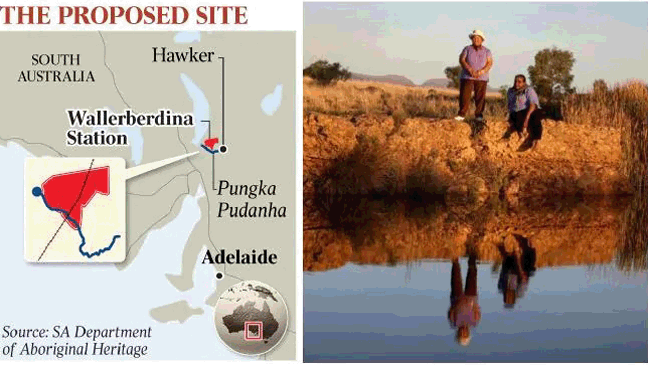 Enice Marsh, left, and Regina McKenzie at Yappala in the northern Flinders
I love Australia and I love the Flinders Ranges .
Even in my own room at Flinders House, at 2 o’clock in the morning, I have received phone calls telling me I’d better change my mind or else face tribal retribution. Because of my traditional ties to this land, these phone calls frightened me terribly. I am not a violent person. I’ve also had phone calls through the day saying huge benefits ie house, property could come my way if I was to say yes and encourage my people to also say yes to the dump.
Through all of this process over the last two years the government finally, in January of this year, 2018, employed a company who did a site cultural survey on Wallerberdina Station. This group of people desecrated one of our women’s traditional sites. Once again the terrible anguish that is being put on the people to see what has happened, is something that I never dreamed would be happening to my family and friends both black and white.
Local indigenous not impressed! ANSTO brought an indigenous nuclear spruiker from New South Wales to Flinders Ranges
 Heather Mckenzie Stuart Fight To Stop Nuclear Waste Dump In Flinders Ranges SA, 5 May Why is ANSTO and DIIS bringing a yaninjanha yura from Darwahl tribe in NSW to Hawker in the Flinders Ranges, making trouble saying urdnus are the only ones protesting against the proposed nuclear waste dump at Barndioota and are using yuras?
We go to protests and we will keep going to protests we will stand against the vartani. Anyway who gives that man the right to come here and talk in Adnyamathanha country, Wilyaru mirus and Adnyamathanha artuyani yarta. This is our ancestors lands, he has no shame we wouldnt go and talk in his yarta about his country. Dont come here pushing a nuclear waste dump on us, keep the poison in your country. You ANSTO and DIIS keep that yura in his country and let him dribble his rubbish over there in NSW. Hands off our sacred sites and stay in your yarta!! Ps his cultural consultancy means nothing to us, he want to stay at Lucas Heights.
Australia’s “Nuclear Archbishop” Dr Adi Paterson, graced Kimba with a visit
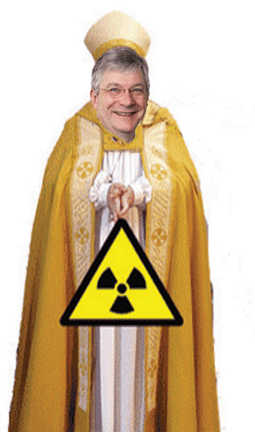
Dr Paterson visited Kimba on Friday with Carmelo Pesce, the mayor of the Sutherland Shire, which is home to the Lucas Heights reactor. According to the Eyre Tribune, the nuclear guru promised “45 jobs [that] will vary from full-time work, to shift work and on-call.
Dr Paterson said the announcement to the Kimba Economic Working Group and Consultative Committee and other members of the community received a positive reaction. ……..
If the proposed facility does go ahead in Kimba, Dr Paterson said it would receive a number of ongoing visits.
“There would be ongoing visits from independent regulators, visiting scientist and general visitors like tourists and school groups.”
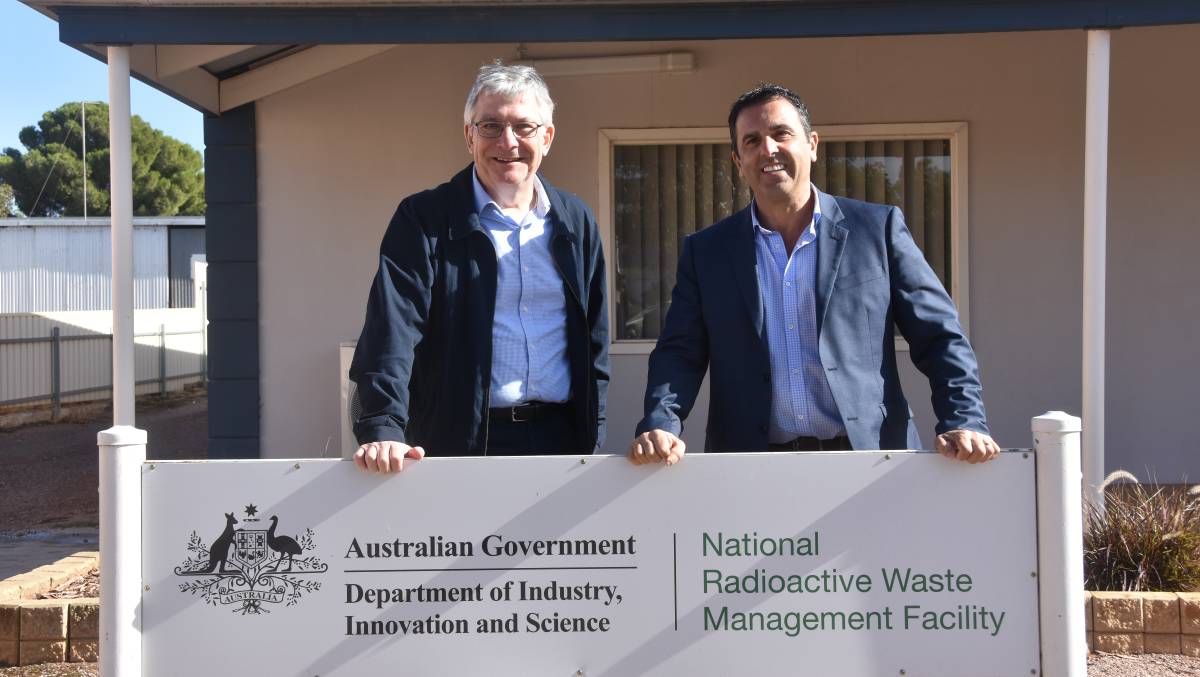
BHP, Heathgate, and Turnbull government keen to sell uranium to India
 Boost to nuclear-power: Two Australian firms in talks to export uranium to India, The Indian Express, by Anil Sasi | New Delhi May 2, 2018
Two Australian companies BHP Billiton, the world’s biggest mining company, and Heathgate Resources, an affiliate of US company General Atomics, are in discussions with the Department of Atomic Energy (DAE) for exporting uranium to India.
A sales contract for enabling the transfer, which is part of the ongoing commercial negotiations between Australian uranium vendors and India’s DAE on fuel contracts for civil nuclear-power generation, is currently under discussion, officials indicated…..
A steady supply of uranium is good news for the country’s nuclear power sector, something that is expected to boost the performance of Indian nuclear power plants, as well as of several fuel cycle facilities.
Former Australian Prime Minister Tony Abbott had signed an agreement with Prime Minister Narendra Modi for civil nuclear cooperation in September 2014, clearing the way for uranium sales. Australia’s current PM, Malcolm Turnbull, had said in April last year that he was looking forward to exporting uranium to India “as soon as possible” after holding talks with the Indian PM. Ongoing discussions with Melbourne-based BHP and Adelaide-based Heathgate Resources are aimed at formalising commercial contracts to enable uranium shipments to India. …….http://indianexpress.com/article/india/boost-to-nuclear-power-two-australian-firms-in-talks-to-export-uranium-to-india-5159318/
American climate denialist Scott Pruitt’s would have been c o-hosted by the climate denying IPA
 Climate sceptic group IPA suggested as co-host of Australian visit by Trump’s environment chief, Scott Pruitt’s cancelled trip would have promoted ‘innovation deregulation’, emails released under FoI show Guardian, Adam Morton.4 May 18The climate sceptic thinktank the Institute of Public Affairs was mooted as a co-host of an Australian visit by Donald Trump’s beleaguered Environment Protection Agency head, Scott Pruitt, which may have included discussion with local officials on whether environmental deals should be changed or cancelled.
Emails released to the US environment group the Sierra Club under freedom of information laws show that Matthew Freedman, a Washington consultant who describes himself as “a close personal friend” of the Australian environment minister, Josh Frydenberg, played a central role in organising Pruitt’s proposed August trip before it was cancelled when Hurricane Harvey hit the Texas gulf coast.
In the US, the emails are of interest as evidence that Pruitt relied on business figures and lobbyists to plan and justify his overseas travel. They were first published by the New York Times.
From an Australian perspective, they give insight into Pruitt’s proposed agenda and schedule. They discuss focusing on promoting “innovation deregulation”, federal-state relations and how to counter potential disagreements with Australian officials about climate change. The EPA administrator rejects mainstream climate science and worked closely with fossil fuel companies to reduce environmental regulation when he was Oklahoma’s attorney general.
Freedman suggested that Pruitt meet several members of the Australian government including the prime minister, Malcolm Turnbull (listed as “Malcomb”), the foreign minister, Julie Bishop, the trade minister, Steve Ciobo, and the then resources minister, Matt Canavan, along with Frydenberg …..
Roskam also recommended Pruitt meet Maurice Newman, a former chair of Tony Abbott’s business advisory council who has described global warming as “a delusion”, the former Productivity Commission head Gary Banks and the economist Henry Ergas …..
Roskam said Freedman, the US embassy in Canberra and the US consulate in Melbourne had approached the IPA about Pruitt’s potential visit. He said the organisation had welcomed the chance to “work closely with the world’s leading advocate for cutting environmental red tape” …….
Pruitt faces 11 federal investigations in the US, including into his spending on travel and his business relationships with lobbyists. Freedman worked on national security-related issues for Trump’s transition team but was removed after using a personal email address to conduct government business. https://www.theguardian.com/environment/2018/may/04/climate-sceptic-group-ipa-suggested-as-co-host-of-australian-visit-by-trumps-environment-chief
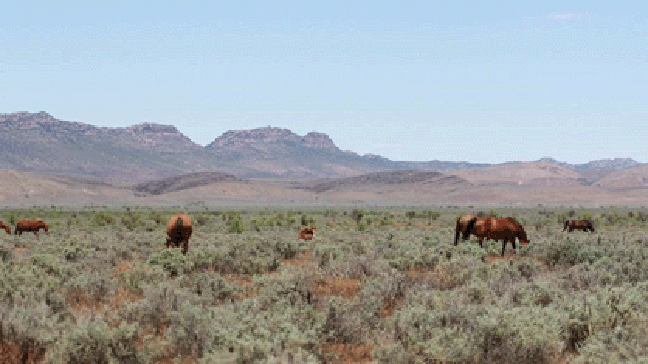
Pastoralist Donald Fels finds that Barndioota, South Australia, is a totally unsuitable site for a nuclear waste dump
I feel we are scapegoats for the eastern seaboard. There is 450 hectares at Lucas Heights and only 60 hectares at present. It has been said that only an area the size of three Olympic swimming pools are required so there is room at Lucas Heights for many years to come – why shift it now.
Mr Donald Fels Submission to inquiry regarding the proposed nuclear waste repository at Barndioota, Submission 76 to Senate Inquiry on Selection process for a national radioactive waste management facility in South Australia
I am a 65 year old 4th generation pastoralist, owner of Merna Mora Station, which has been in the family for 130 years, and is located approximately 19 kms from the proposed facility. I also own Wintabatinyana Station located 10 – 15 kms northwest of the facility site.
As well as running stock we have a tourist development at Merna Mora which commenced 50 years ago. From this clean, green belt we have been selling steers to the Japanese market for 24 years via AMH and JBS Swift as marbled shorthorn beef now part of Thousand Guineas Beef as well. We have very good quality merino wool and sheep meat which is sought after. We recently sold wethers to Turkey and as such must meet strict marketing codes. It has been important to keep our options
open as margins are very small in the meat and wool game. We definitely do not need the stigma of nuclear waste for our products or indeed in terms of our equity if we are ever to sell.
We are in the driest state in the driest continent in the world so water is another great concern and needs very little to upset the ecosystem. My grandchildren are 6th generation here and wish to continue here but none of the family want a waste facility near us.
The land here is very seismically unstable, the ground is very porous and the water table very close to the surface within 1 -2 km radius is less than a metre down.
The process of selection was not done properly. Many people were not surveyed. A lot of younger people who only have mobile phones were not surveyed. We were not surveyed and there are 4 families of us. We were advised why bother we were against it anyway. When consultants are employed to do surveys the right questions are asked to get the outcome needed.
Five very talented long term geologists working in an immediate area advised that it is not the right area in which to construct as the ground is too unstable, porous and prone to flooding. In a one in a hundred year flood it could result in a major catastrophe. Temporary Intermediate storage could
result in a longer term than this.
As for the job creation very few would eventuate as most construction would be by a major firm such as Downer or John Holland. They would bring in their preferred sub- contractors and place in a mobile camp. Tours would be unlikely to persist and really don’t see this as continuing.
The landlord is absentee, never likely to live here. Neighbours and community were not consulted prior to the land being offered. Land is perpetual lease country which is out of district council areas.
In outback areas, perpetual lease is exempted from native title but not native heritage.
I feel we are scapegoats for the eastern seaboard. There is 450 hectares at Lucas Heights and only 60 hectares at present. It has been said that only an area the size of three Olympic swimming pools are required so there is room at Lucas Heights for many years to come – why shift it now.
I feel strongly against this proposal to build this facility – please take these points into your consideration in the selection process. The consultation process has caused a deep rift in our once close knit community with many friendships now very distanced. All some see is the money but there is so much more to this. No monies should go to individual businesses only to community projects but there is already a bad precedence right from the first round. Several individuals received funds and now it is expanding to whole of the Flinders Ranges Council area 70 – 80 kms away.
I have been disappointed with the lack of continuity by ANSTO and do not feel that the consultation process has been fair and equitable.
The North Shore Environmental Stewards – Liberals aim to unseat Tony Abbott, over his climate denialism
 Liberal activists target Tony Abbott’s seat over climate change policy
Sydneysiders urged to join party in former PM’s seat to ‘shift the politics’ and speak up for the environment,Guardian, Anne Davies, 3 May 18,
Tony Abbott’s political future could be under threat from a group of activists who have been organising environmentally conscious voters to join Liberal partybranches on Sydney’s north shore – a move that could unseat the former prime minister.
Billing themselves as “the counterweight” to the pro-coal power Monash Forum, the North Shore Environmental Stewards have held at least two recruitment functions at which attendees were urged to tap into their networks of environmentally conscious people to join the Liberal party branches in Abbott’s seat of Warringah and on the lower north shore.
The NSES has a Facebook page that says the group “supports clean energy and a healthy environment, and believes in traditional Liberal party values of environmental stewardship”………https://www.theguardian.com/australia-news/2018/may/03/environmentally-conscious-liberals-urged
What is electromagnetic radiation? and how safe is it?
 Why does this article not mention the difference in vulnerability between children and adults?
What is mobile phone radiation and how safe is it? ABC Science,By science reporter Belinda Smith
“…. What is electromagnetic radiation?
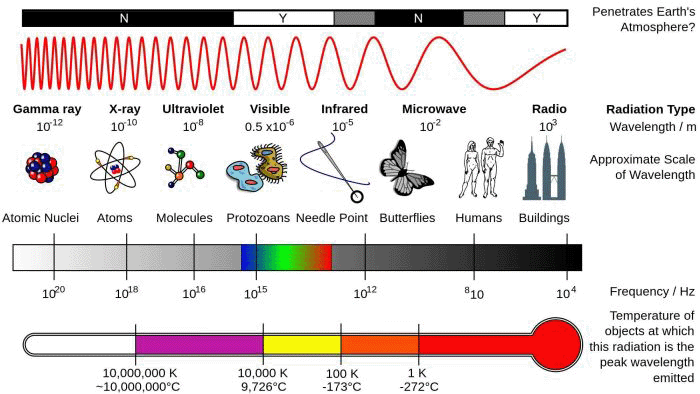
We are surrounded by all sorts of different types of electromagnetic radiation every day: your eyes pick up visible light, your bag is scanned by X-rays at airport security, microwaves heat your lunch and too much ultraviolet light gives you sunburn.
At its essence, electromagnetic radiation is energy comprising an electric field and magnetic field, which travel together, but perpendicularly, in waves.
Sometimes the length of these waves (or wavelength) is very short — a few nanometres for X-rays — while others are much longer — a few centimetres up to kilometres.
It’s these long wavelengths, called radio waves, that are the electromagnetic radiation of choice for mobile phones and base stations.
Unlike shorter wavelengths, such as visible light, radio waves can pass through walls. The longer the wavelength, the better it can penetrate solid stuff.
Another term you might see is frequency, which is the number of times a wave makes a full oscillation each second.
Frequency and wavelength are closely related. Wavelength is the speed of light divided by the frequency, so long wavelengths also have low frequency.
What are ionising and non-ionising radiation?

The radio frequency end of the electromagnetic spectrum is home to what’s known as “non-ionising radiation”, said Rodney Croft, from the University of Wollongong and director of the Australian Centre of Electromagnetic Bioeffects Research.
It’s the high-frequency, short wavelength radiation, such as X-rays, that can tinker with your DNA and are linked to cancer.
These waves are small enough and carry enough energy to knock electrons off atoms, ionising them.
Radio frequency used in mobile communications simply doesn’t have the energy to do that. But that’s not to say it doesn’t exert any effects on the matter it travels through.
“It’s an oscillating wave, which swings between positive and negative,” Professor Croft said
“If you have a bunch of molecules rotating, that causes friction, and energy is given off as heat. It’s how a microwave oven works.”
Does anyone regulate radio frequency limits?
In Australia, mobile phone and base station exposure limits are set by the Australian Radiation Protection and Nuclear Safety Agency (ARPANSA) and regulated by the Australian Communications and Media Authority.
The ARPANSA standard looks at how much energy a user absorbs from a mobile phone over time.
The maximum limit is currently 2 watts per kilogram of tissue. Phone manufacturers usually specify their maximum absorption rate in their manual.
You can find how much radio frequency is emitted by base stations at the Radio Frequency National Site Archive.
According to ARPANSA, it’s “typically hundreds of times below the [ARPANSA] limits”.
What are the effects of mobile radio frequency on tissues?
So are we microwaving our head whenever we answer the phone? A tiny bit, but not enough to be worried about, Professor Croft said.
He and his team found mobile phone radiation exposure increases the temperature of the outer grey, wrinkled layer of the brain called the cortex, but it’s only “maybe about 0.1 degree, which is very small compared to the temperature variation the body normally has to contend with”, he said.
“We do find that we get a slight change to thermoregulation, so the body, even with that small change, is sending a bit more blood out to the periphery to cool it, so your body doesn’t end up warming up.”
……...What about cancer in rodents?
Mobile phones are classed as “possibly carcinogenic” by the International Agency for Research on Cancer, putting them in the same category as aloe vera, bracken fern and Asian pickled vegetables.
And while radio frequency is non-ionising radiation — remember, it can’t knock electrons off atoms, fiddle with genetic material and trigger tumour growth like ionising radiation can — studies still investigate possible links.
Research published in February this year by the US National Toxicology Program found tumours grew in the nerves around the heart of male rats if they were bathed in extremely high levels of mobile radiation.
But, Professor Croft said, “there were so many difficulties with that study.
………Risks and benefits
Despite research showing no link between safe levels of radio frequency and cancer, telecommunications companies and other organisations do offer suggestions if you want to reduce exposure.
The obvious action, Dr Halgamuge said, is to limit mobile phone use: “You have no control over base stations, because that radiation is around you all the time, but you do have control over your mobile phone.”
The ARPANSA also recommends using hands-free or texting instead of calling, “but none of those things are actually based on any health effects”, Professor Croft said.
………So: does radio frequency have any effect on human tissue, apart from heating it a fraction of a degree?
That question is still open, Professor Wood said.
“Even though some of the evidence [that radio frequency causes damage] on the face of it looks quite compelling, there’s still a question of consistency…….http://www.abc.net.au/news/science/2018-04-30/mobile-phone-radiation-health-explainer-biophysics/9702630
Nuclear waste dump site decision an all-Australia matter , says Independent and Peaceful Australia Network South Australia
 Stephen Darley – Co-ordinator, Independent and Peaceful Australia Network IPAN (SA) SUBMISSION ON PROPOSED NUCLEAR WASTE MANAGEMENT FACILITIES IN South Australia We wish to respond to your Terms of Reference in relation to the appropriateness and thoroughness of the site selection process for a national radioactive waste management facility at Kimba and Hawke in South Australia, noting that the Government has stated that it will not impose such a facility on an unwilling community.
Our first response is to query whether your committee has given cognisance of the results of the recent Royal Commission into the Nuclear Fuel Cycle held in Adelaide in 2015, where the Citizens Jury (representing citizens selected at random and given comprehensive, expert information), overwhelming voted that they wanted NO part of the nuclear cycle developed here. This included nuclear waste management facilities.
The SA government agreed to abide by this decision. Consequently we would like to know under what legislation the Commonwealth can now override this decision and welcome your response to this query.
We make the following comments in response to your terms of reference :
a) The financial compensation offered to applicants for the acquisition of land under the Nominations of Land Guidelines:
This is a vexed issue as we would prefer that this proposal does not proceed, but should it do so, we believe that an independent panel should recommend the appropriate compensation where required and no land should be compulsorily acquired without the full consent of the owner and the surrounding community agreeing to any facility placement in their vicinity.
b) How the need for “broad community support” has played and will continue to play a part in the process, including:
i)The definition of ‘broad community support’ and
It is imperative that the broadest possible support be obtained before proceeding further as this is a national project that could affect other States where waste material is transported from. Transport, whether by sea, rail or road, will be a major hurdle for the proposed project as many communities have actively campaigned against waste material being trucked or shipped through their community (ie the sustained Port Adelaide and South Australians opposition to earlier proposed nuclear waste facilities). Not only is safe transport a major concern, but also the water table being contaminated if a spill occurs or the facility is not secured safely underground. We have no details of the type of facility proposed but all proposed waste management facilities, even low and intermediate level nuclear waste are recommended to be stored in very stable rock at considerable distance underground. How can people make a decision when they have no details of the actual storage being proposed ? To ask people to consent to transport and storage of toxic waste (which could conceivably increase to high level nuclear waste at some future date) is disingenuous.
Citizens must have all the proposed site facts put before them so that they can make a well informed decision on how this could/would impact on their State and/or community.
We recommend that both local, state and nationwide support be sought with all the above pertinent facts on the proposed structure, transport and guarantee, including exactly what level nuclear waste would be housed, with a firm guarantee that this would not be increased over time. A response level of 90% YES vote would be appropriate to ensure this proposal does have wide, genuine support – perhaps a postal vote would be the way forward. This process should also be carried out by an independent body.
- How broad community support has been or will be determined for each process advancement stage. Our response is incorporated in the above recommendation.
c) How any need for Indigenous support has played and will continue to play a part in the process including how indigenous support has been or will be determined for each process advancement stage;
We believe it is paramount that the Australian government fully outline and commit to whatever level of nuclear waste material would ever be stored at these sites. There is talk of intermediate level waste (and perhaps even high level). These levels require very stringent and specific storage sites which we doubt are available at the areas selected ie stored in stable geological rock for thousands of years with no possibility of leaching into any water table – mindful that the Artesian Basin is close by which stores most of Australia’s underground water. Your proposal needs to cover all the levels of waste and how they will be stored in full compliance with international standards.
It is paramount that indigenous peoples, especially around the proposed sites, should be in agreement first, before proceeding to canvass wider state and national support. Our local knowledge and experience, doubts that this will occur as we are mindful of the sustained and successful campaigns opposing any nuclear waste facilities in South Australia in the past, especially the Kunga Juta Aboriginal Women’s successful campaign to stop nuclear waste facilities on their land in the 1990s. They remember the consequences of the Maralinga Tests which adversely affected many of their communities, so there is a strong resistance to any nuclear waste facilities. Their combined support for such a facility would need to be evident through signatures and spokespeople standing up publicly to support any proposal, before canvassing this idea further.
- Whether and how the Government’s community benefit program payments affect broad community and indigenous community sentiment;
We are not cognisant of the community benefits program but suggest that they should be disentangled from this issue, as any monetary or community program inducement would be seen as a bribe to ensure support for a nuclear waste facility. Indigenous people should be provided with all the community services they require, without tying them to this proposal.
e) Whether wider Eyre Peninsular or state-wide community view should be taken into consideration and, if so, how this is occurring or should be occurring,
As mentioned above it is imperative that such an important and long lasting project gets overall support from first the local indigenous people, then the local communities, South Australians and lastly Australians overall. All the salient facts need to be published and people invited to vote. This information should the fact that waste is currently being stored successfully on-site where it is subject to regular scrutiny. People would need to have all transport routes identified and a guarantee that this project will not escalate into high level waste from overseas being shipped and stored here.
The project should only proceed if it has an overall majority vote of 90% in favour as what is proposed, once begun can not easily be undone.
f) Any other related matters. As seen above there is a lot more information and project management work to be drawn up before this proposal should be taken any further. At the moment it seems in the “wish list” category but serious information and planning needs to occur before this proposal cam be taken further. The first matter to be solved being the right of the Australian government to override the SA legislation which opposes any nuclear waste facility here. We would appreciate your response on this matter.
Australia, France, in support of Iran nuclear deal
Emmanuel Macron, Malcolm Turnbull fear looming demise of Iran nuclear deal Financial Review 1 May 18 by Andrew Tillett
Last-ditch efforts to prevent the Iran nuclear agreement from completely collapsing will feature in talks between Prime Minister Malcolm Turnbull and French President Emmanuel Macron on Wednesday, amid the growing likelihood Donald Trump will ditch the deal.
Australia has expressed its support for retaining the agreement, which requires Iran to curtail the development of nuclear weapons in return for economic and diplomatic sanctions being lifted, in a rare split with the White House.
During Mr Turnbull’s recent European visit, Germany Chancellor Angela Merkel and NATO Secretary-General Jens Stoltenberg both pressed upon him their concerns that Mr Trump will not certify the agreement by the May 12 deadline.
Both Ms Merkel and Mr Macron pushed Mr Trump not to abandon the agreement during their separate visits to Washington DC last week, with the French leader conceding he expected Mr Trump would cancel the deal because of US domestic politics.
A senior government source said Mr Turnbull would offer Mr Macron support for keeping the agreement alive when they meet in Sydney on Wednesday.
Mr Macron’s visit will be dominated by security and defence, including greater cooperation between Australia and France on development in the South Pacific to serve as a counterweight to China’s rise.
……Foreign Minister Julie Bishop said Australia’s position was that the agreement – formally known as the Joint Comprehensive Plan of Action (JCPOA) – should remain in place until such time as an alternative could be negotiated.
“I have made our views clear to the Trump administration and again during my recent discussion with US Secretary of State Mike Pompeo,” Ms Bishop told The Australian Financial Review.
“Our ongoing political support for the JCPOA is based on advice from the International Atomic Energy Agency that the deal is providing verifiable assurances on Iran’s nuclear program.
…..Lowy Institute non-resident fellow Anthony Bubalo said Australia was a peripheral player in the debate but Canberra would be “very conscious of any implications” a US withdrawal would have for negotiations with North Korea. Far from sending the “right message” to Kim Jong-un, it signalled to North Korea not to trust a deal struck with an US administration.
“It undermines efforts to strike a deal with North Korea,” he said. http://www.afr.com/news/emmanuel-macron-malcolm-turnbull-fear-looming-demise-of-iran-nuclear-deal-20180501-h0zh4t
Unanswered questions: what does ANSTO do with the high level nuclear waste canisters at Lucas Heights?
 Michael Skeet Kilowsky Fight To Stop Nuclear Waste Dump In Flinders Ranges SA
Gary See They’ve made an arbitrary date where waste has to leave Lucas Heights so they can argue for the first dump. The they’ll have intermediate level waste there that needs to move so that will be the argument for the next dump which will likely temporarily store high level waste so that makes the argument for the high level dump.
Once they have that they can go for new nuclear reactors and look at importing waste for money.
It’s just a low level waste dump though, they say
Now we are told the next shipment from England will be returned to Australia in 2020 -21 and shipped directly to the ‘new’ facility.
I agree, nuclear waste dumps are the trojan horse of the nuclear industry, pushing vunerable communities into believing it is for ‘the good of all’ with bribes and bullshit. A waste host town will just be that. A town that hosts deadly poison for hundreds and (probably) thousands of years. There’ll be no end to it.
Gary See There will be a proposal for an intermediate level facility and then a high level one after that.
At least that is the plan as far as I understand it.
https://www.facebook.com/groups/344452605899556/Australia can be the first 100 per cent renewables-powered continent
 ‘Captain Sunshine’ says Australia is not living up to its solar potential, https://www.smh.com.au/business/the-economy/captain-sunshine-says-australia-is-not-living-up-to-its-solar-potential-20180426-p4zbr0.html By Cole Latimer Australia can be the first 100 per cent renewables-powered continent, but it needs the political will to do so, a global solar expert says.
“Australia is not living up to its potential for power generation. It should be aiming for 100 per cent renewable energy, but Australia is up against the older, entrenched fossil fuel industry,” renewable energy entrepreneur and the chief executive of energy investor Energiya Global Capital, Yosef Abramowitz, said.
Dubbed “Captain Sunshine”, Mr Abramowitz is considered a global authority on the application and commercialisation of solar energy technology and has raised millions of dollars to build solar energy projects in Israel and East Africa.
Currently, solar energy accounts for just over 5 per cent of Australia’s total power generation despite it having the world’s highest average solar radiation – the potential for solar energy – of about 58 million petajoules of energy, or about 10,000 times the nation’s annual energy consumption. The size of a solar farm needed to power all of Australia would cover about 6270 square kilometres or approximately 0.1 per cent of the country.
“It’s a myth that the technology is not quite there yet. The time is now to scale towards 100 per cent given Australia’s amazing solar, wind and land resources,” Mr Abramowitz told Fairfax Media.
One of the major hurdles for the integration of more wind and solar power into Australia’s energy mix is the intermittency of the generation. For example, what to do when the wind isn’t blowing and the sun isn’t shining. Overcoming this requires more consistent generation, known as “reliability”, in the grid, which can be provided through gas- and coal-fired generation as well as pumped hydro storage. This need for reliability is one of the main pillars of the federal government’s National Energy Guarantee, which has limited the levels of wind and solar in the future energy mix to ensure a secure grid.
Mr Abramowitz said while the task of shifting to complete renewable generation seemed gargantuan, it was possible.
“In Israel, we wanted the whole southern tip of the country to be 100 per cent powered by solar energy during the day, from the Red Sea to the Dead Sea, – it seemed unlikely,” Mr Abramowitz said. “Today, that region is 70 per cent powered by solar energy during the day and can be 100 per cent by 2020.”
He said Australia lacked the political will to make the push for more renewable energy but added that it was a two-way street and the people needed to demand a shift in energy.
“Political leaders will follow the people’s will, we’d like to see more green audacity,” he said.
He said with more political support and policy frameworks solar markets could strengthen in Australia.
“Australia has had an on/off progress in solar – investors need to see a horizon,” he said.
“It’s difficult for the investment community to go ahead now, Australia needs to project a long-range horizon that investors can get excited about.
Australia needs to re-examine its coal-fired power plants and consider the costs of phasing them out; the timing is a political decision but the economic decision is simple.”
He added that Australia’s vast gas resources could also be utilised to aid this shift away from coal power.
Mr Abramowitz said solar power could provide a massive economic opportunity for the Northern Territory, particularly in remote communities. “When you have people living off the grid they tend to be poorer, as there is a real correlation between a lack of access to energy and a lack of economic development,” he said.
Renewable energy jobs up by a third – Australian Bureau of Statistics
 27 Apr 18, The number of jobs in Australia related to renewable energy production grew by one-third in 2016-17 to 14,820 full-time equivalent (FTE) positions, according to data released today by the Australian Bureau of Statistics.
ABS Director of Environment and Agriculture Statistics, Lauren Binns, said the 33 per cent increase on the previous year was mainly due to a number of major wind and solar energy projects starting their construction phase.
“The increase in employment in 2016-17 was driven primarily by three states, Queensland, New South Wales, and South Australia ” said Ms Binns.
Queensland had the largest increase in renewable energy employment, gaining an extra 1,220 FTE jobs, as a result of construction of large scale solar farms.
New South Wales and South Australia, on the other hand, realised most of their increases from new wind farm construction.
“In recent years, Australia has experienced growth in the amount of energy derived from renewable sources. While the proportion of energy from renewable sources remains relatively small there is considerable interest in renewable energy activities and associated employment,” said Ms Binns.
While roof top solar employment accounts for nearly half of the renewable energy jobs, the numbers have declined substantially over time, from a peak of 14,300 in 2011-12 to 6,430 in 2016-17.
The ABS publication, Employment in Renewable Energy Activities, Australia, provides experimental estimates of the levels of employment in renewable energy by state and territory, and by types of renewable energy activities.
The scope of employment estimates in this publication is employment in activities principally motivated by the production of renewable energy, and/or by the design, construction and/or operation and maintenance of renewable energy infrastructure.
Two years of community resistance
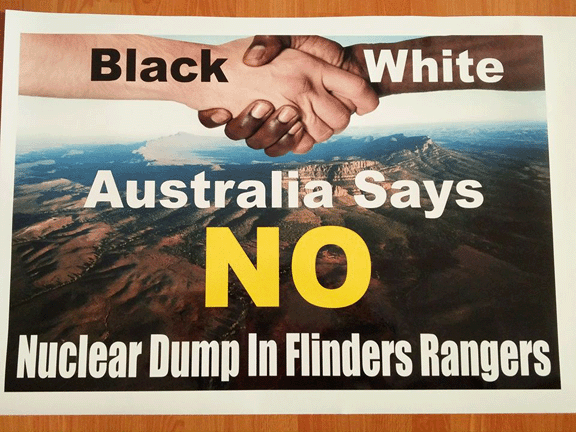 Sunday 29th April 2018 marked two years since then Minister Frydenberg selected Barndioota in the Flinders Ranges as a possible site to dump and store Australia’s radioactive waste.
Members of the Flinders Local Action Group, No Dump Alliance and Don’t Dump on SA spent the weekend at the Adnyamathanha-run Wilpena Pound and in Hawker to raise awareness of the issue with locals and tourists alike.
Overseas visitors were surprised and horrified to learn about the federal government’s proposal to put a radioactive waste facility in the area and were happy to sign postcards being collected to send to Minister Matt Canavan to show their opposition to a nuclear waste dump in SA.
The cited employment and economic opportunities are modest: some short-term fencing and construction work and just 12 to 15 longer term security and maintenance jobs. In contrast, the South Australian Tourism Commission states that visitor expenditure in the Flinders Ranges is $415 million p.a. with 1,400 jobs directly in the tourism industry and 1,300 indirect jobs – a total employment impact of 2,700 people.
Current federal Minister Matt Canavan recently announced that an AEC community vote for a planned waste dump and store would begin on August 20th. This is despite the fact that there is currently a Senate Inquiry examining the flawed and divisive site selection process and exhibits no regard for recommendations which may arise from the inquiry that will not report to parliament until mid-August. The Minister has not clarified what constitutes ‘broad community support’ despite repeated community requests.
Minister Canavan recently visited the area but failed to consult with the Adnyamathanha people. In response, the Adnyamathanha Traditional Lands Association (ATLA) released a short video message to the Minister.
Regina McKenzie, Adnyamathanha woman who lives next door to the proposed site, said “it’s been two years of the government not listening, they turn deaf ears towards the whole Adnyamathanha Nation who say no to the waste dump. We say no waste dump in our country”.
Greg Bannon, chair of the Flinders Local Action Group, said “this fight has been going since the site was shortlisted. For two years, the government has had a continual presence in district. The process has dragged on, but the government needs to know that we are committed to stopping this proposal. They have using a site selection model that has been tried and failed for years: forcing a radioactive waste dump on a remote community.”
Leading civil society organisations including environment, public health, Indigenous, trade union and faith groups all support an expert, open and independent inquiry into the full range of radioactive waste management options.
Anica Niepraschk calls on the government to dismiss the Hawker and Kimba site nominations for nuclear dumping
I hereby call onto the Minister to dismiss the Hawker and Kimba site nominations and reconsider all options available, including co-hosting the radioactive waste management facility at an already existing nuclear site.
Submission : Anica Niepraschk Selection process for a national radioactive waste management facility in South Australia Submission 29 In this submission, I wish to point out the inappropriateness of the site selection process for a national radioactive waste management facility at Kimba and Hawker in South Australia.
In 2015, when the current voluntarist approach to the National Radioactive Waste Management Project (NRWMP) was in its early phase calling for land nominations to site Australia’s low and intermediate level radioactive waste management facility, I conducted a study on international best practices for such siting processes. Please thoroughly consider my research findings in the attached report. In my research, I found that a number of characteristics have internationally proven to be crucial for the success and integrity of a voluntarist approach. The NRWMP is lacking in most of these. Interestingly, in the cases I looked into, siting has only been successful in communities where a repository can be co-hosted with other nuclear facilities. These are communities with a nuclear history of some sort, such as hosting a nuclear reactor or intermediate storage facilities for radioactive waste.
Even when other communities had shown initial interest in hosting a radioactive waste facility, they ended their engagement in the siting process quite early on. This shows that it is much more likely for a repository to be hosted by a ‘nuclear community’, which partly roots in it already being familiar with the risks and benefits involved and thereby being much more comfortable to make an informed decision. An already existing positive relationship with the respective nuclear operator can furthermore contribute to a community showing interest.
Australia currently has a limited number of nuclear activities and stores its radioactive waste materials in numerous intermediate storage places, most of them very small. Only the site of the Australian Nuclear Science and Technology Organisation’s nuclear reactor and larger radioactive waste storage facility at Lucas Heights would reflect this experience. This is also where the majority of Australia’s radioactive waste is already stored. It would therefore provide the opportunity of simply improving on the current facilities and not having to transport the existing waste to a remote facility, thereby reducing risky and unnecessary transport of dangerous materials.
To be a truly voluntary process, community and public opinion has to be effectively taken into account by the respective decision making institutions and reflected in decisions. This means thatcommitments to not impose a repository on any community have to be observed. Showing respect towards informed decision-making necessitates providing local communities and the wider public with the necessary time and information. This is an essential factor to build trust towards the implementing agency.
Furthermore, a truly voluntary process acknowledges the role of the communities by engaging with them throughout the whole duration of the repository project. This should not be limited to the siting process but extend to the construction, operation and closure phases of the project. As the case of Belgium shows, communities can engage on issues such as the facility design and wider community implications e.g. facility monitoring and socio-economic projects. The early provision of information is essential, providing the community and wider public with the possibility to commission studies, reports and expert opinions. This encompasses an extensive assessment of environmental impacts and of alternative methods and siting options as major references to base a meaningful siting decision on for both the implementing agency and the community. These provisions enhance transparency and accountability and help build a more trusting relationship with the community. They raise the chance of a successful siting process as it is based on an informed decision and allows communities to feel more confident. Indigenous communities and Traditional Landowners play a central role in the siting process in some countries. Their consent and close engagement is critical in Australia where Traditional Owners are directly affected by the sites currently progressed. Furthermore, community engagement should also encompass neighbouring communities, which might be affected by the project.
A non-restrictive timeframe should be applied in siting processes, providing all stakeholders with sufficient time to make informed decisions. In the international case studies this has shown to require years. When the community feels comfortable to make a decision on the matter, a test of community support should be taken to establish its position. Similarly, the right-to-veto the government’s or operator’s siting decision should also provide the community with the final say on hosting a facility or not. In general, a community should be able to leave the siting process at any time if wished. As the UK example shows, this was one of the main factors communities wanted ensured when consulted on how to improve the siting process and has further proven to be a key feature of all the siting processes, making engagement really voluntary.
All the international examples enabled community engagement through providing funding to use according to their own needs to engage effectively on the issue. Additionally, some countries provide benefit packages for communities participating in the process and/or hosting the planned facility as a way to compensate for the efforts and risks associated and further drive local development, apart from the economic benefits already associated with the project such as employment, improved infrastructure and know-how. In case of any provisions in this respect, it is important that communication on funding or contributions is very clear from the beginning and that it does not compromise the position of the community on the issue and can be handled independently from nuclear operators or facility proponents.
In the case of Australia community engagement is completely carried out and funded by the National Radioactive Waste Management Project (NRWMP) and aimed at supporting the understanding of the project, instead of providing room for engaging on the issue. This transactional approach does not allow for the community to engage in ways it finds meaningful.
The main concern regarding the continuation of the site selection process, however, is the community opposition, which has been apparent for both the Barndioota site near Hawker as well as Kimba.
In the case of Barndioota, the local Adnyamathanha community at Yappala station, just kilometres away from the site, has been very vocal in its opposition to the siting from the beginning. With this site, the government chose, after pursuing Coober Pedy from 1998 to 2004 and Muckaty in the NT from 2005 to 2014, to not only once again target an Aboriginal community but also a culturally highly significant site. The proposed property is part of a songline and hosts many cultural sites, including the beautiful Hookina springs, a sacred women’s site for the Adnyamathanha. The local community remains actively connected to the maintenance and preservation of the land and is documenting and preserving their culture and history through recording traditional heritage sites and artefacts and mapping storylines in the area. The proposal is seen as an attack on their cultural beliefs, history and heritage.
The terms of reference of this inquiry clearly note the Government’s statement that it will not impose such a radioactive waste facility on an unwilling community. If the government is serious about its voluntary intentions and wants to be successful in the siting of the facility, it is paramount not to proceed with the shortlisted sites at Hawker and Kimba as they very clearly do not fulfill the essential criteria of community support. Attempts to ‘convince’ the local community of potential benefits of hosting the facility should be avoided under all circumstances, and the informed decision, which communities have taken, respected.
I hereby call onto the Minister to dismiss the Hawker and Kimba site nominations and reconsider all options available, including co-hosting the radioactive waste management facility at an already existing nuclear site. https://www.aph.gov.au/Parliamentary_Business/Committees/Senate/Economics/Wastemanagementfacility/Submissions
1 This month


Help Aunty Sue Protect Her Land and Sacred Sites From Destructive Rocket Testing.
.

Australians deserve the truth
about
AUKUS – https://aukuspublicinquiry.com/

PETITION – To: Prime Minister Anthony Albanese and the Australian Labor Government

of the week – Australians for War Powers Reform (AWPR)
To see nuclear-related stories in greater depth and intensity

