Indigenous work for the dole scheme ‘failing abysmally’, worsening poverty, Greens say
By political reporter Dan Conifer
“Whilst this program is allowed to continue,
there are kids not getting food on the table and communities
are being pushed into further poverty and disadvantage,”
Senator Siewert said.
‘Key points:
* Greens claim scheme is worsening poverty and hunger in Aboriginal communities
* Participants receive more penalties than every other Australian jobseeker combined
* Greens senator renewed calls to scrap penalty that freezes welfare for eight weeks ‘
‘The Government has conceded the Community Development Programme (CDP) needs a “complete rejigging”.
But it has indicated an overhaul will not be fully implemented until July 2019. … ‘Remote work for the dole participants work up to three-times longer than city-based jobseekers to receive Centrelink payments.
‘The CDP covers three-quarters of Australia’s landmass,
and the overwhelming majority of its 33,000 participants
are Aboriginal or Torres Strait Islander. … ‘
www.abc.net.au/news/2018-03-17/work-for-the-dole-program-worsens-poverty-greens-say/9558012
Group of Montebello nuclear test veterans have no medical insurance, not entitled to gold card
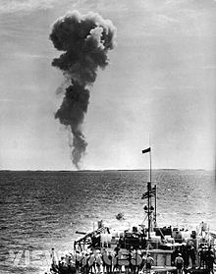 Montebello nuclear testing veterans exposed to radiation vent anger over gold card refusal http://www.abc.net.au/news/2018-03-15/nuclear-testing-veterans-hold-protest-at-wa-parliament/9551658 By: Jacob Kagi
 Paul Waldon – a warning on safety tests of dry casks storing nuclear wastes
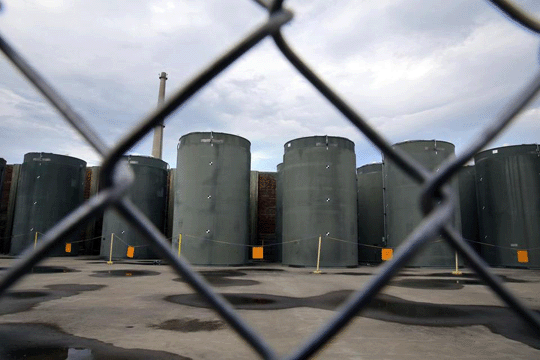 Paul Waldon Fight To Stop Nuclear Waste Dump In Flinders Ranges SA, 16 Mar 18 A successful safety test is one that shows the limitations or structural integrity of a product, just like car crash tests. Dry-casks have only had one successful safety test, where a cask was compromised with a less than 10 meter drop. However this had approximately 6 tonne of water which is a shortfall of the weight of nuclear fuel, plutonium being 1.8x heavier than lead, which shows heavy manipulated data can NOT always fuel the nuclear industries factoids.
ANSTO and nuclear lobby gearing up for tax-payer funded nuclear propaganda
The global nuclear lobby has smartened itself up a bit – especially in Australia. When it comes to “new nukes’ Generation IV -( those elusive super-expensive new gimmicks for which there is no market at all) the goal of propaganda is to give the industry a makeover – a young, female-friendly, image.
ANSTO – ever ready to spend our tax dollars on pro nuclear spin, is backing this new publicity tack in a big way.

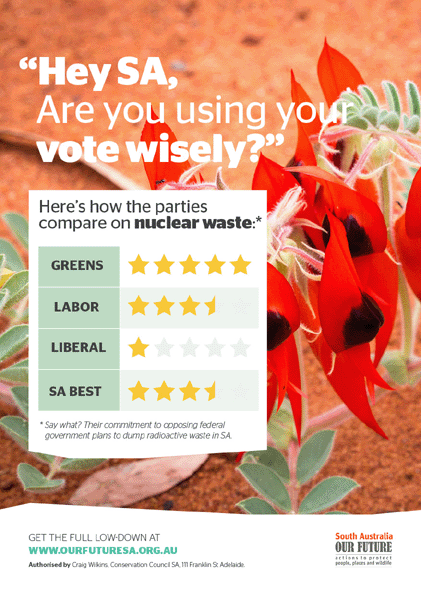
Nuclear waste dump for South Australia? Deafening silence by politicians and journalists
MOSS, No Nuclear Waste Dump Anywhere in South Australia
“What is each party’s position when it comes to defending the South Australian Nuclear Waste Storage (Prohibition) Act 2000?”
 The single most important issue in the history of South Australia, as it has significant impact on our future generations, has been ignored by all parties as an election issue. South Australia has a law prohibiting the development of a nuclear waste dump, yet the Federal Government is currently making plans to override it and build a nuclear waste facility in the heart of our prime farming land in Kimba, South Australia and also the Flinders Ranges only 40km from Wilpena Pound. Which party will uphold this law and why hasn’t any party put it on the agenda for this election. Please don’t suggest it’s a Federal issue, because it’s not. A nuclear waste dump for South Australia is breaking one of our own existing laws so it is very much a State Government issue.
We heard Nick Xenophon, Steven Marshall and Jay Weatherill on the ABC Adelaidethis morning and thought some hard hitting questions would be asked but instead heard a continuation of the “Cat Fight” we have been hearing for some time now. I’m thinking we need another Laurie Oaks.
Nuclear Waste Storage (Prohibition) Act 2000
We kindly ask that you please share this post to assist broader support.
7 News Adelaide 9 News Adelaide Ten Eyewitness News Adelaide A Current Affair 60 Minutes Australia Wilpena Pound Resort – Flinders Ranges, SA No Dump Alliance No Nuclear Waste Dump in Flinders Ranges Nuclear Free Adelaide – No Nukes HereFlinders Local Action Group: FLAG, Dr Helen Caldicott
South Australia’s renewable energy future hanging by a thread
 http://reneweconomy.com.au/south-australias-renewable-energy-
 future-hanging-thread-81721/ By Giles Parkinson on 15 March 2018
It’s an election that is impossible to call. And too important to ignore.
Just two days out from the South Australia state poll, the result is in the balance, and so too is the fate of South Australia’s status as a world leader in renewable energy. It’s an outcome that could have a huge bearing on the pace of the energy transition for the whole of the country.
It was supposed to be a three-horse race between Labor – facing the monumental task of trying to secure a fifth consecutive term after 16 years in power – the SA Liberals, and Nick Xenophon’s newly formed SA Best.
Xenophon – hugely popular three months ago – has slipped back in the polls, but his party could still be kingmaker early next week, choosing to support a minority government of either Labor or the Liberals, based on the number of seats, votes, or some other criteria.
For what it’s worth, SportsBet is favouring a Labor victory, saying the odds have come in at $1.78 from $2.30), compared to the Liberals ($2.10, out from $1.57) and SA Best ($16, out from $6.50). The best odds are for a hung parliament ($1.33, in from $1.45).
More relevant, perhaps, is the assessment of ABC election analyst Anthony Green, who says that due to a redistribution of seats since the 2014 poll, the Liberals are already sitting on a notional majority of 24 seats.
That means Labor would need a 3 per cent swing in its favour, not counting the influence of SA Best, to displace them. On local radio on Thursday morning, the local pundits weren’t seeing it – putting Labor at 18-19 seats, well short of the 24 they will need to govern in their own account.
This is a troubling prospect for the clean energy industry, and for those who want to see South Australia continue its world-leading transition to a renewables-based economy, and to set an example for the rest of the country.
If renewables were to be the deciding factor in this election, then Labor would be a shoe-in.
Renewables – despite the repeated attempts to demonise wind and solar – remain hugely popular, even among Liberal voters. But Labor is the only party to fully articulate how it sees the state’s energy future unfolding, and how it will manage it.
Premier Jay Weatherill has outlined a 75 per cent renewable energy target for 2025, along with a 25 per cent “renewable storage” target, and has made it clear that he will not be cowed by the right-wing bully boys in Canberra, or the coal lobby. He has set the state’s own agenda and is sticking to it.
His policy is to focus on embracing this energy transition with world-leading and world-biggest initiatives such as the Tesla big battery, the world’s biggest solar tower at Port Augusta, the world’s biggest “virtual power plant”, and the biggest wind and solar-powered hydrogen electrolyser, among a host of other projects.
Crucially, this renewables vision is backed up by the actions of business people like Sanjeev Gupta, who says the future of manufacturing and other energy intensive industries depend on cheap green energy, and Germany’s sonnen, which intends to build a battery storage manufacturing plant in Australia.
The Liberals, on the other hand, are all over the shop. Their campaign – much of it based around the sort of conservative myths we outline here – has already been censured by the SA electoral commission, which accuses them of being “inaccurate and misleading.”
The Liberals issued a fleeting and begrudging apology over its claim of huge bill reductions. (Most of the reductions will be delivered by Labor’s in-place policies). But if the Liberals win, the energy industry is not sure what to expect, apart from more myth making.
The Liberals policy document constantly refers to out-dated solutions such as “baseload”, without ever explaining what that might be: in South Australia, that cannot mean coal, nor should it mean expensive gas.
They vow to scrap the state-based target, and they declare support for the federal Coalition’s National Energy Guarantee, despite fears it would worsen South Australia’s principal problem – the lack of competition and the resultant high prices.
The inconsistency of the Liberals position is perhaps best summed up by the blogger Ronald Brakels, who noted in this piece on SolarQuotes:
- They (the Liberals) blame Labor for not having enough back up power but are against the state-owned power plant that provides back up power.
- They say they support free market policies but blame Labor for not interfering in the market to prevent a private company from closing a coal power station.
- The (Liberal policy) document claims the SA grid is unreliable but also says the state-owned power plant is a waste of money because the grid is so reliable it will only get used an average of once every 10 years.
- They have nothing good to say about Labor, but many policies they say they will follow are similar to what Labor is doing.
It is this last point that is most salient to the industry.
The state – with the projects under construction – is already committed to well in excess of 50 per cent renewables. It is the lack of vision, and the sort of mindless opposition to new technologies that pervades their federal counterparts, that scares participants the most.
The Liberals don’t support a state-based target, but Marshall himself has admitted that reaching 75 per cent by 2025 is certainly achievable.
In fact, apart from deliberately blocking the likes of Gupta from building huge solar plants to protect the future of industries like the Whyalla steel works, it’s hard to see how South Australia could fail to meet that target.
The Australian Energy Market Operator, for instance, says that S.A. could reach 73 per cent renewables by 2020/21, and doesn’t seem concerned about being able to manage this, talking enthusiastically of the new technologies like the Tesla big battery.
But stopping people from reaching targets is what the Coalition has proved adept at doing.
The national RET effectively came to a halt for three years – a major cause for the recent price spikes on the wholesale market – as the Coalition looked to trash the scheme altogether. And the NEG appears to be designed with the intent to stifle wind and solar projects over the next decade.
Ominously, the SA Liberals talk of requiring solar and wind developers to provide “market impact” studies for renewable projects.
The Liberals openly agree with Labor only on their support for the proposed solar tower and molten salt storage project in South Australia (it’s in the electorate of the Liberals energy spokesman, Dan van Holst Pellekaan), and on delivering battery storage for households.
The Liberals target 40,000 households in a means-tested grant program offering $2,500 for each installation, while Labor targets 60,000 households in two different schemes targeting low-income households with zero upfront payments.
Liberals wants an interconnector to NSW to be built soon, Labor is happy to wait. The Liberals don’t seem to have a plan of what to do with excess wind and solar capacity.
Labor is looking at battery storage and pumped hydro, and its Renewable Technology Fund has probably already locked in about 400MW of storage capacity. It is also looking to see if hydrogen can deliver the promise of green energy exports.
As for the others, Xenophon’s SA Best remains vague on its details, and how to manage this energy transition, but it accepts that it is inevitable, and that 90 per cent renewables by 2030 is possible,although not a target.
The Greens want to go the whole hog, to 100 per cent by 2025, but do not appear to have much traction in this poll. Cory Bernardi’s Conservatives propose the usual right-wing nonsense – wanting to build a 1GW coal plant and create a nuclear waste dump.
So, what does the renewable and storage industry want? Without doubt, another Weatherill government.
Liberals leader Steve Marshall and energy spokesman Pellekaan, a former BP executive, have railed long and hard against wind. Pellekaan himself blamed it for power surges that caused outages, and has echoed federal resource minister Matt Canavan’s call for the Northern coal generator to be re-opened.
Labor has mis-stepped – its energy security target was misguided, but it had the sense to dump it; it probably didn’t need to buy the emergency back-up diesel generators when a lease might have been better value; and its pro-gas drilling agenda is troubling for many.
But Weatherill’s vision is clear.
“People are proud of our leadership on renewable energy,” he noted in the recent interview in the popular Energy Insiders podcast. Even people who are not completely convinced about climate change believe that renewables are the technologies of the future.”
But he’s not getting much support in the mainstream media. The Murdoch press, dominant in South Australia, firmly supports the Liberals. Even the Guardian, in its main electoral wrap – slugged “It’s time for change” when first published – ignored the energy issue.
But Weatherill’s fear is that if Labor loses, it will be termed as a defeat for renewables, and an excuse to wind back policies.
“What will happen, should we not be successful, the opponents of renewable energy will say South Australia’s leadership in renewable energy was the cause of their demise. That will be used against any other government that wants to push deeply into renewable energy.”
And that’s a prospect that makes you feel ill.
David Noonan’s Submissions to Senate regarding Reprocessing Nuclear Fuel and Safety of Intermediate Level Wastes
 two David Noonan Submissions to current Federal Parliamentary Inquiry by Joint Standing Committee on Treaties (JSCT) Reprocessing Nuclear fuel – France (to report by 19 June) have been made public,
An ARPANSA Submission (23 Feb, 2 pages) “regarding the safety of intermediate level waste” has also been made public, at: https://www.aph.gov.au/DocumentStore.ashx?id=0739bc51-9403-4490-b0ce-c8cc6ed074a2&subId=563939
See below url’s & extracts for DN sub’s & JSCT Inquiry homepage at: https://www.aph.gov.au/Parliamentary_Business/Committees/Joint/Treaties/NuclearFuel-France
D Noonan Submission (14 Feb): “Public Interest Questions, Scenarios and Consequences of ‘Reprocessing Nuclear fuel – France’ treaty actions & associated nuclear actions”
https://www.aph.gov.au/DocumentStore.ashx?id=eab981b4-146d-4b66-aad9-59f64b275db0&subId=563627
… ANSTO is without a Plan B to address key public interest scenarios which demand answers:
· Reprocessing in France will not prove to be available throughout the OPAL reactor Operating License to 2057. At most, this treaty covers the first 2 of 5 decades of OPAL fuel wastes;
· AND the proposed above ground Store in SA for ANSTO’s nuclear waste will damage and divide community and fall over and fail just as prior attempts have in SA and in NT.
If the OPAL reactor is to continue to operate ANSTO must address required contingencies:
· Extended Storage of OPAL nuclear fuel waste on-site at Lucas Heights in secure cask storage. Lucas Height operates a Store for HIFAR nuclear fuel wastes with capacity to do so until availability of a final disposal option and can now set up to do so for OPAL fuel wastes;
· AND to have to manage ANSTO nuclear fuel wastes entirely with-in Australia through to final disposal. Sending OPAL nuclear fuel waste overseas for reprocessing is used as an excuse to produce a burden of further nuclear waste without capacity or answers for its disposal. …
my Supplementary Submission (28 Feb) provides further evidence on three key aspects:
https://www.aph.gov.au/DocumentStore.ashx?id=f42dce88-9ecf-44f0-8195-5e9e552de078&subId=563627
1. Reprocessing is not International Best Practice, is in decline, and may leave ANSTO stranded
… A key Reprocessing review for consideration by JSCT is: ‘Plutonium Separation in Nuclear Power Programs. Status, Problems, and Prospects of Civilian Reprocessing around the World‘ (IPFM, July 2015), see: http://fissilematerials.org/library/2015/07/plutonium_separation_in_nuclea.html
“France is currently the only country in the world that operates a commercial-scale spent fuel reprocessing plant.” (IPFM Report, Country Studies Chapter 3 France p.30)
… ANSTO should disclose the additional cost in Reprocessing compared to dry-cask storage
“The cost of spent-fuel reprocessing also is about ten times the cost of the alternative option for managing spent fuel, dry-cask spent-fuel storage.” (IPFM, Intro p.11)
 2. Extended Storage of ANSTO nuclear fuel waste at Lucas Heights is a viable option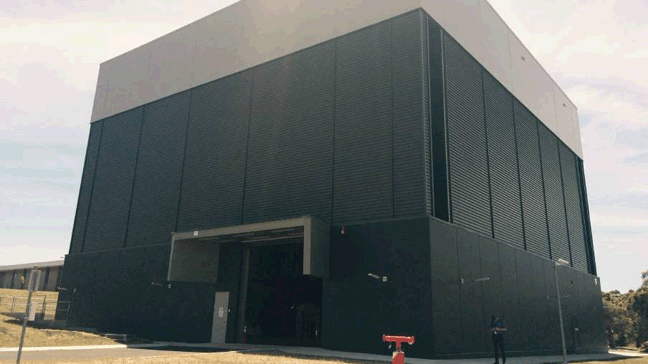
& Contingency to return OPAL reactor Reprocessed fuel waste to Storage at LHs
3. ANSTO failure to provide a disposal strategy for OPAL nuclear fuel wastes flouts best practice

Supreme Court appeal lodged against Yeelirrie uranium mining approval decision

 9/3 /18 The Conservation Council of WA (CCWA) and members of the Tjiwarl Native Title group have announced the filing of an appeal against the Supreme Court’s recent decision which upheld the environmental approval for the Yeelirrie uranium mine proposal.
The Supreme Court challenge brought by CCWA and Native Title holders sought to overturn the environmental approval for the mine issued in the final days of the Barnett Government, against the advice of the WA Environmental Protection Authority (EPA) and the Minister’s own appeal decision. If it goes ahead, the project will cause the extinction of multiple species unique to the Yeelirrie area.
CCWA Director Piers Verstegen said allowing the Supreme Court’s interpretation of the law to go unchallenged would be bad for the environment and bad for democracy.
“The decision to appeal this judgement highlights our commitment to preventing extinction and upholding what we believe are fundamental principles of environmental law.
“If this decision is allowed to stand then the Environment Minister could sign off on the extinction of multiple species with the stroke of a pen, despite what the EPA and appeals processes say.
“According to the Supreme Court ruling, we can have a detailed, thorough, publicly funded environmental assessment process, with all the key information examined in the public domain, followed by a rigorous appeals process, and then the Minister can totally disregard that whole process and make a different decision based on different information that is not available to the public.
“This treats the EPA and its environmental assessment as something to be casually dismissed. Western Australians expect and deserve better government than that.
“CCWA and community groups fought for WA’s environmental protection laws and the EPA. Now, it is again up to community to defend the integrity of those laws and processes in the courts. This is essential to uphold due process in environmental decisions, and to restore confidence in the EPA.
“The WA Environmental Protection Act was never intended to be used to sanction the extinction of wildlife, and it is our responsibility to do everything we can to ensure that it is not used in this way.
“The Yeelirrie approval knowingly allows extinction of multiple species and this should never be contemplated. We must stand up for all creatures, great and small.
“Allowing the extinction of any creature could open the door for other species to be treated in the same way. Numbats, cockatoos and other wildlife could be next, so we can’t allow it to start here.”
Vicky Abdullah, Tjiwarl Native Title Holder, said, “We have fought long and hard to protect Yeelirrie and to stop the uranium project, so we will not stop now.
“This appeal shows that we will continue to fight for our country and our people, and hope that the Court of Appeal will see that the decision to approve the Yeelirrie uranium project was wrong”.
Lismore mayor and citizens remember Fukushima, call for an end to uranium mining, and the whole nuclear chain
Fukushima disaster ‘not over’, rally hears, https://www.echo.net.au/2018/03/fukushima-disaster-not-rally-hears/ Harsha Prabhu ‘The Fukushima nuclear disaster is not over,’ were the chilling words of warning uttered by Toshiko Okada, anti-nuclear activist from Japan, speaking at a gathering to mark the seventh anniversary of Fukushima, at the Channon Market on Sunday.
Scores of people – including members of the region’s Japanese community – attended the gathering, despite the wet weather and the chance of the market being cancelled.
Okada is a member of Ctitzen’s Network for Evacuation from Radiation, which has been promoting the cause of Fukushima children and families affected by radiation.
She said, ‘We are having serious radioactive contamination problems not only in Fukushima but also in Eastern Japan, because life threatening radioactive substances are still discharging from the Fukushima nuclear power plant every day.’
Lethal levels of radiation had been detected at Fukushima’s power plant seven years after the tsunami. Apart from the release of volatile, gaseous radionuclides, a recent Manchester University study also noted the presence of micro particles containing uranium, caesium and technetium, several kilometres from Fukushima.
Plus thousands of gallons of radioactive water and waste are being stored above ground with no safe means of disposal.
Govt forced relocation While experts were warning of a ‘global disaster’ in the making, the Japanese government was busy normalising the situation by marketing food from Fukushima and stopping subsidies for Fukushima evacuees, thus forcing people to relocate to Fukushima. The government had also unilaterally raised the maximum limit of radiation exposure from 1mSv per year to 20 mSv.
Okada and her group are fighting to promote a Japanese version of Chernobyl Law to ‘protect all people in our country, especially future generations from ongoing critical nuclear issues and future nuclear disasters.’
She said, ‘Such law must be applied to all victims of radiation around the world.’
Okada and her citizens’ group hold protest actions at Shinjuku railway station and the Japanese PM’s residence in Tokyo every month. The banner used for this protest action became a rallying cry for Australia’s rainbow region folk, standing in solidarity with the people of Japan.
OK to speak up Local activist and actress Saya Minami said, ‘It’s important to let all the victims of Fukushima know that it’s ok to be scared, it’s ok to tell the truth, to speak up and say what you really feel. We are here with you in Australia!’
Lismore City Council Deputy Mayor and Greens party member Vanessa Ekins said, ‘It’s the seventh anniversary of the Fukushima nuclear power plant meltdown and radioactive water is still pouring into the Pacific Ocean.’
Lismore Council has erected signage at the entrances to Lismore declaring the city a nuclear free peace zone. Ekins said, ‘This may seem tokenistic but it raises awareness. The action we need to take as the federal election looms, is to question Australia’s role in supplying uranium to other countries for nuclear weapons and power.’
Uranium moratorium call She said, ‘Lismore’s Mayor visited Japan last year to join Mayors For Peace, initiated in 1982 by Hiroshima Mayor, and now 6,800 cities in 161 countries are negotiating to eliminate nuclear weapons. I question their focus on nuclear weapons when the nuclear industry itself is so damaging.’
Ekins added: ‘Australia needs to stop mining and exporting uranium.’
One activist said, ‘ This is an international crisis that requires an international solution. Instead of attending to this, governments are busy promoting crisis-ridden, failed nuclear technologies. French President Macron is in India today to sign a nuclear deal with Indian PM Modi. Corporations and governments are brazen in their support for the uranium industry. And Australia supplies uranium to India, a country that has not signed the nuclear non proliferation treaty. The whole uranium cycle is lethal – from uranium mines, to radioactive dumps, to leaking reactors, to nuclear weapons.’
He said, ‘We stand in solidarity with people everywhere fighting the military industrial complex and their baby – the uranium industry.’
Art & music Organisers had set up an art show and all through the rain-soaked day punters were treated to a smorgasbord of music: from soulful kirtans by Mico, Shivam and Armando, to young Belle McGreggor singing ‘Somewhere over the rainbow’; from fiery flamenco by Bart Stenhouse, to happy reggae anthems by JT Rastasamurai; from radical songs by Bo Kaan, to Brazilian folk by Priscila Rios and Anna Hamard-Lecoeur. By the time the six-piece Latin band Passando started their set the sun finally decided to come out to play.
Organisers called on the crowd to ‘say no to uranium. Leave it in the ground, like the aboriginal elders have been saying in their Dreamtime stories and the hippies have been singing for years gone by’.
‘And help the children and families of Fukushima by dreaming up a nuclear free world.’
The new Trans Pacific Partenership (TPP) just as bad for Australia as the old one
 “The deal still includes special rights for foreign investors to bypass national courts and sue governments for millions of dollars in unfair international tribunals over changes to domestic laws, known as ISDS*,” said Dr Ranald.
Dr Patricia Ranald on the TPP
TPP-11: The same dud deal for most Australians as TPP-12https://www.michaelwest.com.au/tpp-11-the-same-dud-deal-for-most-australians-as-tpp-12/ by Sandi Keane | Mar 13, 2018
Bill Shorten – so weak and wishy-washy on Adani coal megamine project
Bill Shorten’s stance on Adani coalmine leaves voters cold – Guardian Essential poll
Highest level of support was for Greens’ anti-Adani position with Turnbull government’s position second
https://www.theguardian.com/australia-news/2018/mar/13/bill-shortens-stance-on-adani-coalmine-leaves-voters-cold-guardian-essential-poll
Michael Brull
The ALP’s ‘on-again off-again’ position on the Carmichael mega-mine is entirely consistent with the party’s recent history
https://newmatilda.com/2018/03/12/bill-shorten-waffles-adani-labor-pocket-big-coal/
Our Future | Beach culture a casualty of climate change industry.
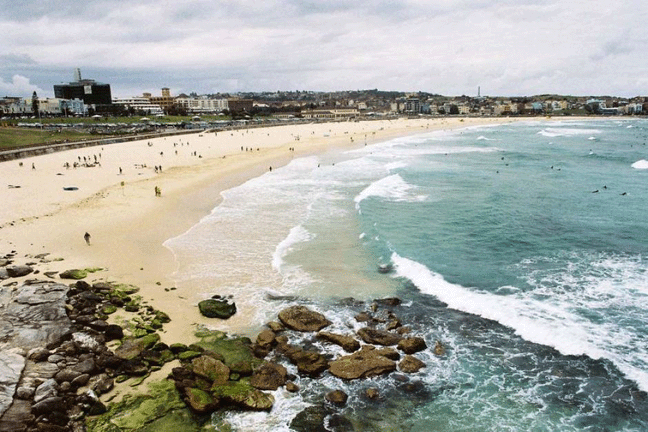
http://www.examiner.com.au/story/5273210/beach-culture-a-casualty-of-changing-climate/?cs=97 Dr David Rissik , 11 Mar 18,
Beaches are important for most Australians. Not only are they an escape for many during the summer, but they’re also the heart of our nation’s tourism industry.
With rising seas beaches and foreshores could be lost, and without beaches to attract tourists, local surf clubs and restaurants may lose their primary source of income.
In some areas houses could be flooded frequently and others undermined through beach erosion, leaving residents to either re-locate or cough up huge financial costs.
Ecosystems will also be impacted as creatures and environments struggle to cope with changing tides and warmer waters.
The impacts are known so well, yet there continues to be development in inappropriate areas, putting homes, lives and businesses at risk.
Some councils and governments are starting to assess the impacts climate change may have, but others have not even considered the risks.
So now, it’s up to businesses, industry, and communities to get the ball rolling.
Raising this issue at work, council meetings or creating awareness groups are great ways to inspire action.
There are many resources that can help you learn more and get started. The National Climate Change Adaptation Research Facility’s (NCCARF) CoastAdapt provides information about climate change on the coast and how we can respond.
But unless we begin to seriously address the risks of climate change, our coastal and beach lifestyle may change forever.
Dr David Rissik is an adjunct Professor with National Climate Change Adaptation Research Facility (NCCARF).
Global weapons corporations lavish gifts on Australia’s top Defence personnel
 Spoils of war? Weapons industry heavyweights wine and dine Defence top brass, Canberra Times Michael Inman, Steven Trask, Markus Mannheim , 9 Mar 18
Weapons industry heavyweights were among companies that lavished almost half a million dollars’ worth of hospitality and gifts on Australian Defence executives and top military personnel.
Government records show sovereign nations, arms manufacturers and private businesses furnished Defence staff with about $490,000 worth of gifts, sponsorships and hospitality in the past four years.
Defence staff are required to register the acceptance or soliciting of gifts, hospitality and sponsorship. The information is kept in a central ledger, which is not published publicly but was made available under freedom of information law.
Six of the world’s largest weapons manufacturers are listed on the register: Lockheed Martin, Boeing, Northrop Grumman, Airbus, Thales and BAE Systems.
Among the declarations on the register were $117,821 worth of gifts, received from 2014 to 2017. ……. The Defence Department also logged more than $34,000 worth of hospitality. http://www.canberratimes.com.au/act-news/spoils-of-war-weapons-industry-heavyweights-wine-and-dine-defence-top-brass-20180307-h0x5h7.html
Bad news for Australia’s uranium industry – India aims to stop importing uranium
World Nuclear News 8th March 2018, India is planning a tenfold increase in uranium production over the next 15 years, Minister of State Jitendra Singh told the country’s parliament
yesterday. State company Uranium Corporation of India Ltd (UCIL) has
outlined expansion plans to meet the Department of Atomic Energy’s (DAE)
vision of achieving self-sufficiency in uranium production.
http://www.world-nuclear-news.org/UF-India-plans-tenfold-uranium-output-growth-0803187.html
1 This month



Help Aunty Sue Protect Her Land and Sacred Sites From Destructive Rocket Testing.
.

Australians deserve the truth
about
AUKUS – https://aukuspublicinquiry.com/

PETITION – To: Prime Minister Anthony Albanese and the Australian Labor Government

of the week – Australians for War Powers Reform (AWPR)
To see nuclear-related stories in greater depth and intensity

