“Broad community support” for a nuclear waste dump near Kimba should mean a national referendum
Steve Dale Nuclear Fuel Cycle Watch South Australia “The federal government has said that it will not choose any site without broad community support.” A statewide referendum is required for that – and maybe a national referendum to ask if Australian’s would prefer to find alternatives to its radioactive waste spewing reactor. https://www.facebook.com/groups/1021186047913052/
Traditional Owners opposing Adani hold smoking ceremony at QLD Parl, call on Premier not to extinguish native title
8 March 2018
‘At a smoking ceremony outside Queensland Parliament today the Wangan & Jagalingou Family Council
called on the Queensland government to rule out extinguishing W&J Native Title for Adani,
the week before a crucial Wangan & Jagalingou Council’s Federal Court case commences.
High quality stills and vision can be made available.
‘Spokesperson Adrian Burragubba said,
“The Queensland Government has the power to extinguish our Native Title,
but they don’t have to go down this path.
Premier Palaszczuk should rule out ever extinguishing our native title for Adani.
‘“We are demanding a meeting with the Premier to explain why there is
no consent from us for Adani’s dirty land deal,
why the Queensland Government should remove its support for the Adani’s sham ILUA,
stop opposing W&J Traditional Owners in the courts
and not extinguish our native title.
‘“Adani’s destructive mine has no part in our future and would tear the heart out of our ancestral lands.
Premier Palaszczuk must pledge to not extinguish our native title for a deal with Adani. [1]
‘“We are determined to prevent our land being taken without our consent
and to protect our country and sacred places from destruction,
for an empty promise of jobs and some trinkets.
‘“We have never given consent to this mine or the surrender of our land rights
and have voted to reject a deal with Adani four times since 2012.
We will not rest until this destructive proposal is abandoned..
‘“A clear majority of Queenslanders are with us and
do not support the government pushing ahead with Adani’s mine
without the consent of Traditional Owners. [2] … ‘
wanganjagalingou.com.au/traditional-owners-opposing-adani-hold-smoking-ceremony-at-qld-parl-call-on-premier-not-to-extinguish-native-title/
wanganjagalingou.com.au/category/latest-news/
New York Times buys into ANSTO’s nuclear spin about Kimba?

This New York Times author gives a fair coverage to the Kimba radioactive waste dump issue. But it’s misleading in 3 important ways, as if the author completely buys the nuclear lobby’s propaganda.:
- States that “The country has no nuclear power plants.” But fails to mention the Lucas Heights nuclear reactor [which is the source of the really important radioactive trash for Kimba]
- Fails to mention the fact that South Australia has a clear law prohibiting establishment of any nuclear waste facility
- Seems unaware of the huge distances (2000 km) involved, which would mean that the vast majority of medical wastes would no longer be radioactive, in transport from the main points of production and use.
A Farming Town Divided: Do We Want a Nuclear Site that Brings Jobs?, NYT, By MARCH 7, 2018 “……… Now, as the federal government considers whether to build the site on one of these two farms in Kimba, this community of about 650 people finds itself divided and angry. The prospect of jobs and subsidies that the site would bring has split locals between those who want to preserve rural Australia’s way of life and those who say the glory days of farming are over…..
Despite the distances, locals say Kimba always had a strong sense of community, at least until the nuclear site was proposed. Some said the allure of millions of dollars’ worth of grants and subsidies that the government was offering the host community had blinded people to the risks.
Protesters unite against nuclear waste in Port Augusta
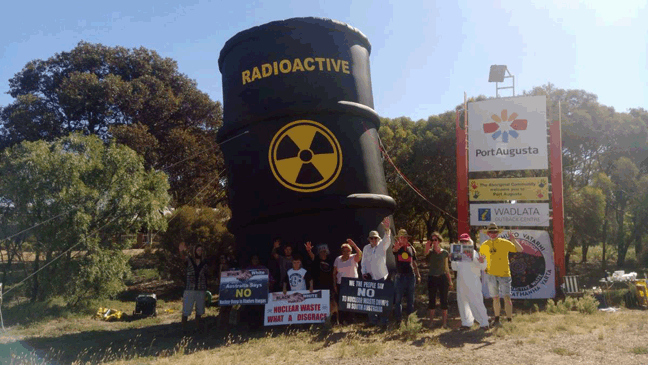
https://www.transcontinental.com.au/story/5271501/protesters-unite-against-nuclear/ Marco Balsamo
Members of the Flinders Local Action Group (FLAG) stood side-by-side with Adelaide-based group Don’t Dump on SA in Port Augusta to protest against a potential radioactive waste facility in South Australia.
The two groups, together with local Adnyamathanha and Barngarla people, joined forces on the Princes Highway ahead of the state election, highlighting their concerns to locals and passing traffic with signs and information packs.
The protesters also encouraged locals to get involved by sending submissions to the Senate Inquiry into the selection process for a national radioactive waste management facility.
FLAG member and Hawker general practitioner Dr Susi Andersson said the broader community needed to know about the issue.
“The federal government is treating this as an issue for the local people only, but many people visit and care about the Flinders Ranges and don’t want a dump there,” Dr Andersson said.
-
Parliament passed the Nuclear Waste Facility (Prohibition) Act 2000 in order to “protect the safety and welfare of the people of South Australia” and the protesters encouraged locals to vote for parties who would defend this legislation.
The Greens scored a five-star rating in a scoreboard conducted by an alliance of environment and community organisations across the state.
The scoreboard was based on responses to a survey sent to the leaders of the state’s five parties, rating them on their commitment to stopping climate pollution, ramping up clean energy and protecting nature.
SA Best scored second-best with a three-star rating, while Labor scored two stars followed by Liberal with 1.5 stars.
The Australian Conservatives, who recently backed a nuclear waste facility in SA, did not respond to the survey.
Minerals Council lobbies for changes to native title laws
The Minerals Council of Australia is lobbying the federal government for urgent changes to native title laws which they say will remove uncertainty over the status of mining leases and tenements following recent court cases.
In a submission to the Attorney-General’s Department consultation on changes to the Native Title Act, the council said legal validation was needed for a series of agreements used for granting mining and exploration rights over land subject to……. (subscribers only) http://www.afr.com/news/minerals-council-lobbies-for-changes-to-native-title-laws-20180308-h0x740#ixzz59CmmR5PN
Best way to make submissions to the Senate Inquiry on Nuclear Waste Dumping
 There have been rumours that Senate Inquiry submissions are limited to 5-6 pages. This is not the case, if your submission is longer than 5 pages you need to provide a summary at the front of your submission. See suggestions below:
The best submissions:
- clearly address some or all of the terms of reference—you do not need to address each one
- are relevant and highlight your own perspective
- are concise, generally no longer than four to five pages
- begin with a short introduction about yourself or the organisation you represent
- emphasise the key points so that they are clear
- outline not only what the issues are but how problems can be addressed, as the committee looks to submissions for ideas to make recommendations
- only include documents that directly relate to your key points
- only include information you would be happy to see published on the internet.
Submissions that include complex argument, personal details or criticise someone may take the committee longer to process and consider.
https://www.aph.gov.au/Parliamentary_Business/Committees/Senate/How_to_make_a_submission
| Is your submission long? Have you provided a summary of your submission at the front? | |
| Have you provided your return address and contact details with the submission? | |
| Have you made sure that your personal contact details are not in the main part of the submission? | |
| If you do not want your submission published on the internet, have you made this clear on the front of your submission and told us why? |
Please read the terms of reference carefully before making your submission. The committee has resolved that it will only accept submissions strictly addressing its terms of reference, with a particular focus on the appropriateness and thoroughness of the site selection process for a national radioactive waste storage facility.
Submissions close on 3 April 2018.
https://www.aph.gov.au/Parliamentary_Business/Committees/Senate/Economics/Wastemanagementfacility
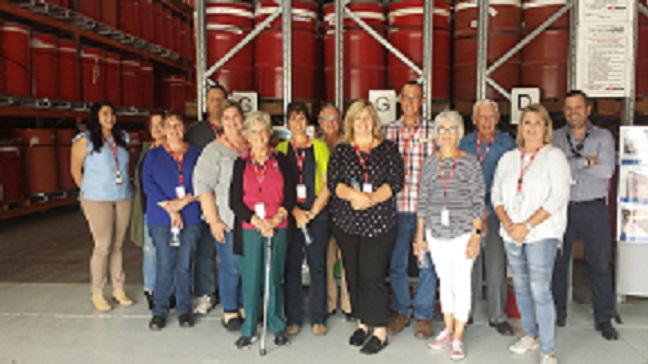
ANSTO spin and lies : Kimba nuclear fans shouted a visit to Lucas Heights
“Australia does not produce any high level waste.” [???] said Bruce McCleary, the General Manager of the National Radioactive Waste 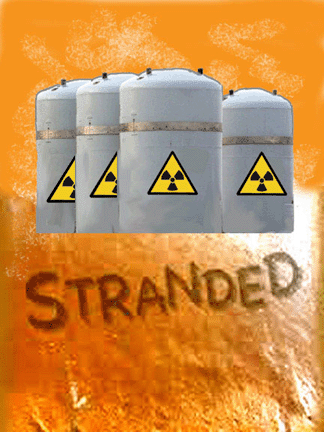 Management Taskforce
[He also did not mention that these wastes for Kimba will be temporary, i.e. STRANDED WASTES]
ANational Radioactive Waste Management Facility:
Kimba locals welcomed to Australia’s nuclear facility Eleven members of the Kimba community were on site at Lucas Heights yesterday, to see first-hand Australia’s nuclear technology and radioactive waste management expertise.
The delegation to the Australian Nuclear Science and Technology Organisation (ANSTO) included people with a variety of views on Kimba hosting the National Radioactive Waste Management Facility.
It included four neighbours of the two volunteered sites in Kimba, and three members of the Kimba Consultative Committee (KCC), as well as other interested community members.
Patricia Beinke saw the OPAL multi-purpose reactor, where ANSTO stores low and intermediate level radioactive waste, and how waste is prepared for transportation.
“It was a much bigger campus and complex than I had ever envisaged. I read all the information that comes my way, but wasn’t expecting this scale,” Mrs Beinke, who is a member of the KCC, said.
“I just found the trip so good. The scientists and engineers spoke on a level that everyone could understand.
“I saw the reactor, and we had a great discussion about how the waste is prepared for transportation, including the processes it would go through before being sent to a national facility.”
Austen Eatts has property that neighbours one of the volunteered sites, and is opposed to the facility, but was pleased to have seen ANSTO’s campus.
“I have always had a reasonable idea of what happens at ANSTO regarding medicine and industry, and what they are doing there is very good actually,” Mr Eatts said.
“The waste has to be put somewhere. I am still of two minds about whether it should be located in Kimba, but I found the trip very informative.”
Mr Eatts stressed that he is against the idea of a facility anywhere in Australia that could store high level, imported waste from overseas – a proposition not being put forward by the Federal Government.
Bruce McCleary is the General Manager of the National Radioactive Waste Management Taskforce, and said it was great to host people with a variety of views on trips such as this.
“Tours of ANSTO’s medicine manufacturing and radioactive waste facilities are a great information tool for communities considering if they want to host a radioactive waste industry,” Mr McCleary said.
“They are also a way of us establishing what questions the community still has, and for them to see and hear from experts who work with this material every day, first-hand.
“I can confirm for Mr Eatts – and anyone else who shares his concern – that the national facility will not hold international or high level waste, because it is for Australian waste only, and Australia does not produce any high level waste. [????]
“Our national facility needs 100-hectares for an above ground low-level waste disposal and temporary storage of intermediate-level waste, whereas an international high-level facility would need to be far larger and would require a deep underground facility in order to be safe and economically viable.”
For more project information: www.radioactivewaste.gov.au
“In Denial” – the so-called environmentalists who promote nuclear power.
Pro-nuclear environmentalists’ in denial about power/weapons connections, Energy Post by Jim Green
Claims by self-styled ‘pro-nuclear environmentalists’ that “nuclear energy prevents the spread of nuclear weapons” and “peace is furthered when a nation embraces nuclear power” do not withstand scrutiny, writes Jim Green, editor of the Nuclear Monitor newsletter. Green looks at the conclusions of some studies which, he says, downplay the troubling connections between nuclear power and weapons. Courtesy Nuclear Monitor.
As discussed previously in Energy Post, nuclear industry bodies (such as the US Nuclear Energy Institute) and supporters (such as former US energy secretary Ernest Moniz) are openly acknowledging the connections between nuclear power and weapons ‒ connections they have denied for decades. Those connections are evident in most of the weapons states, in numerous countries that have pursued but not built weapons, and in potential future weapons states such as Saudi Arabia.
Ideally, acknowledgement of power/weapons connections would lead to redoubled efforts to build a firewall between civilian and military nuclear programs ‒ strengthened safeguards, curbs on enrichment and reprocessing, and so on.
But that’s not how this debate in playing out. Industry insiders and supporters drawing attention to the connections are quite comfortable about them ‒ they just want increased subsidies and support for their ailing civilian nuclear industries and argue that ‘national security’ and ‘national defense’ will be undermined if that support is not forthcoming.
Some continue to deny the power/weapons connections even though the connections are plain for all to see and are now being acknowledged by a growing number of nuclear insiders and supporters. The most prominent of these are self-styled ‘pro-nuclear environmentalists’.
 One such person is Ben Heard from the Australian pro-nuclear lobby group ‘Bright New World‘. Heard claims that nuclear power promotes peace and uses the two Koreas to illustrate his argument: “The South is a user and exporter of nuclear power, signatory to the non-proliferation treaty, and possesses zero nuclear warheads. The North has zero nuclear power reactors, is not a signatory to the non-proliferation treaty, and is developing and testing nuclear weapons.”
Likewise, Michael Shellenberger, founder of the U.S. pro-nuclear lobby group ‘Environmental Progress’, claims that: “One of [Friends of the Earth]-Greenpeace’s biggest lies about nuclear energy is that it leads to weapons. Korea demonstrates that the opposite is true: North Korea has a nuclear bomb and no nuclear energy, while South Korea has nuclear energy and no bomb.”
Heard and Shellenberger ignore the fact that North Korea uses what is calls an ‘experimental power reactor’ (based on the UK Magnox power reactor design) to produce plutonium for weapons. They ignore the fact that North Korea acquired enrichment technology from Pakistan’s A.Q. Khan network, who stole the blueprints from URENCO, the consortium that provides enrichment services for the nuclear power industry. They ignore the fact that North Korea’s reprocessing plant is based on the design of the Eurochemic plant in Belgium, which provided reprocessing services for the nuclear power industry.
Heard and Shellenberger also ignore South Korea’s history of covertly pursuing nuclear weapons, a history entwined with the country’s development of nuclear power. For example, the nuclear power program provided (and still provides) a rationale for South Korea’s pursuit of reprocessing technology.
Nicholas Miller’s article in International Security
Echoing Shellenberger’s claim that “nuclear energy prevents the spread of nuclear weapons”, Heard writes: “Peace is furthered when a nation embraces nuclear power, because it makes that nation empirically less likely to embark on a nuclear weapons program. That is the finding of a 2017 study published in the peer-reviewed journal International Security.” However, the claim isn’t true, and it isn’t supported by the International Security journal article, written by Nicholas Miller from Dartmouth College.
“The annual probability of starting a weapons program is more than twice as high in countries with nuclear energy programs, if one defines an energy program as having an operating power reactor or one under construction” ………..
All the logistic regression models in the world don’t alter the fact that nuclear power/weapons connections are multifaceted, repeatedly demonstrated, disturbing and dangerous:
- Nuclear power programs were involved in the successful pursuit of weapons in four countries (France, India, Pakistan, South Africa) according to Miller (and India and North Korea could be added to that list) and have provided many other countries with a latent weapons capability.
- Power programs have provided ongoing support for weapons programs to a greater or lesser degree in seven of the nine current weapons states (the exceptions being Israel and North Korea).
- The direct use of power reactors to produce plutonium for weapons in all or all-but-one of the declared weapons states (and possibly other countries, e.g. India and Pakistan).
- The use of power reactors to produce tritium for weapons in the US (and possibly other countries, e.g. India).
- Power programs (or real or feigned interest in nuclear power) legitimising enrichment and reprocessing programs that have fed proliferation.
- Power programs (or real or feigned interest in nuclear power) legitimising research (reactor) programs which can lead (and have led) to weapons proliferation.
- And last but not least, the training of experts for nuclear power programs whose expertise can be (and has been) used in weapons programs…….. https://energypost.eu/pro-nuclear-environmentalists-in-denial-about-power-weapons-connections/
Which South Australian parties have the guts to say NO to the Federal nuclear waste dump plan? – theme for March 18
 Is there some reason why the greedy nuclear lobby, the secretive agency ANSTO, and the weak Australian government all seem to think that it’s OK to transport nuclear reactor trash for thousands of km across the land, and dump it on agricultural land in South Australia?
Is it because they’ve decided that South Australia is already radioactively trashed, because the Australian government allowed the British to test 12 major nuclear weapons and hundreds of “minor” ones on Maralinga, S.A.?
It is some sort of weird payback because this State never had convicts dumped on them – so the dominant Eastern States want to put the South Australians in their place?
South Australia is a beautiful place. It has never generated nuclear trash. Let the nuclear trash be kept, (as international conventions and best practice dictate) near to the point of production – AT LUCAS HEIGHTS in Sydney. And then let Australia come to its senses and stop making the foul stuff.
This is NOT a “Kimba” issue, not just a regional issue, – it’s certainly a STATE issue, and a NATIONAL issue.
Aware citizens in Australia are waiting to see if the South Australian Labor Party, Liberal Party, SA Best Party have the guts to join the Greens in saying NO to the Federal nuclear waste dump plan.
South Australia election: Greens OPPOSE, SA Best nearly oppose, nuclear waste dump in SA: Labor and Liberal vacillate
 “SA Best is pleased to provide the following response to … :
level radioactive waste storage and disposal facility
Yes
Refer to SA-BEST environment policy.
11c. Actively support the state Nuclear Waste Storage Facility (Prohibition) Act 2000.
Commit to further strengthen this legislation by removing the modified section
level radioactive waste storage and disposal facility
Yes
Commit to further strengthen this legislation by removing the modified section
 Note: The Liberal response (as published) does not provide an answer to Q 11b:
“The Greens have made the following commitments in response to … :
 11a Categorically rule out the creation of an international high and/or intermediate
level radioactive waste storage and disposal facility
Yes
Commit to further strengthen this legislation by removing the modified section
 Labor: “Thanks for opportunity to outline our position. A detailed response to your questions is attached:
level radioactive waste storage and disposal facility more https://www.ourfuturesa.org.au/scorecard

Nuclear Waste issue highlighted in Port Augusta ahead of state election
 Mara Bonacci, 5 March 2018 On Saturday 3rd March, members of Adelaide-based group Don’t Dump on SA joined Adnyamathanha and Barngarla people and members of the Flinders Local Action Group (FLAG) on the Princes Highway in Port Augusta to highlight concerns over the Federal government’s plan to site a radioactive waste facility in South Australia.
The lively and colourful event involved a giant inflatable radioactive waste barrel, music, free cuppas and a lime green three-headed kangaroo. It received a positive response and lots of encouragement from locals and passing traffic.
Locals who stopped for a chat were given showbag-style information packs and encouraged to send a submission to the federal Senate Inquiry into the selection process for a national radioactive waste management facility in South Australia. An online submission template can be found athttps://nowastedump.good.do/wastedumpsenateinquiry/submission/.
Barngarla woman Linda Dare said “We’re here today to tell people that we don’t want a radioactive waste facility in South Australia. We want people to support us in the fight to stop it”.
FLAG member and Hawker GP, Dr Susi Andersson, said “The federal government is treating this as an issue for the local people only, but many people visit and care about the Flinders Ranges and don’t want a dump there. I feel the broader community need to know about and discuss this issue”.
In response to earlier federal moves to dump radioactive waste in SA our Parliament passed the Nuclear Waste Facility (Prohibition) Act 2000. The objects of this Act are “to protect the health, safety and welfare of the people of South Australia and to protect the environment in which they live by prohibiting the establishment of certain nuclear waste storage facilities in this state.”
In the lead up to the state election on 17 March, people concerned about the imposition of a nuclear waste facility in SA are being encouraged to vote for parties who will defend this legislation. Information can be found at https://www.ourfuturesa.org.au/scorecard.
The hypocrisy of Ben Heard on nuclear weapons proliferation
 Jim Green shared a link. Nuclear Fuel Cycle Watch South , 4 Feb 18 Australia Ben Heard – the paid nuclear lobbyist whose so-called environment group ‘Bright New World’ accepts secret corporate donations – claims that “Peace is furthered when a nation embraces nuclear power, because it makes that nation empirically less likely to embark on a nuclear weapons program. That is the finding of a 2017 study published in the peer-
 reviewed journal International Security.”
That’s false twice over. Firstly, it isn’t true. Secondly, Heard’s assertion isn’t supported by the International Security journal article, written by Nicholas Miller from Dartmouth College.
Miller’s article downplays the power/weapons connections but much of the information in his article undermines his own argument. In Miller’s own words, “more countries pursued nuclear weapons in the presence of a nuclear energy program than without one”, “the annual probability of starting a weapons program is more than twice as high in countries with nuclear energy programs, if one defines an energy program as having an operating power reactor or one under construction”, and countries that pursued nuclear weapons while they had a nuclear energy program were “marginally more likely” to acquire nuclear weapons (almost twice as likely if North Korea is considered to have had a nuclear energy program while it pursued weapons).
Nuclear power/weapons connections are multifaceted, repeatedly demonstrated, disturbing and dangerous:
• Nuclear power programs were involved in the successful pursuit of weapons in four countries (France, India, Pakistan, South Africa) according to Miller (and India and North Korea could be added to that list) and have provided many other countries with a latent weapons capability.
• Power programs have provided ongoing support for weapons programs to a greater or lesser degree in seven of the nine current weapons states (the exceptions being Israel and North Korea).
• The direct use of power reactors to produce plutonium for weapons in all or all-but-one of the declared weapons states (and possibly other countries, e.g. India and Pakistan).
• The use of power reactors to produce tritium for weapons in the US (and possibly other countries, e.g. India).
• Power programs (or real or feigned interest in nuclear power) legitimising enrichment and reprocessing programs that have fed proliferation.
• Power programs (or real or feigned interest in nuclear power) legitimising research (reactor) programs which can lead (and have led) to weapons proliferation.
• And last but not least, the training of experts for nuclear power programs whose expertise can be (and has been) used in weapons programs.
So why does Heard claim that “when a nation embraces nuclear power, because it makes that nation empirically less likely to embark on a nuclear weapons program”? He ignores most of Miller’s article (and Miller himself ignores much that is known about power/weapons connections) and focuses on these findings:
1. The annual probability of starting a weapons program is more than twice as high in countries with an operating power reactor or one under construction (a statistically-significant finding).
2. The annual probability of starting a weapons program is somewhat lower in countries with operating power reactors compared to countries without them (a statistically non-significant finding).
So why does Heard privilege the second of those findings when only the first is statistically significant? Why does Heard privilege the finding that excludes countries with power reactors under construction (but not in operation) when the inclusion of such countries provides a fuller, more accurate assessment of the power/weapons connections? Perhaps Heard’s selectivity is connected to his work as a paid nuclear lobbyist whose so-called environment group accepts secret corporate donations. https://www.facebook.com/groups/1021186047913052/
Federal govt cannot override South Australia law against nuclear waste dump
 Cameron Scott, Submission to ARPANSA on draft Code for Radioactive Waste, 4 Mar 18 It needs to be stated in the Code for Disposal of radioactive Waste that the Federal Government can not override state legislation for building a national facility. The code needs to include a clause protecting farming land from becoming home to hazardous waste. Licensing should require communities to nominate land not individuals.
Call for submissions to the Australian Senate Inquiry about the nuclear waste dump plan
 Conservation Council SA Mara Bonacci, Nuclear Waste Campaigner, 1 Mar 18,
This is welcome.
Conservation Council SA Mara Bonacci, Nuclear Waste Campaigner, 1 Mar 18,
This is welcome.- A single individual or property owner should not be allowed to nominate a site for a nuclear waste dump.
- The federal government have not made a clear or compelling case that we need a national nuclear waste dump in SA.
- The consultation process has been deficient and has caused division in our communities.
- The federal government plan lacks social licence or community consent. Traditional Owners have flagged concerns over cultural heritage issues.
- The project has not considered the full range of options to best advance responsible radioactive waste management in Australia. Australia’s worst waste should be dealt with better.
Xenophon’s SA Best – interesting on renewables, (but what about the planned nuclear waste dump?)
my personal prediction is that this will result in around 90 per cent renewables [in South Australia] by 2030. This is a prediction, not a target.
SA can lead the nation not just on energy generation, but all the manufacturing, construction and jobs that could go with this in areas such as PV panels, components, smart energy, CST mirrors, etc.
 What’s Best for South Australia’s energy policy http://reneweconomy.com.au/whats-best-for-south-australias-energy-policy-28835/, By Graham Davies on 28 February 2018
At a recent energy event in Adelaide where I presented for Nick Xenophon’s SA-BEST, it was encouraging that the Greens, SA-BEST, Labor and Liberal all stated that renewables was the future.
However, the Liberal Party is going to be hamstrung by Turnbull/Abbott and the National Energy Guarantee (a thought bubble to appease the Abbott ilk, masquerading as policy); inaction on climate; and offering a $1 billion loan to Adani. Continue reading
1 This month


Help Aunty Sue Protect Her Land and Sacred Sites From Destructive Rocket Testing.
.

Australians deserve the truth
about
AUKUS – https://aukuspublicinquiry.com/

PETITION – To: Prime Minister Anthony Albanese and the Australian Labor Government

of the week – Australians for War Powers Reform (AWPR)
To see nuclear-related stories in greater depth and intensity

