Julian Assange: Free at last, but guilty of practicing journalism
Pepe Escobar, Strategic Culture Foundation, Wed, 26 Jun 2024, https://www.sott.net/article/492585-Julian-Assange-Free-at-last-but-guilty-of-practicing-journalism
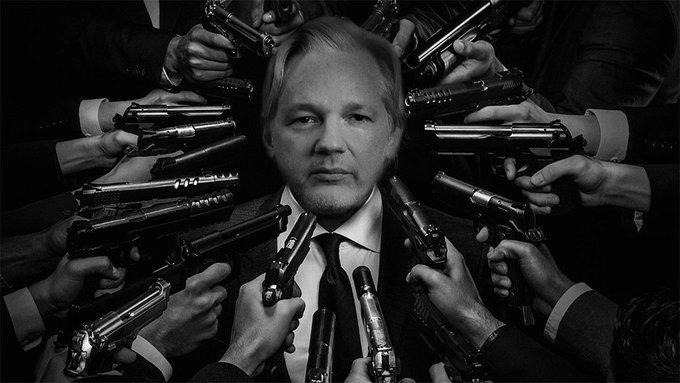
The United States Government (USG) – under the “rules-based international order” – has de facto ruled that Julian Assange is guilty of practicing journalism.
Edward Snowden had already noted that “when exposing a crime is treated as committing a crime, you are being ruled by criminals.”
Criminals such as Mike “We Lie, We Cheat, We Steal” Pompeo, former Trump Secretary of State, who had planned to kidnap and kill Julian when he was head of the CIA.
The indomitable Jennifer Robinson and Julian’s U.S. lawyer Barry Pollack sum it all up: the United States has “pursued journalism as a crime”.
Julian was forced to suffer an unspeakably vicious Via Crucis because he dared to expose USG war crimes; the inner workings of the U.S. military in their rolling thunder War Of Terror (italics mine) in Afghanistan and Iraq; and – Holy of Holies – he dared to release emails showing the Democratic National Committee (DNC) colluded with the notorious warmongering Harpy Hillary Clinton.
Julian was subjected to relentless psychological torture, and nearly crucified for publishing facts that should always remain invisible to public opinion. That’s what top-notch journalism is all about.
The whole drama teaches the whole planet everything one needs to know about the absolute control of the Hegemon over pathetic UK and EU.
And that bring us to the kabuki that may – and the operative word is “may” – be closing the case. Title of the twisted morality play: ‘Plead Guilty or Die in Jail’.
The final twist in the plot line of the morality play runs like this: the combo behind the cadaver in the White House realized that torturing an Australian journalist and publisher in a maximum security U.S. prison in an electoral year was not exactly good for business.
At the same time the British establishment was begging to be excluded from the plot – as its “justice” system was forced by the Hegemon to keep an innocent man and family father hostage for 5 years, in abysmal conditions, in the name of protecting a basket of Anglo-American intel secrets.
In the end, the British establishment quietly applied all the pressure it could muster to run towards the exit – in full knowledge of what the Americans were planning for Julian.
Life in prison was “fair and reasonable”
Cue to the kabuki this Wednesday in Saipan, the largest of the Northern Mariana Islands, unincorporated Pacific land administered by the Hegemon.
Free at last – maybe, but with conditionalities that remain quite murky.
Julian was ordered by this U.S. Court in the Pacific to instruct WikiLeaks to destroy information as a condition of the deal.
Julian had to tell U.S. judge Ramona Manglona that he was not bribed or coerced to plead guilty to the crucial charge of “conspiring to unlawfully obtain and disseminate classified information relating to the national defense of the United States”.
Well, his lawyers told him he had to follow the ‘Plead Guilty or Die in Jail’ script. Otherwise, no deal.
Judge Manglona – in an astonishing brush aside of those 5 years of psychological torture – said, “it appears that your 62 months in prison was fair and reasonable and proportionate.”
So now the – oh, so benign and “fair” – USG will take the necessary steps to immediately erase remaining charges against Julian in the notoriously harsh Eastern District of Virginia.
Julian was always adamant: he stressed over and over again that he would never plead guilty to an espionage charge. He didn’t; he pleaded guilty to a hazy felony/conspiracy charge; was given time served; was set free; and that’s a wrap.
Or is it?
Australia is a Hegemon vassal state, intel included, and with less than zero capability to protect its civilian population.
Moving from the UK to Australia may not be exactly an upgrade – even with freedom included. A real upgrade would be a move to a True Sovereign. Like Russia. Yet Julian will need U.S. authorization to travel and leave Australia.Moscow inevitably will be a sanctioned, off-limits destination.
There’s hardly any question Julian will be back at the helm of WikiLeaks. Whistleblowers may be even lining up as we speak to tell their stories – supported by official documents.
Yet the stark, ominous message remains fully imprinted in the collective unconscious: the ruthless, all-powerful U.S. Intel Apparatus will go no holds barred and take no prisoners to punish anyone, anywhere, who dares to expose imperial crimes. A new global epic starts now: The Fight against Criminalized Journalism.
LABOR AGAINST WAR says nuclear power and nuclear submarines and their wastes should have no part in Australia.

Labor Against War, Marcus Strom , 20 June 2024
ALP Government must be consistent on nuclear energy
Grassroots anti-AUKUS campaign, Labor Against War, joins with the ALP Government in
condemning Liberal leader Peter Dutton’s desperate attempt to reignite the climate wars by
announcing plans for seven nuclear reactors on land sites in Australia.
Nuclear energy should play no part in Australia’s energy mix. Dutton’s distraction is about
extending Australia’s reliance on, and production of, fossil fuels and delaying the urgently
needed transition to renewals. It is not a serious attempt to reduce carbon emissions.
Prime Minister Anthony Albanese has said the policy is a “nuclear fantasy”. We agree. Energy Minister Chris Bowen has said the plans are “too slow, too expensive and too risky for Australia. It’s not a plan, it’s a scam.”
LAW National Convenor Marcus Strom said: “Chris Bowen is spot on, but this assessment equally applies to AUKUS: a dangerous and expensive scam introduced by Scott Morrison. “By continuing with the Morrison nuclear submarine plan, the Albanese Government has unfortunately opened the door to Dutton’s nuclear energy fantasy.
“If nuclear energy is too risky on terra firma, it can’t be safe for our oceans. And AUKUS brings with it the added risk of weapons-grade nuclear waste, nuclear proliferation and a US war with China that is against the interests of the Australian people. “The Government must be consistent: we need to reject nuclear energy on land and at sea.”
Dutton’s reactors will produce nuclear waste for which there is no safe plan for storage. This is the same for the weapons-grade waste that the AUKUS submarines will produce. “And like Dutton’s reactor fantasy, it is still very much up in the air if the AUKUS nuclear submarines will ever arrive,” Mr Strom said.
“The US is way behind its own nuclear submarine manufacturing timetable and by January Donald Trump, a convicted felon, could be back in the White House calling the shots. “In criticising Dutton’s fantasy, the Prime Minister needs to cast out the nuclear beam in his own eye.” Marcus Strom
How the media facilitates Dutton’s nuclear lies
The fault is the media’s also. It entertains the nonsense, repeats it until it is real. It pretends there is debate where there is none. It leans too heavily on conflict. It mistakes credulity for balance.
It is in these false equivalences that Peter Dutton finds his purpose. Here, on these glib plains, he is reinvented as a politician. His lone policy announcement is given the status once reserved for an alternative government.
In journalism, the answer to any question in a headline is almost always no. The hope is that a reader might settle for maybe. The question mark itself bends over in embarrassment.
Last week, the ABC used its leading news podcast to ask: “Could nuclear power really lead to cheaper bills?” Similar questions have been asked across the media. The answer is no, but the headline has already done its work. It has already lent credibility to a fantasy.
According to the latest Lowy polling, two thirds of Australians now support the use of nuclear power. As many as 27 per cent support it strongly. A decade ago the opposite was true: 62 per cent did not want nuclear as part of the energy mix.
The difference is not science. It is mischief. The case for nuclear has not grown stronger. The cost argument has not been won. Uranium has become no safer or less finite. All that has changed is the desperateness of the Coalition and the fecklessness of the press.
Peter Dutton cannot name the experts who advised on his policy. This is most likely because they do not exist. Imaginary reactors are the preserve of imaginary scientists. The policy is not costed and relies on developments that are presently illegal.
Findings from the Australian Energy Market Operator, published this week, make clear that the power grid would fail before even the most optimistic projections of when these reactors might be operational. They are not a solution. They are a distraction.
Cost is another lie. The Commonwealth Scientific and Industrial Research Organisation notes that nuclear power is twice as expensive to produce as renewables. These figures don’t allow for blowouts in construction and time, which are almost inevitable. If everything went right, the answer would still be wrong.
Dutton knows all this. So does the media that asks fallaciously if nuclear power could lead to cheaper bills. They have conspired to solve a problem that exists now with a solution that is never coming.
There is little enough being debated that this is taking up all the space. It is interrupting the inevitable shift to renewables. That is its sole intention.
Once again investment is being slowed. Once again the obvious is being treated as uncertain. This is played out as if it were a game, but it is not: the world is being pushed closer to catastrophe.
No wonder the question marks cower in their headlines, ashamed of their role in this whole sordid scam.
This article was first published in the print edition of The Saturday Paper on June 29, 2024 as “The nuclear question mark”.
Nuclear option ‘not enough’ to avoid rush for more wind and solar

SMH, By Nick Toscano, June 29, 2024
A massive expansion of renewable energy will still be key to driving Australia’s transition away from coal and reaching net-zero emissions by 2050, new modelling shows, even if the Coalition wins the next election and implements a plan to deploy nuclear reactors across the country.
Opposition Leader Peter Dutton rekindled Australia’s climate wars this month, vowing to abandon the government’s target for renewable energy to account for 82 per cent of the grid by 2030, and instead pushing to build seven nuclear generators to achieve the longer-term ambition of reaching net-zero emissions by 2050.
However, modelling from research group Bloomberg New Energy Finance raises questions about how beneficial it would be for Australia to adopt nuclear energy at a time when it faces an imminent wave of more coal-fired power station closures and significant power demand growth driven by electrification and decarbonisation.
Assuming the Coalition’s seven proposed nuclear reactors add 7 gigawatts of nuclear power capacity by 2050, the rollout would reduce the necessary build-out of solar farms by only up to 7 per cent and wind farms by 12 per cent, the analysis found.
Even doubling that to 14 gigawatts, nuclear was found to have a limited role in avoiding the need to hasten the shift to large-scale renewables and to build far more power lines to connect them to the grid and major cities, it said…………………………………………………………………….
n its 25-year road map released this week, AEMO says Australia’s best and lowest-cost pathway through the transition is to build a grid dominated by renewable energy, firmed by grid-scale batteries and backed up by gas-powered generators.
AEMO did not assess the costs of nuclear energy because nuclear energy is banned under federal law. But it said nuclear “is one of the most expensive ways to generate electricity” and it said building the plants “would be too slow to replace retiring coal-fired generation”.
Energy Minister Chris Bowen said the BloombergNEF report was “another example of experts confirming nuclear was too slow, too expensive and too risky for Australia”. https://www.smh.com.au/business/the-economy/nuclear-option-not-enough-to-avoid-rush-for-more-wind-and-solar-20240628-p5jpjk.html
Julian Assange is finally free, but no thanks to the media

The establishment media acted as a willing tool in the demonising narrative the US and British governments carefully crafted against Assange.
The smears might not have stuck so well had they been thrown only by the rightwing tabloids. But life was breathed into these claims from their endless repetition by journalists supposedly on the other side of the aisle, particularly at the Guardian.
In this case, it was Assange. But the same media machine was rolled out against former Labour leader Jeremy Corbyn, another thorn in the establishment’s side. And as with Assange, the Guardian and the BBC were the two outlets that were most useful in making the smears stick.
JONATHAN COOK, 26 JUNE 2024 DeClassified UK
It was the media, led by the Guardian, that kept Assange behind bars. Their villainy will soon be erased because they write the script about what’s going on in the world.
“………………………………………………………………….Everything Assange had warned the US wanted to do to him was proved correct over the next five years, [from 2017] as he languished in Belmarsh entirely cut off from the outside world.
No one in our political or media class appeared to notice, or could afford to admit, that events were playing out exactly as the founder of Wikileaks had for so many years predicted they would – and for which he was, at the time, so roundly ridiculed.
Nor was that same political-media class prepared to factor in other vital context showing that the US was not trying to enforce some kind of legal process, but that the extradition case against Assange was entirely about wreaking vengeance – and making an example of the Wikileaks founder to deter others from following him in shedding light on US state crimes.
That included revelations that, true to form, the CIA, which was exposed as a rogue foreign intelligence agency in 250,000 embassy cables published by Wikileaks in 2010, had variously plotted to assassinate him or kidnap him off the streets of London.
Other evidence came to light that the CIA had been carrying out extensive spying operations on the embassy, recording Assange’s every move, including his meetings with his doctors and lawyers.
That fact alone should have seen the US case thrown out by the British courts. But the UK judiciary was looking over its shoulder, towards Washington, far more than it was abiding by its own statute books.
Media no watchdog
Western governments, politicians, the judiciary, and the media all failed Assange. Or rather, they did what they are actually there to do: keep the rabble – that is, you and me – from knowing what they are really up to.
Their job is to build narratives suggesting that they know best, that we must trust them, that their crimes, such as those they are supporting right now in Gaza, are actually not what they look like, but are, in fact, efforts in very difficult circumstances to uphold the moral order, to protect civilisation.
For this reason, there is a special need to identify the critical role played by the media in keeping Assange locked up for so long.
The truth is, with a properly adversarial media playing the role it declares for itself, as a watchdog on power, Assange could never have been disappeared for so long. He would have been freed years ago. It was the media that kept him behind bars.
The establishment media acted as a willing tool in the demonising narrative the US and British governments carefully crafted against Assange.
Even now, as he is reunited with his family, the BBC and others are peddling the same long-discredited lies.
Those include the constantly repeated claim by journalists that he faced “rape charges” in Sweden that were supposedly dropped. Here is the BBC making this error once again in its reporting this week.
In fact, Assange never faced more than a “preliminary investigation”, one the Swedish prosecutors repeatedly dropped for lack of evidence. The investigation, we now know, was revived and sustained for so long not because of Sweden but chiefly because the UK’s Crown Prosecution Service, then led by Sir Keir Starmer (now the leader of the Labour party), insisted on it dragging on.
Starmer made repeated trips to Washington during this period, when the US was trying to find a pretext to lock Assange away for political crimes, not sexual ones. But as happened so often in the Assange case, all the records of those meetings were destroyed by the British authorities.
The media’s other favourite deception – still being promoted – is the claim that Wikileaks’ releases put US informants in danger.
That is utter nonsense, as any journalist who has spent even a cursory amount of time studying the background to the case knows.
More than a decade ago, the Pentagon set up a review to identify any US agents killed or harmed as a result of the leaks. They did so precisely to help soften up public opinion against Assange.
And yet a team of 120 counter-intelligence officers could not find a single such case, as the head of the team, Brigadier-General Robert Carr, conceded in court in 2013.
Despite having a newsroom stuffed with hundreds of correspondents, including those claiming to specialise in defence, security and disinformation, the BBC still cannot get this basic fact about the case right.
That’s not an accident. It’s what happens when journalists allow themselves to be spoon-fed information from those they are supposedly watching over. That is what happens when journalists and intelligence officials live in a permanent, incestuous relationship.
Character assassination
But it is not just these glaring reporting failures that kept Assange confined to his small cell in Belmarsh. It was that the entire media acted in concert in his character assassination, making it not only acceptable but respectable to hate him.
It was impossible to post on social media about the Assange case without dozens of interlocutors popping up to tell you how deeply unpleasant he was, how much of a narcissist, how he had abused his cat or smeared his walls in the embassy with faeces. None of these individuals, of course, had ever met him.
It also never occurred to such people that, even were all of this true, it would still not have excused stripping Assange of his basic legal rights, as all too clearly happened. And even more so, it could not possibly justify eroding the public-interest duty of journalists to expose state crimes.
What was ultimately at stake in the protracted extradition hearings was the US government’s determination to equate investigative national-security journalism with “espionage”. Whether Assange was a narcissist had precisely no bearing on that matter.
Why were so many people persuaded Assange’s supposed character flaws were crucially important to the case? Because the establishment media – our supposed arbiters of truth – were agreed on the matter.
The smears might not have stuck so well had they been thrown only by the rightwing tabloids. But life was breathed into these claims from their endless repetition by journalists supposedly on the other side of the aisle, particularly at the Guardian.
Liberals and left-wingers were exposed to a steady flow of articles and tweets belittling Assange and his desperate, lonely struggle against the world’s sole superpower for the right not to be locked away for the rest of his life for doing journalism.
The Guardian – which had benefited by initially allying with Wikileaks in publishing its revelations – showed him precisely zero solidarity when the US establishment came knocking, determined to destroy the Wikileaks platform, and its founder, for making those revelations possible.
For the record, so we do not forget how Assange was kept confined for so long, these are a few examples of how the Guardian made him – and not the law-breaking US security state – the villain.
Marina Hyde in the Guardian in February 2016 – four years into his captivity in the embassy – casually dismissed as “gullible” the concerns of a United Nations panel of world-renowned legal experts that Assange was being “arbitrarily detained” because Washington had refused to issue guarantees that it would not seek his extradition for political crimes.
Long-time BBC legal affairs correspondent Joshua Rozenberg was given space in the Guardian on the same day to get it so wrong in claiming Assange was simply “hiding away” in the embassy, under no threat of extradition (Note: Though his analytic grasp of the case has proven feeble, the BBC allowed him to opine further this week on the Assange case).
Two years later, the Guardian was still peddling the same line that, despite the UK spending many millions ringing the embassy with police officers to prevent Assange from “fleeing justice”, it was only “pride” that kept him detained in the embassy.
Or how about this one from Hadley Freeman, published by the Guardian in 2019, just as Assange was being disappeared for the next five years into the nearest Britain has to a gulag, on the “intense happiness” she presumed the embassy’s cleaning staff must be feeling.
Anyone who didn’t understand quite how personally hostile so many Guardian writers were to Assange needs to examine their tweets, where they felt freer to take the gloves off. Hyde described him as “possibly even the biggest arsehole in Knightsbridge” while Suzanne Moore said he was “the most massive turd.”
The constant demeaning of Assange and the sneering at his plight was not confined to the Guardian’s opinion pages. The paper even colluded in a false report – presumably supplied by the intelligence services, but easily disproved – designed to antagonise the paper’s readers by smearing him as a stooge of Donald Trump and the Russians.
This notorious news hoax – falsely claiming that in 2018 Assange repeatedly met with a Trump aide and “unnamed Russians”, unrecorded by any of the dozens of CCTV cameras surveilling ever approach to the embassy – is still on the Guardian’s website.
This campaign of demonisation smoothed the path to Assange being dragged by British police out of the embassy in early 2019.
It also, helpfully, kept the Guardian out of the spotlight. For it was errors made by the newspaper, not Assange, that led to the supposed “crime” at the heart of the US extradition case – that Wikileaks had hurriedly released a cache of files unredacted – as I have explained in detail before.
Too little too late
The establishment media that collaborated with Assange 14 years ago in publishing the revelations of US and UK state crimes only began to tentatively change its tune in late 2022 – more than a decade too late.
That was when five of his former media partners issued a joint letter to the Biden administration saying that it should “end its prosecution of Julian Assange for publishing secrets”.
But even as he was released this week, the BBC was still continuing the drip-drip of character assassination. A proper BBC headline, were it not simply a stenographer for the British government, might read: “Tony Blair: Multi-millionaire or war criminal?”
For while the establishment media has busily fixed our gaze on the supposed character flaws of Assange, it has kept our attention away from the true villains, those who committed the crimes he exposed: Blair, George W Bush, Dick Cheney and many more.
We need to recognise a pattern here. When the facts cannot be disputed, the establishment has to shoot the messenger.
In this case, it was Assange. But the same media machine was rolled out against former Labour leader Jeremy Corbyn, another thorn in the establishment’s side. And as with Assange, the Guardian and the BBC were the two outlets that were most useful in making the smears stick.
Sadly, to secure his freedom, Assange was compelled to make a deal pleading guilty to one of the charges levelled against him under the Espionage Act.
Highlighting the enduring bad faith of the Guardian, the same paper that so readily ridiculed Assange’s years of detention to avoid being locked away in a US super-max jail, ran an article this week, as Assange was released, stressing the “dangerous precedent” for journalism set by his plea deal.
Washington’s treatment of Assange was always designed to send a chilling message to investigative journalists that, while it is fine to expose the crimes of Official Enemies, the same standards must never be applied to the US empire itself.
How is it possible that the Guardian is learning that only now, after failing to grasp that lesson earlier, when it mattered, during Assange’s long years of political persecution?
The even sadder truth is that the media’s villainous role in keeping Assange locked up will soon be erased from the record. That is because the media are the ones writing the script we tell ourselves about what is going on in the world.
They will quickly paint themselves as saints, not sinners, in this episode. And, without more Assanges to open our eyes, we will most likely believe them. https://www.declassifieduk.org/julian-assange-freedom-this-time-no-thanks-to-the-media/
Newly identified tipping point for ice sheets could mean greater sea level rise
Small increase in temperature of intruding water could lead to very big increase in loss of ice, scientists say
A newly identified tipping point for the loss of ice sheets in Antarctica and elsewhere could mean future sea level rise is significantly higher than current projections.
A new study has examined how warming seawater intrudes between coastal ice sheets and the ground they rest on. The warm water melts cavities in the ice, allowing more water to flow in, expanding the cavities further in a feedback loop. This water then lubricates the collapse of ice into the ocean, pushing up sea levels.
The researchers used computer models to show that a “very small increase” in the temperature of the intruding water could lead to a “very big increase” in the loss of ice – ie, tipping point behaviour.
It is unknown how close the tipping point is, or whether it has even been crossed already. But the researchers said it could be triggered by temperature rises of just tenths of a degree, and very likely by the rises expected in the coming decades.
Sea level rise is the greatest long-term impact of the climate crisis and is set to redraw the world map in coming centuries. It has the potential to put scores of major cities, from New York City to Shanghai, below sea level and to affect billions of people.
The study addresses a key question of why current models underestimate the sea level seen in earlier periods between ice ages. Scientists think some ice sheet melting processes must not be yet included in the models.
“[Seawater intrusion] could basically be the missing piece,” said Dr Alexander Bradley of the British Antarctic Survey, who led the research. “We don’t really have many other good ideas. And there’s a lot of evidence that when you do include it, the amount of sea level rise the models predict could be much, much higher.”
Previous research has shown that seawater intrusion could double the rate of ice loss from some Antarctic ice shelves. There is also real-world evidence that seawater intrusion is causing melting today, including satellite data that shows drops in the height of ice sheets near grounding zones.
“With every tenth of a degree of ocean warming, we get closer and closer to passing this tipping point, and each tenth of a degree is linked to the amount of climate change that takes place,” Bradley said. “So we need very dramatic action to restrict the amount of warming that takes place and prevent this tipping point from being passed.”
The most important action is to cut the burning of fossil fuels to net zero by 2050.
Bradley said: “Now we want to put [seawater intrusion] into ice sheet models and see whether that two-times sea level rise plays out when you analyse the whole of Antarctica.”
Scientists warned in 2022 that the climate crisis had driven the world to the brink of multiple “disastrous” tipping points, including the collapse of Greenland’s ice cap and the collapse of a key current in the north Atlantic, disrupting rains upon which billions of people depend for food.
Research in 2023 found that accelerated ice melting in west Antarctica was inevitable for the rest of the century, no matter how much carbon emissions are cut, with “dire” implications for sea levels.
The new research, published in the journal Nature Geoscience, found that some Antarctic ice sheets were more vulnerable to seawater intrusion than others. The Pine Island glacier, currently Antarctica’s largest contributor to sea level rise, is especially vulnerable, as the base of the glacier slopes down inland, meaning gravity helps the seawater penetrate. The large Larsen ice sheet is similarly at risk.
The so-called “Doomsday” glacier, Thwaites, was found to be among the least vulnerable to seawater intrusion. This is because the ice is flowing into the sea so fast already that any cavities in the ice melted by seawater intrusion are quickly filled with new ice.
Dr Tiago Segabinazzi Dotto, of the UK’s National Oceanography Centre, welcomed the new analysis of the ocean-ice feedback loop under ice sheets.
“The researchers’ simplified model is useful for showing this feedback, but a more realistic model is highly needed to evaluate both positive and negative feedbacks,” he said. “An enhancement of observations at the grounding zone is also essential to better understand the key processes associated with the instability of ice shelves.”
Julian Assange is free, but curly legal questions about his case remain

National Tribune, 26 Jun 2024, Holly Cullen, Adjunct Professor in Law, The University of Western Australia
Today Julian Assange walked out of the Federal Court Building in Saipan, North Marianas Islands, a free man. He pleaded guilty to one count of breaching the US Espionage Act.
With the court accepting his 62 months already spent in Belmarsh Prison as a sufficient sentence, he has no more case to answer, and no more sentence to serve.
However, this case leaves behind it a trail of unanswered legal questions and unresolved controversies. In particular, there are questions of fundamental human rights that can only now be addressed in future cases, if ever.
Can freedom of speech concerns stop extradition?
Once Assange had formally pleaded guilty, the US government’s lawyers announced they would immediately withdraw the request to extradite Assange from the UK.
That means the appeal that would have been heard later this year will not go ahead.
To recap, in May the UK High Court gave Assange the right to appeal the UK Home Secretary’s order for his extradition. This was granted on two grounds, both related to free speech.
The first ground of appeal accepted by the court was that extradition would be incompatible with Assange’s right to freedom of expression, as guaranteed in the European Convention on Human Rights.
The second ground, related to the first, is that he would be discriminated against on the basis of his nationality because he could, as a non-citizen of the US, be unable to rely on First Amendment freedom of speech rights.
But as this appeal is no longer proceeding, the issue of whether a threat to the accused’s freedom of expression can stop extradition will therefore not be argued or decided. The European Court of Human Rights and other human rights bodies have never addressed this point. It’s unlikely to arise again soon.
An espionage precedent?
Also on freedom of expression, the relationship between the US Espionage Act and the First Amendment of the US Constitution remains an open question.
In today’s pleadings, Assange and the US government took different views on whether the exercise of freedom of expression should constitute an exception to the offences under the Espionage Act. Nonetheless, Assange accepted that no existing US case law established such an exception.
This leads to the question of whether today’s guilty plea establishes a precedent for prosecuting journalists for espionage.
In the strict legal meaning of precedent in common law, which refers to a binding judicial interpretation, it does not.
The judge made no determination on whether Assange or the US government was legally correct. However, the US government can now point to this case as an example of securing a conviction against a journalist under the Espionage Act.
The question of how much a non-national of the US can rely on the First Amendment likewise continues to be on the table. This issue would also have been addressed in the extradition appeal, as a question of whether Assange would be discriminated against on the basis of his nationality.
Detention or confinement?
Finally, today’s hearing revived the question of whether the time Assange spent in the Ecuadorian embassy between 2012 and 2019 counts as detention.
As the judge moved to determine whether the sentence of “time served” was a sufficient penalty for his offence, the US government insisted the judge could only consider the 62 months in Belmarsh……………………………………………………
Today, the main story is that Assange no longer faces prosecution for espionage and is now free to return to his family. However, some of the legal issues emerging from this case remain tantalisingly unresolved. https://www.nationaltribune.com.au/julian-assange-is-free-but-curly-legal-questions-about-his-case-remain/
Assange’s Release: Exposing the Craven Media Stable

June 28, 2024 by: Dr Binoy Kampmark, https://theaimn.com/assanges-release-exposing-the-craven-media-stable/
The WikiLeaks project was always going to put various noses out of joint in the journalistic profession. Soaked and blighted by sloth, easily bought, perennially envious, a good number of the Fourth Estate have always preferred to remain uncritical of power and sympathetic to its brutal exercise. For those reasons, the views of Thomas Carlyle, quoting the opinion of Edward Burke in his May 1840 lecture that “there were Three Estates in Parliament; but in the Reporters’ Gallery yonder, there sat a Fourth Estate more important far than they all” seem quaintly misplaced, certainly in a modern context.
The media response to the release of WikiLeaks founder Julian Assange from his scandalous captivity after pleading guilty to one count of conspiracy to obtain and disclose national defence information under the US Espionage Act of 1917 provides a fascinating insight into a ghastly, craven and sycophantic tendency all too common among the plodding hacks.
Take, for instance, any number of journalists working for the Australian Broadcasting Corporation, official national broadcaster and devotee of the safe middle line. One, a breakfast news anchor for the network’s meandering twenty-four-hour service, has a rather blotted record of glee regarding the mistreatment of Assange over the years.
Michael Rowland, torturously insipid and ponderously humourless, had expressed his inexpressible joy when the Ecuadorian government cut off Assange’s access to the Internet while confined to the country’s London embassy. “A big gold star to Ecuador,” he chirped on March 28, 2018. Andrew Fowler, another journalist and far more seasoned on the rise of WikiLeaks, reproached Rowland on Twitter, as the X platform was then called. “Why would silencing a fellow journalist be supported?” For Rowland, the matter was as clear as day. “That remains a disputed opinion, Andrew. Publisher and activist yes. But you put yourself in a small camp calling him a journalist.”
These points matter, because they go to the central libelling strategy of the US government’s prosecution so casually embraced by mainstream outlets. In such a generated smokescreen, crimes can be concealed, and the revealers shown to be those of bad faith. Labels can be used to partition truth, if not obscure it altogether: a publisher-activist is to be regarded more dimly than the establishment approved journalist.
The point was rather well made by Antony Loewenstein, himself an independent journalist keen to ferret out the grainier details of abusive power. When interviewed by none other than Rowland himself, he explained, with unflagging patience, the reasons why Assange and Wikileaks are so reviled by the orthodox scribblers of the Fourth Estate. WikiLeaks, he stated with salience, had confronted power, not succumbed to it.
Rowland could only reiterate the standard line that Assange had admitted guilt for a “very serious offence”, refusing to examine the reasons for doing so, or the implications of it. Again, the vulgar line that Assange had “put US lives at risk” with the WikiLeaks disclosures was trotted out like an ill-fed nag. Again, Loewenstein had to remind Rowland that there was no evidence that any lives had been exposed to harm, a point made in several studies on the subject from the Pentagon to the Australian Defence Department.
The tendency is pestilential. While more guarded in his current iteration as a professor of journalism, Peter Greste, formerly a journalist for Al Jazeera, was previously dismissive in the Sydney Morning Herald of Assange’s contributions as he was brutally evicted from the Ecuadorian Embassy in London. “To be clear, Julian Assange is no journalist, and WikiLeaks is not a news organisation.” An organisation boasting “the libertarian idea of radical transparency” was “a separate issue altogether from press freedom.
While approving the publishing activities centred on the release of the Collateral Murder video showing the killing of civilians including two Reuters journalists by Apache helicopters, and the release of the Afghanistan War Logs, the Iraq War Logs and “Cablegate”, Greste fell for the canard that the publisher did not redact names in documents to “protect the innocent” by dumping “them all onto his website, free for anybody to go through, regardless of their contents or their impact they might have had.”
There is no mention of the decrypting key carelessly included in WikiLeaks: Inside Julian Assange’s War on Secrecy by its bumbling authors David Leigh and Luke Harding, or the fact that the website Cryptome was the first to publish the unredacted files ahead of WikiLeaks. There is certainly no discussion of the extensive redacting efforts Assange had made, as many of his collaborators testify to, prior to the release in November 2010.
Writing on June 25 in The Conversation, Greste displays the emetic plumage of someone who has done an about face. “It is worth pausing for a moment to consider all Assange has been through, and to pop a bottle of champagne to celebrate his release,” he writes distastefully, also reflecting on his own carceral experiences in an Egyptian prison cell. He also claims that the role of WikiLeaks, in checking “the awesome power that governments wield”, should be celebrated, while stating, weakly, that he never believed that Assange should “have been charged with espionage.”
In such shifting views, we see wounded egos, cravenness, and the concerns about an estate whose walls had been breached by a usurping, industrious publisher. By all means use the spoils from Assange and his leakers, even while snorting about how they were obtained. Publish and write about them in the hope of getting a press award. Never, however, admit that Assange is himself a journalist with more journalism awards than many have had hot dinners. In this grotesque reality, we are now saddled with a terrifying precedent: the global application of a US espionage statute endangering journalists and publishers who would dare discuss and run material on Washington’s national security
Nuclear more costly and could ‘sound the death knell’ for Australia’s decarbonisation efforts, report says
Peter Hannam Economics correspondent, Guardian, Fri 28 Jun 2024
A nuclear-powered Australian economy would result in higher-cost electricity and would “sound the death knell” for decarbonisation efforts if it distracts from renewables investment, a report by Bloomberg New Energy Finance (BNEF) argues.
The report comes as ANZ forecast September quarter power prices will dive as much as 30% once government rebates kick in. A separate review by the market watchdog has found household energy bills were 14% lower because of last year’s rebates.
BNEF said the federal opposition’s plan to build nuclear power stations on seven sites required “a slow and challenging” effort to overturn existing bans in at least three states, for starters.
Even if they succeeded, the levelised cost of electricity – a standard industry measure – would be far higher for nuclear power than renewables. Taking existing nuclear industries in western nations into account, their cost would still be “at least four times greater than the average” for Australian wind and solar plants firmed up with storage today, Bloomberg said.
“Nuclear could play a valuable, if expensive, role in Australia’s future power mix,” the report said. “However, if the debate serves as a distraction from scaling-up policy support for renewable energy investment, it will sound the death knell for its decarbonisation ambitions – the only reason for Australia to consider going nuclear in the first place.”
Bloomberg’s analysis complements CSIRO’s GenCost report that also found nuclear energy to be far more costly than zero-carbon alternatives. Australia’s lack of experience with the industry would result in a learning “premium” that would double the price of the first nuclear plant, according to the CSIRO.
Bloomberg also found that assuming the opposition’s seven plants had a generation capacity of 14 gigawatts, they would supply only a fraction of the total market.
If governments tried to rely on inflexible generators – whether coal-fired or nuclear – as renewables increased, they would have to resort to subsidies and other market interventions at a cost to taxpayers, Bloomberg said.
“This report speaks for itself,” the energy minister, Chris Bowen, said. “It’s another example of experts confirming that nuclear energy is too slow, too expensive and too risky for Australia.
“The Albanese government’s plan is the only plan backed by experts to deliver clean, cheap, renewable power available 24/7, and get us to net zero by 2050.”
Guardian Australia sought comment from the opposition energy spokesperson, Ted O’Brien.
ANZ, meanwhile, expects residential electricity prices to begin to see big falls starting from next month as federal and state rebates take effect.
@ANZ_Research predicts electricity prices in the September quarter could fall by 30% as fresh rebates kick in. That would lop a large 0.7 percentage points off the inflation rate (to be recovered later unless the rebates continue). pic.twitter.com/fjHWP8duEn— @phannam@mastodon.green (@p_hannam) June 27, 2024
From 1 July, all households in Queensland get a $1,000 rebate, those in Western Australia the first of two $200 rebates and nationally the first of four $75 rebates from the federal government will arrive.
In the September quarter, ANZ estimates consumer prices will fall 0.7 percentage points, temporarily dampening overall inflation – assuming those rebates aren’t extended again.
The Australian Competition and Consumer Commission will also release its annual market inquiry report on Friday. It showed that without the federal government’s energy rebates in the May 2023 budget the median residential energy bill would have been 14%, or $46.64, higher across all regions…………………………………….more https://www.theguardian.com/australia-news/article/2024/jun/28/nuclear-energy-report-australia-expensive-decarbonisation-renewables
Why WikiLeaks founder will plead guilty – and what happens next
Angus Thompson and Millie Muroi, June 25, 2024 , The Age
WikiLeaks founder Julian Assange, 52, has struck a plea deal with the United States that is set to end a years-long legal pursuit over the release of classified documents.
He is expected to plead guilty to conspiring to unlawfully obtain and disseminate classified national defence information in a court in the Northern Mariana Islands at 9am on Wednesday (AEST) but will avoid jail time in the US after spending several years fighting extradition from London’s maximum-security Belmarsh Prison.
Why was Julian Assange released?
Assange is en route to Saipan, the largest of the Northern Mariana Islands, which are a US commonwealth in the western Pacific. There he will face a US Federal Court judge on a single charge of breaching the Espionage Act with the mass release of secret documents leaked by former intelligence analyst Chelsea Manning.
He faced 18 espionage charges after being indicted in early 2019 by the US Justice Department, which began legal proceedings to seek his extradition from Britain in the same year.
The charges sparked a global outcry over press freedom and led a cross-party coalition of Australian politicians, including former Nationals leader Barnaby Joyce and teal independent Monique Ryan, to travel to the US in 2023 to pressure the Biden administration to drop its pursuit.
US President Joe Biden told a press conference earlier this year he was “considering” a deal over Assange, after Prime Minister Anthony Albanese raised it during his October 2023 US visit.
“I’ve made it clear that enough is enough – that it’s time it was brought to a conclusion,” Albanese said.
How long did Assange spend in prison?
Assange was first detained in 2010 and sent to London’s Wandsworth Prison after a Swedish court ordered his arrest on sex crime allegations. He was freed on bail with a £240,000 surety, but in February 2011, a London court ordered Assange’s extradition to Sweden.
The British Supreme Court rejected his final appeal against the extradition in June 2012. Five days later, he took refuge in Ecuador’s embassy in London, seeking political asylum……………………………………………………………….
What does the plea deal mean for Assange’s future?
Assange is expected to face a US judge at 9am local time in Saipan, who is expected to approve the plea deal, meaning he will avoid the maximum 175 years he faced in the US under the original charges.
His future is largely unknown beyond that, however, in a post on social media platform X on Tuesday morning celebrating Assange’s release, WikiLeaks said he was expected to return to Australia.
What has been the Australian government’s response?
Albanese has so far been tight-lipped about Assange’s release. But Coalition and Greens MPs welcomed the announcement. Opposition foreign affairs spokesman Simon Birmingham said he welcomed the fact Assange’s decision to plead guilty would bring an end to the “long-running saga”.
Nationals MP Joyce said the issue was about “extraterritoriality” and went beyond Assange as an individual. “It’s about an issue, about an Australian citizen, who did not commit a crime in Australia,” he said.
Greens senator David Shoebridge said whistleblowers such as Assange continued to pay an unfair price for revealing unethical and criminal actions of governments. https://www.theage.com.au/politics/federal/why-wikileaks-founder-has-been-set-free-and-what-happens-next-20240625-p5joia.html
The Coalition says the rest of the G20 is powering ahead with nuclear – it’s just not true

Adam Morton Tue 25 Jun 2024, Guardian,
The opposition claims Australia is an outlier in the developed world in not having nuclear, yet Germany and Italy have closed their plants.
So much has been said by the Coalition about what nuclear energy could do for Australia, with so little evidence to back it up, that it can be hard to keep up with the claims.
The key assertion by Peter Dutton and Ted O’Brien is that nuclear would lead to a “cheaper, cleaner and consistent” electricity supply. None of this has been supported.
Not cheaper: the available evidence suggests both nuclear and gas-fired electricity – which Dutton says we would need a lot more of – would be more expensive for Australian consumers than the currently proposed mix of renewable energy, batteries, hydro, new transmission lines and limited amounts of gas.
Not cleaner: stringing out the life of old coal plants and adding gas would increase heat-trapping greenhouse gas emissions.
Not more consistent: the Coalition is proposing a small post-2040 nuclear industry that, even in a best-case scenario, is likely to provide only a fraction of Australia’s electricity. It wants less solar and wind but has not explained how this would help keep the lights on as coal plants shut.
There has been less attention on the Coalition’s repeated suggestion that Australia is the only one of the world’s top 20 economies that either doesn’t have or hasn’t signed up to nuclear energy.
It’s a point that has been raised to imply a bigger point: that nuclear energy is flourishing elsewhere and Australia is out on a limb by not having it.
Let’s test that.
Germany, the world’s third biggest economy, shut its remaining nuclear plants in April last year, following through on a commitment after the 2011 Fukushima disaster in Japan to accelerate its shift away from atomic power. It was the end of a nuclear power industry that had operated since the 1960s.
Germany is also using less coal power – it is at its lowest level in decades – and instead backing renewable energy. It has an 80% renewables target for 2030.
Italy, Europe’s third biggest economy, also had a nuclear industry from the 60s, but shut its plants in 1990 after a referendum. Its rightwing government has suggested it would like to reopen the industry. It hasn’t yet.
Germany and Italy are connected to the European power grid, which gets about 20% of its electricity from nuclear energy, mostly from France’s decades-old plants. But to suggest either is a “nuclear country” is to stretch the truth to breaking point.
Indonesia has toyed with the idea of nuclear energy since opening an experimental reactor in 1965 but nothing has been developed. A US company has signed an MoU to study “developing a thorium molten salt reactor for either power generation or marine vehicle propulsion”, and Indonesian officials say they expect nuclear to play a small role in a future grid dominated by renewable energy. But no plants are under construction and the regulatory work to establish an industry has not been done.
Saudi Arabia also has no nuclear plants. It has been considering developing an industry for about 15 years and invited bids to build two large nuclear plants to help replace fossil fuels. But it is mostly backing renewables and has set a goal of 50% of electricity coming from solar by 2030.
Counting Australia, that means five of the G20 has no nuclear industry and attempts to change that are, at best, at an early stage.
That’s not necessarily a good thing. The evidence suggests nuclear energy will be needed for the world to eradicate fossil fuels, especially in places that do not have Australia’s extraordinary access to renewable energy resources. Every country will have to find its own way.
But it is evidence that the Coalition’s claim that nuclear energy is “used by 19 of the 20 biggest economies”, as Dutton put it last week, is misleading.
The data from an annual statistical review by the Energy Institute tells us there is no global wave of nuclear energy investment or construction. Global generation peaked in 2006, dipped after the catastrophe in Japan and has more or less flatlined since.
Electricity generated from solar and wind, on the other hand, has soared from a near zero base at the turn of the millennium to now be more than 50% greater than the output from nuclear…………………………………………… more https://www.theguardian.com/environment/commentisfree/article/2024/jun/25/the-coalition-talks-so-much-about-its-nuclear-energy-plan-but-provides-so-little-evidence
—
‘Long held denialism’: Paul Keating launches stinging attack on Coalition’s nuclear power push
Former Labor prime minister claims opposition leader Peter Dutton will do ‘everything he can to de-legitimise renewables’
Paul Karp Chief political correspondent, Sun 23 Jun 2024 https://www.theguardian.com/australia-news/article/2024/jun/23/coalition-reveals-plan-for-independent-authority-to-rule-on-nuclear-power-plant-output—
Paul Keating has launched a broadside at Peter Dutton’s nuclear policy, accusing him of “seeking to camouflage” the Coalition’s “long held denialism in an industrial fantasy”.
The former Labor prime minister said in a statement the plan for seven nuclear power plants amounted to “resort to the most dangerous and expensive energy source on the face of the earth”.
The Coalition argues that nuclear power will help it achieve net zero by 2050, but abandoning the interim 2030 target has prompted warnings the policy will reduce investment in renewables that bring prices down.
“Dutton, like [Tony] Abbott, will do everything he can to de-legitimise renewables and stand in the way of their use as the remedy nature has given us to underwrite our life on earth,” Keating said.
“Dutton, in his low rent opportunism, mocks the decency and earnestness which recognises that carbon must be abated and with all urgency.”
On Tuesday, Dutton said the federal Coalition wants “to have renewables in the system but we want to do it in a responsible way”, with nuclear energy providing baseload power.
Australia “can’t be reliant on the weather for the ability to turn on the lights. A modern economy just doesn’t work like that”, the opposition leader told reporters.
“I want to make sure we’ve got renewables in the system. We’re happy for batteries, but we can’t pretend that batteries can provide the storage,” he said.
Keating argued the Coalition policy attacks Labor’s efforts to create a “reliable and dependable framework for investment in renewables – the one thing, however late in the piece, the country needs to rely upon to lift the carbon menace off its back”.
Earlier, the shadow energy minister, Ted O’Brien, revealed an independent authority would determine how much nuclear power is produced at each of its seven proposed sites, despite the Coalition claiming it would set the proportion of nuclear in the national energy mix.
On Sunday, O’Brien urged Labor to respect that if the Coalition wins the next election, it arguably has a mandate for nuclear power, but then refused to commit to the opposition dropping the policy if it loses the poll, due by 2025.
In a cagey interview with the ABC’s Insiders, O’Brien repeatedly refused to reveal or even say if he knew how much of Australia’s power could be supplied by nuclear, nor to say if the Coalition would push ahead if local communities rejected the plan.
Asked if electricity prices would go up as coal power plants shut down and nuclear is unavailable for at least 10 years, O’Brien said: “You’re right in that if you have limited supply then prices go up.”
O’Brien said the Coalition’s proposal was to bring in more gas supply and that it supports “the continuation of rolling out renewables”.
Last Monday the Nationals leader, David Littleproud, had suggested the Coalition wanted to cap or limit the rollout of large-scale renewables, but was immediately contradicted by Simon Birmingham, a leading moderate who said they are an “important part of the mix”.
O’Brien confirmed there is “no discussion about capping investment” and Littleproud had since acknowledged this is not Coalition policy.
The Smart Energy Council has estimated the Coalition’s pledge to build seven nuclear reactors could cost taxpayers as much as $600bn while supplying just 3.7% of Australia’s energy mix by 2050.
But O’Brien noted although the Coalition had nominated seven sites there was potential for “multi-unit sites” such as multiple 300 megawatt small modular reactors on the same site.
“In terms of exactly how many on any plant, we’ll be leaving that to the independent nuclear energy coordinating authority,” he said. “It is right we want multi-unit sites. That’s how to get costs down.”
O’Brien said the Coalition would release details of the energy mix “in due course”, after further announcements on gas, renewable energy and market reforms.
“The real question is not – on nuclear, for example – how much it costs. But: is it value for money?”
O’Brien said it would be “crystal clear” how much nuclear the Coalition is planning to implement but up to the independent authority “to work out at each site what’s the feasibility of certain technologies and only from there, can you come down to a specific number of gigawatts”.
This week the deputy Nationals leader, Perin Davey, suggested if communities are “absolutely adamant” they didn’t want nuclear power plants then the Coalition “will not proceed”, but was contradicted by Littleproud.
O’Brien said the Coalition would undertake a two-and-a-half-year consultation with communities, claiming he didn’t think they would reject nuclear power.
“Ultimately the decision … will be a matter for the minister.”
O’Brien said he would base any decision on the “independent coordinating authority’s feasibility report, what is in our national interest, and what’s in the community interest” including “economic, social, and environmental issues”.
O’Brien said that the prime minister, Anthony Albanese, must answer “if we actually get a mandate, will they respect and will he facilitate the uplifting of the moratorium?”
O’Brien then refused to say if the Coalition would ditch the nuclear plan if it lost the election, arguing that it is also advocating for renewables and gas but would not be expected to jettison those.
“We’re doing this because it’s in our national interest,” he said.
On Sunday the environment minister, Tanya Plibersek, told Sky News that the Coalition plan could cost $387bn, and that the CSIRO had estimated that each reactor would cost $8 to 9bn.
Plibersek has approved 54 renewables projects since Labor was elected in May 2022, with a total of 8.6 gigawatts of capacity, comparable to 8.6 large-scale nuclear reactors.
On Sunday, Littleproud told Sky News that the $8.6bn cost of a theoretical 1,000MW nuclear plant built today, outlined in the CSIRO’s GenCost report, “is in the ballpark”.
Littleproud said the Coalition would be “upfront and honest” and acknowledged when asked about the $387bn figure that “there is an upfront capital cost”.
“There is an upfront cost but you get to amortise that over 80 or 100 years,” he said.
The Coalition says its nuclear plants will run for 100 years. What does the international experience tell us?

The average age of an active nuclear reactor worldwide is about 32 years – and a live plant reaching even 60 has ‘never happened’, an expert says
Peter Hannam, Mon 24 Jun 2024 https://www.theguardian.com/australia-news/article/2024/jun/24/coalition-nuclear-policy-peter-dutton-power-plants-100-years-run-time
The federal Coalition’s pledge to build nuclear reactors on seven sites in five states if elected has continued to raise questions this week.
Ted O’Brien, the shadow energy minister, says the plants can operate for between 80 and 100 years, providing “cheaper, cleaner and consistent 24/7 electricity” compared with renewables.
That claim comes despite the CSIRO’s Gencost report estimating each 1-gigawatt nuclear plant could take 15-20 years to build and cost $8.4bn. The first may be double that given the high start-up costs.
But what does the state of the nuclear energy internationally tell us about the Coalition’s proposal?
What is the state of the global nuclear industry?
The world opened five nuclear reactors last year and shut the same number, trimming 1GW of capacity in the process, says Mycle Schneider, an independent analyst who coordinates the annual world nuclear industry status report.
During the past two decades, it’s a similar story of 102 reactors opened and 104 shutting. As with most energy sources, China has been the biggest mover, adding 49 during that time and closing none. Despite that burst, nuclear provides only about 5% of China’s electricity.
Last year, China added 1GW of nuclear energy but more than 200GW of solar alone. Solar passed nuclear for total power production in 2022 while wind overtook it a decade ago.
“In industrial terms, nuclear power is irrelevant in the overall global market for electricity generating technology,” he says.
As for small modular reactors, or SMRs,nobody has built one commercially. Not even billionaire Bill Gates, whose company has been trying for 18 years.
The CSIRO report examined the “contentious issue” of SMRs, and noted that one of the main US projects, Utah Associated Municipal Power Systems, was cancelled last November. Even then, its estimated costs in 2o2o of $18,200/kiloWatt, or more than double that of large-scale plants at $8,655/kW (in 2023 dollars).
“In late 2022 UAMPS updated their capital cost to $28,580/kW citing the global inflationary pressures that have increased the cost of all electricity generation technologies,” CSIRO said. “The UAMPS estimate implies nuclear SMR has been hit by a 57% cost increase which is much larger than the average 20% observed in other technologies.”
So at least some nations are still building large reactors?
Of the 35 construction starts since 2019, 22 were in China and the rest were Russian-built in various nations. Russia sweetens its deals by agreeing to handle the waste from the plants it builds.
“The US has blacklisted CGN and CNNC, which are the two major [Chinese] state-owned nuclear companies [in China] that could respond to an international call for tender,” Schneider says. “So could you imagine that Australia would hire a Chinese company under those conditions to build nuclear reactors?”
Aren’t allies like France an option?
France’s EDF was a poster child for the industry, not least because nuclear provides almost two-thirds of the country’s electricity. However, the firm has €54.5bn ($88bn) debt and hasn’t finished a plant since 2007.
Construction of its Hinkley Point C plant in the UK – two giant, 1.63GW units – began in 2018, aiming for first power from 2025. Rounds of delays now mean it might not fire up until 2031 and the costs may approach $90bn when it is complete.
South Korea’s Kepco has been active too, building the 5.6GW Barakah plant in the United Arab Emirates. As Schneider’s report notes, the UAE “did not agree” to the disclosure of cost, delays or impairment losses.
That Kepco debt totals an astonishing $US154bn ($231bn) is perhaps “a slight indication that they cannot have made tonnes of money in the UAE”, Schneider says.
The 4.5GW Vogtle plant reached full capacity in April, making it the US’s largest nuclear power station. Its first two units exceeded $US35bn, with the state of Georgia’s Public Service Commission saying cost increases and delays have “completely eliminated any benefit on a lifecycle costs basis”.
Can these plants really run 80-100 years?
Of the active 416 nuclear reactors, the mean age is about 32 years. Among the 29 reactors that have shut over the past five years, the average age was less than 43 years, Schneider says.
There are 16 reactors that have been operating for 51 years or more. “There is zero experience of a 60-year-old operating reactor, zero. It never happened. Leave alone 80 years or beyond,” he says. (The world’s oldest, Switzerland’s Beznau, has clocked up 55 years with periods of outages.)
CSIRO’s report looked at a 30- or 40-year life for a large nuclear plant as there was “little evidence presented that private financing would be comfortable” with risk for any longer.
As plants age, maintenance costs should increase, as they have in France. That’s not the case in the US, though, with declining investment in the past decade even as the average reactor age has jumped from 32 to 42 years.
“You have two options as to the outcome: either you hit an investment wall, so you have to have massive investments all over the place at the same time, or you get a very serious safety or security problem somewhere,” Schneider says.
US plants have been running an “incredible” 90% of the time over the past decade. Compare that with France’s load factor in 2022 of just 52%, he says.
“The best offshore wind farms in Scotland have a five-year average load factor of 54%.”
Incoming climate change tsar Matt Kean pours cold water on nuclear push
The next chair of the Climate Change Authority, former NSW Liberal treasurer Matt Kean, has already voiced his scepticism at a push towards nuclear energy.
news.com.au Jessica Wang and Jack Quail, 24 June 24
Incoming Climate Change Authority chair and former NSW Liberal treasurer Matt Kean has poured cold water on the Coalition’s nuclear plans, arguing that a turn to atomic energy would take “far too long” and be “far too expensive”.
Appointed to the position by the Albanese government on Monday, Mr Kean, who announced he was quitting politics just last week, also served as energy and climate change minister under former NSW premier Gladys Berejiklian.
Speaking alongside Prime Minister Anthony Albanese and Energy and Climate Change Minister Chris Bowen, Mr Kean said he would take a “pragmatic approach” to energy policy, and would not be driven by ideology in his role.
“If we get the transition right, we cannot only put downward pressure on electricity bills for families and businesses right across the country but protect our environment and make our economy even stronger and more prosperous for everyone,” he told reporters in Canberra.
“I will be making decisions and providing advice of the government based on facts.”
While not directly commenting on the Coalition’s proposal to build seven Commonwealth-owned nuclear power plants by 2050, Mr Kean said advice he had received as NSW energy minister showed the cost and time frame of nuclear energy ruled it out as a viable option.
…………………………………… Asked if there were other Liberals that were sceptical with the Coalition’s proposed rollout of nuclear power, Mr Kean pointed to analysis conducted by the Australian Energy Market Operator and the CSIRO.
…………………….Announcing Mr Kean’s appointment, Mr Albanese also took a swipe at the Coalition’s plans and the Opposition Leader Peter Dutton.
“This is about delaying the investment that is required,” he said.
“Mr Dutton is on the fringe of Australian politics. He is nowhere near the centre, he is out there on the hard right of Australian politics, being driven by ideology, not common sense.”……………….
Lambie blast Dutton over nuclear switch
Tasmanian senator Jacqui Lambie has unleashed on Peter Dutton’s nuclear ambitions, blasting it as a poorly thought-out plan he pulled “out of his clacker”.
The firebrand politician took aim over a lack of detail over nuclear waste, with Senator Lambie also questioning whether Australia has the experts to execute the project, saying that Australian specialists were “miles behind”.
While Senator Lambie flagged she was open to considering a removal of a federal prohibition on nuclear power, she didn’t hold “much hope” Mr Dutton’s plan would eventuate, she told Today……………………………..
Issues around storing nuclear waste are another tension point.
Senator Lambie pointed to the Coalition’s fumbled plans to build a low-level nuclear waste dump in South Australia’s regional Kimba area that were abandoned by the Albanese government following a Federal Court ruling.
“They had nine years just to find somewhere to put low-level waste and they blew that out of their backside,” she said.
“You want to actually wait for them to do nuclear in the next 10, 15 years … good luck with that, honestly, and this is without even having the high-level waste.”……………………………..
Mr Dutton has previously claimed a 450 megawatt reactor would only produce waste “equivalent to the size of a can of Coke each year” that would be stored on site and then moved to a “permanent home” once the reactor retires.
This, however, has been criticised by experts, who claim a large-scale reactor would produce tonnes of waste.
………………………………….. Government will ‘override’ states on nuclear: Joyce
Nationals MP and former deputy prime minister Barnaby Joyce says a future Coalition government would steamroll the states to secure Australia’s atomic future, in a move he said was “certainly in our national interest”.
Sparring with federal Environment Minister Tanya Plibersek on Sunrise, Mr Joyce was adamant Mr Dutton would be able to overturn the Commonwealth prohibition on nuclear, accusing the Labor Party of being “scared of the truth”………………………………………… https://www.news.com.au/entertainment/tv/morning-shows/jacqui-lambie-blasts-peter-dutton-over-lack-of-detail-in-nuclear-plan/news-story/96cd523d58002e71bf91c97a71fe915e—
Resolve Political Monitor: New poll reveals what Aussie voters think of Peter Dutton’s nuclear power plans

- Aussies divided over nuclear power
- Albanese calls plans ‘economic madness’
By MAKAYLA MUSCAT FOR DAILY MAIL AUSTRALIA, 24 June 2024 https://www.dailymail.co.uk/news/article-13560151/Dutton-Albanese-voters-nuclear-power.html
Aussie voters are divided on Opposition Leader Peter Dutton‘s nuclear power plans, according to a new poll.
According to the latest Resolve Political Monitor survey, 41 per cent support the use of atomic energy, with 37 per cent opposed and 22 per cent undecided.
The latest findings raise the stakes for both Labor and the Coalition when federal parliament resumes on Monday.
The findings revealed that 30 per cent of voters do not have a strong view on nuclear power, which suggests that 62 per cent favour or are open to atomic energy.
Prime Minister Anthony Albanese said developing nuclear projects when wind and solar delivered cheaper energy was ‘economic madness’ following claims it would cost $600 billion to build the seven nuclear plants.
The Coalition is preparing to unveil policies for gas-fired power stations and household renewable programs
The research also found that 43 per cent of voters support using renewables as well as gas-fired power, while 33 per cent prefer the Coalition’s proposal for nuclear energy.
The remainder were undecided.
‘This tells us that while many voters do not reject nuclear out of hand, they can favour an energy pathway that does not include it,’ Resolve director Jim Reed told the Sydney Morning Herald.
Voters prefer renewables over all other forms of energy, with to 84 per cent in favour of rooftop solar.
There was comparatively little support for large-scale wind farms, with only 37 per cent holding a favourable view of those on land, and 34% of turbines off-coast.
Meanwhile, 37 per cent favoured nuclear power when the option was listed alongside renewables and fossil fuels, and only 33 per cent supported coal power.
53 per cent of voters backed gas-fired electricity.
The Resolve Political Monitor surveyed 1003 eligible voters from Thursday to Sunday.
The questions were put to respondents soon after the Coalition announced plans to fund seven nuclear power plants.
1 This month

of the week – Australians for War Powers Reform (AWPR)
To see nuclear-related stories in greater depth and intensity
 Antinuclear