Assange’s Very Life Is at Stake
Julian Assange will soon find out whether he will be granted a final appeal in the U.K. in his fight against extradition, or will soon face the cruel vengeance of the U.S.
By Mary Kostakidis, 4 Feb 24, https://consortiumnews.com/2024/02/04/mary-kostakidis-assanges-very-life-at-stake/
In Julian Assange’s extradition case, Magistrate Judge Venessa Baraitser determined he would not survive imprisonment in a U.S. Supermax facility – that he is very likely to commit suicide.
One of the final witnesses in the 4 week extradition trial in 2020 was an American lawyer whose client Abu Hamza was held in ADX Colorado where Julian is likely to be sent. Abu Hamza has no hands. He was extradited from the U.K. following assurances by the U.S. that the prison system was able to deal with the special requirements of such a prisoner.
His lawyer testified that despite assurances he would not be placed in total isolation, that is indeed where he was kept, under Special Administrative Measures, and the U.S. had also failed to delivered on other undertakings to protect his human rights – he did not have a toilet in his cell he could operate – he was stripped of all dignity, contrary to guarantees.
In the case of David Mendoza Herrera, the Spanish government successfully pursued the return of their citizen who was extradited to the U.S. following assurances the U.S. reneged on – a process that took many years while the prisoner attempted first to seek redress in the U.S. but ultimately only succeeded after suing the Spanish government for failing to protect his rights. It was forced to act after the Spanish Supreme Court virtually threatened to suspend the Spain-U.S. Extradition Treaty.
The assurances provided by the U.S. in their 2021 High Court Appeal of the District Court’s decision in Assange’s case were not tested in Court. They were automatically accepted, a judge expressing complete confidence in the reliability of a guarantee from the United States Government, and differentiating between the guarantee of a State and that provided by a Diplomat.
(Whilst a Diplomat’s assurance may involve a different signature at the bottom of the page, surely it appears there only after the boss’s approval, but evidently this makes a difference).
Significantly however, the assurances were also conditional — they could be revoked at any time, so not worth the paper they were written on, no matter who signed them.
Since that decision was handed down though, the U.K. Supreme Court has delivered a landmark ruling in a case where the U.K. government had accepted assurances provided by a foreign government (Rwanda). It determined that such assurances cannot be automatically accepted – that there is a requirement for ‘meaningful, independent, evidence- based judicial review focusing on the protection of human rights on the ground in that country’.
In Julian’s case, it is the human rights of national security prisoners in the U.S., their treatment and the conditions in which they are kept.
The U.N. considers solitary confinement beyond 2 weeks as torture – special rapporteurs have been arguing this for decades. In condemning the treatment of Chelsea Manning in a U.S. prison, then Special Rapporteur on Torture Juan Mendez said:
“Prolonged solitary confinement raises special concerns, because the risk of grave and irreparable harm to the detained person increases with the length of isolation and the uncertainty regarding its duration… I have defined prolonged solitary confinement as any period in excess of 15 days. This definition reflects the fact that most of the scientific literature shows that, after 15 days, certain changes in brain functions occur and the harmful psychological effects of isolation can become irreversible.” [Emphasis added.]
Abu Hamza has been in solitary confinement for nine years. His lawyer testified walking was too painful for him because his toe nails were so long, and his pleas for them to be cut were ignored.
Significant Recent Changes in Assange’s Health
The automatic acceptance and reliability of the assurances were not the only problem at that time.
A serious problem that arose during that hearing was its failure to note or take into account the change in Julian’s medical condition. It is a critical failure because the decision delivered was based on assurances the U.S. prison system could mitigate against his known risk factors – the risk he would commit suicide. But he had developed another serious physical risk factor.
After the four-week Extradition hearing in the lower court where Assange appeared boxed in a glass booth at the back of the court where he was prevented from communicating with his lawyers, he was permitted to appear via videolink from Belmarsh at subsequent substantive hearings.
At the start of the U.S. Appeal there was a brief pre-hearing chat between Assange’s lawyer and the judge to the effect that the defendant has elected not to appear due to an increase in medication.
It was extraordinary and inconceivable he would choose not to observe the hearing via videolink. Indeed I was later informed by his wife Stella he had wanted to appear but had not been permitted to by the prison.
Both his absence and the explanation flagged a problem.
Assange had not missed a single hearing. He had shown great determination in his struggle to engage with the drama unfolding in court despite enormous challenges such as not being able to attract his lawyers’ attention (after being denied the tools and time to prepare for his own defence), and in spite of medication and a dramatic deterioration in his health as was so throughly documented by former U.N. Rapporteur on Torture Nils Melzer in his book The Trial of Julian Assange: A Story of Persecution.
Why was he so heavily medicated so as not to be able to sit in the video-link room at Belmarsh? What had necessitated this increase in medication? This question was directly pertinent to the decision the court had to make, but I heard no question from the judge about it and the hearing proceeded.
Then, remarkably, some time into the hearing, Julian appeared.
We journalists observing via a link could see him in a window on our screens. He would have been able to see and hear the judge, and those in the courtroom would be able to see him on a monitor as we could.
He looked mighty unwell, not only drugged. He had to use his arm to prop up his head but one side of his face was noticeably drooping and one eye was shut.
During these hearings we were given very occasional, brief glimpses of the defendant – time enough to note he is still observing his own legal proceeding, be it in a depersoned way. I asked the video link host on the chat facility to show us more of the defendant – we needed a better and more frequent look at him as he looked unwell.
Journalists are warned when we join the video-link that using the chat facility for anything other than communicating about technical issues and only with the host (hearings were frequently hamstrung by audio problems) could result in access being withdrawn. But many of the other 30 or so journalists on the link were sending Me Too messages on the Chat. Remarkably and to my relief the host obliged & we were shown Julian more often and for longer than in any previous hearings.
So after the bizarre news Julian was not going to attend his own hearing, the second thing I could not understand is that given his condition when he did appear, there were no questions or adjournment. Those deciding his fate were not perturbed by his state, or had failed to notice what was immediately evident to us.
Julian persisted in his attempt to focus, but he was clearly severely hampered. He eventually gave up, stood up & moved away from the monitor camera. It was as if he could no longer abide the humiliation of being scrutinised by people unknown, witnesses to a feeble, failed attempt to command his body and mind, a mind that has been razor sharp and never before let him down.
The public learnt some nine weeks later, and days after the judgement came down clearing the way for Julian’s extradition, that he in fact had had a TIA – a Transient Ischemic Attack or minor stroke – often a precursor to a major, catastrophic one when prompt access to an MRI machine would be vital if his life was to be saved.
I don’t know whether it is known, exactly when Julian had the stroke. The monitoring of prisoners is not exactly tailored to pick up and quickly respond to such silent stealthy symptoms. Did the stroke occur before the hearing? Was that why he was so heavily medicated? Or did it occur at the time of the hearing?
One thing is clear – he has had a stroke, so his condition has changed, and the assurances accepted took no account of this, though the Court’s decision was handed down long after he had the stroke and a fewsdays before it was finally made public.
One of the two Justices presiding over the U.S. Appeal, Ian Duncan Burnett, was the Chief Justice of the High Court at the time. His decision in the case of U.K. citizen Lauri Love set a precedent where extradition to the U.S. was denied on the basis of a medical condition.
This engendered a little hope that he may not reverse the District Court’s decision in Julian’s case. But as Law Professor Nils Melzer remarked, you don’t need the Chief Justice on a case where he has already set a precedent that can be followed. However you do need him if his precedent is to be overturned.
Throughout the hearing, the Love decision loomed large in our minds and Love was present in Court, but we realised this potential pathway was a dead end when it was finally raised by Julian’s lawyers.
The Chief Justice responded swiftly, dismissively and categorically: ‘Oh but that was an entirely different case. He had eczema.’ (Verbatim to my memory)
So the difference between being extradited or not, was eczema, and there would be no joy for Julian in this court despite the marked deterioration in his physical and psychological health.
Julian sought leave to appeal the decision of the High Court, in the Supreme Court, but that Supreme Court’s determination was that there were no arguable points of law to form a basis for an Appeal.
The Upcoming Hearing
Over two days on Feb. 20-21, a panel of two High Court judges will rule on whether Julian can appeal both the Secretary of State’s decision to extradite him and Judge Baraitser’s decision on the basis of all the grounds he argued which she knocked back, such as the political nature of the prosecution and the impossibility of a fair trial for him in the U.S..
The reliability and adequacy of the U.S. assurances that he will not be held in a super max prison, nor under S.A.M.s, that his suicide can be prevented, that he would be returned to Australia to serve out a sentence at some point, have not been tested in court, and now the medical condition for which they were furnished has changed. And in the meantime there has been a landmark ruling by the [U.K.] Supreme Court in another case, regarding the necessity for judicial review of foreign govt assurances.
A letter very early this year to the U.K. home secretary from a cross party group of our Parliamentarians is an important and timely one, requesting he “undertake an urgent, thorough and independent assessment of the risks to Mr. Assange’s health and welfare in the event he is extradited to the United States.”
Assange has made an application to attend this month’s hearing in person so he can communicate with his legal team.
The judges may make an immediate decision at the conclusion of the two-day hearing or reserve their judgement.
If Assange wins this case, a date will be set for a full Appeal hearing.
If he is denied the right to appeal there are no further appeal avenues at the domestic level.
He can then apply to the European Court of Human Rights, which has the power to order a stay on his extradition – a Rule 39 Instruction, which is only given in “exceptional circumstances”. It may however be a race to lodge the Appeal before he is bundled off on a plane to the U.S.
If Julian Assange is extradited and the U.S. is successful in prosecuting him he will not receive a fair trial there and unlikely to receive the constitutional protection afforded to its own citizens, the U.S. will have redefined in law, investigative journalism as ‘espionage’.
It will demonstrate that U.S. domestic laws, but not protections, apply internationally to non-U.S. citizens.
It will have cost Assange his freedom & likely his life – an example to anyone who attempts to discredit the state sanctioned narrative. A narrative that has been shattered by independent and citizen journalists in Gaza – explosively, daily, globally, and irrevocably.
This is the text of a speech delivered by Mary Kostakidis to a conference on Julian Assange held in Sydney, Australia on Jan. 29.
Journalist Mary Kostakidis presented SBS World News for two decades as Australia’s first national primetime news anchorwoman. Previous articles include “Watching the Eyes” for Declassified Australia. She covers Julian Assanges’s extradition court proceedings live on Twitter.
Funding the imperium: Australia subsidises U.S. nuclear submarines
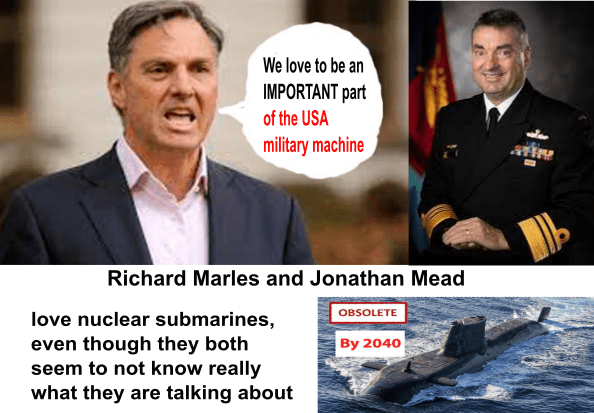
The gem in this whole venture, at least from the perspective of the U.S. military-industrial complex, is the roping in of the Australian taxpayer as the funder of its own nuclear weapons program.
By Binoy Kampmark | 6 January 2024. https://independentaustralia.net/politics/politics-display/funding-the-imperium-australia-subsidises-us-nuclear-submarines,18217
AUKUS, the trilateral pact between the United States, the United Kingdom and Australia, was a steal for all except one of the partners.
Australia, given the illusion of protection even as its aggressive stance (acquiring nuclear-powered submarines, becoming a forward base for the U.S. military) aggravated other countries; the feeling of superiority, even as it was surrendering itself to a foreign power as never before, was the loser in the bargain.
Last month, Australians woke up to the sad reminder that their government’s capitulation to Washington has been so total as to render any further talk about independence an embarrassment. Defence Minister Richard Marles, along with his deputy, Minister for Defence Industry Pat Conroy, preferred a different story.
Canberra had gotten what it wanted: approval by the U.S. Congress through its 2024 National Defense Authorisation Act (NDAA) authorising the transfer of three Virginia class nuclear-powered submarines to the Royal Australian Navy, with one off the production line, and two in-service boats. Australia may also seek congressional approval for two further Virginia class boats.
The measures also authorised Australian contractors to train in U.S. shipyards to aid the development of Australia’s own non-existent nuclear-submarine base, and exemptions from U.S. export control licensing requirements permitting the ‘transfer of controlled goods and technology between Australia, the United Kingdom, and the United States without the need for an export license’.
For the simpleminded Marles, Congress had “provided unprecedented support to Australia in passing the National Defense Authorisation Act which will see the transfer of submarines and streamlined export control provisions, symbolising the strength of our Alliance, and our shared commitment to the AUKUS partnership”.
Either through ignorance or wilful blindness, the Australian Defence Minister chose to avoid elaborating on the less impressive aspects of the authorising statute. The exemption under the U.S. export licensing requirements, for instance, vests Washington with control and authority over Australian goods and technology while controlling the sharing of any U.S. equivalent with Australia. The exemption is nothing less than appropriation, even as it preserves the role of Washington as the drip feeder of nuclear technology.
An individual with more than a passing acquaintance with this is Bill Greenwalt, one of the drafters of the U.S. export control regime.
As he told the ABC last November:
“After years of U.S. State Department prodding, it appears that Australia signed up to the principles and specifics of the failed U.S. export control system.”
In cooperating with the U.S. on this point, Australia would “surrender any sovereign capability it develops to the United States control and bureaucracy”.
The gem in this whole venture, at least from the perspective of the U.S. military-industrial complex, is the roping in of the Australian taxpayer as the funder of its own nuclear weapons program. Whatever its non-proliferation credentials, Canberra finds itself a funder of the U.S. naval arm in an exercise of modernised nuclear proliferation.
Even the Marles-Conroy media release admits that the NDAA helped ‘establish a mechanism for the U.S. to accept funds from Australia to lift the capacity of the submarine industrial base’. Airily, the release goes on to mention that this “investment” (would “gift” not be a better word?) to the U.S. Navy would also ‘complement Australia’s significant investment in our domestic submarine industrial base’.
A few days after the farcical spectacle of surrender by Australian officials, the Congressional Research Service provided another one of its invaluable reports that shed further light on Australia’s contribution to the U.S. nuclear submarine program. Australian media outlets, as is their form on covering AUKUS, remained silent about it. One forum, Michael West Media, showed that its contributors – Rex Patrick and Philip Dorling – were wide awake.
The report is specific to the Navy Columbia (SSBN-826) Class Ballistic Missile Submarine Program, one that involves designing and building 12 new SSBNs to replace the current, aging fleet of 14 Ohio class SSBNs. The cost of the program, in terms of 2024 budget submission estimates for the 2024 financial year, is US$112.7 billion (AU$168.2 billion).
As is customary in these reports, the risks are neatly summarised. They include the usual delays in designing and building the lead boat, thereby threatening readiness for timely deployment; burgeoning costs; the risks posed by funding the Columbia class program to other Navy programs; and ‘potential industrial-base challenges of building both Columbia-class boats and Virginia-class attack submarines (SSNs) at the same time’.
Australian funding becomes important in the last concern. Because of AUKUS, the U.S. Navy “has testified” that it would require, not only an increase in the production rate of the Virginia class to 2.33 boats per year, but ‘a combined Columbia-plus-Virginia procurement rate’ of 1+2.33. Australian mandarins and lawmakers, accomplished in their ignorance, have mentioned little about this addition.
But U.S. lawmakers and military planners are more than aware that this increased procurement rate:
‘…will require investing several billion dollars for capital plant expansion and improvements and workforce development at both the two submarine-construction shipyards (GD/EB [General Dynamics’ Electric Boat in Groton, Connecticut] and HII/NSS [Huntington Ingalls Industries’ Newport News Shipbuilding]) and submarine supplier firms.’
The report acknowledges that funding towards the 1+2.33 goal is being drawn from several allocations over a few financial years, but expressly mentions Australian funding ‘under the AUKUS proposed Pillar 1 pathway’, which entails the transfer component of nuclear-powered submarines to Canberra.
The report helpfully reproduces the 25 October 2023 testimony from the Navy before the Seapower and Projection Forces Subcommittee of the House of Armed Services Committee. Officials are positively salivating at the prospect of nourishing the domestic industrial base through, for instance, ‘joining with an Australian company to mature and scale metallic additive manufacturing across the SIB [Submarine Industrial Base]’.
The testimony goes on to note that:
‘Australia’s investment into the U.S. SIB builds upon ongoing efforts to improve industrial base capability and capacity, create jobs, and utilise new technologies. This contribution is necessary to augment VACL [Virginia class] production from 2.0 to 2.33 submarines per year to support both U.S. Navy and AUKUS requirements.’
The implications from the perspective of the Australian taxpayer are significant.
‘Australian AUKUS funding will support construction of a key delivery component of the U.S. nuclear strike force, keeping that program on track while overall submarine production accelerates.’
The funding also aids the advancement of another country’s nuclear weapons capabilities, a breach, one would have thought, of Australia’s obligations under the Treaty of Non-Proliferation of Nuclear Weapons.
Defence spokesman for the Australian Greens, Senator David Shoebridge, makes that very point to Patrick and Dorling:
“Australia has clear international legal obligations to not support the nuclear weapons industry, yet this is precisely what these billions of dollars of AUKUS funding will do.”
The Senator also asks:
“When will the Albanese Government start telling the whole truth about AUKUS and how Australians will be paying to help build the next class of U.S. ballistic missile submarines?”
For an appropriate answer, Shoebridge would do well to consult the masterful, deathless British series Yes Minister, authored by Antony Jay and Jonathan Lynn.
In one episode, the relevant minister, Jim Hacker, offers this response to a query by the ever-suspicious civil service overlord Sir Humphrey Appleby on when he might receive a draft proposal:
“At the appropriate juncture. In the fullness of time. When the moment is ripe. When the necessary procedures have been completed. Nothing precipitate, of course.”
In one word: never.
Australian Sailors Embed Aboard Submarine Tender for Nuclear Experience
The Sailors and Officers will embed aboard USS Emory S. Land, one of two U.S submarine tenders based in the Pacific territory, for up to five months.
Naval News Staff 04 Feb 2024
A group of 37 Royal Australian Navy officers and sailors have departed for Guam to embed on board USS Emory S. Land, the United States submarine tender.
In December last year, Australia, the United States and United Kingdom announced that Australian sailors would commence duty in Guam from early 2024 as part of preparations for the commencement of Submarine Rotational-Force West where, from as early as 2027, one UK Astute-class submarine and up to four US Virginia-class submarines will have a rotational presence at HMAS Stirling in Western Australia.
The Navy personnel will spend up to five months on board USS Emory S. Land integrating with US sailors and building the unique knowledge, skills and experience in how the US conducts nuclear-powered submarine (SSN) maintenance…………………………………… https://www.navalnews.com/naval-news/2024/02/australian-sailors-embed-aboard-submarine-tender-for-nuclear-experience/
Australian Conservation Foundation is seriously concerned about the AUKUS nuclear submarine project, its costs and consequences and the way this initiative is being advanced.

Submission to the Senate Foreign Affairs, Defence and Trade Legislation Committee – Inquiry into the Australian Naval Nuclear Power Safety Bill 2023
ACF and AUKUS
ACF holds serious concerns around the AUKUS nuclear submarine project, its costs and consequences and the way this initiative is being advanced…..
ACF’s focus in this submission is on the environmental ramifications of AUKUS in Australia. The submission starts from the premise a regulatory system of some kind related to AUKUS in Australia will be adopted by Federal Parliament. The submission identifies gaps in the regime and issues that require further consideration and provides practical recommendations for improvement
Summary
– ACF’s is deeply concerned with the Bill’s potential for approval to be granted for the storage in Australia of high-level radioactive waste from submarines operated by other countries.
– The safety of the Australian public should be the paramount concern here. The Bill’s proposed objects do not adequately reflect this. The objects need to be expanded.
– The current drafting does not provide for any meaningful community information, consultation or reporting. The principles of open government and accountability would suggest that the default position ought to be that information will be available but permit exceptions based on regulations or ministerial discretion.
– The current drafting permits abrogation of responsibility by Commonwealth entities. Non-government third parties (e.g. contractors) could be solely responsible for compliance with the relevant duties. This could include organisations based outside Australia. Given the nature of the risk, Commonwealth entities should be subject to ongoing responsibility, regardless of contractual arrangements.
– The Bill proposes a compliance regime which would make enforcement of the nuclear safety duty problematic. The use of “as far as reasonably practicable” is rare in the criminal offence context and should not be used in the context of nuclear safety.
– Licences ought only to be issued to entities that have demonstrated capability and record and reputation for meeting their regulatory obligations. A requirement that licences only be issued to entities that are a fit and proper person should be included.
Other issues addressed in this submission are:
– Consent considerations and the UN Declaration on the Rights of Indigenous Peoples
– Nuclear Non-Proliferation Treaty
– A Nuclear Industry by Stealth?
– Disregard of advice from ARPANSA’s Radiation Health and Safety Advisory Council
– Clarification on Relationship of New Regulator with Existing Agencies
Summary of Recommendations
1. The Bill be amended to ensure that it only provides for the licencing of radioactive waste storage facilities for HLW from Australian submarines.
2. The Federal Government develop an open approach to future HLW management in Australia that is informed by the wider consideration of domestic ILW (intermediate-level waste) management.
3. That the objects of the Bill be redrafted to address protection of a range of people and the environment, and transparency of information and decision-making and accountability of the Government.
4. That the Bill be amended to improve transparency by requiring, subject to national security exceptions, public notification of applications and decisions, a public register of key applications and decisions and mandatory reporting requirements. The Committee should consider principles of open government and comparable regulatory regimes in developing its detailed recommendations to improve transparency.
5. That the Bill be amended to establish a clear-cut obligation to ensure nuclear safety and then provide a defence if the defendant can demonstrate that they exercised due diligence and took all reasonably practicable precautions.
6. That the Bill be amended to recognise and reflect the foundational management principle of free, prior and informed consent (FPIC).
7. That the Bill be amended to ensure the Commonwealth cannot contract out of liability in relation to compliance with the duties on licence holders created by the Bill. A mechanism should be included to ensure the Commonwealth bears responsibility in relation to nuclear safety for the actions of a contractor who holds a licence.
8. That the Bill be amended to ensure the definition of Commonwealth Contractor does not include sub-contractors to a Commonwealth sub-contractor.
9. That the Bill be amended such that the responsibility of each person in the supply chain or logistics chain is expressed, including in terms of the duties and incident reporting, in a manner similar to the National Heavy Vehicle Laws and Work Health and Safety Laws
10. That the Bill be amended to include a requirement that licences only be issued to entities that are a fit and proper persons similar to the Protection from Harmful Radiation Act 1990 (NSW) or Protection of the Environment (Operations) Act 1997 (NSW).
11. That the Committee request ARPANSA’s Radiation Health and Safety Advisory Council give evidence and consider the divergence of the Bill from the Council’s 2022 advice to the ARPANSA CEO.
12. The Committee recommend the ARPANS Act exclusion be modified or removed.
13. The Committee take evidence from the Department on, and consider, the interaction between the new regulatory regime, ARPANSA and potentially relevant state and territory regulatory controls.
14. The Committee consider amendments to provide for a formal means of contact between ARPANSA and the new regulator. This could include a formal position with the new regulator of the requirement to consider ARPANSA guidance materials.
High-Level Radioactive Waste from Other Countries
The AUKUS initiative brings a profound elevation in the cost, complexity and challenges of radioactive waste management in Australia through the introduction of High-Level Waste (HLW)0F1. This material needs to be securely isolated from people and the wider environment for periods of up to 100,000 years.1F2
The AUKUS initiative brings a profound elevation in the cost, complexity and challenges of radioactive waste management in Australia through the introduction of High-Level Waste (HLW)0F1. This material needs to be securely isolated from people and the wider environment for periods of up to 100,000 years.1F2
Speaking on the ABC in March 2023 Defence Minister Marles stated:
We are making a commitment that we will dispose of the nuclear reactor. That is a significant commitment to make. This is going to require a facility to be built in order to do that disposal, obviously that facility will be remote from populations, and today we are announcing that that facility will be on Defence land, current or future.
Part of the AUKUS deal is that Australia must manage all radioactive waste generated by the submarines on Australian soil. Minister Richard Marles said this was a pre-condition for the whole program.
The ABC also reported that while the sole responsibility of the submarine nuclear waste disposal lies with Australia, the White House has promised the US and UK will help, quoting a White House representative:
The United Kingdom and the United States will assist Australia in developing this capability, leveraging Australia’s decades of safely and securely managing radioactive waste domestically.
At no point has a compelling case been made for why Australia should take responsibility for the management of this waste, especially in relation to waste arising from purchased secondhand US Virginia class submarines.
This lack of rationale was highlighted in an article by Kym Bergmann titled the Nightmare of Nuclear-powered Submarine Disposal in the July-August, 2023edition of the Asia-Pacific Defence Reporter (APDR):
Why Australia has committed to this expensive process, hazardous to human life is unknown. In summary form, we will need to put in place facilities for the following:
• To remove the fuel from the sub.
• To store the recently removed fuel in pools of water.
• To transfer the fuel from the pools to dry casks.
• To store the dry casks on an interim basis.
• To permanently dispose of the spent fuel deep underground.
• To permanently dispose of the rest of the reactor (excluding the fuel).
It is unknown whether the estimated project cost of $368 billion covers this. It is unknown where the facilities will be built. It is unknown whether the decommissioning of submarines
will occur at their east coast base. In addition, the U235 will have to be in a secure location and then guarded forever to prevent its theft for conversion into weapons.
APDR went on to ask:
One of the many mysteries around the AUKUS deal is why Australia has agreed to disposing of the Virginia class submarines here. Surely the logical thing would be to have an agreement where the US took them back at the end of their lives and decommissioned them using their well established procedures.
Who benefits from compelling Australia to develop our own waste disposal industry? Why not lease the used Virginia class subs rather than purchase them outright?
To this can be added the mystery of why agree to second hand submarines at all?………………………………………………………………………………………………………………………………………………………………….
Cost of UK’s flagship nuclear project blows out to more than $A92 billion

But it also has implications for Australia, because one its main political groupings, the right-wing Liberal and National Party coalition, has decided that Australia should abandon its current plan to dump coal for renewables and storage, and wait for nuclear instead.
Australia currently has a target of 82 per cent renewables by 2030, and AEMO’s latest Integrated System Plan suggests it could be close to 100 per cent renewables within half a decade after that.
Giles Parkinson, Jan 29, 2024, https://reneweconomy.com.au/cost-of-uks-flagship-nuclear-project-blows-out-to-more-than-a92-billion/
The cost of the flagship nuclear project in the United Kingdom has blown out again, this time to a potential $A92.6 billion as a result of yet more problems and delays at the Hinkley C project.
The latest cost blowout was revealed last week by the French-government owned EdF, whose former CEO had originally promised in 2007 that the Hinkley project would be “cooking Christmas turkeys” in England by 2017, at a cost of just £9 billion.
But like virtually every major nuclear project built in western economies, that ambitious deadline was never going to be met. The new start-up date is now for 2030, but more likely 2031 – and that is only for one of the two units.
The budget has leaped from the original promise of £9 billion, to £18 billion, and has since blown out multiple times to now reach £31 billion and £34 billion, and it could be more than £35 billion “in 2015 values,” according to EdF. This translates into current day prices, according to Michael Liebreich, the former head of Bloomberg New Energy Finance, of £48 billion, or $A92.6 billion.
“The cost of civil engineering and the longer duration of the electromechanical phase (and its impact on other work) are the two main reasons for this cost revision,” EdF said in its statement. It has also experienced massive cost over-runs and delays at other similar projects in Flammanville in Fance and Olkiluoto in Finland.
It is yet another crippling blow to the UK plans to make nuclear a centrepiece of its green energy transition. EdF has already had to be bailed out by its own government, and ultimately nationalised, because of the cost blowouts and the huge costs of buying replacement power when half its French nuclear fleet went offline in 2023.
China’s CGN had to be brought in to fund one third of the Hinckley project, but is refusing to contribute more funds because China has been frozen out of other UK projects.
Alison Downes of Stop Sizewell C, a campaign group opposed to the planned Suffolk nuclear plant, told the Financial Times that EDF and the Hinkley project was an “unmitigated disaster”.
She added the UK government should cancel Sizewell C, saying state funding for the project could be better spent on “renewables, energy efficiency or, in this election year, schools and hospitals”.
But it also has implications for Australia, because one its main political groupings, the right-wing Liberal and National Party coalition, has decided that Australia should abandon its current plan to dump coal for renewables and storage, and wait for nuclear instead.
The Coalition had been pushing so-called small modular reactors, but after the failure of the leading technology developer in the US last year, and confirmation by the CSIRO and the Australian Energy Market Operator that SMR costs would be three times more expensive than renewables, several key Coalition members pointed to large scale nuclear such as Hinckley.
Australia currently has a target of 82 per cent renewables by 2030, and AEMO’s latest Integrated System Plan suggests it could be close to 100 per cent renewables within half a decade after that.
This switch to low carbon electricity is critical for Australia’s emissions targets, and for emission cuts in other parts of the economy. Any delay in the roll-out of renewables, in the expectation that nuclear would fill its place, will push that timeline out by at least another decade, if not, and blow out the costs of the energy transition.
“It is not like cost over-runs in nuclear projects are a big secret,” Liebreich writes on his Sub-stack blog.
He cites the world’s leading academic expert on project management, Danish Professor Bent Flyvbjerg, author of How Big Things Get Done, who shows that nuclear plants are worse only than Olympic Games in terms of cost over-runs.
“On average they go 120% over the budget, with 58% of them going a whopping 204% over budget,” Liebreich writes.
The Coalition energy spokesman Ted O’Brien complained in December that the CSIRO/AEMO report focused only on the “investment” cost, and not the “consumer cost.”
It’s not clear what he means by that. But as Liebreich notes, while Hinkley’s construction costs are in the £42 to £48 billion range, its first 35 years of electricity at £87.50 or £92.50/MW in 2012 money, adjusted for inflation, will cost UK energy users a gargantuan £111 or £116 billion, or up to $A223 billion.
The Politics of Nuclear Waste Disposal: Lessons from Australia

22 Jan 2024 | Jim Green and Dimity Hawkins, https://www.apln.network/projects/voices-from-pacific-island-countries/the-politics-of-nuclear-waste-disposal-lessons-from-australia
Click here to download the full report.
In this report, Jim Green and Dimity Hawkins explore Australia’s long and complex engagement with nuclear waste issues. With the failure to remediate atomic bomb test sites, and repeated failures to establish a national nuclear waste repository, the approaches of successive Australian governments to radioactive waste management deserve close scrutiny.
A recurring theme is the violation of the rights of Aboriginal First Nations Peoples and their successful efforts to resist the imposition of nuclear waste facilities on their traditional lands through effective community campaigning and legal challenges. Green and Hawkins argue for the incorporation of the UN Declaration on the Rights of Indigenous Peoples into Australian law, and amendments to the National Radioactive Waste Management Act to remove clauses which weaken or override Indigenous cultural heritage protections and land rights.
In addition, they highlight the need for studies, clean-up and monitoring of all British nuclear weapons test sites in Australia in line with the positive obligations in the Treaty on the Prohibition of Nuclear Weapons (TPNW). In light of the failure to manage existing radioactive waste management challenges, it must be questioned whether the Australian government can successfully manage the challenges of high-level nuclear waste management posed by the AUKUS defence pact and the plan to purchase and build nuclear-powered submarines.
This report was produced as part of a project on Nuclear Disarmament and the Anthropocene: Voices from Pacific Island Countries, sponsored by Ploughshares Fund.
Race of the Century: Australia is in the box seat on climate and finance, here is the blueprint for victory

Michael West Media, by Tim Buckley | Jan 23, 2024
The global energy transition is the race of this century. The rewards are enormous. The risks too. This is an edited version of the submission by Tim Buckley and the Climate Capital Forum on how Australia can tackle the race to electrification and a clean economy.
The world is currently in a technology, trade and finance race as the global energy transition takes hold and we grapple with the growing impacts of climate change and climate risk.
For Australia, this is one of the biggest investment, employment and net export opportunities this century, but only if we proactively build a strategic national response proportional to the investment opportunity.
With China’s huge technology leadership and the US Inflation Reduction Act (IRA) providing upwards of a trillion dollars of incentives, “free global markets” are being heavily and rapidly disrupted. To avoid remaining a zero value-add “dig and ship” country servicing China and greater Asia, Australia must pivot quickly to investing in our own development, in partnership with global technology leaders.
This would require a major similar public policy shift at scale, the likes of which has not been seen in decades. It would not only set the right market signals but also strategically leverage the national balance sheet, and selectively provide public budget support to unlock and crowd-in private capital to enable large-scale investment to meet the challenge.
It is already possible to see the impacts and benefits of the IRA in the US: it is driving the energy transition across the country using a mix of policy initiatives – grants, loans, rebates, incentives, and other investments. Central are tax provisions with the dual function of saving families money on their energy bills while also building demand that accelerates the roll out of clean energy, clean vehicles, clean buildings, and clean manufacturing – all opportunities available to Australia with the right investment.
Petro-state Australia: risks of inaction
We know the growing risks associated with inaction. As one the three largest petro-states globally, Australia’s existing, outdated industry profile means failure to overcome the inertia of relying on fossil-fuels will undermine our economic security and sustainable growth.
Two likely consecutive budget surpluses have demonstrated this government’s financial credentials, accompanied by the rolling out of innovative and strategic building blocks, such as: the Safeguard Mechanism; the $20bn Rewiring the Nation fund; the $15bn National Reconstruction Fund (NRF); $4bn into the Critical Minerals facility; establishing the Net Zero Authority and the Climate Act 2023; and the 32GW Capacity Investment Scheme (CIS). And with the fossil-fuel hyper commodity price rises of 2022 slowly fading, general inflation in Australia is starting to moderate, as is the cost of living crisis.
The time is right for the government to broaden its focus to the electrification of everything across the economy and to strategically stimulate onshore value-adding of our resources; to process and build domestically and then export products with embodied decarbonisation to a growing global market. Australia has world leading and affordable renewable energy, and this creates a massive global competitive advantage, if we can harness this cost advantage to build out our capacity and help diversify global supply chains in zero emissions industries of the future.
The global competitors
Globally, multiple economies have released substantial government-backed fiscal packages to shore up their own industries. The US has laid out a massive trillion dollar subsidy through the Inflation Reduction Act (IRA) resulting in the crowding-in of up to US$3 trillion in private investment, the EU has a immense subsidy program in its Net Zero Industry Act (NZIA) and policies such as its Carbon Border Adjustment Mechanism (CBAM) to build domestic EU supply chains, Korea has its massive battery and EV public-private partnership program, Japan has its GX Roadmap and India has its Production Linked Incentive (PLI) funding.
This is all taking place alongside China’s finely-honed strategy to fund R&D and investment at an unprecedented pace and scale with a lack of regard for near term profitability at the individual sector level; this on top of it being the biggest buyer in the world of lithium, rare earths, iron ore, copper and nickel. And at the same time, it is in China’s national interest to flood in new global supply and push down imported commodities prices – those same commodities that Australia produces.
Decarbonising is also an energy security necessity. With next to zero domestic stockpiles of diesel and oil and increasing global supply chain challenges, Australia’s national security is best served by building local supply chains and renewable energy and non-fossil fuelled transport as well as to ensure decarbonised products have the right price signal in both local and international markets.
Profound economic reform and modernisation in Australia is needed, as is international collaboration.
Doing so will ensure that Australia is not just in the race, but that we are a front runner, leveraging our global competitive advantage of the rich natural resources, low population density and world-class renewables, the smarts of our people, the power of our world leading A$3.5 trillion superannuation base, the stability of our political system and our position as a trusted supplier of commodities at global scale.
CCF submission
The Federal budget position today is in rude financial health. After a decade of deficits under previous governments, careful and prudent management – and some good luck on international markets – the Australian government has delivered a very welcome massive fiscal surplus in 2022/23, which is set to be repeated again in 2023/24.
Building on the policy initiatives announced in 2023, we encourage the government to continue to develop programs such as the Capacity Investment Scheme – a clever and innovative low risk response that underwrites cash flows that will crowd-in A$40-50bn of private investment and leverage many state government programs already in place.
This submission builds upon previous recommendations in Climate Capital Forum’s September 2023 Discussion Paper – An Australian Response to the US IRA.
We provide recommendations for the May 2024 Budget by arguing for a strategic public interest response to the global economic changes commensurate with the massive opportunities in front of Australia; one that outlines how we can leverage our own decarbonising actions, illustrate the growing capacity across the economy, and help drive the global move to renewable energy and energy storage, consistent with the COP26 pledge to triple renewables and double energy efficiency by 2030 and the massive uplift in momentum the IEA Renewables 2023 details, noting China’s growing dominance in all these measures.
By making available an additional A$100bn investment of public capital and budget support over the coming decade well over A$200-300bn of private capital can be crowded in – through debt, infrastructure and equity, both domestic and via collaborative partnerships with strategic international technology and industry leaders. We need a “uniquely Australian” response to “complement not copy the priorities and plans” of the US IRA and other nations, as Treasurer Jim Chalmers said.
Provide capital funding that supports the public interest
Focus strategic investment through the development of a package of funding that builds an Australian renewable energy industry – including a value-adding critical minerals industry development package…………………………………………………………………………………………………………………………………………………………………………………………………………………………………….
About Capital Climate Forum
The Climate Capital Forum was established in December 2022. It brings together the investment, decarbonising, and philanthropy sectors as well as climate finance experts and NGOs to work with government, industry and stakeholders to advocate for ambition in Australia’s drive to become a renewable energy superpower. https://michaelwest.com.au/australia-climate-finance-race/
As earth records hottest year, Coalition digs in against climate action and renewables
Pearls and Irritations, By Sophie Vorrath, Jan 23, 2024
The science is in. The European Union’s Copernicus Climate Change Service has overnight confirmed that 2023 was the earth’s warmest year on record: 0.16°C warmer than the previous record year (2016); 0.6°C warmer than the 1991-2020 average; 1.48°C warmer than the pre-industrial period.
The report from Copernicus notes that each month from June to December in 2023 was warmer than the corresponding month in any previous year, with July and August the warmest two months on record.
“2023 marks the first time on record that every day within a year has exceeded 1°C above the 1850-1900 pre-industrial level for that time of year,” the report says.
“Close to 50% of days were more than 1.5°C warmer than the 1850-1900 level, and two days in November were, for the first time, more than 2°C warmer.”
Furthermore, it is likely that a 12-month period ending in January or February 2024 will exceed 1.5°C above the pre-industrial level – the threshold climate scientists had hoped to limit global warming to through the sort of emissions reduction policies and actions they have been calling for for decades.
Around the world, the changing climate manifested itself in extreme heat waves in southern Europe, North America and China, devastating wildfires in Canada and Hawaii, record-breaking sea surface temperatures and record low sea ice extent around Antarctica.
Australia, remarkably, was the only continent that did not see large areas register record temperatures. But the impacts of global warming are no less evident.
Far North Queensland is picking up the pieces following a devastating cyclone and floods, while large parts of Victoria remain on flood watch after some regions experienced rainfall “higher than their 100-year rates” over 48 hours, according to the BOM. In Western Australia, a searing heatwave is on the cards.
“It’s not surprising, unfortunately,” prime minister Anthony Albanese said on Wednesday from Queensland, where he announced a $50 million federal support package for people affected by the state’s most recent extreme weather events.
“All of this is a reminder that the science told us that climate change would mean there would be more extreme weather events and they would be more intense. And unfortunately, we’re seeing that play out with the number of events that we’re having to deal with right around Australia.”
Climate Council research director Simon Bradshaw says the most alarming thing about the news from Copernicus is that 2023 broke heat records by such a considerable margin, with 2024 projected to be even hotter.
“We’re seeing how much more extreme our climate becomes as we approach the 1.5°C warming threshold,” he said on Wednesday.
“This is why we must limit future warming as much as possible by getting our emissions down fast by rapidly phasing out the burning of fossil fuels such as coal, oil and gas. We can’t keep stoking the fire if we want the room to cool down.”
But as the reality sinks in that 2023 shattered annual heat records and that the world looks like sailing past the safe climate zone hoped for by scientists, the federal Coalition has set to work walking back national emissions targets, railing against renewables and still – still! – banging on about nuclear.
On Wednesday, reports emerged that a majority of Liberal and National Party MPs will oppose taking a 2035 emissions reduction target to the 2025 election, arguing it will worsen the cost-of-living crisis for regional and vulnerable Australians.
“This is why we must limit future warming as much as possible by getting our emissions down fast by rapidly phasing out the burning of fossil fuels such as coal, oil and gas. We can’t keep stoking the fire if we want the room to cool down.”
But as the reality sinks in that 2023 shattered annual heat records and that the world looks like sailing past the safe climate zone hoped for by scientists, the federal Coalition has set to work walking back national emissions targets, railing against renewables and still – still! – banging on about nuclear.
On Wednesday, reports emerged that a majority of Liberal and National Party MPs will oppose taking a 2035 emissions reduction target to the 2025 election, arguing it will worsen the cost-of-living crisis for regional and vulnerable Australians
A survey by The Australian has found most Liberal MPs are privately opposed to any sort of 2035 target and didn’t see any point in putting a number to the Australian people.
Nationals MPs were more forthcoming with their views on the matter, with Barnaby Joyce, Colin Boyce, Keith Pitt, Matt Canavan and Bridget McKenzie on the record as rejecting “any target” or expressing serious reservations about adopting one, the Australian reports.
“There is also a smaller rump within the Nationals, including Senator Canavan and Mr Boyce, who want the Coalition to drop the current policy of net zero emissions by 2050,” the paper says
The context to this is that the latest climate science says 2050 net zero targets are now not enough to rein in global warming at the rate required to keep the planet safe and liveable. It has also been argued that such a distant target allows governments to take their time on policy – time they do not have.
Recent modelling by Monash University’s Climateworks Centre found Australia must move its net-zero emissions target forward by a decade to 2040 and cut national emissions by 68 per cent below 2005 levels by 2030 in order to have any hope of limiting warming to 1.5°C.
Federal Labor – which wants to get to 82 per cent renewables by 2030 – is under pressure to adopt a 2035 emissions target of more than 70 per cent, and is in consultation on the size of the interim target it has promised to bring to the 2025 election.
But the LNP is having none of it, preferring to believe that its constituents are unable to make the mental leap that “cost of living” might be intrinsically linked with the social, environmental and economic costs of ever increasing extreme weather events.
“I’m not confident the Labor Party’s current targets, let alone anything more ambitious, can be achieved without significant social and economic detriment to the nine million of us that don’t live in capital cities,” said McKenzie…………………………………………………………………
A National Rally Against Reckless Renewables is on the calendar for February 6 – federal parliament’s first sitting day for 2024 – with the Facebook page for the event promising “lots of great speakers,” including Joyce, Senator Jacinta Nampijinpa Price, David Gillespie MP, Senator Gerard Rennick, Senator Malcolm Roberts, and old mate Matt Canavan……………………………………..
But not all of the Coalition’s “people,” as Pitt claims regional Australians to be, are drinking this particular brand of Kool Aid.
“The impact of climate change on our communities is immediate and devastating,” said Major General Peter Dunn, a member of Emergency Leaders for Climate Action and former Commissioner for the ACT’s Emergency Services Authority on Wednesday.
“The urgency to stop relying on fossil fuels such as coal, oil and gas, which only worsen this crisis, has never been greater. The time has come for Australia to decisively move away from these harmful pollutants.”
Peter Lake, a northern NSW farmer and member of Farmers for Climate Action says the ongoing drought his farm is experiencing shows how climate change is continuing to make farming “unpredictable.”
“The sooner we get serious about reducing our burning of fossil fuels and start to reduce the amount of carbon dioxide going into our atmosphere the better,” he said on Wednesday.
For federal Labor’s part, it is now imperative that they move faster and with more ambition in the opposite direction to the Coalition and hold their nerve against what is bound to be a ramping up of anti-renewables propaganda……………… more https://johnmenadue.com/as-earth-records-hottest-year-coalition-digs-in-against-climate-action-and-renewables/
Nuclear goes backwards, again, as wind and solar enjoy another year of record growth

Jim Green 21 January 2024, https://reneweconomy.com.au/nuclear-goes-backwards-again-as-wind-and-solar-enjoy-another-year-of-record-growth/
The nuclear renaissance of the late-2000s was a bust due to the Fukushima disaster and catastrophic cost overruns with reactor projects. The latest renaissance is heading the same way, i.e. nowhere. Nuclear power went backwards last year.
There were five reactor start-ups and five permanent closures in 2023 with a net loss of 1.7 gigawatts (GW) of capacity. There were just six reactor construction starts in 2023, five of them in China.
Due to the ageing of the reactor fleet, the International Atomic Energy Agency (IAEA) anticipates the closure of 10 reactors (10 GW) per year from 2018 to 2050.
Thus the industry needs an annual average of 10 reactor construction starts, and 10 reactor startups (grid connections), just to maintain its current output. Over the past decade (2014-23), construction starts have averaged 6.1 and reactor startups have averaged 6.7.
The number of operable power reactors is 407 to 413 depending on the definition of operability, well down from the 2002 peak of 438.
Nuclear power’s share of global electricity generation has fallen to 9.2 percent, its lowest share in four decades and little more than half of its peak of 17.5 percent in 1996.
Over the two decades 2004-2023, there were 102 power reactor startups and 104 closures worldwide: 49 startups in China with no closures; and a net decline of 51 reactors in the rest of the world.
In China, there were five reactor construction starts in 2023 and just one reactor startup. Put another way, there was just one reactor construction start outside China in 2023. So much for the hype about a new nuclear renaissance.
Small modular reactors and ‘advanced’ nuclear power
Small modular reactors (SMRs) are the subject of endless hype but there were no SMR construction starts or startups last year. The biggest SMR news in 2023 was NuScale Power’s decision to abandon its flagship project in Idaho despite securing astronomical subsidies amounting to around US$4 billion (A$6.1 billion) from the US government.
The pro-nuclear Breakthrough Institute noted in a November 2023 article that efforts to commercialise a new generation of ‘advanced’ nuclear reactors “are simply not on track” and it warned nuclear advocates not to “whistle past this graveyard”:
It wrote:
“The NuScale announcement follows several other setbacks for advanced reactors. Last month, X-Energy, another promising SMR company, announced that it was canceling plans to go public. This week, it was forced to lay off about 100 staff.
“In early 2022, Oklo’s first license application was summarily rejected by the Nuclear Regulatory Commission before the agency had even commenced a technical review of Oklo’s Aurora reactor.
The nuclear renaissance of the late-2000s was a bust due to the Fukushima disaster and catastrophic cost overruns with reactor projects. The latest renaissance is heading the same way, i.e. nowhere. Nuclear power went backwards last year.
There were five reactor start-ups and five permanent closures in 2023 with a net loss of 1.7 gigawatts (GW) of capacity. There were just six reactor construction starts in 2023, five of them in China.
Due to the ageing of the reactor fleet, the International Atomic Energy Agency (IAEA) anticipates the closure of 10 reactors (10 GW) per year from 2018 to 2050.
Thus the industry needs an annual average of 10 reactor construction starts, and 10 reactor startups (grid connections), just to maintain its current output. Over the past decade (2014-23), construction starts have averaged 6.1 and reactor startups have averaged 6.7.
The number of operable power reactors is 407 to 413 depending on the definition of operability, well down from the 2002 peak of 438.
Nuclear power’s share of global electricity generation has fallen to 9.2 percent, its lowest share in four decades and little more than half of its peak of 17.5 percent in 1996.
Over the two decades 2004-2023, there were 102 power reactor startups and 104 closures worldwide: 49 startups in China with no closures; and a net decline of 51 reactors in the rest of the world.
In China, there were five reactor construction starts in 2023 and just one reactor startup. Put another way, there was just one reactor construction start outside China in 2023. So much for the hype about a new nuclear renaissance.
Nuclear decline vs. record renewables growth
The International Energy Agency (IEA) has just released its ‘Renewables 2023’ report and it makes for a striking contrast with the nuclear industry’s malaise.
Nuclear power suffered a net loss of 1.7 GW capacity in 2023, whereas renewable capacity additions amounted to a record 507 GW, almost 50 percent higher than 2022. This is the 22nd year in a row that renewable capacity additions set a new record, the IEA states. Solar PV alone accounted for three-quarters of renewable capacity additions worldwide in 2023.
Nuclear power accounts for a declining share of share of global electricity generation (currently 9.2 percent) whereas renewables have grown to 30.2 percent. The IEA expects renewables to reach 42 percent by 2028 thanks to a projected 3,700 GW of new capacity over the next five years in the IEA’s ‘main case’.
The IEA states that the world is on course to add more renewable capacity in the next five years than has been installed since the first commercial renewable energy power plant was built more than 100 years ago.
Solar and wind combined have already surpassed nuclear power generation and the IEA notes that over the next five years, several other milestones will likely be achieved:
— In 2025, renewables surpass coal-fired electricity generation to become the largest source of electricity generation
— In 2025, wind surpasses nuclear electricity generation
— In 2026, solar PV surpasses nuclear electricity generation
— In 2028, renewable energy sources account for over 42 percent of global electricity generation, with the share of wind and solar PV doubling to 25 percent
Tripling renewables
The IEA states in its ‘Renewables 2023’ report that:
“Prior to the COP28 climate change conference in Dubai, the International Energy Agency (IEA) urged governments to support five pillars for action by 2030, among them the goal of tripling global renewable power capacity. Several of the IEA priorities were reflected in the Global Stocktake text agreed by the 198 governments at COP28, including the goals of tripling renewables and doubling the annual rate of energy efficiency improvements every year to 2030. Tripling global renewable capacity in the power sector from 2022 levels by 2030 would take it above 11 000 GW, in line with IEA’s Net Zero Emissions by 2050 (NZE) Scenario.
“Under existing policies and market conditions, global renewable capacity is forecast to reach 7300 GW by 2028. This growth trajectory would see global capacity increase to 2.5 times its current level by 2030, falling short of the tripling goal.”
In the IEA’s ‘accelerated case’, 4,500 GW of new renewable capacity will be added over the next five years (compared to 3,700 GW in the ‘main case’), nearing the tripling goal.
Tripling nuclear?
The goal of tripling renewables by 2030 is a stretch but it is not impossible. Conversely, the ‘pledge’ signed by just 22 nations at COP28 to triple nuclear power by 2050 appears absurd.
The Labor federal government signed Australia up to the renewables pledge but not the nuclear pledge. The Coalition wants to do the opposite, and also opposes the Labor government’s target of 82 per cent renewable power supply by 2030.
One of the lies being peddled by the Coalition is that nuclear power capacity could increase by 80 percent over the next 30 years. That is based on a ‘high case’ scenario from the IAEA. However the IAEA’s ‘low case’ scenario — ignored by the Coalition — is for another 30 years of stagnation.
So should we go with the IAEA’s high or low scenarios, or split the difference perhaps?
According to a report by the IAEA itself, the Agency’s ‘high’ forecasts have consistently proven to be ridiculous and even its ‘low’ forecasts are too high — by 13 percent on average.
Nuclear power won’t increase by 80 percent by 2050 and it certainly won’t triple; indeed it will struggle to maintain current output given the ageing of the reactor fleet and recent experience with construction projects.
Comparing nuclear and renewables in China
China’s nuclear program added only 1.2 GW capacity in 2023 while wind and solar combined added 278 GW. Michael Barnard noted in CleanTechnica that allowing for capacity factors, the nuclear additions amount to about 7 terrawatt-hours (TWh) of new low carbon generation per year, while wind and solar between them will contribute about 427 TWh annually, over 60 times more than nuclear.
Barnard commented:
“One of the things that western nuclear proponents claim is that governments have over-regulated nuclear compared to wind and solar, and China’s regulatory regime for nuclear is clearly not the USA’s or the UK’s. They claim that fears of radiation have created massive and unfair headwinds, and China has a very different balancing act on public health and public health perceptions than the west. They claim that environmentalists have stopped nuclear development in the west, and while there are vastly more protests in China than most westerners realize, governmental strategic programs are much less susceptible to public hostility.
“And finally, western nuclear proponents complain that NIMBYs block nuclear expansion, and public sentiment and NIMBYism is much less powerful in China with its Confucian, much more top down governance system.
“China’s central government has a 30 year track record of building massive infrastructure programs, so it’s not like it is missing any skills there. China has a nuclear weapons program, so the alignment of commercial nuclear generation with military strategic aims is in hand too. China has a strong willingness to finance strategic infrastructure with long-running state debt, so there are no headwinds there either.
“Yet China can’t scale its nuclear program at all. It peaked in 2018 with 7 reactors with a capacity of 8.2 GW. For the five years since then then it’s been averaging 2.3 GW of new nuclear capacity, and last year only added 1.2 GW …”
Dr. Jim Green is the national nuclear campaigner with Friends of the Earth Australia and a member of the Nuclear Consulting Group.
Perth nuclear waste storage facility planned for AUKUS submarines at HMAS Stirling on Garden Island

ABC, By Rebecca Trigger and Isabel Moussalli,18 Dec 2023
Low-level radioactive waste generated by nuclear-powered submarines stationed in Perth could be stored elsewhere, WA’s Premier says, despite new documents revealing plans for a local waste facility.
Key points:
- The ABC has revealed AUKUS nuclear waste will be stored at HMAS Stirling
- WA’s Premier believes it could still be sent elsewhere
- Experts say they aren’t overly concerned, but community perception may be negative
Federal government AUKUS briefing notes obtained by the ABC reveal details of a nuclear waste storage facility being planned as part of general infrastructure works at the HMAS Stirling defence base on Garden Island, south of Perth.
The notes, made public through a Freedom of Information application, say the radioactive material will at least be temporarily stored in WA from 2027.
But WA Premier Roger Cook said where the waste ultimately goes remained unclear.
“Around the issue of low-level radioactive waste, well obviously we have significant capability in that, particularly in South Australia, but that will be an issue that will be decided into the future,” he told reporters on Monday.
Greens Senator Sarah Hanson-Young said any plans for a nuclear waste management facility in Western Australia wouldn’t be popular among the community.
“Australians are vehemently opposed to nuclear waste being stored in Australia, in particular international nuclear waste,” she said.
“We know the South Australian community have been very opposed to this for a long time, our cousins in WA are not going to look on this fondly, either.”
A South Australian government spokesperson said it would listen to advice on the best place to store the waste……………………………………..
he question of what to do with the nuclear waste is an ongoing debate, with a dedicated national agency to manage the subs only created in July………………………………….
However when nuclear-powered subs are decommissioned it will create intermediate and high-level waste that will need to be closely managed as it is weapons-grade material.
Federal government plans for a dump near the South Australian town of Kimba were scrapped earlier this year after traditional owners, the Barngarla people, mounted a Federal Court challenge.
Is there any cause for concern?
Griffith University emeritus professor Ian Lowe said low-level radioactive waste was usually relatively benign but communities have historically rejected proposals to store it in their region.
“We still have no system for managing our low-level radioactive waste let alone the much more intractable waste from nuclear submarines,” he said.
“I wouldn’t be particularly concerned about low-level waste, because if that’s under a couple of metres of earth the radiation at the surface isn’t much more than the background radiation to which we’re all exposed.
“What I would be worried about is that this might be the forerunner to a proposal to store the used reactors from nuclear submarines there, and that’s very nasty waste that I certainly would not want either in my backyard or within 20 kilometres of where I live.”
Professor Lowe, also a past president of the Australian Conservation Foundation, said once the most recent proposal to store low-level radioactive waste at Kimba in South Australia, the federal government then said it would be used to store intermediate-level waste.
“If I were in the environs of this proposal in Western Australia I’d be worried that the same thing might happen,” professor Lowe said……………………………………. https://www.abc.net.au/news/2023-12-18/aukus-submarine-nuclear-waste-disposal-in-perth-hmas-stirling/103242730
The Last Flurry: The US Congress and Australian Parliamentarians seek Assange’s Release
January 19, 2024 : Dr Binoy Kampmark, https://theaimn.com/the-last-flurry-the-us-congress-and-australian-parliamentarians-seek-assanges-release/
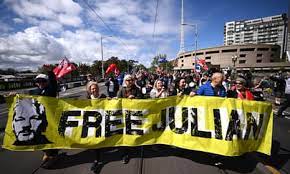
On February 20, Julian Assange, the daredevil publisher of WikiLeaks, will be going into battle, yet again, with the British justice system – or what counts for it. The UK High Court will hear arguments from his team that his extradition to the United States from Britain to face 18 charges under the Espionage Act of 1917 would violate various precepts of justice. The proceedings hope to reverse the curt, impoverished decision by the remarkably misnamed Justice Jonathan Swift of the same court on June 6, 2023.
At this point, the number of claims the defence team can make are potentially many. Economy, however, has been called for: the two judges hearing the case have asked for a substantially shortened argument, showing, yet again, that the quality of British mercy tends to be sourly short. The grounds Assange can resort to are troublingly vast: CIA-sponsored surveillance, his contemplated assassination, his contemplated abduction, violation of attorney-client privilege, his poor health, the violation of free-speech, a naked, politicised attempt by an imperium to capture one of its greatest and most trenchant critics, and bad faith by the US government.
Campaigners for the cause have been frenzied. But as the solution to Assange’s plight is likely to be political, the burden falls on politicians to stomp and drum from within their various chambers to convince their executive counterparts. In the US Congress, House Resolution 934, introduced on December 13 by Rep. Paul A. Gosar, an Arizona Republican, expresses “the sense of the House of Representatives that regular journalistic activities are protected under the First Amendment, and that the United States ought to drop all charges against and attempts to extradite Julian Assange.”
The resolution sees a dramatic shift from the punishing, haute view taken by such figures as the late Democratic Senator Dianne Feinstein, who was one of the first political figures to suggest that Assange be crucified on the unsteady timber of the Espionage Act for disclosing US cables and classified information in 2010. The resolution acknowledges, for instance, that the disclosures by WikiLeaks “promoted public transparency through the exposure of the hiring of child prostitutes by Defense Department contractors, friendly fire incidents, human rights abuses, civilian killings, and United States use of psychological warfare.” The list could be sordidly longer but let’s not quibble.
Impressively, drafters of the resolution finally acknowledge that charging Assange under the Computer Fraud and Abuse Act (CFAA) for alleged conspiracy to help US Army intelligence analyst Chelsea (then Bradley) Manning access Defense Department computers was a fabled nonsense. For one, it was “impossible” – Manning “already had access to the mentioned computer.” Furthermore, “there was no proof Mr Assange had any contact with said intelligence analyst.”
Ire is also directed at the espionage counts, with the resolution noting that “no other publisher has ever been prosecuted under the Espionage Act prior to these 17 charges.” A successful prosecution of the publisher “would set a precedent allowing the United States to prosecute and imprison journalists for First Amendment protected activities, including the obtainment and publication of information, something that occurs on a regular basis.”
Acknowledgment is duly made of the importance of press freedoms to promote transparency and protect the Republic, the support for Assange, “sincere and steadfast”, no less, shown by “numerous human rights, press freedom, and privacy rights advocates and organizations”, and the desire by “at least 70 Senators and Members of Parliament from Australia, a critical United States ally and Mr Assange’s native country” for his return.
Members of Australia’s parliament, adding to the efforts last September to convince members of Congress that the prosecution be dropped, have also written to the UK Home Secretary, James Cleverly, requesting that he “undertake an urgent, thorough and independent assessment of the risks to Mr Assange’s health and welfare in the event that he is extradited to the United States.”
-ADVERTISEMENT-
The members of the Bring Julian Assange Home Parliamentary Group draw Cleverly’s attention to the recent UK Supreme Court case of AAA v Secretary of State for the Home Department which found “that courts in the United Kingdom cannot just rely on third party assurances by foreign governments but rather are required to make independent assessments of the risk of persecution to individuals before any order is made removing them from the UK.
It follows that the approach taken by Lord Justices Burnett and Holroyde in USA v Assange [2021] EWHC 3133 was, to put it politely, a touch too confident in accepting assurances given by the US government regarding Assange’s treatment, were he to be extradited. “These assurances were not tested, nor was there any evidence of independent assessment as to the basis on which they could be given and relied upon.”
The conveners of the group point to Assange’s detention in Belmarsh prison since April 2019, his “significant health issues, exacerbated to a dangerous degree by his prolonged incarceration, that are of very real concern to us as his elected representatives.” They also point out the rather unusual consensus between the current Australian Prime Minister, Anthony Albanese, and his opposition number, Peter Dutton, that the “case has gone on for too long.” Continued legal proceedings, both in the UK, and then in the US were extradition to take place “would add yet more years to Mr Assange’s detention and further imperil his health.”
In terms of posterity’s calling, there are surely fewer better things at this point for a US president nearing mental oblivion to do, or a Tory government peering at electoral termination to facilitate, than the release of Assange. At the very least, it would show a grudging acknowledgment that the fourth estate, watchful of government’s egregious abuses, is no corpse, but a vital, thriving necessity.
Perth could be an ‘especially important target’ due to AUKUS
January 12, 2024
Curtin University Dean of Global Futures Professor Joe Siracusa says while Australia has always been a nuclear target, Perth has particularly become a target for China and Russia due to AUKUS.“They see the AUKUS development here, not only nuclear-propelled submarines, but they’re going to have nuclear cruise missile type things here,” he told Sky News Australia.
Cancelling the Journalist: The Australian ABC’s Coverage of the Israel-Gaza War
- January 18, 2024, by: Dr Binoy Kampmark, https://theaimn.com/cancelling-the-journalist-the-abcs-coverage-of-the-israel-gaza-war/#
What a cowardly act it was. A national broadcaster, dedicated to what should be fearless reporting, cowed by the intemperate bellyaching of a lobby concerned about coverage of the Israel-Gaza war. The investigation by The Age newspaper was revealing in showing that the dismissal of broadcaster Antoinette Lattouf last December 20 was the nasty fruit of a campaign waged against the corporation’s management. This included its chair, Ita Buttrose, and managing director David Anderson.
The official reason for that dismissal was disturbingly ordinary. Lattouf had not, for instance, decided to become a flag-swathed bomb thrower for the Palestinian cause. She had engaged in no hostage taking campaign, nor intimidated any Israeli figure. The sacking had purportedly been made over sharing a post by Human Rights Watch about Israel that mentioned “using starvation of civilians as a weapon of war in Gaza”, calling it “a war crime”. It also noted the express intention by Israeli officials to pursue this strategy. Actions are also documented: the deliberate blocking of the delivery of food, water and fuel “while wilfully obstructing the entry of aid.” The sharing by Lattouf took place following a direction not to post on “matters of controversy”.
Human Rights Watch might be accused of many things: the dolled up corporate face of human rights activism; the activist transformed into fundraising agent and boardroom gaming strategist. But to share material from the organisation on alleged abuses is hardly a daredevil act of dangerous hair-raising radicalism.
Prior to the revelations in The Age, much had been made of Lattouf’s fill-in role as a radio presenter, a stint that was to last for five shows. The Australian, true to form, had its own issue with Lattouf’s statements made on various online platforms. In December, the paper found it strange that she was appointed “despite her very public anti-Israel stance” (paywalled). She was also accused of denying the lurid interpretations put upon footage from protests outside Sydney Opera House, some of which called for gassing Jews. And she dared accused the Israeli forces of committing rape.
It was also considered odd that she discuss such matters as food and water shortages in Gaza and “an advertising campaign showing corpses reminiscent of being wrapped in Muslim burial cloths.” That “left ‘a lot of people really upset’.” If war is hell, then Lattouf was evidently not allowed to go into quite so much detail about it – at least when concerning the fate of Palestinians at the hands of the Israeli war machine.
What also transpires is that the ABC managers were not merely targeting Lattouf on their own, sadistic initiative. Pressure of some measure had been exercised from outside the organisation. According to The Age, WhatsApp messages had been sent to the ABC as part of a coordinated campaign by a group called Lawyers for Israel.
The day Lattouf was sacked, Sydney property lawyer Nicky Stein buzzingly began proceedings by telling members of the group to contact the federal minister for communication asking “how Antoinette is hosting the morning ABC Sydney show.” Employing Lattouff apparently breached Clause 4 of the ABC code of practice on impartiality.
Stein cockily went on to insist that, “It’s important ABC hears from not just individuals in the community but specifically from lawyers so they feel there is an actual legal threat.” She goes on to read that a “proper” rather than “generic” response was expected “by COB [close of business] today or I would look to engage senior counsel.”
-ADVERTISEMENT-
Did such windy threats have any basis? No, according to Stein. “I know there is probably no actionable offence against the ABC but I didn’t say I would be taking one – just investigating one. I have said that they should be terminating her employment immediately.” Utterly charming, and sufficiently so to attract attention from the ABC chairperson herself, who asked for further venting of concerns.
Indeed, another member of the haranguing clique, Robert Goot, also deputy president of the Executive Council of Australian Jewry, could boast of information he had received that Lattouf would be “gone from morning radio from Friday” because of her anti-Israeli stance.
There has been something of a journalistic exodus from the ABC of late. Nour Haydar, an Australian journalist also of Lebanese descent, resigned expressing her concerns about the coverage of the Israel-Gaza conflict at the broadcaster. There had been, for instance, the creation of a “Gaza advisory panel” at the behest of ABC News director Justin Stevens, ostensibly to improve the coverage of the conflict. “Accuracy and impartiality are core to the service we offer audiences,” Stevens explained to staff. “We must stay independent and not ‘take sides’.”
This pointless assertion can only ever be a threat because it acts as an injunction on staff and a judgment against sources that do not favour the accepted line, however credible they might be. What proves acceptable, a condition that seems to have paralysed the ABC, is to never say that Israel massacres, commits war crimes, and brings about conditions approximating to genocide. Little wonder that coverage on South Africa’s genocide case against Israel in the International Court of Justice does not get top billing on in the ABC news headlines.
Palestinians and Palestinian militias, on the other hand, can always be written about as brute savages, rapists and baby slayers. Throw in fanaticism and Islam, and you have the complete package ready for transmission. Coverage in the mainstays of most Western liberal democracies of the Israeli-Palestinian conflict, as the late Robert Fisk pointed out with pungency, repeatedly asserts these divisions.
After her signation Haydar told the Sydney Morning Herald that, “Commitment to diversity in the media cannot be skin deep. Culturally diverse staff should be respected and supported even when they challenge the status quo.” But Haydar’s argument about cultural diversity should not obscure the broader problem facing the ABC: policing the way opinions and material on war and any other divisive topic is shared. The issue goes less to cultural diversity than permitted intellectual breadth, which is distinctly narrowing at the national broadcaster.
Lattouf, for her part, is pursuing remedies through the Fair Work Commission, and seeking funding through a GoFundMe page, steered by Lauren Dubois. “We stand with Antoinette and support the rights of workers to be able to share news that expresses an opinion or reinforces a fact, without fear of retribution.”
Kenneth Roth, former head of Human Rights Watch, expressed his displeasure at the treatment of Lattouf for sharing HRW material, suggesting the ABC had erred. ABC’s senior management, through a statement from managing director David Anderson, preferred the route of craven denial, rejecting “any claim that it has been influenced by any external pressure, whether it be an advocacy group or lobby group, a political party, or commercial entity.” They would, wouldn’t they?
‘Do or die’: MPs launch urgent bid to spare Assange from US extradition.

By Matthew Knott, January 15, 2024 — https://www.theage.com.au/politics/federal/do-or-die-mps-launch-urgent-bid-to-spare-assange-from-us-extradition-20240114-p5ex2h.html
Australian politicians across the political divide have launched a last-ditch bid to prevent Julian Assange from being extradited to the United States to face espionage charges as the WikiLeaks founder faces a crucial final legal challenge in Britain next month.
The four co-convenors of the cross-party Bring Julian Assange Home Parliamentary Group wrote to British Home Secretary James Cleverly arguing for an urgent review of Assange’s case. This was in light of a judgment in the Supreme Court of the UK in November, striking down Prime Minister Rishi Sunak’s controversial plan to send asylum seekers to Rwanda.
On February 20 and 21, two British High Court judges will review an earlier ruling that refused Assange permission to appeal his extradition order. This is expected to be his final bid to prevent being sent to the US.
Assange faces decades in prison over his role in the publication of US classified files and diplomatic cables relating to the wars in Afghanistan and Iraq.
“If he loses in the UK courts next month he could be extradited to the USA within 24 hours,” Assange’s brother Gabriel Shipton said of the High Court review.
“This is literally a do-or-die scenario for Julian.”
Assange’s lawyer Jennifer Robinson has argued he was at high risk of suicide if the High Court rejects his final appeal, saying Assange was so mentally unwell that he would be unlikely to survive extradition.
Liberal MP Bridget Archer, Labor MP Josh Wilson, independent MP Andrew Wilkie and Greens Senator David Shoebridge wrote in their letter to Cleverly: “We are deeply concerned that the legal proceedings involving Mr Assange will now continue, first in the United Kingdom and then in the United States, if extradition is ordered and consented to by you.
“This would add yet more years to Mr Assange’s detention and further imperil his health.
“To this end, we are requesting that you undertake an urgent, thorough and independent assessment of the risks to Mr Assange’s health and welfare in the event he is extradited to the United States.”
As Home Secretary, Cleverly is one of the government’s most powerful ministers, presiding over law enforcement, national security and immigration and with oversight of the domestic counter-intelligence agency MI5.
The MPs argued in their letter that the judges’ reasoning in the Rwanda Supreme Court case – which found it was illegal for Britain to send asylum seekers to Rwanda – “clearly has direct relevance to the extradition proceedings involving Julian Assange”.
“The decision found that courts in the United Kingdom cannot just rely on third-party assurances by foreign governments but rather are required to make independent assessments of the risk of persecution to individuals before any order is made removing them from the UK,” they wrote.
The MPs said that the justices in Assange’s key extradition hearing had “expressly relied on the ‘assurances’ of the United States as to Mr Assange’s safety and welfare should he be extradited to the United States for imprisonment and trial.
“These assurances were not tested, nor was there any evidence of independent assessment as to the basis on which they could be given and relied upon.”
The MPs wrote that they were deeply worried about Assange being sent to a high-security American prison because he “has significant health issues, exacerbated to a dangerous degree by his prolonged incarceration, that are of very real concern to us as his elected representatives”.
In 2021, District Judge Vanessa Baraitser blocked the attempt to extradite Assange on the basis that the harsh conditions of US solitary confinement would create a substantial suicide risk. Her ruling was overturned on appeal.
Peace Pod: an aural adventure in anti-militarist activism. With teacher resources

Get Your Armies Off Our Bodies is the inaugural series of Peace Pod.
Wage Peace is beyond proud to present our latest creation: a podcast featuring the stories, passions and insights of some of our most treasured collaborators. Tune in, subscribe and immerse yourself in the journeys of artists, activists and academics campaigning for peace on the stolen lands of this continent and further afield.
Peace Pod features some of the foremost academics, journalists and activists for peace on this continent, such as Michelle Fahey, Mujib Abid, Izzy Brown, Ned Hargreaves and Aunty Sue Coleman Haseldine, along with international luminaries such as Anthony Feinstein and Matthew Hoh.
Dr Miriam Torzillo has put together high quality teaching resources for students in years 10-12. Dr Torzillo has included a guide to curriculum placement:
- Curriculum Areas
- General Capabilities
- Australian Cross Curriculum Priorities and
- Key Concepts
The Teachers Resource sits with the Podcast here, in one easily accessible page
There is a huge resurgence in interest in the role of the weapons companies because of the genocide in Palestine. Young people are trying to make sense of militarism and peace. The podcast introduces militarism against First Nations people in both Australia and West Papua and the way STEM is being used by weapons corporations to reproduce militarism in the classroom.
1 This month

of the week – Australians for War Powers Reform (AWPR)
To see nuclear-related stories in greater depth and intensity
 Antinuclear