If the deal does go ahead with backing from Chinese state-owned enterprises, it could see Australia providing big direct and indirect subsidies to a company effectively owned by an Indian billionaire and the Chinese Government.
Adani: Chinese state-owned company could help bankroll Carmichael coal mine, ABC News, 2 Nov 17 By business reporter Stephen Long For years it has been a mystery where Adani would get the money to build its giant Carmichael coal mine in North Queensland.
Key points:
Chinese state-owned enterprise CMEC in negotiations with Adani
Deal would involve CMEC given manufacturing contract in return for procuring finance
Some close to the negotiations sceptical about deal being finalised
Now we may have the answer.
The ABC has learned that a Chinese state-owned enterprise, China Machinery Engineering Corporation (CMEC), is in negotiations with Adani and its principal engineering and procurement contractor, Downer EDI.
If the deal goes ahead, it would see CMEC awarded contracts to build key mining plant and equipment in return for China’s financial backing of the Carmichael mine.
CMEC is listed on the Hong Kong stock exchange, but is 78 per cent owned by the giant Chinese state-owned enterprise China National Machinery Industry Corporation Ltd, or Sinomach. Continue reading →
could it be that our own government is walking into the middle of an economic contest between China and India for control over industry and infrastructure?
Surely our government wouldn’t be using public money to subsidise Adani’s mine, undermining its own country’s interest and supporting China to strengthen its grip on power and infrastructure in countries neighbouring India?
Last month I claimed that using a $900 million, publicly funded loan to bail out Adani’s otherwise unviable Carmichael coal mine proposal was the height of absurdity.
The Australian government has been equally desperate, creating an agency and filling it with taxpayers’ money so we can fund a project opposed by the majority Australians.
But the government’s efforts to support Adani stretch well beyond the financial.
Pacific Islanders call for Australia not to fund Adani coalmine, Caritas says thousands face threats to their wellbeing, livelihoods and ‘their very existence’ due to rising sea levels, Guardian, Naaman Zhou, 1 Nov 17, Pacific Islanders whose homes face eradication by rising sea levels have called on Australia to not fund the Adani Carmichael coalmine, as a new report reveals the worsening impact of climate change across Oceania.
Residents of the endangered islands have described their forced displacement as like “having your heart ripped out of your chest” as they called on the Australian government to do more to combat climate change.
A report released by international aid group Caritas on Wednesday found that thousands of Pacific people across the region faced “threats to their wellbeing, livelihoods and, in some places, their very existence” due to rising sea levels, king tides and natural disasters brought about by climate change.
n Papua New Guinea, 2,000 households across 35 coastal communities were displaced by coastal erosion over the past year. In Samoa, 60% of the village of Solosolo was relocated to higher ground.
In the Torres Strait, 15 island communities were identified as at risk over the next 50 years.
The mayor of the Torres Straight Island regional council, Fred Gela, described the forcible removals as like having your heart ripped out “because you are told you’re not able to live on your land”.
Erietera Aram, a resident of Kiribati who works for the Department of Fisheries, said he decided to visit Australia to ask its government to take action.
“We talk about the Adani coalmine,” he said. “That’s a new one. I think it’s not a good idea – it makes the world worse for all of us. It is inconsiderate of other humans on this planet.
“We didn’t think of Australia as a country that would do that. We looked at it as our bigger brother. Proceeding with that new mine is a sad move. We live together in the environment but it’s like they are ignoring us.
“We’re two metres above sea level. With the sea level rise, most of our lands have been taken by coastal erosion. We love our country and we want our children to live there as well, hopefully forever. It’s hard to talk about leaving the place where you belong.”
Julie Bishop warns Donald Trump’s Iran backflip could weaken pressure on North Korea, SMH, David Wroe, 29 Oct 17,
Foreign Affairs Minister Julie Bishop has said there is a “powerful argument” that US President Donald Trump’s threat to scrap the Iran nuclear deal could imperil efforts to negotiate a peaceful outcome with North Korea.
In a significant sharpening of Australia’s public rhetoric on the Obama-era Iran agreement, Ms Bishop said she had asked US officials, including Secretary of State Rex Tillerson, how they would counter the argument that North Korea could not trust the US if it walked away from previous international agreements…..
The US President vowed during his election campaign to tear up the deal, but this month kicked the issue to the US Congress, effectively demanding it either come up with a tougher approach or he would follow through on his threat to scrap it.
By endorsing the argument that ditching the deal could set back efforts to negotiate with North Korea over its nuclear program, Ms Bishop has taken the firm, if diplomatically sensitive position, of pressuring the White House not to push ahead with what many international experts say would be a self-defeating move but one in which Mr Trump is personally invested.
Ms Bishop said she had discussed the matter with American officials last month after Iran mounted the argument to the United Nations General Assembly that the US would lose credibility including in its stand-off with North Korea.
Ninety organisations have joined ICAN to call for Australia to sign and ratify the Treaty on the Prohibition of Nuclear Weapons.
In an open letter addressed to Malcolm Turnbull the groups warn of the “existential threat” that nuclear weapons pose. “There are no safe hands for nuclear weapons. We face a clear choice: continue to let these weapons spread and risk their inevitable use, or eliminate them”.
The letter is signed by a range of health, union, student, Indigenous, humanitarian, environment and faith organisations from across Australia. It highlights the urgency of disarmament amidst current heightened risks of nuclear conflict.
“There is no argument – moral, ethical or rational – for the retention of weapons with the capability to end life on Earth. No person or group of people should wield that kind of power,” Stuart McMillan, President of the Uniting Church in Australia.
“The Treaty on the Prohibition of Nuclear Weapons provides the necessary vehicle for nations to walk away from these unacceptable, and now illegal, weapons. Australia has signed the treaties banning chemical and biological weapons, landmines and cluster munitions. It’s time to take genuine action against these weapons by signing and ratifying the ban treaty,” said Tilman Ruff from ICAN.
The signatories to the letter include World Vision Australia, Oxfam Australia, Save the Children Australia, ChildFund Australia, the Australian Council of Trade Unions and the Uniting Church in Australia.
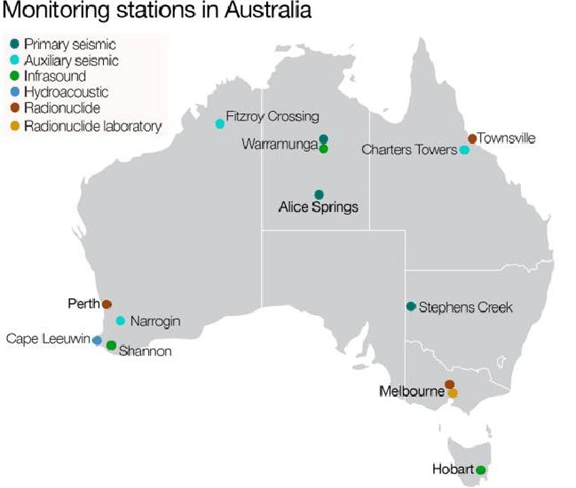
The Warramunga Seismic and Infrasound Research Station is 35km to the southeast of the township of Tennant Creek and monitors any signs of nuclear activity across the globe.
It has recorded all of North Korea’s nuclear tests.
Warramunga’s work doesn’t just include nuclear blasts. It also monitors earthquakes and storms.
ANU’s Dr Michelle Salmon said Warramunga was manned by a small team from the Australian National University’s Research School of Earth Sciences and was one of 321 monitoring stations around the world.
“The station is considered one of the best in the world for recording nuclear blasts because of its quiet site and because it is manned 24/7,” she explained.
We have people living there and this means we can deal with problems that occur immediately.
“Our station is part of a big word wide community that is trying to monitor and make sure that we know what’s going on around the world.
“You can’t explode a large nuclear weapon around the world and not let someone know about it.
“We know where and we know when a blast happens. We really know how big they are getting.”
Former president Anote Tong compares Kiribati’s future to the sinking of the Titanic, ABC News By Sarah Hancock , 13 Oct 17 Anote Tong is the former president of the Republic of Kiribati and his island home, in the central Pacific Ocean, is already suffering from the effects of climate change.
Rising sea levels are causing land to be engulfed by tidal waters, driving people away from their homes and leaving them displaced.
Anote Tong is the former president of the Republic of Kiribati and his island home, in the central Pacific Ocean, is already suffering from the effects of climate change.
Rising sea levels are causing land to be engulfed by tidal waters, driving people away from their homes and leaving them displaced.
“What I have seen in my lifetime over the years has been villages, communities, who have had to leave … because it is no longer viable,” he said. “The sea is there and there is nothing. Everything has been taken away so they have had to relocate.”……..
“As a grandfather I have got to think beyond that, as a leader I have to think beyond what will happen today, and knowing what we know today, what will happen to the next generation,” he said.
Mr Tong compared Kiribati’s future to the sinking of the Titanic.
“We are the people who will be swimming,” he said.
THERE are 321 monitoring stations around the world all designed with one common goal. The International Monitoring System (IMS) uses four technologies to monitor nuclear activity in countries including North Korea.
Unsurprisingly some of these stations are located within our own borders and play a powerful role in monitoring rogue nations.
In a piece for The Conversation, Trevor Findlay, Senior Research Fellow Department of Social and Political Sciences at the University of Melbourne reveals the key role Australia plays.
Dr Findlay writes Australia hosts six seismic, two infrasound, and one hydroacoustic station, including a large seismic array and infrasound station at Warramunga in the Northern Territory.
DETECT AND RELAY
The Vienna-based Comprehensive Test Ban Treaty Organization (CTBTO) uses the IMS to detect nuclear tests around the world.
This means if Kim Jong-un decides to conduct another nuclear test there are several monitoring stations in Australia which could potentially pick up this abnormal activity.
According to Dr Findlay its monitoring system, which began construction in 1996, is “sensitive enough to detect underground nuclear tests below 1 kiloton”.
The CTBTO picked up the September 3 blast detecting a seismic magnitude of 6.1 and a blast yield of 160 kilotons.
Data such as this is picked up is transmitted to Vienna via satellite where it is analysed and distributed to member states.
The CTBTO’s International Monitoring System is basically designed to verify compliance with the 1996 Comprehensive Nuclear Test Ban treaty.
POWERFUL TOOL
According to Associate Professor at Australian National University’s Strategic and Defence Studies Centre Dr Stephan Fruhling, the monitoring system is hugely beneficial.
“The technologies used by the monitoring system (seismic, infrasound, and radionucleides) were all used developed the Cold War to monitor other countries’ nuclear tests, and/or are also the same as used in geophysical monitoring,” he said.
However, it has a much more vital function.
“The main innovation of the CTBTO system is that it makes all raw data freely available, which means that all member states have now access to a global detection system that is meant to give confidence that the treaty is effective, whereas before only the superpowers had such capabilities,” Dr Fruhling said.
He also said the system is operating “even though the CTBTO itself isn’t actually legally in force, and probably never will be.”
Dr Fruhling said the system was very effective and expects it to become even more so over time as sensors and computing improve and the last few stations come online.
He said the system wasn’t perfect.
“There are some limits to the system in terms of very low-yield tests, especially where reduced enrichment fuels are used that do not produce a full yield but still a useful neutron flux to validate a weapons design,” he said.
“However, this is something that is of more use to the advanced nuclear powers who have a lot of experience and access to past testing data, than it is to a new proliferant like North Korea.
AUSTRALIA’S ROLE
Nuclear disarmament campaigner John Hallam said the system and Australia’s role in it was actually quite remarkable.
Mr Hallam said the system has managed to not merely detect, but diagnose every North Korea test right from their first which was just a fraction of a kiloton.
“Australia plays quite a key role, mainly with the big seismic and infrasound array at Warramunga and the Hydroacoustic station at Cape Leeuwin,” he said.
“The CTBTO manages to do amazing work not only in detection of nuclear blasts, but also in detecting earthquake and volcanic activity and a secondary role as a tsunami early warning network.”
However Mr Hallam said the current policies of the US threaten all of that as the CTBTO has been in effect “boycotted” by the Government, despite being the first to actually sign it.
CTBTO’s executive Secretary Lassina Zerbo is geophysicist who used to be the Director of the International Data Centre which processes and analyses all the data coming from the more than 300 stations around the globe.
CTBTO’s work, including the establishment and maintenance of the IMS, is mandated by the Comprehensive Nuclear-Test-Ban Treaty which was negotiated under the auspices of the United Nations Conference on Disarmament in the 1990s and endorsed by the General Assembly. It opened for signature in 1996.
Foreign Minister Julie Bishop has made the case to the US that the nuclear deal with Iran should remain. Australia has urged the US to retain the nuclear deal with Iran in the absence of any credible alternatives.
US President Donald Trump will make an announcement this week on an “overall Iran strategy”, including whether to decertify the international deal curbing Tehran’s nuclear program, the White House says.
“We are urging that it be maintained and Iran’s other behaviour be dealt with in different circumstances,” Foreign Minister Julie Bishop told ABC TV.
Australia blocks North Korean youth football team over nuclear program, http://www.sbs.com.au/news/article/2017/10/10/australia-blocks-north-korean-youth-football-team-over-nuclear-program A youth football qualifying fixture is likely to be moved offshore after the government moved to stop the North Korean team from entering Australia. The federal government has prevented a North Korean youth football team from coming to Australia to play in a tournament, saying allowing them would be contrary to its opposition to the rogue nation’s nuclear program.
The North Korean U19 team was due to play in the Asian Football Confederation championship qualifiers in November, amongst a group consisting of Australia, Hong Kong, and the Northern Mariana Islands.
The North Korean team was due to play Australia on November 8 in Shepparton, Victoria. A Victorian Government spokesman said the fixture will now be moved to a “neutral venue”.
Foreign Minister Julie Bishop confirmed she stopped the group from arriving.
“The government has decided to not allow the North Korean U19 soccer team to enter Australia for the Asian Football Confederation U19 Championship Qualifiers,” Ms Bishop told SBS World News in a statement.
“Hosting the team would be contrary to the Government’s strong opposition to North Korea’s illegal nuclear and missile development programs.
“It would also be inconsistent with our efforts to increase diplomatic and economic pressure on Pyongyang to comply with UN Security Council resolutions.”
Football Federation Australia said it was disappointed that the qualifying fixtures would now be played elsewhere.
“Football Federation Australia is disappointed that qualifying fixtures for the Asian Football Confederation U-19 Championship … are now likely to be relocated outside Australia due to the Federal Government’s decision not to grant visas to the team from DPR Korea,” a spokesman told SBS World News.
“FFA respects the Australian Government’s responsibility to make decisions on visa applications.”
It’s understood the potential financial losses from the hosting rights would be minimal but the decision would cost the Australian youth team competitive advantage.
Earlier this year, Malaysia’s qualifying match against North Korea for the 2019 Asian Cup was postponed after the two countries were involved in a tiff over the assassination of the estranged half-brother of Pyongyang ruler Kim Jong-un.
“We’re calling on all countries to sign the new UN treaty prohibiting nuclear weapons, which offers a powerful alternative to a world in which threats of mass destruction are allowed to prevail.
“We will work in coming months to persuade more nations to sign this landmark treaty.
“One of our priorities will be to bring the Australian government on board.
By Jessica Haynes The International Campaign to Abolish Nuclear Weapons (ICAN) has taken out one of the world’s most prestigious awards, the 2017 Nobel Prize for Peace.
So how did a campaign from Melbourne make its way to the international stage?
Key points:
Group honoured for “ground-breaking efforts” to achieve nuclear ban treaty
ICAN also awarded for drawing “attention to the catastrophic humanitarian consequences” of nuclear weapons
215 individuals and 103 organisations were nominated for the prize
So what is ICAN?
ICAN describes itself as a coalition of non-governmental organisations in 100 countries promoting adherence to and implementation of the United Nations nuclear weapon ban treaty.
It has advocated at the United Nations and in parliaments around the world, bringing the stories of those impacted by nuclear testing and survivors of the Hiroshima and Nagasaki bombings to a world stage.
How did it form?
ICAN set up its first office in Melbourne, with disarmament campaigner Felicity Hill as the coordinator.
It officially launched in Vienna, Austria in April 2007 during the Non-Proliferation Treaty preparatory committee meeting.
ICAN campaign director Tim Wright said it was inspired by the International Campaign to Ban Landmines, which had played a major role in the negotiation of the Anti-Personnel Mine Ban Convention, also known as the Ottawa treaty. Continue reading →
During a time when the risk of nuclear conflict is imminent, the prestigious Nobel peace prize has been awarded to a Melbourne-born advocacy group that pushed to establish the first treaty to ban nuclear weapons.
The Nobel Committee honoured the now Geneva-based group, the International Campaign to Abolish Nuclear Weapons, “for its work to draw attention to the catastrophic humanitarian consequences of any use of nuclear weapons and for its ground-breaking efforts to achieve a treaty-based prohibition of such weapons.”
The group worked to advance the negotiations that led to the Treaty on the Prohibition of Nuclear Weapons, which was passed earlier this year at the United Nations.
In July, 122 nations voted to pass the treaty, but nuclear-armed states including the United States, Russia, China, Britain and France stayed out of the talks.
The evolving tragedy that is North Korea is now at the mercy of a mere miscalculation, or accident, an isolated piece of stupidity, or a Trump shot from the hip – even just a piece of an intercontinental ballistic missile (ICBM) dropping on Japan.
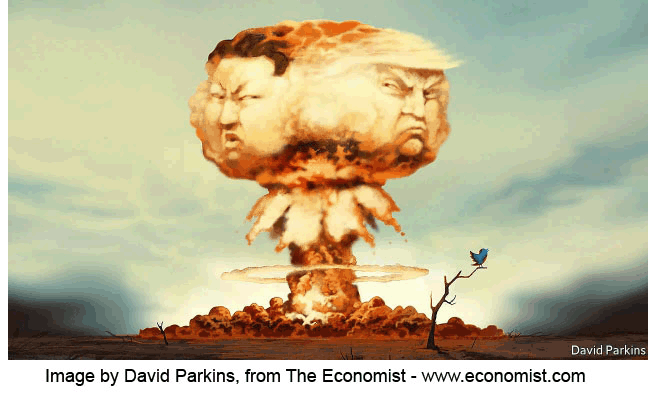
This vicarious situation necessitates Australia adopting a strong, independent, foreign policy stance on this challenge, in our national interest. The inflammatory rhetoric from both Trump and Kim Jong-un seems to have no limit, but achieves very little, except more missiles and tests from Pyongyang, and more threats of military options/retaliation from the US.
Sanctions are important, especially now they have been given greater grunt by China, but they will take many months to be fully effective. Clearly, military engagement would be catastrophic, so every effort should be made to foster effective diplomatic engagement and, ultimately, hopefully, negotiation. Obviously, the major powers, the US, China, Russia and Japan, would be fundamental to any effective resolution.
In this context, Australia needs to consider what more we can do, if anything, as a middle-ranking power, but capable, at times, of punching above our weight, especially from the point of view of our national interests.
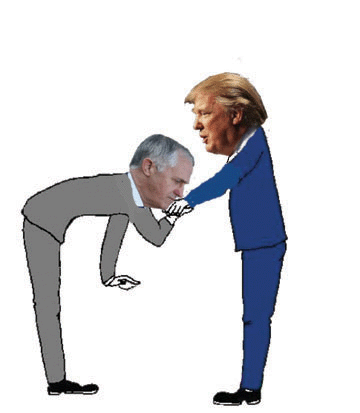
I fear that we are far too embedded in the US position, and where it may go. I am concerned that our political leadership is simply happy to be subservient to the US, leaving them, Trump, to define us. Yet, we could play a more significant role, diplomatically, in attempting to manage the emerging crisis.
In attempting to understand and strategise on how events might unfold, we would have to contemplate the possibility, even if we gave it a low probability, that an effective target for North Korean aggression could be Pine Gap – it would not kill many of us, but would represent a very significant blow to US intelligence capability.
To be absolutely clear, despite all the US bluster, I sincerely doubt that Pyongyang will ever be the aggressor, would ever initiate a war. Apparently, China has told the North Koreans that they will only come to their defence if they are attacked, but not if they are the aggressor. But have no doubt, the nuclear tests, and rocket launches, will continue, with rockets directed towards say Guam, but to land outside their territorial waters.
The point is that we need to look after our own interests, and position ourselves most effectively, from that perspective. In these terms, we could announce a desire to establish an embassy in Pyongyang, with a view to opening and developing a dialogue, perhaps, ultimately leading to a resumption of the Six Party talks.
Other back channels could also be exploited. For example, I was somewhat surprised that our Foreign Minister, Julie Bishop, didn’t create the opportunity to meet with her North Korean counterpart at the recent UN meetings. Australia could also play a significant role in co-ordinating the responses of many of our Asian neighbours, from sanctions to missile interception and defence capabilities.
We presently run our “diplomacy” with North Korea, with a non-resident ambassador, based in Seoul, making trips up North. This would surely be insulting to the North Koreans, and easily dispensed with as just another “branch of the US”. It doesn’t begin to give Pyongyang the global recognition that it so desperately craves.
We need to be seen to be able to stand on our own two feet, and we might be surprised at just how much influence we could achieve.
Despite all the sabre rattling and inflammatory rhetoric, the world needs a diplomatic solution on North Korea. Sanctions may ultimately force Pyongyang to the negotiating table, but there will be no alternative to face-to-face, hard-headed negotiations that, surely, must initially accept North Korea as an emerging nuclear power, and then focus on deterrence. Think about it from their point of view. The world seems to happily accept countries such as India, Pakistan, and Israel, as nuclear powers, but where is the balance of risks? These are risks that we don’t want to talk about, while at the same time saying that North Korea is a “clear and present danger”.
The government needs to be prepared to discuss publicly its assessment of the North Korean situation. I really don’t understand why we don’t use the processes of Parliament, and encourage a parliamentary debate, leading to a broader debate across civil society.
All too often, the way government has worked in this country is that government closes down debate on an issue, calls all the shots, and, in the end, we drift into a situation that is not necessarily in our national interest. Recall the futility of Howard’s sycophantic support of Bush junior in the Iraq war. We never should have been involved.
On North Korea, we are again letting the issue drift, driven by the possible irrationality of the US. We will end up where, in our national interest, we won’t want to be. Yet, we could play a globally significant role in resolving the matter.
John Hewson is a professor at the Crawford School of Public Policy and a former leader of the Liberal Party.
Leonid Petrov, a leading North Korean expert, said Australia could play a much better and more viable option in the crisis.
Dr Petrov, a visiting fellow at the College of Asia and the Pacific at the Australian National University, said it was obvious someone who served as US deputy assistant secretary of defence for nuclear and missile defence policy would recommend buying a US-made piece of equipment.
However, Dr Petrov said there was a cheaper option on the table.
“Australia can save a lot of money (and lives) by using its diplomatic channels and mediate a comprehensive peace deal, which North Korea is begging for since 1974,” he said.
North Korea missile crisis: Could Australia be targeted by Kim Jong-un? A PENTAGON adviser has warned Australia could be on the receiving end of Kim’s fury as experts say anything could happen.news.com.au Debra Killalea@DebKillalea 2 Oct 17
IT WAS a stunning warning that made Australia sit up and take notice.
Former Pentagon official Dr Brad Roberts said Australia needed to develop greater missile defences in the event of a North Korea missile strike.
Dr Roberts, who served as US deputy assistant secretary of defence for nuclear and missile defence policy between 2009 and 2013, also warned Australia had no say in Kim Jong-un’s decisions.
“Unfortunately, Australia doesn’t really get to choose whether or not North Korea threatens it — it’s the choice that the North Korean leader,” he told the ABC.
“His objective is to make us fearful so that our leaders will not stand up to his threats and coercion.”
But just how much of a target is Australia, and are we likely to feel the wrath of Kim?
CAN A NORTH KOREAN MISSILE HIT AUSTRALIA?
Experts warn anything is possible and hope this scenario remains an unlikely possibility. Continue reading →
I never had any doubt about the genuineness of Hawke’s position when he said at the time that “we are not an aligned country which had to agree, or did agree, with every single aspect of US policymaking.
The ability to maintain a healthy balance in our alliance relationship seems, unhappily, to have largely evaporated since the Hawke-Keating years.
Gushing sentiment has become the norm..
The election of President Donald Trump has given a new urgency to restoring some real balance in the alliance relationship. We can only hope that enough cooler and wiser heads than his own will emerge to eventually dispel the worst fears generated during his campaign and in his first weeks in office.
We now have to be ready for American blunders as bad as, or worse than, in the past. We will have to make our own judgments about how to react to events, based on our own national interests.
Australian foreign and defence policy for the foreseeable future is going to have to be founded on three core principles: More self-reliance. More Asia. Less United States.
Trump era: Australia should rely less on the US, GARETH EVANS, The Australian,
Australia’s alliance with the United States was not undervalued by the Hawke-Keating governments. But nor did we overvalue it, and we certainly did not accept that its care and maintenance demanded obeisance to all Washington’s whims and wishes.
Then, as today, there could be little doubt that the ANZUS alliance contributes hugely to our military capability, above all in the access it gives us to American intelligence and weapons systems. As self-reliant as we may be, we are by no means completely self-sufficient, certainly when it comes to really major threat contingencies. It has been credibly estimated that without the alliance, Australia would have to triple or quadruple its defence spending, at a budgetary cost of an additional $70 billion to $100bn a year. There is, moreover, the deterrent value against potential aggressors that a close alliance with a global superpower, on the face of it, seems clearly to provide.
But the issue of deterrent value needs closer scrutiny than it usually gets. The ANZUS Treaty formally provides only that each party “will consult together whenever in the opinion of any of them the territorial integrity, political independence or security of any of the Parties is threatened in the Pacific” (Article III) and that in the event of an “armed attack in the Pacific Area on any of the Parties” each “would act to meet the common danger in accordance with its constitutional processes” (Article IV). That is in significant contrast to the language of Article 5 of the NATO treaty, whereby “The Parties agree that an armed attack against one or more of them in Europe or North America shall be considered an attack against them all” and commit to applying armed force as necessary in response. Continue reading →














 Antinuclear