Where’s the policy?’: Coalition criticised over ‘pipedream’ nuclear plan

Sky News Australia, 19 Feb 25, https://www.msn.com/en-au/news/other/where-s-the-policy-coalition-criticised-over-pipedream-nuclear-plan/ar-AA1zjMZd
Sky News Political Editor Andrew Clennell believes the rate cut by the Reserve Bank “puts the focus” on Opposition Leader Peter Dutton.
The Reserve Bank has cut the official cash rate for the first time in more than four years, lowering it by 25 basis points, from 4.35 per cent to 4.10 per cent.
“I think this very much puts the focus on Peter Dutton now, I have to say,” Mr Clennell said.
“We’re at five minutes to midnight on an election now. Where’s the policy?
“They announced a nuclear policy – seven federal government-owned nuclear power plants, and then they kind of ran away from it.
“They’d have to convince a hostile Senate to end the moratorium.
“That looks like a pipedream.”
Before we decide where to dump nuclear waste, let’s answer the bigger questions
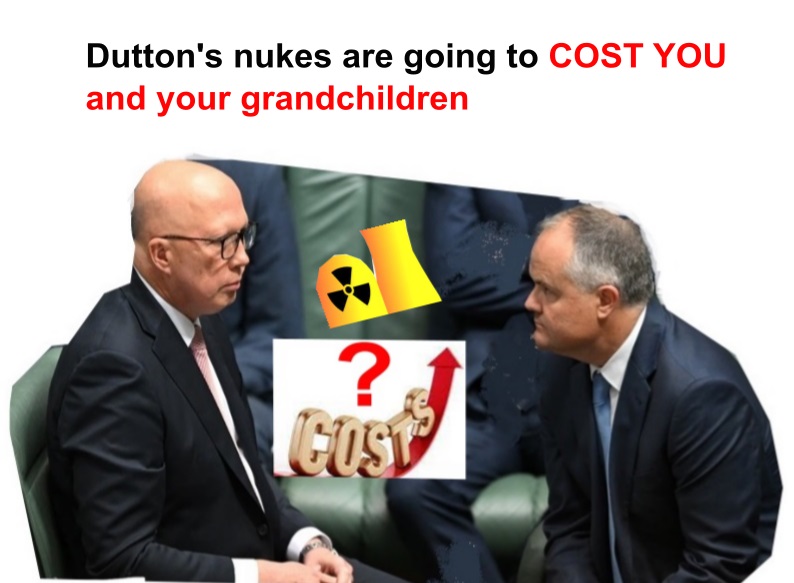
February 19, 2025 AIMN Editorial, Australians for Affordable Energy, https://theaimn.net/before-we-decide-where-to-dump-nuclear-waste-lets-answer-the-bigger-questions/
Australians for Affordable Energy is urging caution following calls for South Australia to become a nuclear power hub and waste storage site, warning fundamental questions about nuclear remain unanswered.
Alexander Downer’s comments advocating for nuclear power plants in South Australia and positioning the state as a nuclear waste storage site are deeply concerning given there has been no comprehensive discussion around nuclear power.
The nuclear debate must go beyond location discussion and first address economic and logistic concerns, Australians for Affordable Energy spokesperson Jo Dodds said.
“Before we even talk about where to dump nuclear waste, we need to ask some hard questions. How much will nuclear really cost Australian taxpayers? What will it do to energy prices and the cost of living? How long will it take to build? Who funds insurance?” Ms Dodd said.
“There are global examples of nuclear projects that have blown out in cost and time frames and just fallen over, leaving consumers to foot the bill. Australians deserve transparency on these issues before any commitments are made.”
The practical implications of nuclear power for everyday Australians remain unclear. Australians deserve a full and open discussion of nuclear power’s real impacts rather than ideological endorsements from political figures.
“We know nuclear energy requires massive upfront investment, long construction times, intensive oversight, expensive insurance, and creates long-term waste management challenges. These factors could seriously impact affordability – for the country and individuals who will have to pay the bills since private investment won’t go near nuclear,” Ms Dodds said.
“We need an evidence-based national conversation about our energy future before committing to specific locations for waste storage. We can’t afford to let political enthusiasm override economic and practical considerations.
“If politicians are serious about nuclear, let’s see the full breakdown of costs, risks and alternatives before making any decisions.”
AFAE warns against locking into costly or uncertain energy options and calls for a transparent review of nuclear power in Australia before any site is considered for waste storage.
Nuclear Gamble is an Economic Wrecking Ball
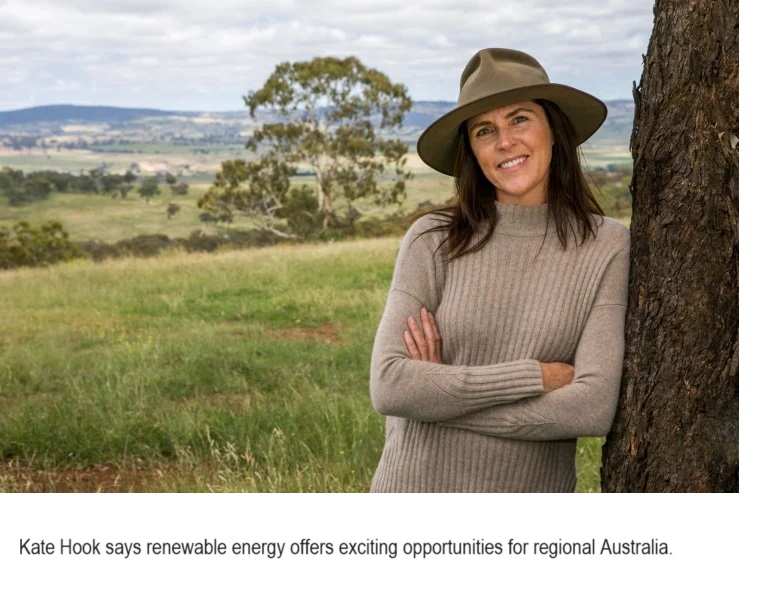
February 17, 2025 AIMN , Kate Hook
Nuclear gamble is an economic wrecking ball – Lithgow and the Central West deserve better
Independent candidate for Calare, Kate Hook, has slammed the Coalition’s nuclear proposal, calling it an economic wrecking ball that will waste billions, push up power prices, and stall job creation in regional Australia.
“Energy experts, market operators and Australia’s leading economists have been clear – Australia can achieve a secure, reliable, and affordable power system without nuclear power,” Ms. Hook said. “The Coalition’s plan is a costly distraction, and I will not support it.”
“The communities that will suffer most from this reckless policy are the very ones that need investment in real, job-creating industries right now – not in 15 or 20 years.”
Ms. Hook called out the nuclear plan for what it is – a stalling tactic to prop up fossil fuel operators, keep government subsidies flowing to outdated industries, and leave Australian taxpayers to foot the bill.
Nuclear reactors take decades to build and cost tens of billions of dollars – public money that could instead be spent on renewables, storage, and grid upgrades today. By the time nuclear power could even begin operating, Australia’s energy system will already be overwhelmingly powered by cheaper, cleaner alternatives.
“We are at 40% renewable energy now and in the last 6 years alone, we’ve already added over 46 TWh (Terra Watt hours) of annual renewable energy generation to the grid. This number might not mean much to most people but it’s huge! It’s the equivalent of six nuclear power stations. And we did it in six years – not 15 or 20 years,” Ms Hook said.
Renewables and Storage: Reliable, Affordable, and Ready Now
The Australian Energy Market Operator (AEMO) has mapped out the most efficient path forward—and nuclear isn’t part of it. The smart, cost-effective way to secure Australia’s energy future is through renewables, backed by battery storage, pumped hydro, and modern grid technology.
Big battery projects like South Australia’s Hornsdale Power Reserve are already proving their worth. Originally built with a capacity of 129 MWh – enough to power 30,000 homes for a day – it has since expanded to 194 MWh, providing power to 50,000 homes and stabilising the grid within milliseconds during sudden demand spikes.
“This fast response prevents blackouts and keeps energy prices stable—something nuclear power just can’t do,” Ms. Hook said.
Pumped hydro projects like Snowy 2.0 will ensure around-the-clock reliability. When completed, its 2.2 GW capacity will generate enough electricity to power three million homes during peak demand – like when air conditioning use surges on a hot summer evening.
With 350,000 MWh of storage, Snowy 2.0 could power 500,000 homes for an entire week or every home in Sydney for three days.
“We don’t need to waste time and money on nuclear power when we have already invested in proven, ready-to-go solutions that lower energy bills and create jobs right now,” Ms. Hook said.
Lithgow Needs Smart Investments, Not Costly Distractions
Kate Hook recognises that Lithgow has been at the heart of Australia’s energy production for generations. With coal mines closing and Mt Piper Power Station scheduled to shut in 2042, Lithgow needs a real plan for its future – not a decades-long delay.
“Lithgow deserves practical, affordable, and proven energy solutions – not a risky, drawn-out experiment that will leave taxpayers footing the bill for decades,” Ms. Hook said.
Beyond spiralling costs and construction delays, nuclear power comes with long-term risks that regional communities like Lithgow will be forced to bear. The Coalition has no plan for nuclear waste storage, no consultation with impacted communities, and no clear strategy for financing these massive projects.
……………………………………….“Nuclear is a dead-end policy – an economic wrecking ball that will drive up power prices and leave communities paying the price,” Ms. Hook said. “Instead of pouring billions into an outdated, high-risk technology, we should be investing in industries that will deliver affordable energy and secure jobs for Lithgow and all of Calare.”
A Clear Choice on Election Day
With voters in Calare facing a critical decision at the next election, Kate Hook urged the community to reject the Coalition’s nuclear “plan” and back a renewables-led future.
“This election is about who we trust to deliver cheaper energy, good jobs, and a secure future for our region,” Ms. Hook said. “Nuclear power in Australia is an expensive fantasy which is not backed by economic or energy experts – renewables are the real opportunity for Calare.”…………………………. https://theaimn.net/nuclear-gamble-is-an-economic-wrecking-ball/
Dutton’s nuclear disaster: Cheap lies and a $20 billion deficit
By Steve Bishop | 17 February 2025, https://independentaustralia.net/politics/politics-display/duttons-nuclear-disaster-cheap-lies-and-a-20-billion-deficit,19447
The Coalition’s nuclear policy announcement comes with a massive price tag but is also built on disinformation, writes Steve Bishop.
A $20 BILLION deficit and cheap lies mean that Opposition Leader Peter Dutton‘s attempt to “extend the life” of coal-fired power plants with a nuclear “fix” has come spectacularly unstuck.
Dutton and the Coalition stand condemned for presenting the public with a shoddy, ill-prepared policy on a multi-billion dollar project that the Climate Council warns could risk power shortages in the 2030s.
On 13 December last year, Mr Dutton promised:
SEARCH
Daily Telegraph tries and fails to stage antisemitic incident
Share the love — Gift an IA Subscription!
Dutton isn’t just exploiting antisemitism — he’s driving it
Dutton’s vow to slash public servant numbers another Coalition disaster
The Apprentice tells Trump’s supervillain origin story
Daily Telegraph tries and fails to stage antisemitic incident
Share the love — Gift an IA Subscription!
Dutton isn’t just exploiting antisemitism — he’s driving it
Dutton’s vow to slash public servant numbers another Coalition disaster
The Apprentice tells Trump’s supervillain origin story
Politics Opinion
Dutton’s nuclear disaster: Cheap lies and a $20 billion deficit
By Steve Bishop | 17 February 2025, 3:00pm | 0 comments |

The Coalition’s nuclear policy announcement comes with a massive price tag but is also built on disinformation, writes Steve Bishop.
A $20 BILLION deficit and cheap lies mean that Opposition Leader Peter Dutton‘s attempt to “extend the life” of coal-fired power plants with a nuclear “fix” has come spectacularly unstuck.
Dutton and the Coalition stand condemned for presenting the public with a shoddy, ill-prepared policy on a multi-billion dollar project that the Climate Council warns could risk power shortages in the 2030s.
On 13 December last year, Mr Dutton promised:
‘By 2050, our plan will deliver up to 14 GW of nuclear energy, guaranteeing consistent and stable electricity for all Australians.’
Yet the Coalition’s costings report, released on the same day, repeatedly deals with only 13 GW.
That’s 1,000 MW short of the target.
Three small modular reactors (SMRs) producing 345 MW each would be needed to make up the shortfall at a cost of almost $20 billion based on the US$4 billion (AU$6.2 billion) price of Opposition energy spokesman Ted O’Brien‘s favoured Natrium reactor.
Just to put this critical mess in focus — that’s twenty thousand million dollars. It makes a mockery of Dutton’s claim that “the Liberal Party has always been a better economic manager…”
And then come the cheap lies.
Mr Dutton claims:
“…electricity is cheaper where there is a presence of nuclear energy. That is a fact.”
No, it’s not a fact. It is a lie.
Ted O’Brien has repeatedly talked about Ontario as having cheap power because it has nuclear reactors.
But Quebec’s electricity prices are far cheaper than Ontario’s. Quebec closed its only nuclear power plant in 2012.
Not only that, but Quebec’s power company paid the provincial government a dividend of $2.5 billion in 2023/24.
On the other hand, the Ontario Government pays subsidies of up to $720 a year to families of four earning less than $65,000 a year.
Coalition frontbencher Dan Tehan says nuclear power contributes to low power prices in Tennessee but Electric Choice shows that this month Idaho, Kentucky, Oklahoma and Utah all have lower power prices — and none of them has nuclear power,
Dutton claims “Australian families at the moment are paying some of the highest energy costs in the world” and they would enjoy ‘massive savings’ if we had nuclear power.
The Opposition Leader also says it’s a fact that countries such as the UK and France, with their nuclear power, have cheaper power prices than Australia.
Here’s the lie exposed again. It’s a complete meltdown. According to Statista, power prices in the UK and France are more expensive than in Australia.
Here’s another lie.
Mr Dutton asserts:
‘…nuclear energy… has proven to get electricity prices and emissions down all over the world…’
Slovenia has a nuclear power plant but is one of the most expensive providers in Europe with Switzerland‘s nuclear power prices not far behind.
Slovakia generates half its power from nuclear plants but power prices are more than twice what Norwegians, with no nuclear power, pay.
Then Dutton has the chutzpah to accuse the Government of lying when it points out that nuclear power is the most expensive type of energy.
In the 2021 edition of its annual cost report, Wall Street firm Lazard estimated that the levelised cost of electricity from new nuclear plants will be $131–204 per megawatt-hour (MWh), whereas newly constructed utility-scale solar and wind plants produce electricity at somewhere between $26–50MWh.
An independent report commissioned by the Clean Energy Council and conducted by Egis, a leading global consulting, construction and engineering firm, has confirmed that nuclear energy is up to six times more expensive than renewable energy.
The Institute for Energy Economics and Financial Analysis (IEEFA) found nuclear power in Australia could result in electricity bills rising by $665 a year on average
And the Commonwealth Scientific and Industrial Research Organisation (CSIRO) has found:
‘…building nuclear reactors in Australia would cost at least twice as much as renewable power…’
No wonder that Coalition whistleblower Senator Matt Canavan revealed the nuclear policy is no more than a fix. It doesn’t even deserve a half-life.
Taxpayers should not foot the bill for nuclear risk
Australians for Affordable Energy, 17 Feb 25, https://theaimn.net/taxpayers-should-not-foot-the-bill-for-nuclear-risk/
If private insurers refuse to cover nuclear reactors the financial risks will be shifted onto Australian taxpayers, meaning we are still unclear how much taxpayers will have to cover of the nuclear bill.
Australians for Affordable Energy has expressed deep concern over the revelation the private sector may not be able to insure nuclear reactors, following comments on Monday from the CEO of the Insurance Council of Australia.
Many of Australia’s leading insurance companies won’t cover damage from a nuclear disaster, leaving the government as the insurer. By shifting the financial burden of insuring nuclear facilities onto taxpayers, Australians could be exposed to potentially tens of billions of dollars in liabilities if a nuclear accident were to occur.
“We know that private investors won’t put money into building the industry, that we will need to create a massive new government agency to oversee it, and now we are hearing that we will need to pay for the insurance too? What’s next?”
“Advocates for nuclear energy need to say whether it can stand on its own, including paying their insurance. And they need to tell us what other costs we might be asked to carry. The fact is by the time the reactors are done it won’t be us paying the bills for the insurance, it’ll be our grandkids. I’d like to know what we’re signing them up for. ”
Australians for Affordable Energy spokesperson Jo Dodds, a bushfire survivor and advocate for evidence-based policy, said: “Australians are already struggling with rising energy costs, the last thing we need is a power source that could further inflate our electricity bills and our taxes.
“The high costs associated with uninsured nuclear power could be passed onto consumers, who are already looking at paying higher bills if we were to shift to nuclear power. This is money hardworking Australians simply can’t afford to pay.”
AFAE is warning against locking into costly or uncertain energy options and is calling for greater transparency on the long-term costs of competing energy plans.
Why are young people like this 18-year-old fronting the pro-nuclear push in Australia?
SBS News, 13 February 2025
The regional sessions were not publicised beforehand on Nuclear for Australia’s social media accounts or the tour page on its website — you could only register for tickets if you knew the URL for the event’s webpage.
Campaigns director for the Conservation Council of Western Australia, Mia Pepper, said when she tried to get tickets for the Perth event online, she was denied. She said a colleague also failed to get tickets using their real name, but able to get in using an alias.
Shackel said Nuclear for Australia Googles people’s names beforehand to determine whether they are “likely going to cause a disruption or a threat”
Some polling suggests older Australians are more supportive of nuclear power than their younger counterparts. So why are young people fronting a pro-nuclear push?
SBS News, By Jennifer Luu, 13 February 2025
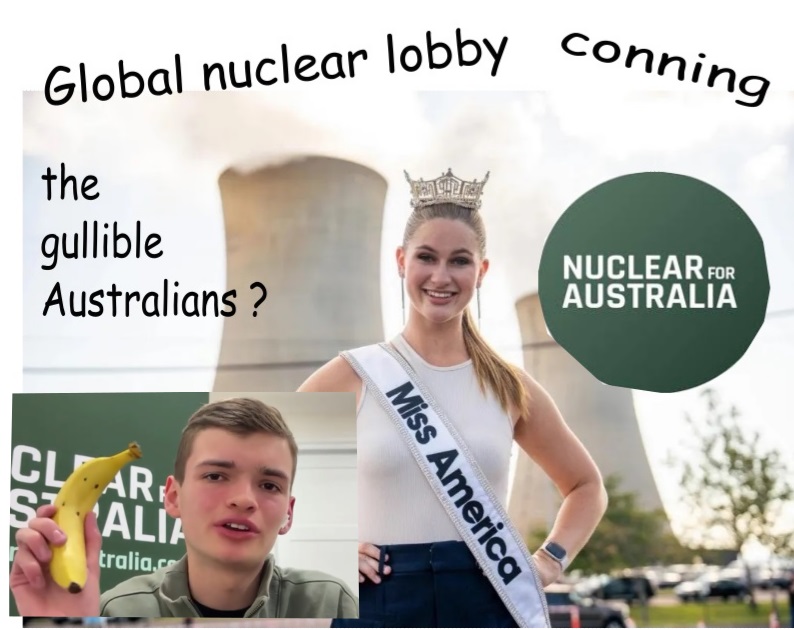
In a function room at Brisbane’s The Gabba sports ground, around 600 people have gathered to hear Miss America 2023 try to convince Australians nuclear power is a good idea.
Sporting a blue cocktail dress, blonde hair and a wide smile, 22-year-old Grace Stanke looks the part of a beauty pageant contestant.
She’s also a nuclear engineer touring the country with Nuclear for Australia: a pro-nuclear lobby group founded by teenager Will Shackel and funded by donors that include entrepreneur Dick Smith.
The event — billed as an information evening featuring a panel of experts — is off to a rocky start. A protester steps in front of the audience and speaks into a microphone.
“All of the organisers, presenters and sponsorship of this event tonight has a very deep vested interest — ” he says, before he’s drowned out in a chorus of boos and the mic is seized from his hand.
Audience members continue to disrupt last month’s event, raising their voices and speaking to the crowd before being herded out by security.
Among them is Di Tucker, a retired psychologist concerned about climate change. She said she became upset after submitting half a dozen questions online to be answered by the panel — and felt like they were being deliberately ignored.
“I felt so frustrated by the lack of factual information in that so-called information session forum on the safety, the timescale and the reality of nuclear energy,” Tucker told The Feed.
“I did stand up and I addressed the crowd, and I said something like: ‘You people need to go away and do your own research … it’s glossing over facts’.”
Nuclear for Australia founder Will Shackel, who was emceeing, estimated there were 20 to 30 protesters heckling the room.
He labelled their behaviour “simply unacceptable and … not in the interest of a fair discussion”.
“They were yelling abuse at us on stage. We had people come up to Grace at the end, call her a clown,” he claimed.
Shackel told The Feed: “We had people [who] had to be physically dragged out because they were resisting security … it was pretty ugly and pretty disturbing.”
Tucker disputes this: “Nobody I saw leave the room was hostile or aggressive, physically aggressive towards the security guards.”
“In fact, it was the opposite. The security guards were shoving the people outside.”
Outside, a separate group of protesters wields banners warning against the dangers of radioactive waste.
The words “Nuclear energy distracts from the climate emergency” are projected onto The Gabba over the image of a red herring.
The teen and the beauty queen
Tucker said the audience was mostly male and over 60. So why are two young people fronting the pro-nuclear movement in Australia?………………………….
As well as launching Nuclear for Australia — which describes itself as “the largest nuclear advocacy organisation in Australia” with over 80,000 supporters — he’s addressed a Senate committee and interviewed French President Emmanuel Macron for his organisation’s social media at the COP28 climate conference in Dubai in 2023.
Shackel first became fascinated with the nuclear debate while in high school in Brisbane.
“I’d just done a school assignment on nuclear energy when I realised it was banned. And that, as a 16-year-old kid, was pretty shocking to me,” he said.
Australia is one of the few countries where using nuclear energy to produce electricity is illegal. The ban was introduced in 1998, when the Howard government made a deal with the Greens in order to build a nuclear reactor in Sydney for research purposes.
At 16, Shackel launched a petition calling on Australia to lift its nuclear energy ban, garnering a flurry of media attention……….
As well as launching Nuclear for Australia — which describes itself as “the largest nuclear advocacy organisation in Australia” with over 80,000 supporters — he’s addressed a Senate committee and interviewed French President Emmanuel Macron for his organisation’s social media at the COP28 climate conference in Dubai in 2023……………………………
Nuclear power is still a contentious topic, but more Australians have become supportive of the idea over time.
A 2024 Lowy Institute poll of 2,028 Australians
indicates 61 per cent support Australia using nuclear power to generate electricity, while 37 per cent were opposed.
Among the 18- to 29-year-olds surveyed, 66 per cent supported nuclear power while 33 per cent were opposed.
In contrast,
a December 2024 poll of 6,709 people conducted for the Australian Conservation Foundation suggests young people were less likely to agree that nuclear is good for Australia, compared to older respondents. For example, 42 per cent of males aged 18-24 agreed, while 56 per cent of males over 54 agreed.
There’s also a gender gap — in the same poll, just over a quarter of women thought nuclear would be good for Australia, compared to half of men.
Nuclear for Australia hopes Grace Stanke can convince the sceptics. Dubbed “the real-life Barbenheimer”, she works for the operator of the largest fleet of nuclear power plants in the US, Constellation. (The company operates 21 of the US’s 94 nuclear reactors).
Now 18, Shackel suggests young Australians are more open-minded towards nuclear power than older generations and are more likely to support parties that are concerned about climate change……..
Physicist Ken Baldwin speculates the rise in support for nuclear power is due to shifting demographics.
He said older generations are more likely to have historical hangups around the dangers of nuclear power, having lived through the British and French weapons tests in the Pacific and nuclear catastrophes like the 1986 accident in Chernobyl and the 2011 accident in Fukushima. ……
“The younger generation … doesn’t have that particular historical baggage, and perhaps they’re more attuned to thinking about the need to do something about climate change,” he said.
Nuclear for Australia hopes Grace Stanke can convince the sceptics. Dubbed “the real-life Barbenheimer”, she works for the operator of the largest fleet of nuclear power plants in the US, Constellation. (The company operates 21 of the US’s 94 nuclear reactors)…………….
Nuclear for Australia has been drumming up public support for nuclear power over the past fortnight, touring every capital city (except Darwin) and holding a parliamentary briefing in Canberra.
It also targeted regional areas near the Coalition’s proposed sites for future nuclear power stations — including Morwell in Victoria, Collie WA, Port Augusta SA, Callide and Tarong in Queensland and Lithgow in NSW. The Coalition says its taxpayer-funded plan is for five large and two smaller reactors, with the smaller ones to come online in 2035 and the rest by 2037.
Nuclear for Australia was slow to reveal all the names for a total number of regional locations for the tour. During the first week of the tour, Nuclear for Australia told The Feed there would only be two regional stops.
The regional sessions were not publicised beforehand on Nuclear for Australia’s social media accounts or the tour page on its website — you could only register for tickets if you knew the URL for the event’s webpage.
Campaigns director for the Conservation Council of Western Australia, Mia Pepper, said when she tried to get tickets for the Perth event online, she was denied. She said a colleague also failed to get tickets using their real name, but able to get in using an alias.
She accused Nuclear for Australia of blacklisting known anti-nuclear activists and trying to avoid criticism by attempting to “creep around the country”.
“If they were really genuine about having a mature debate, they would do their best to invite some people like myself that have engaged really respectfully in the debate over many years to answer the tough questions,” she said.
Shackel said Nuclear for Australia Googles people’s names beforehand to determine whether they are “likely going to cause a disruption or a threat”, and that regional events aren’t publicised on social media because they are not relevant to city-based audiences.
“We care about the safety of our attendees, we care about the safety of our experts,” Shackel said.
“If we believe that someone is a known protester … someone who could cause a physical threat to people in there, we will not allow them in.”
Pepper said: “I have never been physically aggressive to anybody in my entire life.”
“The idea that because you are opposed to nuclear power, you somehow would be aggressive or violent is absolutely outrageous.”
Locals left with more questions than answers
South of Perth, around 100 of the 9,000 residents of the tiny coal mining town of Collie showed up to the Nuclear for Australia event, hoping to learn more about how living next to a nuclear reactor could affect them.
The Coalition has proposed converting Collie’s coal-powered station into a nuclear power plant. But the state government is vowing to phase out coal by 2030 and there’s little chance nuclear power could come online by then, leaving coal workers in limbo.
Resident Jayla Anne Parkin said the information session was “an utter waste of time”, and she came away with more questions than answers. “Their whole speech was very generic. They were probably using the same speech for every single area,” she said.
Parkin asked one of the experts where the water for a nuclear power plant would come from — with large amounts needed to cool the radioactive core.
“He gave a long-winded speech about how we can take any body of water, whether it be the ocean, the river, pool, sewage, and treat it and turn it into the water. But at the end of him answering it, he still didn’t tell me what source of water in Collie they were going to use,” she said.
“We’re very limited with water here as it is.”……………………………………………
there have been reports about Shackel’s alleged political ties.
A 2024 research report from progressive activist group GetUp on nuclear disinformation in Australia
analysed Shackel’s LinkedIn connections and reported that their political party affiliation leant heavily towards Liberal Party MPs, Senators and advisors.
GetUp reported at least 36 of Shackel’s connections, including 11 current or former politicians, were directly linked to the Liberal Party — with the party having the highest concentration of current employees from a single organisation in his network…………………………………..
Lobby groups are allowed to have political party affiliations. While registered charities can participate in campaigning and advocacy, they “cannot have a purpose of promoting or opposing a particular political party or candidate”, according to the Australian Charities and Not-for-profits Commission.
……………………………………………………… Professor Ken Baldwin said nuclear is “not really viable” as an option for decarbonising Australia by 2050, as it would take 15 years at the very minimum to develop the necessary regulations and build a nuclear power station.
“We will have, according to the current plans, converted our current energy system to almost an entirely renewable energy system by that time,” Baldwin said.
“Australia is at the leading edge of the renewable energy transition. We’re installing solar and wind at one of the fastest rates per capita of any country in the world.”…………… https://www.sbs.com.au/news/the-feed/article/will-shackel-australia-pro-nuclear-movement-young-people/gucu0iefz
Dutton’s nuclear policy is a Coalition scam
By Steve Bishop | 10 February 2025, https://independentaustralia.net/life/life-display/duttons-nuclear-policy-is-a-coalition-scam,19427
Overwhelming evidence is proving the Coalition’s nuclear plan to be a scam, writes Steve Bishop.
OPPOSITION LEADER Peter Dutton is scamming Australians with a nuclear power promise he knows he cannot deliver.
LNP research would have revealed the impossibility of providing nuclear power by the Coalition’s target of the mid-2030s.
This means a Dutton government would continue the years of Coalition ineptitude in tackling climate change and failing to provide a workable energy policy.
Coalition Senator Matt Canavan has revealed it’s nothing more than a “fix”.
Canavan said:
“Nuclear is not going to cut it. But we’re latching on to it… because it fixes a political issue for us… But it ain’t the cheapest form of power.”
In other words, it’s a con. Or to use a good Aussie word: a rort.
It’s why an internet search has found no trace of an authoritative nuclear body or expert endorsing the Coalition’s nuclear timeframe.
It’s simply a version of the old-time medicine show that peddled worthless cures to the gullible. The evidence demonstrates that the flimflammery of Mr Dutton’s Miracle Nuclear Elixir cannot work.
Mr Dutton promised:
‘A Federal Coalition Government will initially develop two establishment projects using either small modular reactors or modern larger plants such as the AP1000 or APR1400. They will start producing electricity by 2035 (with small modular reactors) or 2037 (if modern larger plants are found to be the best option).’
The CSIRO found in its GenCost 2023‐24 report that the earliest deployment for large-scale nuclear rectors would not occur until after 2040.
In the U.S., which has a nuclear power industry, AP1000 units at Vogtle, Georgia took 15 years to build, more than twice the projected timeline.
In Finland, the 1600mw Olkiluoto 3 was completed in 2023 — 18 years after construction started.
Even in China, with fewer hurdles to jump and a massive nuclear industry, it took 14 years for the Sanmen1 nuclear power station to be completed with plans for two units approved in 2004 and the first 1200mw reactor starting commercial operation on September 2018.
So it would be impossible to switch on a large plant in Australia before 2040. Is it feasible for the Coalition to build small modular reactors (SMRs) by 2035 as projected?
The ANU Institute for Climate, Energy and Disaster Solutions suggests it would be more like 15 years before the first reactor could start producing.
It says:
In Western countries… recent construction times have far exceeded a decade.
Before any nuclear power plant can be built here, we would first need to establish a regulatory system. That could take up to five years.
The Institute for Energy Economics and Financial Analysis (IEEFA) has found:
‘SMRs would not be operating before the 2040s in Australia, too late to replace coal.’
It also revealed construction delays of 12 to 13 years had occurred in four of the few completed SMRs in Argentina, China and Russia.
Similarly, the Australian Academy of Technological Sciences and Engineering (ATSE) has found
‘…a mature market for the technology may emerge in the late 2040s.’
Professor Hugh Durrant-Whyte, a nuclear engineer, told a NSW inquiry in 2020 that it would be naïve to think a power plant could be built in less than two decades.
The UK, which already has nuclear power stations, claims it is running the world’s fastest process to deliver an operational SMR by the mid-2030s. But it started this process in 2021 with a target date of the early 2030s and that has already blown out to the mid-2030s — some 16 years on from 2021.
This process aims to invest in demonstration SMRs in 2029. But a research paper filed on Social Science Research Network (SSRN) has found that if it then takes only two years to deploy resources ready for construction, only three years to build the plant and a further two years to demonstrate successful operation, any follow-on capacity would only come online well after 2040.
Even if a Coalition government was able to emulate this “fastest” process it would be after 2040 before an SMR is built. But a graph on page 7 of the plan released by Mr Dutton shows about 1,750mw of nuclear power being produced by 2036.
That would require six reactors having gone through the planning process, built, tested and commissioned — an impossibility based on the expert evidence.
In June, Mr Dutton said:
“I’m very happy for the Election to be a referendum on energy, on nuclear, on power prices…”
The overwhelming evidence means the Coalition scam should be rejected at the ballot box.
Lidia Thorpe erupts in a fiery outburst at an American pro-nuclear activist during her visit to Parliament, (Media coverage of Dutton’s nuclear campaign- example 2)
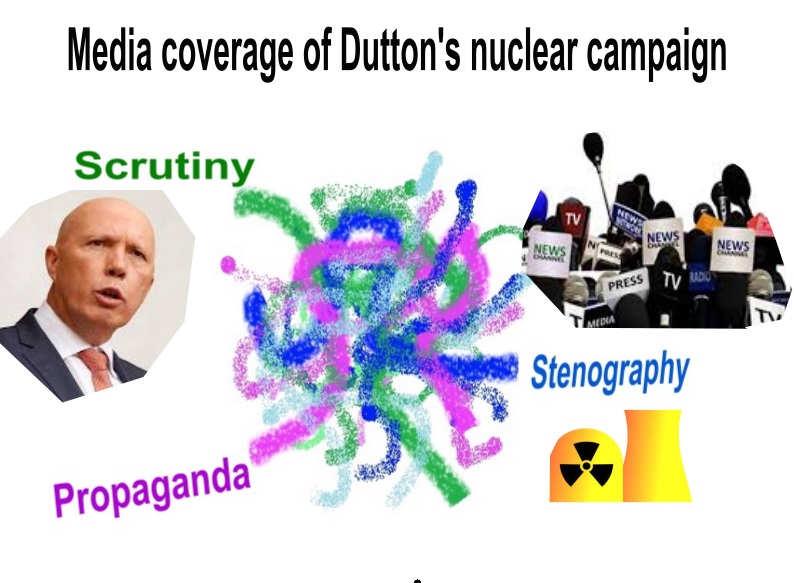
This article, despite “fiery” language , is the STENOGRAPHY style of journalism – i.e – tells us what was said and done, without being propaganda, but also without examining, scrutinising, what was said.
- American visitor Grace Stanke heckled by Thorpe
- Ms Stanke’s sponsor, Dick Smith, welcomes publicity
The 22-year-old is touring Australia advocating nuclear energy, in a trip partly funded by entrepreneur Dick Smith.
Mr Smith told Daily Mail Australia that Ms Stanke is ‘obviously very capable’ and he will meet her at a dinner in Sydney on Wednesday night.
In reaction to Sen Thorpe’s outburst, Mr Smith said: ‘That’s going to create some publicity for this important issue, I think it’s good.
‘I’m very concerned about climate change for our grandchildren and we need as much discussion as possible.
‘My strong view is that the only way we can reduce carbon to very low levels is nuclear.’
He added that he had a ‘lot of Leftie friends that are completely and utterly opposed to nuclear and it’s like a religion with them’.
‘I’m pro-renewables but it’s delusional to run the country on them.’
The businessman has previously come out in support of Opposition leader Peter Dutton’s nuclear plan.
Last year Mr Dutton pledged to build seven publicly-owned nuclear power plants in Australia if elected, with the first predicted to come online from the mid-to-late 2030s, as they require meticulous development.
He has argued nuclear will be crucial to stopping blackouts and lowering electricity bills as it can provide relatively cheap baseload power in the same way coal did, without the pollution.
He also said his $331billion plan will be 44 per cent cheaper than Labor’s program to almost replace coal and gas power with solar and wind energy within 15 years.
Labor’s plan is for renewable energy to comprise 82 per cent of Australia’s energy generation by 2030, rising to 98 per cent by 2040 based on solar and wind.
Both sides of politics support a goal of net zero carbon dioxide emissions by 2050, but the Coalition sees nuclear making up 38 per cent of Australia’s electricity generation by that time, with solar and wind energy making up 49 per cent.
Nuclear curious? Here’s what you need to know about the Coalition’s energy claims
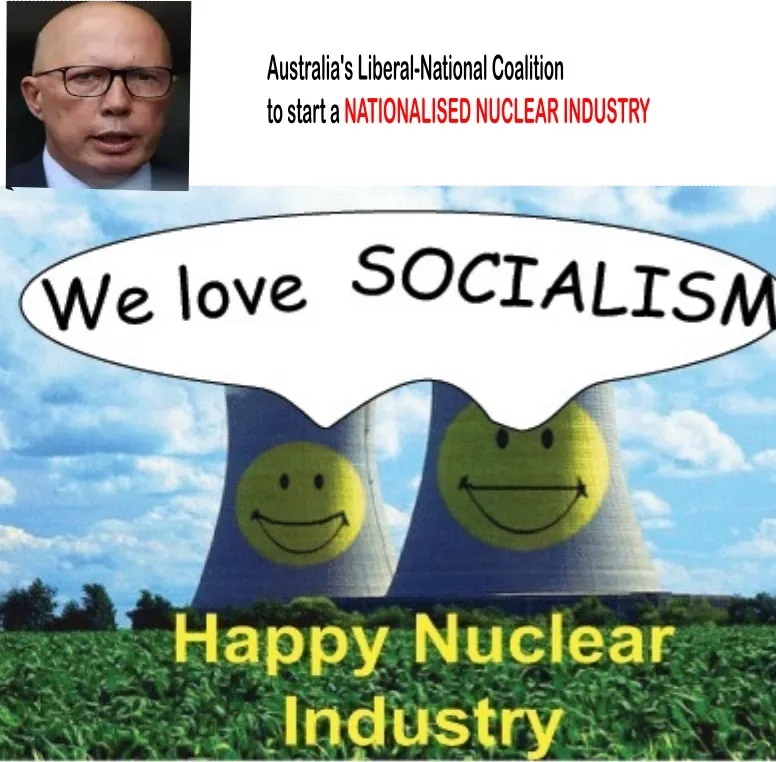
Peter Dutton says building nuclear reactors will bring down power prices but experts doubt it and say it will cost the climate too
Graham Readfearn, https://www.theguardian.com/australia-news/2025/feb/04/nuclear-power-liberal-coalition-energy-power-plan-details
Peter Dutton says the Coalition would slow down the rollout of renewable energy and and instead eventually spend tens of billions of taxpayer dollars to build nuclear power plants at seven sites across the country.
He claimed “power prices will be cheaper under us in the near term” and that his policy would be expected to lead to “a 44% reduction, or of that order, being passed through in energy bill relief” – that is, a dramatic and unprecedented cut in household power bills.
Does this stack up? Here’s what you need to know about the Coalition’s plans, the risks it poses to the country’s electricity supply and its climate targets.
What does the Coalition say it will do?
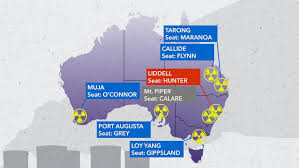
The Coalition wants to build large nuclear reactors at the sites of five coal-fired power stations – Liddell and Mount Piper in New South Wales, Tarong and Callide in Queensland, and Loy Yang in Victoria.
Small modular nuclear reactors, which are not yet commercially available anywhere, are proposed at the sites of Northern power station in South Australia and Muja power station in Western Australia.
All the reactors would be taxpayer-funded. The Coalition claims it could have smaller units working by 2035 and the first large reactor working by 2037.
How long would it take?
Most energy experts, including those from the CSIRO, say the Coalition’s timeline is unrealistic.
They argue it is highly unlikely Australia could do everything necessary – including creating a regulatory system, developing a skilled workforce, completing geological and environmental work and commissioning and building a nuclear reactor, with community approval – before the early 2040s, if not later.
The Coalition would also have to overturn a legislated federal ban on nuclear energy and convince the states to overturn their bans. Most state premiers and opposition leaders are opposed to introducing a nuclear energy system.
With Labor, the Greens and some independents opposed to nuclear energy, repealing federal laws would be a major obstacle.
The Nationals senator Matt Canavan has claimed the Coalition was “not serious” about building nuclear and it was being backed because it “fixes a political issue”.
Would building nuclear reactors keep the lights on?
Many of Australia’s coal plants are old.
On average, coal plants are forced offline through unplanned outages for about 10% of the year. Australia’s electricity market operator expects 90% of coal-fired power stations to be closed by 2035 – two years before the Coalition claims its first nuclear plant would be producing power.
The Coalition’s plan would mean requiring ageing coal plants to run for longer, increasing the risk of unplanned outages unless there was significant new spending on maintenance.
Experts say promising to build taxpayer-funded nuclear plants could also lead to investors deciding not to build the solar, wind, batteries and pumped hydro currently planned, and needed now, to replace much of the electricity from coal.
Would nuclear power really bring down the cost of living?
The Coalition has provided no evidence to back up its claim that its proposal could bring electricity prices down.
Dutton has claimed that modelling by Frontier Economics judged the Coalition’s plan to be 44% cheaper than Labor’s policy of running the grid overwhelmingly on renewable energy, and that this meant power bills would be cut by 44%.
This claim has no basis in fact. Frontier’s own modelling report said it had not modelled the impact of a nuclear plan on prices.
The modelling used by the Coalition is based on an electricity system producing 31% less electricity than Labor’s preferred renewables-based approach.
More than half of a household’s electricity bill is related to factors outside the Coalition’s plans, such as the cost of local poles and wires, or the costs passed on by retailers.
Overseas, particularly in western democracies, nuclear plants have become notorious for large cost blowouts and delays.
The Coalition says its plan would cost less because it would avoid having to build some of the new towers and power lines needed to connect the new solar, wind and battery farms planned across the country.
But CSIRO analysis found even if Australia had an established nuclear program with a suite of reactors, the electricity would cost at least 50% more than power from solar and wind backed by battery and other energy infrastructure needed to ensure the power grid remained reliable even when the wind wasn’t blowing and the sun wasn’t shining.
What will the Coalition’s nuclear plan mean for the climate crisis?
About a third of Australia’s greenhouse gas emissions come from burning coal and gas to produce electricity. Cleaning up the grid is essential to cutting Australia’s climate pollution and meeting its international commitments.
The Coalition’s plan assumes that for the next 20 years or so there would be significantly less renewable energy and significantly more electricity from coal and gas-fired power stations than proposed by regulators and backed by the Labor government.
Not surprisingly, this would mean higher emissions. This point was reinforced in modelling supported by the Coalition released in late 2024. It found that Dutton’s proposal would lead to substantially higher pollution between now and 2048 than on the current path.
Independent analysis has backed this up, suggesting the Coalition’s plan would lead to an extra 1.7bn tonnes of CO2 being emitted by 2050. This is equivalent to about four years’ worth of emissions released across the entire Australian economy.
The Coalition’s plan also assumes slower decarbonisation in other parts of the economy. It suggests fewer people would buy electric vehicles than under Labor, and fewer rooftop solar panels would be installed.
The Coalition has aligned its plan to a scenario laid out by the Australian energy market operator that is in line with global heating of about 2.6C by 2100.
Lies, damned lies and Coalition energy economics: Dutton’s latest nuclear claim slammed
“Mr Dutton is either dangerously ill‑informed or he is lying to the Australian public.
Sophie Vorrath, Feb 3, 2025, https://reneweconomy.com.au/lies-damned-lies-and-coalition-energy-economics-duttons-latest-nuclear-claim-slammed/
Blink and you might have missed it, but Peter Dutton delivered another toe-curling example of energy policy hokum on Sunday morning, as the first guest of the first episode of the ABC’s Insiders program for 2025.
In amongst other well-spun lies – such as the claim Labor’s energy policy requires 28,000km of new transmission to be built – the leader of the federal opposition appeared to say that electricity bills would be 44 per cent cheaper under a Coalition government than under Labor.
“[Frontier Economics] look[d] at our energy policy compared to Labor’s, they judge[d] that it’s 44 per cent cheaper than Labor’s,” Dutton says.
When Insiders host David Speers points out that the 44% figure – itself hotly contested, as is Frontier’s Economics’ entire approach to modelling nuclear costs for Australia – relates to the cost of building nuclear between now and 2050 and not the power price impact, Dutton fudges further.
“If you’re delivering a model that’s 44% cheaper, that translates into cheaper power prices,” he says.
Pushed on this point, Dutton says, “If you apply the economics, so if there’s a 44% reduction in the model of delivering an energy system, you would expect a 44% reduction, or of that order, being passed through in energy bill relief.”
Pushing once more, Speers says: “But Frontier didn’t tell you that that number, you’re just, you’re just drawing that assumption yourself.”
Dutton: “Again, David, I mean, that’s that’s the economics of it. …All other variables being equal, if you have a 44% reduction in the overall cost to deliver that model, that is going to translate into that price reduction for households and for businesses, and that’s what we must do.”
Happily for Dutton, the discussion switches away from energy at this point, leaving his highly questionable application of “the economics of it” more or less unchallenged.
Unhappily for Dutton, certain energy market experts and actual economists are not having it.
The Smart Energy Council has responded on Monday by publishing the findings of its own analysis and calculations, using – it says – the same assumptions put forward by the federal Coalition and the nuclear policy costings of Frontier Economics. It also uses modelling from the Institute of Energy Economics and Analysis (IEEFA).
This analysis finds that for Australia’s 4 million (and counting) solar homes, power bills would go up more than $1,100 a year under Dutton’s nuclear policy. For non-solar homes, power bills would increase by an average $665 a year – a 30% jump.
The SEC says the hike in energy costs for solar homes of between $1,181 to $2,468 a year would come from lost energy savings, with “always on” nuclear likely to knock out rooftop solar for an average 67% of the year, forcing consumers on to higher nuclear power prices.
For both solar and non-solar homes, part of the jump in energy bills would come from the fact that nuclear power is a more expensive form of generation – as shown in IEEFA’s report, Nuclear in Australia would increase power bills.
The IEEFA report finds that for a nuclear plant with similar costs to those reported for Sizewell C in the UK to be commercially viable in Australia, wholesale energy prices would need to rise by $98 to $168 per megawatt-hour, relative to 2023-24 levels, to enable cost recovery.
This equates to a 74% to 127% rise in wholesale prices, which would see average household power bills across the states in the National Electricity Market increase by between $561 and $961 (with GST), assuming electricity retailers don’t add a margin on top.
“The latest reported cost blow-out for the UK’s proposed Sizewell C nuclear plant further underlines that the Coalition’s proposal to bring nuclear power to Australia is unrealistic,” say the report’s authors, Tristan Edis and Johanna Bowyer.
“Sizewell C’s revised capital cost estimate is about 2.5 times the capital cost used in the Coalition’s modelling.”
And then there are the other, other costs to Dutton’s nuclear policy plan – including the further cost to taxpayers of propping up old coal plants and relying more heavily on expensive gas.
As SEC chief John Grimes put it in a joint press conference with federal energy minister Chris Bowen on Monday, Dutton’s plan to build nuclear is more accurately – for the next decade, at least – a coal keeper, gas booster and renewables stopper program.
“Billions of dollars to go into coal to keep it in the system for as long as possible… [and] a massive scaling up of the amount of fossil gas, the most expensive fuel in the energy system. And a solar stopper program, a cap of 54 percent on renewable energy, solar and wind, by 2050,” Grimes said on Monday.
“Peter Dutton, he has a plan that will double power bills for ordinary Australians. We think that that is outrageous. We’re here today to call it out.
“Mr Dutton is either dangerously ill‑informed or he is lying to the Australian public.
“We know that his plan… will effectively transfer wealth from homeowners to the big fossil fuel companies. Peter Dutton’s plan delivers for his rich fossil fuel mates. But his plan, his power plan, is a big stop in the road, a stop for solar, a stop for wind, a stop for batteries, a stop for EVs, a stop for ordinary Australians slashing their power bills with solar,” Grimes said.
“A stop for the effective transition of our economy and the massive environmental benefits that that delivers, and economic benefits as well.”
‘No idea what he’s talking about’: Dutton’s nuclear plan could raise – not cut – electricity bills, experts warn
Opposition leader claims a 44% cost reduction compared with Labor’s plan would be passed on to Australian household bills, but not everyone agrees
Graham Readfearn, 4 Feb 25, https://www.theguardian.com/australia-news/2025/feb/04/no-idea-what-hes-talking-about-duttons-nuclear-plan-could-raise-not-cut-electricity-bills-experts-warn
Energy experts have rubbished claims by Peter Dutton that his plan to slow the rollout of renewable energy while waiting more than a decade for taxpayer-funded nuclear plants could bring down electricity bills in the short term.
Dutton said if there was “a 44% reduction in the model of delivering an energy system, you would expect a 44% reduction, or of that order, being passed through in energy bill relief”.
However, that was a “complete misunderstanding “of the Coalition’s own policy, according to Dr Dylan McConnell, an energy systems expert at the University of New South Wales. “He has no idea what he is talking about,” McConnell said.
Speaking to the ABC’s Insiders program on Sunday, Dutton said “power prices will be cheaper under us in the near term as well as in the medium to longer term as well”.
If elected, the Coalition would have to overturn federal and state bans on nuclear power; it claims it could have the first plants built by 2037. Experts, including the CSIRO, say the early 2040s is a more realistic timeframe.
The Coalition has not revealed any details on its near-term plans for electricity generation but Dutton said “we’re going to have to do a lot more with gas, with coal, in the system”.
Analysis by McConnell suggested the Coalition’s reliance on more coal and gas would add 1.7bn tonnes of CO2 to the atmosphere by 2050, compared with Labor’s plan.
Data from the CSIRO suggests using gas for power generation is more expensive than coal, and solar and wind. Nuclear electricity would be at least 50% more expensive than renewables, the CSIRO has said.
Gas prices tripled when the Coalition was in power, according to Tristan Edis, an analyst at Green Energy Markets.
He said energy prices were likely to fall over the next two years after the inflation caused by Russia’s invasion of Ukraine subsides.
“Beyond this two-year period, it is difficult to understand how the Coalition will lower power prices if they intend to simply rely on the power plants which are already in place and not foster additional competition,” he said.
“The coal plants are getting old and banks are reluctant to finance refurbishment costs. If we rely on additional gas, that will push up power prices, not reduce them – because gas is expensive.
Edis said the Coalition’s costs for building a 1GW nuclear plant had been set at $1bn, which was “unrealistically low” and could be at least double that. This would push up wholesale electricity prices and household bills, he said.
Frontier Economics released modelling, backed by the Coalition, that compared the cost of Labor’s preferred renewables-based plan with an electricity system that anticipates less demand for electricity and includes nuclear.
Of Dutton’s claim that modelling showed the Coalition’s approach would cost 44% less than Labor’s plan, McConnell was doubtful.
“That’s a clear misunderstanding of what makes up an electricity bill and what the [modelling report] shows.”
He said only about 45% of a household electricity bill related to the cost of the electricity system and the wholesale costs that relate to the cost of the system referred to by Dutton. The rest related to the costs of local poles and wires, retail costs and environmental charges.
Danny Price, managing director of Frontier Economics, defended Dutton’s comments, saying if he was referring to the energy costs portion of people’s bills then the lower cost should transfer to households.
But on the impact on households’ overall electricity bills, “it’s a much more complicated question” he said, because of uncertainties around how prices are set in the market.
For that reason, his company had not attempted to forecast what the Coalition’s plan would do for people’s electricity bills or to electricity prices.
The paradox of recent politics
Crispin Hull, 2 February 25
A paradoxical realignment is under way in Australian and US politics.
Until recently, the Republican Party in the US and the Liberal Party in Australia were the parties of business, entrepreneurs, the professions, and the relatively wealthy. And the Democrats and Labor were the parties of the worker. The Democrats and Labor were always wary of new technology because it invariably costs jobs.
It was a fairly straight-forward labour-capital divide.
Then came some big changes: the rise of China; the threat of global heating; the social revolutions relating to identity (race, gender, nationality, and religion); and the collapse of organised labour.
Global heating was seen by Republicans and Liberals as some trendy, leftie anti-capital nonsense. They saw, with some justification, the rise of China as menacing. They attracted working-class votes based on nationalism and opposition to social causes on racial and sexual equality.
Those changes have thrown up some irreconcilable contradictions.
Private-Sector Economic Rationalist Peter Dutton has a plan under one arm to axe 36,000 “Canberra” public servants. Under the other arm Commissar Dutton he has a plan for massive public ownership of the means of energy production and management with seven nuclear power stations – just so his mates can keep up the profitable burning of fossil fuels for a few more years.
No sensible private-sector organisation will go near the nuclear plan, for obvious reasons. Moreover, only a third of federal public servants work in Canberra. But it sounds good to cut “Canberra” public servants. As if they do nothing – aside from, say, running air-traffic control; policing the borders; running Medicare, the Pharmaceutical Benefits Scheme, and the defence forces; doing weather forecasts; and generally making society tick.
It leaves Labor, the party that has usually been unenthusiastic about entrepreneur-driven new technology, embracing and financing private-sector investment in new energy………………………………………………………….
Labor, the party of the environment, has now shelved legislative protection for endangered species and approved dozens of extensions to coal and gas projects while putting its hand on its heart saying it has approved no “new” coal or gas projects.
Despite election promises, Albanese, who “goes after Tories”, has delivered a corruption watchdog that bares its gums in private. And his whistle-blower-protection promises have evaporated. His political finance “reforms” tinker about the edges while continuing to allow big corporations and unions to be puppet-masters.
It is a government that clears the in-tray by moving things into the too-scared basket.
Dutton, meanwhile, the friend of the Australian Jewish Community, cynically weaponises and politicises antisemitic attacks in Australia so he can argue that Albanese is “weak” while stirring up divisions for his own ends. With any luck it will back-fire because the Jewish community is a bit more sophisticated and understanding of the nuances of public policy than the former Queensland policeman.
The attacks, of course, are not coming from racialised Muslims, but far-right, nationalist, self-labelled “Christian” neo-Nazis.
Surely these things mean that Dutton and Albanese have disqualified themselves from leading a majority government. Surely, events of the past three years tell us that a cross-bench holding the balance of power in the House of Representatives will improve government.
If Albanese is Prime Minister, they will demand action on obvious things on pain of being thrown out of office. If Dutton is Prime Minister, they will demand detail, justification, and costings for his nuclear policy or to drop it – again on pain of being removed from office.
How else can the major parties be weaned off the insidious corporate, union, and lobby-group influencers that conspire against the public interest?
The glimmer of hope here is Labor’s massive support of renewable energy. The Australian Energy Market Operator reported this month that coal’s share of electricity generation had fallen below half for the first time. Coal-fired power stations are becoming less reliable and less economic.
The economics are so obvious that households are taking up solar at an unforeseen rate. And they are telling everyone about their zero power bills. So, it is on an unstoppable roll. https://www.crispinhull.com.au/2025/02/03/the-paradox-of-recent-politics/?utm_source=mailpoet&utm_medium=email&utm_campaign=crispin-hull-column
Dutton defends nuclear costings as opponents warn of power bill hit
“Peter Dutton wants to force millions of Australians to switch off the solar they bought, make them pay for more expensive nuclear power, and use their taxes to build nuclear reactors,”
The Age, By Shane Wright, February 2, 2025
Opposition Leader Peter Dutton has claimed his nuclear energy policy would cut power bills by 44 per cent, but analysis by the renewables sector warns it could actually drive up electricity costs by more than $1000 a year for millions of Australians with rooftop solar panels.
Ahead of an election that will be dominated by cost-of-living issues, Dutton said while it would take time for energy prices to fall under his $331 billion plan to build seven government nuclear plants, they would ultimately drive down costs for consumers and business owners.
Modelling commissioned by the Coalition for its plan to build the reactors by the mid-2040s asserts total costs will be 44 per cent lower compared to the mass rollout of renewables. The same modelling did not estimate a reduction in retail power prices.
But Dutton told the ABC’s Insiders program on Sunday it was “economics” that lower construction and production costs would lead to a large drop in prices paid by consumers…………………
The modelling, however, has come under fire for its underlying assumptions, including an effective lid on the amount of renewable energy. Renewable energy under the Coalition’s modelling reaches 54 per cent of the total power market by 2050. By the end of last year, it had already hit 46 per cent.
Research to be released on Monday by the Smart Energy Council warns that millions of rooftop solar systems would have to shut off every day to allow the baseload power generated by nuclear reactors to fit into the grid.
It found that non-solar households could pay an extra $665 a year in power prices, while for those with rooftop solar, the bill shock could be more than $1000. Rooftop solar households were forecast to pay an extra $1262 a year in NSW, $1108 in Victoria and $1419 in south-east Queensland.
The higher costs to the more than 4 million rooftop solar households were in part because they would be blocked from feeding power into the energy market, the council said. As nuclear needed to be run constantly, if there was too much energy in the market, the first to be turned off would be rooftop solar, which was the easiest to prevent competing against nuclear.
Smart Energy Council chief executive John Grimes said every person who had invested in rooftop solar would pay far more for their energy if expensive nuclear power was forced into the grid.
“Peter Dutton wants to force millions of Australians to switch off the solar they bought, make them pay for more expensive nuclear power, and use their taxes to build nuclear reactors,” he said.
“We know that power bills are going to soar for all Australians because Peter Dutton wants to cap cheap, clean renewable energy and substitute it with expensive, unreliable, polluting coal and gas, while we wait a couple of decades to build their nuclear fantasies.”
The battle over electricity prices is part of a broader debate over the size of government, with Dutton accusing Prime Minister Anthony Albanese of overseeing a $347 billion increase in spending and a 36,000 lift in public servants…………………….
Pressed on where he would cut spending, Dutton ruled out an audit but signalled that voters would have to wait until after the election to get final details………
Treasurer Jim Chalmers said part of the increase in spending and public servants included the indexation of the aged pension and extra resources to the Veterans’ Affairs Department, Medicare and to lift housing construction.
He accused Dutton of trying to hide his planned cuts because he knew people would not support them.
“It is extraordinary that he’s saying to the Australian people he wants to cut $350 billion, but they will have to wait until after the election before he would tell them what that is,” he said.https://www.theage.com.au/politics/federal/dutton-defends-nuclear-costings-as-opponents-warn-of-power-bill-hit-20250202-p5l8wu.html
Nuclear waste. AUKUS agency’s reckless indifference
Last Friday, government solicitors acting for the Australian Submarine Agency sent me a warning against publishing some embarrassing information about their conduct.
Neither I (Rex Patrick) nor Michael West Media will be subject to their bullying, however.
The Australian Submarine Agency deals with high-level Defence secrets and fissile material, yet it has been caught ignoring security obligations while threatening Rex Patrick, who reports on their conduct.
by Rex Patrick | Feb 3, 2025, https://michaelwest.com.au/aukus-agency-reckless-on-nuclear-waste/
Last Friday, government solicitors acting for the Australian Submarine Agency sent me a warning against publishing some embarrassing information about their conduct.
Neither I nor MWM will be subject to their bullying, however.
The Australian Government has undertaken to accept responsibility for the spent nuclear fuel from our planned AUKUS submarines. This is no light undertaking. It’s more than a lifetime obligation; indeed,
it’s an obligation that will last tens of thousands of years.
The Government has announced that this high-level radioactive waste will be stored on Defence land.
As reported in MWM, in February 2023, the Australian Submarine Agency awarded a contract for nearly $400K to former Defence Department Deputy Secretary Steve Grzeskowiak to find a suitable Defence location
The very expensive irony that lurked behind this contract was the fact that Grzeskowiak had, when he was inside Defence, looked for a location on Defence land to store low-level radioactive waste and had been unable to find a suitable site.
According to Grzeskowiak, there wasn’t a single spot anywhere across the vast Defence estate that was suitable for storing low-level radioactive material. Yet he was now the go-to person who would, through some miraculous divination, find the Australian Submarine Agency a location across the very same territory.
Document request
In December 2023, I requested Mr Grzeskowiak’s report under our Freedom of Information laws. I was refused access on the basis the report was a Cabinet document.
But here’s the interesting thing. I knew that the report had been being worked on by multiple agencies, so I requested related documents from the Australian Nuclear Science and Technology Organisation (ANSTO), the Australian Radiation Protection and Nuclear Safety Agency (ARPANSA), Geoscience Australia (GA), the Department of Industry, Science and Resources (DISR) and the Department of Prime Minister and Cabinet (PM&C).
What those documents showed me was the report was not, at least until after I made my FOI request, developed on the Government’s CabNet+ system.
I’m now in a legal fight at the Administrative Review Tribunal, pressing my case for the report to be made public.
The Cabinet Handbook, the bible for Cabinet’s processes, makes it crystal clear that cabinet documents must be prepared on a special CabNet+ system.
The protective security framework of the Government also commands that Cabinet documents are stored on CabNet+.
Despite this, the Australian Submarine Agency didn’t do that.
Why? I can’t publish their evidence in the proceeding until the matter has been heard in the Tribunal, but what I can say is that it’s a case of reckless indifference to the rules.
It begs the question, will the Australian Submarine Agency also play fast and loose with the rules in relation to our highly classified data or our allies’ highly classified data?
“The Australian Submarine Agency is under a great deal of pressure to “get the job done”.
There are unquestionably a lot of unrealistic expectations coming down from the top. Will they follow the rules when it comes to nuclear safety, or will they bend and break the rules when they find it expedient to meet a politically driven objective?
Legal arguments
In their legal submissions, the Australian Government asserts: “The fact that the document was not created within the ‘CabNet’ system is not indicative one way or the other as to the intention of the authors.”
Actually, the rules of Cabinet are very strict. A document must meet two tests to qualify as a cabinet document 1) it must have been bought into existence for the dominant purpose of submission for consideration by the Cabinet, and 2) it must have been submitted to Cabinet.
I am satisfied it meets the second test but not the first.
To meet the first test the Government has to present objective evidence to the Tribunal that a minister so commissioned the document for consideration by Cabinet.
“They have not done so.”
And the fact that the document, in breach of the rules, just floated around on a government network not authorised to hold Cabinet documents for months on end will work against the Australian Submarine Agency in the end.
Hypocrisy
In response to insistence from Prime Minister Anthony Albanese that Peter Dutton should disclose the intended location of seven nuclear power stations, the Opposition Leader did so.
But Albanese is refusing to be transparent about the intended location of a high-level radioactive waste dump. His government wants to block public debate for as long as possible and then present people with a fait accompli.
It’s yet to be seen whether the Government will win on its claim that the report I’m after is a Cabinet document. But in the end, if it were determined that the report is that, there would still be nothing to stop Albanese from being true to his past rhetoric about the importance of government transparency and releasing the report to inform public debate.
“Australians have a right to know. The fact that the Prime Minister hasn’t already done this says a lot.”
For me, given that the Government has cautioned me against publishing details that reveal security incompetence inside the Australian Submarine Agency, I’ll wait for the knock on the door from the Federal Police. I’m not going to be intimidated.
There’s a vital democratic principle to be defended – the right to publish embarrassing information about government. The only way to protect that right, especially in the face of Government bullying, is to publish.
Dutton’s nuclear plan requires ‘huge’ new bureaucracy.
“Every single dollar spent on nuclear will come from the taxpayer. So of course, that will lead to a bureaucracy.
Opposition Leader Peter Dutton has criticised what he calls Labor’s “big government” approach and “wasteful” spending
A “huge” new bureaucracy, numbering thousands of extra public servant positions, would need to be created by the Coalition to establish and support an Australian nuclear power industry, according to the minister for public service, Katy Gallagher.
The proposal for a civil nuclear power program, as described by shadow energy minister Ted O’Brien last year, included “institutional architecture” that he said would entail an expansion of the regulatory agency, the Australian Radiation Protection and Nuclear Safety Agency (ARPANSA), a new independent nuclear energy coordinating authority and a government business enterprise to be called Affordable Energy Australia.
That architecture raises questions in the midst of the current opposition attacks on the growth and efficiency of the bureaucracy under the Albanese government. The Coalition’s election campaign push to cut government spending, sharpened by the nomination last week of Senator Jacinta Nampijinpa Price to lead a proposed efficiency department, has focused so far on paring back the public service.
The Coalition’s coal-to-nuclear strategy appears to defy that objective, as it requires building a large department “from scratch”, Gallagher tells The Saturday Paper. “We haven’t run state energy systems for so long,” the minister says. “It would be up there with departments like, you would think, Services Australia. Probably a bit smaller than the NDIA [National Disability Insurance Agency, Defence. It would be thousands of public servants.”
Gallagher likens the bureaucratic infrastructure for a nuclear power industry, which the Coalition has said would be taxpayer funded, to Labor’s creation of the Climate Change Department of more than 2500 staff. She expects more than that would be needed, including outside Canberra, for the Coalition plan to build its proposed seven nuclear power plants across five states.
“It would be planning, construction, safety, getting the skills. I don’t even know how you’re going to get the skills into that,” Gallagher said. “It’d be a lot of travel because you’re all around the country.”
Last year, O’Brien revealed that, under the Coalition’s plan, a coordinating authority would determine how much nuclear power is produced at each of the seven proposed sites before it enters the national energy mix.
“In terms of exactly how many on any plant, we’ll be leaving that to the independent nuclear energy coordinating authority,” he told the ABC’s Insiders last June. “It is right we want multi-unit sites. That’s how to get costs down.”
The shadow minister was not available for an interview. In response to emailed questions, O’Brien did not address the size of a civil nuclear power bureaucracy or the cost of expanding nuclear agencies and creating new ones, but acknowledged that “a highly skilled nuclear workforce will be paramount to ensuring the success of this plan”.
In his response, O’Brien gave more detail about the nuclear program, including outlines of private and public partnerships and a proposition to include the Australian Safeguards and Non-Proliferation Office (ASNO), which looks after Australia’s international treaty obligations.
“Experience is not cheap, because you’ll have to get it from overseas … we’ll be having to buy that in, at expense. You don’t just train someone up over a two-year period.”
“The ARPANSA legislation will be amended to allow the licensing and regulation of civilian nuclear facilities, including power stations,” the shadow minister said. “ARPANSA will have its resources increased to prepare to license the establishment projects and advice will be sought regarding the merits of regulatory consolidation of ARPANSA and ASNO.
“The independent Nuclear Energy Coordinating Authority will lead community consultation and manage a process to select experienced nuclear companies to partner with Government to deliver these projects.
“Affordable Energy Australia will be financed by the federal government through a combination of debt and equity and, through its partnership arrangements with experienced nuclear companies, will own, develop and operate the establishment projects.”
A former energy adviser to Britain’s Thatcher government says the Coalition is trivialising the bureaucratic support needed for a local nuclear power industry.
Greg Bourne, who is a former president of BP Australasia and is a councillor on the Climate Council, said the experience in the UK showed that the nuclear part of the electricity industry had to be regulated, as “no one commercially wanted it”.
He says established nuclear power countries in comparable democracies such as the United States have very large regulatory organisations rigorously covering issues such as skills, construction, safety, finance and radioactive waste.
“What you would need to do – almost certainly getting the people from overseas, building ARPANSA’s strength – it’s not a trivial act,” Bourne tells The Saturday Paper.
“They will have to build a complete set of public servants, for want of a better word, to be able to advise Department of Energy … on what can be done, what can’t be done, the pace at which it can be done and so on.”
The scale of the Coalition’s nuclear proposal, Bourne says, is obviously a far cry from Australia’s experience with its sole reactor, the 20-megawatt nuclear medical reactor at Lucas Heights in southern Sydney.
“We will have to buy experience. And buying experience is not cheap, because you’ll have to get it from overseas,” he says. “People will be coming in with different models. European models… a number of United States, Canadian models. They’ll all be coming in with different things, but we’ll be having to buy that in, at expense,” he says. “You don’t just train someone up over a two-year period.
“Lucas Heights is a very, very different thing. The people there are good. They understand what they’re doing. I do not think that [the Coalition] will be able to grab the head of the nuclear agency from Lucas Heights, and then that person will have credibility with two gigawatt-size reactors.”
The public service minister suggests that if the nuclear bureaucracy were to be added to the Department of Climate Change, Energy, the Environment and Water (DCCEEW), not only would the department need to be “a lot larger” but there would likely be “a huge consultant bill”, over decades. “You’d be paying for all of that before anything gets happening.”
The Albanese government, meanwhile, is moving to accelerate household electrification efforts, through a deal with the Senate crossbench to support Labor’s Future Made in Australia legislation. The government aims for 82 per cent of power to be sourced from renewable energy by 2030 – a plan the Coalition has derided as “unrealistic”.
Energy Minister Chris Bowen revealed this week he used ministerial powers at the end of last year to direct the Australian Renewable Energy Agency to consider funding solar panels and home batteries. However, the basis of Labor’s transition plan, Bowen says, is private-sector funded.
“Every single dollar spent on nuclear will come from the taxpayer. So of course, that will lead to a bureaucracy. Our plan is based on private-sector investment. Theirs is based on public investment and a bureaucracy,” the minister tells The Saturday Paper.
He points to the lack of detail in the Coalition’s planning, in contrast with its demands for more detail in the lead-up to the Indigenous Voice to Parliament vote: “They campaigned against an alleged government bureaucracy in the referendum, and they’re proposing at least two new government organisations.”
The Coalition’s plan to build seven nuclear power plants to replace Australia’s ageing coal-fired power stations is backed by a contested set of costings, prepared by Frontier Economics and released late last year, amounting to roughly $300 billion spread over 50 years. The modelling suggests the Coalition plan is $263 billion cheaper than Labor’s renewables proposal, but a wide range of economists have countered that the costings lack crucial information about how the figures were calculated, and are based on a scenario of dramatically lower energy use than is realistic.
The delays in getting the reactors on line have also drawn strong criticism. The opposition insists its plan, under the best-case scenario, would begin producing electricity by 2035, but this is five years earlier than the earliest estimate by the Australian Academy of Technological Sciences and Engineering, and assembling the necessary regulation and skills is a key component of that timeline.
The Coalition’s energy spokesman says the opposition’s civil nuclear policy is well formed and ready to start.
“[T]his policy follows the most comprehensive study ever undertaken by an Opposition, learning from experts in 10 nations about their decarbonisation policies while keeping prices down, the lights on and ensuring energy security,” O’Brien said in his statement.
“Upon entering government, the Coalition will be ready to implement a detailed energy policy immediately, informed by global best practices and established relationships.”
Opposition Leader Peter Dutton has criticised what he calls Labor’s “big government” approach and “wasteful” spending that he says has exacerbated inflation in the lead-up to an election that will be heavily focused on the cost of living.
His most cited example is the 36,000 additional Average Staffing Level places in the public service funded by Labor over three budgets.
The opposition leader now has four frontbenchers whose portfolios cover the public service, two of whom are solely tasked with zeroing in on waste and efficiency: Jacinta Nampijinpa Price and James Stevens.
While Dutton isn’t explicitly referencing as its inspiration the Elon Musk-led Department of Government Efficiency in the US, he’s elevating the mission within his ranks just as the Trump administration takes over. Australia’s richest person, Gina Rinehart, has long urged the Coalition to emulate the MAGA policy agenda.
“Our argument is to bring that role, that function, into [the Department of the] Prime Minister and Cabinet as a key central agency, and then to have the authority of Prime Minister and Cabinet to run the operation of senior efficiencies achieved across every department of the Commonwealth,” the Coalition leader told reporters in Perth on Tuesday.
“And that’s something that we would take very seriously.”
Dutton says Labor’s spending on public service positions is a question of “priorities”. Speaking to reporters in his electorate of Dickson last weekend, the opposition leader said, “That’s money that we could be spending elsewhere to provide support to people during Labor’s cost-of-living crisis, or into defence or into security and into priorities for Australians otherwise.
“I just don’t think any Australian can say that their lives are simpler or better off today because of the tens of thousands of additional public servants that the prime minister’s employed in Canberra.”
The plans for cuts have been flagged for at least six months.
“The first thing we’ll do is sack those 36,000 public servants in Canberra, that’s $24 billion worth,” Nationals leader David Littleproud told commercial radio station Triple M in August.
The figure for additional public servants equates to 20 per cent of the workforce, a boost that entailed rebuilding positions lost to more expensive outsourced labour. The cost cited by the opposition is over four years.
An audit, ordered by the Albanese government soon after the 2022 election, found that the Coalition government in the 2021-22 financial year alone spent $20.8 billion on almost 54,000 contractors and external providers. The bulk of the external labour was employed in the defence, social services and agriculture portfolios.
The 36,000 figure under the Albanese government, confirmed in federal budget papers, also covers Labor’s moves to rein in Centrelink and other government call centre waiting times, as well as additional staffing to reduce chronic backlogs in claims and visa processing times.
Gallagher, who is also finance minister, accepts that efficiencies remain to be made within government. She adds that $92 billion was saved over the past three Labor budgets and mid-year updates.
“We’ve had over $4 billion saved from not using consultants as much as the former government did,” the senator says.
She says there is an ongoing effort in explaining the worth and work of the public service.
“It’s always up to us to explain what we’re doing and why we’re doing it, but I would say to Peter Dutton, go and speak to a veteran who actually is getting their pension now, who’s getting their appropriate payment. There was a 40-month wait for people to get their pension,” she told reporters last week. “What he wants to pretend is that you don’t need anyone to do these jobs. Two thirds of these jobs are in the regions. They’re in every part of Australia.”
1 This month

of the week – Australians for War Powers Reform (AWPR)
To see nuclear-related stories in greater depth and intensity
 Antinuclear