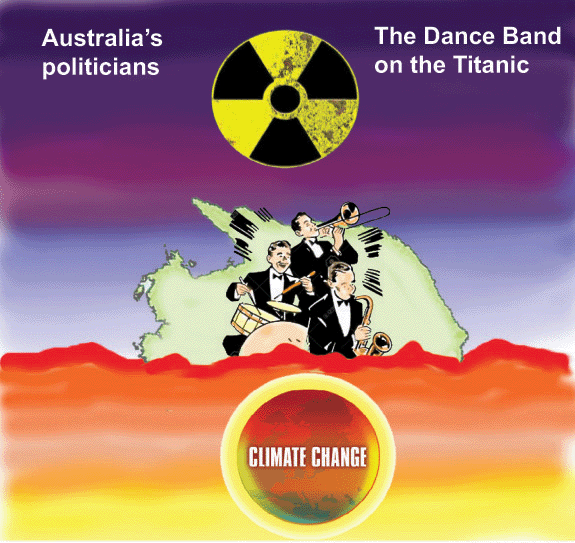
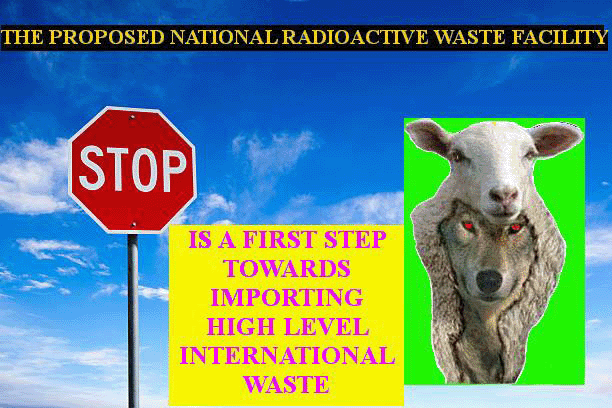
THE Federal Government’s site selection for a national radioactive waste facility is a “sham” after a private company says it has support for the repository to be built in Western Australia.
Centre Alliance senator Rex Patrick told The Advertiser the decision to establish a low-level facility at one of two sites in South Australia appeared to be a “done deal” following the revelation.
In August, Azark Project made a nomination to include the commercial operation of an underground storage facility, near the remote central mining town of Leonora, north of Kalgoorlie.
The South Australian senator, who visited Leonora, said the proposal appeared to have “considerable support” and unlike the two SA sites near Kimba and Hawker, did not need taxpayer funds to proceed.
“Resources Minister Matt Canavan needs to properly engage the proponents of the proposed site near Leonora or risk the whole selection process being confirmed as an absolute sham,” he said.
“It appears as though the new site is a ‘faster runner’ in the race, but won’t be allowed to participate because the Minister is determined to rush to select one of the South Australian sites despite there being a divided community.”
Azark Project chairman George Gear said the WA site had no environmental, land rights or water issues, and the proposal had support of the 2900 people in Leonora Shire.
Mr Gear said he had no confidence in the specially-formed government taskforce considering sites for the waste facility, given Leonora was not on the table.
“Apart from this being a superior site located in a mining area and in solid rock, this wouldn’t cost the taxpayer any money as it’s a private company that will build this,” Mr Gear, a former minister in the Keating government, said.
“The taskforce to date has either spent or committed $40 million and they haven’t finalised the project.
“Azark has completed all of its due diligence at its own cost and has offered to make it available to the taskforce — this invitation was not accepted.”
Mr Gear said Azark Project had decided to pursue the plan on its own, but was expected to meet Mr Canavan in Perth, today.
The Government is expected to decide in coming months whether to build the waste facility in SA, after a final ballot of Kimba and Hawker districts, on August 20.
Mr Canavan has previously said “broad community support” would be needed for the waste facility to go ahead — although no arbitrary figure has been provided.
The two-year site selection process has divided both communities — those in favour believe it would create economic opportunities, while those opposed say it will jeopardise industries.
The district where the waste facility is located would be rewarded by the government with a $10 million community fund to spend on local projects.
Both districts were already benefiting from a $4 million grants fund as a reward for being involved in the site selection process.
Senator Patrick this year successfully pushed for a Senate inquiry into the site selection process used for the national waste facility and an outcome is expected only days before the ballot, on August 14.
In a submission to the inquiry, Kimba’s mayor said more information on financial rewards and jobs was needed before the community voted in the ballot.
Mr Canavan did not respond to questions before deadline.
June 13, 2018
Posted by Christina Macpherson |
AUSTRALIA - NATIONAL, Federal nuclear waste dump, politics |
Leave a comment
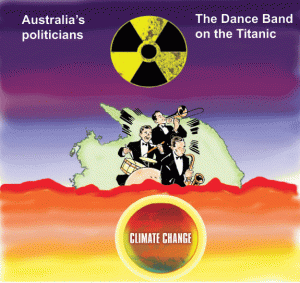 Australia’s emissions reduction target ‘unambitious, irresponsible’
New Australia Institute paper finds neither Coalition nor Labor’s pollution reduction targets would see us doing our fair share, Guardian, Katharine Murphy @murpharoo 12 Jun 2018
Pollution reduction targets for 2030 proposed by the Coalition and Labor will not see Australia contributing its fair share to cut greenhouse gas emissions under the Paris climate agreement, according to new research.
A paper from the progressive thinktank the Australia Institute finds the Turnbull government’s target of a 26-28% reduction on 2005 levels is “inadequate according to any recognised principle-based approach” and the Labor target of a 45% reduction is “the bare minimum necessary for Australia to be considered to be making an equitable contribution to the achievement of the Paris agreement’s two degree target”…..
The next round of international climate negotiations will be held in the Polish city of Katowice in December this year. The looming talks are critical to ensuring the signatories to the Paris deal maintain the momentum of their various emissions reduction pledges.
Unlike the United States, Australia remains in the Paris agreement, despite continued rumbling from conservatives about climate policy. However, the Turnbull government is still struggling to land its national energy guaranteewhich would impose emissions reductions in the electricity sector.
Because of internal pushback within the Coalition, and lobbying by some sectors, the government has not yet flagged a roadmap for emissions reductions across the economy, and there is widespread criticism of the lack of ambition in the target proposed for emissions reduction in electricity.
The latest official emissions data shows pollution increased by 1.5% in the year to December 2017. Australia’s emissions levels are now higher than they were in 2012 and have climbed by 3.6% since the carbon price was repealed in 2014.
Emissions are increasing in most sectors of the economy – in waste, agriculture and transport. Only one sector of the economy has recorded a decrease – the electricity sector – because aging coal-fired power plants have exited the system, and new renewables projects are coming on stream.
Merzian says Australia is continuing to “profit from high emissions rather than take up its fair share of reductions. We are unfairly shirking our global responsibilities onto others.”…….. https://www.theguardian.com/environment/2018/jun/12/australias-emissions-reduction-target-unambitious-irresponsible
June 13, 2018
Posted by Christina Macpherson |
AUSTRALIA - NATIONAL, climate change - global warming, politics |
Leave a comment

This award sure shows you where the present Australian government’s priorities lie.
Also – it’s on of those master spin strokes that are supposed to tell women that the nuclear industry is good for women
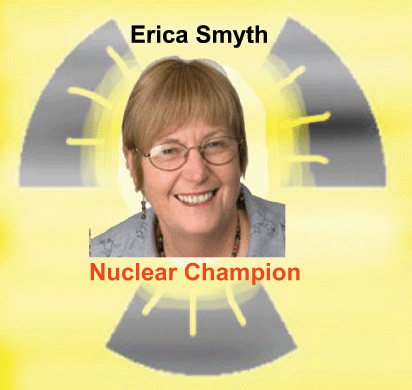
QUEEN’S BIRTHDAY 2018 HONOURS – COMPANION (AC) IN THE GENERAL DIVISION “For eminent service to the community through corporate governance roles with charitable, medical research, higher education, nuclear scientific and technology organisations, to the minerals exploration sector, and to women in business.”
Erica Smyth – Deputy Chair of the Australian Nuclear Science and Technology Organisation Director of the Deep Exploration Technologies CRC
Smyth began her career with BHP (now BHP Billiton) at Newman in the Pilbara region of Western Australia. Her later positions included 7 years as Principal Geologist for BHP Minerals and BHP-Utah Minerals International’s Beenup Project Manager for 4 years. She then moved to BHP Petroleum as their Manager Gas Market Development WA and later joined Woodside Petroleum as General Manager – Corporate Affairs. She has been a professional company director since 2005. S he is a past chair of uranium explorer Toro Energy
“Clean energy ….nuclear can be… an almost immediate part of that solution.” says Erica
June 10, 2018
Posted by Christina Macpherson |
AUSTRALIA - NATIONAL, politics, spinbuster |
Leave a comment
A Senate committee report into the political influence of donations has stated there is “no justification” for imposing a further regulatory burden on charities, but Coalition Senators have expressed concerns that “politically-active charities” are seeking to influence elections. Pro Bono Australia , 7th June 2018 Luke Michael, Journalist,
The Select Committee into the Political Influence of Donations, chaired by Greens leader Senator Richard Di Natale, released its report on Wednesday.
The committee extensively examined the regulation of third parties – which include charities and not for profits – and noted they were “integral to the political process, providing important context and commentary on the issues being decided on in an election”.
The report comes in the midst of a Turnbull government push to ban foreign donations through its Electoral Funding and Disclosure Reform Bill.
The charity sector has strongly argued that the legislation – which requires registration and disclosure requirements for a broader group of non-party political actors than is the case currently – would stifle advocacy and impose unnecessary red-tape on these organisations.
The Senate committee said much of the evidence it received noted that any further regulation of third parties should reflect their unique role in the political system, and not unfairly burden them.
“The committee received consistent evidence over the course of the inquiry that the recently amended legislation and current legislative proposals before Parliament carry the very real danger of stifling the voice of third parties in delivery of their core purpose to advocate on specific issues,” the report said.
“The committee is of the strong view that only activity by third parties that is seeking to directly influence elections should be regulated.
“The committee therefore recommends that a thorough consultation exercise be carried out by the federal government before any detailed regulatory mechanisms are put in place.”
The report said the committee had heard “almost universal views” that the extensive regulatory regime that governs charities effectively made any recent legislative proposals under electoral law redundant.
The committee therefore recommended that no further burden be placed on charities…….. https://probonoaustralia.com.au/news/2018/06/senate-committee-says-regulatory-burden-charities-unnecessary/
June 8, 2018
Posted by Christina Macpherson |
AUSTRALIA - NATIONAL, civil liberties, politics |
Leave a comment
AdnyamathanhaTraditional Land Association (ATLA) RNTBC Email ceo@atla.com.au ICN 3734 ABN 14 146 238 567 PO Box 4014 Port Augusta 5700 Ph 0429900222 29/5/2018
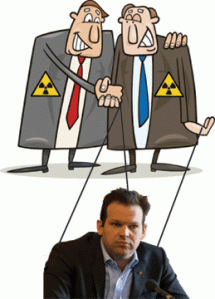 To. Minister Canavan PO Box 6100 Senate Parliament House Canberra ACT 2600
per email senator.canavan@aph.gov.au Minister Canavan [Minister.Canavan@industry.gov.au]
Dear Minister
I again write to you with regards to your departments treatment of ATLA.
I have already stated on numerous occasions, ATLA is the prescribed body corporate in terms ofour Native Title and we are an Aboriginal Regional Authority with the State Government and recognised as the peak organisation with regards to any heritage issues in our area. We are the representative body for Adnyamathanha people.
However, your department continues to use divide and conquer tactics with regards to the nuclear waste dump in our land.
We raised very grave concerns in relation to the Heritage Assessment and we had no choice but to pull out of this very early in the process. We have no faith in the process or the assessment and we will not accept any findings from this flawed non-inclusive process.
You visited our land recently and didn’t even contact ATLA.
It is not true that Bruce Wilson tried to contact me, I have had no communication with him in relation to your visit. The first I knew about you being here was when I was told you were meeting with individual Adnyamathanha people at Mamma Lou’s café in Port Augusta, that is only about 500 metres from my office in Port Augusta! You then added to the insult by entering our land with no contact with us.
I call on you as Minister to tell the truth and remove these lies from your website.
ATLA is a vital part of this whole process we are the Traditional Owners and we say NO!
Now you are going to hold some sort of vote for the people who live very close to Wallerberdina, however, this is Adnyamathanha land and ALL Adnyamathanha people must get the chance to vote.
I demand you include all Adnyamathanha people who are on the electoral roll in this vote!
This process has been flawed from the start, you continue to ignore our concerns and opposition to this dump and the very least you can do is include us in the vote. I believe there are at least 1500 Adnyamathanha people eligible to vote.
This is our land, ATLA is the peak body, show us respect as the Traditional Owners.
Please take action on this matter with some urgency and include Adnyamathanha people in the vote.
Yours sincerely
Vince Coulthard, CEO
May 30, 2018
Posted by Christina Macpherson |
aboriginal issues, AUSTRALIA - NATIONAL, Federal nuclear waste dump, politics |
Leave a comment
 Labor trusted more on energy: Newspoll https://au.news.yahoo.com/labor-trusted-more-energy-newspoll-190748195–spt.html
More voters trust Labor to deliver lower power prices and secure supply than the coalition, despite the Turnbull government’s National Energy Guarantee policy, a Newspoll shows.
The poll shows 39 per cent trust Labor, 37 per cent back the coalition, while 24 per cent remain uncommitted to keep prices down and secure supply, the Newspoll conducted for The Australian showed.
It comes as the federal government has pushed its NEG while facing mutiny in the partyroom over coal-fired power stations, such as Liddell.
The poll was conducted between May 24-27 and covered 1591 voters across regional areas and the major cities.
May 30, 2018
Posted by Christina Macpherson |
AUSTRALIA - NATIONAL, energy, politics |
Leave a comment
Adani to pay for Isaac council staff working on Carmichael mine activities, ABC News 28 May 18  , By Josh Robertson and Emilia Terzon
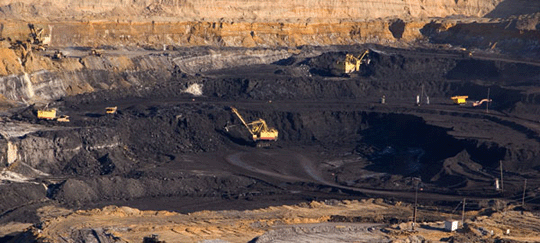
Adani will bankroll the jobs of local government staff tasked with assessing activities around its Queensland mine proposal — a deal anti-corruption campaigners say raises “serious questions” about independent oversight.
The Indian mining giant has struck an unusual deal to pay up to $1.15 million in wages, housing and vehicle costs for four Isaac Regional Council employees to deal with the “extraordinary workload” created by the Carmichael coal project.
Anti-corruption think tank Transparency International Australia called the scenario unprecedented, saying it would raise questions about the independence of council decisions and perceptions of conflict of interest.
But the council said the staff were under its direction and not controlled by Adani.
It said it was protecting ratepayers from bearing costs for a transnational corporation.
A council resolution last October stated that negotiations with Adani led to the company committing to “fund certain positions within council … to address the extraordinary workloads generated for council by the Adani projects”.
According to council minutes, jobs for an executive and legal support officer, a senior engineering manager and two field officers would be “fully funded (including labour and other on-costs, housing and vehicle costs) by Adani”.
‘Potential for conflict of interest’
Transparency International chief executive Serena Lillywhite said the arrangement raised “real questions around the perception or the potential for a conflict of interest, and for undue industry influence, and certainly questions around the independence of decisions being made by the council”.
She said it took the risk of regulatory capture to “a whole new level”.
“When you have a situation whereby people who are employed by the council but are in fact being paid for by Adani to undertake responsibilities and tasks — such as legal support and compliance with contractual arrangements, engineering support to check whether or not there is compliance with standards regarding engineering or environmental aspects — it does create some real concerns.
“You can understand how at best there would be a perception that there is not an arm’s-length arrangement between the council and the company.”
……… No other council has similar arrangement
However, a spokeswoman for the Local Government Association of Queensland (LGAQ) said it was not aware of any other such arrangement between a council and a company where funding was tied to jobs involving oversight of the company’s activities.
The ABC has confirmed this is the case with Rockhampton and Townsville councils, which struck their own deals with Adani that they would pay about $30 million for its airport in return for local hiring guarantees……….http://www.abc.net.au/news/2018-05-28/adani-to-pay-for-isaac-council-staff-working-on-carmichael-mine/9801988?utm_source=sfmc&utm_medium=email&utm_campaign=%3a8935&user_id=b5c7b9f32422565bb60e137da05ce4996754bac02a16a453ac7a4213430ce2e8&WT.tsrc=email&WT.mc_id=Email%7c%7c8935&utm_content=ABCNewsmail_topstories_articlelink
May 27, 2018
Posted by Christina Macpherson |
climate change - global warming, politics, Queensland, secrets and lies |
Leave a comment
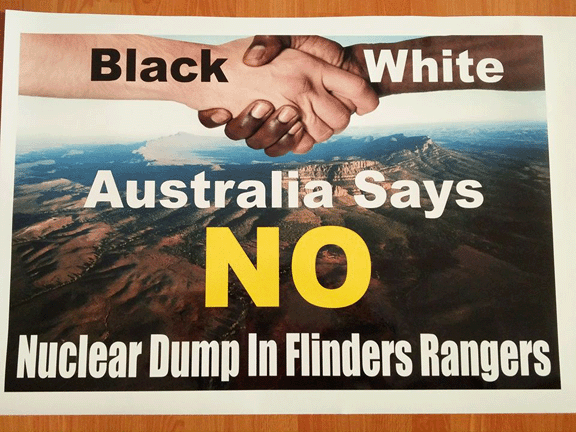
Make peace by defying SA nuclear dump https://www.eurekastreet.com.au/article.aspx?aeid=55371 Michele Madigan 17 May 2018
As Aboriginal elder and justice campaigner Kevin Buzzacott has said: ‘If we can’t make peace for the country, and look after the country — what’s the good of us?’
Sunday 29 April 2018 marked the second anniversary for many such South Australian peacemakers. It was on that date in 2016, at 2.30am, that Adnyamathanha Elder Aunty Enice Marsh heard the news that the federal government had ‘chosen’ the Flinders Ranges to be the ‘top of the list’ site of the proposed national nuclear dump.
Incredulous at hearing this on the 8am news, I rang Aunty Enice. ‘I’m sitting here trying to eat my weetbix and keep my thoughts calm,’ she said. ‘But do you know what I was thinking? Colonisation is again attacking the First Nations people and poisoning their land.’
For her colleague, Regina McKenzie, it was ‘like getting news of a death’: death to a 60,000-year cultural heritage.
Since then, South Australia’s international grain farming area of Kimba has again emerged as an alternative site. At last month’s first joint meeting in Port Augusta, both Kimba and Flinders Ranges peoples opposing the dump reported that after ‘a quiet last few months’, the pressure from the federal government is now back on with a vengeance.
The announcement of $2 million in ‘untied’ government grants to various local applicants in each region has been integral to this. What was surprising to the Kimba opponents, faced with the absence of five of their key colleagues, was the unannounced (at least to them) appearance of the Minister, National Party Senator Matt Canavan, at this announcement.
When challenged about this lack of notice, the senior public servant’s response was that he hadn’t been ‘really sure’ that the Minister was coming. Kimba opponents cite this as just another example of the government campaign strategy: ‘It’s all about stealth.’
The Minister also announced that the Australian Electoral Commission local voting for and against either region becoming Australia’s national nuclear dump would take place on 20 August. Currently there is a Senate Estimates Committee examining the process of site selection and related matters, with its recommendations due on 13 August — leaving hardly time for a dispersion, reading and respectful cognisance of its findings prior to the vote.
Political maneuvering is again evident in the insistence of the Minister to tightly restrict the voting area — as if the small numbers of local people will be the only ones affected. Kimba farmer opponents warn constantly of the danger to their international markets of other crops and produce (such as Port Lincoln’s seafood trade) on the whole of the Eyre Peninsula region.
The oft-repeated government saying: ‘We will not impose the federal nuclear dump on an unwilling community’ continues to fly in the face of the lately renewed state legislation, which actually forbids the transportation of such waste into South Australia.
On 28 April, some of us ‘southerners’ joined locals at the glorious Wilpena Pound (pictured) site to inform national and international tourists of the Australian government’s intention to make the region home to Australia’s highest level nuclear waste — if permitted.
Predictable reactions to the news (‘Incredible!’ ‘Why?‘) included inquiries about the distance from the Pound. Amazement followed the map sighting: that any government would deliberately jeopardise such an internationally recognised site by proposing, just 40km away, a dump site for nuclear waste. Measured by radioactivity, over 90 per cent of the waste would be intermediate long lived nuclear waste from the Lucas Heights nuclear reactor in Sydney — waste that will be hazardous for thousands of years.
Our dinner at the camping ground was accompanied by ring-necked parrots and, later, flocks of apostle birds. In the morning, my prayer companions included a mother kangaroo, who fossicked among the leaves while keeping herself discreetly behind the wire fence. Her joey however was a close encounter type, constantly circling within a metre of my chair.
The Flinders is an idyllic place. Kimba is important grain farming country. No wonder much of the emphasis in the government campaign, and by local proponents for both regions, continues to be on the low level nuclear waste component.
With the campaign stretching past its third year since the announcement of the respective leaseholders simply ‘offering’ their respective properties, both Aboriginal and non-Aboriginal opponents are rock solid in their constant efforts ‘to look after the country’. But it has come at huge personal and communal costs.
Barry Wakelin, the retired Coalition federal member, is one of the farmers fiercely opposing the plan. In the face of groundwater, transport and serious, hugely long-term safety risks, Wakelin insists, ‘This is a national issue, not something that a regional community should be left to deal with.’
A national response (in the form of a petition being circulated by Conservation South Australia) can be made in solidarity with the country and peoples who will be affected by the proposed site. Click here to sign the petition.
May 19, 2018
Posted by Christina Macpherson |
AUSTRALIA - NATIONAL, Federal nuclear waste dump, politics |
Leave a comment
Labor considers tougher environmental laws as branches call for new agency
Tony Burke says Labor isn’t afraid to strengthen laws as grassroots campaign calls for more proactive protections, Guardian, Katharine Murphy Political editor@murpharoo17 May 2018
May 17, 2018
Posted by Christina Macpherson |
AUSTRALIA - NATIONAL, environment, politics |
Leave a comment
Anti-Nuclear Coalition South Australia No Nuclear Waste Dump Anywhere in South Australia, 16 May 18 Richard Yeeles is the Policy Director of the Liberal Party of South Australia. In his 2016 submission to the Nuclear Fuel Cycle Royal Commission he recommended:
“That as a demonstration of its strong interest in, and commitment to the further development of a safe and sustainable Australian nuclear industry, and as a first step in such further development, the South Australian Government offers
to host a national facility for storage and disposal of Australia’s own low and intermediate-level radioactive waste with the ultimate aim of securing Federal Government support for hosting an international radioactive waste management facility in South Australia”
Lib Senator Ramsay triggered KImba’s offer whilst Lib ex-Senator & absentee landlord Chapman dumped on the Flinders.
Join the Dots peeps! https://www.facebook.com/groups/1314655315214929/
May 15, 2018
Posted by Christina Macpherson |
AUSTRALIA - NATIONAL, Federal nuclear waste dump, politics |
Leave a comment
Hours before the doors swung open on the budget lock-up, the bright sparks on Twitter had already started a new meme. #KeepMyTenDollars was a reminder that Australians would gladly forgo an extra few bucks a week for to see the governments prioritise spending on health, education and renewables, not corporate and high-end tax cuts. It was certainly funnier than Scott Morrison’s bizarre attempt at humour.
“What have you achieved?” would have been an odd opening line to the government’s pre-election budget speech, were it not coming from the mouth of the man who famously waved a lump of coal around in Parliament to declare his love for the toxic fuel. The joke was lost on the rest of us, but it was the punch line that betrayed the confusion of the government.
The world’s leading economists have been warning for decades that the damage caused to the climate by burning coal, oil and gas poses one of the most serious threats to the global economy. The cost of destruction in agriculture, tourism, finance, insurance, property, and even mining caused by sweeping floods, droughts and bushfire caused by distorting the world’s life support systems is nearly unimaginable.
Indeed, it’s hard to imagine a sector that will not be severely impacted by climate change. But collapsing costs in renewables and a rising global movement against pollution is changing the headwinds – not that our Government seems to have noticed.
You would think that a Government that waxes lyrical about intergenerational equity would have at least a primary school grasp on climate change. Yet the forbidden words were nowhere to be seen in the budget speech, save for a small reference to the Government’s plans to walk away from innovation in the renewables sector (whatever happened to that dogged commitment to ‘jobs and innovation’). The devil, as always, was in the detail of the budget papers.
Budgets are a statement of values that mark the principles of legislators. In this year’s budget, the Government’s values were laid bare, with climate spending slashed by almost half, falling further to $1.2 billion by 2022. Analysis by the Australian Conservation Foundation found that the under-resourced Department of Environment and Energy will have an axe taken to its bottom line, with spending slated to plunge by 43 per cent on 2013 levels (when the Government took office) by 2022.
The Renewable Energy Target will be abolished by 2020. Taxpayer largesse will continue to flow to the Government’s friends in fossil fuel companies, with $30 billion in diesel tax subsidies pouring into private companies over the forecast period. No additional money for renewables or climate mitigation and adaptation will be forthcoming.
The opportunities that come from renewable energy, which are now cheaper as well as being cleaner and healthier, are being seized by the community of nations while Australia clings to a wheezing, out-dated economy.
On the same day the budget was delivered, the meter at Mauna Loa, Hawaii clocked 410 parts per million of carbon dioxide in the atmosphere – a level not seen in 800,000 years, well before humans developed agriculture, let alone donned suits and waved rocks around in Parliament.
The other critical budget, the carbon budget, is in obvious deficit.
The Government should keep my ten dollars, and use it to achieve real progress towards a coal-free, more liveable society. Most Australians would gladly chip in for wind and solar, and our vast weight of numbers will eventually prevail.
It’s clear after this budget that it will take concerted action from all Australians everywhere for the Government to regain its grip on reality.
May 12, 2018
Posted by Christina Macpherson |
AUSTRALIA - NATIONAL, climate change - global warming, politics |
Leave a comment
 SA parliament to debate whistleblower laws http://www.news.com.au/national/breaking-news/sa-whistleblower-laws-to-be-debated/news-story/8185705eee839b9c9b9277c456641777
A law shielding South Australian journalists from liability for refusing to reveal their sources will be tabled in state parliament.
Whistleblowers may soon have stronger protections under a bill introduced to parliament in South Australia.
The Liberal government on Thursday introduced legislation to shield journalists from criminal or civil liability if they do not disclose the identity of their sources when the information is in the public interest.
“This legislation enhances the public’s right to know by encouraging whistleblowers to come forward on the understanding that journalists will not be forced to disclose their identity in a court of law,” Attorney-General Vickie Chapman said.
The proposed legislation would make the default rule that journalists cannot be compelled to answer a question or produce a document that may disclose the identity of an informant.
“I anticipate it will be a very rare day that a court will deem revealing the identity of the informant is necessary to protect the public interest,” Ms Chapman said.
SA Law Society President Tim Mellor said the legislation was an important step in the protection of a free press.
“Like an independent judiciary, the fourth estate of a free press is an integral part of an open and transparent society,” Mr Mellor said
South Australian and Queensland are the only two states without shield laws.
May 11, 2018
Posted by Christina Macpherson |
civil liberties, politics, South Australia |
Leave a comment
 Liberal activists target Tony Abbott’s seat over climate change policy
Sydneysiders urged to join party in former PM’s seat to ‘shift the politics’ and speak up for the environment,Guardian, Anne Davies, 3 May 18,
Tony Abbott’s political future could be under threat from a group of activists who have been organising environmentally conscious voters to join Liberal partybranches on Sydney’s north shore – a move that could unseat the former prime minister.
Billing themselves as “the counterweight” to the pro-coal power Monash Forum, the North Shore Environmental Stewards have held at least two recruitment functions at which attendees were urged to tap into their networks of environmentally conscious people to join the Liberal party branches in Abbott’s seat of Warringah and on the lower north shore.
The NSES has a Facebook page that says the group “supports clean energy and a healthy environment, and believes in traditional Liberal party values of environmental stewardship”………https://www.theguardian.com/australia-news/2018/may/03/environmentally-conscious-liberals-urged
May 4, 2018
Posted by Christina Macpherson |
AUSTRALIA - NATIONAL, climate change - global warming, politics |
Leave a comment
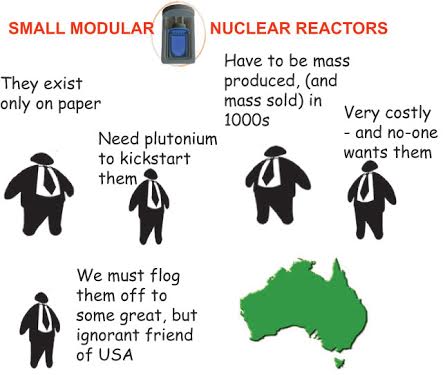
Barilaro sees nuclear future, Labor criticises lack of detail, Canberra Times, Elliot Williams – – 21 Apr 18, NSW Deputy Premier John Barilaro has not ruled out one day having nuclear reactors in his home electorate of Monaro, near the ACT.
Mr Barilaro has garnered attention this week after advocating for nuclear energy to be considered in NSW in a speech to an energy policy forum in Sydney on Wednesday.
But when questioned whether he would ever consider bringing nuclear reactors to Monaro Mr Barilaro refused to rule anything in or out.
……..Mr Barilaro said he envisaged a future where small modular reactors were set up in a series and could be air, gas or sand cooled rather than the familiar technology of large reactors situated on the coastline for easy access to water.
He said recycling of radioactive material had improved and waste products would remain radioactive for around 300 years rather than hundreds of thousands of years.
However Mr Barilaro has been criticised by Labor candidate for Monaro Bryce Wilson and the Nature Conservation Council for his reluctance to provide details about his plan to bring nuclear power to the state.
“John can’t stand there and say he wants to provide relief to household energy bills without giving us any figures,” Mr Wilson said.
“This isn’t primary school debating, this is a conversation for grown ups.
“How can we have a conversation about nuclear power without knowing where reactors would go, how much it would cost and what would happen to the waste?
Mr Wilson added he would not endorse bringing nuclear reactors to any part of the region………The federal government has a ban on nuclear power in Australia and federal member for Eden-Monaro Mike Kelly said he would not support nuclear power in the region.
“It is not necessary to build nuclear power stations in Australia, as we have an abundance of natural renewable resources that can be utilised to create energy,” Dr Kelly said.
“For our region, there is a real opportunity in becoming a hub for research and development in renewable energy and the scope for manufacturing renewable energy components.”
Mr Barilaro said he wanted to see more investment in renewable energy, particularly in Monaro, but said it would not be possible to do so without ensuring a greater baseload of energy, which nuclear power could provide.
He said nuclear was a cleaner option than coal or gas to achieve the necessary baseload…….ACT minister for climate change and sustainability Shane Rattenbury ruled out nuclear power as an option for the territory.
“Both Greens and Labor national platforms specifically preclude the construction of nuclear power plants in Australia,” Mr Rattenbury said.
“The ACT is committed to 100 per cent renewable electricity, and nuclear power does not form part of this commitment.” http://www.canberratimes.com.au/act-news/barilaro-sees-nuclear-future-labor-criticises-lack-of-detail-20180420-p4zaty.html
April 22, 2018
Posted by Christina Macpherson |
New South Wales, politics |
Leave a comment