 Submission by Barbara Walker Senate Economics References Inquiry – National Radioactive Waste Management Facility
Introduction:
My name is Barbara Walker. My husband and I bought a home in Quorn fifteen years ago, retiring to the peace and tranquility of the magnificent Flinders Ranges. We are both active volunteers within our community. I served as a volunteer lifeguard/supervisor at the Quorn swimming pool for nine years and am also a volunteer at
the Platform Gallery in Port Augusta. I am a member of the Flinders Local Action Group – a group of concerned citizens protecting the Flinders Ranges and against a pending nuclear
waste repository.
My husband is a regular volunteer for several local clubs and community fundraising events.
He is also an organiser for an annual military veterans retreat and a volunteer radio operator
for the VKS-737/RFDS Radio Network.
Through our network of friends and radio contacts we have always encouraged people to
visit the iconic Flinders Ranges. Many travellers visit us while travelling through Quorn and
most are horrified after discovering a nuclear waste repository is pending for the Flinders
Ranges.
A nuclear waste facility will adversely affect tourism within the Flinders and outer regions.
Many travellers from Australia and abroad have said they will not return if a waste dump is
located in the Flinders Ranges.
The prospect of a nuclear waste repository has also caused much division and ill health
within our local communities.
The Flinders Ranges is the home of the Adnyamathanha people who coincide with tourism
operators and local pastoralists in showcasing the marvels of the Flinders Ranges.
The question of broad community support:
I believe the Orima survey was flawed and inconsistent with broad community views and
opinions. Orima survey phone calls were made but only to some fixed home phones. These days most
people use mobile phones. Mobile phone users were not surveyed.
Orima offered small incentives in the form of supermarket vouchers to some indigenous
respondents. Proof of this is written in the Orima survey, headed “Interview Method”. Why
was this necessary? Would this be classed as a bribe?
In my opinion a better way to survey people would be through the postal system, canvassing
the whole community by using a simple democratic process. Perhaps using the AEC would
have been a better and fairer solution, and in doing so, every community member would
have a voice.
South Australia’s Nuclear Waste Storage Facility (Prohibition) Act 2000 states it is illegal to
have a nuclear waste storage facility in South Australia, in which case, the whole of South
Australia has already said a clear NO to the storage of nuclear waste, and if that were to be
changed by Government, all South Australians should be asked for consent.
At our own expense, Flinders Local Action Group also conducted a survey. It was posted to
the people living in Hawker, Quorn and Cradock. People were simply asked for a YES, NO
or UNDECIDED vote regarding storage of nuclear waste in the Flinders Ranges. Flinders
Local Action Group then asked if the results could be opened and scrutinized by the CEO of
the Flinders Ranges Council. FRC kindly obliged and final results showed 79% of the
respondents were against having a nuclear waste repository in the Flinders Ranges.
The consideration of Indigenous support:
The consideration of indigenous support is an important factor within the Flinders Ranges
and the wider community. Any support for a nuclear waste repository would firstly have to be
given from the Adnyamathanha community because, in the case of
Wallerberdina/Barndioota, a nuclear waste repository on that site would be invasive to their
culture. Intrusion would cross cultural songlines and disturb artifacts, sacred sites and the
Hookina – The Hookina is a culturally important place for Adnyamathanha women.
Adnyamathanha families from Hawker and surrounding areas have been severely affected
by this controversial process. It has caused great heartache, division and ill health for many
people. Families and friends are feeling torn apart by the long and ongoing processes from
ANSTO and the Department of Industry, Innovation and Science.
Community Benefits Program:
Another example of division. Many think the Community Benefits Program is divisive and
creates an impression of bribery. Some businesses needing monetary assistance,
regardless of their ‘for’ or ‘against’ opinions, are happy the money has been offered and
therefore feel it is up for the taking. Others refuse to apply as they regard it as bribe money.
Some people in the community were selected for paid positions, and part of their role is to
reassure people that a nuclear waste repository would be a positive enhancement to the
Flinders Ranges – jobs, tourism and Federal money. A few of these people have used their
positions as a license to bully community members who are not in favour of a nuclear waste
dump. I suggest in future jobs like these need to be screened and monitored regularly if
people are to receive Federal funding for this kind of employment.
Small vulnerable communities would be best served if community benefits were given in
constructive growth projects, like tourism and small business, not a nuclear waste repository
that offers minimal employment and destroys tourism and cultural heritage.
Wider Community Views and conclusion:
Wider community views should always be considered regarding the storage of nuclear
waste. Most people would agree there needs to be a single repository for a low level nuclear
waste facility somewhere in Australia but it is fundamentally important to find the right place.
The Flinders Ranges is not the right place.
The intermediate nuclear waste stored at Lucas Heights should stay where it is. The Lucas
Heights storage facility is purpose built for safety and has ‘state of the art’ security with plenty
of storage availability for years to come. Why move it to a place that has massive floods, frequent earthquakes and sometimes 50+ degree days in summer?
April 21, 2018
Posted by Christina Macpherson |
Federal nuclear waste dump, politics |
Leave a comment
This is the best of several submissions to the Senate Inquiry, that I have read so far. It can be heavy going for the reader, because it is densely informative. For a start, I have summarised some of the major arguments,
ENUFF argues that “the Taskforce has not properly nor fully informed either the wider public; nor their arbitrary ‘local community’ cohort; nor the State Government; &, it would appear, not even their own Federal Minister – about the whole radioactive waste regimen. Instead they almost only & exclusively accentuate & promote Australian usage of medical radioisotopes. ”
The community consultation methods have been inadequate and unfair. There is no scientific need for Lucas Heights nuclear wastes to be transported to rural South Australia, and medical wastes amount to only a tiny fraction of the radioactive wastes planned for the S.A. Dump.
Stirling North and Leigh Creek residents would be affected, but were excluded from the consultation. Adnyamathanha Traditional Lands Association were NOT consulted prior to the Wallerberdina preferred site announcement , contrary to UN endorsed Indigenous Rights.
In surveys run by Flinders Local Action Group a clear majority voted “no” to the establishment of a National Radioactive Waste Management Facility in the area .
Scrutiny of the Barndioota Consultative Committee NRMWT survey reveals questionable and biased methodology and results.
National Radioactive Waste Management Facility’s communications and publicity have been deceptive with its pretense that the waste is predominantly medical Low Level Wastes, ignoring Intermediate Level Waste volumes intended for ‘temporary’ storage
Given the prime-facie maladministration ans deficiencies described above, ENuFF calls for a judicial inquiry into the NRWMF ‘s processes.
ENuFF-SA Submission 1 to the Senate ERC NRWMF Inquiry (not yet published on the Senate website)
CONTENTS Page 2 Acronyms 3 Introduction 5 Executive Summary 6 History 8 Contemporary Action 9 Wallerberdina 16 Indigenous appraisal 19 Correspondence with the Taskforce 22 Afterword 25 Bibliography
In order to determine whether or not maladministration &/or negligence has any bearing upon the community consultation process, ENuFF asks the committee to recommend a judicial inquiry into the performance of the NRWMF Taskforce…..
EXECUTIVE SUMMARY Continue reading →
April 20, 2018
Posted by Christina Macpherson |
AUSTRALIA - NATIONAL, Federal nuclear waste dump, politics |
Leave a comment

Barilaro slams “ignorant 1970’s thinking” on nuclear, 2GB.com – 19 Apr 18 MICHAEL MCLAREN
Acting NSW Premier John Barilaro has been speaking on energy, declaring nuclear power “inevitable” and slamming the “ignorant 1970’s thinking” that has inhibited the development of our nation’s uranium reserves.
Michael McLaren is also pointing out the hypocrisy of Australia’s engagement with nuclear energy, noting that despite being the world’s third largest exporter of uranium, Australia has a banning moratorium on the resource.
“In 2016, Australia exported uranium worth more than $900 million to other places around the world. But we didn’t use one iota of it at home,” says Michael.
“If you ask me, that’s completely stupid.” “It has been forgotten for no other then ideological reasons.”….. Download this podcast here https://www.2gb.com/podcast/barilaro-slams-ignorant-1970s-thinking-on-nuclear/
April 20, 2018
Posted by Christina Macpherson |
New South Wales, politics |
Leave a comment
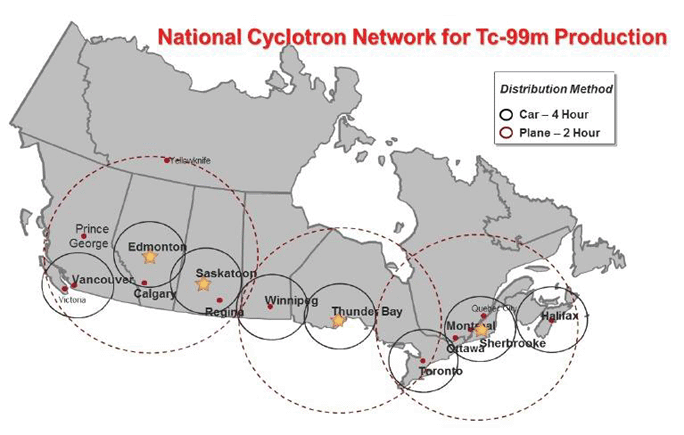
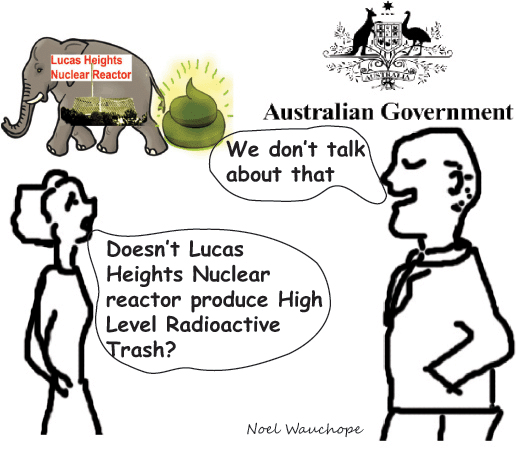
With the prospect of more bursts of extreme weather in the future, yet another danger of the Lucas Heights nuclear reactor is apparent.
Meanwhile, other countries are turning to the safer and far more practical methods of producing medical radioisotopes. (After all, the tax-payer funded Australian National Science and Nuclear Technology Organisation ANSTO claims that the only purpose of the reactor is medical) . Map above shows Canada’s network for production and distribution of the most important medical radioisotope, Technetium-99m , as well s as others.
Bushfire now contained About 200 firefighters worked on Tuesday at Holsworthy and Barden Ridge backburning and creating containment lines.
By 6:30pm, the Holsworthy bushfire was considered contained, Mr Garlick said.
“Over the next few days our crews have a lot of hard work ahead of them mopping up and extinguishing all the hotspots within the containment lines of this fire,” he said.
“As these days continue, we are expecting milder conditions which will ease that threat, but residents should monitor those conditions and take advice from firefighters on the ground and through our website.”
As a result of backburning operations, some smoke would continue to remain in the Sydney area, potentially even as far as the Blue Mountains.more https://tinyurl.com/yaky4nqf
April 20, 2018
Posted by Christina Macpherson |
AUSTRALIA - NATIONAL, health, politics |
Leave a comment
Comment by There is something really rotten about the Nationals lately. Four Corners (4corners, fourcorners) can you please follow the stink/money trail and find out who is pulling the strings on these politicians? We have had a Royal Conmission into nuclear, I think what we really need is a Royal Commission into Nuclear lobbying and its corrupting influence on our political system.
 John Barilaro to push the nuclear power button The Australian, April 17, 2018 Acting NSW Premier John Barilaro will declare nuclear power “inevitable” in a speech that slams “ignorant, 1970s” thinking for preventing development of the nation’s uranium reserves and condemning residents to blackouts.
The speech by the state Nationals party leader, seen by The Australian and to be delivered on Wednesday night at an energy policy forum in Sydney, calls for small modular reactors, likely imported from the US, to reduce dependence on high-emission coal and gas-fired power over the next five to 10 years……
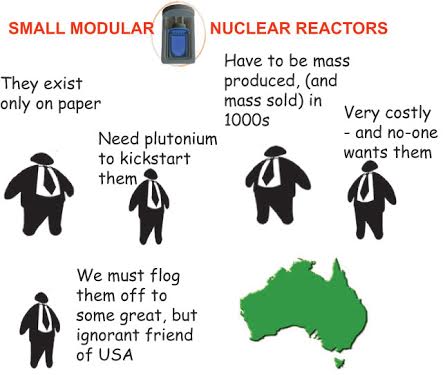
“There has never been a better moment to include nuclear energy in Australia’s energy future,” it adds, just days before the Council of Australian Governments’ Energy Council is to meet in Melbourne to bed down details of the federal government’s National Energy Guarantee….. https://www.theaustralian.com.au/business/mining-energy/john-barilaro-to-push-the-nuclear-power-button/news-story/bab8853166732f22c23c22c55731eac4
Mr Barilaro, who recently returned from an Advanced Reactor Summit in Atlanta, Georgia, spoke out in favour of nuclear power a year ago, prompting Premier Gladys Berejiklian, currently in India on a trade mission, to declare she was open-minded on the issue. “I’m in the camp of the jury’s still out,” she told the ABC then.
…….The Minerals Council of Australia, a proponent of nuclear power, said the federal nuclear ban could be reversed “with a single amendment to the Environment Protection and Biodiversity Conservation Act. “The removal of four words — ‘a nuclear power plant’ — would allow nuclear industries to be considered for development in Australia,” it said.
April 18, 2018
Posted by Christina Macpherson |
New South Wales, politics |
Leave a comment
Federal Science Minister Canavan this week announced a postal ballot August 20 of the so-called ‘local communities’ – Kimba & Wallerberdina – for the purpose of gaining consent towards furthering the NRWMF Site Selection process.
Informed consent requires both these electorates (& the wider Australian society) be fully appraised of all facets integral to any nuke dump.
Such would include these minimal requirements:
1. Adequate time to digest & follow up the outcomes from the current Senate Select Committee Inquiry into the NRWMF Community Engagement Process.
2. A complete knowledge of the actual nature, containment types, timings, duration & volumes of material destined for the facility – including a full & competent inventory of radioactive waste legacy holdings. For example: HIFAR decommissioned; ILW from all sources; CSIRO & DoD Woomera; DSTO Edinburgh; & SAGovt Radium Hill, amongst others.
Without such widespread understanding, any Poll result would lack competency, demonstrate a failure of administrative process & further exacerbate the existing community divisions created by the NRWMF Project deficient governance.
So far, the National Radioactive Waste Management Facility Taskforce has focused almost exclusively upon ANSTO radiopharma production gloves & gowns @ Lucas Heights.
THE TASKFORCE NEEDS TO PRO-ACTIVELY FULLY APPRAISE EVERYONE BEFORE ANY CASTING OF BALLOTS
ENuFF[SA]
Office Admin
https://www.facebook.com/sanuclearfree/
April 14, 2018
Posted by Christina Macpherson |
AUSTRALIA - NATIONAL, Federal nuclear waste dump, politics |
Leave a comment

Senate Inquiry Submission into the Nuclear Waste Site Selection Process , Janet Tiller I am deeply concerned and upset that the Federal Government are considering Kimba as potential site for a Radioactive Waste Facility. Kimba has been a farming community since the land was starting to be cleared in the late 1800’s. We produce mainly Wheat, Meat and Wool and I am afraid if the Radioactive waste is stored anywhere in our community it could adversely affect the prices for our land and the Wheat, Meat and Wool (they can be very fickle industries).
I would also like to know what is the true definition of broad community support. We were advised it was 65 percent then after the vote to determine those for and against the facility, Matt Canavan the Minister for Industry, Innovation and Science decided it would be 57 percent. Why? The vote was only for Kimba residents, farm owners and people that owned property in the community. The Dump could adversely affect more than just Kimba it could affect the whole of Eyre Peninsula with its “ Clean Green” image, a Radioactive Waste Facility won’t exactly fit in there.
A committee of 16 has been formed and their aim is to decide where the $2 million (now we are in the 2nd stage of the process) will be spent in the community. The committee was selected from applicants and said to be chosen from a broad selection of the community from Farming, Business, some for the RWF and some against. There are only 4 people on that committee of 16 that were against the dump, they won’t have a very strong voice will they? I look forward to your reply.
April 14, 2018
Posted by Christina Macpherson |
AUSTRALIA - NATIONAL, Federal nuclear waste dump, politics |
Leave a comment
 Marshall still open to nuclear power, IN Daily, 11 April 19 Premier Steven Marshall says establishing a nuclear generation industry in South Australia is not on his “short-term” radar but it could “come back onto the agenda further down the track” as he considers “every option to ensure we have lower energy prices”.
Marshall today embarked on his third regional tour since seizing office at last month’s election, visiting the South-East seat of Mount Gambier where Liberal-turned-Independent MP Troy Bell is a firm advocate for nuclear power.
Marshall and Bell broke bread this morning, their second face-to-face meeting since election day.
Bell quit the party after being charged with dishonesty offences following an ICAC investigation. He is pleading not guilty in an ongoing court case.
Marshall told InDaily he was “looking forward to a close working relationship with all the crossbenchers”, and that Bell was “the duly elected member for Mount Gambier and as such I’ll be treating him with respect”.
“I’ve always worked with Troy Bell… it’s quite obvious we share a lot of common aspirations for the people of the South-East,” he said.
One of those aspirations could yet be the establishment of a nuclear generator after Marshall last year flagged his interest in considering the industry, despite Royal Commissioner Kevin Scarce rejecting it as a commercially viable option “in the foreseeable future”.
“There will be a time when it may become viable, and desperate times call for desperate solutions – and we are in a desperate situation,” Marshall told media in February 2017.
Bell, who spearheaded the Liberals’ South-East fracking moratorium before he left the party-room, is a strong advocate for nuclear power and told InDaily he was “absolutely happy to lead the discussion” about establishing a local  industry.
Asked if he would advocate for a nuclear generator in the South-East, he said: “A small modular one – yes definitely.”…..
Bell said he was “very interested” in the nuclear option, insisting that “with modern technology and advancements there’s more discussions that need to be had in that space”.
“The problem is nobody wants it in their backyard,” he said.
……….Marshall told InDaily today nuclear power was “not on the short-term agenda of the Government”.
“We’ve got a very robust plan for energy [and] we’re already well on the [record] for saying we want to be neutral on that issue,” he said……https://indaily.com.au/news/local/2018/04/11/marshall-still-open-nuclear-power/
April 11, 2018
Posted by Christina Macpherson |
politics, South Australia |
Leave a comment
Coalition told to rewrite foreign donations bill in unanimous report
Joint standing committee on electoral matters says Turnbull government should remove contentious elements of bill, Guardian, Paul Karp, 9 Apr 18,
The Turnbull government should rewrite its foreign donations bill to narrow the definition of political expenditure and make it less likely to harm advocacy by civil society groups, the electoral committee has recommended.
In a unanimous report released on Monday, the joint standing committee on electoral matters sought to preserve the consensus to ban foreign political donations by calling on the government to strip out more contentious elements of the electoral funding and disclosure bill . GetUp characterised the report as a major backdown and argued the bill is unworkable but the Liberal senator Linda Reynolds, the chairwoman of the committee, told Guardian Australia it could be passed with adoption of mostly minor changes.
Major parties close to deal on charities and foreign donations. In the majority report, the Coalition and Labor members recommended political expenditure should be defined as spending “to influence voters to take specific action as voters, so as not to capture non-political issue advocacy”.
The changes would allow higher reporting requirements to be imposed on campaigning groups such as GetUp while making it less likely they will capture charities and not-for-profits campaigning on issues such as increasing foreign aid or protecting the Great Barrier Reef.
It recommended dumping new proposed categories of third-party campaigners and political campaigners in favour of a new register for groups attempting to influence voters.
Joining the register could be done voluntarily but would be mandatory for organisations with significant political expenditure, which the report suggests would be the $13,500 threshold that triggers the requirement to submit a return to the Australian Electoral Commission.
The committee recommended the requirement for organisations to seek statutory declarations from political donors be reconsidered.
t also wants the government to reconsider changes to the definition of “associated entity”, which could see campaigning organisations classified as related to political parties merely if they agree on policy matters.
In a minority report, the Greens senator Lee Rhiannon took a harder line that the bill may infringe the freedom of political communication and recommended that issues-based advocacy should be explicitly exempted from the definition of political expenditure.
The GetUp national director, Paul Oosting, said the report was an acknowledgement the bill was unworkable and noted the report did not explicitly recommend passage of the bill…… https://www.theguardian.com/australia-news/2018/apr/09/coalition-told-to-rewrite-foreign-donations-bill-in-unanimous-report
April 11, 2018
Posted by Christina Macpherson |
AUSTRALIA - NATIONAL, politics |
Leave a comment
 Nationals rule out nuclear power ‘madness’ Echo Daily April 6, 2018 | by The Echo
The NSW Nationals have ruled out plans for building a nuclear power station on the north coast in the face of mounting pressure to do so ‘once and for all’.
Labor candidate for the seat of Ballina, Asren Pugh, made the call in the wake of the recent attendance at a US nuclear industry conference by NSW Nationals leader and Deputy Premier, John Barilaro.
But Mr Barilaro’s spokesman told Echonetdaily there were ‘absolutely’ no plans for such plants on the north coast nor nuclear energy ‘anywhere in NSW’.
However, the spokesman said Mr Barilaro’s views ‘are not representative of the party’s position or the NSW governments’.
‘Nuclear energy is banned under federal law,’ the spokesman said.
On Tuesday during a radio interview, Mr Barilaro said that premier Berejiklian was “open minded” to nuclear power in NSW.
But the deputy premier’s spokesman said the Nationals did not support the idea of nuclear power in NSW, and that Mr Barilaro was ‘expressing his personal views, in the interests of sparking a conversation about the prospects and environmental benefits of nuclear energy’.
Mr Pugh said Mr Barilaro not only participated in the US conference but was a key speaker, billed as one of the ‘Biggest Names in Nuclear’.
He said that since returning to Australia from the International SMR and Advanced Reactor Summi, in Atlanta, Mr Barilaro ‘has been spruiking nuclear power right across NSW, claiming that it could be a reality within 10 years’.
‘When the Nationals leader started this madness, most people thought it was just an April Fools joke, but this is now getting serious,’ Mr Pugh said. ‘There are no circumstances in which our community on the North Coast want nuclear power here. ‘Nuclear power is unsafe, dangerous and leaves a legacy of toxic waste to our children and our children’s children.
‘Our community doesn’t want a discussion about nuclear power on the North Coast, or anywhere in NSW. I am calling on the Nationals MPs from across the North Coast to stand up for our community and say no.
‘I am asking for a clear commitment to a nuclear free North Coast,’ Mr Pugh said.
Mr Barilaro’s spokesman said the deputy premier’s position on nuclear energy ‘is his own. It is not the position of the Nationals or the NSW Government’……….https://www.echo.net.au/2018/04/nationals-push-nuclear-power-north-coast-madness/
April 6, 2018
Posted by Christina Macpherson |
New South Wales, politics |
Leave a comment
South Coast nuclear option ‘makes no sense’: Mike Kelly http://www.begadistrictnews.com.au/story/5325720/nuclear-not-a-real-option-says-mp-kelly/ 5 Apr 18,
The stretch of coastline between Merimbula and Bermagui has been earmarked as having the potential to host a nuclear power station.
In a study by the Nuclear for Climate Australia group published on its website, the Far South Coast is among 18 proposed sites or “areas of interest” in NSW.
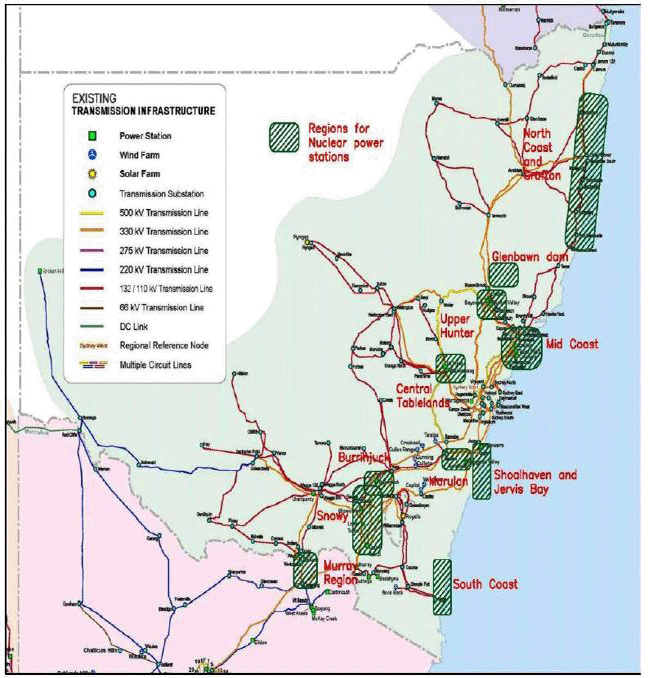
Eden-Monaro MP Mike Kelly, a vocal supporter of renewable energy investment in the electorate, said while he understood potential benefits, the study “makes no sense whatsoever”.
“The way I look at it, we haven’t solved issues around disposing of the waste, and risk issues,” Dr Kelly said.
“The results can be catastrophic.”
Dr Kelly said Jervis Bay has long been looked at as a nuclear site, even as recently as by prime minister John Howard.
“If we were going to move down that road, we would’ve had to in the 1960s,” he said.
“Why do it if you have the opportunity to avoid it?”
Nuclear for Climate Australia states the reactor would “have potential if included with other power plants built at East Gippsland, the Snowy or Jervis Bay”, would be cooled in sea water, and would require an “extensive grid upgrade” and a port upgrade at Twofold Bay.
“The big issue is they [nuclear power plants] require water, and our rivers don’t have enough, which means you need the coastline, and where on our coast would you want one?” Dr Kelly said.
“Development would take 20 years, and in that time we have every available renewable energy resource here in Australia, which will transfer to cheaper power, especially with the Snowy Hydro announcement.
“For our region there’s real benefit in becoming a hub for research and development, and even manufacturing components.”
April 5, 2018
Posted by Christina Macpherson |
New South Wales, politics |
Leave a comment
Three local sites identified as possible nuclear power stations https://www.lakesmail.com.au/story/5318455/munmorah-eraring-vales-point-identified-as-possible-nuclear-reactor-sites/ 3 April 18 Eraring has been identified as a possible future site for nuclear power by the Australian Nuclear Association.
YASMIN Catley is calling for Premier Gladys Berejiklian to rule out nuclear power in NSW.
The Member for Swansea’s comments came after it was revealed the Deputy Premier John Barilaro was on a taxpayer-funded trip to the US where he attended the International SMR and Reactor Summit, in Atlanta, on March 27.
The NSW Nationals leader has on previous occasions called for nuclear power to be “part of the debate” about the state’s future energy mix.
Mr Barilaro was an invited speaker at the summit and billed on its website as one of the “biggest names in nuclear”.
While in the US he also met with representatives from NuScale and U-Battery, his office said.
These companies are “developing Gen IV reactors which will possibly be available mid 2020s, as well as the US Department of Energy to get an insight in relation to the Government’s approach to new nuclear technology,” a spokesperson for his office said.
“This was an opportunity to learn and gain knowledge about the sector.”
Ms Catley pointed to a 2016 map produced by the Australian Nuclear Association which identified two sites in Lake Macquarie and one site at the Central Coast – Eraring, Vales Point and Munmorah – which could be potential nuclear power plants.
However, Mr Barilaro’s office said he had not considered locations for any future nuclear power sites.
 The Australian Nuclear Association’s Robert Parker said the Lake Macquarie and Central Coast sites were among many his organisation had identified across Australia.
The local sites’ suitability was due to existing power generation infrastructure, population density, access to cooling water, road and transport infrastructure, and an existing skilled workforce, Mr Parker said.
He stressed his organisation were proponents of small modular reactors, not large reactors.
The organisation would like to see 18 reactors operating in NSW by 2040.
“It’s impossible for them to have meltdown issues like at Fukushima,” Mr Parker said.
Ms Catley has called on the Premier to rule out nuclear power in NSW. “The Central Coast has a long history of being the powerhouse for NSW, but nuclear is not the way forward,” Ms Catley said.
The Member for Lake Macquarie Greg Piper said while he did not support nuclear power in Lake Macquarie, “Mr Barilaro should not be shut down if he believes it’s something that should be looked at.”
“But the people of Lake Macquarie would have a meltdown.”
April 4, 2018
Posted by Christina Macpherson |
New South Wales, politics |
Leave a comment
Premier Berejiklian ‘openminded’ to nuclear energy, deputy premier says 2GB, BEN FORDHAM, 3 April 18 Premier Gladys Berejiklian is “openminded” to nuclear power in Australia according to Deputy Premier John Barilaro.
Mr Barilaro has touched back down in Australia this week after visiting the US to push new nuclear technology in our state.
After meeting with American companies who are building the world’s first small modular reactors, he says this is the way of the future.
April 4, 2018
Posted by Christina Macpherson |
New South Wales, politics |
Leave a comment
Nuclear Fuel Cycle Watch South Australia, 2 April 18 Larry Anthony is the president of the National Party, but is also the founding director of the SASGROUP, a lobbying firm. SASGROUP clients include Delta Electricity and St Baker Energy Innovation Fund. Both involve Trevor St Baker who is director of SMR Nuclear Technology company. Even Tony Abbott has concerns about the unhealthy mixture of lobbying and politics. http://lobbyists.pmc.gov.au/register/view_agency.cfm?id=227
‘We need to have a discussion’ about nuclear energy: MP, Northern Star, by JASMINE BURKE, 31st Mar 2018 ………NSW Labor Opposition has called on the Premier to intervene and put an end to the investigation by her Deputy, National Party Leader John Barilaro, into the potential establishment of a nuclear power industry in NSW.
In his speech to the Small Modular Reactor Summit in Atalanta this week Mr Barilaro said: “We need to have the discussion (about nuclear energy) and we need to have it now.”
He added the discussion will take place over a “5-10 year period”, before any nuclear energy options could even be introduced in Australia.
A spokesperson for Mr Barilaro said he met with some companies in the US including NuScale and U-Battery, who are developing Gen IV reactors which will possibly be available mid 2020’s, as well as the US Department of Energy to get an insight in relation to the Governments approach to new nuclear technology.
They said “the meetings were an opportunity to learn and gain knowledge about the sector”.
The Nuclear for Climate Australia website identifies 18 possible sites for nuclear power plants in NSW – including a 250km stretch of coast from Port Macquarie to north of Grafton.
The plan envisages the 18 reactors being constructed in NSW by 2040.
Last year NSW Labor leader Luke Foley accepted Mr Barilaro’s invitation to debate nuclear power and suggested Lismore host the forum.
In a letter addressed to the Premier dated June 1 2017, Mr Foley described nuclear power as “both risky and irresponsible” and said: “I accept your call for a debate and propose that we hold a public debate in Lismore to discuss the issues at stake.
“Lismore would be an appropriate location for such a debate as it is one of the most environmentally conscious communities in NSW.”
But when asked if Mr Barilaro was considering the offer his spokesperson said Mr Foley was “playing politics with the issue and is completely ignorant to the issues and clueless about the technology”.
……….More recently, Shadow Minister for Industry, Resources and Energy, Adam Searle MLC and Shadow Minister for Primary Industries, Mick Veitch MLC, made a two day visit to the North Coast to meet with primary producers and explore potential solutions to the energy crisis.Mr Searle said nuclear reactors would tarnish NSW’s clean and green image, and threaten the reputation and emerging markets of many north coast primary industries.
“Mr Barilaro’s nuclear thought bubbles were a distraction from real long term energy solutions that provide the cheapest and most sustainable forms of electricity for the community and business – which is renewable energy,” he said.
“The Premier has let this debate run for too long and now needs to rule out herself any proposal to build nuclear power plants here in NSW.”
He also called for the Deputy Premier to “come up to the North Coast and explain why the National Party believes nuclear reactors are the best option”.
Mr Veitch said: “North Coast primary producers pride themselves on the quality of their goods and their clean and green reputation.”
“The National Party Leader’s obsession with building nuclear reactors would jeopardise this hard fought for advantage for local producers on the North Coast,” he said…..https://www.northernstar.com.au/news/nuclear-power-plants-still-on-the-cards-for-north-/3374502/
April 2, 2018
Posted by Christina Macpherson |
New South Wales, politics |
1 Comment
 Why Australians Need A National Environment Protection Agency to Safeguard Their Health The rationale for reform is clear, writes David Shearman, Emeritus Professor of Medicine at University of Adelaide, in this article which first appeared in The Conversation. PrBono Australia, , 28th March 2018 David Shearman
Australia needs an independent national agency charged with safeguarding the environment and delivering effective climate policy, according to a new campaign launched by a coalition of environmental, legal and medical NGOs.
Most Western democracies have established national regulatory action, such as the US Environmental Protection Agency – yet Australia is a notable exception.
On Tuesday in Canberra, the Australian Panel of Experts on Environmental Law (APEEL) will hold a symposium on the reform of environmental laws in Australia. If enacted, these proposals would offer protection to Australia’s declining biodiversity and environment, as well as helping to safeguard Australians’ health.
The proposal would involve establishing a high-level Commonwealth Environment Commission (CEC) that would be responsible for Commonwealth strategic environmental instruments, in much the same way that the Reserve Bank is in charge of economic levers such as interest rates.
The new CEC would manage a nationally coordinated system of environmental data collection, monitoring, auditing and reporting, the conduct of environmental inquiries of a strategic nature, and the provision of strategic advice to the Commonwealth government on environmental matters, either upon request or at its own initiative. The necessary outcomes would then be delivered by government and ministers via a newly created National Environmental Protection Authority (NEPA).
On Wednesday, this call will be echoed by a major alliance of leading environmental groups, including Doctors for the Environment Australia. Similar to the CEC/NEPA proposal, this group has called for an independent National Sustainability Commission that would develop conservation plans, monitor invasive species, and set nationally binding air pollution standards and climate adaptation plans.
The new body would replace the EPBC Act, which has failed to deliver the protections it promised in key areas such as land clearing and species protection, and has no role in limiting climate change which is a major factor in species loss.
The new agencies would be in a position to provide authoritative and understandable consensus reports, similar to those produced by the Intergovernmental Panel on Climate Change but with a stronger legal basis on which the government should act on its advice.
Why change the system?
The rationale for reform is clear. Only last week the International Energy Agency reported that Earth’s greenhouse emissions have increased yet again. Meanwhile, extreme weather events have increased, while wildlife diversity is on the decline………..https://probonoaustralia.com.au/news/2018/03/australians-need-national-environment-protection-agency-safeguard-health/
March 31, 2018
Posted by Christina Macpherson |
AUSTRALIA - NATIONAL, environment, politics |
Leave a comment