Minerals Council says it makes political donations to gain access to MPs
Mining body says contributions ‘provide additional opportunities for the MCA to meet with members of parliament’, Guardian, Paul Karp @Paul_Karp, The Minerals Council of Australia has conceded it makes political donations and pays to attend fundraisers to gain access to members of parliament in a submission to a Senate inquiry.

Brett Stokes – a reminder about ANSTO and its zeal for the nuclear industry
 Brett Burnard Stokes about ANSTO 15 Jan 18
(a) government backed nuclear corporation ANSTO are spending lots of money to establish a nuclear waste dump in South Australia,
|(b) there are laws in SA against nuclear waste dumps (see http://petition.dyndns.org/ ) including a provision that no public money be spent promoting nuclear waste dump.
(c) in contempt of SA laws, ANSTO has spent millions of dollars of public money on propaganda campaigns in South Australia, targetting various places with three sites active now, two in Kimba and one in the Flinders.
(d) ANSTO have run polling a while back, where the results were pretty marginal … and way short of “clear local consent” to proceed.
(e) ANSTO want to pretend that there is “clear local consent” so they are lying and also changing the rules,
(f) ANSTO have dodgy expansionary business plans involving huge export earnings from “medical isotopes” they plan to make at Lucas Heights.
If they do this, it will produce a lot of waste that they do not want to keep at Lucas Heights where there is room.
The business plans are dodgy on many levels.
(g) ANSTO are bullies with lots of cash.
Former Big Nuclear propagandist Ziggy Switkowski is back – now spruiking for Small Nukes.
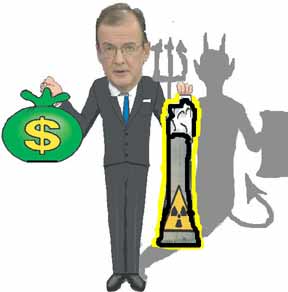 Australia has ‘missed the boat’ on nuclear power, SMH, Cole Latimer, 11 Jan 18, The Minerals Council of Australia has called for the country’s prohibition on nuclear power to be lifted. But both critics and supporters see little future for large-scale nuclear power in Australia’s energy mix.
The man who once famously called for 50 nuclear reactors across Australia, nuclear physicist and NBN chairman Ziggy Switkowski, says “the window for gigawatt-scale nuclear has closed”.
A lack of public support and any actual proposals for a nuclear plant had resulted in government inertia, he said on Thursday.
“Government won’t move until a real business case is presented and none has been, to my knowledge, and there aren’t votes in trying to lead the debate,” he said, adding that renewables were now a more economically viable choice. “With requirements for baseload capacity reducing, adding nuclear capacity one gigawatt at a time is hard to justify, especially as costs are now very high (in the range of $5 billion to $10 billion), development timelines are 15+ years, and solar with battery storage are winning the race.”
Warwick Grigor, the former chairman of Uranium King, mining analyst, and a director of uranium miner Peninsula Energy, agrees.
“I think nuclear energy is great, but we’ve missed the boat in Australia, no one is going down that path in the foreseeable future,” Mr Grigor told Fairfax Media.“When Fukushima [the 2011 nuclear accident in Japan] occurred, that was the closing of the door to our nuclear power possibilities.”
Mr Grigor sees battery technology, a market he has since entered, as a better alternative.
Australian Conservation Foundation nuclear free campaigner Dave Sweeney said talk of nuclear power was “a dangerous distraction” from the steps that needed to address the energy and climate challenges facing Australia.
Nuclear energy has been officially banned in Australia since 1998, with the Australian Nuclear Science and Technology Organisation’s OPAL reactor at Lucas Heights, NSW, the only nuclear reactor in the country.
But the Minerals Council’s executive director for uranium, Daniel Zavattiero, said the nation had excluded a low-emissions energy source of which Australia has an abundant supply from the current debate.
“Maybe nuclear power might be something that is not needed, but an outright prohibition on it is not needed,” he said.
Federal Energy Minister Josh Frydenberg supported the Mineral Council’s stance. “There needs to be bipartisan support for nuclear power and that does not exist right now,” Mr Frydenberg said. “You would also need state-based support and that is not clear at this stage either.”…..
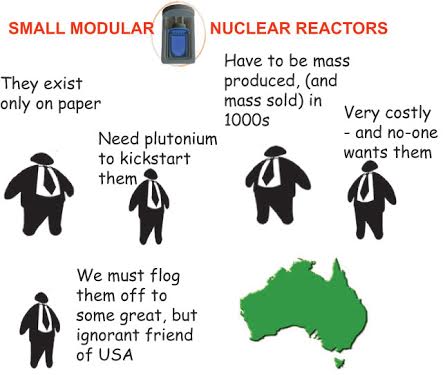 Mr Switkowski said smaller, modular nuclear reactors could play a part in the future energy mix, and could support regional centres.
An ANSTO spokesman told Fairfax Media these smaller plants could technically work in Australia.“If Australia did want to expand into nuclear energy technologies, there would be a number of options to consider in the future, including small modular reactors and Generation IV reactors, which could be feasible if the policy, economic settings and technology were right and public support was in place,” he said.
However, the country currently did not have enough skilled personnel to safely operate a nuclear energy industry, he said.
“The question of whether nuclear energy is technically or economically feasible is a different question to whether Australia should or should not have a nuclear energy program, the latter of which is a matter for policy makers and the people of Australia,” the spokesman said…….. http://www.smh.com.au/business/the-economy/australia-has-missed-the-boat-on-nuclear-power-20180111-p4yyeg.html
Minerals Council puts in its bid to overturn Australia’s laws prohibiting nuclear power
 Lift nuclear power ban: Miners http://www.theaustralian.com.au/news/latest-news/lift-nuclear-power-ban-miners/news-story/231d015d56b36a3e8f0fa94ea9ec86df, Australian Associated Press
January 10, 2018 The peak mining body has urged the federal government to lift the ban on nuclear power in Australia in order to help shore up the nation’s energy supply.
The Minerals Council of Australia made the call in its pre-budget submission.
“Nuclear power has the advantage of being able to generate baseload electricity with very low CO2 emissions over its life cycle,” the submission says.
The council said the ban on nuclear power in Australia is hampering an open debate about future energy and climate change management and stands at odds with Australia’s export uranium mining industry.
Turnbull government’s duplicity on climate and greenhouse gas emissions
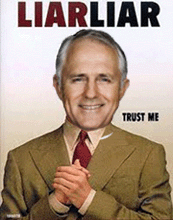 Turnbull Government conceals damning climate data, Independent Australia, Turnbull Government is negligently concealing its massive climate change policy failure, writes Peter Boyer. 8 January 2018
“……..a malignant trend in public life: the willful, calculated, planned use of the festive season to disguise government failure to meet its obligations.
In this case, it’s about accounting for national carbon emissions as required under an international agreement to which we’re a party — and the principal culprits are Minister for the Environment and Energy Josh Frydenberg and Prime Minister Malcolm Turnbull……
Climate change is not just some trivial idea to be tossed aside at will. It’s real and it’s dangerous. And in failing to take their reporting obligations seriously, the Minister and his leader are seriously negligent.
This latest example of Turnbull Government misbehaviour also happened last year. By rights, the pair should be made publicly accountable; and applying their own party’s law-and-order mantra about repeat offenders they should, at the very least, lose their jobs. Fat chance, I know.
The emissions data released before Christmas takes us up to June 2017, fully six months ago. The Government has had all that time to put it out there for public and Parliamentary scrutiny. But this matter of crucial importance was relegated to a footnote that got buried in the Christmas rush.
To understand why the official figures have been withheld for so long, we need to set aside land use data, which since the 1997 Kyoto Protocol has repeatedly been used by successive Australian governments to make the picture look much rosier than it really is.
The Turnbull Government’s climate policy centrepiece, the Emissions Reduction Fund (ERF), has been focussed mainly on land use — including tree growing and clearing. The problem with that is huge uncertainty around the data, making it impossible to measure the scheme’s effectiveness.
With fossil fuel use, which the ERF does not address, we know where we stand. The good news from last year was that our per capita emissions were at their lowest for 28 years and the emissions intensity of the economy was nearly 60 per cent below its 1990 level.
But the really important figure is the actual amount of emissions, which in 2016-17 totalled 550.2 megatonnes. That is a rise of 0.7 per cent on the previous year and continues a clear, steady rising trend since early 2014……..
The Turnbull Government’s National Electricity Guarantee, which is being heavily promoted in the Government’s climate policy review, does no more than shut the stable door after the horses have bolted. It will do little to cut electricity emissions and will not affect petrol and diesel use.
Expectations were low ahead of the release of the policy document this month, but even so, it’s a big disappointment. Having set weak emission targets for 2020 and 2030, the Government seeks to avoid heavy lifting by using foreign carbon credits while relaxing the obligations of business.
We have nothing to look forward to in 2018. Malcolm Turnbull may be a better policy salesman than former PM Tony Abbott, but the awkward truth is that, just like his predecessor, while having no climate measures of any substance to offer, he hoodwinks electors into thinking all is as it should be.
It isn’t. National climate policy is a shambles. Frydenberg’s attempts to hide emissions data show that he knows the figures are damning, yet he and his leader continue to play games with us.
We need an explanation, and they need to be called to account. They will be hoping the silly season erases all this from people’s memories. I hope and expect they’ll be proved wrong. https://independentaustralia.net/politics/politics-display/turnbull-government-conceals-damning-climate-data,11087
Adani not likely to succeed in its efforts to get tax-payers’ $1b loan for giant coal mine development
Adani $1b loan bid was likely to fail key criteria for NAIF approval, ABC News, By Josh Robertson, 5 Jan 18, Adani’s bid for a $1 billion taxpayer-funded loan may have been doomed even before it was scuppered by Queensland’s Palaszczuk Government, the Productivity Commission has said.
Key points:
- Qld Govt vetoed critical $1 billion loan for Adani mine
- Productivity Commission says mine may have failed loan criteria anyway
- Qld Govt could also veto rail company loan bid
The miner’s proposed Galilee Basin rail line faced rejection by the Northern Australian Infrastructure Facility (NAIF) because it may have failed key hurdles, the commission’s latest bulletin suggested.
However, the commission is yet to analyse a rival NAIF loan bid by rail operator Aurizon, which the State Government will also consider blocking in line with an election promise relating to Adani.
It comes as environmental activists plan to target Aurizon over its rail proposal, which would set up an export route for Adani.
State Labor told lobby group GetUp! during the election campaign in November it would veto “any NAIF loan” that enabled Adani’s coal project.
The Productivity Commission’s December newsletter noted that projects seeking low-interest loans from NAIF must “not otherwise be able attract finance, but would be commercially viable once constructed”.
There must also be “a public benefit from the infrastructure [to justify the cost to the taxpayer of the short-term assistance provided]”.
“Many of the projects suggested in the media as candidates for NAIF funding — such as the rail line to the Galilee Basin and various large irrigation dams — may fail at least one of these criteria,” it said.
This raised the risk of taxpayers throwing good money after bad, the commission suggested.
“If the return on the investment does not cover the operational costs of the infrastructure and the costs of servicing the loan at market rates over the life of the asset, the small initial level of assistance provided by a concessional loan may simply become another case of inefficient resource allocation,” it said……http://www.abc.net.au/news/2018-01-05/adani-loan-bid-likely-to-fail-before-palaszczuk-intervention/9305040
Reflecting on 2017 in the Australian nuclear-free movement
 DAVE SWEENEY | Nuclear Free Campaigner, Australian Conservation Foundation | www.acf.org.au | @AusConservation
A note to reflect on 2017 which has seen the Australian nuclear free community restrict uranium exports, derail plans for a global high level radioactive waste dump and help advance an international initiative to abolish nuclear weapons and receive the Nobel Peace Prize.
Not too shabby!
The end of the calendar year provides a pause to welcome the entrance of new life and to mark and mourn the passing of old.
It is also a time to reflect on our collective efforts and achievements – the below observations are by no means comprehensive but my sense of gratitude, solidarity and respect is.
With all best wish for a refreshing and recharging break.
I look forward to seeing and working with you in season 18,
Uranium:
A big year of activity that has seen the industry further contested and constrained.
In March the WA state election saw the defeat of the aggressively pro-nuclear Barnett government. WA Labor were elected with a strong no uranium policy but have disappointingly failed to clearly implement this and are allowing four projects to continue to be advanced. All projects remain the focus of community concern and active opposition. The WA Conservation Council and Traditional Owners have taken Supreme Court action to oppose the approval of Cameco’s Yeelirrie project with a decision expected in the first quarter of 2018 and pressure is growing on Vimy Resources, the most enthusiastic uranium hopeful. There are no commercial uranium operations in the West and any wannabe miners face a very tough road.
In November Queensland Labor were returned to government with a strong anti-uranium position and the door remains tightly shut on the uranium sector in the sunshine state.
In the NT further assessment is under way about rehabilitation and clean up options for the contaminated Rum Jungle site and issues around the closure and rehabilitation of the heavily impacted Ranger mine site on Mirarr land in Kakadu moved to centre stage. The era of uranium mining in Kakadu is over: Jabiluka is stopped and stalled, Koongarra is finally and formally part of Kakadu National Park and Ranger has stopped mining and is in the final days of mineral processing. The challenge now is a massive one – to help ensure that the NT and federal governments and Rio Tinto have the commitment, competence and capacity to clean up, exit and transition in the most credible and effective way.
South Australia remains the nations sole uranium mining state but even the pro-nuclear Royal Commission found that there was no justification for increased mining. The global uranium market remains over-supplied and the commodity price remains deeply depressed. Our planets energy future is renewable, not radioactive and Australia is ripping and shipping less uranium oxide each year. In contrast to the continuing column inches and Mineral Council of Australia drumbeats – the market and the community both continue to have little confidence in, or time for, the uranium sector.
International radioactive waste:
One of the best news stories of 2018 was the declaration in June that the plan to ship, store and ultimately bury one-third of the world’s high level radioactive waste into South Australia was dead’.
This result is a massive tribute to the sustained efforts, action and advocacy of so many – especially SA Aboriginal communities and representatives who spearheaded the community resistance. The result is also a real validation of the potency of people power over poisoned power. There was deep and well-resourced political, corporate, media and institutional support for the dump plan and this was stopped by the little people stepping up and doing big things. This result has significant international implications as the absence of an Australian based ‘disposal pathway’ makes it harder for aging reactors overseas to gain license extensions.
This is the second time in as many decades that the Australian community has successfully opposed plans to open a global high level radioactive waste dump with Pangea Resources seeking to advance a plan in WA in the late 1990’s. Some of the same players then were also behind the recent SA push and, like liberty, the price of keeping Australia free from being a global dumping ground is eternal vigilance.
National radioactive waste:
The federal government continues to lurch along an increasingly dry gully in its search to find a site to develop a national radioactive waste dump and store. Three sites in South Australia – one in the Flinders Ranges and two near Kimba on the Eyre Peninsula – remain the focus. All sites are strongly contested by large numbers of locals and in the Flinders Adnyamathanha Traditional Owners are continuing to lead the campaign. There has been lots of activity with publications, films, songs, exhibitions, rallies, actions, speaking tours, gatherings, public meetings, media events, Canberra trips and much more.
The government faces a set of sustained and significant procedural and community roadblocks in advancing this plan. It has had its eyes off the ball and been playing musical chairs over Ministerial responsibility – the song has now stopped with Matt Canavan in the hot seat. A growing range of groups are advocating a revised approach to responsible waste management based on extended interim storage at the two federal sites where 95% of the waste is currently stored and a detailed examination of the full range of future management options, not simply a search for a remote postcode. Hardly rocket science and set to be an area of key movement focus in 2018.
Nuclear weapons abolition:
Viva ICAN!
Against a backdrop of increasing global nuclear tensions an Australian born initiative has provided hope and a pathway to peace. The International Campaign to Abolish Nuclear Weapons was formed in Melbourne a decade ago and ICAN was behind the UN’s adoption of a treaty to prohibit nuclear weapons earlier this year. The treaty seeks to make nuclear weapons illegal and to challenge and change the ways these weapons are viewed and valued. It is our shared planets best chance to get rid of our worst weapons. In October ICAN was awarded the 2017 Nobel Peace Prize in recognition of its efforts. Surreal, timely and important. In 2018 work will continue to grow the treaty, including pressuring Australia to sign and ratify.
Along with ICAN’s Nobel there was other external recognition and acknowledgement of the efforts of Australian nuclear free work in 2017 including WA’s Judy Blyth’s commendation in ACF’s Rawlinson Award, respected and beloved Yankunytjatajara elder and prominent anti-nuclear and land rights campaigner Yami Lester was posthumously awarded a SA Environment Award lifetime achievement and the makers of the remarkable Collisions virtual reality film telling a key part of the Martu story won an Emmy Award. And more….congratulations to all.
Of course most of our work is not seeking and does not receive awards. It is done to move Australia away from fuelling and facilitating a trade that disrespects and endangers community and country today and far into the future. It is profound and pivotal – and it is making a real and demonstrable difference and I am proud to work and travel alongside you in this continuing journey.
Very few Australians approve of Turnbull’s climate “policies” – poll shows
 Ipsos poll: Only 18 per cent think Turnbull government is doing a good job on climate change, SMH, Matt Wade, 26 Dec 17, One in two Australians believe climate change is already damaging the Great Barrier Reef and causing more extreme storms, floods and droughts.
But only 18 per cent think the Turnbull government is doing a good job tackling global warming, a new poll has found.
An annual survey by Ipsos, which has probed public opinion on climate change for the past 12 years, shows eight in 10 agree human activity is contributing to climate change – 42 per cent say humans are mainly or entirely responsible while 38 per cent believe climate change is caused partly by humans and partly by natural processes.
Just 3 per cent of respondents think there is no such thing as climate change, a share that has hardly shifted during the past decade. ………
Those aged less than 50 are much more likely to think climate change is mostly or entirely caused by human activity than those aged over 50.
Australians are sceptical about letting market forces alone determine how much power is generated from renewable sources. Only 27 per cent supported a deregulated, “market only” approach with no national target for the uptake of renewable energy.
Seven in 10 were in favour of the federal government setting a national target for renewable energy use (32 per cent strongly support this) with just 15 per cent opposed…..http://www.smh.com.au/national/ipsos-poll-only-18-per-cent-think-turnbull-government-is-doing-a-good-job-on-climate-change-20171222-h09e5t.html
Labor and Greens slam Coalition climate review
Guardian, Eleanor Ainge Roy, 20 Dec 17, In the shadow of a cabinet reshuffle yesterday, the government released a long-anticipated review of its climate policies which foreshadows loosening the current safeguard mechanism for pollution levels.
Labor and the Greens blasted the new annual emissions projections, which predict Australia will increase its emissions all the way to 2030 and beyond, and called the Coalition’s action on climate change woefully inadequate. “When you look at those numbers you really do start to understand why [the government] would sneak them out, because they are a shocking set of numbers,” the shadow climate change minister, Mark Butler, said.
Butler also condemned the permissive signal on the safeguards mechanism in the review, as did the Greens’ climate spokesman, Adam Bandt, who noted the government wanted to weaken its “flawed” emissions reduction fund by allowing companies’ pollution baselines to be increased. “The data is devastating and the policy review is a travesty,” Bandt said. “Pollution is going up, we won’t meet even our paltry Paris targets and the government’s only plan is to make matters worse by allowing companies to buy dodgy permits from pig farms in China instead of cutting Australia’s emissions.”…..https://www.theguardian.com/australia-news/2017/dec/20/morning-mail-labor-and-greens-slam-coalition-climate-review
Queensland Premier’s first act will be to veto Adani railway line loan
Annastacia Palaszczuk to officially veto Adani railway loan after swearing in
Letter confirming veto will be sent to Malcolm Turnbull as Liberal National party elects new leadership team, Guardian, Amy Remeikis, 12 Dec 17, The Queensland premier, Annastacia Palaszczuk, will move to officially veto any loan to the Indian mining company Adani from the Northern Australia Infrastructure Facility, as soon as she and her new government are sworn into office.
After almost two weeks of vote-counting, Labor was declared the winner of the 25 November poll on Friday, returning to parliament with a majority for the first time under Palaszczuk’s leadership.
A letter confirming the Adani veto, which marked a turning point in Labor’s campaign, will be sent to the prime minister immediately after Queensland’s governor swears in the new state government on Tuesday……
The move to veto the Naif loan has frustrated the federal government, particularly the minister for resources and northern Australia, Matt Canavan, who last week told News Corp the Queensland government decision was motivated by “xenophobia” and “racisim”, comments Bill Shorten’s office labelled “unhinged”…….
She further vowed to stop all direct taxpayer funds going to the mine and its associated infrastructure……. https://www.theguardian.com/australia-news/2017/dec/12/annastacia-palaszczuk-to-officially-veto-adani-railway-loan-after-swearing-in
Any integrity Turnbull ever had is now blown as he kowtows to the Right on energy
 Turnbull blows trumpet for right wing idiocy on energy http://reneweconomy.com.au/turnbull-blows-trumpet-for-right-wing-idiocy-on-energy-35004/
After more than two years at the helm, Turnbull has done nothing to change the policies laid out by his predecessor Tony Abbott, and has only added to uncertainty by canning the major recommendation of the Finkel Review and trying to force the likes of AGL to invest yet more money in their ageing coal fired generators.
In an appearance on ABC TV’s Q&A program on Monday night, on the same day as a series of end-0f-year interviews with mainstream media, Turnbull appeared triumphant, cock-sure and combative, and unwavering from the hard right line on climate and energy.
Asked about his warnings – made in 2010 – that failing to address climate change would endanger future generations, Turnbull predicted a long future for fossil fuels, and repeated the usual fear-mongering about wind and solar.
“Energy policy has to be driven by engineering and economics, not by ideology, and as we’ve seen, for example, in South Australia, sheer idiocy.
“You know, where you had an enormous investment in wind power – nothing wrong with that, except they didn’t have anything to keep the lights on when the windmills stopped turning. A catastrophe. So you’ve got to plan it right. There will be a role for fossil fuels for a long time.”
But whether Turnbull likes it or not, the idiocy does not lie with Labor in South Australia; it lies with the mind numbing ignorance and obstinacy of the right wing in Australia’s politics and media, forever holding on to their attachment to coal.
The blackout in South Australia proved one thing, that the country’s ageing dumb grid was no longer fit for purpose, and the solution would not come from last century technologies like coal and gas, but a new system built around wind, solar, smart thinking and new management practices.
The Coalition’s response to wind and solar, and new technologies such as battery storage and smart things like demand response, betray their own ideology and their lack of respect to both engineering and economics.
Turnbull will be buoyed by the fact that the mainstream media has declared the energy policy issue to be “sorted” – the AFR on Tuesday said the energy policy conundrum was “fixed” and even the Guardian has suggested any opposition to the proposed National Energy Guarantee is just “playing politics”.
But energy and climate policy is anything but: stitched up maybe, fixed no.
Turnbull claims, and did so again on Q&A, that the NEG – currently little more than a thought bubble – has widespread support, but that is only among the incumbents and big business players that stand to profit from it, and their lobbyists and boosters.
The support of others is highly conditional, and is on the basis that the NEG must not look like what the modelling suggests it might look like – useless on emissions, inviting no new investment, doing little on prices, and simply reinforcing the market power of the incumbents.
The lack of scrutiny from mainstream media, and its willingness to pursue Coalition and fossil fuel industry talking points about “clean coal” and “base-load”, will make Turnbull’s task easier and take much of the political risk out of his informal treaty with the technology troglodytes on his right.
But his pursuit of these lines is all the more disappointing because he has plenty of evidence say otherwise.
+ The government’s own modelling suggested that more rnewsbles, not less, would lead to the greatest price reductions;
+ The Finkel report on storage reinforced what the CSIRO and the networks had already made clear, that the level of storage required is remarkably small and almost non-existent for the levels contemplated by this government;
+ And numerous reports put emissions at their ever highest level, point out the uselessness of the current Direct Action policy and the growing risks from global warming.
That’s why the AGL decision on Liddell is significant. A combination of renewables, storage, and some gas peaking plant would slash emissions and offer technology 20 per cent cheaper than the Coalition’s preferred option of spend money keeping ageing and unreliable coal generators on line.
But as the Institute of Sustainable Futures points out, emissions could be cut even further, and costs halved (rather than cut by 20 per cent), if an even smarter approach was adopted – a mixture of renewables and energy efficiency and demand management.
However, as ISF’s Chris Dunstan points out, this does require the government to actually do something, and reframe policy so that utilities and consumers benefit.
The sole incentive for the utilities under current market settings is to invest in more generation and continue to extract the monopoly rents from their market dominance that are screwing consumers. This report from the regulator last week underlines exactly how they are doing that.
This makes Turnbull’s latest utterings completely indefensible.
It is no longer good enough to lock himself into the Abbott era policies designed and framed by climate deniers and technology skeptics who sought to do the minimum possible.
(It may be partially explained by the fact that one of his principal climate and energy policy advisors, Sid Marris, used to work for the Minerals Council of Australia. And Patrick Gibbons, the former advisor to environment minister Greg Hunt, is now head of climate and energy at the MCA).
If he wants it, Turnbull has all the evidence he needs to argue that the energy trilemma – emissions, reliability and affordability – is best addressed by wholesale market and policy reform and ambitious renewable and climate targets.
It would lead to a smarter, cleaner, cheaper, and more reliable grid. And in quick time. What’s not to like about that?
The issue over marriage equality showed how reasoned argument, and just a little political and a lot of community leadership, can overcome the fear and loathing of the small but powerful conservative base.
But Turnbull has shown that he has not the courage, nor the political need, to push these through.
Instead, he is likely to push ahead with Snowy 2.0 pumped hydro scheme. Its feasibility study, due to be released soon, will make fascinating reading.
But if climate policies stay as they are, then Snowy 2.0 will not be, as Turnbull claimed on Q&A, “the largest single renewable project in our history since the Snowy Mountains Scheme was built”.
In fact, it won’t be renewable at all, it will simply be using excess coal power at night to push water up hill and then wait for high prices before allowing it to cascade back down again.
And if Snowy 2.0 is built in these circumstances, it will lock in the power of the incumbents, the arrival of zero marginal cost generation from wind and solar will be kept to a minimum, and it won’t just be customers getting screwed, it will be the planet as well.
But that’s the Turnbull we’ve come to know.
Prime Minister Turnbull snubbed Nobel prize winner International Campaign to Abolish Nuclear Weapons (ICAN)
Turnbull Government criticised for not congratulating ICAN on Nobel Peace Prize, ABC News 10 Dec, 17 By Europe Correspondent James Glenday in Oslo, Norway Anti-nuclear activists have attacked the Turnbull Government for not formally congratulating an Australian-born group, which will receive the Nobel Peace Prize in Norway later today.
Key points:
- The UN treaty banning nuclear weapons remains opposed by all nuclear powers and many of their allies
- Anti-nuclear activist Sue Coleman-Haseldine says the Government “should be ashamed” for not congratulating the group
- Australia has long argued banning the bomb outright will not lead to any meaningful reduction in nuclear weapons
 The International Campaign to Abolish Nuclear Weapons (ICAN) won the prestigious award for successfully securing the backing of 122 countries to set up a controversial UN treaty banning nuclear weapons.
But the document is somewhat symbolic because it remains opposed by all nuclear powers and many of their allies — NATO and Australia, for example, have fought against it.
“The Government should be ashamed of themselves [for not congratulating the group],” South Australian Indigenous anti-nuclear activist Sue Coleman-Haseldine said.
“Australians helped win this.
“They [the Government] could have said ‘Congratulations — even if I don’t agree with you’. They could have said that. But they haven’t………
Karina and Rose Lester, daughters of the late Yankunytjatjara Elder Yami Lester who went blind after British nuclear testing in South Australia in 1950s, said they were proud an Australian organisation would win the Nobel Peace Prize.
ICAN helped bring attention to their community’s struggle, Karina Lester said.
“The British government thought that our country was barren, nothing and nobody was out there,” she said.
“But there were communities, Anangu communities there as well.
“So it was really important for us as Anagu community to get that voice out to the international world to say we’re on that same journey as everybody else.” http://www.abc.net.au/news/2017-12-10/nobel-peace-prize-australian-government-accused-of-shame-job/9244194
Traditional Owners fighting Adani make demands of new Labor Govt
New Queensland polling released showing support for mine delay wanganjagalingou.com.au/wj-make-demands-of-new-labor-govt-on-adani/ ‘Brisbane, 8 December 2017.
‘With the announcement of a new majority Qld Labor government, and
with the National Native Title Tribunal set to decide today whether to register Adani’s sham Indigenous Land Use Agreement,
the Wangan and Jagalingou Traditional Owners Council have presented a clear set of demands.
‘Wangan and Jagalingou (W&J) Traditional Owners Council Spokesperson Adrian Burragubba said,
‘“Our fight to protect our country and heritage will continue until Premier Annastacia Palaszczuk acknowledges
that we are the people from that land, and Adani does not have the consent it requires from us for this destructive mine.
‘“We call on the Palaszczuk Government to stand up for our rights and not the interests of Adani.
We have written to our more than 100,000 supporters in the wider community this morning,
asking them to press the Premier and Deputy Premier to demand that the returned Palaszczuk Government –
‘acknowledge that Adani and the Queensland Government do not have the consent of W&J Traditional Owners for the Carmichael mine
remove Queensland’s ‘signature’ from Adani’s contested Indigenous Land Use Agreement
rule out extinguishing Native Title to allow Adani to proceed, even if the ILUA is registered by the NNTT
stop opposing the rightful W&J Traditional Owners in court and wait for all our cases to be heard, and
end Adani’s special treatment – which will enable the destruction of W&J country and heritage – including keeping the Premier’s election promise to veto Adani’s $1BN taxpayer-funded loan”’
‘“This follows an an authorisation meeting of our Claim Group on 2 December at which,
for the fourth time since 2012, our people voted unanimously to reject an Indigenous Land Use Agreement (ILUA) with Adani. … ‘
Call For Senate Inquiry Into South Australia’s Nuclear Dump Sites
Going Ballistic Over “Pathetic” Nuclear Dump response
*Call For Senate Inquiry Into SA’s Nuclear Dump Sites After Minister Squibs on Senate Documents Order
NXT Senator Rex Patrick and SA-Best Leader Nick Xenophon say the only way to get answers for the communities of Kimba and Hawker on the reasons their townships were selected as a potential radioactive waste dump sites is through a Senate inquiry into the consultation and selection process.
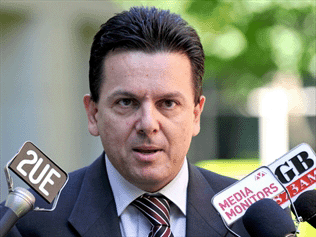 Both Senator Patrick and his SA-Best colleague, Nick Xenophon, are gobsmacked at the totally inadequate response by Senator Matt Canavan, the Minister for
  Resources and Northern Australia, to a Senate order to produce all the documents he used to determine there was ‘broad community support’ to continue exploring Kimba as a site for the low-level waste dump.
On Wednesday Senator Patrick successfully moved the motion for the Minister to make public all the information gathered by Government departments.
Earlier in the year the Minister advised he would need a figure in the range of 65% community support to progress plans in Kimba. Three ballots have been run in Kimba and none have reached 60%.Yet despite not hitting the criteria he set himself, the Minister selected two Kimba sites for further assessment.
Senator Patrick sought the Senate order after the Government refused to provide a local community member with a definition of ‘broad community support’ under freedom of information laws.
“When I asked for all the information used by Minister Canavan on how he came to make his determination to proceed to the next phase of consultation, all I got was a disingenuous response saying that there was no threshold which constituted ‘broad community support,” Senator Patrick said.
Nick Xenophon said: “None of the information used to make the decision was provided. We need to see and share with the community what was put to him to make his decision.”
Senator Patrick will move for the Senate inquiry into the contentious issue when parliament resumes next year.
“If I cannot get satisfactory answers, then there’s no choice but to ask the Senate to look into the process undertaken to date and the Government’s reasoning in moving forward to the next stage of the assessment despite the deep division in the community,” he said.
“I made it very clear to the Government during my first speech in the Senate that I had a strong interest in accountability and transparency.
“I want to work constructively with this Government but my enthusiasm to do so is contingent on them embracing a key principle of responsible government – openness and transparency.
“When it comes to decisions made about the people and supposedly for the people, they must be open about them, particularly when it comes to a nuclear dump site, “ said Senator Patrick. Follow links to the response from Minister Canavan and Senator Patrick’s Senate motion
https://www.pdf.investintech.com/preview/437f7094-dbb4-11e7-9f8d-0cc47a792c0a/index.html
Having won the Queensland election, Annastacia Palaszczuk will be vetoing the Adani coal megamine
 Annastacia Palaszczuk finally wins Qld election
The veto of a federal loan for Adani’s controversial $16.5 billion Carmichael mine will be one of Annastacia Palaszczuk’s first jobs once her government is sworn in she says…. (subscribers only)
http://www.afr.com/news/politics/annastacia-palaszczuk-finally-wins-qld-election-after-tim-nicholls-concedes-20171207-h015mi
1 This month

of the week – Australians for War Powers Reform (AWPR)
To see nuclear-related stories in greater depth and intensity
 Antinuclear