Turnbull government drops plans to curb green groups but doubts remain, The Age, 6 Dec 17 Peter Hannam Environment groups have welcomed the Turnbull government’s retreat from plans to curb environmental advocacy but concerns remain about other proposals to restrict the charity sector.
Kelly O’Dwyer, Minister for Revenue and Financial Services, announced the government would drop its intention to require environmental charities spend at least 50 per cent of donation income on “environmental remediation work” to retain their tax-deductible status.
“The government will not mandate a level of remediation by environmental organisations,” Ms O’Dwyer said.
The push for a required level of environmental work lost traction after BHP indicated it would oppose such curbs. The Australian Conservation Foundation welcomed the backdown of the government’s “anti-democratic proposal” to curb environmental advocacy.
“Advocacy makes Australia a better place,” Kelly O’Shanassy, ACF’s chief executive, said. “It has kept oil rigs off the Great Barrier Reef, and given us Landcare, clean energy, air and water, and a Franklin River that flows.” “It is interesting this backdown follows a statement by BHP opposing the changes, and even a retreat by the Minerals Council in recent weeks,” she said.
The Minerals Council of Australia had sought as much as a 90 per cent requirement for remediation efforts, with only 10 per cent for advocacy for green groups to retain their tax-deductibility status.
Other worries emerge
But other moves by the Turnbull government are fanning uncertainty, including plans released on Tuesday to ban foreign donations to advocacy groups.
Samantha Hepburn, a law professor at Deakin University, said financial reporting requirements under the Annual Information Statement (AIS) collected by the Australian Charities and Not-for-profits Commission could pose other challenges for environmental groups.
Where an environmental group provided an AIS that revealed strong expenditure on political advocacy rather than remediation, it might be investigated by the Australian Taxation Office. The proposed changes increased funding for the ACNC and the ATO to review more groups for their ongoing eligibility for tax benefits, she said.
“This creates uncertainty for environmental organisations,” Professor Hepburn said. “It is unclear whether their public interest imperatives in pursuing political advocacy for such issues, such as climate change and matters of national environmental significance, will actually result in their ongoing eligibility being put at risk.”
Mark Parnell MLC , Parliamentary Leader, Greens SA, 6 Dec 17,
The last couple of sitting weeks of the year in State Parliament have been huge, and the Greens have had some significant wins
A win for democracy
My amendment to the South Australian Constitution to make it fairer to all parties and candidates passed both Houses of Parliament. Under the mis-leadingly named “fairness clause” in the Constitution, the boundaries of electorates were required to be rigged so that one of the two major parties would form a government. This is despite the fact that a growing number of South Australians don’t vote for either of the old parties.
For elections beyond 2018, the review of electorate boundaries will have regard to population, one-vote-one-value, geography, communities of interest and other relevant factors but won’t be artificially rigged to favour the old parties. The Greens have ensured that future elections will be more democratic and better reflect the will of the people of South Australia.
No more public money to spruik nukes
A big majority in Parliament passed my Greens Private Members Bill to prohibit the Government spending public money on spruiking the benefits of nuclear waste dumps in SA. We won the campaign against the high level international nuclear waste dump but we still have the national dump proposed for the Flinders Ranges and Kimba. Not only are these dumps illegal in SA, but now it is also illegal to use public money to encourage or finance nuclear waste dumps……..
There is a real crisis in biodiversity in South Australia, which is under threat from many sides including loss of habitat and climate change. Whilst passing a law for a new State Biodiversity Planning Policy won’t fix the problem overnight, it sends an important message to State and Local Governments that they can’t ignore the natural environment when making decisions about development or rezoning land.
Can SA be 100% renewable?
Absolutely! Despite attempts by some opportunistic MPs to blame renewable energy for the Statewide electricity blackout last year and other weather-related outages, a Parliamentary Inquiry has found that renewable energy was not to blame. What’s more, there is now a clear pathway to achieving 100% renewable energy in South Australia. The key is to use wind and solar energy backed by batteries, pumped hydro and solar thermal storage. This is achievable without compromising system reliability, security and affordability for consumers. With our State’s national leadership on renewables and our fantastic wind and solar resources, the future is looking bright. My report is at p.42 of the Committee’s Report.
The far Right in Australia have turned their attention, for the moment, away from efforts to sabotage the Equal Marriage Bill, and on to efforts to sabotage Australia’s laws against the nuclear industry .
In the Australian Senate, Cory Bernardi (Australian Conservatives) introduced the Nuclear Fuel Cycle (Facilitation) Bill 2017 and 3 right-wing senators backed it:
– Ian MacDonald (Liberal)
– David Leyonhjelm (Liberal Democrats)
– Eric Abetz (Liberal)
We surely miss Greens Senator Scott Ludlam. However, Senator Claire Moore (Labor) rose nobly to the defenceof Commonwealth bans on nuclear power and on nuclear fuel processing, reprocessing and enrichment. These bans are found in the Environment Protection and Biodiversity Conservation Act, and the Australian Radiation Protection and Nuclear Safety Act.
SPEAKER: Moore, Sen Claire (ALP) 30 Nov 17
“…..Over the years, issues around nuclear energy have come before this place and they have been part of the wider community discussion. Through that process, a number of investigations have taken place, and, as our shadow minister, Mark Butler, has said, the simple fact is that nuclear power in Australia simply doesn’t add up. The arguments do not add up now and they didn’t add up in the past. Sometime in the future they may, but at this time they just don’t add up. The Australian Nuclear Science and Technology Organisation, which is well skilled and well knowledgeable in this space, noted: ‘It’s difficult to envisage traditional nuclear power plants being established on the NEM given the current grid structure.’…..
In the CSIRO publications out there on the public record, the issues surrounding challenges to nuclear power in Australia include the legislative and regulatory framework development, including for protection, operational safety, waste storage and decommissioning. I’ll go back to some of those later, but they are areas of concern that would need to be considered when debating further implementation or consideration of nuclear energy in our nation. Another area is education, science and technical skills development in this area. Amidst a range of university and developmental areas of research across Australia—a very competitive field, as you know—there has not been a focus on nuclear energy. I’m led to believe that there are no universities in Australia offering courses in nuclear engineering and that there’s little nuclear engineering experience in our nation. Again, that is not to say that there should be an absolute denial; it’s a statement on the reality of the knowledge base in our country at the moment.
Another concern raised by CSIRO is the commercial and economic framework to support significant up-front capital costs and eventual planned decommissioning. There has been considerable debate over the years about the various costs of different forms of energy in our nation and, consistently, the costings that have come forward about introducing a nuclear energy process in Australia have led to very significant calculations of the costs that would be involved. These costs need to be taken into account when you’re looking at the various forms of energy options that we have. The expense of getting a new industry started, the expense of the technology needed and the expense of the actual infrastructure needed are very important elements for consideration. Currently, the indications we have and the data that’s available to us indicate that the significant up-front capital costs are a major concern for anyone who is looking at this discussion around nuclear energy. Also, we have seen overseas—and, naturally, a lot of our experience is from overseas—that the cost of plant decommissioning has been found to be extremely expensive. Where countries have had to decommission nuclear power stations, nuclear power plants, it has caused a great deal of concern in terms of how much it costs to make them safe and also in terms of being able to continue operating in the area after they have gone through the process of closing them down.
Another major issue, if a decision were made to build a nuclear energy facility at a particular point, would be how long would it take for it to be operating on the ground, providing the kind of energy that we, as a nation, require? The CSIRO calculations say that it’s a 10- to 15-year interval from the commencement to the start-up of a reactor. I know that Senator Bernardi gave other figures. I understand that it would be part of a discussion in this area, but the data that we have before us on the current knowledge that’s out there from the CSIRO says that the time frame from commencement to completion and to operation is a 10- to 15-year process, and that, of course, is a very long-term plan, if we’re looking at a transition to another form of energy.
There is also the issue of reactor locations. When we talk about nuclear reactors and nuclear waste facilities, a massive community discussion occurs when proposals are put up for these types of facilities. ….. Our personal experience in Australia has been that when these things are brought out into the open—when finally, after discussions that often take place in secret, I’ll say, and when finally decisions are made public as to where a nuclear reactor or a nuclear waste facility could be located—there does seem to be a reaction from the community that is not positive…..
…water use. CSIRO has done a lot of work generally on the issue of water use in our community. They’ve used that knowledge in the discussion on what would be necessary for nuclear plants or nuclear operations. The indications that they have—and this is available on their website—is that nuclear plants use more cooling water than coal and gas plants. In terms of the sensitivities in our community and also the necessities of our climate and our access to water in Australia, that is a really important issue. Where would you be able to ensure that there were appropriate water sources, that would be safe and that would provide the support that would be necessary for the implementation of nuclear energy?
Even if you were to overcome the community, legal and political barriers to nuclear energy, it’s clear that due to the skills and other technical barriers it would take very many years, over a decade—and that’s the optimistic option—for Australia to be ready to begin construction of a nuclear power plant. That also does not take into account, as I said, the real need existing in our nation, and I am very much aware of strong community opposition to nuclear power…
As I was saying, that remains a major issue within the community in terms of any acceptance of a change to the current position that we have in the country around nuclear power. Senator Macdonald did allude to the ‘issue’ or ‘incident’—I should have written it down—of Fukushima. His dismissal of the significant issues around what happened at Fukushima was, I think, indicative of the lack of genuine understanding of the concerns in the community around this issue. Certainly over a long period of time one of the clear issues that has been raised within the community about anything around the further development of nuclear energy in our country has been a concern around a guarantee for safety and that there not be the kind of environmental, social and serious damage that occurred as a result of a series of nuclear incidents over many years. The most recent of those was in Fukushima, but the Chernobyl situation, of which we’ve just passed a significant anniversary, caused immense damage all across northern Europe and into the Arctic. In parts of Europe and the UK—I know that the UK are probably not referring to themselves as part of Europe any longer—there is still monitoring being done of ongoing issues around environmental damage in that area as a result of an incident that happened well over 20 years ago.
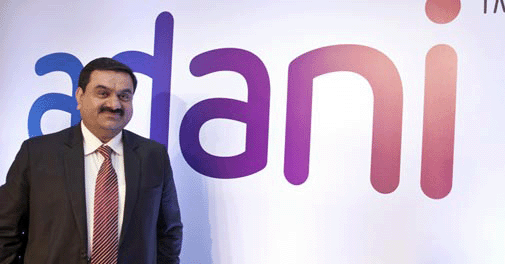
The future of the Adani mine,Overwhelming public opposition to the Adani coalmine in northern Queensland tipped the scales in state election campaigning. But now that’s over, what influence does it have at a federal level and on the mine’s future? The Saturday Paper, By Alex McKinnon. 2 Dec 17,
“……Palaszczuk’s explanation for abandoning her long-time support of the loan was to avoid a potential conflict of interest, arising from her partner’s work on Adani’s Northern Australia Infrastructure Facility (NAIF) loan application as a consultant for PwC. But state treasurer Curtis Pitt admitted during the campaign that the real reason for Palaszczuk’s about-face was the overwhelming public opposition to taxpayers’ money being used to fund a private mine.
Queensland’s Labor government supports the Adani mine going ahead, to provide jobs in struggling regional areas. But GetUp! environmental justice co-director and Stop Adani campaigner Sam Regester points to the huge swings to the Greens in a swath of inner-Brisbane electorates as proof Labor recognised anti-Adani sentiment was hurting them enough to force a response. Counting still under way in Maiwar could lead to the Greens winning their first seat at a general election, and candidate Amy MacMahon came close to knocking over Labor deputy premier Jackie Trad in South Brisbane.
ON THE ISSUE OF THE NAIF LOAN, AT LEAST, PUBLIC OPINION IS EMPHATIC ENOUGH TO PRESSURE PALASZCZUK INTO KEEPING HER WORD.
“The Greens’ strong position on Adani was directly responsible for their strong showing in the inner city,” Regester says. “Labor tried to have it both ways for three years, and they offset some of the damage by deciding to veto the NAIF loan, but voters rewarded the party that had a consistent stance.”
Given Labor will most likely form a majority government, that balancing act appears to have worked for now. What comes next – for the mine, those opposing it, and the government that could make or break it – is less clear. As counting continues and the Palaszczuk government prepares to go back to work with whatever parliament the voters have given it, anti-Adani campaigners are planning their next moves.
The Stop Adani Alliance, the umbrella organisation of environmentalists, climate scientists, traditional owners and civil society groups that formed to campaign against the mine in March, largely regards the election result as a win. Nicholls’ Liberal National Party, which has backed the mine to the hilt, remains in opposition. One Nation’s promised windfall of seats failed to materialise………
Palaszczuk’s Labor government will likely hold 47 or 48 seats in Queensland’s 93-member, single-house parliament. Once it nominates a speaker, the government will have the barest of majorities, provided every Labor MP stays in line. Given the record of Palaszczuk’s previous government, which lost Pyne and former Cook MP Billy Gordon to the crossbench, that may be too much to hope for. If Labor is forced to negotiate with the KAP’s three parliamentarians, One Nation’s Stephen Andrew, or Noosa independent Sandy Bolton, it may find the competing interests over the Adani mine can’t be finessed away.
On the issue of the NAIF loan, at least, public opinion is emphatic enough to pressure Palaszczuk into keeping her word. ReachTel polling conducted for the Stop Adani Alliance during the campaign found 70 per cent of Queenslanders oppose directing public funding towards the Carmichael project, with voters across political lines expressing strong support for the government using its veto power.
Queenslanders are more evenly split on the larger question of the mine itself, but losing the NAIF loan will compound Adani’s difficulties in securing the $3.3 billion it needs to fund the first stage of the project, and could sink the mine altogether. While Adani has made noises about seeking financing from Chinese banks, such a move would likely require construction materials and infrastructure contracts to be sourced from Chinese firms, further souring the project in the public eye and undermining the argument that the mine will bring local jobs.
So much attention has been devoted to Palaszczuk’s manoeuvring, it’s easy to forget how much of Adani’s ultimate fate lies in Canberra. The federal opposition leader, Bill Shorten, stayed far away from Queensland during the campaign, not least to avoid awkward questions about where he stands. Shorten tied himself in knots trying to articulate his various positions on the mine earlier this year, sometimes changing his mind mid-sentence……..
With the state election over, Shorten and federal Labor no longer have the luxury of dithering. Regester says the anti-Adani movement’s top post-election priority, “besides ensuring the veto goes through” and “working to ensure Adani can’t secure funding from anywhere else”, will be recentring the campaign on the national stage.
“Unless a major party moves on Adani, we’ll be making it an issue at the next federal election,” Regester says, highlighting “marginal seats in Sydney, Melbourne and Brisbane” where support for Adani could prove costly. Labor’s Terri Butler and the Liberals’ Trevor Evans will be looking nervously at the huge upswing in the Greens’ vote across territory their inner-Brisbane seats cover, while the Stop Adani movement’s large Melbourne presence could see the thumping Greens victory in the Victorian Northcote byelection repeated in Batman, Wills, Higgins and Melbourne Ports…….. https://www.thesaturdaypaper.com.au/news/politics/2017/12/02/the-future-the-adani-mine/15121332005585
India’s finance secretary has called for decision clearing company of allegations of siphoning huge sums into tax havens to be reviewed, Guardian, Michael Safi in Delhi, 1 Dec 17, The Adani Group is likely to again have to answer allegations it siphoned more than US$600m (£445m) into overseas tax havens after senior Indian finance authorities recommended an appeal of a judgment clearing the mining giant.
The Indian finance secretary has confirmed to local media the August decision clearing the Adani Group had been reviewed by senior officials in November who ordered an appeal to be lodged by 14 December.
According to two sets of Indian customs intelligence documents from 2014, the Adani Group was accused of inflating the cost of electricity equipment for power projects in Maharashtra and Rajasthan states using fraudulent invoices. Authorities valued the alleged scams at nearly $852m.
The company or entities linked to it are currently being scrutinised for their suitability for a $681m concessional loan from the Australian government to build a railway line linking the proposed coal mine to a Queensland port. However it is reportedly close to securing loans from a Chinese state-owned company that would make the Australian loan unnecessary.
The Adani Group has denied any wrongdoing and was cleared on one set of allegations in August and a second set in October.
But the Indian finance secretary, Hasmukh Adhia, has confirmed the August judgment – referring to fraud allegations worth around $600m – has been recommended for appeal by senior customs officials.
“As per the procedure for review of orders of the Adjudication Authority, a committee comprising of two chief Commissioners of Customs has reviewed this order of Adjudicating Authority and directed the Commissioner of Customs vide their order dated November 15, 2017 to file an appeal in the tribunal,” Adhia said
Customs officials have until 14 December to lodge the appeal, which will be heard by the Customs, Excise and Service Tax Appellate Tribunal. Any subsequent appeals would be heard by the Indian supreme court.
Six Adani subsidiaries are among 40 companies being investigated by Indian authorities over a separate alleged fraud involving the over-invoicing of coal imports from Indonesia.
The general modus operandi of the alleged scams is that the energy companies used fake middlemen to inflate the price of equipment or coal they sourced from overseas.
The extra money allegedly paid by the businesses was allegedly channeled into offshore bank accounts out of the reach of Indian regulators or tax authorities.
The Indian Express reported on Thursday that the outcome of the allegations against the Adani Group could impact a $125m compensation package the company has been promised from electricity distribution companies in Haryana state over its “financial difficulties” in the area.
Indian opposition groups have called for a supreme court inquiry into the company over the fraud allegations which, if proved, could have pushed up power prices for local consumers.
A public-interest lawsuit has also been filed in the supreme court calling for an investigation into alleged over-invoicing by the Adani Group and other energy companies.
Adani: Chinese Government denies receiving application to fund Carmichael mine, ABC News, 30 Nov 17, By Stephen Long, As Adani angles for Chinese money for its giant coal mine in North Queensland, China’s Australian embassy has made clear that any backing from Chinese state enterprises would need central government approval.
Senior embassy officials have also told opponents of the mining venture that no applications for funding have been made, despite Adani insiders claiming recently that finance from China had been secured.
Over the past month, businessman and environmentalist Geoff Cousins and prominent investment banker Mark Burrows, AO, have held talks with Chinese embassy officials in Canberra to lobby against Adani’s Australian project, amid reports Adani was close to finalising a deal for Chinese backing.
“Myself and Mark Burrows went to see senior officials from the Chinese embassy; we explained that China might think that Australians supported the Adani mine and we gave them a lot of evidence that that was not the case,” Mr Cousins told the ABC.
“The Chinese embassy was very forthright in saying that investment from a Chinese corporation would require the approval of the central government and that also no such proposal had been put.”……….
Chinese funding for the project is becoming more critical as prospects for a subsidised loan of up to $1 billion from the Northern Australia Infrastructure Facility for the mine railway fade.
The Labor Party, which looks likely to form a government in Queensland, has pledged to effectively veto the loan.
Pauline Hanson’s One Nation Party, which has secured at least one seat in the state parliament, is also opposed to the loan.
29 Nov 17, Today the Lower House of the SA Parliament passed my Greens Private Members Bill to remove the clause in the Nuclear Waste Storage Facility (Prohibition) Act 2000 that allowed the Government to spend public money on spruiking the benefits of an international high-level nuclear waste dump in SA.
That means that this will now become South Australian law as it has passed both Houses of the SA Parliament.
The Government will no longer be able to spend public money on pursuing an international nuclear waste dump.
With the focus now on fighting the Turnbull Federal Government’s plans for an intermediate-level nuclear waste dump in Kimba or the Flinders Ranges, it’s important to show your opposition to these plans. Come along to the “Don’t Dump on SA Rally” at 11am this Saturday, 2 December 2017 on the steps of Parliament House.
I will be speaking at the rally, outlining the Greens position on this important issue.
The Greens stand with the people of South Australia who choose a nuclear-free future for our State.
I also suspect that the federal Labor opposition may now adopt a position against the Adani project, in light of Queensland’s state election result.
I suspect that the Adani project is already a stranded asset, and definitely not worthy of either Australian taxpayer support or Chinese investment.
The Queensland election outcome is a death knell for Adani’s coal mine https://theconversation.com/the-queensland-election-outcome-is-a-death-knell-for-adanis-coal-mine-88148John Hewson The coal mine proposed for Queensland’s Galilee Basin by Indian mining giant Adani has been a moveable feast, with many stories about its scale, purpose, financing, job prospects, and commerciality. The prospect of a return of the Palaszczuk government in Queensland is effectively the death knell for the project.
Mining industry body retreats from hardline stance on charities, Minerals Council pulls previous support for policies limiting advocacy by environmental charities, Guardian Michael Slezak, 28 Nov 17, Australia’s mining industry has stepped back from its hard line on trying to limit the charity sector’s lobbying on energy and climate change issues.
The Minerals Council of Australia says it does not support policies requiring environmental charities to devote most of their resources to on-the-ground remediation, despite previously writing submissions to government calling for it to consider such policies.
Although the new stance seems to contradict earlier statements, the MCA insists there has been no change in its position.
The move comes amid fractures between the MCA’s membership over the tough approach, with BHP recently publicly distancing itself from the MCA’s position on activity requirements for environmental charities.
“They’ve over-reached in bashing-up on civil society, coal and climate and energy issues,” said Rod Campbell from the Australia Institute, who pressured the MCA to clarify its position. “They’ve gone rogue and they’re being pulled back – and that’s a good thing.”……..
Now, in a letter to Transparency International, the MCA has unequivocally said it does not support the moves it previously appeared to advocate for, writing:
However, the MCA does not support the government’s proposal to require environmental deductible gift recipients to commit no less than 25% and up to 50% of their annual expenditure to environmental remediation as referenced in your email………
The MCA has also been campaigning for all charities who receive foreign donations not to be allowed to take part in political advocacy during election campaigns. The Coalition has said it will introduce legislation before the end of the year that will do that.
Queensland election: how Adani helped undo the LNP’s push to regain power
Exit polls in the state’s south-east found up to 70% of respondents were against the billion-dollar rail line loan for Adani, Guardian, Amy Remeikis, 27 Nov 17, It was the sleeper issue that ended up dominating the Queensland election campaign – and, in the end, activists believed, may have saved government for Labor.
Among those were Maiwar, the electorate held by the shadow treasurer, Scott Emerson, who looks to have lost largely due to Greens preferences, along with other LNP-held inner-city seats such as Mount Ommaney and Mansfield, which both look to have fallen to Labor.
Exit polls commissioned by GetUp in those electorates found up to 70% of respondents were against the billion-dollar rail line loan for Adani, while another 30% said Labor’s decision to veto the loan helped decide how they would vote.
“We already know the majority of voters from every single party at play opposed the Naif loan, including LNP and One Nation voters,” the GetUp environmental justice director, Sam Regester, told Guardian Australia. “Taking a stronger position against Adani clearly contributed to the swing in south-east Queensland. Just as tellingly, Labor held on to the regional seats that folks like conservative analysts predicted would fall because of the veto.”…….
Regester said that..voters in the south-east, particularly, saw a point of difference.
“The strong showing of the Greens, particularly in south Brisbane and Maiwar, showed more than anything the value of having the clearest, strongest policy on Adani,” he said. “ For most of the last term of government, the two major parties were equally bad on this key issue, so it’s no wonder they picked up a swag of votes.
“Labor was able to offset this somewhat with the Naif veto but this election made it clear that the Greens can be a threat to both major parties when they’re not up to scratch, particularly on Adani.”……..
Under the Naif rules, the states need to give approval for the loan. On Sunday, Palaszczuk confirmed she would stand by the veto decision. She also committed Labor to not allowing any taxpayer funds to flow to the mine, or its associated infrastructure, although has refused to give details of the royalty holiday granted to Adani, worth about $350m, which she said would be paid back with interest.
“We will veto the loan, they said on the 6th of June that they had the green light that they would build the mine and the rail line and we expect them to get on with it,” a Palaszczuk spokesman said.
The future of Adani now rests on whether it can receive financing to begin construction in the Galilee Basin, with some reports it may be close to securing Chinese money to open the mine. That has the potential to create another issue for the Queensland government, be it the LNP or Labor, as both have said they remain in support of the mine for the jobs it will create, with the Chinese funds potentially coming with Chinese labourer and steel strings attached.
GetUp have not finished fighting the project and Regester said Labor’s position was “still nowhere good enough” and a potential issue for the next federal election.
Current polling from Galaxy puts the ALP on track to win the required 47 seats for a majority, but as the Brisbane Courier-Mail reports, this will hinge on a number of factors, including unpredictable preference flows from One Nation supporters.
As at the federal level, politics in Queensland has been heavily focused on energy in the run-up to Saturday’s poll.
The Labor Palaszczuk government – which has a 50 per cent RET by 2030 for the state – has been campaigning strongly around renewables, with a particular focus on increasing rooftop solar uptakeas a way to cut power costs for businesses and homes around the state.
The new policies, launched in late October as part of the Palaszczuk government’s $2 billion Affordable Energy Plan, will offer no-interest loans to consumers wishing to invest in rooftop solar and battery storage, but lacking the up-front capital to do so.
They will also work to give landlords and renters equal access to solar, through a trial initially involving 1000 rental households. Queensland energy minister Mark Bailey said the rental solar scheme had the potential to save tenants up to 10 per cent off their annual bill, or up to $150 a year, while landlords could get a rebate of up to $520 per year.
On large-scale renewables, as we reported here, Labor, has promised to follow through on a program already underway to underwrite 400MW of renewable energy projects.
Following on from this, it has committed to support a further 1000MW of renewable energy projects via a new government power company; and to look to construct new transmission infrastructure in Northern Queensland that would unlock a vast new province of wind, solar and hydro power projects.
On the other side of the political divide, the LNP conservative coalition that is seeking to replace the current Labor government has made its intentions on energy clear: the end of renewables incentives; government money for a new coal generator in north Queensland; and support for the Adani coal mine.
The LNP is also claiming a huge reduction in consumer bills: $160 a year for two years, followed by savings of up to $460 a year in 2020.
But this is largely a mirage, as energy analyst Hugh Grant has pointed out. He noted that the only parties with policies that would deliver price reductions were the Greens, and Labor.
Not that Queenslanders got to read about that anywhere – apart from RenewEconomy, the local media refused to publish the results, as Michael West points out in this piece.
In the Conservative corner in the fight for new coal is federal minister for resources and northern Australia, Matt Canavan, who – recently restored to his portfolio – is as keen as ever to use the federal government’s Northern Australia Infrastructure Facility to help fund a new coal-fired power plant in Queensland’s north, as well as to get the Adani coal mine and port project off the ground.
One Nation is also keen to build a coal-fired power station west of Townsville, with party leader Pauline Hanson pledging to commit $1.5 billion to the project, which she wants built in Collinsville – a former coal hub of the state that is more recently turning to large-scale solar.
In fact, according to data gathered for RE’s Renewable Energy Index, the North Queensland region has more power generating capacity under construction than the entire state of NSW, and almost as much as Victoria, South Australia and Western Australia combined.
Meanwhile, Queensland home and business owners are leading the country – which in turn is leading the world – in rooftop solar uptake.
A Climate Council report last month showed that almost one third (31.6 per cent) of all Queensland homes now have solar panels, which puts the state ahead of South Australia, at 30.5 per cent, and Western Australia at 25.4 per cent.
What’s more, there are 14 postcodes in the Sunshine State alone where more than 50 per cent of households have rooftop solar, including the the Moreton Bay region town of Elimbah, where an impressive 63 per cent of homes have PV panels on their roofs.
The Australian Solar Council – newly rebranded as the Smart Energy Council – aren’t resting on their laurels, though. The peak solar industry body is spooked enough about a possible LNP victory that is has launched its own major election campaign, urging voters to put the Coalition last.
“Queensland voters face a stark choice at the election tomorrow,” the SEC said in an email to members on Friday:
“A new polluting coal-fired power station or a solar thermal plant providing 24-hour solar power; no new large-scale renewables and massive job losses or 1,000 megawatts of new large-scale renewable projects in regional Queensland; and a National Energy Guarantee that delivers the longest solar eclipse in history or sensible national energy policy.”
A National Energy Guarantee could be bad news for the ACT, Canberra Times, Katie Burgess , 24 Nov 17, A National Energy Guarantee could risk years of ACT energy policy and force Canberrans to pay more, ACT climate change minister Shane Rattenbury has warned.
The Greens minister met with his state and federal counterparts at the COAG Energy Council meeting in Hobart on Thursday and Friday.
But Mr Rattenbury said he was concerned that the guarantee would “stymie” new sources of renewable energy, the emission targets were too low, the agreement too short and the modelling was tailored to “inflate the apparent cost-savings”.
He also said an “artificially suppressed” wholesale price would impact on the contract-for-difference model the ACT used as part of its plan to go 100 per cent renewable by 2020.
Through its reverse auctions, ActewAGL pays each large-scale renewable energy generator the difference between their feed-in tariff and the current wholesale price per megawatt hour.
However when wholesale prices are higher than the feed-in tariff, the generator pays ActewAGL and the savings are passed onto customers.
That model has insulated Canberra customers from future price rises.
But if the wholesale price was pushed down, Mr Rattebury said the ACT could pay more.
“We are concerned it will suppress artificially prices in the wholesale market and we believe the wholesale market is an effective means of driving good energy outcomes so the transition across to a certificate-based approach we think distorts the price signalling effect the labour wholesale market is designed to operate,” Mr Rattenbury told a stakeholder meeting.
“As a jurisdiction it’s particularly problematic for us because we have set ourselves on a pathway that’s premised on having an effective wholesale price. For our consumers it’s going to represent a potentially significant cost increase because of the way our electricity contracts are set for the next 20 years.”………
The federal government chose not to adopt the Clean Energy Target recommended by Chief Scientist Alan Finkel, instead opting for a National Energy Agreement which would require energy retailers to meet a reliability and emissions guarantee.
The reliability guarantee compels retailers to make a proportion of electricity available from “dispatchable” sources like batteries, hydro or gas, that can be switched on when demand is high.
The emissions guarantee requires retailers to cut their greenhouse emissions by 26 per cent on 2005 by 2030.
The energy guarantee won’t apply to Western Australia and the Northern Territory, meaning those two jurisdictions will have no federal emissions reduction policy after the Renewable Energy Target is scrapped in 2020.
The ACT and South Australia called on the federal government to model the cost of a Clean Energy Target and a Renewable Energy Target as well but they refused.
Mr Rattenbury that was “deeply concerning”.
“We know the National Energy Guarantee is the fourth or fifth best choice because that’s what the backbench watered it down to.
It is notable that as late as two days before Australia’s energy ministers gathered in Hobart, the Turnbull government was still hoping to secure in-principle support for its national energy guarantee.
“Expecting us to sign up was a ridiculous proposition,” Lily D’Ambrosio, Victoria’s energy minister told Fairfax Media, adding there was a “massive pushback” against such undue haste.
So it’s perhaps no wonder the resulting COAG communique was unusually thin.
Indeed, the first pass at modelling the vaguely outlined policy was only completed and shared a few days earlier. Modelling can be made to do almost whatever you want it to do. That’s especially the case when the modeller – in this case, Frontier Economics – wasn’t commissioned to compare outcomes for other schemes.
South Australia and the ACT tried to have the Energy Security Board – which is supposed to answer to all COAG members but so far has served as chief cheerleader of the guarantee – expand the next stage of modelling to consider other options.
While on the face of it a reasonable request, the bid stirred anger from at least one other state because Josh Frydenberg, the environment and energy minister, would never have got such a proposal near his partyroom for approval.
More number crunching in any case may not be the answer – at least, not until the design of the two elements of the guarantee to curb emissions and boost reliability are better defined.
A better approximation of the market distortions caused by relying on the electricity retailers to carry the guarantee obligations – rather than generators, as other programs such as an emissions intensity scheme, would require – may also reveal smaller savings for consumers than being touted.
Closer scrutiny of the guarantee modelling to date only fans doubts.
As South Australia’s Tom Koutsantonis notes, renewable energy schemes of Victoria and Queensland have largely been ignored, while the massive Snowy 2.0 pumped hydro scheme that hasn’t passed a feasibility study is assumed as operating.
The emissions trajectory also falls far short of what has otherwise been projected for the electricity sector – an industry that accounts for about a third of Australia’s carbon pollution.
As Dylan McConnell of Melbourne University notes, the modelling to date has been based on sector emissions for the National Electricity Market, totalling 1352 million tonnes of carbon-dioxide equivalent for 2021 to 2030.
Separate work by the government’s Climate Change Authority last year, however, projected electricity sector emissions of 1600 MT of CO2 for the whole 2020-50 period, and included Western Australia and the Northern Territory in that total.
Compared with the Authority’s work then, the national energy guarantee would leave less than two years’ of current power sector emissions for the entire 20 years after 2030, he says.
It really does look like there’s a lot more work to be done.
no amount of corporate black washing – including Indigenous participation plans that champion strong and effective relationships between Adani and W&J, alongside jobs and traineeships – can hide Adani’s direct and immediate part in walking over the rights of Traditional Owners.
Traditional Owners Expose Adani’s Relentless Pursuit of W&J Country, New Matilda By Kristen Lyonson
In the third in a five part series on the proposed Adani Carmichael coal mine, Kristen Lyons looks at a deal struck between the miners and the local traditional owners, and why it just adds to the smell that pervades the entire project.
Introduction
The Indian industrial conglomerate, Adani Enterprises – well known for environmental damage and human rights abuses at its project sites around the world, and built upon a complex business structure with tax havens in the Cayman Islands – entered Australia in 2010 with the purchase of coal tenements in the Galilee Basin, in Central Queensland.
Despite its controversial back story, some of which has only come to light since approvals were granted for its Australian project, Adani quickly rose to become a poster child for the State Government, based on promises its Carmichael mine project would deliver jobs and economic growth for regional Queensland.
Managed by its domestic arm, Adani Mining Pty Ltd, over the following years it developed a project proposal that included a coalmine, as well as rail and port infrastructure, thereby opening up the massive Galilee Basin for coal exports.
With seven years gone since acquisition of the coal tenements, and marred by substantial project downsizing, Adani is yet to start construction of its mega mine. Wangan and Jagalingou Traditional Owners Family Councils’ (W&J) defiant opposition to Adani’s proposed Carmichael mine has been central to this delay; opposition that has, in itself, exposed the dirty deeds Adani is willing to perpetrate against Traditional Owners who seek to defend their right to say no to a mine that would destroy their country.
This article exposes some of Adani’s deeds, including its nefarious actions in reaching an ‘agreement’ with Traditional Owners, Continue reading →
Queensland election: Palaszczuk refuses to rule out Adani mine road upgrade funding, ABC, By Chris O’Brien, 23 Nov 17, Premier Annastacia Palaszczuk has not ruled out helping central Queensland councils upgrade roads for Adani’s planned Carmichael mine.
Ms Palaszczuk previously stated that taxpayers’ money would not be provided for the mine.






 Antinuclear