The cloud of coal has long hung over the Latrobe Valley. Now nuclear power is dividing it
Cait Kelly, Mon 24 Jun 2024 https://www.theguardian.com/australia-news/article/2024/jun/23/the-cloud-of-coal-has-long-hung-over-the-latrobe-valley-now-nuclear-power-is-dividing-it
No matter where you are in the Latrobe Valley, you can see the smoke haze. The transmission lines that punctuate the region’s dairy farms and clusters of blue gums all lead to some of the country’s biggest coal-fired power plants, where the plumes of smoke soar from smokestacks and steam from cooling towers.
This valley provides most of Victoria’s electricity, but it’s been on the edge of a precipice. Over the next 11 years, Loy Yang A and Yallourn are expected to be decommissioned. Residents know the writing is on the wall for coal, but confusion over what comes next is creating a deep chasm.
Now the valley’s communities – and those of six other locations around Australia – are on a new energy frontline. On Wednesday, the Coalition promised that, if elected to government, a part of the Loy Yang station would be one of seven sites to host a nuclear reactor.
The announcement spread quickly down the valley. Some welcome it, seeing it as a lifeline for their dying community. And then there are pockets of outrage.
Wendy Farmer is an unlikely advocate for renewables because coal is in her blood. She is a miner’s daughter; her father was a miner’s son. Her husband worked at the Hazelwood plant before it was decommissioned in 2017. The plant was infamous for two things – the 2014 fire that burned for 45 days and for being Australia’s dirtiest power station.
But Farmer is helping lead a group of advocates for a healthier and more sustainable valley – and she’s outraged by the nuclear proposal when “we have the technology we need to move forward without it”.
“It’s a slap in the face,” she says. “It’s them going, ‘You’re desperate, so you’ll take it’.”
There are many questions about the Coalition policy, including the cost, what to do about the waste, how the plants could be built and when, how many jobs would it actually create – and how geographically safe would it be to have a nuclear plant near a faultline.
“Why would you even consider putting nuclear on earthquake faultlines?” Farmer says.
“It doesn’t feel like it’s community-driven – no one in the community has been asked about it. They’ve just been told this is what our plan is.”
On Wednesday, Farmer led a snap protest outside the Gippsland National MP Darren Chester’s office. Chester has cautiously welcomed the nuclear policy, saying in a statement it could create “enduring social and economic benefits to our community”, before adding that “more detailed investigations will be required in the years ahead”.
‘Always looking for more jobs’
Traralgon is the biggest town in the valley and is wedged between the power plants and the big hole left by Hazelwood – between a brown coal past and Australia’s commitment to get to net zero emissions by 2050.
Of the 125,000 people who live in the valley, 26,000 call Traralgon home.
In the newsagent it’s buzzing. People are queueing for their Lotto ticket or a copy of the paper. The workers behind the counter won’t say much about nuclear – one thinks it’ll just get her in trouble and the other says she’s supportive but will grab the boss.
The boss is Gary Garth. He’s upfront with his opinion and cares about his community and the number of jobs. He loves the nuclear idea.
“I think there are a lot of hurdles, obviously, they’ve got to get through to do it. But I think the vision is good. And it would be great for the area,” Garth says.
“We are always looking for more jobs for locals and that’s probably the most important thing a society can have: people in employment.”
Decades ago, this area was booming – high-paying jobs created a cashed-up community. But coal is no longer king. The most recent census had unemployment sitting at 6.6%, higher than the Victorian average of 5%.
“If the governments can come up with a way of turning energy into nuclear where it’s safe, safe for the environment, safe for everyone, it’s very clean, so if it can be done, that would be a real benefit to the area,” Garth says.
In parts of the community, renewables are also seen as a threat. Garth describes windfarms as “a disaster for the environment” – he’s worried about the birds and what we do with the materials when they come to the end of their lifespan.
But it’s not a concern he holds for nuclear waste.
“Australia is a big place. They need to be able to come up with something – they seem to do in other countries around the world,” he says.
He thinks the community will vote for it and says the Coalition will have a mandate to proceed with it if it wins power – and that the state government would be foolish not to listen to the electorate.
Before the announcement, the Coalition reportedly polled each of the seven communities, with 55% of the Latrobe Valley respondents said to be supporting nuclear.
But on the streets of the valley, not everyone is convinced by the Coalition’s promise.
Ian, a former geologist, says the opposition leader, Peter Dutton, “hasn’t done his homework”.
But another resident, Jesse, thinks it will be a good creator of jobs.
“I think it’s a good thing, especially with all the coal shutting down,” Jesse says.
“I think the nuclear side of things will offer more ongoing jobs [than windfarms]. And we’ll have a stable power supply. Everyone needs the power to keep warm and cook and all that sort of stuff … We need to have a stable power supply.”
‘Softened up for nuclear’
Penelope Swales is sitting in a rare slither of winter sun on her organic farm at the bottom of the Strzelecki Ranges. It’s cut from a different cloth to Traralgon – there’s a rail trail, a brewery and a beloved community band. It lures former city slickers with its shaggy green hills and bush walks, and turns them into locals. Swales was a lawyer before she took up the plough.
“I feed 20 local families with this farm,” she says.
“That cloud between the two trees” – she points to the distance where the smoke is slowly filling the air, making a large cloud that drifts east towards Melbourne – “that’s Loy Yang. So pretty close.”
Swales is joined by her friends Marge Mackay and Lisa Mariah, who have also moved to the valley for its natural beauty and relaxed lifestyle. They don’t want nuclear.
“The demographic here is a little bit odd,” Swales says.
“While most people work in Morwell and Traralgon, progressive and pro-renewable voices don’t get a lot of a look in because most of us live up here in the Strzelecki corridor, which is bisected by the electoral boundary.
“So a bunch of us are on one side and a bunch of us are on the other side.”
She says that, over the past four years, the region has been “softened up for nuclear”. There has also been a bitter campaign over plans to build a windfarm in a pine plantation overlooking the former Hazelwood coal plant.
“People came in from outside, held public meetings, ran a very slick campaign telling people, ‘this is going to be bad for your community, this is going to destroy your community, this is going to ruin your property values, infrasound will keep you awake at night’,” Swales says.
The fight spread misinformation and put the sleepy community at loggerheads, she says.
“The more progressive people tend to keep their heads down,” she says. “There’s been some very vicious stuff going on. We’ve had vandalism. One of their friends had ‘sell-out’ sprayed on the footpath outside at home. You know, she’s a pensioner.”
The long campaign against renewables has created “fertile ground”, Swales says. If someone says “jobs”, they get the votes.
But the group of friends is determined to fight – they say they’ve done it before. Mackay jumps in and says her community was dumped with coal, was not supported after the Hazelwood fire and is now getting shunted with nuclear. She wants a different future.
“The valley has been the dumping ground for Victoria for a very long time,” she says.
“There is a lack of forward vision for future generations – this is your children and your grandchildren.
Coalition’s taxpayer-funded nuclear con a road to ruin

We estimate that the fiscal damage would be in the order of a minimum $100 billion “nuke builder” tax, but likely considerably more given the international experience.
AFR Tim Buckley and Annemarie Jonson 25 June 24
We now know that if the federal opposition wins the next election, it proposes to gouge Australians to bankroll a national build-out of government-owned nuclear reactors across seven locations – because private capital won’t touch nuclear.
Coalition Leader Peter Dutton’s fact-free, 900-word press release on the topic – the totality of the Coalition’s policy announcement – failed to produce costings for what would be a long-term, multibillion-dollar “nuke builder” tax. We estimate that the fiscal damage would be in the order of a minimum $100 billion, but likely considerably more given the international experience…………………………………………… (Subscribers only)
Peter Dutton says nuclear power plants “burn energy.” No they don’t

Giles Parkinson, Jun 25, 2024 https://reneweconomy.com.au/peter-dutton-says-nuclear-power-plants-burn-fuel-no-they-dont/
Opposition leader Peter Dutton has betrayed his complete ignorance about the nuclear technology he threatens to impose on the Australian population by a making a fundamental error: He thinks they burn fuel, or energy.
The comments were made in a heated Question Time in parliament house on the first day of the winter session which promises to be focused on energy and climate.
Opposition energy spokesman Ted O’Brien was ejected from the house by speaker Milton Dick, and Dutton ran close, earning the ire of the speaker on several occasions when he interjected as Labor ministers spoke.
At one point Dutton – trying to tie Labor up in knots over waste from a nuclear submarine, said this, according to Hansard:
Mr Dutton: It’s on relevance. And, perhaps, to be of assistance to the minister, the propulsion system burns energy—that’s how the system is working—and it’s stored in the—
The SPEAKER: Resume your seat.
Actually, they don’t burn fuel. That’s the point of them. If they did, they would likely create emissions, as defence minister Richard Marles explained.
Mr MARLES: Actually, it doesn’t burn any fuel, because burning is oxidisation, which is what happens in an internal combustion engine, which is exactly what happens when you use hydrocarbons. What this is is a nuclear reaction which gives rise to power. That is what happens inside the sealed nuclear reactor. The point is that the waste that will need to be disposed of …
And if he doesn’t accept Labor’s word on it, the Opposition leader could also read up on the website of the Nuclear Energy Institute:
“Nuclear plants are different because they do not burn anything to create steam. Instead, they split uranium atoms in a process called fission. As a result, unlike other energy sources, nuclear power plants do not release carbon or pollutants like nitrogen and sulfur oxides into the air.”
It reminds me of an encounter I had when I first started driving an EV. It was rubbished by a passer-by who suggested the car would be better off powered by nuclear. He seemed to think you could just shovel uranium into a boiler and off you go. Just top it up at the local refuelling station.
It could be that the aspiring prime minister thinks along the same lines. After all, we are constantly told we should mine Australia’s vast uranium reserves – heck, why not burn them like we do with coal.
It’s not the only major misunderstanding of nuclear by Dutton. He has suggested that what he defines as a small nuclear reactor, around 400 MW, would produce just a single can of coke as waste. It will need to be a very big can.
Emeritus Professor Ian Lowe, of Griffith University’s school of environment and science, told the SMH it was safe to say an SMR would generate many tonnes of waste per year, and it was likely that waste would be more radioactive than the waste from a large-scale reactor.
“For a 400-megawatt SMR, you’d expect that to produce about six tonnes of waste a year. It could be more or less, depending on the actual technology but certainly multiple tonnes a year,” he said. “They run on highly enriched uranium and produce a much nastier and a much more intractable set of radioactive waste elements that have to be treated.”
The Coalition’s entire nuclear push is based on lies and misconceptions, from their claim that wind, solar and storage can’t power a modern economy, that their plan needs no additional transmission, that its cheaper than renewables, and that it’s consistent with climate targets.
As virtually all experts have pointed out, with the exception of an heroic rear guard action on Sky News, the policy makes no sense economically, environmentally, or from an engineering point of view.
Perhaps Dutton needs to watch a few more episodes of The Simpsons. Or perhaps not.
The insane amount it could cost to turn Australia nuclear – as new detail in Peter Dutton’s bold plan is revealed
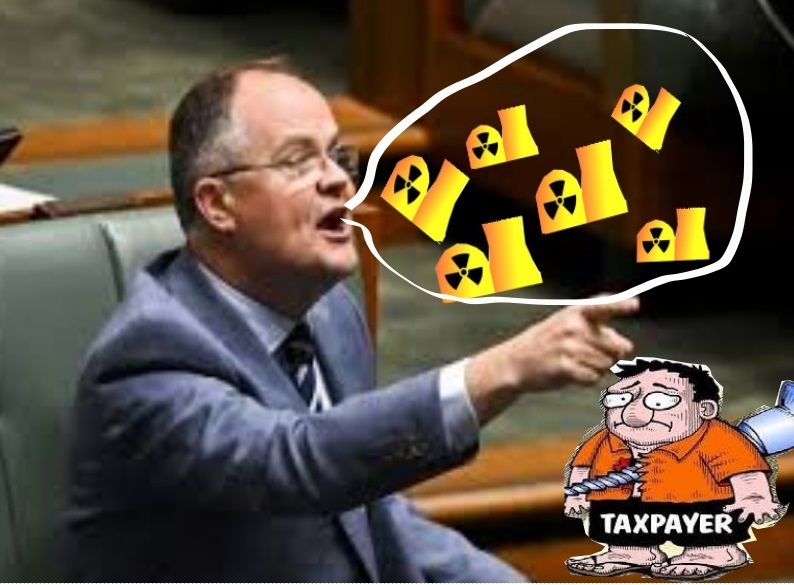
The large-scale and small modular generators would be Commonwealth-owned, similar to arrangements governing the Snowy Hydro 2.0 scheme, requiring a multibillion-dollar funding commitment from taxpayers.
- Peter Dutton nuclear plan slammed
- Proposal could cost $600billion
By JACK QUAIL FOR NCA NEWSWIRE and AUSTRALIAN ASSOCIATED PRESS 23 June 2024, more https://www.dailymail.co.uk/news/article-13559019/The-insane-cost-turn-Australia-nuclear-Peter-Dutton-slammed-completely-irrational-plan.html
Labor frontbencher Tanya Plibersek has added her voice to the tirade of criticism against the Opposition’s nuclear energy push, labelling the proposal as ‘completely irrational’ and ‘designed to be a distraction’.
Speaking on Sunday, the environment and water minister criticised the Coalition for its refusal to detail the estimated cost to add nuclear generation to the national electricity market in the biggest overhaul of energy policy in decades.
‘He’s saying to Australians: ‘I don’t trust you. I don’t trust you with the costing we’ve done,’ if he’s got costings,’ Ms Plibersek told Sky News.
According to analysis released by the Smart Energy Council using data from the latest GenCost report, Labor’s non-nuclear energy plan is estimated to cost $117bn through to 2050, while the Coalition’s pledge would cost upwards of $600bn.
Opposition energy spokesman Ted O’Brien has flagged an evolution in the Coalition’s nuclear power policy, revealing that each of the seven sites could host multiple reactors.
But in a major concession, Mr O’Brien said on Sunday the Coalition would not go to the election announcing the estimated generation capacity of its nuclear power plan, leaving this decision to an independent body until after the election.
‘One of the lessons we learned from overseas, in order to get prices down, you need multi-unit sites,’ Mr O’Brien told the ABC’s Insiders program.
‘Let’s say the small modular reactors … When you talk about a nuclear plant, these are modularised compartments. You can add another 300, add another 300.
‘You’re talking about multi-unit plants.’
An independent nuclear energy coordinating authority would make recommendations on the number and type of reactors per site, Mr O’Brien said, which would then determine the final generation capacity.
‘The independent body would look at each plant, and come up with a recommendation as to what sort of technology should be used,’ he said.
‘From there, it would be exactly what capacity based on that technology.
‘Only from there can you come down to a specific number of gigawatts’.
Last week Coalition unveiled plans to build seven nuclear power plants by 2050 with the first reactor slated to be operational in just over a decade in a move designed to deliver cheaper, zero-emissions and reliable power supply.
The large-scale and small modular generators would be Commonwealth-owned, similar to arrangements governing the Snowy Hydro 2.0 scheme, requiring a multibillion-dollar funding commitment from taxpayers.
The Coalition has proposed to locate the reactors in Queensland, NSW, Victoria, South Australia and Western Australia on the sites of former coal fired power stations, adding no more than 10GW to the power grid, meaning renewables will remain the vast majority of the energy mix.
Smart Energy Council chief executive John Grimes said Mr Dutton’s nuclear proposal would deliver ‘at best’ 3.7 per cent of the energy required at the same cost as the government’s current strategy.
‘In reality, current cost overruns happening right now in the UK could mean a $600 billion bill to Australian taxpayers, whilst delivering a small proportion of the energy that is actually required,’ he said.
Nuclear had no place in a country with cheap, reliable energy powered by the sun and wind and backed up by renewable energy storage, Mr Grimes said.
‘The most optimistic assessment of Peter Dutton’s nuclear proposal indicates it is a pale shadow of the reliable renewables plan outlined and costed by the Australian Energy Market Operator,’ he said.
The council has called on the opposition to release its analysis of the costings and generation capacity from the seven proposed nuclear reactor sites.
‘They need to explain how their forecasts contradict the experts at the CSIRO and AEMO,’ Mr Grimes said.
‘It is extraordinary that the details are being hidden from the Australian public.’
Separate analysis released by CSIRO put the cost of building a large-scale nuclear reactor at $8.6bn, bringing the total cost to approximately $60bn, however nuclear projects are often subject to hefty delays and soaring cost overruns.
Asked why Australia had eschewed nuclear power when many other advanced economies had adopted the technology, Ms Plibersek pointed to Australia’s comparative advantage in renewable power generation.
‘We’ve got the room, we’ve got the resources, we’ve got the critical minerals we need, battery manufacturing, we’re investing in green hydrogen,’ Ms Plibersek said.
‘We can be a renewable energy superpower and instead Peter Dutton wants to slam the brakes on, instead of leading the world with renewable energy investment.
‘He wants to fast track nuclear, and put us on the slow lane when it comes to renewables. It’s just mad.’
Dutton’s nuclear plan can only exist in a broken democratic system
By Klaas Woldring | 24 June 2024
Dutton’s nonsensical foray into nuclear energy reminds Australian voters again of the issues prevalent within this country’s Constitution and democratic institutions, Dr Klaas Woldring writes.
WE HAVE RECENTLY experienced the nonsense of the “No” vote by the official Opposition against the highly sensible proposal by the Albanese Government to introduce an Indigenous Voice in the archaic Australian Constitution.
The Dutton Opposition then made use of the staggering ignorance of the voters about the white Australian Constitution. Now it is preparing to drag Australia into the creation of unnecessary nuclear energy plants which would be developed in seven safe conservative electoral seats.
The use of the single-member electoral system is now planned for an energy system that is not supported by the majority and is indeed widely rejected for several important reasons. It should be noted now that the planned use of single-member districts for this purpose is, in fact, a further negative of that system.
The role of the Opposition Leader to develop opposing policies – the Westminster function of an Opposition leader – has now resulted in quite unnecessary threats to endanger society.
David Crowe in the Sydney Morning Herald has already pointed out ‘two black holes before getting to countless questions about secondary details’ — the cost to build them and to run them for decades, as well as design.
Above all, Australians surely can generate plenty of solar and wind energy. The need for nuclear power simply does not exist in Australia at all.
To try to use safe conservative seats for that negative purpose is to further abuse that electoral system. That two-party system is altogether no longer providing an effective democracy.
We have had a gut full of pork barrelling, of neglected safe seats and of the fact that only a handful of seats are decided on the first count, the rest on compulsory preferences. Let’s stop pretending that this is a fair system, nothing could be further from the truth.
Australian voters have already turned their back on the Liberal Party, voted strongly for Independent women and the Greens in 2022 and, by doing so, essentially said goodbye to the two-party system.
However, further reflection is needed as to what that means and what will replace it.
The major parties may be reluctant to replace the single-member electoral district system with a much more democratic system.
Although it had a marginally positive election outcome for the ALP in 2022, as it still delivered its majority government despite a very low primary vote of 32.6%, it is further proof that major electoral system change is in fact long overdue.
The single-member district system with compulsory preferencing has strongly, but quite unfairly, favoured the major parties. The outcome also still resulted in severe under-representation of the Greens in the House of Representatives even though they ended up with four seats.
Proportionally, they should have gained around 18 seats. A Proportional system naturally is based on multi-member seats. Still, the somewhat unusual 2022 Election outcome does not mean that the electoral system has changed at all.
The Oppositionist culture will continue — clearly a potential threat to unity and progress in Australia. However, this may not be the preferred way of Prime Minister Albanese either.
His stated preference is for cooperation — also for fairness and democratic representation. Really, here is his opportunity. The Westminster legacy of Australia’s inherited parliamentary and electoral systems is no longer really fit for the purpose intended.
Even in the UK and U.S., this is widely recognised. Certainly, the Greens and most – perhaps all of the Independents as well – will now reflect on campaigning for a more democratic electoral system.
For nearly half the voters – culturally diverse – the system is altogether of questionable value. Therefore, it is high time to move away from the two-party system and the single-member district electoral system that produces it.
Governance and political education have to be a much more prominent part of the longer-term reforms, but the electoral system can be changed straight away. A new electoral law can be developed right now. The Parliament has the constitutional power to make electoral reforms. That is stated in several clauses.
Multi-member electoral systems (MMP) could be 15 of, say, 10 MPs for the Federal House of Representatives. This would yield a national multi-party system and more Independents.
The nonsensical need for Opposition leaders to dream up unhelpful alternatives against the government party would disappear forever. The emphasis would be on cooperation rather than Opposition, a major step forward in the nation.
The recent political history in Australia demonstrates that the need for system change is urgent. The new electoral system should be national, not based on based on federal-state boundaries.
Of course, similar system changes should follow in the federal states as well.
Peter Dutton’s flimsy charade is first and foremost a gas plan not a nuclear power plan

Dutton’s nuclear castle is made of cardboard. Close questioning over the many months until election day will show that behind the costly facade, it’s not so much a nuclear plan, as a plan to give up on our climate targets, turn our back on a clean energy future and burn a lot more gas (and money).
Simon Holmes à Court, 21 June 24, https://www.theguardian.com/commentisfree/article/2024/jun/21/peter-dutton-nuclear-power-plan-gas-energy
Straight from the Donald Trump playbook the opposition leader left Australia with more questions than answers.
Finally, on Wednesday morning Peter Dutton announced his nuclear plan … well, it’s more a vibe than a plan – a flimsy announcement leaving us with more questions than answers.
If there’s any doubt that Dutton has internalised the Trump playbook, here’s an example of how he’s deployed the infamous Steve Bannon technique: “flood the zone with shit”.
The media conference was a stream of falsehoods, empty rhetoric and veiled swipes, deftly delivered with unwavering confidence.
As an energy nerd, there’s a lot I like about nuclear technology, and my long-held interest has led me to visit reactors in three countries. Last year I took a nuclear course at MIT and met nuclear developers, potential customers, innovators and investors, tracing many footsteps of the shadow energy minister, Ted O’Brien.
I strongly believe nuclear power is an important technology – but it has to make sense where it’s used and that requires close questioning. Here are some important questions, and what we know so far.
How to remove the current bans?
Nuclear is banned in Australia by two acts of parliament. Naturally, to repeal the ban the Coalition would need to win back control of the house – a daunting task when they are 21 seats shy of a majority – and control of the Senate, power it hasn’t held since the end of the Howard era.
Once the federal ban is lifted, Dutton needs a plan for lifting state bans in Victoria, New South Wales and Queensland.
The leaders of the Labor governments and their Coalition oppositions in each of these key states have expressed their clear opposition. Dutton rehashed the old quip that you wouldn’t want to stand between a state premier and a bucket of money, indicating that he thinks dangling commonwealth carrots will solve the issue.
They will not be cheap carrots!
Where will the reactors go?
The Coalition has named seven specific locations, two in Queensland, two in New South Wales and one each in Victoria, South Australia and Western Australia, all on sites of retired or soon-to-be-retired coal power stations.
One big problem – the commonwealth doesn’t own any of these sites, and in many cases the owners of the sites have plans to redevelop the sites, such as a $750m battery on the site of the old Liddell power station being built by AGL.
On Wednesday Dutton hinted that if the owners wouldn’t sell the sites, he had legal advice that the commonwealth could compulsorily acquire them. That’ll go down well.
How do we keep the lights on?
Australia’s 19 coal power stations generated 125 TWh of electricity last year. The Australian Energy Market Operator expects all will be retired by 2037. On top of that, our energy demand is expected to increase by more than 230 TWh by 2050. Over the next 25 years we need to build facilities that generate at least 355 TWh every year.
Dutton announced that the Coalition would build five large reactors and two small modular reactors by 2050. This would be about 6.5 GW of new capacity, which at best could be expected to generate 50 TWh a year – less than 15% of the new generation needed.
The Coalition has been quite clear that it wants to see renewable energy development slowed to a crawl. This would leave a massive hole in our energy supply, which could only be filled by extending the life of coal and a massive increase in gas power generation.
This is first and foremost a gas plan, not a nuclear plan.
What will it cost?
Gas is the most expensive form of bulk energy supply in the electricity market … at least until nuclear is available.
Replacing the cheapest form of energy – wind and solar, even including integration costs – with the two most expensive forms can only send energy prices higher.
The Coalition’s announcement is too vague to cost precisely and nobody really knows what SMRs will cost, but a reasonable estimate using assumptions from CSIRO’s GenCost would be in the order of $120bn, or to coin a new unit of money, one-third of an Aukus.
What does this mean for emissions?
An analysis by Solutions for Climate Australia, released before Wednesday’s announcement and which assumes a much more aggressive nuclear build, shows an aggregate increase in emissions by 3.2bn tonnes of carbon dioxide by 2050 – the emissions equivalent of extending the life of our entire coal fleet by 25 years.
While the Coalition has turned its back on Australia’s legislated 2030 target, their talking points say they’re still committed to net zero emissions by 2050. This does not compute. Dutton’s proposal would see high emissions in the electricity sector all the way to 2050 and beyond, blowing our carbon budget and every emissions target along the way.
What if locals object?
For years Coalition members have been running around the country fomenting then amplifying community concern around wind and solar farms. Genuine community consultation, which has sometimes been lacking, is the best antidote to opposition.
Yet the Coalition has made a massive blunder in telling communities exactly where they’ll go before any consultation. Worse, it has adopted a strong-man posture that communities will have to accept that the reactors are in the national interest. It will be fascinating to watch how the Coalition handles local opposition over the coming months.
How will they be built?
With a combination of astronomical costs and zero interest by energy companies, there only ever was one possible owner of a nuclear power station in Australia: the commonwealth government.
One of the biggest challenges will be locking in major contractors. With the high likelihood that a future Labor government would cancel any contracts, no contractor would proceed without very expensive cancellation protection.
When will the reactors come online?
We often hear that a nuclear reactor can be built in eight years. In reality it takes three to four years from signing the contract to completing the civil works to begin ‘construction’, and it would very optimistically take four years to complete site selection, planning, licensing, vendor selection and contracting. Add in the inevitable legal challenges and it’s highly unlikely a reactor could be delivered by 2035 – as Dutton claimed – let alone before the early 2040s.
The newest reactors in the United States took 18 years from announcement to commercial operation, while in the UAE, it took 13 years under an authoritarian regime … and I’m being kind by not mentioning contemporary projects in France, the UK, Finland and Argentina.
Dutton has said he favours the Rolls-Royce SMR, tweeting an artist’s rendering on Wednesday.
These SMRs exist only on paper, yet Dutton wants us to believe he can provide one by 2035. Remember, this is the mob that brought us the NBN and the Snowy 2.0 disaster. This is the team that couldn’t even build commuter car parks.
What about the water and the waste?
I think we can relax a little about water and waste. Yes, nuclear power stations generally require large volumes of water for cooling, but so do coal power stations. By choosing sites with existing access to cooling water, the Coalition has sidestepped this concern.
Public concern around nuclear waste is high, but ultimately the problem is manageable. The waste will be kept on site, likely in dry casks and eventually moved to wherever Australia decides to store its waste from the Aukus program. Nobody has ever been harmed by spent nuclear fuel.
Who will provide disaster insurance?
While serious nuclear accidents are very rare, their costs can be astronomical. The Japan Centre for Economic Research has estimated that total costs related to the 2011 Fukushima Daiichi nuclear accident may reach $350 to 750bn. The only viable solution is for the commonwealth to accept liability.
For a long time the Coalition’s nuclear plan sat beyond the horizon, to be unveiled before the election. But now Dutton’s built a castle and he has to defend it.
Dutton is still learning about nuclear. On Wednesday he said that an SMR would emit only a “coke can” of nuclear waste a year. In reality it would probably produce more than 2,000 times that.
Nuclear energy is complex. He and his team will keep making mistakes. Keith Pitt, a Nationals backbencher told RN Breakfast on the same day that the grid couldn’t handle more than 10% wind and solar power combined. Over the past year the grid has averaged 31% wind and solar.
Some people want to believe there are simple solutions to the complex solutions behind the cost of living crisis, and like his political forebear Tony Abbott, Dutton has a knack for delivering simple messages with cold competence.
But Dutton’s nuclear castle is made of cardboard. Close questioning over the many months until election day will show that behind the costly facade, it’s not so much a nuclear plan, as a plan to give up on our climate targets, turn our back on a clean energy future and burn a lot more gas (and money).
- Simon Holmes à Court is a Director of The Superpower Institute, the Smart Energy Council and convener of Climate 200. Contrary to Coalition belief, he is not a large investor in renewable energy.
Dutton’s plan to nuke Australia’s renewable energy transition explained in full
Giles Parkinson, Jun 21, 2024, https://reneweconomy.com.au/duttons-plan-to-nuke-australias-renewable-energy-transition-explained-in-full/
Opposition leader Peter Dutton has outlined his plan to bring the renewable energy transition in Australia to a halt, keep coal fired power stations open, build more gas and use taxpayer funds to build nuclear power plants in the 2030s and 2040s – if the Coalition wins the next election.
Here is an explanation of the plan as far as we know it.
What are the details?
There are not many, because the nuclear “policy” has been released in a one page press release. The Coalition says it wants to build seven nuclear power plants – all at the site of current or former coal fired power stations – in five states. It favours a mix of small modular reactors and large-scale nuclear. It wants the first reactor built by 2035.
Where exactly will they be built?
Two sites in NSW (Liddell in the Hunter and Mt Piper near Lithgow), two in Queensland (at the Tarong and Callide power plants), one in Victoria (Loy Yang in the Latrobe Valley), one in South Australia (Port Augusta), and one in Western Australia (Collie).
Are the site owners OK with that?
No, they say they haven’t been consulted and they say they have their own multi-billion dollar plans to build clean energy and industrial hubs. AGL CEO Damien Nicks says: “There is no viable schedule for the regulation or development of nuclear energy in Australia, and the cost, build time and public opinion are all prohibitive. ” However, the Coalition says if the site owners do not co-operate they will compulsory acquire the land needed.
Which technology will the Coalition use?
It’s not clear. Dutton wants to build small nuclear reactors at two sites, in South Australia and W.A. But SMRs do not exist yet, none have planning approval, and none even have licences to be built anywhere in the western world. Of the two large scale nuclear technologies cited, one (APR1400) has not been ordered anywhere in the world outside South Korea for 15 years. The other, the AP1000, sent its maker Westinghouse bankrupt in 2017 and was the technology used in the Vogtle reactor in the US whose massive delays and cost overruns might make it the last ever built in that country.
When is the timeline for the Coalition nuclear build?
The Coalition wants the first SMR up and running by 2035, and the first large-scale nuclear plant by 2037, with the rest in the 2040s.
Is that realistic?
No. SMRs – for all intents and purposes – haven’t been invented yet. There is no design in any western country that has even been licensed, let alone been given approvals or started construction. Globally, the industry is hopeful of getting the first up by the end of the decade. Even Canada, with a well established nuclear industry and an available site, says it is unlikely to have the second SMR up and running by 2035.
The timelines for large-scale nuclear are even longer. All four projects built or under construction in the last three decades in the US, France, Finland and the UK have suffered massive delays and cost over-runs. Australia has no regulatory platform, and no existing industry, apart from the small reactor at Lucas Heights in Sydney. Even pro-nuclear advocates like former chief scientist Alan Finkel say nuclear cannot realistically be delivered in Australia until the 2040s.
What are the costs?
The Coalition hasn’t said anything about costs, which is not surprising. SMRs have not been built and the only one that got close was cancelled by its would-be customers because it would have been hideously expensive. The Coalition’s timeline of 2035 means it wants to be an early adopter. The CSIRO puts the costs at more than $600/MWh, which might be palatable for a technology used only rarely for evening peaks, but such a price for “always on” power would be insane.
Would it lead to lower bills?
All Australian and international studies show that the Coalition’s choice of technologies – nuclear, gas and carbon capture – are by far the most expensive. See CSIRO, AEMO, Lazard, and BloombergNEF. Energy analysts say the growing reliance on gas power while renewables are stopped and coal kept on line would lead to soaring prices and an extra $1,000 on annual bills for the average household. The nuclear rollout will be entirely funded and subsidised by the taxpayer, which means that – as in France, Ontario and elsewhere – the costs of nuclear would be borne by the government and hidden from consumer bills.
What would happen to emissions?
Emissions will rise significantly if the Coalition puts its plan into action. One study suggests it would result in some 2.3 billion tonnes of additional carbon emissions over the Australian Energy Market Operator’s step change scenario.
What about Australia’s obligations to the Paris climate treaty?
The Coalition has made clear it will not seek to meet the current interim target of a 43 per cent cut in emissions. That means it is effectively ignoring the climate treaty, which requires no back-tracking on committed targets.
What about the net zero by 2050 target?
The Coalition says it still intends to meet that – but, by stopping wind and solar and building more gas, that target looks impossible under their plan.
The Coalition says the sites were chosen because they will not need new transmission. Is that true?
No. The site owners have their own plans. In Port Augusta, for instance, the grid capacity has already been mostly taken up by new wind, solar and batteries. “The myth that a nuclear reactor could just plug into the old Pt Augusta coal power station transmission lines is not true,” says South Australia energy minister Tom Koutsanstonis. “The transmission lines are already nearly full from new renewables. In truth, a nuclear reactor at Pt Augusta would need new transmission lines, the exact thing the LNP are complaining about.” And the large-scale nuclear reactors cited by Dutton will be twice the size of any existing unit in Australia, so it will need more grid infrastructure, and also more “back-up” in case those units fail.
The Coalition says the market operator has warned that the reliance on wind and solar will mean the lights will go out. Is that true?
No. The Australian Energy Market Operator says the biggest threat to energy reliability and security is the failure of ageing and increasingly unreliable coal fired generators.
The Coalition says wind and solar cannot power modern economies and businesses. Is that true?
No. The owners of Australia’s biggest smelters and refineries, including Rio Tinto and Ark Energy, are contracting multiple gigawatts of wind and solar to power their assets. South Australia says it has been flooded with inquiries from business with more than 2 GW of energy demand seeking to move to the state to access cheap wind and solar.
The Coalition says wind and solar cannot provide more than 10 per cent of the energy mix without causing problems. Is that true?
No. South Australia already enjoys a 75 per cent share of wind and solar, and the isolated W.A. grid has had 36 per cent wind and solar over the past year. The market operator says instantaneous levels of 100 per cent should be achieved in coming years.
The Coalition says the Labor government wants to build 28,000 km of new transmission lines by 2030. Is that true?
No. The market operator’s system plan envisages just over 5,000 km by 2030, one third of which have already been built, and some of the rest needed by growth in population and industry. The 28,000 km number comes from the “green export superpower” scenario and is for 2050. That assumes a switch from fossil fuel exports to green industries (steel, power, ammonia), and would likely be required whatever the technology.
Isn’t nuclear banned in Australia?
Yes, at federal and state levels. If the Coalition wants to repeal the laws it will need to get it through both houses of parliament, and who knows where the numbers will be after the next election, with the two-party preferred polls even stevens and any number of independents and minor parties also likely to emerge.
Do the states want nuclear?
No. The Labor governments in Queensland, NSW and Victoria have state laws against nuclear and intend to keep them. LNP Opposition leader David Crusafulli, favoured to take power in Queensland’s election in October, is also against nuclear. State governments in Western Australia, South Australia and even the Liberals in Tasmania are also opposed to nuclear, but legal experts say if the Commonwealth pulls rank, it is heading for the courts.
What if local communities object?
Nationals leader David Littleproud has spent the last few years defending the right of communities to oppose wind, solar, battery and transmission projects, and has demanded a pause and a “re-set.” But he says the Coalition will brook no opposition to its nuclear plans. If local communities don’t like it, tough luck. “We need strong leadership in this country, to have the courage of its convictions, to follow through and to make the tough calls in the national interest,” he told the ABC.
What will be the future of large-scale renewables under a Coalition government?
If the Coalition wins power, it won’t be good. Littleproud wants them stopped, and has vowed to rip up contracts written by the Commonwealth under the Capacity Investment Scheme, which could have 12 GW of capacity lined up over the next 12 months. States may plough on, but will face roadblocks and vetoes on projects. Investors say they need certainty.
So what is the real strategy here?
It’s pretty clear that the strategy is less about building nuclear and more about stopping renewables and protecting the fossil fuel industry, something that the Coalition has not been shy about for the last two decades. It will lead to higher costs, more emissions, squandered industry opportunities, and make the grid less reliable.
Will the strategy work?
Quite possibly. To people in the industry, pushing nuclear and walking away from Australia’s low cost wind and solar resources is nuts – from an engineering, economic and environmental point of view. But 95 per cent of people do not know, and are not interested in, the fine details of the complex energy system. They just want cheap power and the lights to stay on.
And to many of them the Coalition’s fear mongering may sound entirely plausible, particularly when the obvious misinformation is not contradicted by mainstream media – with a few notable exceptions such as The Guardian. See Trump, see Aboriginal voice referendum.
The fossil fuel industry is funding a massive campaign on social media to share simple and effective stories that make nuclear sound sensible and wind and solar as madness. They didn’t just think of this yesterday. If the renewable energy industry and Labor are not careful, they will lose this battle for hearts and minds.
Wow, that was exhausting. Do you need a lie down?
Yes.
Peter Dutton is seated aloft the nuclear tiger, hoping not to get eaten

The Conversation, Michelle Grattan, Professorial Fellow, University of Canberra, June 20, 2024
“…………………………………………… Peter Dutton and energy spokesman Ted O’Brien “are as well informed on things nuclear as any group I’ve talked to in the last 20 years in Australia,” Switkowski said, adding Dutton was “exactly right” is saying the nuclear generators should be government-owned
In the timing of his announcement, Dutton is putting his nuclear power policy through an early stress test……………
Parliament is about to start its final fortnight before a winter break, giving the government the chance for sustained king hits on the nuclear policy. If Labor can use the sitting to its advantage, and Dutton also takes a knock in the next polls, the “vibe” will change. The government could regain some momentum. It should be helped in this by the July 1 start of the tax cuts.
…………………Both sides claim to welcome the election being a referendum on energy. It’ll be about much more than that but energy – the government’s transition progress, the opposition’s response – will be a central battleground. With nuclear firmly out there, the weaponry is being marshalled.
By announcing the seven proposed sites for reactors, Dutton is attempting to reduce uncertainty, and counter the “would you want a reactor in your backyard?” scare.
Indeed the Coalition proposes to put the reactors – all on sites of former or current power stations – in its own backyards.
Of the seven seats involved, five are Coalition (three held by the Nationals, two Liberal). The affected part of the one Labor seat, Hunter, would transfer under the draft redistribution boundaries into the New England electorate of former Nationals leader Barnaby Joyce (a great fan of nuclear). The remaining seat, Calare, is held by independent Andrew Gee, formerly a National.
Of the seats, only one is on a margin of less than 5% (Flynn in Queensland).
Opposition sources say that in its polling, nuclear had more than 50% support in all these electorates. But the polling hasn’t been released.
Communities affected will be offered packages but there will still be local dissent over the plan. So local divisions will be running on two tracks in coming months – in the Dutton areas over the nuclear proposal, and in various other places over the rollout of transmission infrastructure and big renewable projects.
While naming the sites early is sensible, holding back the plan’s cost leaves the Coalition open to attack, especially given a major question over nuclear is that it’s so expensive.
There’s also the criticism the Coalition’s plan is pitched so far into the future it could create a big gap in the middle of Australia’s energy transition.
Dutton has abandoned Australia’s 2030 emissions reduction target; the renewed climate and energy wars are likely to hit investor confidence; and it’s not clear to what degree a Coalition government would slow the renewables rollout. All this could leave Australia in a limbo land in the late 2020s-early 2030s.
And history tells us it would be a miracle if the nuclear projects were on time or on budget (think Snowy Hydro 2).
The Coalition can thank Labor’s embrace of AUKUS for undercutting the safety argument. The planned nuclear-powered submarines with their attendant needs, facilities and waste have bipartisan support.
Nevertheless safety will be an issue for some people. In vox pops this week, there were mentions of Chernobyl and Fukushima…………………………
Regardless of polling, given the danger of big-target election pitches, Dutton’s nuclear radicalism is remarkable, albeit that it’s partly driven by a risk-averse desire to keep some climate doubting Nationals in the tent.
One mark of this radicalism is the pledge the generators would be government-owned. It’s a reminder the Coalition easily shrugs off its “small government” cloak, just like it did with all that spending during the pandemic…………………………..
It’s too early to predict how voters will judge the energy face-off. Nationals MP Darren Chester, who holds the Victorian seat of Gippsland, which would host a nuclear plant where the Loy Yang coal-fired power plant is located, puts it this way: “We’ve run out onto the field, maybe tossed the coin, but we haven’t even played the first quarter yet”. https://theconversation.com/grattan-on-friday-peter-dutton-is-seated-aloft-the-nuclear-tiger-hoping-not-to-get-eaten-232910
No costing, no clear timelines, no easy legal path: deep scepticism over Dutton’s nuclear plan is warranted
Ian Lowe, Emeritus Professor, School of Environment and Science, Griffith University June 20, 2024 https://theconversation.com/no-costing-no-clear-timelines-no-easy-legal-path-deep-scepticism-over-duttons-nuclear-plan-is-warranted-232822
It is very difficult to take Opposition Leader Peter Dutton’s nuclear announcement seriously. His proposal for seven nuclear power stations is, at present, legally impossible, technically improbable, economically irrational and environmentally irresponsible.
Given the repeated community objections to much more modest nuclear proposals, such as storage of low-level radioactive waste, there is almost certainly no social licence for nuclear power stations.
Dutton promises that, if elected, he would make nuclear power a reality within a little over ten years. Given the enormous obstacles even to turn the first sod, this seems like a pipe dream.
Here’s why.
Legal status: seemingly impossible
Some 25 years ago, the Howard Coalition government legislated a ban on nuclear energy in its environment laws. Coalition governments have been in power federally for most of the time since, but have made no attempt to repeal the ban.
Even a sweeping victory in the forthcoming federal election would not give the Coalition the Senate majority necessary to change the ban in the next term of parliament. As is usually the case, only half the Senate will be elected, so simple arithmetic shows no prospect of a Coalition majority. The only possibility would be negotiating with the crossbench.
Of the seven nuclear power stations Dutton is proposing to build on the site of old coal stations, five would be in the eastern states: two in Queensland at Tarong and Callide, two in New South Wales at Mount Piper and Liddell, and one in Victoria at Loy Yang.
Each of these states have their own laws banning nuclear power. The eastern premiers have made clear they will not change their laws. Even Dutton’s Queensland Liberal National Party colleagues, who face a state election in October, do not support the plan.
So the proposal does not satisfy current laws and there is no realistic possibility of these changing in the timeframe Dutton would need to get the first reactors built (he says the first would be operating by the mid-2030s).
Dutton could try to bypass the states by building on Commonwealth land. But this would mean missing the supposed benefit of locating reactors next to existing transmission lines at old coal plant sites.
Cost: astronomical
Cost is a huge problem. Dutton has promised nuclear will deliver cheap power. But CSIRO’s latest GenCost study on the cost of different power generation technologies shows there is no economic case for nuclear power in Australia. Nuclear power would cost at least 50% more than power produced by renewables and firmed with storage.
This estimate is conservative – in reality nuclear would likely cost even more, as GenCost relies on the nuclear industry’s cost estimates. All recent projects have gone way over budget.
The three nuclear power stations being built in western Europe are all costing two to four times the original budget estimate.
It is true a renewables-dominated grid will require more storage, which means building more grid batteries and pumped hydro schemes. It is also true we’ll need to expand our existing 40,000 kilometres of transmission lines by 25% to get renewable electricity to consumers.
But even when we add these extra costs, and even when we accept industry figures, nuclear still cannot compete with solar farms or wind turbines. CSIRO costs nuclear at between A$8 and $17 billion for a large-scale reactor.
There are no private investors lining up to build nuclear. Overseas, nuclear has always been heavily bankrolled by the taxpayer. Dutton’s plan would either require a huge spend of public money or a major increase to power bills. In the United Kingdom, for example, the government has assured the developer of its Hinckley Point C reactor they will be able to recoup the cost by charging higher rates for the power.
While Dutton is promoting nuclear as a way to avoid building expensive and often unpopular new transmission lines, this is not true. Several proposed reactors would need their own lines built, as coal transmission capacity is rapidly being taken up by renewables, as South Australia’s energy minister Tom Koutsantonis has pointed out.
Time: we’re out of it
Building a nuclear reactor takes years or even decades. Dutton has promised Australia would have its first nuclear power station operational in a decade, assuming his party is elected and their scheme implemented without delay in 2025.
This claim is wholly without merit. In 2006, the Coalition government commissioned a study on whether nuclear power was viable in Australia, which found it would likely take 15 years to build a reactor here. The timeframe today would be similar, because we don’t have a workforce with experience of building large nuclear reactors. We also don’t have the regulatory framework needed to give the community confidence nuclear power stations could be built and operated safely.
Even in the United States, the UK and France – three countries with long experience with nuclear – no recent project has been completed within ten years.
It defies logic to suggest we could start with a blank sheet of paper and build complex systems faster than countries with long-established industries and regulatory regimes.
Nuclear backers often point to examples in China and the United Arab Emirates, which have both built reactors within about a decade. But these countries do not tolerate the community objections which would be inevitable. In Australia, consultation, legal challenges and protests often delay far less controversial projects.
Why does this matter? Dutton’s push for nuclear isn’t happening in a vacuum. This is the crucial decade for action on climate change. As Australian climate scientist Joëlle Gergis has written, we are now paying the cost of long inaction on climate change in damage from more severe bushfires, floods and drought.
Let’s say the Coalition is elected and sets about making this plan a reality. In practice, this would commit us to decades more of coal and gas, while we wait for nuclear to arrive. We would break our Paris Agreement undertaking to make deep cuts to emissions, and keep making climate change worse.
There is no shortage of Coalition U-turns on nuclear. But this Aukus example might be the most remarkable

So the Coalition is going all-in, no longer responsible for upholding the guarantees of government nor at the same risk of sparking proliferation speculation that might arise if it did so while in office.
Karen Middleton, Sat 22 Jun 2024 https://www.theguardian.com/environment/article/2024/jun/22/there-is-no-shortage-of-coalition-u-turns-on-nuclear-but-this-aukus-example-might-be-the-most-remarkable
From the nuclear submarine pact to community vetoes, Peter Dutton has abandoned pledges the Coalition made in government with his latest announcement.
When he unveiled preliminary details of his nuclear power plan this week, Peter Dutton was not asked any questions about the relevance of the Aukus agreement.
His energy spokesperson, Ted O’Brien, mentioned the nuclear-powered submarine pact in his opening remarks at Wednesday’s joint news conference, called to name seven sites for possible future nuclear reactors.
O’Brien’s reference was in the context of safety – that nuclear technology was already in use in Australia medically and anticipated for the military.
Journalists were more concerned about interrogating the absence of details on cost, reactor type, volume of power generated and the like, than exploring what relevance Aukus might have.
But there’s an Aukus-related back story to this week’s nuclear announcement that sheds some new light on how we got here. Or, more precisely, why we didn’t get here sooner.
When Scott Morrison was prime minister, the Coalition thought about having a second go at a nuclear power policy. It had been part of John Howard’s bid to engage with climate change in late 2006 as the Kevin ’07 juggernaut advanced.
Twelve years later, contemplating the 2022 election, Morrison considered having another go. The climate debate had shifted and embracing coal was no longer going to cut it. Nuclear energy offered a possible low-emissions course.
But polling on the proposal came back negative and Morrison quietly shelved the idea immediately, despite the urgings of some who thought a case could be made.
Then came the Aukus negotiations and the extraordinary announcement in September 2021 that Australia had ditched its contract with France to buy conventional submarines, securing a nuclear-powered option instead.
With a Coalition government in power, it seemed logical this might reopen the nuclear energy debate in Australia. But any thoughts of that were banished before they had time to form.
“Australia is not seeking to acquire nuclear weapons or establish a civil nuclear capability,” Morrison declared at the surprise announcement via satellite with the United States president and British prime minister. “And we will continue to meet all our nuclear non-proliferation obligations.”
Turns out, this wasn’t just a definitive Morrison statement. It was a condition of the Americans agreeing to go ahead.
As the Aukus deal reached its crucial end point, the US made it plain to senior members of the Morrison government that if there was any suggestion the submarine deal could precipitate any broader policy change in Australia – anything at all that could generate speculation about acquiring nuclear weapons, no matter how fanciful – the deal was off. It must not, under any circumstances, give rise to any extraneous suggestion that the US was bending non-proliferation rules.
That included any talk of establishing a civil nuclear industry.
At the announcement, all three leaders – Morrison, Boris Johnson and Joe Biden – emphasised that the agreement did not and would not breach the nuclear non-proliferation treaty.
“I want to be exceedingly clear about this: we’re not talking about nuclear-armed submarines,” Biden said at the time, throwing in a shout-out to snubbed and furious France, a “key partner and ally”. “These are conventionally armed submarines that are powered by nuclear reactors. This technology is proven. It’s safe. And the United States and the UK have been operating nuclear-powered submarines for decades.”
Peter Dutton was defence minister at the time. But three years later and now in opposition, his circumstances have changed. Aukus has become a Labor government project. Domestically, the historical public animosity towards nuclear power also appears to have softened – at least in principle
So the Coalition is going all-in, no longer responsible for upholding the guarantees of government nor at the same risk of sparking proliferation speculation that might arise if it did so while in office.
And now Aukus isn’t a handbrake but its own nuclear weapon against Anthony Albanese and his Labor colleagues who are now the agreement’s custodians.
On Wednesday, the fact that journalists gave him no direct opportunity to enlist Aukus to counter inevitable nuclear safety scares did not stop Dutton from doing it.
“There will be a reactor there where submariners, in Australian uniforms, will be sleeping in a submarine alongside the reactor in a safe way,” Dutton said, in a lengthy response to a question that was actually about whether he could convince the Senate to overturn a nuclear ban.
To a question about the viability of getting reactors up and running within 10 years, he said: “I mean, this is a good question to the government in terms of Aukus. The Aukus submarines will arrive in 2040 and that’s a decision that we’ve taken now, with a lead time.”
A question about convincing Australians that nuclear technology is safe allowed him to talk about it again.
“Would a prime minister sign up to an Aukus deal using this nuclear technology to propel submarines, and to have our members of the Australian Navy on those submarines 24/7, if he thought, or she thought that that technology was unsafe?” he asked. “No.”
And there was one final opportunity, when a question came about where nuclear waste should be stored. Dutton said the waste should be stored onsite until the end of the reactor’s life and then moved to a permanent disposal site.
“That should be where the government decides for the waste from the submarines to be stored,” he said.
So Aukus has gone from being the reason Australia couldn’t have a nuclear energy industry to the Coalition’s handiest argument in favour.
It’s not the only aspect of this policy that involves a 180-degree swivel.
The seven sites the Coalition has chosen for nuclear reactors – sites that host coal-fired power stations now – are not negotiable. There was a brief suggestion late on Wednesday from Nationals’ deputy leader Perin Davey that unhappy locals would have a veto.
“If the community is absolutely adamant, we will not proceed,” Davey told Sky News.
Littleproud and Dutton said she was wrong.
But in late 2019, back when the Morrison government was briefly entertaining the idea of nuclear power again, it was the Davey – not the Dutton – view prevailing.
In December that year, the House of Representatives Standing Committee on the Environment and Energy published a report entitled Not Without Your Approval: a Way Forward for Nuclear Technology in Australia. The chair of its inquiry into the pre-requisites for nuclear energy in Australia was Ted O’Brien.
Its terms of reference noted Australia had a bipartisan moratorium on nuclear energy and declared it would “remain in place”. Nonetheless, it was commissioned to look at “the circumstances and prerequisites necessary for any future government’s consideration of nuclear energy generation”.
O’Brien wrote a foreword, which included a final note headed “Honouring the will of the people”.
“The Committee believes the will of the people should be honoured by requiring broad community consent before any nuclear facility is built,” O’Brien wrote. “That is, nuclear power plants or waste facilities should not be imposed upon local communities that are opposed to proposals relating to nuclear facilities presented to them.”
But that was then and this is now.
Whether to the US government or the federal parliament, it seems nuclear undertakings given in government no longer apply.
Nuclear thuggery: Coalition will not take no for an answer from local communities or site owners
Jim Green, Jun 20, 2024, https://reneweconomy.com.au/nuclear-thuggery-coalition-will-not-take-no-for-an-answer-from-local-communities-or-site-own
Former Liberal prime minister Malcolm Turnbull famously described Coalition leader Peter Dutton as a “thug”. That description appears particularly apt in Dutton’s nuclear power plans.
The Coalition’s nuclear project is opposed by state Labor governments in each of the five states being targeted. Victoria, NSW and Queensland have laws banning nuclear power. The Labor governments in SA and WA may follow suit if they think state legislation will give them some legal protection, or any political advantage.
Could a Dutton government override state laws banning nuclear power? Anne Twomey, a Sydney University Professor Emerita with lengthy experience teaching and practising in constitutional law, argues that states probably could not prevent the Commonwealth establishing a nuclear power plant, nor could they prevent necessary associated operations such as transmission lines and nuclear waste transport.
Would a Dutton Coalition government attempt to override state opposition to nuclear power plants? Almost certainly it would. Nationals leader David Littleproud said in March that “if the Australian people vote for us that’s a fair indication to premiers that they should get out of the way”.
Coalition and Labor federal governments have pursued attempts to impose a national nuclear waste dump in SA and the NT despite state/territory laws banning such facilities. Those attempts have all failed, largely due to community opposition led by affected Aboriginal Traditional Owners.
Legal challenges helped stop three of the four proposed nuclear dump sites — Woomera (SA) under the Howard government, Muckaty (NT) under the Abbott government, and Kimba (SA) under the Morrison and Albanese governments. But the legal difficulties could have been overcome if the government of the day was ruthless enough and wasn’t suffering too much political pain because of its racist, undemocratic thuggery.
What about the companies who own the sites being targeted by the Coalition for nuclear power plants, and who have their own multi-billion dollar plans to develop their own clean energy industrial hubs based around renewables. Well, they can get stuffed too.
Dutton hasn’t bothered to consult these companies, but he has sought legal advice. This is what he said yesterday:
“We will work with the companies, the owners of the sites. If we find a situation where we apply a national interest test and we require that site to be part of the national grid, then the legal advice that we have is that the Commonwealth has ample power to compulsorily acquire that with ample compensation.”
According to energy minister Chris Bowen, six of the owners of the seven targeted sites have ruled out agreeing to nuclear power reactors on their land.
The Coalition also hasn’t bothered to consult communities around the sites targeted for nuclear reactors. And, like state governments and the owners of the targeted sites, the wishes of those communities will also be ignored.
Nationals deputy leader Perin Davey made the mistake of saying that the Coalition would not impose nuclear power plants on communities that were adamantly opposed.
She was corrected by Littleproud, who said: “She is not correct and we made this very clear. Peter Dutton and David Littleproud as part of a Coalition government are prepared to make the tough decisions in the national interest.”
Likewise, Dutton said: “Perin I think made a mistake yesterday as everybody does from time to time … We’ve identified the seven locations and we believe it’s in the community’s interests and the national interest to proceed.”
Democracy is for wimps, apparently, and for traitors who oppose the ‘national interest’ as Comrades Dutton and Littleproud see it.
All this stands in stark contrast to a 2019 parliamentary inquiry led by current shadow energy minister Ted O’Brien. The Committee’s report was titled ‘Not without your approval: a way forward for nuclear technology in Australia’.
O’Brien said in 2019 that a future government should only proceed with nuclear power on the condition that it make “a commitment to community consent as a condition of approval for any nuclear power or nuclear waste disposal facility”.
He also waffled on about “maintaining a social license based on trust and transparency” and putting the Australian people “at the centre of any approval process”.
That was then, this is now. The ‘national interest’ is at stake.
Prof. Anne Twomey notes that the Dutton government would need to get legislation through Parliament, including the Senate, both to repeal federal laws banning nuclear power and also “to provide any necessary legal support and protection for a nuclear power industry in Australia”.
An uncooperative Senate could block Dutton’s nuclear power plans, but could not stop him expanding the use of fossil fuels and derailing the renewable energy transition.
Dr Jim Green is the national nuclear campaigner with Friends of the Earth Australia and co-author of a new ACF report, ‘Power Games: Assessing coal to nuclear proposals in Australia’.
Patricia Karvelas: Peter Dutton’s nuclear energy plan breaks all the rules of policy making. Is it genius or career self-destruction?

By Q+A and RN Breakfast host Patricia Karvelas, https://www.abc.net.au/news/2024-06-20/nuclear-dutton-coalition-unanswered-questions-beak-rules/104000664
Peter Dutton has broken every single rule when it comes to unveiling radical policy as opposition leader, tearing up the script and gambling with his party’s chances at the next election with his nuclear policy.
If he can pull it off and convince enough voters that his blueprint for an Australian nuclear future is feasible and preferable, it will be the most unorthodox approach we’ve seen from an opposition leader in recent memory. It will rewrite our understanding of how modern politics works and reshape Australia.
Dutton has just placed a target on his back — and many of his state and even federal colleagues are scratching their heads trying to work out what the larger strategy here is. Is it cunning genius or the longest political self-destruction?
But what will it cost?
For months, journalists have been inquiring about when and why the nuclear policy announcement was being delayed. Senior Coalition figures informed me that the opposition — knowing full well that Labor and others would throw everything at pulling it apart — were doing their most comprehensive piece of work to deliver a “bulletproof” policy that could withstand dissection and sustained attack.
Yet when Dutton and his colleagues stood up before the media yesterday, they outlined a policy with many questions unanswered — including, most crucially, the actual cost of their nuclear rollout. The Coalition says it will reveal the cost down the track. But to leave unanswered such a crucial detail when the entire debate is centred around the cost of energy leaves the policy vulnerable and impossible to critically assess.
It is stunning and unheard-of for a mainstream political party to put forward such a significant and consequential policy blueprint without the numbers attached.
One senior Liberal suggested the delay in releasing the figures was to rob Labor of the ability to question the economic basis of the policy — you can’t pull and pick apart numbers that haven’t been provided. Conventional politics would involve the unveiling of modelling and robust independent accounting to explain the cost for taxpayers.
Tony Barry, the director of political research organisation RedBridge Research and a former Liberal Party strategist, says the way the policy had been announced makes the Coalition vulnerable to criticism.
“It isn’t so much ‘bulletproof’ but rather wearing a high-vis vest with a bullseye on it,” Barry told me. “The Coalition has to try and sell its product while Labor only has to convince people not to buy it, and in that scenario, Labor has the easier job.”
There are hurdles to jump
Among the many hurdles for the Coalition to jump before it can even develop a nuclear site will be the state premiers, who have lined up against this blueprint to establish nuclear power plants at seven locations across the country. Peter Dutton says the states’ concerns were easy to deal with.
“Somebody famously said, ‘I would not stand between the premier and a bucket of money’, and we’ve seen the premiers in different debates before where they’ve been able to negotiate with the Commonwealth and will be able to address those issues,” he says.
A Coalition government would also have to convince federal parliament — the Senate too — to lift restrictions on nuclear power and find a solution for nuclear waste. It would also have to build a nuclear workforce from scratch.
Is it achievable? It would be a big departure from the usual way Australia does business.
And then there’s the question of social license. Communities would need to get on board and provide support to build nuclear facilities in their neighbourhood. The Coalition says polling in some of these seats shows that there is support — even if it’s tight.
A poll released by the Lowy Institute earlier this month of 2,000 voters showed 61 per cent said they supported Australia including nuclear generation in its energy mix. Public opinion towards nuclear power in Australia has shifted over time. A significant minority (37 per cent) “somewhat” or “strongly” oppose it. Those who “strongly support” nuclear power generation (27 per cent) outnumber those who “strongly oppose” it (17 per cent).
But on the question of the rights of communities to raise objections, the Nationals were at odds yesterday.
Nationals leader David Littleproud contradicted his deputy, Perin Davey, who said that, “if a community is absolutely adamant, then we will not proceed”. But the Nationals leader later said Davey’s claim was “not correct”.
“Peter Dutton and David Littleproud, as part of a Coalition government, are prepared to make the tough decisions in the national interest. We will consult, and we will give plenty of notice.”
More unanswered questions
Part of the motivation for this massive climate pivot is the opposition to the rollout of renewables. Given the controversy on poles and wires and their rollout on the basis that some communities don’t want them, it seems a stretch that other communities would be pushed to accept nuclear.
The Coalition is right to observe some questioning of the pace and cost of the renewables rollout. But it’s a big leap to go from detecting softening support for renewables to assuming there will be full-blown support for nuclear in the community.
If we accept that community opposition to the idea of nuclear is softening — although we can’t be sure of how much — then the fight shifts to cost.
Will the Coalition be able to convince the public that nuclear will really give them cheaper bills? On this pivotal question, the evidence has not been provided.
The real reason Peter Dutton wants nuclear power
SMH, JUNE 20, 2024
There is no Coalition nuclear plan, except to get re-elected (“Dutton hits the nuclear button”, June 20). No nuclear power plants will ever be built here. Avoiding questions about the exorbitant costs, electorate opposition, absence of technology and radioactive waste, Dutton is exploiting those worried about climate change and energy costs who haven’t the time or ability to question his remedy.
Unfortunately, this will then be followed by countless committees to look into the best way to implement such a “ground-breaking” and “important” policy for another election cycle or two until, finally, some election strategist decides that changes in policy may be needed. Ten years later Australia is left penniless, without enough energy, and polluting the world with the scraps of fossil fuels it is desperately burning to keep the lights on. Andrew Scott, Pymble
Canada, a country similar to Australia, has five nuclear plants containing 22 reactors, built 40 to 60 years ago. They produce only 15 per cent of that nation’s electricity requirements. This raises two issues: Firstly, if we could manage to build two reactors by 2037, as Dutton claims, Australia would still need to source more than 90 per cent of our electricity from fossil fuels or renewables. Secondly, the Canadian Nuclear Safety Commission states on its website that each 600MW reactor produces 90 tonnes of high-level radioactive waste per year which has to be stored on-site in water-filled bays for six to 10 years until cooled enough to be moved to reinforced concrete canisters also on site. John Keene, Glebe
David Crowe (“Seven sites and two black holes: voters deserve better”, June 20) highlights the lack of detail in Dutton’s plan for nuclear power. However, we should allow for the possibility that Dutton thinks that nuclear power will probably never happen in Australia. His only plan is likely to be that of winning the next election by whatever means he can. As in the lead-up to the Voice vote, the aim will be to dominate the framing of the debate and spread division and strengthen tribal partisanship. We may expect a drip feed of bits of the nuclear plan over the coming months, each morsel lacking details. But that won’t matter to Dutton as long as disinformation and division dominate the news cycle. Peter Thompson, Grenfell
Dutton doesn’t care about nuclear. It’s all theatre. What he does care about is causing division with the aim of winning power because the Coalition can’t bear its current irrelevance. He does this via fear, obfuscation and a claim to care about “battlers”. If we voters can’t see through this then all Dutton’s theatrics will pay off. Judy Hungerford, Kew (Vic)
One of the issues in centralising baseload power is national defence planning. Jump forward to 2050, any country threatening us needs just seven intercontinental ballistic missiles to cripple industry and transport over the entire country, never mind the spread of nuclear waste over land and water. Smaller countries could disable the plants effectively with a few drones. Mad Max is real! Keith Smith, Lane Cove
So let me get this right. The political party that claims to be the superior economic manager is offering us an uncosted, unplanned, unsafe, unsure energy efficiency power source on land that they have yet to acquire in communities that it has yet to consult to be constructed decades into the future to address today’s cost of living crisis. Got it! Barry Ffrench, Cronulla
Several years ago I bought a solar array and a battery for my house. The battery was very expensive at $1000 per kW of storage although the costs for gel-ion batteries (developed in Australia) are even less. Our storage carries our household of five through the afternoon/evening peak and most often overnight. We also have a battery-run circuit dedicated to running some lights, the fridge, oven and microwave should there be a blackout in which case we are automatically disconnected from the grid. If the federal Coalition were to spend a portion of the cost of nuclear power stations, say a mere $20 billion, on solar batteries they could currently buy one million 20kW lithium-ion batteries. If the state governments chipped in the same amount, there’d be two million batteries. If the combined governments provided the money as a 50 per cent subsidy, with home and business owners contributing the remaining 50 per cent, there’d be 4 million batteries; eight million if each battery had only 10kW capacity. Even more batteries if gel-ion production was ramped up. Personal storage is one of the best ways to reduce electricity costs. Our worst quarterly bill in three years, for a cloudy, wet autumn was $127 and that included $90 for being connected to the grid. Over a year, we are in credit, so I don’t understand the Coalition’s antipathy to renewables and either state-run or private battery storage. In the face of buying or subsidising battery use, going nuclear would be a mind-boggling silly use … of our taxpayer money. Peter Butler, Wyongah
While visiting a friend in Switzerland recently, she received a package of iodine tablets in the mail. These were issued free by the government, replacing the ones they sent previously which were deemed past their use-by date. Why? Because she lives within 50km of a nuclear power plant … just in case. Julie Wilson, Dubbo
Peter Dutton’s faith in future Coalition leaders is bemusing. I wonder how keen they will be after his maybe six years, to continue with his extraordinarily expensive dream. Where will the costing cuts be made to pay for this? You can bet your life it won’t be negative gearing, franking credits or tax cuts to big business. Watch out you “battlers” facing the cost of living crisis and the need for essential services. Mary Billing, Allambie Heights
Peter Dutton talks of many countries having nuclear power plants, but nearly all of these were built in the past when there were limited other options. Some of the countries are decommissioning functioning plants because of the danger they pose. Very few are building new nuclear plants because there are many better, cheaper, cleaner options. Nuclear is old technology. Peggy Fisher, Manly
Is it too late to nominate the upper north shore for a nuclear plant? With all of our overachieving private schools, there’s no shortage of young people involved in STEM. We’ve also got lots of lawyers and consultants, so the contracts are sorted. As for builders, have you seen the place? Every tradie in Sydney is working on a new six-bedroom, 10-bathroom mansion. We’ve already got lots of trees, so the climate’s covered. As for space, take your pick of the hundreds of parks and ovals ready for development. The upper north shore is ready for a bit of radioactive action. What could go wrong? Chris Andrew, Turramurra
Kudos to John Shakespeare on the brilliant cartoon depicting Peter DOH!tton as Homer Simpson. I expect John Howard will be rolled out soon in desperation as usual by the Libs to play the part of Montgomery Burns. Paul McShane, Burradoo……………………………………………………………………………………………. more https://www.smh.com.au/national/nsw/the-real-reason-peter-dutton-wants-nuclear-power-20240620-p5jna2.html
Dutton’s nuclear lights are out and no one’s home
But none of this matters to Dutton. The reason he is pushing for nuclear is plain: since any nuclear energy plan is unattainable for at least 20 years, it ensures his coal and gas mining mates can continue destroying our natural environment for a long, long time to come.
By Michelle Pini Independent Australia, 20 June 2024
Dutton’s alternative facts on nuclear energy demonstrate that the Coalition is no longer fit for purpose as a credible opposition, let alone a serious government contender. Michelle Pini reports.
APART from frequently changing leaders, nothing has changed about the Liberal-National Party Opposition for a very long time, certainly not since the Abbott/Turnbull/Morrison retrograde regime.
Put simply, since the whole point of an opposition party in a two-party system is to provide credible alternative policies – not to recycle the ideas and innovations of a bygone era – today’s Coalition is simply no longer fit for purpose.
This is perhaps best illustrated by Dutton’s most recent set of alternative facts masquerading as policies, the recycled 1950s nuclear power plan.
Sure, the Liberals/Nationals are the parties of the status quo but the fact is, they have taken this concept well past its natural use-by date. Basically, if this was the age of the telephone invention, Opposition Leader Peter Dutton and his band of unmerry naysayers would be advocating to keep tin cans and string because phones would put can and string manufacturers out of business — not to mention the plight of carrier pigeon trainers.
Wait, that is actually the same reasoning that led to over a decade of third-world-standard NBN, but we digress.
Carrier pigeons and tin cans notwithstanding, today, the Coalition want us to get behind a leader who, if elected, would catapult us back to an age before science, before technology and before we worked out the Earth wasn’t flat — in every facet of our lives.
A word is needed about the role of the entire mainstream media, here, including the national broadcaster – yet again – in providing a framework where Dutton’s idiotic ramblings are given prominence — nay, are exalted as if they came from the Heavens.
There are so many subtle ways in which his party’s every brain fart is reported in the media as a credible idea and Alan Austin’s latest analysis provides a more detailed explanation of how the ABC’s news coverage, in particular, subtly facilitates this Liberal Party agenda. (You can read more here.)
So, to summarise the Dutton Coalition “policy platform”, it goes something like this:
Finding it hard to keep up with the changing world? Need a scapegoat for your woes?
Then, has Dutton got an idiotic plan, a minority group and a few gaslights, courtesy of the establishment media, for you?!
It is the exploitation of these core fears – the primal fears of change and of “others” – that form the basis of Dutton’s Coalition “policy structure”. It is the reason he does not provide any substantial “detail” in support of his claims. And it provides ongoing ammunition for the climate and culture wars he favours. It’s really no more complicated than that.
Let’s take a close look at Dutton’s banal nuclear “power plan”, which has been presented as a legitimate argument in the legacy media.
A NUCLEAR NIGHTMARE
Dutton – or at least the Coalition’s expert advisers, assuming they still have any – is abundantly aware of the following:
- nuclear energy is not safe by any stretch of the imagination;
- it is not clean;
- it is prohibitively expensive; and
- a nuclear energy industry is unachievable, certainly in the foreseeable future.
But none of this matters to Dutton. The reason he is pushing for nuclear is plain: since any nuclear energy plan is unattainable for at least 20 years, it ensures his coal and gas mining mates can continue destroying our natural environment for a long, long time to come.
With the main game already established, it is only necessary to deflect and obfuscate, providing no “details”, such as properly calculated costs or a realistic timeline. Even his claim that the first seven reactors would be built in Victoria, New South Wales and Queensland was debunked by the state premiers, who have unanimously rejected the idea. According to one ABC report, even some state Liberal and National MPs have ‘distanced themselves from nuclear’.
It’s fine, though, according to Dutton, who may eventually give us the details after his party is elected.
NO RENEWABLES FOR US!
Because the efficiency of renewable energies poses a real and imminent threat to fossil fuels, Dutton also plans to ensure any further great strides in this sector will die a quick and unceremonious death by imposing a cap on renewable energy investment.
And because Dutton’s plan is only about fear, he harnesses the fear of running out of power, or of exorbitant energy prices with idiotic statements like, “We can’t allow the lights to go out.”………………………………………………….. https://independentaustralia.net/politics/politics-display/duttons-nuclear-lights-are-out-and-no-ones-home,18701
1 This month

of the week – Australians for War Powers Reform (AWPR)
To see nuclear-related stories in greater depth and intensity
 Antinuclear