Call to Premier Gladys Berejiklian to stand up for a nuclear-free New South Wales
 Premier must stand up to Barilaro on nuclear power, https://www.smh.com.au/politics/nsw/premier-must-stand-up-to-barilaro-on-nuclear-power-20200310-p548k3.html 10 Mar, 20, Deputy Premier John Barilaro has issued another ultimatum to the NSW government, this time over his obsession with starting a nuclear industry, but it is high time Premier Gladys Berejiklian called his bluff. Mr Barilaro is demanding that cabinet endorse a report by an upper house parliamentary committee backed by One Nation which recommends lifting the ban on uranium mining and nuclear power generation that has been in place since 1986. If cabinet refuses, he is threatening that he and perhaps the whole National Party will go their own way and vote in favour of a bill to that effect.
Similarly, the prospects are also poor for nuclear power generation here any time soon. Nuclear reactors are very expensive and would take decades to build. By most reckonings, they cannot compete on cost with renewables – backed up by battery storage – or pumped hydro. Private companies will not build them without subsidies from taxpayers.
But she must not allow policy on such an important issue to be driven by a minority of Nationals MPs and the whims of One Nation backbenchers. As Premier, it should be Ms Berejiklian who sets the priorities of the state’s energy policy.
This is a good chance for Ms Berejiklian to stamp her authority on the government. Mr Barilaro has backed down in the past. He knows how much he and his party need to be in government. His bark is often worse than his bite.
Australian government manipulates the National Radioactive Waste Management Act so as to prevent an Appeal
 Govt accused of legal appeal block, Whyalla News , Louis Mayfield , 11 Mar 20, Govt accused of legal appeal block, Whyalla News , Louis Mayfield , 11 Mar 20,
A South Australian Senator has accused the government of stonewalling any attempts to launch a legal appeal against their legislation for a National Radioactive Waste Management Facility (NRWMF) at Napandee. According to a letter from Resources Minister Keith Pitt to Centre Alliance Senator Rex Patrick, the government has not formalised the decision to make Napandee the location for the facility under the National Radioactive Waste Management Act 2012. Senator Patrick said this was a deliberate move by the government to avoid the legislation being challenged legally. “The whole motive behind getting the Parliament to make an Act that selects the site is that what Parliament does is not reviewable by the courts unless someone thinks it’s unconstitutional,” he said. “The pathway they’re taking this down denies anyone the ability to seek judicial review into whether or not they have achieved broad community support. “We know the Barngarla people are clearly opposed, we also know there are some neighbours who are opposed as well. “It’s important that people need to be made aware that no decision has been made, only an assessment.” Legislation for the NRWMF is now before a Senate Inquiry, with Resoures Minister Keith Pitt saying the government had self-referred the bill…. Both Senator Patrick and Greens Senator Sarah Hanson-Young are calling for a public hearing to be held in Whyalla regarding the legislation. The Senate Economics Committee are now taking submissions from the public. https://www.whyallanewsonline.com.au/story/6673978/govt-accused-of-legal-appeal-block/?fbclid=IwAR3GEn2HgTDReXDl2Qhp9pkDFk6H7NMonpjmIxg2IC6_pTDObtu5SZIAxxA |
|
|
NSW Environment Minister Matt Kean contradicts the Coalition party line – wants climate action and NO nuclear
 It’s time to win climate wars, Kean says https://www.canberratimes.com.au/story/6674567/its-time-to-win-climate-wars-kean-says/?cs=14231, Jodie Stephens, 11 Mar 20, It’s time to win climate wars, Kean says https://www.canberratimes.com.au/story/6674567/its-time-to-win-climate-wars-kean-says/?cs=14231, Jodie Stephens, 11 Mar 20,
Outspoken NSW Environment Minister Matt Kean says it’s time to “win the climate wars” and for the political right to show better leadership on the issue. In the wake of a devastating bushfire season, Mr Kean wants an end to “futile arguments” about whether climate change exists. He told an Affinity Intercultural Foundation event on Wednesday people had weaponised climate change for too long and to the country’s detriment.
He stressed reducing emissions didn’t need to come at the expense of the economy. “That’s something that has been absent from the debate for a long time. The economics have changed dramatically,” Mr Kean said at the Sydney event. “Right now, it presents an enormous economic opportunity for our nation that’d be too good to miss.” Mr Kean said renewables backed up by pumped hydro offered the cheapest way to deliver electricity, adding, “It’s not nuclear, it’s not coal, it’s not gas.” He said the global push to reduce emissions would require trillions of dollars of investment in low-emissions technology and he wanted a big slice of that money coming into NSW. “There’s no country on the planet better placed to take advantage of a low-carbon world than Australia,” he said. “We’ve got masses of land, we’ve got some of the best wind and solar sources anywhere on the planet.” Criticised earlier this year for linking bushfires to climate change, Mr Kean said at the time federal cabinet ministers wanted stronger action. Prime Minister Scott Morrison responded by claiming most of his colleagues didn’t know who Mr Kean was and that he “doesn’t know what he’s talking about”. Mr Kean on Wednesday said he was glad he raised the issue because it demonstrated “that the sensible people in this discussion need to stand up”. “The centre of Australian politics has vacated the field when it comes to climate change for too long,” he said. He said the right of Australian politics hadn’t been showing the leadership they should have for a long time. “It’s time for that to change. “As someone on the right of Australian politics, the reason I’m there is because I believe in the power of markets. I’m a capitalist.” Mr Kean told the event he intended to win the nuclear debate, after Deputy Premier John Barilaro said the Nationals would support a bill to repeal state bans on uranium mining and nuclear facilities. “For the people arguing for nuclear, you’re actually arguing for more expensive electricity which is less safe and dirtier. I don’t think that’s a good argument,” he said. |
|
Australian defence officials and politicians, like Christopher Pyne, rotate quickly between government and weapons industry jobs
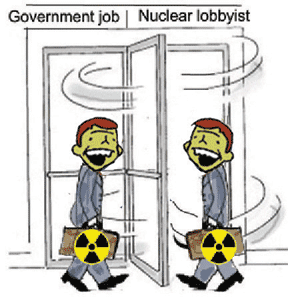 Brothers-in-Arms: the high-rotation revolving door between the Australian government and arms merchants. Michael West Media by Michelle Fahy | Mar 11, 2020 | A disturbing number of Australia’s military personnel, senior defence and intelligence officials and politicians leave their public service jobs and walk through the ‘revolving door’ into roles with weapons-making and security-related corporations. Nowhere is government and industry more fused than in defence. Michelle Fahy reports. Brothers-in-Arms: the high-rotation revolving door between the Australian government and arms merchants. Michael West Media by Michelle Fahy | Mar 11, 2020 | A disturbing number of Australia’s military personnel, senior defence and intelligence officials and politicians leave their public service jobs and walk through the ‘revolving door’ into roles with weapons-making and security-related corporations. Nowhere is government and industry more fused than in defence. Michelle Fahy reports.
The majority of transitions between politics and the Australian defence sector pass unremarked, with only an occasional high profile name making media headlines. It is a career pathway which has been normalised. This despite the sensitive nature of defence and the astronomical size of the nation’s defence spending. A recent example is the 21 February 2020 appointment to the Thales Australia board of one of the nation’s most senior intelligence chiefs, former ASIO boss Duncan Lewis, which barely rated a mention. Nine newspapers were an exception in noting the appointment, but there were no hard questions asked and no analysis by Nine as to the implications of this swift move into the private sector by such a powerful well-connected person: a move into an industry over which Lewis until recently had had oversight. Upon his appointment to the Thales board, Lewis had only been out of ASIO for five months, having spent five years as its Director-General. ASIO was his final public sector role in a long career that also spanned the military, the departments of the prime minister and cabinet and defence, as well as diplomatic roles. Thales is the world’s 10th largest weapons-making corporation; a French multinational that also encompasses cybersecurity and space projects. It also owns 35 per cent of Naval Group, the lead contractor of the $80 billion Future Submarines project. Thales Australia is a multi-billion-dollar contractor to the Australian government. When respected senior leaders such as Lewis leave public service for the weapons industry, they take with them extensive contacts, deep institutional knowledge, and rare and privileged access to the highest levels of government. Their presence in the private sector serves to affirm and entrench the influence of the weapons industry on government decision-making. The public interest risks becoming conflated with corporate interests. In addition to these issues, the well-trodden path from public service into such industry appointments raises the troubling possibility that some senior decision-makers on defence and national security matters, with an eye on possible future board appointments or consulting roles (whether consciously or not), might favour a certain proposal over another, or become hesitant to make decisions that could displease corporate interests. How would the public they serve ever know?
|
|

Resources Minister Keith Pitt shows poor grasp of nuclear waste issues.
From Keith Pitt’s Website…. There are some glaring problems with his understanding of the portfolio including “the people of Napandee”….storage of Low Level Waste when it is Disposal….the inference that waste at the other 100 sites is nuclear medicine related….that nuclear medicine “keeps us well”….just to name a few,
 Interview with Paul Culliver, Breakfast program of ABC North and West SA, 4 March 2020
Interviewer: Paul Culliver
Subject: Radioactive waste facility site, community consultation, progress with facility legislation, National Party Government to be built in Kimba. I just asked him: coming to this portfolio, and this process, what his mindset is. ………
PAUL CULLIVER: Obviously, Matt Canavan’s been the face of it for the Government for many years now and it’s now going to be you. Does anything change?
KEITH PITT: ……. really we just want to move forward with the legislation, get it through the system in terms of the House, the Senate, get royal assent and start to deliver for the people of Napandee.
PAUL CULLIVER: ……… Obviously, there’s people still with very strong views about this and very strong concerns about the process. I mean are you interested in hearing from those people still or are you just pushing forward?
KEITH PITT: We’re moving forward. We’ll always continue to consult with the community, but there’s been very broad community support; 61 per cent of the voters in Kimba support the facility; close on 60 per cent of local businesses; close on 60 per cent of submissions supported it; 100 per cent of the direct neighbours that share a boundary support the facility……..
PAUL CULLIVER: And what’s your feeling on the fact that the Barngarla people feel left out of that consultation process when people talk about broad community support? The Barngarla people say well we didn’t get a say in that community vote.
KEITH PITT: Well firstly, we’ve worked very closely with Barngarla people and there’s still an opportunity for us to continue to work closely with them as we’ve said we would both publicly and privately.
PAUL CULLIVER: The legislation’s gone into Parliament now; it’s been referred to a Senate inquiry. Could you just explain sort of what the process is there? What’s going to happen with that legislation?
KEITH PITT: Well firstly, the legislation’s been introduced to the Parliament. It will probably be debated in the House of Reps sometime this week,……. It will be debated in the Senate. Once it passes both the House and the Senate, after the committee process, it goes to what’s called royal assent with the Governor-General and becomes law and then we push on.
PAUL CULLIVER: And what exactly does this legislation do?
KEITH PITT: So effectively, it does make some changes around some pre-existing legislation to identify the site at Napandee as the site. There’s some bits around the community development package. ……….. but one of the points I really want to make is, you know, the low level waste which we stored here, around 80 per cent of that comes from nuclear medicine. ……
PAUL CULLIVER: One criticism from people vocal about this facility is that the intermediate waste is going to have to be moved on again somewhere anyway, so what’s the point of parking it in one place if you’re just going to have to find a new facility for it later?
KEITH PITT: So what we’ve said from the beginning is that this will be a storage facility for low level, and potentially intermediate waste. …….. we just have to be able to deal with the waste in a practical and sensible way.
PAUL CULLIVER: Will you be visiting Kimba?
KEITH PITT: It’s certainly on the list……I’ve spoken with Rowan Ramsey a number of times and I’ll take the first opportunity I can to get down in South Australia and talk to the local community…… https://www.facebook.com/groups/941313402573199/
Australian govt rejects a report that recommends nuclear submarines
French submarine program ‘dangerously off track’ warns report urging Australia to consider nuclear alternative, ABC News, By defence correspondent Andrew Greene 11 Mar, 20 Australia’s $80 billion Future Submarine Program is “dangerously off track” according to a new report that urges the Government to ditch the controversial project and consider a nuclear option.
Key points:
- The report indicates there are fears the current project is at a high risk of failing
- The Defence Minister denies those fears and maintains the project remains on track
- Under a proposed “Plan B” scenario, the company that designed the Collins class submarines would prepare an updated design
Businessman Gary Johnston, who commissioned and funded the study, fears the current plan to build 12 attack class submarines designed by French company Naval Group is at “high risk” of failing.
His report, prepared by Insight Economics, suggests Australia should instead immediately begin work on a “Plan B” — an evolved version of the current Collins class fleet — before eventually acquiring nuclear-powered boats.
Earlier this year, a report from the auditor-general confirmed the Future Submarine Program was running nine months late and Defence was unable to show whether the $396 million spent so far had been “fully effective”.
“The Government’s own advisory body, including three American admirals, even recommended the Government should consider walking away from the project,” Mr Johnston said.
Under the proposed “Plan B”, Swedish company Saab Kockums, which designed the navy’s Collins class submarines, would be asked to prepare an updated design for the future submarine fleet.
In 2022-23, both Naval Group and Saab will present their competing preliminary design studies for building the first batch of three submarines in Adelaide — based on a fixed price, capability, delivery and local content.
Mr Johnston, along with former naval officers in the Submarines for Australia organisation, argue that over the long term the Government should begin preparing to acquire nuclear submarines……
Government rejects report, issues warning
The Submarines for Australia report will be formally launched by ANU Emeritus Professor Hugh White at the National Press Club today, but it is already drawing fire from the Morrison Government.
“I totally reject the premise that this project is ‘dangerously off track’, as stated in the new Submarines for Australia report”, Defence Minister Linda Reynolds said.
“The delivery of the attack class submarine remains on track, with construction set to commence in 2023.”
Senator Reynolds said the technical feasibility of delivering an evolved Collins class submarine was reviewed in 2013-14, but a review found it would be equivalent to a whole new design, involving similar costs and risks, without a commensurate gain in capability.
“This assessment by Submarines for Australia will only increase cost, delay the delivery, and put at risk our submarine capability.”
The Defence Minister also flatly rejected any suggestion of a nuclear-powered submarine in the future.
“As has been the policy of successive Australian Governments, a nuclear-powered submarine is not being considered as an option for the attack class submarine,” Senator Reynolds said.
https://www.abc.net.au/news/2020-03-11/australia-urged-to-embrace-nuclear-submarines/12043444
Liberal-National Coalition in nuclear disarray
|
Mr Barilaro’s position is also causing division in his National Party, with some of the party’s coastal MPs concerned that his position would put their seats at risk. The Nationals’ leader last week declared his party would support Mr Latham’s bill when it comes back before the upper house for a vote this month. The bill would allow the bans on uranium mining and nuclear power to be lifted but it has not yet been considered by the Liberal or National party rooms or cabinet. It follows a parliamentary inquiry report, which said the government should support the bill. But the issue has caused such anger within Liberal ranks that one senior minister told the Herald they would quit cabinet before supporting Mr Latham’s bill. A senior Liberal minister said: “I did not get into Parliament to support a One Nation bill”, while another minister said: “Crossbenchers don’t set the government’s agenda”. “It’s amazing that John Barilaro listens to the views of One Nation over his colleagues,” a fourth senior minister said. Last week, Local Government Minister and Liberal MP Shelley Hancock told Parliament she would not support a nuclear reactor in her electorate. But Mr Barilaro shot back and said the Liberals repeatedly say they “support technology agnostic energy policy” but then refuse to have a discussion about the role of nuclear. “Forget about this being a crossbench bill, I would take this to my party room and then put up my own bill if I need to,” Mr Barilaro said. |
|
|

Christiana Figueres- “Australia, you’re not ‘meeting and beating’ your emissions targets”

Be honest Australia, you’re not ‘meeting and beating’ your emissions targets https://www.smh.com.au/environment/climate-change/be-honest-australia-you-re-not-meeting-and-beating-your-emissions-targets-20200307-p547u1.html 8 Mar 20, Optimistic. Prosperous. A country of rare beauty, blessed with abundant natural resources. Australia has all the “golden eggs” needed to position itself as a global leader, to help its Asia-Pacific region leapfrog to a new energy future, and to guarantee Australian prosperity in the process.
Watching this summer’s unprecedented firestorms, I was heartbroken by the sheer scale of the human and ecological tragedy. “This must be the tipping point on climate politics in Australia,” I said to myself. “Surely now the politicians will join hands and forge a bipartisan plan for a better future.”
Instead, the climate wars have returned, driven by a handful of deniers afraid to let go of longstanding vested interests, and given air by powerful media sympathisers and a Prime Minister unwilling to fully embrace the science and stare them down.
For Australia, the choice between danger and opportunity is clear, and that choice must be made now. Since the 2008 Stern Review, the world has known that the cost of not acting is much greater than the cost of our current path. And since the 2008 Garnaut Review, Australians have known that without stronger action, droughts and bushfires would become more frequent and intense, and “observable by 2020”. It is time to move on from denial, delusion and delay towards preparedness, productivity and prosperity.
The following three steps will put Australia on track to the future we must create.
First, be honest about where Australia is at. Your country is much more than 1.3 per cent of the global climate problem. Carbon emissions from Australia’s use and export of fossil fuels account for about 5 per cent of the global fossil fuel footprint. With exports included, Australians have the biggest per capita carbon footprint in the world.
Australia is not “meeting and beating” its emissions targets. Emissions have increased in every calendar year since 2014. The government’s own projections say Australia will reduce emissions by only 16 per cent by 2030, not the 26 to 28 per cent it promised in Paris, nor the 50 per cent required by science to limit warming to 1.5 degrees. Kyoto “carryover” can’t be used to make up the gap. The Paris Agreement doesn’t allow it. To suggest otherwise is at best an attempt to paper over Australia’s lagging efforts; and at worst, a legally baseless ploy that encourages cheating and holds back development of the next phase of carbon markets.
A highly vulnerable Australia cannot address climate change on its own, but its heel dragging leaves it without the international credibility to drive a stronger global response. The Australian government must look seriously at how to really meet and beat its 2030 target, and ask other major emitters to join it in an alliance for higher ambition at the COP26 climate summit in Glasgow this November.
Second, Australia needs a bipartisan, long-term vision for decarbonisation. Rattled by the bushfires and growing evidence of climate-related risks and stresses, Australia’s biggest corporations – including Rio Tinto, Qantas, Telstra and BHP – have announced support for a national net zero target for 2050. For them, legislating this target is important to finally end the climate wars, and provide the necessary certainty to underpin investment in the transition.
All states and territories have 2050 net zero targets, as do 73 other nations, including Britain and Canada. British Prime Minister Boris Johnson would welcome Australia joining these ranks ahead of the COP26, and giving consideration to the British model of using an independent expert body to advise government on five-yearly carbon budgets en route to net zero by 2050. Independent MP Zali Steggall’s private members’ bill does exactly that.
Third, Australia must embrace net zero by 2050 as a central pillar of its economic plan for the future. The plan must prioritise the policies, industries and technologies that are scientifically aligned with the 1.5 degree temperature limit, and retire those that are not, albeit with gratitude for the service provided in the past.
Despite a booming renewables industry, coal still accounts for around 60 per cent of Australia’s energy mix. But the technology is tired and unreliable in the summer, highly polluting, and no longer price competitive with solar and wind, firmed up by big batteries or pumped hydro. There is no place for governments signed up to the Paris Agreement to provide subsidies for dying coal. We must instead invest in the future.
These ground-breaking projects are just three examples of how Australia can lead and prosper. With political honesty and vision, ambitious targets, and a stubborn commitment to innovation, Australia stands ready to assume its rightful place as a clean energy superpower of the world. With the right choices, the future is bright.
Christiana Figueres is the former UN climate chief who oversaw the negotiation of the 2015 Paris Agreement, and is convenor of the Mission 2020 climate campaign. She is co-author of The Future We Choose and is visiting Australia this week.
New South Wales South Coast to become a nuclear wasteland? That’s the plan of the National Party
Nationals to support nuclear power;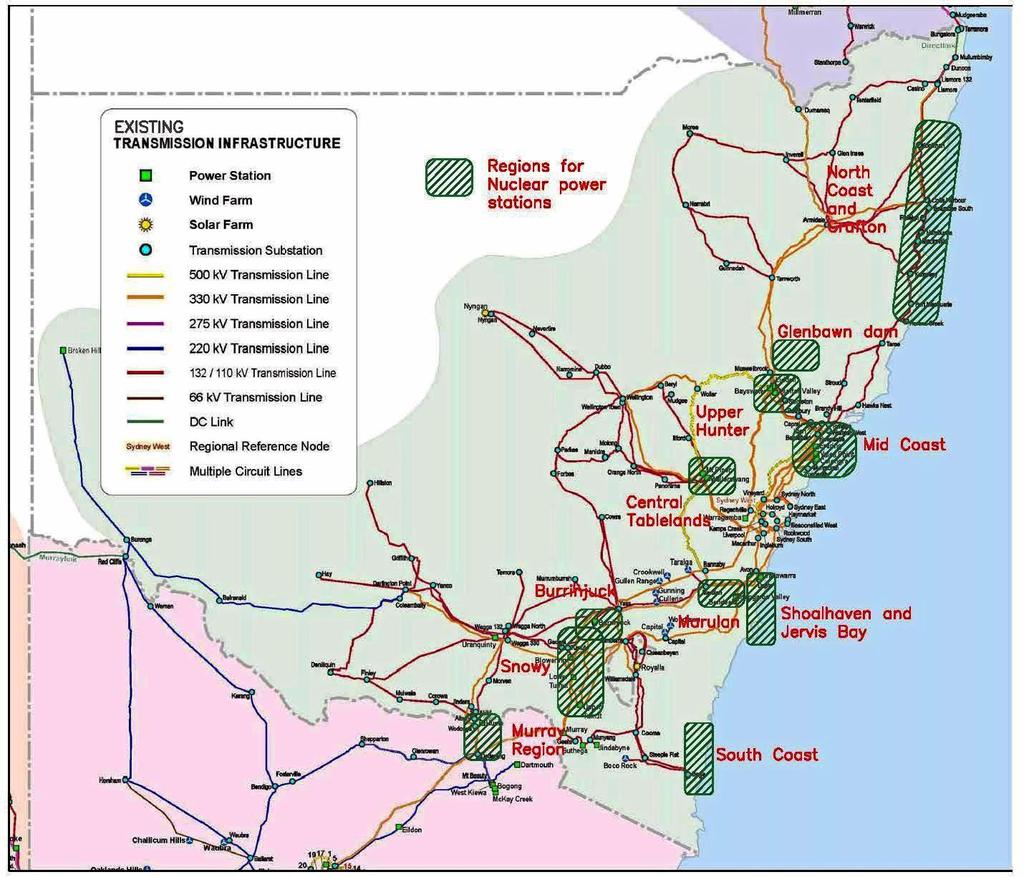 Far South Coast flagged as possible location https://www.begadistrictnews.com.au/story/6665667/nationals-to-support-nuclear-power-far-south-coast-flagged-as-possible-location/, Albert McKnight 6 Mar 20,
The Nationals will support a bill to allow nuclear power in NSW, while separately the Far South Coast has been flagged as a possible location for a nuclear power plant.
When speaking to Sky News earlier this week, Deputy Premier John Barilaro confirmed The Nationals would support a bill proposed by One Nation on the matter, and said the state would not achieve its 2050 net zero emissions target without nuclear energy.
Mr Barilaro has been vocal about the nuclear power issue for years, last year saying it was “guaranteed baseload energy with zero emissions, no fossil fuels and probably the cheapest cost to the average Australian household”.
In a study by Nuclear for Climate Australia published on its website, the area between Bermagui and Merimbula is among 18 proposed areas of interest in NSW for a nuclear power station.
Under its proposal it states the South Coast has potential if included with other power plants that could be built at East Gippsland, the Snowy Mountains or Jervis Bay.
While it states the coast has many sites with “good access to once-through sea water cooling” – running a large amount of water through a power plant’s condensers then discharging it into a waterway with only a small amount of evaporation – an extensive grid upgrade would be required for a 2.2GW plant.
Shadow Minister for Climate Change and Energy Adam Searle confirmed a McKay Labor Government would maintain a ban on uranium exploration, extraction and export.
“Nuclear is the most expensive form of power and its waste is a disaster for the environment,” he said.
“Regional and coastal communities now face the grim prospect of becoming a nuclear power plant wasteland, as a result of Mr Barilaro leading this government by the nose.”
Shadow Minister for the Illawarra and South Coast Ryan Park said coastal communities would never embrace nuclear energy.
“This has clearly divided the Liberal-National Government,” he said.
“[Member for South Coast] Shelley Hancock has already said she would not support nuclear plants on the South Coast.”
He said Member for Bega Andrew Constance should do the same. Mr Constance has been approached for comment.
One Nation’s Mark Latham introduced the bill to lift the ban on nuclear power and uranium mining in NSW, saying it would “create jobs, investment” and “undertake the long-term planning needed to keep the lights on”.
Does NSW need nuclear power? Write a letter to the editor
Nature Conservation Council says the Nationals’ support for nuclear power is a “dangerous and expensive distraction”
|
Environment groups say nuclear push a “dangerous distraction” to clean energy debate, Macquarie Port News, 6 Mar 20, THE Nature Conservation Council says the Nationals’ support for nuclear power is a “dangerous and expensive distraction” from the coal to clean energy debate and is not the sustainable, long-term priority for the environment. Deputy premier John Barilaro has confirmed The Nationals will support a One Nation bill to allow nuclear power in NSW, reigniting debate on the controversial topic. NSW One Nation leader Mark Latham’s Uranium Mining And Nuclear Facilities (Prohibitions) Repeal Bill is currently before the upper house and, if successful, would see the 36-year prohibition on uranium mining and nuclear lifted.
NSW Labor hit back immediately confirming it would not introduce nuclear power in NSW, if elected. Port Macquarie, Kempsey, Grafton and Coffs Harbour have all been flagged as regions of
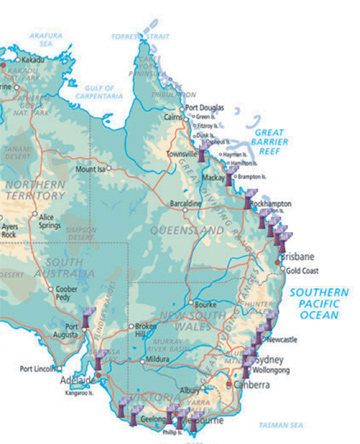 interest for nuclear power plants. interest for nuclear power plants.Other regions include the Upper Hunter (Singleton, Muswellbrook), Shoalhaven (Jervis Bay, Nowra), Central West (Lithgow), Snowy Mountains, and Albury/Wodonga. “Local MPs Leslie Williams and Stephen Bromhead need to tell us whether they support their leader’s plans to make it legal to build a nuclear power plant on the Mid-North Coast,” Nature Conservation Council chief executive Chris Gambian said. “Nuclear power is extremely dangerous and leaves a legacy of radiation pollution that lasts generations. “It is a dangerous and expensive distraction from urgent work we need to do to transition from coal to clean energy and storage. “People on the Mid-North Coast don’t want nuclear power and they don’t need it. “Clean energy is by far the cheapest, cleanest and most sustainable way to meet our energy needs and it offers regional areas a very bright future. “The transition from dirty coal and gas to clean solar, wind and storage will attract $25 billion of investment, result in the construction of about 2,500 wind turbines and installation of more 42 million solar panels across the state.”….. Newcastle MP Tim Crakanthorp slammed the Nationals’ move and condemned the Nationals’ “reckless support” for nuclear power in NSW at its 2019 conference. https://www.portnews.com.au/story/6665518/environment-groups-say-nuclear-push-a-dangerous-distraction/ |
|
The demonisation of Julian Assange: Former foreign minister Carr calls on the Australian govt to intervene
As anger mounts over Assange’s persecution, former foreign minister Carr calls for moral appeals to Australian government, WSWS, By Richard Phillips, 6 March 2020
Popular opposition to the ongoing imprisonment and state persecution of WikiLeaks publisher Julian Assange is increasing following last week’s extradition hearing in Britain. The four-day show trial, which blatantly violated Assange’s basic legal rights and subjected him to even more psychological torture, has deeply shocked many people and intensified the determination of those fighting for Assange’s release.
Addressing a public meeting last week in the New South Wales (NSW) parliament, Bob Carr, a former federal foreign minister and state Labor premier from 1995–2005, denounced the bogus espionage charges against Assange and warned that if extradited to the US, he would die.
Carr and other speakers, including Assange’s Australian lawyer Greg Barns and former SBS television journalist Mary Kostakidis, insisted, however, that those defending Assange should concentrate on lobbying state and federal MPs.
This orientation, they suggested, would pressure the Liberal-National Coalition government and Foreign Minister Marisa Payne to ask Washington to release the WikiLeaks publisher.
uCarr called for Payne to have a “friendly chat” with Mike Pompeo, the former CIA chief and current US Secretary of State, and offered some talking points…….
Carr said nothing about Pompeo’s threatening denunciations of WikiLeaks as a “non-state hostile intelligence service,” his visit to Sydney last August when he demanded greater Australian involvement in Washington’s aggressive confrontations with Beijing and Iran, or his role as former CIA chief.
As for Payne, she rejected any defence of Assange, declaring in the Senate a day earlier that the WikiLeaks publisher would receive a fair trial and disparaging UN Special Rapporteur on Torture Nils Melzer’s reports on the decade-long persecution of Assange.
Carr’s opposition to the US-led vendetta against Assange, which he first voiced in May, appears to constitute a remarkable political turn around. Eight years ago, as foreign minister in the Labor government of Prime Minister Julia Gillard—from early 2012 to September 2013—Carr, like other federal Labor MPs and the party as a whole, was virulently hostile to Assange…….
The demonisation of Assange by Australia’s political establishment and the corporate media, which is part and parcel of its commitment to the US alliance, has not convinced tens of thousands of ordinary Australians. Important layers of workers, young people, students and middle-class people have taken up Assange’s defence as part of a growing international movement. …… https://www.wsws.org/en/articles/2020/03/06/carr-m06.html
Morrison to cancel Australia’s participation in the Energy Transition Hub
 Morrison government to stop funding international collaboration on shift to zero emissions. The five-year Australian-German initiative to transition to new energy and low emissions was due to end in 2022, Guardian , Adam Morton Environment editor @adamlmorton Fri 6 Mar 2020 The Morrison government has told researchers at two of Australia’s leading universities it will break a commitment to fund an international collaboration into what is required to shift to a zero emissions future. Morrison government to stop funding international collaboration on shift to zero emissions. The five-year Australian-German initiative to transition to new energy and low emissions was due to end in 2022, Guardian , Adam Morton Environment editor @adamlmorton Fri 6 Mar 2020 The Morrison government has told researchers at two of Australia’s leading universities it will break a commitment to fund an international collaboration into what is required to shift to a zero emissions future.
The Australian-German Energy Transition Hub was announced in 2017 by then prime minister Malcolm Turnbull and German chancellor Angela Merkel as a collaboration that would “help the technical, economic and social transition to new energy systems and a low emissions economy”. Based at the University of Melbourne, the Australian National University and three German institutions, it was to receive $4m over five years from the Department of Foreign Affairs and Trade as part of an eventual full cross-country funding of $20m. But in an email to staff on Friday afternoon, hub managers said the department had told them the government had decided it would “not follow through on its original commitment to fund the hub until 2022”. Government funding for the hub will end in June. Guardian Australia has been told there is $1.75m unpaid from the original agreement. Some researchers said the decision made little sense given the hub’s work included areas of government interest, particularly the development of a clean hydrogen industry. Other hub projects focus on energy storage, energy system modelling, plans for a just transition to clean energy and integrating solar energy into the grid……..https://www.theguardian.com/environment/2020/mar/06/morrison-government-to-stop-funding-20m-international-collaboration-on-shift-to-zero-emissions |
|
|
Conservative push for nuclear power will drive a wedge into the Coalition
 Conservative push for nuclear power will drive a wedge into the Coalition, Jim Green, 5 March 2020, RenewEconomy https://reneweconomy.com.au/conservative-push-for-nuclear-power-will-drive-a-wedge-into-the-coalition-39428/
The NSW Parliament’s State Development Committee has released its report into nuclear power. In a rare show of unity, conservative committee members held together, with Liberals, Nationals, Shooters Fishers and Farmers, and Paulina Hanson’s One Nation all recommending repeal of state laws banning uranium mining and nuclear power. But that unity is unlikely to last. Comments by Premier Gladys Berejiklian and Energy Minister Matt Kean suggest they oppose the push to repeal legislation banning nuclear power.
Elsewhere, deep rifts are evident within the Coalition. The SA Liberal government’s submission to a 2019 federal nuclear inquiry opposed the pursuit of nuclear power, as did the Tasmanian Liberal government’s submission and even that of the Queensland Liberal-National Party.
The federal government said it would not repeal laws banning nuclear power even before it established the nuclear inquiry. The majority report of the inquiry recommended a partial repeal of the bans ‒ retaining the ban against large, conventional reactors but permitting the development of non-existent ‘Generation IV’ reactor concepts ‒ but that recommendation is unlikely to be adopted by the Morrison government.
The prospects for Generation IV concepts ‒ such as thorium or fusion ‒ were studied by the South Australian Nuclear Fuel Cycle Royal Commission. The Commission concluded in its 2016 report that Generation IV concepts are unlikely to be feasible or viable in the foreseeable future, and carry a high commercial and technical risk.
For both conventional and Generation IV nuclear power, cost is the main sticking point ‒ even for conservatives. “I don’t sign up on anything if I can’t look Australians in the eye and say how much it will cost,” Prime Minister Morrison recently said.
There are many examples of shocking cost overruns overseas. The cost of the two reactors under construction in the US state of Georgia has doubled and now stands at A$20.4‒22.6 billion per reactor. In 2006, Westinghouse said it could build a reactor for as little as A$2.1 billion ‒ 10 times lower than the current estimate.
The only other reactor construction project in the US, a twin-reactor project in South Carolina, was abandoned in 2017 after the expenditure of at least A$13.4 billion. Westinghouse filed for bankruptcy soon after, almost bankrupting its parent company Toshiba in the process.
The cost of the only reactor under construction in France has nearly quadrupled and now stands at A$20.0 billion. The cost of the only reactor under construction in Finland has nearly quadrupled and now stands at A$17.7 billion. The projects in France and Finland are both 10 years behind schedule, and still incomplete.
The cost of the four reactors under construction in the United Arab Emirates has increased from A$7.5 billion per reactor to A$10‒12 billion per reactor. South Korea ‒ which is supplying the UAE reactors ‒ is held out to be a model for the global nuclear industry. But South Korea is slowly phasing out its nuclear reactors, its nuclear industry is riddled with corruption (the courts have dispensed a cumulative 253 years of jail time to 68 offenders), and its business model clearly sacrifices safety in order to improve economics.
In the UK, the estimated cost of the only two reactors under construction is A$25.9 billion per reactor. In the mid-2000s, the estimated cost was almost seven times lower. The UK National Audit Office estimates that taxpayer subsidies for the project will amount to A$58 billion, despite earlier government promises that no taxpayer subsidies would be made available.
The Australian debate should be seen in the context of the culture wars, not the energy debate. With few exceptions, pro-nuclear conservatives don’t believe in climate science, they support subsidised fossil fuel plants, and they vigorously oppose renewables. Former Prime Minister Malcolm Turnbull describes nuclear power as the “loopy current fad … which is the current weapon of mass distraction for the backbench”.
Pro-nuclear conservatives hope to split the Labor Party and environmentalists on nuclear power, but they are only dividing themselves. They should take a history lesson. The Howard government’s promotion of nuclear power was alive in the 2007 election campaign, but the policy did nothing to divide the Labor Party or the environment movement.
On the contrary, it divided the Coalition, with at least 22 Coalition candidates publicly distancing themselves from the government’s promotion of nuclear power during the 2007 election campaign. The policy of promoting nuclear power was seen to be a liability and it was ditched immediately after the election.
A December 2019 report by CSIRO and the Australian Energy Market Operator finds that construction costs for nuclear reactors are 2‒8 times higher than costs for wind or solar. Costs per unit of energy produced are 2‒3 times greater for nuclear compared to wind or solar including either two hours of battery storage or six hours of pumped hydro energy storage.
Australia can do better than fuel higher carbon emissions and unnecessary radioactive risk. We need to embrace the fastest growing global energy sector and become a driver of clean energy thinking and technology and a world leader in renewable energy technology. Our shared energy future is renewable, not radioactive.
Dr. Jim Green is the national nuclear campaigner with Friends of the Earth Australia and editor of the World Information Service on Energy’s Nuclear Monitor newsletter.
“NuclearHistory” exposes the unpleasant facts about liquid fluoride thorium nuclear reactors

Some people believe that liquid fluoride thorium reactors, which would use a high temperature liquid fuel made of molten salt, would be significantly safer than current generation reactors. However, such reactors have major flaws. There are serious safety issues associated with the retention of fission products in the fuel, and it is not clear these problems can be effectively resolved. Such reactors also present proliferation and nuclear terrorism risks because they involve the continuous separation, or “reprocessing,” of the fuel to remove fission products and to efficiently produce U-233, which is a nuclear weapon-usable material. Moreover, disposal of theused fuel has turned out to be a major challenge. Stabilization and disposal of the
remains of the very small “Molten Salt Reactor Experiment” that operated at Oak
Ridge National Laboratory in the 1960s has turned into the most technically challenging cleanup problem that Oak Ridge has faced, and the site has still not been cleaned up. Last updated March 14, 2019″ Source: Union of Concerned Scientists, at https://www.ucsusa.org/sites/default/files/legacy/assets/documents/nuclear_power/thorium-reactors-statement.pdf I wonder who is correct, The Union of Scientists or Mr. O’Brien and ScoMo?
The Industry Push to Force Nuclear Power in Australia, Part 1 of A Study of the “Report of the inquiry into the prerequisites for nuclear energy in Australia” Australian Parliamentary Committee 2020.by nuclearhistory, February 29, 2020, “………Nuclear power enables the great powers to project power. It is a crucial geo-political influencer. If the committee has it’s way, we will be working with Russia and China and others on reactors they want to develop, that their own people have not had a say in, that are all based upon reactor designs first thought of in the 1950s, and where actual examples were built at that time, turned out to be unsafe failures which continue to present cost and risk at their sites to this day.
The committee’s first recommendation to government includes the following two sub parts:
c. procuring next-of-a-kind nuclear reactors only, not first-of-a- kind.” end quote.
“procuring next-of-a-kind nuclear reactors only, not first-of-a- kind” How refreshing that the Committee does not want the first gen iv type reactors – the Fermi 1 and Monju type for example. Those dangerous failures that sit like wounded Albatross in the US and Japan and continue to demand taxpayer funds. The failure of Monju, which has long been foreseen by many, renders the original basis for the Japanese nuclear industry subject to severe doubt. As result of vastly improved safety standards, fuel reprocessing in Japan is in doubt, its future course uncertain, and the nature of high level waste management has been an even more pressing issue.
Nuclear free has served NSW well and should remain- Australian Conservation Foundation
 Nuclear free has served NSW well and should remain, https://www.miragenews.com/nuclear-free-has-served-nsw-well-and-should-remain/ Nuclear power has no role in Australia’s energy future and is a dangerous distraction from the climate challenges facing Australia.
A pro-nuclear NSW upper house inquiry initiated by One Nation MLC Mark Latham has recommended removing the state’s long-standing legislative ban on uranium mining and opening the door to nuclear power, but Labor committee members have reaffirmed their party’s opposition to uranium mining and nuclear energy.
The inquiry report recommends the repeal of the Uranium Mining and Nuclear Facilities (Prohibitions) Act, but a dissenting statement by Labor committee members says a ‘Labor Government will maintain a ban on uranium exploration, extraction and export’ and a ‘Labor Government will not introduce nuclear power in NSW’.
The Australian Conservation Foundation said Australia was blessed with outstanding renewable resources and did not need to explore dangerous nuclear energy options. “The state ban on uranium mining has served NSW well and should remain,” said ACF nuclear campaigner Dave Sweeney.
1 This month

of the week – Australians for War Powers Reform (AWPR)
To see nuclear-related stories in greater depth and intensity
 Antinuclear