 Labor’s climate policies are ‘unshakeable’ despite
  election loss, Mark Butler says
Shadow climate minister says he believes Scott Morrison may shift on issue during the coming term, Guardian, Katharine Murphy Political editor @murpharoo, 21 Sep 2019 Mark Butler wants to make one thing clear: the shadow minister for climate change and energy is not for turning. It wasn’t a mistake to pursue an ambitious climate policy in the 2019 election and “we are not going to change our position to get to a level of profound irresponsibility [on policy], like the government”, he tells Guardian Australia’s politics podcast.
“Our position on climate is unshakeable.”……..
he also thinks it is possible Scott Morrison will shift on climate during the coming term, particularly if the Australian community remains vocal on the issue, and business also continues to demand policy certainty to allow it to deal with carbon risk. He says for people who want practical climate action, as opposed to rhetoric, bipartisanship remains “the holy grail”.
Butler says Morrison is not Malcolm Turnbull on climate, and not Tony Abbott, but somewhere in the middle. He suspects the prime minister has no “deep beliefs” on the issue, but that could enable him to pivot to a more plausible policy position in the event he makes a judgment that climate change is harming the electoral prospects of the Coalition. Perhaps Morrison, he says, can take “some baby steps to break down the culture war”.
…….. Butler says all the survey evidence he has seen indicates Australian voters are alarmed by the lack of policy action on climate change, and the issue rates second behind concerns about cost of living pressure. He says he is “utterly convinced” that public opinion in favour of action is “broad, deep and growing”.
Politicians, he says, need to be particularly aware that young people are hugely motivated on climate change. Butler has teenaged children and meets regularly with young activists.
“I can see it in their eyes,” he says. “They think our generation is from a different planet.” He says there is a risk of climate change widening the generation gap, which is more substantial now, he thinks, than at any time since the 1960s
“If we get to 2030 with the level of inertia we’ve had over the last decade, then we have profoundly let down our children and grandchildren”. https://www.theguardian.com/australia-news/2019/sep/21/labors-climate-policies-are-unshakeable-despite-election-loss-mark-butler-says?fbclid=IwAR0EPtILqei1clnBN_uRzHHflc-m2HBdcrvmQ3E9SUt0A3JkunlqKVc08Sk
September 21, 2019
Posted by Christina Macpherson |
AUSTRALIA - NATIONAL, climate change - global warming, politics |
Leave a comment
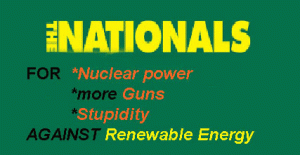 Nuclear energy: Nationals MPs welcome AWU support for domestic industry Union to tell parliamentary committee it’s ‘ludicrous’ to export uranium but not benefit from the energy source at home. Guardian, Sarah Martin 20 Sept 19, Nationals MPs have welcomed support from the Australian Workers’ Union for a domestic nuclear industry, as the union calls on progressives not to reject a “zero carbon compromise”.
A House of Representatives committee chaired by Barnaby Joyce will hear from the union during a roundtable discussion in Sydney on Friday, before MPs visit the Lucas Heights nuclear facility for a site visit…….
The AWU national secretary, Dan Walton, said that while he accepted that the Labor party had already expressed opposition to nuclear, there were people on both sides of politics who were stuck in old ideological debates over the issue. …….
The potential for Australia’s nuclear ban to be lifted has been revived since the May election after a group of Nationals lobbied for the issue to be revisited by a parliamentary inquiry.
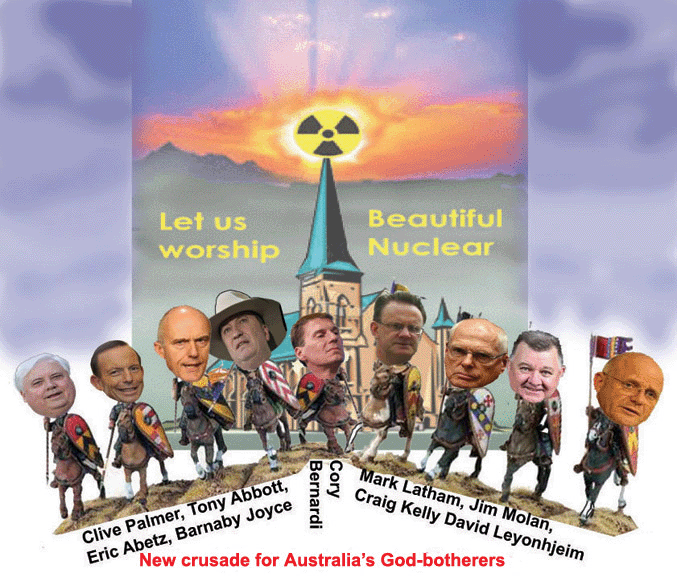
Following a referral from the energy minister, Angus Taylor, in August, the environment and energy committee is conducting an inquiry into the “prerequisites for nuclear energy in Australia”.
At the same time, Joyce has tasked his lower house committee to also look at the issue through a series of roundtable events. Taylor has said that while there are no plans to drop the existing moratorium on nuclear energy, the government’s role was to plan for the decades ahead.
 The resources minister, Matt Canavan, a senior Nationals senator from Queensland, said the AWU’s view was welcome as the debate over nuclear continued.
“I welcome the AWU’s contribution,” he told Guardian Australia. “It will, of course, need support from a broad range of organisations, including the Labor party, to progress nuclear power…..
The Nationals MP for Hinkler, Keith Pitt, said that there could be no change to Australia’s current position on nuclear without bipartisan support……
Support for a domestic nuclear industry also appears to be gathering pace within the Coalition, with two new government senators, South Australian Alex Antic and NT National Sam McMahon, both using their first speeches to parliament this week to back the technology……
The union’s support will likely buoy conservative supporters of nuclear who are hoping the twin inquiries into the issue will be sufficient to win a change to government policy.
Ziggy Switkowski, who headed a 2006 review of nuclear power for the Howard government, told the environment committee that the technology had no chance of being introduced unless Australia had a coherent energy policy.
He also said that it would take about a decade before it was clear whether small nuclear reactors were suitable for Australia, and about 15 years to bring a plant online if a decision was made to build one.
The Australian Nuclear Association, which advocates for nuclear science and technology, has said nuclear power could provide cheap, reliable, carbon-free energy in Australia, but would only be financially competitive with a carbon price.
 In a group submission released this week environmental and civil society groups warned the government that nuclear power has “no role” in Australia, saying the issue was a distraction from “real movement on the pressing energy decisions and climate actions we need”. https://www.theguardian.com/environment/2019/sep/20/nuclear-energy-nationals-mps-welcome-awu-support-for-domestic-industry
September 21, 2019
Posted by Christina Macpherson |
AUSTRALIA - NATIONAL, politics |
Leave a comment
Big claims and corporate spin about small nuclear reactor costs, Jim Green, 19 September 2019, RenewEconomy https://reneweconomy.com.au/big-claims-and-corporate-spin-about-small-nuclear-reactor-costs-65726/
The ‘inquiry into the prerequisites for nuclear energy in Australia’ being run by Federal Parliament’s Environment and Energy Committee has finished receiving submissions and is gradually making them publicly available.
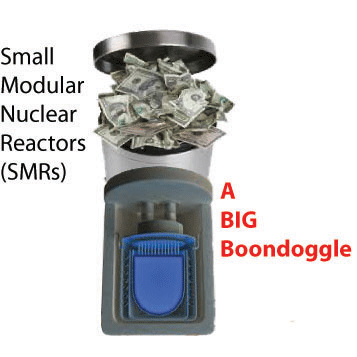
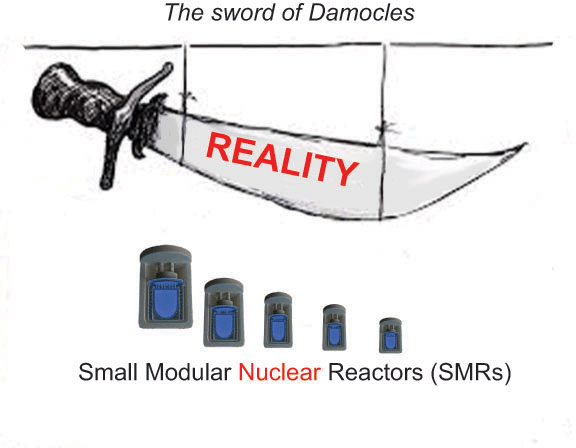
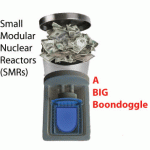 The inquiry is particularly interested in ‘small modular reactors’ (SMRs) and thus one point of interest is how enthusiasts spin the economic debate given that previous history with small reactors has shown them to be expensive; the cost of the handful of SMRs under construction is exorbitant; and both the private sector and governments around the world have been unwilling to invest the billions of dollars required to get high-risk SMR demonstration reactors built.
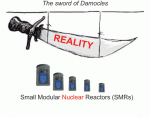 To provide a reality-check before we get to the corporate spin, a submission to the inquiry by the Institute for Energy Economics and Financial Analysis notes that SMRs have been as successful as cold fusion – i.e., not at all. The submission states:
“The construction of nuclear power plants globally has proven to be an ongoing financial disaster for private industry and governments alike, with extraordinary cost and construction time blow-outs, while being a massive waste of public monies due to the ongoing reliance on government financial subsidies. … Governments have repeatedly failed to comprehend that nuclear construction timelines and cost estimates put forward by many corporates (with vested interests) have proven disastrously flawed and wrong.”
The Institute is equally scathing about SMRs:
“For all the hype in certain quarters, commercial deployment of small modular reactors (SMRs) have to-date been as successful as hypothesized cold fusion – that is, not at all. Even assuming massive ongoing taxpayer subsidies, SMR proponents do not expect to make a commercial deployment at scale any time soon, if at all, and more likely in a decade from now if historic delays to proposed timetables are acknowledged.”
Thus the Institute adds its voice to the chorus of informed scepticism about SMRs, such as the 2017 Lloyd’s Register survey of 600 industry professionals and experts who predicted that SMRs have a “low likelihood of eventual take-up, and will have a minimal impact when they do arrive“.
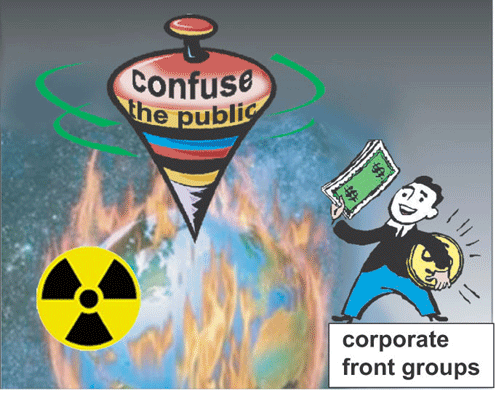
 Corporate spin #1: Minerals Council of Australia
The Minerals Council of Australia claims in its submission to the federal inquiry that SMRs could generate electricity for as little as $60 per megawatt-hour (MWh). That claim is based on a report by the Economic and Finance Working Group (EFWG) of the Canadian government-industry ‘SMR Roadmap’ initiative.
The Canadian EFWG gives lots of possible SMR costs and the Minerals Council’s use of its lowest figure is nothing if not selective. The figure cited by the Minerals Council assumes near-term deployment from a standing start (with no-one offering to risk billions of dollars to build demonstration reactors), plus extraordinary learning rates in an industry notorious for its negative learning rates.
Dr. Ziggy Switkowski noted in his evidence to the federal inquiry that “nuclear power has got more expensive, rather than less expensive”. Yet the EFWG  paper takes a made-up, ridiculously-high learning rate and subjects SMR cost estimates to eight ‘cumulative doublings’ based on the learning rate. That’s creative accounting and one can only wonder why the Minerals Council would present it as a credible estimate.
Here are the first-of-a-kind SMR cost estimates from the EFWG paper, all of them far higher than the figure cited by the Minerals Council:
- 300-megawatt (MW) on-grid SMR: C$162.67 (A$179) / MWh
- 125-MW off-grid heavy industry: C$178.01 (A$196) / MWh
- 20-MW off-grid remote mining: C$344.62 (A$380) / MWh
- 3-MW off-grid remote community: C$894.05 (A$986) / MWh
The government and industry members on the Canadian EFWG are in no doubt that SMRs won’t be built without public subsidies:
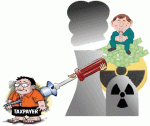 “The federal and provincial governments should, in partnership with industry, investigate ways to best risk-share through policy mechanisms to reduce the cost of capital. This is especially true for the first units deployed, which would likely have a substantially higher cost of capital than a commercially mature SMR.”
The EFWG paper used a range of estimates from the literature and vendors. It notes problems with its inputs, such as the fact that many of the vendor estimates have not been independently vetted, and “the wide variation in costs provided by expert analysts”. Thus, the EFWG qualifies its findings by noting that “actual costs could be higher or lower depending on a number of eventualities”.
Corporate spin #2: NuScale Power
US company NuScale Power has put in a submission to the federal nuclear inquiry, estimating a first-of-a-kind cost for its SMR design of US$4.35 billion / gigawatt (GW) and an nth-of-a-kind cost of US$3.6 billion / GW.
NuScale doesn’t provide a $/MWh estimate in its submission, but the company has previously said it is targeting a cost of US$65/MWh for its first SMR plant. That is 2.4 lower than the US$155/MWh (A$225/MWh) estimate based on the NuScale design in a report by WSP / Parsons Brinckerhoff prepared for the SA Nuclear Fuel Cycle Royal Commission.
 NuScale’s cost estimates should be regarded as promotional and will continue to drop – unless and until the company actually builds an SMR. The estimated cost of power from NuScale’s non-existent SMRs fell from US$98-$108/MWh in 2015 to US$65/MWh by mid-2018. The company announced with some fanfare in 2018 that it had worked out how to make its SMRs almost 20% cheaper – by making them almost 20% bigger!
Lazard estimates costs of US$112-189/MWh for electricity from large nuclear plants. NuScale’s claim that its electricity will be 2-3 times cheaper than that from large nuclear plants is implausible. And even if NuScale achieved costs of US$65/MWh, that would still be higher than Lazard’s figures for wind power (US$29-56) and utility-scale solar (US$36-46).
Likewise, NuScale’s construction construction cost estimate of US$4.35 billion / GW is implausible. The latest cost estimate for the two AP1000 reactors under construction in the US state of Georgia (the only reactors under construction in the US) is US$12.3-13.6 billion / GW. NuScale’s target is just one-third of that cost – despite the unavoidable diseconomies of scale and despite the fact that every independent assessment concludes that SMRs will be more expensive to build (per GW) than large reactors.
Further, the modular factory-line production techniques now being championed by NuScale were trialled with the AP1000 reactor project in South Carolina – a project that was abandoned in 2017 after the expenditure of at least US$9 billion.
Corporate spin #3: Australian company SMR Nuclear Technology
In support of its claim that “it is likely that SMRs will be Australia’s lowest-cost generation source”, Australian company SMR Nuclear Technology Pty Ltd cites in its submission to the federal nuclear inquiry a 2017 report by the US Energy Innovation Reform Project (EIRP).
According to SMR Nuclear Technology, the EIRP study “found that the average levelised cost of electricity (LCOE) from advanced reactors was US$60/MWh.”
However the cost figures used in the EIRP report are nothing more than the optimistic estimates of companies hoping to get ‘advanced’ reactor designs off the ground. Therefore the EIRP authors heavily qualified the report’s findings:
“There is inherent and significant uncertainty in projecting NOAK [nth-of-a-kind] costs from a group of companies that have not yet built a single commercial-scale demonstration reactor, let alone a first commercial plant. Without a commercial-scale plant as a reference, it is difficult to reliably estimate the costs of building out the manufacturing capacity needed to achieve the NOAK costs being reported; many questions still remain unanswered – what scale of investments will be needed to launch the supply chain; what type of capacity building will be needed for the supply chain, and so forth.”
SMR Nuclear Technology’s conclusions – that “it is likely that SMRs will be Australia’s lowest-cost generation source” and that low costs are “likely to make them a game-changer in Australia” – have no more credibility than the company estimates used in the EIRP paper.
SMR Nuclear Technology’s submission does not note that the EIRP inputs were merely company estimates and that the EIRP authors heavily qualified the report’s findings.
The US$60/MWh figure cited by SMR Nuclear Technology is far lower than all independent estimates for SMRs:
- The 2015/16 South Australian Nuclear Fuel Cycle Royal Commission estimated costs of A$180-184/MWh for large light-water reactors, compared to A$225 for an SMR based on the NuScale design (and a slightly lower figure for the ‘mPower’ SMR design that was abandoned in 2017 by Bechtel and Babcock & Wilcox).
- A December 2018 report by CSIRO and the Australian Energy Market Operator found that electricity from SMRs would be more than twice as expensive as that from wind or solar power with storage costs included (two hours of battery storage or six hours of pumped hydro storage).
- A report by the consultancy firm Atkins for the UK Department for Business, Energy and Industrial Strategy found that electricity from the first SMR in the UK would be 30% more expensive than that from large reactors, because of diseconomies of scale and the costs of deploying first-of-a-kind technology. Its optimistic SMR cost estimate is US$107-155 (A$157-226) / MWh.
- A 2015 report by the International Energy Agency and the OECD Nuclear Energy Agency predicted that electricity from SMRs will be 50−100% more expensive than that from large reactors, although it holds out some hope that large-volume factory production could reduce costs.
- An article by four pro-nuclear researchers from Carnegie Mellon University’s Department of Engineering and Public Policy, published in 2018 in the Proceedings of the National Academy of Science, concluded than an SMR industry would only be viable in the US if it received “several hundred billion dollars of direct and indirect subsidies” over the next several decades.
SMR Nuclear Technology’s assertion that “nuclear costs are coming down due to simpler and standardised design; factory-based manufacturing; modularisation; shorter construction time and enhanced financing techniques” is at odds with all available evidence and it is at odds with Dr. Ziggy Switkowski’s observation in a public hearing of the federal inquiry that nuclear “costs per kilowatt hour appear to grow with each new generation of technology”.
SMR Nuclear Technology claims that failing to repeal federal legislative bans against nuclear power would come at “great cost to the economy”. However the introduction of nuclear power to Australia would most likely have resulted in the extraordinary cost overruns and delays that have crippled every reactor construction project in the US and western Europe over the past decade – blowouts amounting to A$10 billion or more per reactor.
Nor would the outcome have been positive if Australia had instead pursued non-existent SMR ‘vaporware‘.
Dr Jim Green is lead author of a Nuclear Monitor report on SMRs and national nuclear campaigner with Friends of the Earth Australia.
September 19, 2019
Posted by Christina Macpherson |
AUSTRALIA - NATIONAL, business, politics, reference, secrets and lies, spinbuster, technology |
Leave a comment
Nationals MP lashes renewable energy as ‘hoax’ and ‘fraud’ but says nuclear will help solve energy crisis, 7 News,Matt Coughlan AAP 18 September 2019 Nationals senator Sam McMahon has lashed renewable energy as a “fraud” and a “hoax” as she made the case for oil, gas and nuclear energy.
She became the second government senator in as many days to use their first speech to parliament to talk up nuclear power after South Australian Liberal Alex Antic did the same on Tuesday.
The NT senator said Australia was looking down the barrel of an energy crisis which “quiet Australians” wanted government to solve.
“Research must continue in the development of renewable technologies, but for commercial use they currently remain immature and in many cases fundamentally flawed,” McMahon told parliament on Wednesday.
“A hoax of immature technology replacing safe, clean, reliable and inexpensive power stations has unfolded. “……..
She also said 30 per cent of the world’s uranium reserves were located in the NT.
“The time is right for us to visit and re-examine options for us to utilise this [nuclear] technology.”…….https://7news.com.au/politics/federal-politics/nationals-mp-lashes-renewable-energy-as-hoax-and-fraud-but-says-nuclear-will-help-solve-energy-crisis-c-460357
September 19, 2019
Posted by Christina Macpherson |
AUSTRALIA - NATIONAL, politics |
Leave a comment
 New Lib senator joins nuclear power push, Matt Coughlan 7 News, AAP, 17 September 2019
New Liberal senator Alex Antic has joined the push for nuclear power through capitalising on South Australia’s uranium industry.
Senator Antic’s first speech to parliament on Tuesday signalled he would add another nuclear advocate to the Liberal Party’s parliamentary ranks.
“The reckless rush into the unproven, un-costed world of renewable energy represents both the deceased canary down the coalmine, as well as a masterclass of failed policy from a failed former Labor government,” he said.
The Morrison government has announced an inquiry into nuclear power after the issue was raised by a rump of coalition backbenchers.
Senator Antic said “everything old could be new again” in his state, noting its history of uranium mining dating back to the early 1900s…….
The former Adelaide councillor said small modular reactors would increase efficiency and safety, while reducing the cost of nuclear power generation. …..
South Australia has the capacity to develop a safe nuclear waste facility which could bring billions into the state, he said.
Senator Antic also took aim at the “tyranny” of political correctness…….https://7news.com.au/politics/new-lib-senator-joins-nuclear-power-push-c-458275
September 19, 2019
Posted by Christina Macpherson |
AUSTRALIA - NATIONAL, politics |
Leave a comment
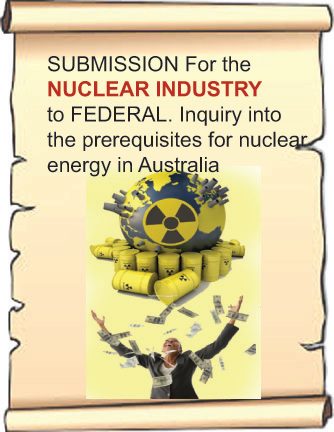 I have now analysed the available, published, submissions to the FEDERAL. Inquiry into the prerequisites for nuclear energy in Australia. Just looking at the 30 pro-nuclear submissions , for a start, I’m here listing the topics, in order of the arguments most often presented:
- The subject most often discussed was new nuclear reactors – Generation IV, Small Modular Reactors, and especially Thorium reactors .
- Then nuclear wastes. These were seen as not really a problem, either already solved, or soon to be solved. Indeed, a number of writers saw radioactive wastes as an advantage for Australia. They suggested a waste repository, set up in South Australia could import nuclear wastes, and that business could then fund the development of nuclear power stations for Australia.
- Economics. Nuclear power was seen as cost-effective, (with only one exception – one writer was dubious on this)
- Renewable energy was downgraded, (though one writer argued for a renewables+nuclear project)
- Safety issues were downgraded, including the severity of Chernobyl and Fukushima accidents New nuclear described as safer now – one saw Fukushima as a learning exercise.
- Education. Several stressed the necessity of public education, including in schools, on the benefits of nuclear power.
- Necessity to end Australia’s ban on nuclear activities.
- Climate change – nuclear needed to combat this.
- Opposition to nuclear power was described as irrational.
- Radiation – low dose ionising radiation discussed as harmless, (one suggested beneficial)
- Carbon price advised by 2 writers.
- There were several other suggestions made, notably that the Government should lead and fund nuclear development, and should be advised by highly paid top technical staff. The full nuclear fuel cycles is needed “cradle – to grave”. Reprocessing was advocated. Korea should supply the reactors. Nuclear power would give Australia international status. Would help prevent nuclear weapons proliferation.
September 17, 2019
Posted by Christina Macpherson |
AUSTRALIA - NATIONAL, politics |
Leave a comment
|
 Broad coalition representing millions of Australians opposes nuclear power, https://www.sbs.com.au/news/broad-coalition-representing-millions-of-australians-opposes-nuclear-power Broad coalition representing millions of Australians opposes nuclear power, https://www.sbs.com.au/news/broad-coalition-representing-millions-of-australians-opposes-nuclear-power Some 40 groups have drawn up a statement calling on the federal government to embrace renewable energy rather than going down the path of nuclear.
More than 40 groups representing millions of Australians have come together to issue a clear message to the federal government that the nation’s energy future is renewable, “not radioactive”.
However, the mining industry is calling for the ban on nuclear energy to be lifted.
The coalition of groups has submitted a shared statement in response to the federal parliamentary inquiry into the prospects for nuclear power in Australia.
“The groups maintain nuclear power has no role in Australia’s energy future and is a dangerous distraction from real progress on our pressing energy and climate challenges and opportunities facing Australia,” the Australian Conversation Foundation said.
“[We call] for the federal parliament to embrace renewable energy as the cleanest, quickest, cheapest and most credible way to power Australian homes and workplaces, and re-power regional communities and the national economy.”
The ACF is joined by a broad coalition of faith, union, environmental, aboriginal and public health groups.
These include the ACTU, state and territory trade unions and councils, the Public Health Association of Australia, Uniting and Catholic church organisations, the Smart Energy Council, the Aboriginal-led Australian Nuclear Free Alliance, climate action groups and Greenpeace Australia Pacific.
Their statement raises concerns over the long-life of nuclear waste, the volume of water needed to cool a nuclear reactor, the time needed to build a reactor, the high cost of a plant, security and safety.
However, in its own submission, the Minerals Council of Australia called on the legislated ban on nuclear to be lifted and uranium mining to be mainstreamed with other minerals.
Council chief executive Tania Constable said nuclear energy should be considered as part of the energy mix if Australia is to retain its strong industrial sector with high-paying long-term jobs.
It will also encourage investment and maintain system and price stability through a stable and reliable electricity market while significantly cutting greenhouse gas emissions.
“Australia has lost its comparative advantage in energy,” Ms Constable said in a statement. “Rising prices and falling reliability are forcing businesses to invest overseas instead of Australia.”
|
|
September 17, 2019
Posted by Christina Macpherson |
AUSTRALIA - NATIONAL, politics |
Leave a comment
|
Trump and nuclear weapons worry Young Labor, https://www.theaustralian.com.au/nation/politics/trump-and-nuclear-weapons-worry-young-labor/news-story/c84899302a288e48a08fc1caa92cd0ff GEOFF CHAMBERS FEDERAL POLITICAL CORRESPONDENT, SEPTEMBER 17, 2019
Young Labor has described Donald Trump as “concerningly pro-authoritarian and isolationist”, and warned Australia could become a “nuclear target” if US missiles were stationed in the north.
Ahead of Scott Morrison’s landmark visit to the US this week, where the US President will host the Prime Minister at a state dinner, Australian Young Labor passed two motions at its national conference on the weekend warning about the Trump administration’s “erratic policies”.
NSW Young Labor president Paul Mills, who moved two motions opposing US missiles in Australia and committing to the US alliance, said Labor should “draw the line at nuclear weapons”.
Mr Mills said his US alliance motion endorsed “sentiment expressed” by former Labor foreign minister Gareth Evans, of “Less US, more self-reliance, more Asia, and more global engagement”.
“We would expect state conferences from around Australia to carry similar motions and for the policy to be adopted at the next national ALP conference to which I’ve been elected one of three Young Labor delegates,” Mr Mills said.
Mr Morrison hosed down suggestions last month that the US was aiming to deploy ground-based missiles in Darwin amid the battle for dominance in the Indo-Pacific region between China and the US.
Security experts last month warned of weaknesses in the nation’s defence capabilities in northern Australia, calling for more personnel and upgraded air bases as part of a long-term strategy.
Opposition defence spokesman Richard Marles — a strong supporter of the US alliance — told The Australian the government had “previously ruled out receiving any formal request for US missiles being stationed in Australia”.
“This is consistent with conversations Labor had with the Secretary of Defence in early August. Australia and the United States are natural allies; we have shared values of democracy, human rights, the rule of law and shared aspirations to build a global rules-based order,” Mr Marles said.
Mr Mills praised the comments of former prime minister Paul Keating opposing the deployment of US missiles and said it would render as impossible “any sovereign Australian decision about participating in American warfare directed at a third country”.
It also makes Australia a nuclear target,” he said.
Young Labor’s 50 delegates, who passed the motion unanimously, are the first branch of the party to endorse the anti-missile position.
The motion said the “federal Labor leadership should be unequivocal in asserting: Australia must not become a missile base”.
Young Labor’s agreed platform on the US alliance says it remains “beneficial for Australia’s national security interests and should recognise that regardless of Trump’s presidency, we should not lose sight of the continuing benefits” of the security pact.
|
|
September 17, 2019
Posted by Christina Macpherson |
AUSTRALIA - NATIONAL, politics |
Leave a comment
Nationals MPs snub launch of farming group’s climate change report https://www.theguardian.com/environment/2019/sep/16/nationals-mps-snub-launch-of-farming-groups-climate-change-report
Australia’s agricultural production will fall and food insecurity will rise without a climate strategy, report warns, Sarah Martin Chief political correspondent 16 Sept 19, Nationals MPs have snubbed a farmers’ group launching a major climate change report that warns the Australian agricultural sector faces “significant threats to viability” without a new national climate strategy.
The report, launched by the Farmers for Climate Action group at Parliament House on Monday, warns that agricultural production will fall, farm profits will decline and food insecurity will increase if the government does not come up with a cohesive national strategy on climate change and agriculture.
Lucinda Corrigan, the chair of Farmers for Climate Action, said she had wanted Nationals MPs to attend the event, saying she believed cross-party support was needed given the challenge facing producers.
“It would have been great if they had been there because they need to take this seriously,” Corrigan said.
“Because being green is actually our agenda, it’s actually a conservative agenda, being a conservationist is a conservative agenda, it is not a green agenda, it has been taken from us and we actually want it back.”
She also said Nationals MPs should consider the concerns within the agricultural sector about climate change separately to the issues affecting the energy sector. Continue reading →
September 17, 2019
Posted by Christina Macpherson |
AUSTRALIA - NATIONAL, climate change - global warming, politics |
Leave a comment
Is building small nuclear reactors as ‘loopy’ as it sounds? news.com.au Charis Chang 14 Sept 19 Experts have warned of “catastrophic failure” if Australia adopts nuclear power, so why is the Government considering it?
A huge metal structure seven stories high and less than 100 metres wide could contain the key to Australia’s future energy supply.
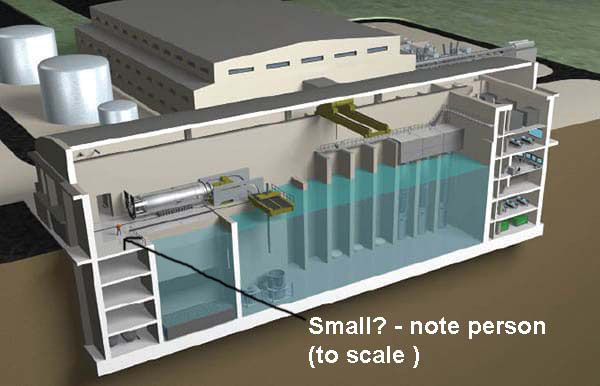
NuScale’s small nuclear reactors are being spruiked as an exciting new option to supply Australia with reliable and secure electricity as the country shifts away from coal-fired power.
But the jury is still out on this untested technology, which has been called “loopy” and a “fantasy”.
The possibility of Australia lifting its ban on nuclear power is again being debated with politicians like Nationals MP Barnaby Joyce suggesting people living close to reactors could be given free power to help build support for the controversial idea.
Amid growing calls from Coalition backbenchers for the option to be seriously examined, Energy Minister Angus Taylor has called a parliamentary inquiry into whether nuclear is a feasible solution for Australia’s future energy needs. Not everyone is supportive.
In a tweet, former prime minister Malcolm Turnbull suggested nuclear was a “loopy” option.
“The bottom line is renewables + storage are cheaper than new coal let alone the loopy current fad of nuclear power which is the current weapon of mass distraction for the backbench,” he wrote.
Labor has also slammed nuclear as too expensive and wants the Coalition to put the “fantasy” to bed, saying it’s three times as costly as other options and would not be operational for decades.
“It is a distraction that will do nothing to solve the energy crisis that is confronting Australian households and businesses now,” Opposition energy spokesman Mark Butler told reporters recently…….
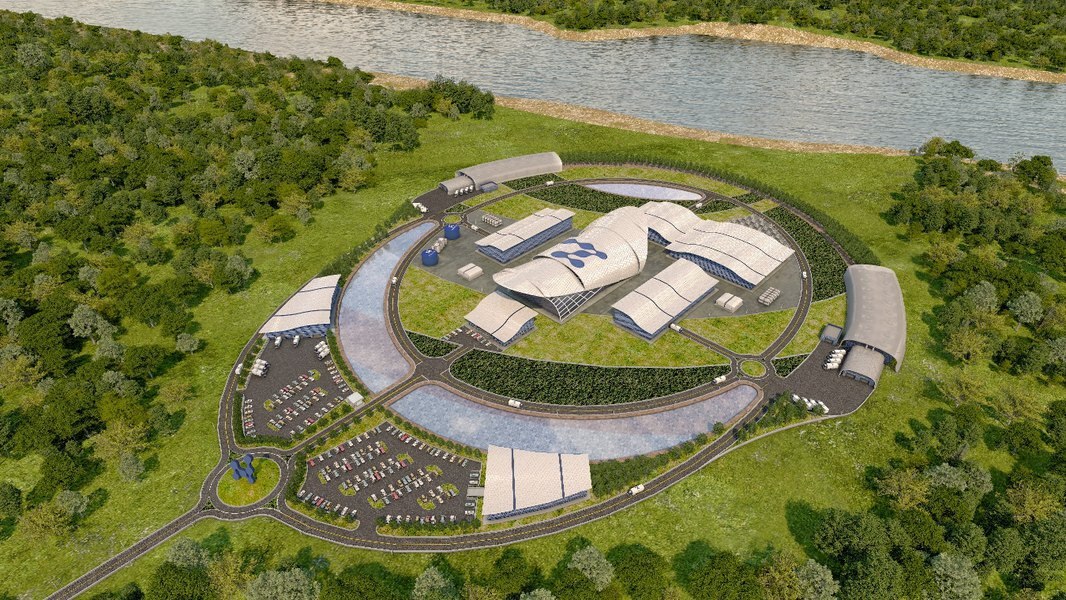
NuScale has developed a small modular reactor (SMR) that can be made up of 12 separate nuclear modules, manufactured in factories and then shipped to site. Each module could generate 60MW of electricity each. …..
NuScale told news.com.au the modules consisted of reactors inside a metal containment vessel that stood about seven storeys high and 4.5 metres wide.
A plant with 12 modules would likely need to be located on a site of about 14 hectares, which is equivalent in size to about 14 rugby fields……..
IT COULD TAKE YEARS
One of the biggest downsides to nuclear is that it takes ages to build and when it comes to small modular reactors, they have yet to be proven.
NuScale is working towards building its first plant at the Idaho National Lab and is set to begin construction in 2021. It will take five years before the first module is expected to come online in 2026, with the full 12-module plant to be operational by 2027.
There is no guarantee this can be achieved within the expected timeline, and even if it was, the reactors may not be available commercially until 2030. Export sales to countries like Australia could take even longer.
Dr Switkowski, who led a Howard government review into nuclear power, said overseas experience showed timeframes were more likely to be longer than expected, and there were also considerable commercial and political risks because the project would be built over five or more political cycles.
“Can you draft a long-term commitment to nuclear energy on to a currently unconfirmed national energy policy? The answer to that is no, in my opinion,” he said…….
Analysis from the CSIRO and the Australian Energy Market Operator (AEMO) released in 2018 found the capital costs for a small modular reactor would be $16,000 per kilowatt hour, one-and-a-half times more than previous estimates for large-scale nuclear.
It’s almost twice as expensive as solar thermal and storage, which is $7000 per kilowatt hour and is also expected to halve by 2050. Nuclear is not expected to get any cheaper.
AEMO chief system design and engineering officer Dr Alex Wonhas told the inquiry that building wind or solar firmed by pumped hydro was roughly about the same price as building a new gas or coal-fired power plant.
“Our expectation is that renewables will further decrease in their cost, and therefore firmed renewables will well and truly become the lowest cost of generation for the National Energy Market,” he said.
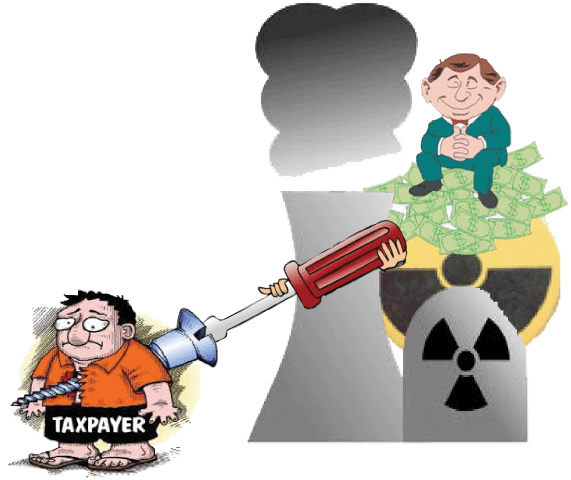
It’s likely taxpayers will also have to foot the bill for at least some part of the cost of a nuclear option.
Dr Switkowski said he couldn’t think of any countries that had funded investments in nuclear without government assistance, including through military programs.
“There was no known example that I could see where a country introduced nuclear power on the back of investments from people who were familiar with the infrastructure and were seeking to make an economic return,” he said.
The power produced by a small modular reactor will also be more expensive than one produced by a large reactor or by wind and solar backed up by storage.
Dr Switkowski acknowledged the rise of renewables made the case against nuclear power stronger.
Australia will also have to consider the security issues around who they buy the reactors from, as the leading manufacturers are now China, South Korea, Russia and probably France.
“Would Australia order a nuclear reactor from China?” Dr Switkowski asked.
However, Dr Switkowski supported the lifting of the moratorium on nuclear power to encourage businesses and experts to consider the potential of the technology.
“No one’s put money on the table to fund it because they’re not allowed to fund nuclear power in Australia,” he said.
WE NEED FLEXIBILITY
While discussion about nuclear often focuses on the need for reliable, dispatchable “baseload” power, Dr Wonhas said Australia didn’t need many more plants with a “very stable output profile”.
The AEMO chief system design officer said there were now periods during the day when electricity effectively costs “zero dollars” and the focus was now on new plants that could start up quickly to provide extra energy during peak periods instead.
“I think what we are really looking for is a plant that can increase and decrease capacity relatively quickly and respond to the needs of the market,” he said.
This includes gas, which is a “very effective firming option” because it can respond quite quickly.
“Frankly, there’s a whole range of other technologies out there that can provide similar services. There is, for example, solar thermal with molten salt storage. That’s another technology that is quite dispatchable,” Dr Wonhas said.
While molten salt storage is at a less mature stage than some of the other technologies, Dr Wonhas believes there are many different technology options.
“For nuclear investment to be the optimal choice for Australia it will have to demonstrate, among many other things, that it is more cost-effective compared to alternative technologies and that it is sufficiently flexible so it can be integrated in what we expect to be a highly dynamic future energy market,” he said.
NOT IN MY BACKYARD
One of the major barriers to getting nuclear off the ground is that no one in Australia wants to live next to it or next to a nuclear waste dump.
Labor has tapped into this, highlighting nearly 140 places around Australia that have been mooted as potential locations for nuclear reactors and radioactive waste dumps over the past half century.
The vast majority are around the country’s coastlines, and almost all are near residential communities.
Some sites, like Townsville, Toowoomba and Wagga Wagga, have been proposed multiple times, a map collated by the Parliamentary Library shows.
“Instead of indulging the policy fantasies of his restive backbench, (Prime Minister Scott) Morrison should reject the nuclear option or be upfront with Australians about exactly where he wants to build nuclear reactors,” Labor energy spokesman Mark Butler last week.
Storing nuclear waste is even more of an issue, with Australia struggling to gain support for even a small, low-level waste facility in Central Australia.
RISK OF ‘CATASTROPHIC FAILURE’
If there’s one overarching concern then it has to be the risk of something going wrong.
“After Three Mile Island in 1979, Chernobyl in 1986 and Fukushima in 2011, the possibility of catastrophic failing within a nuclear system is non-negligible,” Dr Switkowski said.
No matter how safe a system is designed to be from a technical point of view, there will always be a risk of human error……https://www.news.com.au/technology/innovation/is-building-small-nuclear-reactors-as-loopy-as-it-sounds/news-story/9e35d409fdc142907190c1a5b89337d3?fbclid=IwAR2m_pty2W9BBf8oBMF3P3zaEO3V93VmQCenhwFJvEXPkbYjzCcRZMKV6e0#.0f155|5hb17
September 16, 2019
Posted by Christina Macpherson |
AUSTRALIA - NATIONAL, politics |
Leave a comment
 Environmental groups warn against push for nuclear power in Australia https://www.theguardian.com/australia-news/2019/sep/16/environmental-groups-warn-against-push-for-nuclear-power-in-australia
Joint submission calls nuclear ‘a dangerous distraction’ from real action on climate as Zali Steggall backs 2050 zero-emissions target , Paul Karp@Paul_Karp 16 Sep 2019 Environmental and civil society groups have warned the government nuclear power has “no role” in Australia as crossbench independents urge it to recognise climate change as a health issue.
On Monday submissions to the inquiry on nuclear power will close. A diverse group of stakeholders has called on the government to rule-out changing the law to allow nuclear energy in Australia.
Signatories to the statement include union peak bodies, the Public Health Association of Australia, Uniting and Catholic church organisations, the Smart Energy Council, the Aboriginal-led Australian Nuclear Free Alliance, climate action groups, Greenpeace Australia Pacific and the Australian Conservation Foundation.
The anti-nuclear group warned it is “a dangerous distraction from real movement on the pressing energy decisions and climate actions we need”.
“If Australia’s energy future was solely a choice between coal and nuclear then a nuclear debate would be needed. But it is not,” they said in a statement.
“Our nation has extensive renewable energy options and resources and Australians have shown clear support for increased use of renewable and genuinely clean energy sources.”
Ziggy Switkowski, who headed a 2006 review of nuclear power for the Howard government, has told the inquiry that the technology had no chance of being introduced unless Australia had a coherent energy policy but nevertheless agreed the prohibition should be lifted.
September 16, 2019
Posted by Christina Macpherson |
AUSTRALIA - NATIONAL, politics |
Leave a comment
 Mining industry renews push for nuclear option, https://www.theage.com.au/business/the-economy/mining-industry-renews-push-for-nuclear-option-20190913-p52r2r.html, By Nick Toscano
September 16, 2019 Australia’s mining sector has launched a fresh push to lift the prohibition on nuclear energy arguing new-look compact nuclear reactors could provide the “cheapest, zero-emissions” baseload power to replace retiring coal-fired power stations.
As the resources industry prepares for a transition away from fossil fuels in coming decades, the Minerals Council of Australia has told a federal government inquiry that nuclear power must be explored as part of the future energy mix to address the worsening problem of rising power prices and deteriorating energy grid reliability.
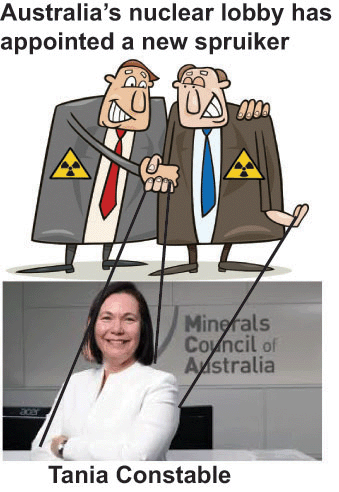
“Only a commitment to restore energy affordability and reliability will reverse this drift, and nuclear power – especially innovative small modular reactors – will go a long way to providing clean, reliable and lower-cost power for Australian homes and businesses,” said Tania Constable, chief executive of the lobby group which represents mining giants including BHP and Rio Tinto.
Touted by some as the next generation of nuclear power, small modular reactors (SMRs) can be built in factories and assembled on location.
Their deployment is under consideration in a number of countries including the United States and Canada although their cost is not yet known as none are yet commercially available.
Apart from existing run-of-water-hydro, the Minerals Council said, nuclear was the only energy source capable of providing affordable, continuous and zero-emissions power at industrial scale.
“It is a mature, proven and safe power generation … yet Australia’s ban on nuclear power means that our communities and businesses are denied its many benefits,” Ms Constable said.
Australia has a third of the world’s economically recoverable uranium, which is mined and exported for use around the world, but domestic nuclear energy is banned under federal legislation.
The mining group’s calls for nuclear are contained in a submission to a federal parliamentary inquiry launched by Energy and Emissions Reduction Minister Angus Taylor to investigate the potential for nuclear as a future power source for Australia.
At the inquiry’s first public hearing, prominent business leader and nuclear physicist Ziggy Switkowski, who headed a 2006 review of nuclear power for the Howard government, said while the window for large, gigawatt-scale nuclear power plants had closed, SMRs could provide opportunities in regional towns and mining sites for generation of “clean, safe baseload power”.
But, he added, it would likely be more than a decade until it was known whether small modular reactors were suitable for Australia and about 15 years to bring such a plant online.
Dr Switkowski said nuclear power was comparable to renewable energy in its low level of greenhouse gas emissions but was not weather-dependent in the same way as wind and solar generation.
The challenges to supporting a nuclear energy strategy, he said, included that the lack of political and public support and the fact that the risk of a catastrophic nuclear failure such as Chernobyl in Ukraine or Fukushima in Japan was not “negligible”.
Former prime minister Malcolm Turnbull last week voiced the opinion of many critics, saying it was obvious that nuclear power was more expensive than renewables and battery storage and describing the push for nuclear power as “loopy” and a “distraction” for politicians.
September 16, 2019
Posted by Christina Macpherson |
AUSTRALIA - NATIONAL, politics |
Leave a comment
 Climate crisis confronts Morrison https://www.theguardian.com/australia-news/2019/sep/16/environmental-groups-warn-against-push-for-nuclear-power-in-australia– Paul Karp@Paul_Karp16 Sep 2019
When parliament resumes on Monday Scott Morrison will play host to Fijian prime minister Frank Bainimarama.
Defence, labour mobility, trade, investment, illegal fishing and climate change are all on the agenda for the bilateral meeting. Bainimarama was heavily critical of Morrison at the Pacific Islands forum, saying the Australian PM had insulted and alienated Pacific leaders over his failure to back stronger emissions targets.
The climate crisis will also be forced back onto the agenda by the member for Warringah, Zali Steggall, who will bring a motion, seconded by independent MP Helen Haines, calling on the government to decarbonise the economy by 2050 to reduce the health impact and linking it to extreme weather events.
Earlier in September the Australian Medical Association formally declared climate change a health emergency; Steggall’s call will be backed by peak health bodies pointing to heat related illnesses, respiratory diseases and hypoallergenic conditions caused by global heating.
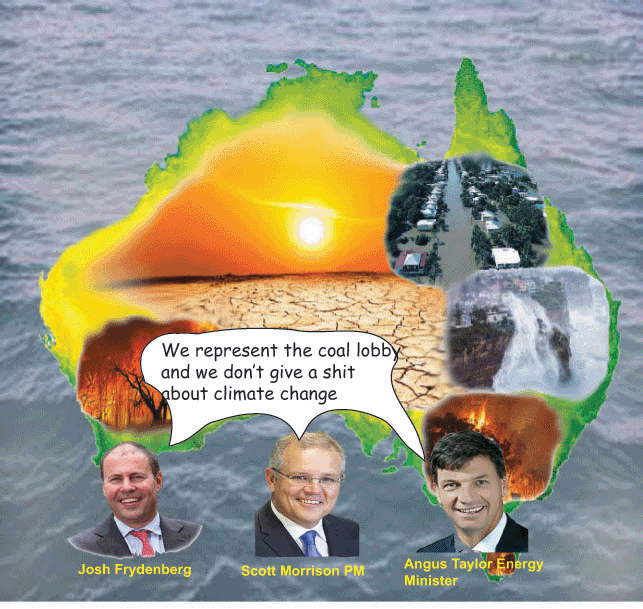
Australia is in the grip of early-spring fires in New South Wales and Queensland and a drought that could see parts of NSW run out of water as early as November.
Steggall said the “unprecedented fires” and the “shocking drought” are “events causing terrible health impacts which are going to get more severe as the world continues to warm”. https://www.theguardian.com/australia-news/2019/sep/16/environmental-groups-warn-against-push-for-nuclear-power-in-australia
September 16, 2019
Posted by Christina Macpherson |
AUSTRALIA - NATIONAL, climate change - global warming, politics |
Leave a comment

Australia to attend climate summit empty-handed despite UN pleas to ‘come with a plan’ The Conversation, Frank Jotzo, Director, Centre for Climate and Energy Policy, Crawford School of Public Policy, Australian National University
September 16, 2019 This story is part of Covering Climate Now, a global collaboration of more than 250 news outlets to strengthen coverage of the climate story.Climate action will be on the world stage again at a meeting of world leaders in New York on September 23. The United Nations has convened the event and urged countries to “come with a plan” for ambitious emissions reduction.
UN Secretary-General António Guterres called the meeting because he says global efforts to tackle climate change are running off-track. He wants leaders to present concrete, realistic pathways to strengthen their existing national emissions pledges and move towards net zero emissions by 2050.
Australia is not expected to propose any significant new actions or goals. Prime Minister Scott Morrison – in the US at the time to visit President Donald Trump – will not attend the summit. Foreign Minister Marise Payne will attend, and is likely to have to fend off heavy criticism over Australia’s slow progress on climate action.
Australia has gained an international reputation as a climate action laggard – plagued by political acrimony over climate change, offering few policies to reduce emissions and embroiled in diplomatic rifts with our Pacific neighbours over, among other things, support for coal.
For many afar, it is difficult to understand the policy vacuum in a country so vulnerable to climate change……..
Come with a plan, and make it good
The landmark Paris agreement includes a global goal to hold average temperature increase to well below 2°C and pursue efforts to keep warming below 1.5°C above pre-industrial levels.
Countries set so-called “nationally determined contributions” (NDCs) outlining an emissions reduction target and how they will get there.
…… Australia’s emissions are rising
Australia’s annual greenhouse gas emissions are about 12% lower than in 2005, the base year for the Paris target. But since 2013 they have steadily risen, and are continuing to rise…….
We could do so much better
With meaningful policy effort, Australia could meet the Paris target without resorting to Kyoto credits, and possibly meet a much more ambitious target………
2050: defining a strategy
Limiting the risk of catastrophic climate change demands that global emissions fall rapidly in coming decades. Keeping temperature rise to 2°C or less means reducing emissions to net-zero.
Australia will be expected to table strategies to get to net-zero by 2050 next year, at the UN’s climate COP, or “conference of the parties”.. That process should be a chance for Australian governments, industry and civil society to put heads together about how this could work.
The year 2050 is beyond the horizon of most corporate interests vested in existing assets, and it allows greater emphasis on long term opportunities than on short term adjustments. This should encourage a more open discussion than the often acrimonious debates about 2030 emissions targets and short-term policies.
Australia should show the world it can imagine a zero-emissions future, and hatch the beginnings of a plan for it. It would help position the nation’s resources industries for the future and help with our international reputation. https://theconversation.com/australia-to-attend-climate-summit-empty-handed-despite-un-pleas-to-come-with-a-plan-123187
September 16, 2019
Posted by Christina Macpherson |
AUSTRALIA - NATIONAL, climate change - global warming, politics |
1 Comment
Coquillard, Arnaud (59) Says that the government is considering Generation IV nuclear reactors, but they don’t even exist yet. Their safety over time is uncertain. They still produce toxic wastes. Uranium mining is also environmentally harmful. Australia should deveop non nuclear clean energy technologies.
“Please think of the people that you represent, the responsibility you have towards humanity, the plant and animal kingdom and the planet as a whole. Compare that responsibility to the minority of corporate, businessman that pressure you to have nuclear power plant.”
September 14, 2019
Posted by Christina Macpherson |
AUSTRALIA - NATIONAL, politics |
Leave a comment









 Antinuclear