Despite weather extremes the grand Walkatjurra Walkabout against uranium mining presses on
K-A Garlick at Nuclear Free WA, 15 Aug 18 The Walkatjurra Walkabout have survived the first 10 days of the protest walk in freezing overnight temperatures and long hot walking days. Walking strong a group of 55 people gathered at Yeelirrie to support Traditional Owners, Aunty Shirley, Lizzie Wonyabong and Vicky Abdhullah in their 40-year struggle to stop the proposed Yeelirrie uranium mine.
The three women have shared stories of the area where they and their families grew up on. and their ancestors grew up. The group was joined by Youno Downs Station, who shared stories of the history of uranium exploration and company intimidation over the years they have lived on the pastoralist station. “Water is what the company is after, they (Cameco) need up to 10 millions of litres of water and they want us to give it to them!” ……. to be continued!
Uranium, nuclear, reactor produced isotopes – unstable industries with poor future
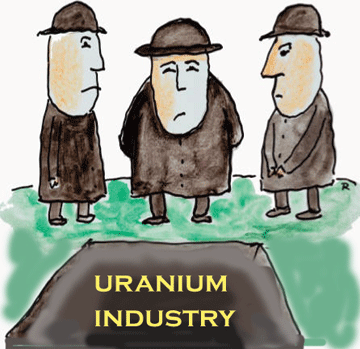 Anne McMenamin Fight To Stop Nuclear Waste Dump In Flinders Ranges SA 5 Aug 18 Olympic Dam produces 90 times as much copper as uranium. Without the copper sales, the mine would not be viable. The amount of uranium produced has barely gone up over the last 10 years, and, across Australia, it’s actually gone down. Beverley is almost mined out. Four mile has recently come on line, but produced less last year than the year before. World-wide the industry is winding down.
Australian company Silex pulls out of U.S. laser uranium enrichment projects
Silex pulls out of U.S. laser enrichment projects, JUNE 13, 2018
Silex Systems Limited, an Australian company that own the Silex laser enrichment technology, announced that it will not be participating in the restructuring of the Global Laser Enrichment (GLE), a venture that was set up by General Electric and Hitachi to use the technology to build uranium enrichment facilities in the United States. Canadian company Cameco joined the project in 2008.
In 2012 GLE obtained a license to build an enrichment facility in Wilmington, NC. That project, however, was put on hold as the demand for enrichment services dropped after Fukushima. In 2014, GLE expressed interest in building a facility in Paducah, at the site of the gaseous diffusion plant closed down in 2013. The new plant was supposed to enrich tails of the old enrichment operation to produce “natural-grade” uranium. In November 2016 GLE secured an agreement with the U.S. Department of Energy to acquire the tails. In April 2016, however, GE-Hitachi announced its intent to leave GLE. Silex Systems considered acquiring the GE-Hitachi stake in the company (which is 76%), but now ti decided against it.
In addition, Silex said it intends to give notice to GLE of the termination of the SILEX technology license “unless circumstances change dramatically in the short term”. This most likely means that all plans to build a Silex-based commercial uranium enrichment facility in the United States are now terminated.
Uranium industry in Australia – stagnant at best – Department of Industry
 Dept of Industry, Energy Quarterly, June 2018
Predicts stagnant production/export of Australian uranium over the next few years.
Expects growth from Olympic Dam, no new mines, doesn’t even mention Ranger.
Uranium exploration almost non-existent: “Only $1.9 million was spent on uranium exploration in the March quarter 2018: a drop from an already-low level of $2.9 million spent in the December quarter. Uranium exploration is now largely confined to South Australia, tailing off in all other states.”
Australian Medical Association urges fixing the uranium-polluted water supplies to remote communities
Filtering out heavy metals years away, despite high uranium detected in water, ABC News , By Bridget Brennan, Isabella Higgins and Stephanie Zillman, -20 June 18
The Northern Territory Government has downplayed concern following the ABC’s revelation that drinking water has been high in uranium in three Aboriginal communities for a decade — even as the Power and Water Corporation said a plan to filter heavy metals was still years away.
Key points:
- Earlier this week ABC revealed at least three Central Australian communities have uranium levels in drinking water that exceed health guidelines
- The NT Health Minister has now responded, saying the NT Health Department and Power and Water were working together on the issue
- But medical professionals said the situation was “unacceptable”
The response came as the Australian Medical Association urged the water supplies be fixed, with Aboriginal health organisations describing the situation as “unacceptable”.
On Tuesday, ABC’s 7.30 revealed the central desert communities of Laramba, Wilora and Willowra supplied bore water with elevated levels of uranium.
Data from the Power and Water Corporation showed Laramba’s water supply contained uranium at higher than 0.04 milligrams per litre (mg/L).
Australian Drinking Water Guidelines outline those levels should not exceed 0.017 mg/L — and the corporation agreed that several communities are drinking water above the national guidelines.
Yet the Power and Water Corporation said a plan to filter out elevated levels of heavy metals like uranium from drinking water in some Central Australian communities is still years away……….
Doctors said fixing the supply should be a priority.
“Contaminants which do make the drinking water unsafe to drink above the guidelines as stipulated, should be treated as a health priority,” AMA president Dr Tony Bartone said.
“All governments — of either jurisdiction — need to ensure that all Australians have access to potable drinking water.”
Dr Bartone said the AMA wanted safe drinking water levels to be part of the Closing the Gap targets, which are currently undergoing a review after 10 years of limited progress.
“Access to safe drinking water is a prerequisite for good health,” he said.
“You can’t really set aspirational targets for health without really pinning the strategy to the building blocks around good health — the social determinants of health.”
John Paterson, chief executive of the Aboriginal Medical Services Alliance Northern Territory, said an independent review was needed “as soon as possible”.
“Governments need to respond to this, we need the experts out there to explain how much contamination is in the water and what solutions have been provided,” he said.
Rod Little, co-chair of National Congress of Australia’s First Peoples, said he was shocked to hear of uranium levels not meeting health guidelines in Aboriginal communities. http://www.abc.net.au/news/2018-06-20/high-uranium-detected-in-central-australian-bore-water/9891522
Unacceptable levels of uranium in drinking water for several remote communities
 ‘Our kids need proper water’: Families plead for action over uranium in drinking water, ABC, 7.30 by Indigenous affairs reporters Isabella Higgins, Bridget Brennan and Emily Napangarti Butcher, 19 June 18,
Australian Radiation Protection and Nuclear Safety Agency (ARPANSA) agreement with IAEA on enhanced protection for uranium workers
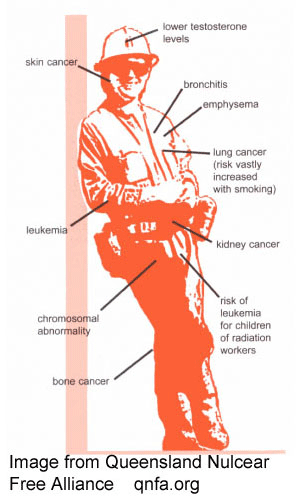 IAEA and Australia’s Regulatory Body Strengthen Cooperation to Enhance Radiation Protection of Uranium Mining and Processing Workers https://www.iaea.org/newscenter/news/iaea-and-australias-regulatory-body-strengthen-cooperation-to-enhance-radiation-protection-of-uranium-mining-and-processing-workers ,
Decades overdue Ranger Uranium Mine rehabilitation plan released The world is watching
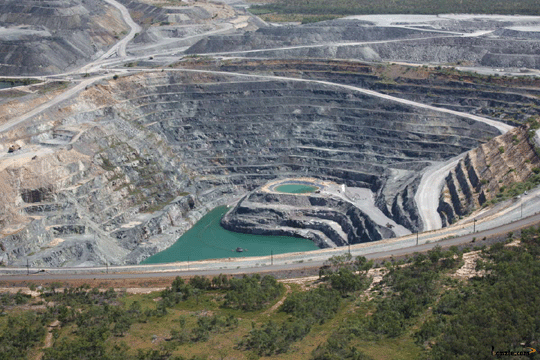
Northern Land Council, 5 June 2018 The Northern Land Council and Gundjeihmi Aboriginal Corporation welcome today’s public release of the Ranger Mine Closure Plan by Energy Resources of Australia. The plan is decades overdue and critical to the company meeting the objectives of rehabilitation.
The NLC and GAC, representing the Mirarr Traditional Aboriginal Owners of the mine site, will now review the plan and engage with stakeholders as part of the approval process. While not part of a public environmental impact statement process, the public release of the plan does provide the broader community with an opportunity to comment on the plan to the Australian government.
The Mine Closure Plan is of a very high level and even though Ranger’s closure is imminent, a significant amount of detailed planning and supporting studies remain outstanding. ERA and its parent company Rio Tinto must clearly demonstrate that they have sufficient resources devoted to mine closure to provide stakeholders with confidence that the objectives outlined in the closure plan can be met.
The Ranger plan remains unenforceable until it is approved by the federal Minister for Resources. The mine’s operational life must cease by January 2021, ahead of five years’ rehabilitation. The future of Aboriginal communities downstream of the mine and the World Heritage listed values of Australia’s largest national park are at stake.
ERA and Rio Tinto’s rehabilitation obligations include remediation of the site such that it can be incorporated in the surrounding Kakadu National Park. The final determination as to whether the area can be incorporated into the World Heritage area sits with the UNESCO World Heritage Committee, on advice from its expert advisory bodies the International Union for Conservation of Nature (IUCN) and International Council on Monuments and Sites (ICOMOS).
NLC contact: Martha Tattersall 0427 031 382 GAC contact: Kirsten Blair 0412 853 641
Ranger mine closure and rehab to cost $1bn
The $1 billion plan for the closure and rehabilitation of Australia’s oldest operating uranium mine has been released by Energy Resources of Australia… (subscribers only)
http://www.ntnews.com.au/business/ranger-mine-closure-and-rehabilitation-to-cost-1-billion/news-story/f86aa022ca5c700cf3264c7fe8d3abdd
Yet another failure for Australian uranium company Paladin – Namibia uranium mine mothballed

Paladin mothballs Namibia uranium mine Crreamer Media’s Mining Weeekly 25TH MAY 2018
BY: ESMARIE SWANEPOEL CREAMER MEDIA SENIOR DEPUTY EDITOR: AUSTRALASIA ERTH (miningweekly.com) – Dual-listed Paladin Energy on Friday confirmed that its Langer Heinrich uranium mine, in Namibia, was being placed under care and maintenance, but said that the low-cost openpit operation would be one of the first to resume production when the uranium market normalised.
Paladin in April said that it was unlikely to resume physical mining activities at the mine despite the medium-grade ore stockpile currently feeding the processing plant set to be exhausted before mid-2019.
The ASX and TSX-listed company on Friday said that it had received consent from all the relevant stakeholders to place the operation under care and maintenance, and had now stopped presenting ore to the plant.
There would be a run-down phase of up to three months where various stages of the plant would be progressively suspended and cleaned, and during this time, there would be some continued production of finished uranium.
Paladin noted that once the run-down phase was complete, operations would have been completely suspended and Langer Heinrich would be under care and maintenance. ……http://www.miningweekly.com/article/paladin-mothballs-namibia-uranium-mine-2018-05-25
BHP, Heathgate, and Turnbull government keen to sell uranium to India
 Boost to nuclear-power: Two Australian firms in talks to export uranium to India, The Indian Express, by Anil Sasi | New Delhi May 2, 2018
Two Australian companies BHP Billiton, the world’s biggest mining company, and Heathgate Resources, an affiliate of US company General Atomics, are in discussions with the Department of Atomic Energy (DAE) for exporting uranium to India.
A sales contract for enabling the transfer, which is part of the ongoing commercial negotiations between Australian uranium vendors and India’s DAE on fuel contracts for civil nuclear-power generation, is currently under discussion, officials indicated…..
A steady supply of uranium is good news for the country’s nuclear power sector, something that is expected to boost the performance of Indian nuclear power plants, as well as of several fuel cycle facilities.
Former Australian Prime Minister Tony Abbott had signed an agreement with Prime Minister Narendra Modi for civil nuclear cooperation in September 2014, clearing the way for uranium sales. Australia’s current PM, Malcolm Turnbull, had said in April last year that he was looking forward to exporting uranium to India “as soon as possible” after holding talks with the Indian PM. Ongoing discussions with Melbourne-based BHP and Adelaide-based Heathgate Resources are aimed at formalising commercial contracts to enable uranium shipments to India. …….http://indianexpress.com/article/india/boost-to-nuclear-power-two-australian-firms-in-talks-to-export-uranium-to-india-5159318/
Uranium slump looks like being permanent
Perhaps a uranium price increase is on the way but it will do little to salvage Australia’s uranium industry. Apart from BHP’s Olympic Dam mine in SA, the only other operating uranium mine in Australia is Beverley Four Mile in SA. At Ranger in the NT, mining has ceased, stockpiles of ore are being processed, and ERA is planning a $500 million project to decommission and rehabilitate the mine site.
And with the cost of a single power reactor climbing to as much as $20 billion, proposals to introduce nuclear power to Australia seem more and more quixotic and are now largely limited to the far right ‒ in particular, Australians Conservatives’ luminary Senator Cory Bernardi and the Minerals Council of Australia.
Even Dr Ziggy Switkowski ‒ who used to be nuclear power’s head cheerleader in Australia and was appointed to lead the Howard government’s review of nuclear power ‒ recently said that “the window for gigawatt-scale nuclear has closed”. He said nuclear power is no longer cheaper than renewables and the levelised cost of electricity is rapidly diverging in favour of renewables.
Countless would-be uranium mining companies have given up, some trying their luck in other areas such as property development or growing dope. Some mines have closed, others have been put into care-and-maintenance, and others have reduced output. But supply has continued to exceed demand ‒ and to exert downward pressure on prices.
Uranium industry slumps, nuclear power dead in the water, Chain Reaction magazine, Dr Jim Green, April 2018
Very few mines could operate at a profit at current prices. Some mines are profitable because earlier contracts stipulated higher prices, while many mines are operating at a loss. Many companies have been loathe to close operating mines, or to put them into care-and-maintenance, even if the only other option is operating at a loss. They have been playing chicken, hoping that other companies and mines will fold first and that the resultant loss of production will drive up prices. “We have to recognise that we over-produce, and we are responsible for this fall in the price,” said Areva executive Jacques Peythieu in April 2017.
Current prices would need to more than double to encourage new mines ‒ a long-term contract price of about US$70–$80 is typically cited as being required to encourage the development of new mines.
The patterns outlined above were repeated in 2017. It was another miserable year for the uranium industry. A great year for those of us living in uranium producing countries who don’t want to see new mines open and who look forward to the closure of existing mines. And a great year for the nuclear power industry ‒ in the narrow sense that the plentiful availability of cheap uranium allows the industry to focus on other problems.
Cut-backs announced Continue reading
Paladin may shut loss-making Langer Heinrich uranium mine
Paladin Energy has flagged the potential closure of its flagship Langer Heinrich uranium mine, just two months after it returned to the Australian Stock Exchange after an $800 million debt restructuring. … (subscribers only)
https://www.theaustralian.com.au/business/mining-energy/paladin-may-shut-lossmaking-langer-heinrich-uranium-mine/news-story/53c1dda5b5b01ff36771af7b683aaafc
Longterm slump in uranium industry looks like being permanent
Very few mines could operate at a profit at current prices. Some mines are profitable because earlier contracts stipulated higher prices, while many mines are operating at a loss.
And with the cost of a single power reactor climbing to as much as $20 billion, proposals to introduce nuclear power to Australia seem more and more quixotic and are now largely limited to the far right ‒ in particular, Australians Conservatives’ luminary Senator Cory Bernardi and the Minerals Council of Australia.
BHP marketing vice-president Vicky Binns said in December 2017 that uranium markets would remain oversupplied for close to a decade, with downward pressure remaining on uranium prices
Uranium industry slumps, nuclear power dead in the water Jim Green, Online Opinion, 23 F
……….These days, the market exhibits multiple levels of weirdness, all stemming from the growing acknowledgment that nuclear power and the uranium industry face a bleak future.
The uranium market has a “subdued outlook” and Cameco’s uranium is now “more valuable in the ground” according to Warwick Grigor from Far East Capital, because the cost of production is higher than the prices currently being offered. Cameco CEO Tim Gitzel agrees, saying in January 2018 that at current prices “our supply is better left in the ground.” So uranium industry executives and market analysts are finally coming around to rallying cry of the anti-uranium movement: Leave it in the ground!
We’ve also had the odd situation over the past year of nuclear lobbyists arguing repeatedly that the nuclear power industry is in “crisis” and wondering what if anything can be salvaged from “the ashes of today’s dying industry“. Usually such claims come from the anti-nuclear movement ‒ sometimes more in hope that expectation.
And we’ve had the odd situation of industry bodies (such as the US Nuclear Energy Institute) and supporters (such as former US energy secretary Ernest Moniz) openly acknowledging the connections between nuclear power and weapons ‒ connections they have strenuously denied for decades.
Such arguments are now being used in an effort to secure preferential treatment for uranium mining companies in the US. Ur-Energy and Energy Fuels have lodged a petition with the Department of Commerce seeking a mandated requirement for US power utilities purchase a minimum 25% of their requirements from US mines. Uranium is “the backbone of the U.S. nuclear deterrent and fuels ships and submarines in the U.S. Navy”, the companies state………
Another miserable year for the uranium industry Nuclear power has been stagnant for the past 20 years. Although power reactors account for an overwhelming majority of uranium demand, uranium production ‒ and prices ‒ have been up and down and all over the place.
Uranium mine production increased by 50% from 2007 to 2016. The increase was driven, initially at least, by expectations of the nuclear renaissance that didn’t eventuate. Mine production plus secondary sources (e.g. stockpiles and ex-military material) have consistently exceeded demand ‒ 2017 was the eleventh consecutive year of surplus according to the CEO of uranium company Bannerman Resources.
Stockpiles (inventories) have grown steadily over the past decade to reach enormous levels ‒ enough to keep the entire global reactor fleet operating for around eight years. Supply from mines and secondary sources in recent years has exceeded demand by about 18%.
Those dynamics have put downward pressure on prices. After six years of steady decline, uranium prices were flat in 2017. The spot price as of 1 December 2017 was less than one-third of the pre-Fukushima price and the long-term contract price less than half the pre-Fukushima price.
Countless would-be uranium mining companies have given up, some trying their luck in other areas such as property development or growing dope. Some mines have closed, others have been put into care-and-maintenance, and others have reduced output. But supply has continued to exceed demand ‒ and to exert downward pressure on prices.
Very few mines could operate at a profit at current prices. Some mines are profitable because earlier contracts stipulated higher prices, while many mines are operating at a loss. Many companies have been loathe to close operating mines, or to put them into care-and-maintenance, even if the only other option is operating at a loss. They have been playing chicken, hoping that other companies and mines will fold first and that the resultant loss of production will drive up prices. “We have to recognise that we over-produce, and we are responsible for this fall in the price,” said Areva executive Jacques Peythieu in April 2017.
Current prices would need to more than double to encourage new mines ‒ a long-term contract price of about US$70–$80 is typically cited as being required to encourage the development of new mines.
The patterns outlined above were repeated in 2017. It was another miserable year for the uranium industry. A great year for those of us living in uranium producing countries who don’t want to see new mines open and who look forward to the closure of existing mines. And a great year for the nuclear power industry ‒ in the narrow sense that the plentiful availability of cheap uranium allows the industry to focus on other problems.
Cut-backs announced
The patterns that have prevailed over the past five years or so might be changed by decisions taken by Cameco and Kazatomprom (Kazakhstan) in late 2017 to significantly reduce production. Continue reading
Hunters Hill residents still waiting on government to clean up uranium contaminated land
 Hunters Hill residents wary of latest announcement on uranium contamination, ABC News, 20 Feb 18, By Jade Macmillan
Residents on Sydney’s lower north shore have dismissed the Government’s latest plans to clean up land contaminated by a uranium smelter more than hundred years ago as “a hollow promise”.
Property Minister Victor Dominello announced $30 million to remediate the waterfront land on Nelson Parade in Hunters Hill, the former site of the Radium Hill refinery, which closed in 1915.
The area was also occupied by a carbolic acid plant until the early 1900s and a tin smelter until the 1960s.
Residents have spent decades urging the Government to remove the affected soil, which the NSW Environment Protection Authority found it was contaminated with petroleum hydrocarbons, coal tar pitch, arsenic and lead.
“Having this funding should give the community confidence that we are determined to remediate the site,” Mr Dominello said, ahead of a public meeting of more than 200 residents on Tuesday night.
“The Government is currently considering suitable disposal locations for the waste, and is in discussions with the Federal Government on the possibility of using the proposed National Radioactive Waste Management Facility earmarked for development in South Australia.”
The minister did not provide a timeframe for the works and a site for the radioactive facility has not yet been selected.
Rosemary Manusu, 80, who has lived on Nelson Parade for more than 50 years, said she had little faith in the announcement after years of inaction from successive governments.
“It’s been promised and promised about three or four times. So until they actually start moving it, I don’t believe a word they say,” she said……http://www.abc.net.au/news/2018-02-21/hunters-hill-uranium-contamination-residents-wary/9468272
1 This month

of the week – Australians for War Powers Reform (AWPR)
To see nuclear-related stories in greater depth and intensity
 Antinuclear